Author: Henry Rzepa

  • Why an Electron-Withdrawing Group is an o, m-Director rather than m-Director in Electrophilic Aromatic Substitution: The example of CN vs NC.

    In the previous post[cite]10.59350/rzepa.28993[/cite] I followed up on an article published on the theme “Physical Organic Chemistry: Never Out of Style“.[cite]10.1021/acs.joc.5c00426[/cite] Paul Rablen presented the case that the amount of o (ortho) product in electrophilic substitution of a phenyl ring bearing an EWG (electron withdrawing group) is often large enough to merit changing the long held rule-of-thumb for EWGs from being just meta directors into being ortho and meta-directors, with a preference for meta. I showed how Paul’s elegant insight could be complemented by an NBO7 analysis of the donor-acceptor interactions in the σ-complex formed by protonating the phenyl ring bearing the EWG. Both the o– and m– isomers showed similar NBO orbital patterns and associated E(2) donor/acceptor interaction energies and also matched the observation that the proportion of meta is modestly greater than ortho substitution (steric effects not modelled). These interactions were both very different from those calculated for the para isomer.

    Here using the same NBO7 analysis, I look at what happens when you transpose the atoms of CN to form the isocyanide NC.

    The orbital overlaps for NC as substituent can be seen as 3D rotatable models below (click on image to open model).

    These effects (ωB97XD/Def2-QZVPP/SCRF=DCM) can be summarised in the table below.

    ΔΔG, kcal/mol o m p
    CN 0.51 0.0 1.23
    NC 0.36 2.86 0.0
    NBO7 E(2) Terms: o m p
    CN as donor 14.3 9.4 0.2
    CN as acceptor 18.8 23.9 0.2
    NC as donor 28.8 17.9 0.4
    NC as acceptor 12.4 15.7

    What emerges is that the two groups cyanide (CN) and isocyanide (NC) can act as both π-electron acceptors and π-electron donors. For the former, the o– and m– electron acceptor interactions are larger, whilst for the latter the o– and m– electron donor effects dominate. However, the interactions for both o– and m– are qualitatively very similar and it is therefore correct to group them together, as was implied in the title of the recently published article.[cite]10.1021/acs.joc.5c00426[/cite] In contrast it seems appropriate to treat p– direction as a qualitatively different effect.


    This post has DOI: [cite]10.59350/rzepa.29121[/cite]

  • “Typical Electron-Withdrawing Groups Are o, m-Directors Rather than m-Directors in Electrophilic Aromatic Substitution”

    The title of this post comes from an article published in a special virtual issue on the theme “Physical Organic Chemistry: Never Out of Style“[cite]10.1021/acs.joc.5c00426[/cite] There, Paul Rablen presents the case that the amount of o (ortho) product in electrophilic substitution of a phenyl ring bearing an EWG (electron withdrawing group) is often large enough to merit changing the long held rule-of-thumb for EWGs from being just meta directors into these substituents are best understood as ortho, meta-directors, with a preference for meta. I cannot help but add here a citation[cite]10.1039/CT8875100258[/cite] to the earliest publication I can find showing tables of both o,p and m-directing groups and dating from 1887, so this rule is 138 years old (at least).

    Here I thought I might show some computational models (ωB97XD/Def2-QZVPP/SCRF=Dichloromethane)[cite]10.14469/hpc/15341[/cite] derived from the relative stability of the Wheland or σ-complex produced by protonating the Ph-EWG molecule in the three possible positions on the ring – and now taking the opportunity to add some unusual EWGs to the table to explore how far this effect might be pushed.

    I start by looking at the results reported for benzonitrile (EWG = CN), for typical product distributions:

    1. o– (~16%), m– (~82%) and p– (~2%) are cited for nitronium ion as electrophile
    2. o– (23%), m– ( 74%) and p– (3% ) for chlorination
    3. o– (34%), m– (55%) and p– (1%) for uncatalysed bromination (see [cite]10.1002/jcc.23985[/cite] for an unexpectedly complex mechanism and kinetic analysis of this particular reaction)
    4. σ-complex calculations [cite]10.1002/poc.4457[/cite] which result in values of o– (43%), m– (55%) and p– (2%) for benzonitrile.
      • The observation was made[cite]10.1002/poc.4457[/cite] that inclusion of a solvation correction substantially improved the agreement with the limited experimental information available to us regarding product distributions in EAS and the results below certainly confirm that (especially for benzonitrile). Solvent also has a significant effect on the optimised geometry of each system (see Table).

    The calculations reported here[cite]10.14469/hpc/15341[/cite] are similar to those reported using a slightly different model[cite]10.1002/poc.4457[/cite]. For the specific example of benzonitrile, the authors of the original report expressed surprise that their computations showed that “the ortho and meta σ-complexes were … about equally stable“. The results for this blog show a slightly larger and perhaps more realistic (?) discrimination in favour of meta by 0.51 kcal/mol in the free energy.

    Other noteworthy observations include that

    1. compared with CN, the iso-electronic isonitrile group NC is a strong and conventional o/p director, with a preference for p.
    2. The EWG R=BO (a known, albeit very unstable molecule[cite]10.1021/jo401942z[/cite]) is the next isoelectronic isomer of CN and it now reveals a very strong preference for meta-substitution, with only 3.5% ortho. So this group does NOT follow the proposed new rule of “ortho, meta-directors, with a preference for meta” although this is unlikely to ever be able to be tested experimentally due to the instability of this species (it readily trimerises).
    3. Finally in this isoelectronic progression for R=BeF, the calculations seem now to show that this is a strong o– director (61%) and that m is only 29%, again not following the newly modified rule but probably untestable.
    4. R=NO however does seem to be an example of the new modified rule, since the percentage of o– is as high as 23.8%. Here it is significant that for both the o– and mσ-complexes, the NO group was calculated as being co-planar with the phenyl ring, thus indicating significant conjugation – but the p-isomer (2.3%) was twisted and hence un-conjugated (dihedral values shown below).
    5. The same result is obtained for R=NO2, with the p-isomer having a twist angle of 67°.

    Cationic intermediates in electrophilic substitution of Ph-R
    R ΔΔG298, kcal/mol
    (pop, %) ortho,
    rC-R
    Å
    ΔΔG298,
    (pop, %) meta
    rC-R ΔΔG298,
    (pop, %) para
    rC-R
    NC, gas
    -4.72
    (21.42)
    1.349
    0.0
    (0.01)
    1.369
    -5.51
    (78.57)
    1.348
    NC, DCM
    -2.50
    (35.51)
    1.359
    0.0
    (0.56)
    1.377
    -2.86
    (63.93)
    1.359
    CN, gas
    -1.38
    (60.56)
    1.423
    0.0
    (6.07)
    1.433
    +0.36
    (33.37)
    1.425
    CN, DCM
    +0.51
    (27.68)
    1.428
    0.0
    (64.05)
    1.435
    +1.23
    (8.27)
    1.433
    BO, gas
    +0.96
    (16.76)
    1.541
    0.0
    (82.34)
    1.540
    +2.72
    (0.09)
    1.549
    BO, DCM
    +1.99
    (3.52)
    1.537
    0.0
    (96.34)
    1.532
    +3.93
    (0.14)
    1.547
    BeF, gas
    +0.23
    (38.78)
    1.727
    0.0
    (56.73)
    1.714
    +1.53
    (4.49)
    1.737
    BeF, DCM
    -0.46
    (61.21)
    1.748
    0.0
    (28.66)
    1.731
    +0.63
    (10.13)
    1.762

    CF3, gas
    +0.25
    (30.86)
    1.524
    0.0
    (46.87)
    1.521
    +0.45
    (22.27)
    1.533
    CF3, DCM
    +1.45
    (8.11)
    1.518
    0.0
    (89.66)
    1.513
    +2.22
    (2.23)
    1.528
    NO, gas
    +0.44
    (25.07)
    1.460
    0.0
    (52.32)
    1.477
    +0.51
    .22.61)
    1.395
    NO, DCM
    +0.68
    (23.84)
    1.458
    0.0
    (73.87)
    1.456
    +2.09
    (2.29)
    1.429
    NO2, gas
    +1.08
    (13.38)
    1.487
    0.0
    (79.88)
    1.487
    +1.49
    (6.73)
    1.476
    NO2, DCM
    +1.80
    (4.73)
    1.480
    0.0
    (94.25)
    1.478
    +2.73
    (1.01)
    1.481

    On to the suggested explanation,[cite]10.1021/acs.joc.5c00426[/cite] where interaction of the π-electrons from the σ-complex with the π* orbital from the EWG was suggested to be stronger not only for the m-isomer but also the o-isomer as compared to the p-isomer. This can now be quantified using NBO7 analysis, which indicates the energy of interaction between pairs of filled donor and empty acceptor orbitals.

    For the m-isomer[cite]10.14469/hpc/15354[/cite] of protonated benzonitrile, the overlap of the two orbitals (CN acting as an acceptor and the phenyl ring as a donor) is shown below (click on the image to get a rotatable 3D model) with blue positively overlapping with purple and red with orange. The NBO E(2) interaction energy is 23.85 kcal/mol (green bond above interacting with R=CN π*).

    A reverse donation, from the π-system of the CN group now acting as a donor to the π* of the benzene ring acting as an acceptor has a smaller E(2) = 9.4kcal/mol. This shows that CN can act as both a donor and as an acceptor, but the latter effect is stronger.

    For the o-isomer[cite]10.14469/hpc/15355[/cite] (below), the NBO E(2) interaction energy is somewhat reduced to 18.8 kcal/mol (orange bond above interacting with R=CN π*). but is still considerable and more or less commensurate with the relative free energies of the o– and m-isomers.

    A reverse donation, from the π-system of the CN group now acting as a donor to the π* of the benzene ring acting as an acceptor has a smaller E(2) = 14.3 kcal/mol. This again shows that CN can act as both a donor and as an acceptor with the latter effect the stronger.

    Things are quite different for the p-isomer[cite]10.14469/hpc/15353[/cite]. The equivalent CN-acceptor/phenyl-donor orbitals are shown below; they has no real overlap and the associated value for E(2) of 0.23 kcal/mol (red bond above interacting with R=CN π*) is tiny compared to that for the o- and m– isomers.

    The reverse donation from the π-system of the CN group now acting as a donor to the π* of the benzene ring acting as an acceptor is equally small, E(2) 0.15 kcal/mol.

    Furthermore, the p-isomer NBO E(2) interaction energy for the same atoms as with o– and m– shows two instances of 3.0 kcal/mol (because of the C2v symmetry), also very much reduced from 23.85 or 18.8 kcal/mol.

    Although many other interactions can be found in the NBO analysis, this accounts for by far the largest difference between the o, m, and p isomers. These results also match with the observation made above that for R=NO, the o– and m-isomers are fully coplanar, but for the p-isomer the NO group is twisted by about 90° with respect to the phenyl ring. This is also reflected in the calculated torsional or twisting vibrations of the R group, being 89 cm-1 for m-Nitroso vs 23 cm-1 for o-nitroso and again 55 cm-1 for m-nitro vs 38 cm-1 for o-nitro.

    So this new NBO7 orbital overlap analysis helps to quantify these effects (the reported qualitative analysis[cite]10.1021/acs.joc.5c00426[/cite] was based on molecular orbitals rather than localised NBO orbitals) and confirms that for some EWG groups at least, the o-isomer is almost as favoured as the m-form. Well, an observation that is 138 years old gets new light shone on it!


    This post has DOI: 10.59350/rzepa.28993

  • WATOC 2025 report – extending the limits of computation (accuracy).

    This are just a few insights I have got from some of the talks I attended. As usual, this does not represent a report on the WATOC congress itself, but simply some aspects that caught my personal eye.

    1. Frank Neese talked about his Bubblepole approximation for large molecules.[cite]10.1021/acs.jpca.4c07415[/cite] And he was not kidding – large. Lets say a DFT calculation at the Def2-TZVPP basis set level (often the level used in this blog). Thus Crambin + 500H2O, which is 2142 atoms can not only be done at this basis set level (33,562 basis functions) but at the astonishing Def2-QZVPP level (rarely attempted here!) with 86,667 basis functions. But that is not the largest – he has also done unhydrated Crambin octamer (5132 atoms) with 116,904 basis functions using the Bubblepole method. Currently this method appears only in his ORCA code – and if I understood correctly they are still working on first and second derivatives. So it will be a little while longer before e.g. reaction transition states for such sizes appear, but probably not that long!
    2. Martin Head Gordon is responsible for the highly regarded ωB97 set of DFT functionals (again used throughout this blog). Until now, the most recent of these, ωB97M(2) from 2019[cite]10.1063/1.5025226[/cite] had represented a significant advance in accuracy (let’s say reaction barrier heights) over the previous generations, this having a mean error of ~0.9 kcal/mol compared to 2-3 kcal/mol for earlier generations. At the conference he introduced a “Carefully Optimised and Appropriately Constrained Hybrid” or COACH functional. He introduced 17 constraints or exact conditions that an ideal functional should have and explained that COACH satisfied 12 of these (another relatively recent functional, SCAN satisfies all 17[cite]10.1021/acs.jpclett.0c02405[/cite]). Earlier functionals satisfy ~6 or less. For 7 selected properties, including barrier heights, the mean errors are around ½ to ⅓ of earlier functionals such as the veritable B3LYP+D4 dispersion. His concluding remarks suggested that DFT as such is nearing the ultimate limit of general purpose accuracy achievable by such procedures. I hope to be trying out e.g. COACH here in the next year or so.
    3. Fritz Schaefer “threw the kitchen sink” at the small tetra-atomic fulminic acid, or HCNO, to try to answer the simple question – is it bent or linear?[cite]10.1021/jacs.4c13823[/cite] At the CBS (complete basis set) limit and the CCSDTQ(P) level of coupled cluster theory (wow!), the answer converges to the conclusion that it is linear! This level cannot be that far off an exact solution of the Schroedinger equation – and it agrees with experiment!
    4. Oh, a general observation, machine learning permeates the entire congress.
  • WATOC25 and its (Dr Who like) regeneration to Young WATOC25.

    The WATOC congresses occur every three years. WATOC25, the 13th in a series which started in 1987  takes places tomorrow in Oslo, Norway, The day before the main event there is something new – a session just for early career researchers or “Young WATOC”. As an “old” WATOCer, I dropped into the opening session and was delighted to find a packed auditorium, with literally standing room only comprising mostly young researchers in their 20s.

    Apparently in terms of presenters, the event was more than five times over-subscribed with >100 submissions, of which around 18 being selected for presentation.

    The first talk was also really great, involving how to locate the equilibrium geometries of molecules and the transition states connecting their reactions. The standard methods used nowadays involve Taylor series expansions of the energy and it’s good to see new methods based on ML and image processing techniques being adapted for this.

    It looks like the future of computational chemistry is in enthusiastic new hands! And, for the first time, this 13th Congress now has its own app containing speaker information, abstracts, the timetable and much more. All indexed and searchable!

    The week ahead is packed with talks and I may report back here.

  • Mechanism of the dimerisation of Nitrosobenzene.

    I am in the process of revising my annual lecture to first year university students on the topic of “curly arrows”. I like to start my story in 1924, when Robert Robinson published the very first example[cite]10.1002/jctb.5000435208[/cite] as an illustration of why nitrosobenzene undergoes electrophilic bromination in the para position of the benzene ring. I follow this up by showing how “data mining” can be used to see if this supports his assertion. I have used the very latest version of the CSD crystal structure database to update the version originally posted here in 2020.[cite]10.59350/c6thp-wqe69[/cite]

    I then discuss some possible reasons why Robinson might have thought that bromination goes in the para position, including the observation[cite]10.1002/mrc.1260251118[/cite] that nitrosobenzene is in equilibrium with its dimer, and that such a dimer might be expected to more reactive towards electrophiles than the “deactivated” monomer.

    Not part of the main lecture, but held in reserve for any questions at the end, is the following curly arrow pushing for the dimerisation.

    This raises a simple question – do both the red and blue arrows shown below participate at the same time, or do they go sequentially? Time then for some calculation to answer this last question. An ωB97XD/Def2-TZVPP/SCRF=chloroform calculation[cite]10.14469/hpc/15278[/cite] using a closed shell wavefunction (to correspond to two-electron curly arrows) appears to show a smooth reaction profile. The N-N bond length also converges from no bond to a double bond shortly after the transition state (NN = 1.3Å) without anything intermediate (this for the (Z)-stereochemical isomer, not the one shown above and which will be discussed later). The reported activation free energy for this process ΔG198 is 15.7 kcal/mol[cite]10.1002/mrc.1260251118[/cite] whilst the calculated value by this method is 25.5 kcal/mol. Even allowing for a concentration effect (1M) and quasi-harmonic corrections to the free energy, it is still 23.9 kcal/mol.

    In a previous post[cite]10.59350/k4340-t6971[/cite] when an overly large barrier was computed, one reason is that the wavefunction might have “biradical” character and that the appropriate curly arrows might not be the appropriate two electron variety at all, but instead one-electron ones, as shown below.


    The degree of biradical character is given by the spin-expectation operator <S2>, which has a value of 0.0 for no biradical character and 1.0 for a pure biradical. This time the transition state for the dimerisation is calculated to have a value of <S2> = 0.5418 and ΔG198 is now calculated as 21.8 kcal/mol (20.3 with quasi-harmonic corrections).

    The energy and N-N bond length profiles for the reaction coordinate using “one-electron” curly arrows are shown below, the former being around 4 kcal/mol lower than for the two-electron arrows.


    The dihedral at the central C-N-N-C bond shows it almost entirely twisted at the transition state (as might befit a biradical) and then a smooth rotation to co-planarity (as befits a double bond) as the second bond forms.

    Because the system has C2-symmetry and importantly no plane of symmetry, the π and σ electrons are now allowed to mix together and this can be seen in the two (equivalent) orbital overlap models below at the transition state, each nitrogen lone pair managing to overlap constructively (blue with purple, red with orange, click on the diagram to load the orbitals) with the N-O π* orbital of the second nitrosobenzene.

    Why is this simple system better described (energetically) by the use of one-electron arrows rather than two electron ones? A simple explanation might be that the electrons like to move consecutively simply to reduce the electron repulsion that the two-electron model would impose on it (reducing the electron correlation incurred in the process). It’s probably more complicated than this, but it shows a rare example where two-electron arrows are not the most appropriate for describing a chemical reaction.


    Postscript. The 1-electron transition state (<S2> = 0.981) for formation of the trans stereochemical (E) isomer is higher than the cis (Z) by ~4 kcal/mol.


    Roald Hoffmann has alerted me to an important early paper of his describing exactly this phenomenon.[cite]10.1021/ja00709a002[/cite]

  • How many of the compounds that appear in the chemical literature are mentioned just once?

    Tom recently emailed me this question: Do you know how to find out how many of the compounds that appear in the chemical literature are mentioned just once? Intrigued, I first set out to find out how many substances, as Chemical Abstracts refers to the them, there were as of 5 June, 2025. There is a static estimate here (219 million), but to get the most up to date information, I asked CAS directly. They responded immediately (thanks Lee!) with 294,778,693 on the date mentioned above. It is not actually possible to answer the first question itself using CAS SciFinder, but again CAS came up with a value: “there are 113,383,649 substances in CAS Registry with only one CAplus citation” equivalent to  “38.5% of the current substances have only 1 reference.” I should add this estimate was qualified by “that can be misleading, since that includes salts, multicomponents, etc. But that’s a first pass.” I am actually impressed that as many as 61.5% are mentioned more than once, since before learning the answer, I had intuitively guessed that percentage as being much lower.

    My mind then went back to the year 1974, when my PhD thesis was published.[cite]10.14469/spiral/20860[/cite] As part of this research, I had managed to synthesize several sterically hindered indoles, culminating in the preparations of 2-Methyl-3,5-di-t-butylindole (3, R=Me)and  2,4,6-tri-t-butylindole (3, R=t-Butyl) by the route shown below (R= Me, t-Butyl –  a different route also gave the same product). I was very proud of this, since my research supervisor intimated to me a few years later that he had not believed I would succeed, on the grounds that making sterically hindered systems can be quite challenging! This work was published in a journal in 1975.[cite]10.1039/P29750001209[/cite]

    Next, to find out what “impact” this work has had in the intervening 50 years. Well, a CAS SciFinder search revealed that 2-Methyl-3,5-di-t-butylindole (3, R=Me) was one of the 38.5% of the current substances that have only 1 reference, to just our own work. Zero impact then! But worse was to come –  2,4,6-tri-t-butylindole (3, R=t-Butyl) did not even have 1 reference – as far as CAS was concerned, it was an unknown compound! So too were the precursors 2-methyl-3,5-di-t-butylaniline (1) and the anilides 2 (R=Me, t-butyl).

    The explanation can be found – at least  in part – by reading our article[cite]10.1039/P29750001209[/cite] and from  the computational modelling I did some forty years later.[cite]10.59350/1jhn9-9v717[/cite] We were measuring kinetic isotope effects on the rate of diazo-coupling of these indoles and had noted in the article that 2,4,6-tri-t-butylindole was so hindered it simply did not diazo-couple at any measurable rate. As a result, it was not included by us in the experimental section detailing its synthesis (we really should have). The absence of the anilides 2 in the CAS database is perhaps understandable, since they are merely precursors to the final cyclisation and these are not always characterised as fully as final products. I have retrieved the experimental information in my PhD thesis[cite]10.14469/spiral/20860[/cite]  and reproduce it here so that you can see it as well.  I note that the anilide 2, R=Me) is mentioned only in passing (red text below) whilst for 2, R=t-Butyl, only an m.p. and mass spec weight are included.

    I have now set myself the challenge of whether substances 1 and especially 3 (R=t-Butyl) at least can be retrospectively added to the CAS database. Watch this space!


    2-Methyl-3,5-di-t-butylaniline.

    Bromine (8g) was added to dimethylsulfide (3.2g) in dichloromethane (40 ml) at -46° (chorobenzene/N2 cooling bath) with no precautions taken to exclude moisture. A yellow crystalline precipitate of bromosulfonium bromide salt was formed. 3,5-Di-t-butyl aniline (10g) and triethylamine (5g) in dichoromethane (10 ml) were added dropwise, during the course of which the yellow salt dissolved and white crystals of triethylammonium bromide were deposited. After 2 hours at -46°, a solution of sodium (2.5g) in methanol (15 ml) was added, resulting in the production of a white precipitate of sodium bromide. After 8 hours at 20° the rearrangement was essentially complete and the solution was shaken with water, the solvent separated and evaporated to give a yellow oil (12g, 95%) which crystallised on standing. δ 1.30 (9H, s), 1.47 (9H, s) 2.13 (3H, s), 4.12 (4H, br), 6.53, 6.83 (2H, dd, JAB 2Hz). m/e 265 (M+), 218 (M+-CH3S+).

    Raney nickel (prepared from 210g of 50% Na/Al alloy) was stirred with a solution of the 2-methylthiomethyl-3,5-di-t-butylaniline (32g) in ethanol (150 ml) at 70° for 1 hour. Filtration and evaporation of the solvent gave an oil which on distillation gave 2-methyl-3,5-di-t-butylaniline (66%), b.p. 126°/2.7 mm. δ 1.25, 1.38 (18H, d), 2.17 (3H, s), 3.27 (2H, s), 6.43, 6.75 (2H, dd, JAB 2Hz).

    2-Methyl-3,5-di-t-butylindole.

    2-Methyl-3,5-di-t-butylaniline (2g) in ether (20 ml) and triethylamine (1g) was mixed with acetyl chloride (1.2 g) in ether. After 1 hour the ether was washed with 0.01N HCl and the solvent removed to give the acetyl derivative (90%). The acetyl derivative was cyclised by potassium t-butoxide at 360° to give a melt which was boiled up with water. Ether extraction followed by crystallisation from hexane gave 2-methyl-4,6-di-t-butylindole (30%), m.p. 176°. νmax 3370, 1617, 1538, 849, 784, 755 cm-1. δ 1.35, 1.45 (18H, d), 2.37 (3H, s), 6.27 (1H, m), 6.97 (1H, s), 7.4 (1H, br, exchanges with D2O). λmax (log ε) 223 (4.35), 272 (3.95). m/e 243 (M+), 225 (M+-15). Found C, 81.95; H, 11.41; N, 6.19%. C15H25N requires C, 82.12; H, 11.48; N 6.38%.

    2,4,6-Tri-t-butyl indole.

    2-Methyl-3,5-di-t-butyl aniline was acylated with trimethyl acetyl chloride in ether to give the anilide (97%), m.p. (ether) 215°, m/e 303 (M+). Fusion with potassium t-butoxide at 350C gave on cooling a solid which was treated with water, giving brown crystals of the 1:1 t-butanol complex. These were dried and sublimed very slowly at 70° to give a colourless glass (25%), pure by nmr and tlc. νmax 3450, 3310, 2960, 2870, 1645, 1600, 1370, 800 cm-1. δ 1.30, 1.35, 1.48 (27H, t), 6.25 (1H, d, 2Hz), 6.95 (1H, d, 2Hz, 7.72 (1H, s, exchanges with D2O). m/e 285 (M+), 270 (M+-15). Found C, 84.12; H, 10.97; N, 4.76%. C20H31N requires C, 84.14; H, 10.94; N 4.90%.


  • Cyclo-S6 (Hexathiane) – anomeric effects again!

    I thought I was done with exploring anomeric effects in small sulfur rings. However, I then realised that all the systems that I had described had an odd number of atoms and that I had not looked at any even numbered rings. Thus hexasulfur is a smaller (known) ring version of S8, the latter by far the best known allotrope of this element of course.

    Its crystal structure[cite]10.1515/znb-1978-1238[/cite] shows it has D3d symmetry, with six identical S-S bond lengths of 2.068Å. A MN15-L/Def2-TZVPP calculation[cite]10.14469/hpc/15261[/cite] replicates this pretty well.

    Since anomeric effects manifest in crystal structures by unequal bond lengths, at first sight it seemed unlikely that this ring could be shown to exhibit them. But wait, another conformation can be found, what in cyclohexane would be called the twist-boat. It is however around 12 kcal/mol higher in free energy than the stable form.[cite]10.14469/hpc/15260[/cite] and has lower (chiral) D2 symmetry. This now shows two slightly shorter bonds and four slightly longer bonds. The anomeric NBO E(2) perturbation energies are a relatively modest 7.93 kcal/mol (S1Lp-S2-S6σ*) resulting in modest S1-S2 bond shortening and comensurate S2-S6 lengthening. By symmetry, three other identical effects manifest.

    So these stereoelectronic effects CAN manifest in even-numbered rings, but only in this case as a higher energy conformer.

    I also show O6, with C2 symmetry. As with O7 and O5 discussed previously[cite]10.59350/rzepa.28407[/cite] the anomeric effect promotes (partial) dissociation into three molecules of O2[cite]10.14469/hpc/15259[/cite], but this process is not complete (computationally)  and weak partial bonds of ~1.997 and 2.06Å remain between the three O2 species, which are probably in fact artefacts of using a single-determinantal wavefunction. However it is fun to observe that the NBO E(2) terms are now (O1Lp-O5-O6σ*) 135 kcal/mol and the even larger (O2Lp-O3-O4σ*) 218 kcal/mol (tending to ∞ for a fully broken bond). These absurdly large values are a consequence of the non-converging perturbation expansion, but they are still amusing to see.

    If you want to see the orbital interactions (as shown on the earlier blogs on this topic), why not download the wavefunction (the .fchk file) from the repository archive at the DOIs shown above and reveal them for yourself using suitable programs (the free Avogadro2 program is one that can do this exceedingly well). After this, I hesitate to say I will not find some other aspects of small sulfur and oxygen rings to write about, but other topics call for the time being!

  • Forty (one) years on – The pico-mac-nano and Chemdraw.

    Last year I reminisced on the occasion of the 40th Anniversary of the Macintosh computer.[cite]10.59350/f11dr-93t29[/cite] Four decades of advances in technology now mean I can do a fair amount of computational quantum modelling on a recent Mac (one from 2022 with M1 processor), and since then they have only got even (~2 or 3 times) faster with the M4 processor. Many of the recent calculations done for these blogs have included at least one or two that were done on the Mac. So I was intrigued to find that a real working version of the original Mac is about to be released for sale, but with a twist. Its called the “Pico-mac-nano” and from its name it is truly diminutive, being only 6.2 cm high – half the height of a can of cola – and with a 2″ LCD display. It comes with a connector for a keyboard and mouse, although currently it has no sound.

    Although that is not really its purpose, would it not be amazing if eg Chemdraw could be installed, a program that is also now 40 years old! Happy anniversary Chemdraw!


    (Image from https://blog.1bitrainbow.com/wp-content/uploads/2025/03/Big-Brother-Mono-926×1024.jpg)

  • S7I1+: The largest anomeric effect exhibited by sulfur.

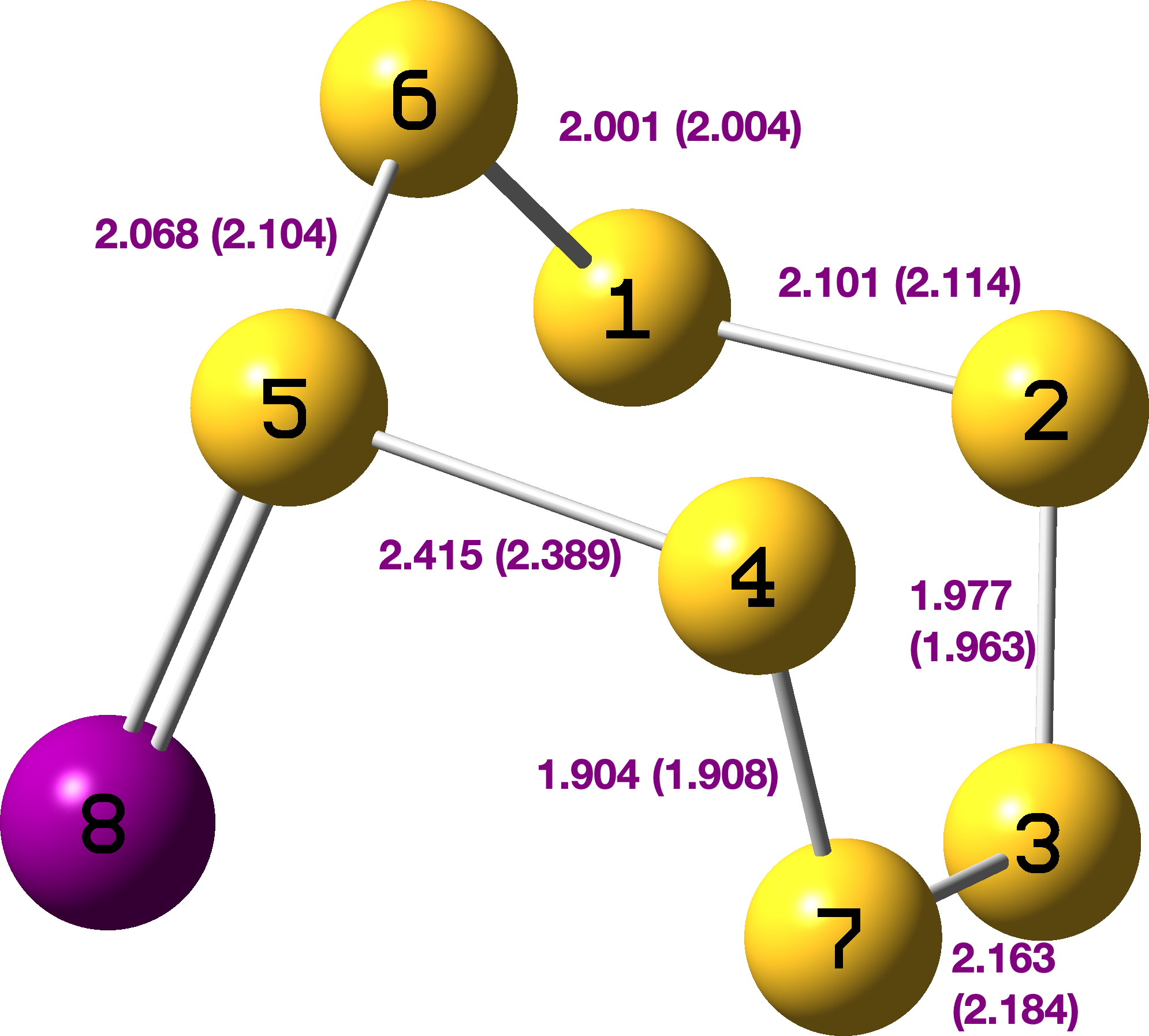
    In this series of posts about the electronic effects in small sulfur rings[cite]10.59350/rzepa.28615[/cite] I have explored increasingly large induced geometric effects. Here is the largest so far, for the compound S7I1+[cite]10.1021/ic50225a048[/cite]


    The calculated geometry[cite]10.14469/hpc/15236[/cite] is shown below, with the crystallographic values in parentheses – the two matching very well.

    The calculated NBO7 stereoelectronic analysis identifies an especially strong donor (S7) interaction with an acceptor S4-S7, the E(2) energy being 36.9 kcal/mol. The Wiberg S4-S5 bond index is 0.512 and the S-S stretching wavenumber is ν 131. The Wiberg index for S4-S7 is 1.4618 and the S-S stretch ν 667 cm-1, matching the shortest bond.

    The electronic overlap is shown below (click on image to view as a 3D model).

    So we end with the current record for an SLp/SSσ* interaction of 36.9 kcal/mol. Who would have thought that small sulfur rings could be such fun!

  • 5-Imino-5λ4-heptathiepane 3-oxide. More exuberent anomeric effects.

    The two previous  posts[cite]10.59350/rzepa.28515[/cite],[cite]10.59350/rzepa.28407[/cite] on the topic of anomeric effects in 7-membered sulfur rings illustrated how orbital interactions between the lone pairs in the molecules and S-S bonds produced widely varying S-S bond lengths in the molecules, some are shorter than normal (which is ~2.05Å for e.g. the S8 ring) by ~ 0.1Å and some are longer by ~0.24Å. Here we extend this to the unknown molecule shown below.

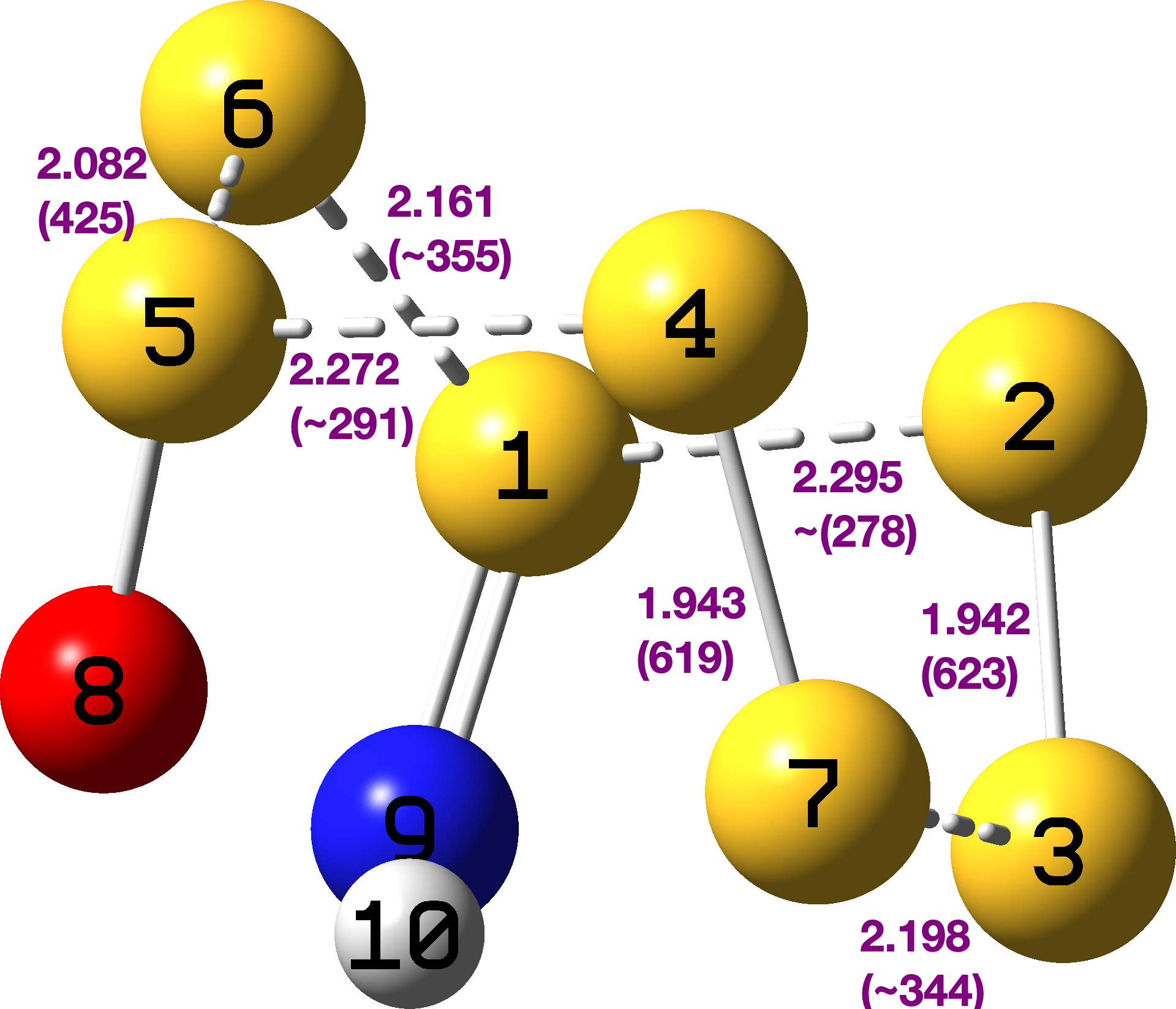
    The usual MN15L/Def2-TZVPP calculation[cite]10.14469/hpc/15235[/cite] gives the calculated geometry shown below. In parentheses are the calculated S-S vibrational wavenumbers (some are marked with ~ since these modes are contaminated by mixing with other parts of the molecules).

    The interaction energies between the donor and acceptor, E(2), are shown below. Numbers 5-8 are the same as was identified for the parent molecule S7, but the energies have increased substantially (previously 12.3/10.1 kcal/mol). The Wiberg bond index for the strongest bond (S2-S3) is 1.276 and the weakest (S1-S2) is 0.610, quite some variation! Given that the known S7O was already very unstable[cite]10.1002/anie.197707161[/cite], it seems unlikely that the probably even more unstable S7ONH could ever be isolated, but there is a challenge!

    # Acceptor S-S bond Donor Lp NBO E(2) Energy
    1 S4-S5 O8 31.9
    2 S1-S2 N9 29.6
    3 S1-S6 N9 27.0
    4 S5-S6 O8 20.4
    5 S4-S5 S7 16.8
    6 S1-S2 S3 16.4
    7 S3-S7 S2 15.4
    8 S3-S7 S4 15.2

    There are numerous compounds with six, seven and eight membered sulfur rings, and it would always be worth keeping an eye out for unusually short or long S-S bonds in them, since they may well be more manifestations of these sulfur anomeric effects.