Tag: animation

  • Mechanistic Ménage à trois

    Curly arrow pushing is one of the essential tools of a mechanistic chemist. Many a published article will speculate about the arrow pushing in a mechanism, although it is becoming increasingly common for these speculations to be backed up by quantitative quantum mechanical and dynamical calculations. These have the potential of exposing the underlying choreography of the electronic dance (the order in which the steps take place). The basic grammar of describing that choreography tends to be the full-headed curly arrow for closed shell systems and its half-barbed equivalent for open shell systems. An effectively unstated and hence implicit rule for closed shell systems is that only one curly arrow is used per breaking or forming bond, i.e. electrons move around bonds in pairs. So consider the following reaction (inspired by a posting on  Steve Bachrach’s blog)
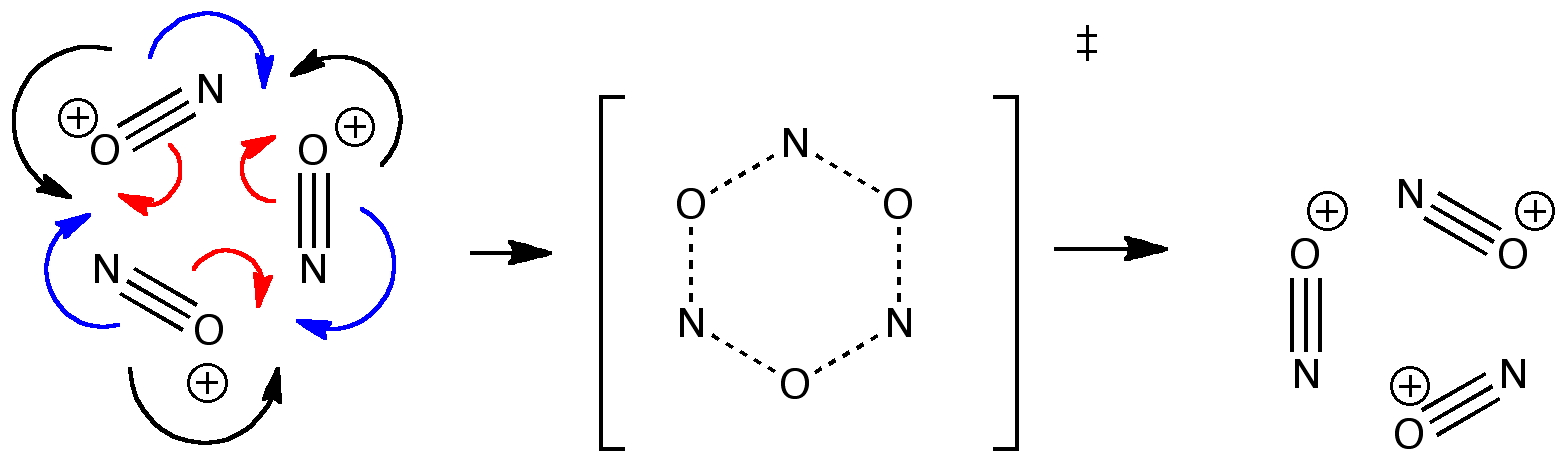
    Oxygen-nitrogen exchange between three nitrosonium cations

    This is very much a hypothetical mechanism, or a thought-experiment if you will. Three nitrosonium cations decide to get together to swap their partners. Each diatomic molecule swaps e.g. one oxygen for another during this exchange reaction (it could easily be studied experimentally of course using isotopic substitution). Three sets of three curly arrows have been used, shown in different colours above.  One set of these arrows at least has plenty of analogy in the real world; representing a π2s+π2s+π2s cycloaddition reaction. The other two sets represents rotation of the  in-plane π-set and the in-plane σ-set. What about the choreography? Can all three sets move at the same time? If so, they would provide an exception to the rule above; three bonds would concurrently change their order from 3 to 0; the other three the reverse of 0 to 3.

    What does quantum mechanics say about this? Well, a well defined, synchronous concerted transition state can indeed be found (B3LYP/6-31G(d), DOI:  10042/to-2905) It has one imaginary frequency (click on the above diagram to view the animation) which does indeed perform the bond transposition function required! It has the form of the so-called Kekule mode (deriving from a mode found in benzene which involves shortening of the lengths of three bonds, and lengthening of the other three, much in the manner of the resonance named after  Kekule; see e.g. DOI: 10.1039/B911817A for more details). Of course, describing it as a change in the bond orders 3 → 0/0 → 3 is simplistic; the bond order in the nitrosonium cation itself is almost certainly somewhat less than three.  But clearly, the implicit rule that  mechanistic arrow pushing should not involve more than one arrow departing from or arriving at any one bond can be broken. I will leave it to the reader of this blog to see what happens when you try to rearrange the choreography of the above reaction. Try pushing first one set of three arrows, then another and a final third. What do you get? (the why of the dance is almost certainly due to electrostatic repulsions between the three nitrosonium cations).
  • The SN1 Reaction- revisited

    In an earlier post I wrote about the iconic SN1 solvolysis reaction, and presented a model for the transition state involving 13 water molecules. Here, I follow this up with an improved molecule containing 16 water molecules, and how the barrier for this model compares with experiment. This latter is nicely summarized in the following article: Solvolysis of t-butyl chloride in water-rich methanol + water mixtures, which (for pure water) cites the following activation parameters

    • ΔH283 = 23.0 kcal/mol
    • ΔG283 = 19.7 kcal/mol
    • ΔS283 = +11.1 cal/mol/K

    But first, a word about how this new transtion state has been obtained. The DFT treatment used is quite standard (B3LYP/6-31G(d) ), and one can indeed locate a transition state using just this approach (this is how the previous model was obtained). One has to work very hard to orient the starting guess for the geometry so that as many hydrogen bonds between the waters themselves, and to the substrate, are created. The previous model took quite a few guesses and attempts! The solvent in such a model is simulated by the explicit water molecules themselves. Of course, the quality of the solvent then depends on how many water molecules are used. A proper solvent field using explicit water molecules is thought to require 100s of water molecules! But a reasonable approximation/compromise may well be 13.

    So how can the model be improved? Well, in many ways, some of which include treating the dynamics of the system. But I will stick just to two.

    1. Firstly, we assume that the water molecules are used to form a bridge between the incoming nucleophile (another water) and the leaving group (the chloride). In the previous model, two such bridges were constructed using the 13 water molecules. But in fact, there is still space between two of the methyl groups to construct a third bridge. This takes the total solvent molecules to 16.
    2. Solvent can also be modelled as a continuum, in which a cavity which the substrate occupies is surrounded by a field generated by the continuum solvent. The problem with these cavity approaches in the past has been that it is not easy to optimize the geometry of the molecule contained within the cavity. Because the cavity was constructed by tesselation, the first derivatives of the energy of the molecule within the cavity were not regular, and as a result, geometry optimization (and particularly transition state optimization) would frequently meander and fail to converge. Darrin York and Martin Karplus came to the rescue (some time ago, it has to be said, DOI: 10.1021/jp992097l) by formulating a smoothed out solvation cavity where the first (and second derivatives) are stable and well behaved. This new algorithm has now been implemented in Gaussian09, and it now allows really easy transition state location within a solvent cavity

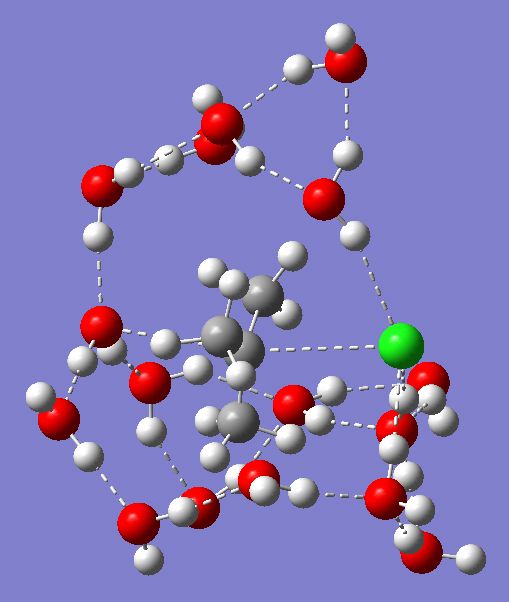
    The result of this optimization is shown below (and can be seen in original form at the following DOI: 10042/to-2894).

    Transition state for  Sn1 solvolysis of  tert-butyl chloride
    Transition state for Sn1 solvolysis of tert-butyl chloride. Click for animation.
    The model has not changed that much compared to before. The reaction (imaginary) mode still clearly shows formation of the C-O bond and cleavage of the C-Cl bond. Also as before, there is a lot of motion of the methyl groups, as the forming cation induces stereo-electronic alignment with the adjacent C-H bonds (and which explains the large secondary deuterium isotope effects measured for this reaction, kH/kD (298) = 2.39, see DOI: 10.1021/ja01080a004). The hydrogen bonding pattern is also retained (despite the surrounding solvent field!). But what of the predicted activation parameters

    • ΔH298 = 17.4 kcal/mol
    • ΔG298 = 18.7 kcal/mol
    • ΔS298 = -4.4 cal/mol/K

    The overall free energy is in great agreement with experiment! But the entropy is the wrong sign!! The calculation is predicting that the transition state is more rigid than the reactant. One can see how this might happen, since the greater ionic character produces very much stronger hydrogen bonds, which strengthen the three solvent bridges. It may be simply that the rigid-rotor-harmonic-oscillator approximation breaks down horribly for the entropy in this calculation. But it is encouraging that the activation barrier is reproducing experiment, which suggests the model cannot be completely wrong!

  • Jmol and WordPress: Loading 3D molecular models, molecular isosurfaces and molecular vibrations into a blog

    Click on the static image to get an active model. The code used to obtain the above was:

    1. <script src="../Jmol/Jmol.js" type="text/javascript" />
    2. This line is best added to the theme header by editing the file /wp-content/themes/default/header.php to add the following line in the header:

      <script src="../Jmol/Jmol.js" type="text/javascript"></script>

    3. <img onclick=”jmolInitialize(‘../Jmol/’,’JmolAppletSigned.jar’);jmolSetAppletColor(‘yellow’);
      jmolApplet([450,450],’load wp-content/uploads/2009/08/HV2-62.jvxl;isosurface translucent;zoom 5;moveto 4 0 2 0 90 70;’);”  alt=”A lemniscular molecular orbital” src=”http://www.ch.imperial.ac.uk/rzepa/blog/wp-content/uploads/2008/04/14-knot.jpg” />

      where of course the uploads directory needs to be modified to correspond to your own content, and the file and script following it also correspond to the effect you wish to achieve.

    The path wp-content/uploads/2009/08/ is that created by the built-in editor using the Add media file upload mechanism. The Jmol directory is located at the level above that of the blog itself. The JVXL file is created from either the corresponding (Gaussian) output file, or a CUB file created using a program such as Gaussview. Any suitable surface can be displayed using JVXL. In addition to MOs, we have also displayed ELF (Electron localization function) isosurfaces and molecular vibrations. For the latter, use a script of the form

    'load wp-content/uploads/2008/04/vibration.log; frame 9; vectors on;vectors 4;vectors scale 5.0; color vectors green; vibration 10;animation mode loop;'

    where the vibration you want is contained in e.g. frame 9.

    There does appear to be a display bug with the above; the Jmol model replaces the window rather than being inlined in it. Once the model is displayed, just refresh the page to return to the blog entry.

    A recent addition is the display of non-covalent-interaction (NCI) surfaces, which are colour coded by using the values in one cube of points to colorize a second cube.

    'load wp-content/uploads/2011/05/isobornyl1.xyz;isosurface wp-content/uploads/2011/05/isobornyl1.jvxl colorscheme translucent bgyor;'