In a time of change, we often do not notice that Δ = ∫δ. Here I am thinking of network bandwidth, and my personal experience of it over a 46 year period.
I first encountered bandwidth in 1967 (although it was not called that then). I was writing Algol code to compute the value of π, using paper tape to send the code to the computer. Unfortunately, the paper tape punch was about 10 km from that computer. The round trip (by van) took about a week, the outcome being often merely to discover that the first line of the code contained a compilation error. I think I got to computing π after about six weeks. That is a bandwidth of about 18 characters (108 bits) in 3628800 seconds, or 0.00003 bits per second.
I did my undergraduate work in 1969, when the distance between the card punch and the computer had reduced to about 50m, and instant turnaround involved circulating in a loop between the punch and the line printer, hoping that neither suffered a paper-wreck. The bandwidth had certainly gone up. On a good day, you could make 20 or so circuits, which did leave one feeling faintly dizzy.
The next improvement came in 1972, when I was solving non-linear equations for kinetic rate constants, using a 110 bits per second (baud) or ~ 18 characters per second using the 6-bit computers of that era) teletypewriter. This was about 50m from the lab where the kinetic measurements were made (using, if you are interested a scintillation counter. Yes, I was mildly radioactive for most of my PhD, but I do not believe I glowed in the dark). This bandwidth was in fact fine for uploading kinetic data, and receiving the computed rate constant and its standard error. You might note however that this teletypewriter was the only one in the building I occupied, and yet demand for it was small (I was pretty much its only user).
The next increment occurred in Texas 1974-1977, where I was now doing quantum chemical calculations. Back in time to the card punch and the lineprinter (Texas is big, and so now the distance between them was a 10 minute walk). But in my last year there, a state-of-the-art 300 baud teletypewriter was installed! This was now fast enough to play a computer game (something to do with Dragons and Dungeons I think), and so now there was competition to use it. Particularly from one of my friends, who shall be called George, and who on one occasion spent about 48 virtually contiguous hours trying to get to the last level. The rest of us returned to the card punch to submit the calculations. It was also during this period that the first emails started to be exchanged, but only really as a curiosity: “it would never catch on” was the opinion of most.
Back in the UK by 1977, I was overwhelmed by the speed of the 9.6 kbaud graphics terminal I now had access to, 32 times faster. And the rate continued to multiply, by a further 1000 to attain 10 Mbaud in 1987. But another change occurred during this period. The previous eras had involved transmitting the data no more than ~200m, from one point in the campus to another. But by 1986, if one tried hard enough,† one could reach ARPANET. And that was 5000 km away! My first use of such distances was to reach California and download Apple’s system 5.0 for the Macs in the department (I have described elsewhere the role the Mac’s printer port played in this). From then on, we always did have the latest operating system installed on most of the machines (although not always did this subterfuge address the intended issue, which was to stop the computer crashing as often).
These speeds however did not reach beyond the university. Back home, around 1983, I was back to using a 300 baud modem, with an acoustic coupler to the land line. Our young daughter, aged 3 at the time, joined in the data transmission with gusto. Her joyful shrieks were invariably picked up by the acoustic coupler, and translated into a jumble of characters, which were then interleaved into the numbers coming back from quantum calculations. It was sometimes difficult to tell them apart! These domestic modems gradually got faster, probably attaining 9.6 kbaud by about 1993 (during the course of which the acoustic component was replaced by electronics, and oddly, our daughter stopped shrieking in quite the same way).
Back in the university in 1993, the first 100 megabits per second (100Mbps ≅100 Mbaud) ethernet lines and switches were being installed, but the national and international backbones were still a lot slower. It was in this year that I was approached to be part of a SuperJanet project. We were going to do a molecular videoconference from London to Cambridge and Leeds; a three-way connection, and this needed ~ 20Mbps to transmit the signal from the video camera as well as the 3D images of molecules in real-time (compression techniques were not so advanced in those days). Because BT was sponsoring the project, they naturally wanted some publicity, and so we even got to appear on the national television news that night. But we came within about 1 minute of a disaster. Our 20Mbps connection went through the SuperJanet national backbone, the capacity of which was, you guessed, ~ 20 Mbps. The network operators (located at the Rutherford-Appleton laboratories), who we had not had the foresight to pre-warn, came within 1 minute of isolating Imperial College from the national network because of our bandwidth hogging. I met them a month or so later, and they told me this. I feel I was lucky to escape with my life and body intact from that meeting (or to put it another way, they were not happy bunnies).
By about 2000, I had achieved 1 Gbps to my desktop computer (and there it has stayed for the past 13 years). What about home? Well, to cut the story short, I recently benchmarked the domestic WiFi connection between a laptop and “the world” at about 65 Mbps (download) and 18 Mbps (upload), a little less than 1 million times greater than 30 years earlier and a 12 orders of magnitude greater than in 1967. I gather however that some lucky inhabitants of Austin Texas (the scene of my 1974-1977 experiments), courtesy of Google, can get 1 Gbps!‡
I will end by quoting Samuel Butler, writing in 1863: I venture to suggest that … the general development of the human race to be well and effectually completed when all men, in all places, without any loss of time, at a low rate of charge, are cognizant through their senses, of all that they desire to be cognizant of in all other places. … This is the grand annihilation of time and place which we are all striving for, and which in one small part we have been permitted to see actually realised” (Quoted in George Dyson, “Darwin amongst the Machines, The Evolution of Global Intelligence”, Addison-Wesley, N.Y., 1997. ISBN 0-201-400649-7).
‡ I just benchmarked my office computer (using only solid-state memory and that 1Gbps connection) and got 58Mbps (download)/75Mbps (upload).
† The standard program was NCSA Telnet if I remember. You made a connection from the computer (using its printer port) to the ARPANET node at University College London (not a widely advertised service), and thence to an Apple FTP site where one could initiate an anonymous file transfer back to one’s computer. System 5 was about half a Mbyte then, and this took about 1-2 hours to retrieve (unless the connection went down, in which case one started again).
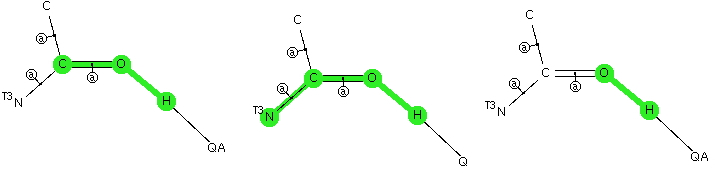
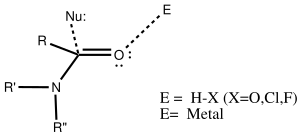 My first thought was to calculate the wavefunction and identify the location and energy (= electrophilicity) of the lone pairs (the presumed attractor of an electrophile). But a better more direct approach soon dawned. A search of the crystal structure database. Here is the search definition, with the C=O-E angle, the O-E distance and the N-C=O-E torsion defined (also specified for R factor < 5%, no errors and no disorder).
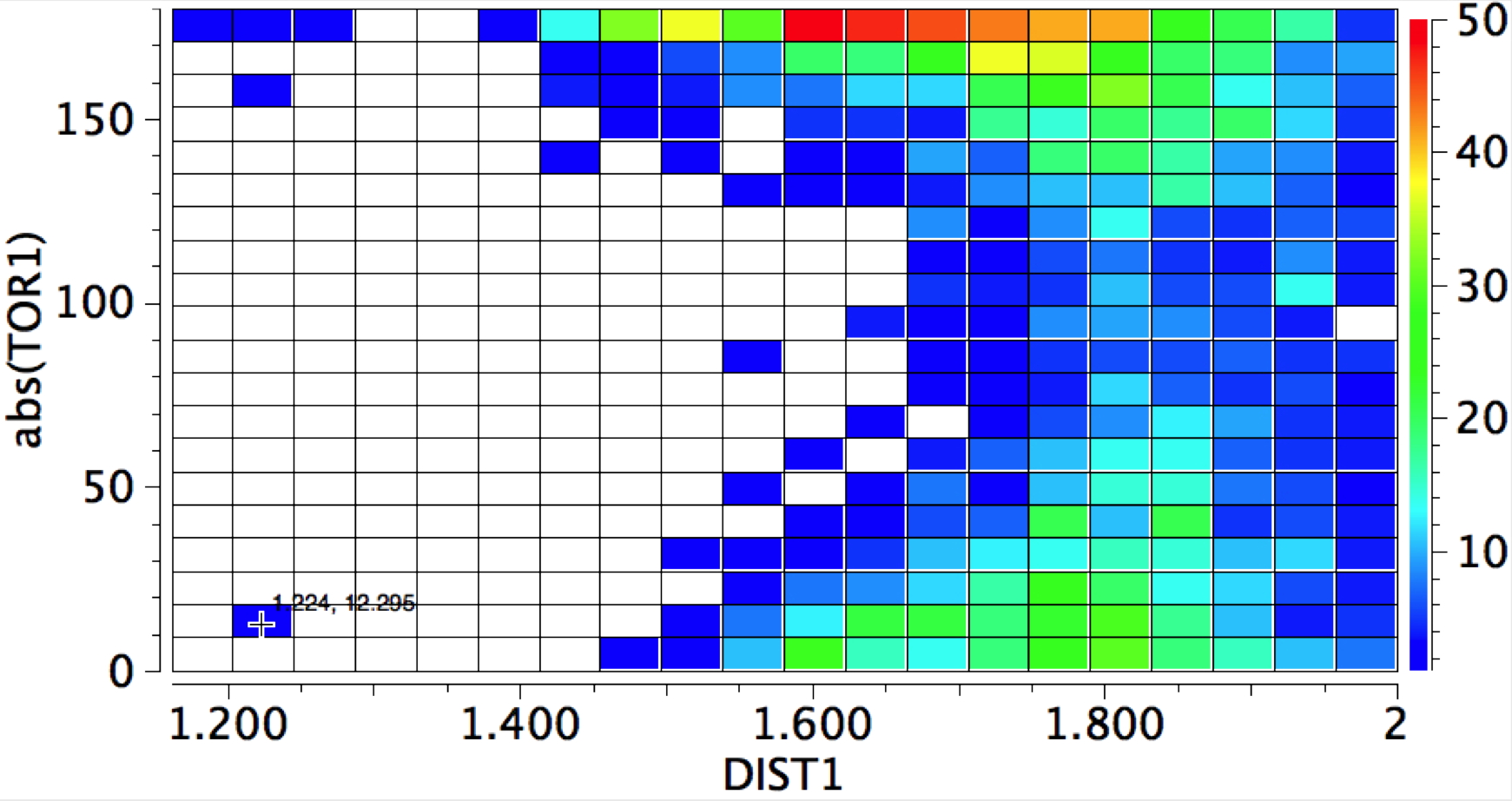
  The first plot is of the torsion vs the distance, for E = H-X (X=O,F, Cl)