Tag: Google

  • The Fragile Web

    One of the many clever things that clever people can do with the Web is harvest it, aggregate it, classify it etc. Its not just Google that does this sort of thing! Egon Willighagen is one of those clever people. He runs the Chemical blogspace which does all sorts of amazing things with blogs.

    He sent me a message recently, saying that unfortunately, he was not able to do any amazing things to my blog, since it was not failsafe any more. Apparently, deep down in the software he was using to harvest the details of my blog, an error along the lines of Bytes: 0xA0 0x0A 0x49 0x74 was causing grief. This is the sort of message that would make most people quake. In this instance, the excellent W3C comes to the rescue. By putting this blog feed into their RSS Validator , one can narrow down the error. It proved to be on a single line of an earlier blog posting. Remove this line, and all becomes well. In fact, if the line was displayed on a regular text editor, one eventually notices that the end of the line (which looks just like a space) might be the suspect. Remove just that one character, and the RSS Validator is (almost perfectly) happy. I hope that Egon will be too now!

    But the lesson of this little exercise is that a single character can still bring the whole edifice crashing down (or at least my entire blog). Single characters of course have been notorious in the past. One that springs to mind was a single (white) space, inserted by accident into a line of Fortran code. That space subverted the meaning of the code, which in fact was being used to control the navigation of a spacecraft on its way to Jupiter. Result? The probe missed Jupiter by quite a margin, and the entire cost of the mission was lost (around 1$billion!).

    It is also a lesson  in how an individual might operate within the  modern Web.  During the period  1993 to around 2001, most of the content on the  Web was in the form of static  HTML pages. This was written either by hand, or using software tools to do so.  This was scary stuff for most people. Then along came two  social inventions; the Wiki and the  Blog. Each of these hid (most of) the scary  HTML from the user, and allowed pain-free (almost) creation of content.  As time passed, everyone became accustomed to using such tools, and they started to trust them implicitly to produce  valid HTML under the hood. In my case,  I trusted the Blog software (WordPress) to both not produce faulty  HTML,  or at least to detect it if it got in by accident. In this instant, it is more subtle, with an error in the character encoding.  But this is the lesson.  As the skills of olden time (i.e. writing native  HTML) are lost, we will be more and more at the mercy of the modern tools.  Will we even notice the errors, which might propagate out with our name attached?  Or will the software get even smarter and fix the errors before they cause problems?  Will humans become almost entirely redundant?
  • The mystery of the Finkelstein reaction

    This story starts with an organic chemistry tutorial, when a student asked for clarification of the  Finkelstein reaction. This is a simple SN2 type displacement of an alkyl chloride or bromide, using sodium iodide in acetone solution, and resulting in an alkyl iodide. What was the driving force for this reaction he asked? It seemed as if the relatively strong carbon-chlorine bond was being replaced with a rather weaker carbon-iodine bond. But its difficult to compare bond strengths of discrete covalent molecules with energies of ionic lattices. Was a simple explanation even possible?

    All is not as it seems however. The traditional explanation, found by the quick Google search linked above, is that the reaction illustrates Le Chatelier’s principle, whereby an equilibrium is driven over to completion by removal of one of the products (in this case sodium chloride or sodium bromide, which crystallize out of solution). Well, we have replaced one possible (and probably complicated) explanation based on bond strengths and ionic lattices by another based on the solubilities of an ionic material in a moderately polar solvent. But all we have done is ask a different question, which now becomes why is sodium iodide highly soluble in acetone, whereas sodium chloride and bromide are not? The answer to this is less easily found using Google!

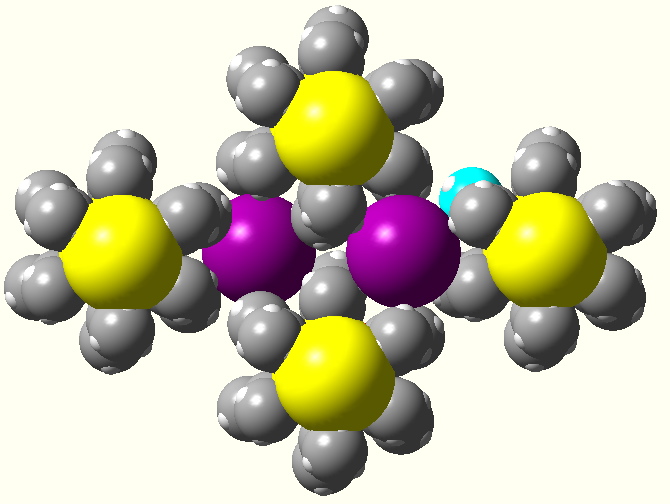
    A good start would be the crystal structure of any complex formed between acetone and sodium iodide. Fortunately, one such does exist, and it is shown below (sodium=yellow, iodine=purple).

    (Acetone)3. NaI
    (Acetone)3+NaI. NAIACE. Click for 3D.

    The formula shows three acetone molecules for each sodium iodide. The carbonyl oxygen has two lone pairs of electrons, and each of these is used to coordinate a (different) sodium cation. This allows each sodium to be coordinated by a total of six lone pairs, giving it octahedral coordination. This sets up what in fact is quite a rigid scaffold, with the unusual feature of an approximately triangular shaped channel running down the lattice (two such are shown above). The size of this hole is determined by the methyl groups of the acetone, and it is into this cavity that the halide ion must fit.

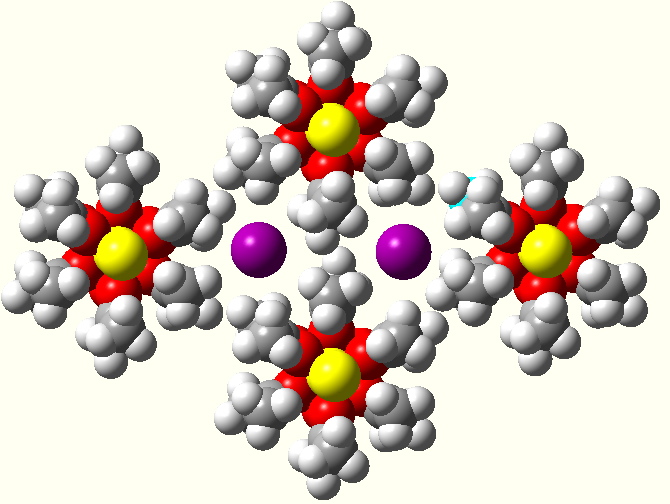
    As it happens, the iodide anion is exactly the right size to produce a perfectly snug fit up against those methyl groups (click on the image above to view this). If a chloride or bromide anion were to be fitted into the cavity, there would be empty space surrounding it. The cavity itself is too rigid to collapse around the halide anion to absorb this space. This means these halide anions are further away from the positively charged sodium than they would like to be such that they minimize their ionic lattice energies. Instead they avoid fraternizing with the acetone at all, and form a pure sodium chloride or sodium bromide lattice (where the two oppositely charged ions CAN approach at optimal distances). The result is that sodium chloride crystallizes out of solution, and the Finkelstein reaction proceeds to completion!

    Acetone. NaI in spacefill mode
    Acetone. NaI in spacefill mode. Click for 3D.

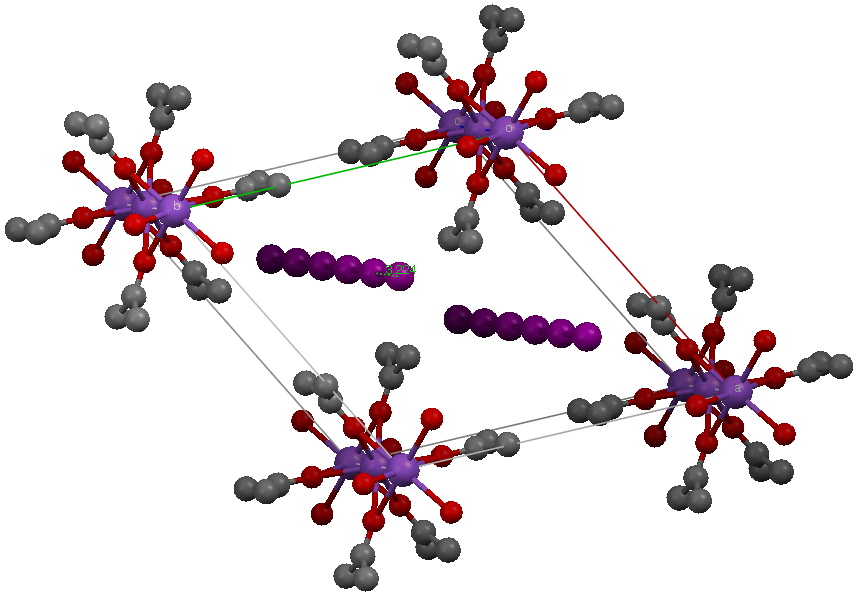
    But that is not quite the end of the story. If you view the acetone.NaI lattice sideways (click on the diagram above to view this aspect), you will find that in fact there is still space in the scaffold after all! Each iodide anion has room above or below it, with space for exactly one more iodine atom to fit without having to change the shape of the scaffold. And indeed such a molecule has been reported[cite]10.1107/S0108270103006395[/cite],[cite]10.5517/CC75TZ5[/cite] but it is an odd one! The stoichiometry is now (acetone)3.NaI2, which implies that the iodide anion has been joined by an iodine atom. I2(-) is called a radical anion, and as such has an unpaired electron. Just like two iodine atoms can couple their unpaired electrons to form a covalent bond, so can two I2 radical anions, forming I42- [or I3.I] or on to infinity as a linear iodine polymer, of formula n[I42-], with all the I…I distances equal at 3.224Å (a system with no Peierls distortion). Straight rod-like polymeric chains of a single element might appear highly unusual, but curiously, another class of elements that exhibits this behaviour is Cu/Ag/Au and Ga,[cite]10.1002/anie.200601726[/cite] the ultimate in thin wires!).

    Acetone. NaI2
    Acetone+NaI2. GADMOO. Click for 3D.

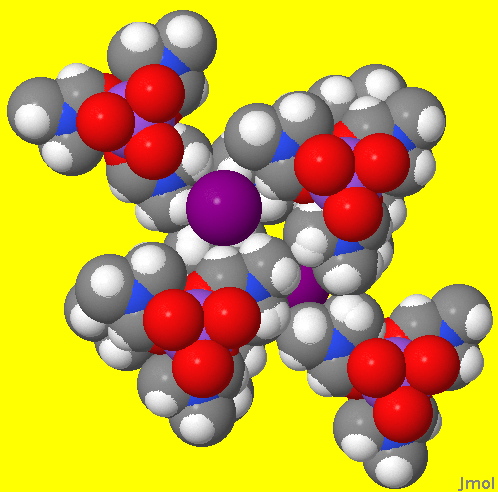
    Finally, it is worth noting that the same phenomenon occurs with the dimethylformamide.NaI complex. In this example, only the NaI and not the NaI2complex has been reported.

    DMF. NaI
    DMF+NaI. Click for 3D.

    Acknowledgments

    This post has been cross-posted in PDF format at Authorea.