Tag: Methane

  • Reaction coordinates vs Dynamic trajectories as illustrated by an example reaction mechanism.

    The example a few posts back of how methane might invert its configuration by transposing two hydrogen atoms illustrated the reaction mechanism by locating a transition state and following it down in energy using an intrinsic reaction coordinate (IRC). Here I explore an alternative method based instead on computing a molecular dynamics trajectory (MD).

    I have used ethane instead of methane, since it is now possible to envisage two outcomes:
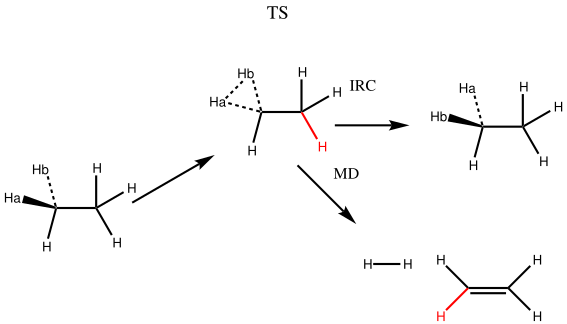
    An animation of the IRC starting from the located transition state is shown below (DOI: 10.14469/hpc/2331). This is based purely on the computed potential energy surface of the molecule. The IRC is computed from the forces experienced on the atoms as they are displaced from an initial set of coordinates corresponding to the located transition state and then following the direction indicated by the eigenvectors of the negative force constant required of a transition state. Importantly, there is no time component; the path is based entirely on energies and forces.

    Next, a molecular dynamics simulation (ωB97XD/6-31G(d,p), DOI: 10.14469/hpc/2330).  This uses the ADMP method, which requests a classical trajectory calculation using the “atom-centered density matrix propagation molecular dynamics model”. This integrates kinetic energy contributions from the molecular vibrations and so explicitly now includes a time component. In this example the evolution of the system from the transition state is charted over a period of 100 femtoseconds (1000 integrated steps). As it happens this is a relatively short period of evolution; sometimes periods of picoseconds may be required to get a realistic model, especially if one is also dealing with explicit solvent molecules (of which perhaps 500 might be required).

    Such explicit inclusion of the kinetic energy from molecular vibrations in effect allows the molecule to “jump” over shallow barriers. In this case, the barrier for a [1,2] hydrogen shift from the methyl group to the adjacent carbene (watch atom 8). Simultaneously, the path taken by two hydrogens no longer corresponds to their transposition but to their elimination as a hydrogen molecule. So this quite different outcome from the IRC is very probably also a much more realistic one.

    If the MD method is so much more realistic than the IRC, then why is it not always used? The simple answer is computational time! For this very small molecule and using quite a modest basis set (6-31G(d,p)), the relatively short 1000 time steps took about three times as long to compute as the IRC. The factor gets worse as the size of the molecule increases and the number of time steps for a realistic result increases. Perhaps, as technology gets better and new computer architectures emerge, MD simulations of ever increasingly complex reactions will become far more common. In ten years time, I expect most of the examples on this blog will use this method!
  • How does silane invert (its configuration)?

    In the previous post, I found intriguing the mechanism by which methane (CH4) inverts by transposing two of its hydrogens. Here I take a look at silane, SiH4.

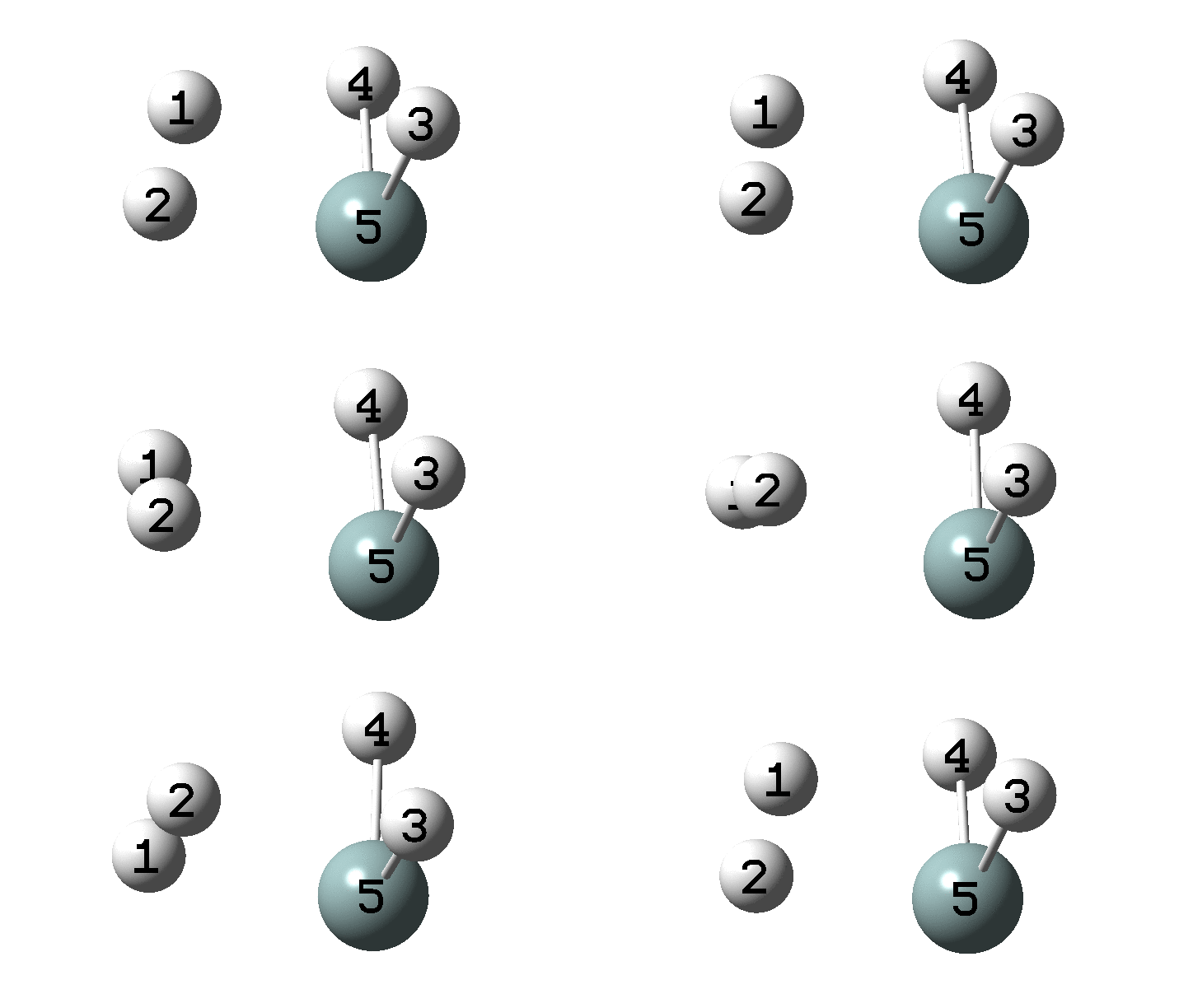
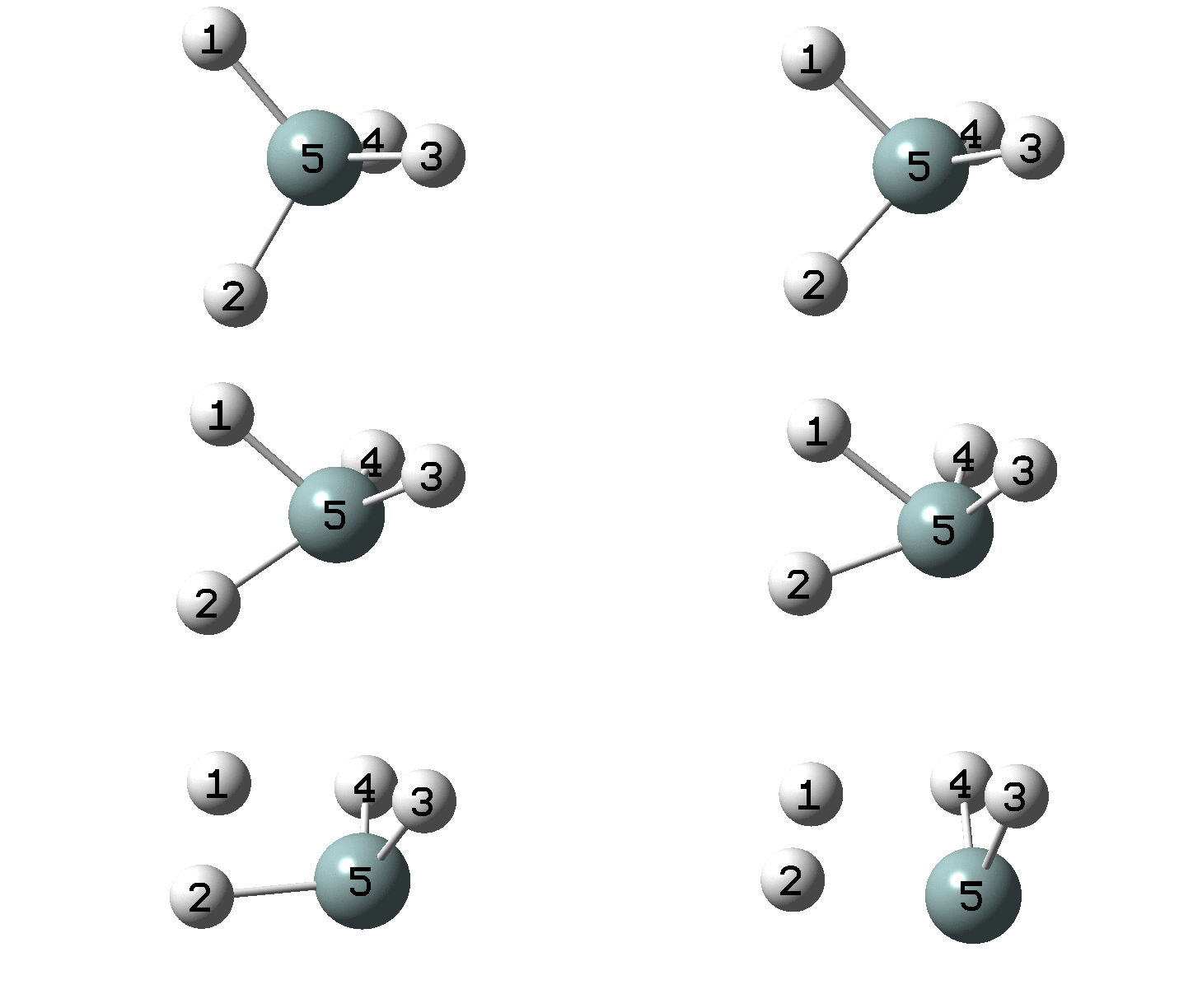
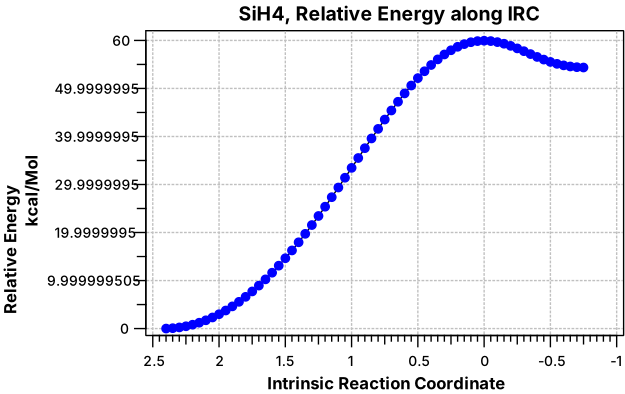
    It appears it is a three-stage process! Firstly, silane eliminates molecular hydrogen to form a molecular complex between Hand SiH2 (DOI: 10.14469/hpc/2290). The barrier (~60 kcal/mol) is very much lower than with methane.

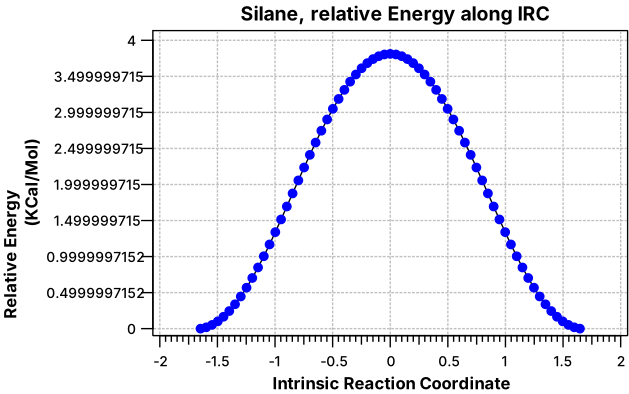
    The H2 component of this complex then rotates (DOI: 10.14469/hpc/2289) transposing atoms 1 and 2. The barrier for this process is tiny (~4 kcal/mol).

    Finally, the rotated H2/SiH2 complex goes back to silane by the first route, but now with the two hydrogens transposed.

    So this inversion is a stepwise process in contrast to methane which was concerted, albeit with “frustrated” elimination of hydrogen. Again a little molecule can show us so much chemistry, in this case also illustrating the avoidance of a Woodward-Hoffmann forbidden cheletropic elimination by desymmetrisation.

  • How does methane invert (its configuration)?

    This is a spin-off from the table I constructed here for further chemical examples of the classical/non-classical norbornyl cation conundrum. One possible entry would include the transition state for inversion of methane via a square planar geometry as compared with e.g. NiH4 for which the square planar motif is its minimum. So is square planar methane a true transition state for inversion (of configuration) of carbon?

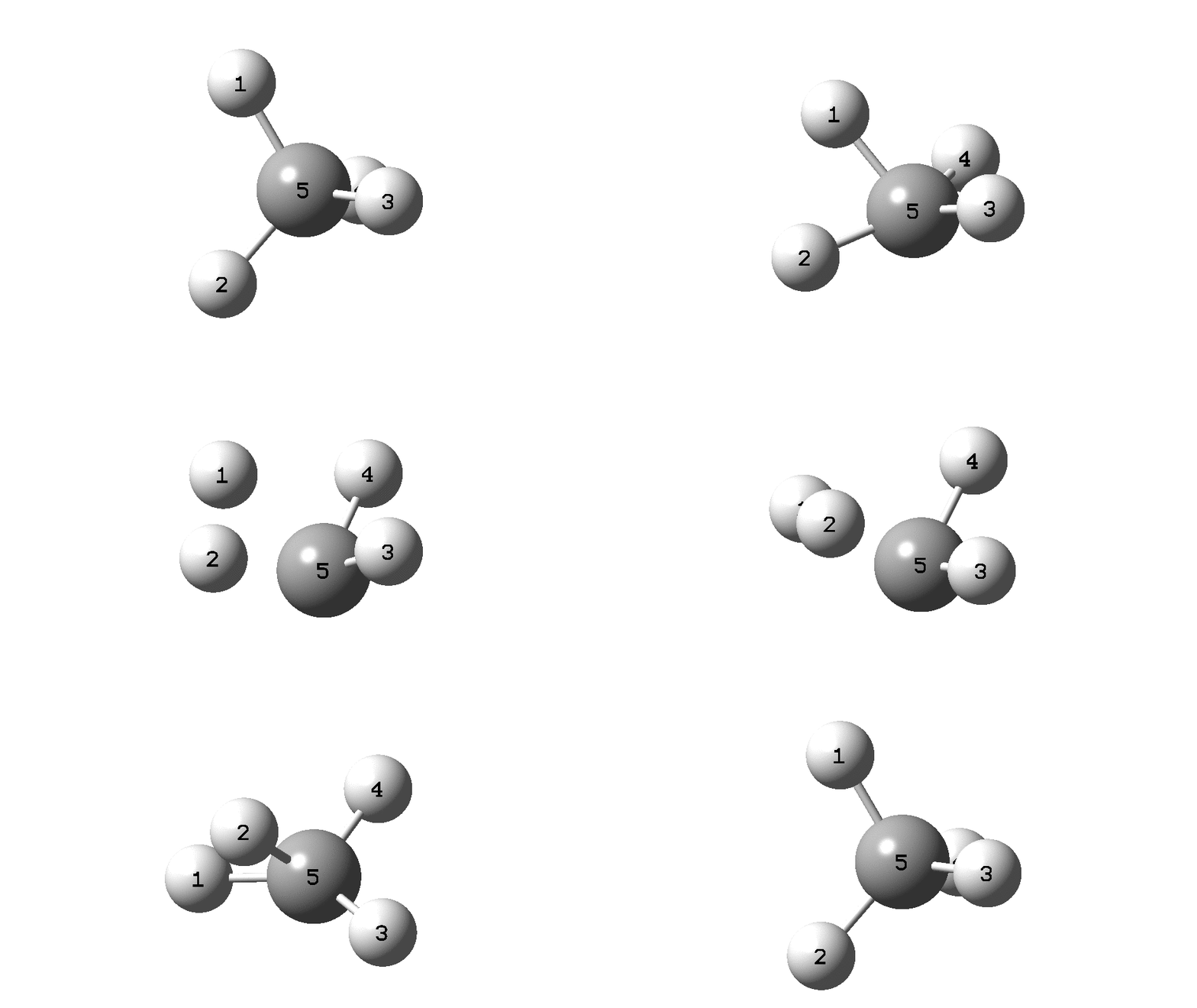
    The history of this topic is nicely told as far back as 1993[cite]10.1021/ja00069a056[/cite], when square planar methane was shown to be a 4th-order saddle point (i.e. four negative force constants) and not the first order one required of a transition state. A true transition state was located, and here I show it as part of an animated IRC (intrinsic reaction coordinate). Go to DOI: 10.14469/hpc/2288 for the calculation outputs.

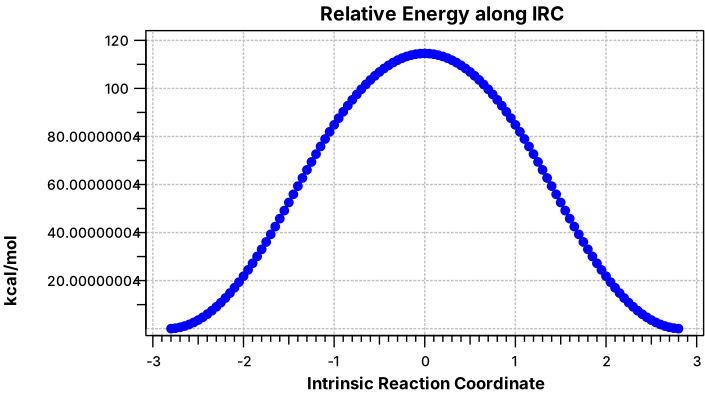
    To convince yourself that the configuration really does invert, focus on the CIP rule. With atom 1 pointing behind, atoms 2 → 3  → 4 rotate in a clockwise direction. Now focus on the final point at the end of the IRC, when 2 → 3  → 4 rotate anti-clockwise. The configuration has inverted! The barrier as can be seen below is ~118 kcal/mol. At this value the half-life for the process would be far longer than the age of the universe.

    The process can be described as an interesting variation on pseudorotation, for which the classic example is of course PF5. Alternatively it can be thought of as the partial extrusion of H2 to give carbene, followed by re-addition of the H2 to reform methane. Partial because the extrusion is never fully achieved.

    I have to say I did not expect anything quite so interesting to be associated with methane;  one can learn from the simplest of molecules!


    It was not entirely trivial to recover appropriate coordinates for recomputing this TS from the article. But it is in fact an easy one to find from scratch. Hopefully with the files at 10.14469/hpc/2288 to help, this will not be an issue here.

    There are many kinds of pseudo-rotations. For others see here.[cite]10.1021/ic0519988[/cite] and [cite]10.1021/ic062473y[/cite]