Tag: Molecular geometry

  • Impossible molecules.

    Members of the chemical FAIR data community have just met in Orlando (with help from the NSF, the American National Science Foundation) to discuss how such data is progressing in chemistry. There are a lot of themes converging at the moment. Thus this article[cite]10.1039/c7np00064b[/cite] extolls the virtues of having raw NMR data available in natural product research, to which we added that such raw data should also be made FAIR (Findable, Accessible, Interoperable and Reusable) by virtue of adding rich metadata and then properly registering it so that it can be searched. These themes are combined in another article which made a recent appearance.[cite]10.1021/acsomega.8b03005[/cite]

    One of the speakers made a very persuasive case based in part on e.g. the following three molecules which are discussed in the first article[cite]10.1039/c7np00064b[/cite] (the compound numbers are taken from there). The question was posed at our meeting: why did the referees not query these structures? And the answer in part is to provide referees with access to the full/primary/raw NMR data (which almost invariably they currently do not have) to help them check on the peaks, the purity and indeed the assignments. I am sure tools that do this automatically from such supplied data by machines on a routine basis do exist in industry (and which is something FAIR is designed to enable). Perhaps there are open source versions available?

    17 18 19

     
    328[cite]10.1002/ejoc.201301308[/cite] 348 713

    Here I suggest a particularly simple and rapid “reality check” which I occasionally use myself. This is to compute the steric energy of the molecule using molecular mechanics. The mechanics method is basically a summation of simple terms such as the bond length, bond angle, torsion angle, a term which models non bonded repulsions, dispersion attractions and electrostatic contributions. The first three are close to zero for an unstrained molecule (by definition). The last three terms can be negative or positive, but unless the molecule is protein sized, they also do not depart far from zero. A suitable free tool that packages all this up is Avogadro.

    The procedure is as follows

    1. Start from the Chemdraw representation of the molecule. If the publishing authors have been FAIR, you might be able to acquire that from their deposited data. Otherwise, redraw it yourself and save as e.g. a molfile or Chemdraw .cdxml file.
    2. Drop into Avogadro, which will build a 3D model for you using stereochemical information present in the Chemdraw or Molfile.
    3. In the  E tool (at the top on the left of the Avogadro menu) select e.g. the MMFF94 force field. This is a good one to use for “organic” molecules for which the total steric energy for “normal” molecules is likely to be < 200 kJ. Calculate that for your system; this normally takes less than one minute to complete. The values obtained for the three above are shown in the table. All three are well over 200 kJ/mol, which should set alarm bells ringing.
    4. A “more reasonable” structure for 17 is shown below. This has a steric energy of 152 kJ/mol, some 176 kJ/mol lower than the original structure. This does not of itself “prove” this alternative, but it is a starting point for showing it might be correct.Of course mis-assigned but otherwise reasonable structures are unlikely to be revealed by the steric energy test. But impossible ones will probably always be flagged as such using this procedure. 

    Postscript: Hot on the heels of writing this, the molecule Populusone came to my attention.[cite]10.1021/acs.orglett.9b00423[/cite] On first sight, it seems to have some of the attributes of an “impossible molecule” (click on diagram below for 3D coordinates).

    However, it has been fully characterised by x-ray analysis! The steric energy using the method above comes out at 384 kJ/mol, which in the region of impossibility! This can be decomposed into the following components: bond stretch 30, bend 51, torsion 32, van der Waals (including repulsions) 177, electrostatics 87 (+ some minor cross terms). These are fairly evenly distributed, with internal steric repulsions clearly the largest contributor. The C=C double bond is hardly distorted however, which is in its favour. Clearly a natural product can indeed load up the unfavourable interactions, and this one must be close to the record of the most intrinsically unstable natural product known!

  • Hypervalent or not? A fluxional triselenide.

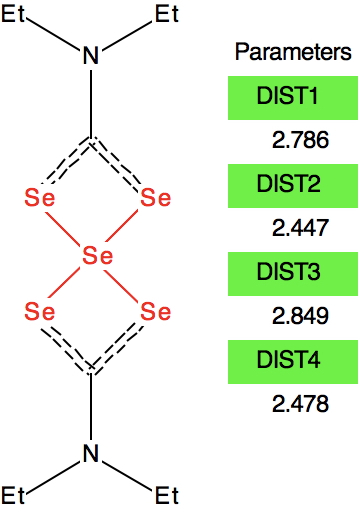
    Another post inspired by a comment on an earlier one; I had been discussing compounds of the type I.In (n=4,6) as possible candidates for hypervalency. The comment suggests the below as a similar analogue, deriving from observations made in 1989.[cite]10.1016/S0040-4039(00)99132-9[/cite]

    This compound was investigated using 77Se NMR, with the following conclusions:

    1. The compound is fluxional, with the lines at room temperature broadened compared to those at -50°C.
    2. At -50°C the peaks are sharp enough to discern 1JSe-Se couplings, with multiplicities and integrations that suggest a central Se is surrounded by four equivalent further Se atoms, with shifts of 655.1 and 251.2 ppm.
    3. The magnitude of this 1JSe-Se coupling (391 Hz) leads to the suggestion of a considerable contribution of a resonance form with Se=Se bonds (structure 2 above).
    4. This was supported by 2J13C-77Se couplings which also imply a symmetrically coordinated central  Se.
    5. Thus the two resonance forms 1 or 2 above were suggested as the predominant form at -50°C, with an increasing incursion of the open chain isomer 3 at higher temperatures giving rise to the observed fluxional dynamic behaviour.
    6. One may surmise from these results that the central Se is certainly hypercoordinated and by the classical interpretations hypervalent.

    Here are some calculations (R=H), at the ωB97XD/Def2-TZVPP/SCRF=chloroform level.‡ In red are the calculated Wiberg Se-Se bond orders, which give little indication of any Se=Se double bond character. 

    The calculated 77Se shifts are shown in magenta, with the observed values being 655 and 255 ppm. The match is not good, the errors were 120 and 20.5 ppm.  However calculated shifts for elements adjacent to e.g. Se or Br etc suffer from relativistic effects such as spin orbit coupling.[cite]10.1021/np0705918[/cite] Thus the shift for the central Se, surrounded by four other Se atoms is likely to have a significant error, but the error for the four other Se atoms should be less. The reverse is true.

    However, all the calculations of this species (up to Def2-TZVPPD basis set) showed this symmetric form of D2h symmetry to actually be a transition state, as per below.

    There is a minimum with the structure below in which one pair of Se-Se lengths are longer than the other pair and for which the free energy is 6.5 kcal/mol lower. The Wiberg bond orders for the two sets of Se-Se bonds are now 0.16 and 0.86, which very much corresponds to structure 3 above.

    Assuming that this compound is fluxional even at -50°C, the average of the pairs of Se atoms gives calculated shifts of 667 ppm (655 obs) whilst the central Se is 204.6 ppm (251 obs). The latter, influenced by two especially short Se-Se distances, is likely to have a very large spin-orbit coupling error, whilst for the former the error will be smaller (13C shifts adjacent to one Br typically have induced calculated errors of about 14 ppm[cite]10.1021/np0705918[/cite]).

    At this point I searched the Cambridge structure database for Se coordinated by four other Se atoms. A close analogue[cite]10.1039/DT9760000908[/cite] has the structure shown below, in which pairs of Se-Se interactions have unequal bond lengths, the shorter being ~2.45Å. This matches the calculation above reasonably well.

    Reconciling these various observations, we might assume that even at -50°C the fluxional behaviour has not been frozen out. Given that the fluxional barrier is only 6.5 kcal/mol, it is unlikely that the spectrum could be measured at a sufficiently low temperature to reveal not two sets of Se signals in the ratio 4:1 but three in the ratio 2:2:1. The spin-spin couplings reported presumably are a result of averaging a genuine 1JSe-Se coupling with a through space coupling.

    So it appears that the analysis of the 77Se NMR reported in this article [cite]10.1016/S0040-4039(00)99132-9[/cite] may not be quite what it seems. A better interpretation is that structure 3 is the most realistic. This means no hypercoordination for the Se, never mind hypervalence!


    FAIR data at DOI: 10.14469/hpc/3724. The original reference, Me2Se was incorrectly calculated without solvation by chloroform. The values shown here are now corrected from those shown in the original post.

  • Are diazomethanes hypervalent molecules? An attempt into more insight by more “tuning” with substituents.

    Recollect the suggestion that diazomethane has hypervalent character[cite]10.1039/C5SC02076J[/cite]. When I looked into this, I came to the conclusion that it probably was mildly hypervalent, but on carbon and not nitrogen. Here I try some variations with substituents to see what light if any this casts.

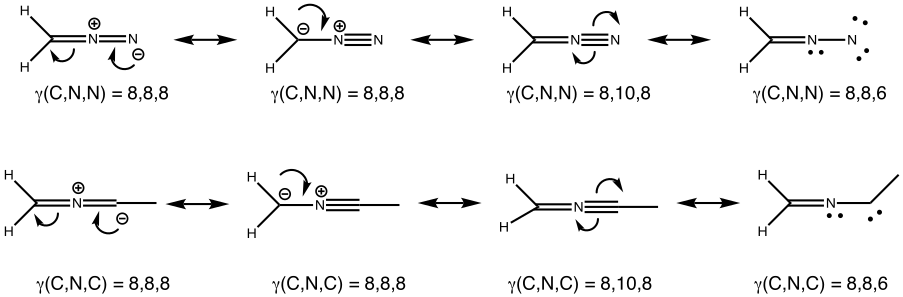
    I have expanded the resonance forms of diazomethane by one structure from those shown in the previous two posts (a form by the way not considered in the original article[cite]10.1039/C5SC02076J[/cite]) to include a nitrene. This takes us back to an earlier suggestion on this blog that HC≡S≡CH is not a stable species but a higher order saddle point which distorts down to a bis-carbene, together with the suggestion that hypervalent triple bonds have the option of converting four of the six electrons into two carbene lone pairs, replacing the triple bond with a single bond. This in turn harks back to G. N. Lewis’ 101 year old idea for acetylene itself!

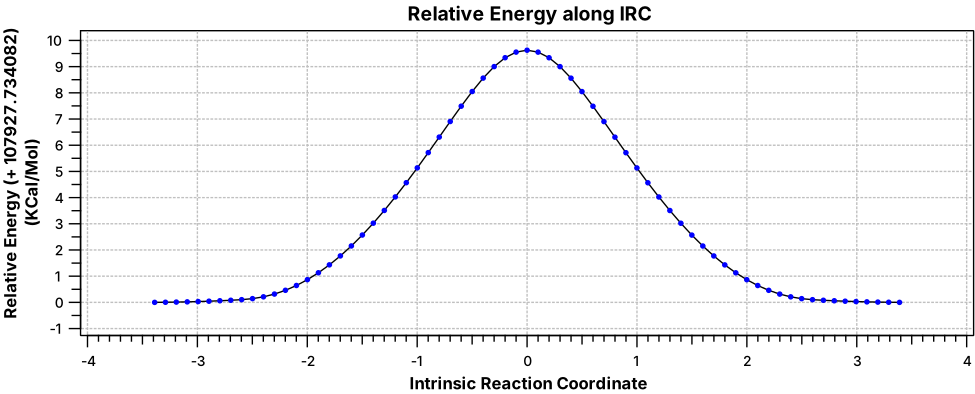
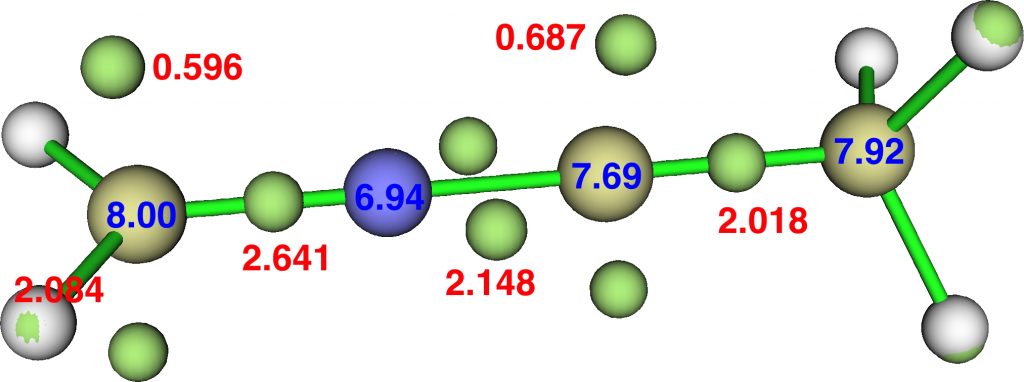
    To explore this mode, I start by replacing the terminal ≡N in diazomethane with a ≡C-Me group, which cannot absorb electrons into lone-pairs in the manner that nitrogen can. A ωB97XD/Def2-TZVPP calculation reveals that the linear form is a transition state for interconversion into a carbene. The IRC for the process (below) shows this carbene is ~10 kcal/mol lower than the linear “hypervalent” form. 

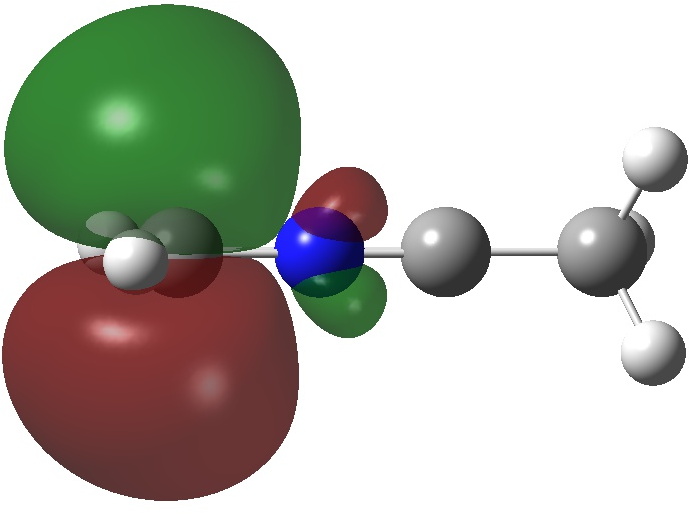
    NBO analysis of this transition state reveals a similar orbital pattern to diazomethane itself, including a non-bonding orbital on the H2C carbon. The Wiberg carbon bond indices are 3.6764 and N 3.6454 and the bond orders C=N 1.1390 and N=CMe 1.6192.

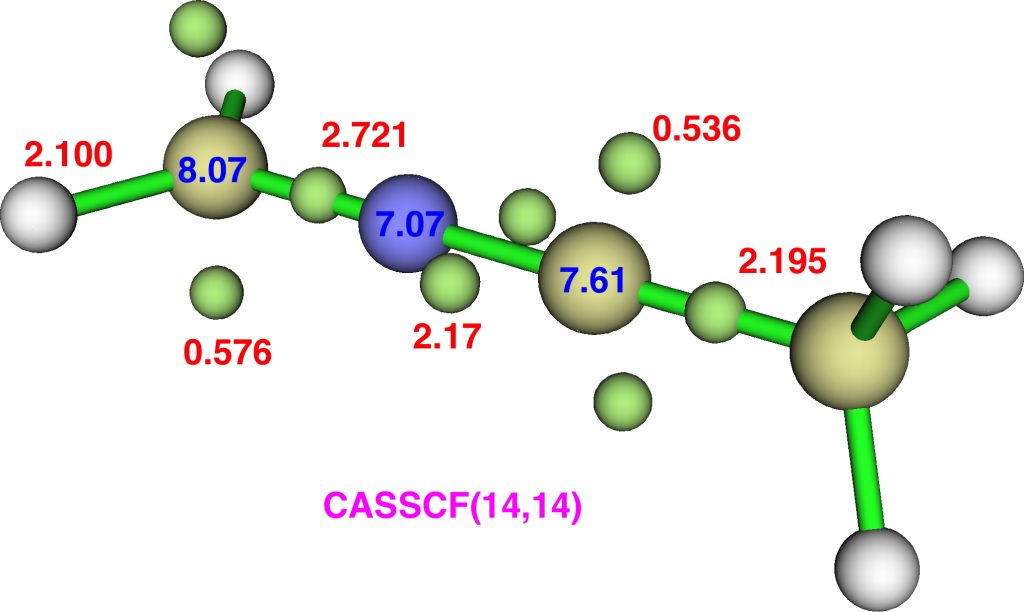
    ELF analysis of this transition state reveals the presence of two non-bonding pairs on the carbon atoms either side of the nitrogen but unshared with it, with populations of 1.19e and 1.37e (DFT). That nitrogen really does not like excess electrons! The four atoms C,N,C,C have ELF valence basins totalling 8.00, 6.94, 7.69 and 7.92e (DFT) or 8.07, 7.07 and 7.61e (CASSCF), suggesting that unlike diazomethane itself, the octet-excess induced hypervalence on carbon is slightly decreased.

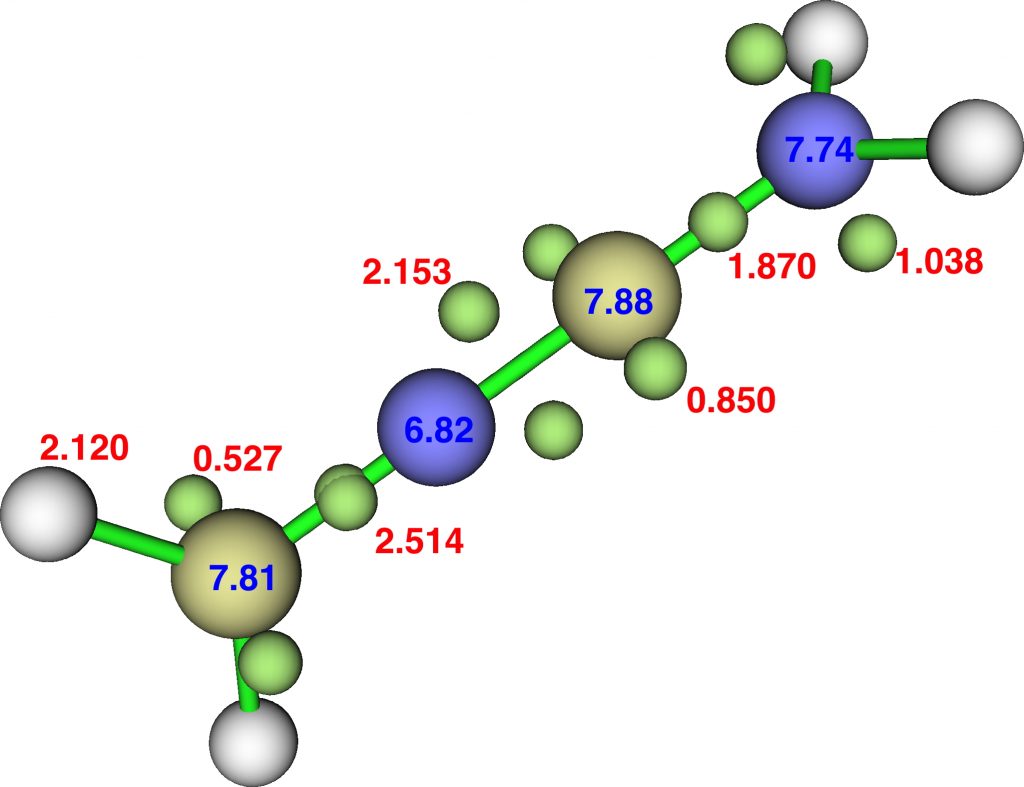
    Pumping even more electrons in by replacing the ≡C-Me group with ≡C-NH2 does not increase any hypervalence, but does induce more electrons to reside in “lone pairs”. Of the four atoms along the chain, three have “lone pairs” associated with them, a total of 4.83e that do not contribute to bonds (valence).

    An electron withdrawing ≡C-CN group replacing the ≡C-NH2 reverses the effect of the latter, but this linear species is still a transition state for carbon isomerisation:

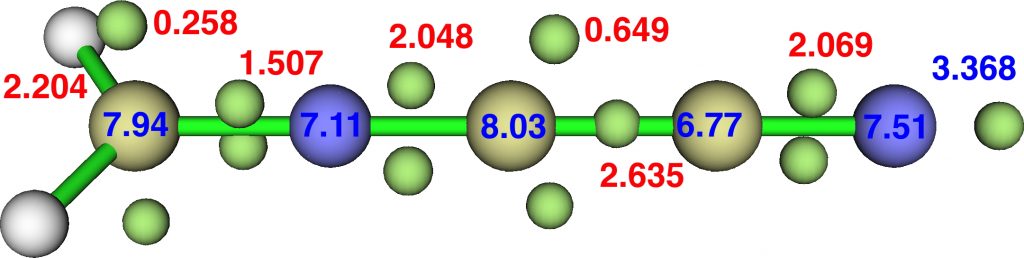
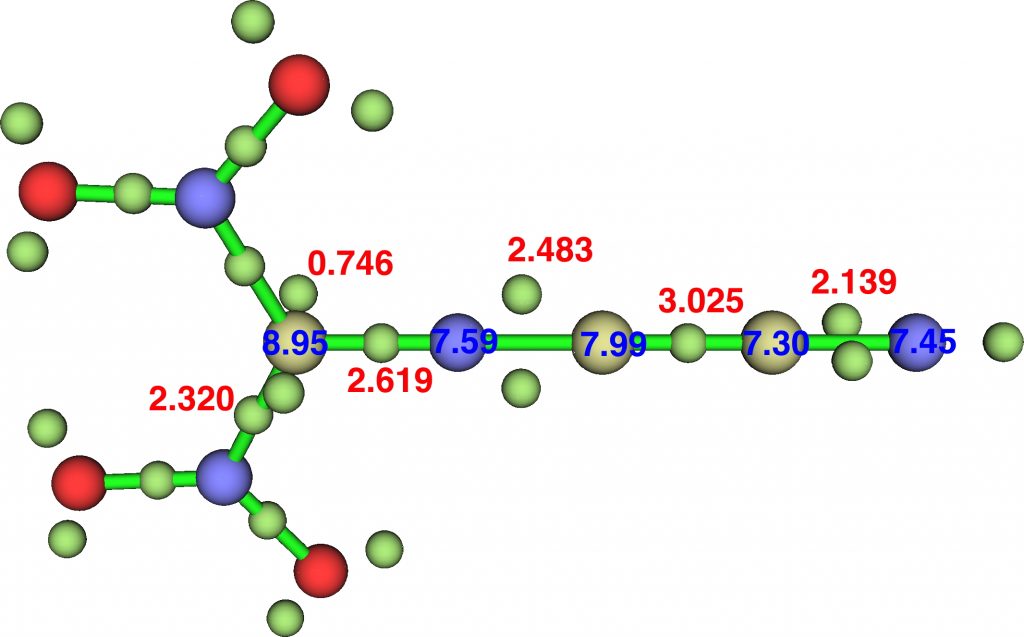
    Finally, combining all we have learnt by adding in nitro groups on the first carbon. This is no longer a transition state but now a stable species; the sum of the ELF basin integrations around the carbon on the left reaches 8.95e, slightly higher than the dinitro-diazomethane discussed in the previous post. The numerical Wiberg atom bond indices are C 3.8713, N 3.6898, C 3.8503, C 3.9958 and N 3.0288 for the atoms along the chain, with the first nitrogen the “least-valent”.

    So we see that “hypervalence”, or at least “octet-excess”, which is not exactly the same as hypervalence since it includes contributions from non-bonding electrons, is balanced on a knife-edge. Trying to increase the octet-excess by pumping electrons in turns the system into a transition state for carbene formation. Octet-excess is seen as a metastable property, to be relieved by geometric distortions where possible or localization of electrons into non-bonding lone pairs. And I remind yet again that no evidence has manifested in calculations of the molecules above that the central nitrogen of these diazomethane-like systems has any propensity for octet or valence-excess as implied by the formula C=N≡X.[cite]10.1039/C5SC02076J[/cite]


    FAIR data for all calculations is available at DOI: 10.14469/hpc/3476

  • Can any hypervalence in diazomethanes be amplified?

    In the previous post, I referred to a recently published review on hypervalency[cite]10.1039/C5SC02076J[/cite] which introduced a very simple way (the valence electron equivalent γ) of quantifying the effect. Diazomethane was cited as one example of a small molecule exhibiting hypervalency (on nitrogen) by this measure. Here I explore the effect of substituting diazomethane with cyano and nitro groups.

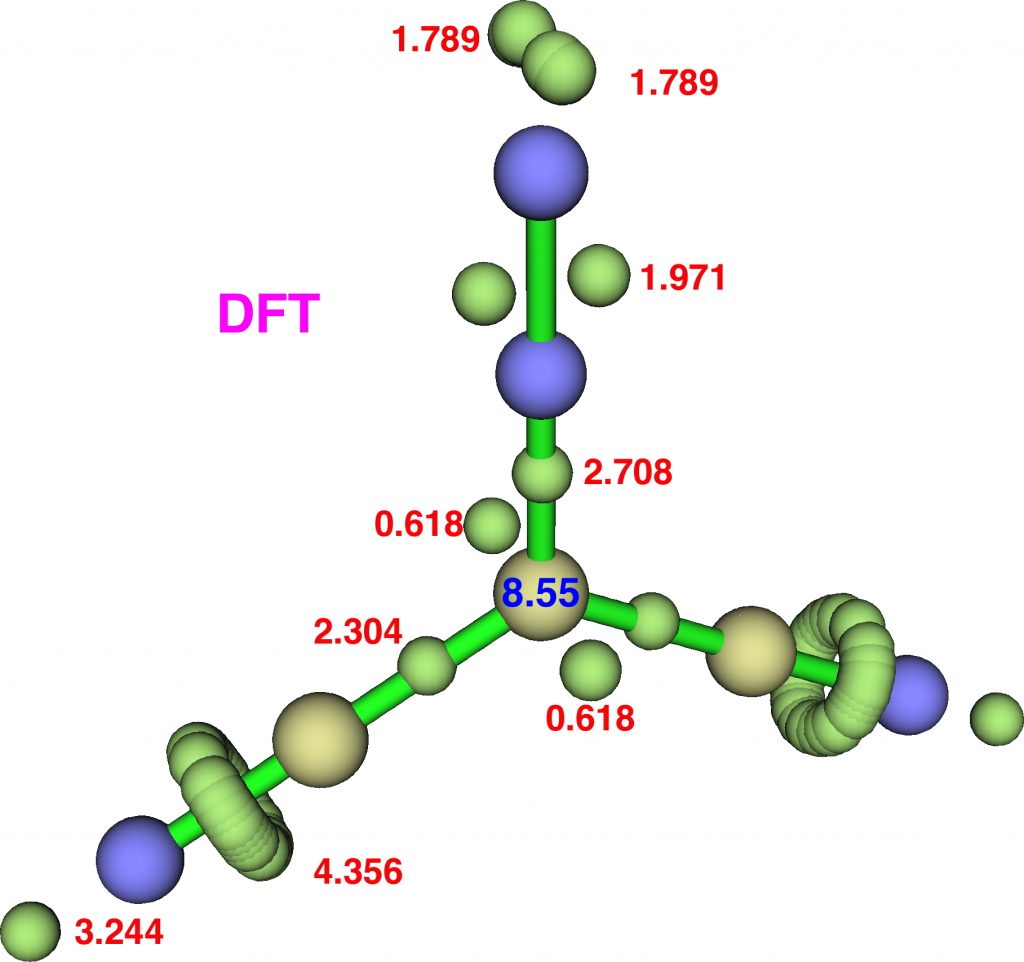
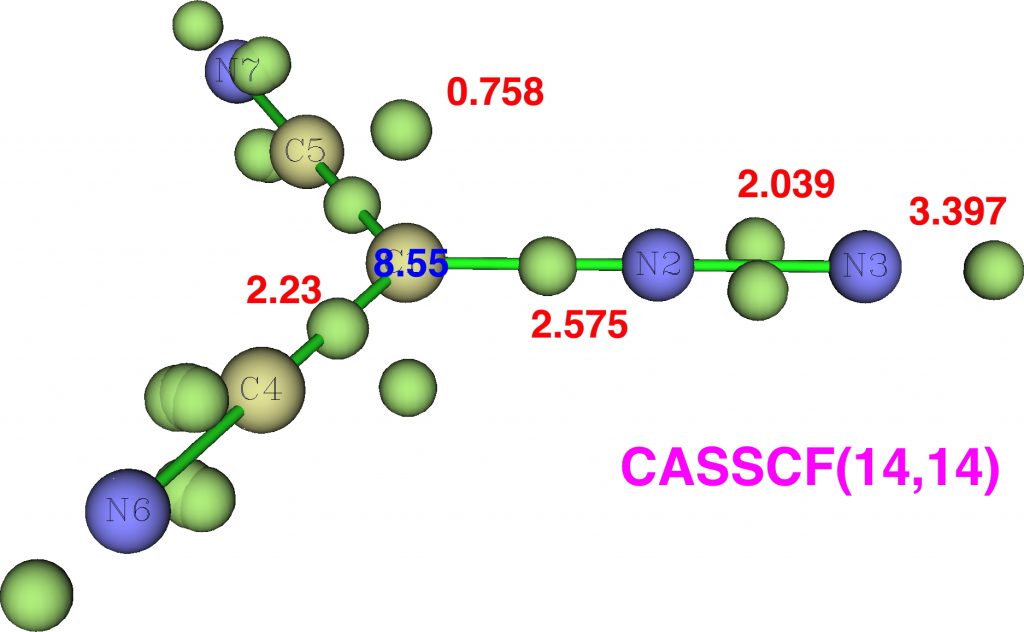
    Firstly, dicyanodiazomethane. NBO analysis reveals the following atom bond indices; C, 3.810; N 3.834; N 2.971. Compare these values to diazomethane itself, C, 3.716; N 3.802; N 2.907 and you can see that the carbon bond index has increased slightly. The ELF basin integrations (below) which also take into account the “lone pair” on carbon are: C, 8.55, N, 6.65, N, 7.52 (DFT), again compared with diazomethane as C, 8.16; N, 6.59; N, 7.52. The CASSCF(14,14) result is very similar.

    So the “γ(C)” has increased from 8.2 to 8.55. Next, dinitrodiazomethane;

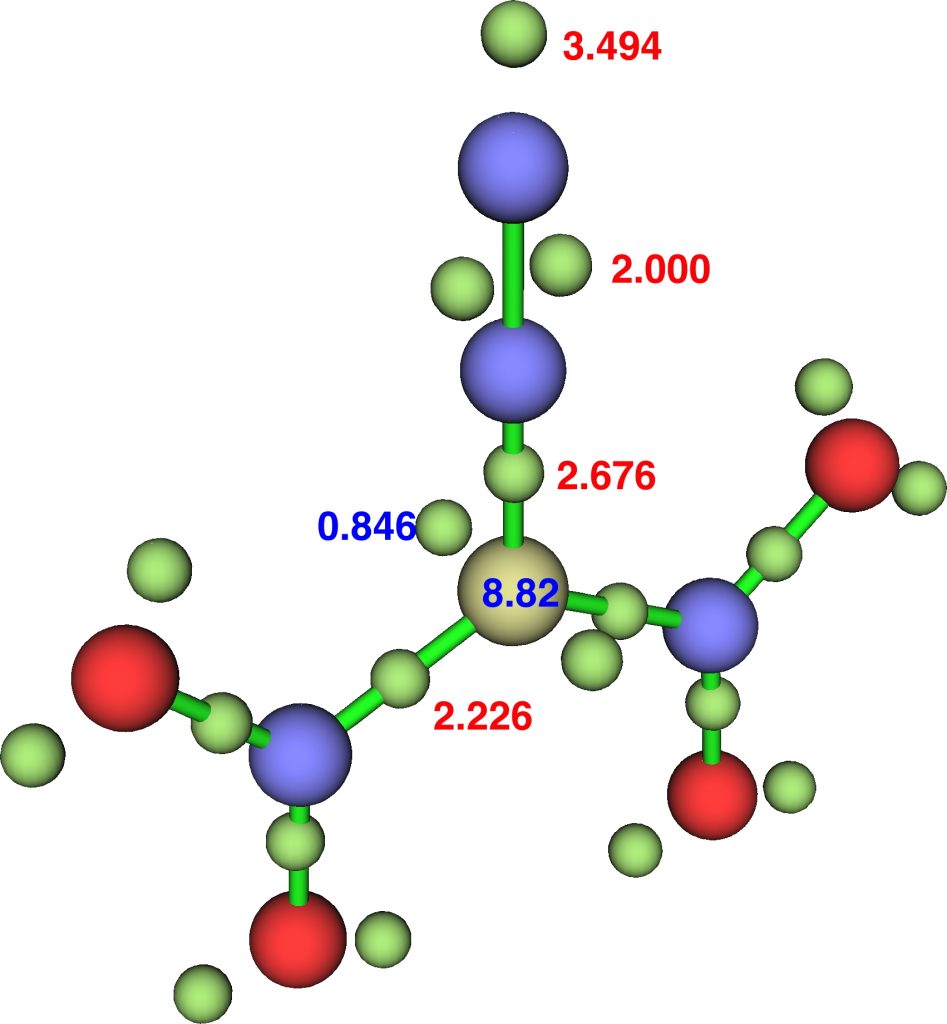
    The NBO bond indices are C, 3.8203; N 3.8255; N 2.9802 and ELF integrations C, 8.82, N, 6.68, N, 7.49 (DFT).

    So “γ(C)”  increases along the series 8.16 → 8.55 → 8.82, whereas “γ(N)” changes as 6.59 → 6.65 → 6.68, a smaller effect. Whilst 8.82 is still some way off the value of γ(N)=10 quoted[cite]10.1039/C5SC02076J[/cite] for diazomethane, dinitrodiazomethane is still a pretty good candidate for hypervalent carbon. The question now is whether even larger values of “γ(C)” can be identified in other molecules. 


    FAIR data for all calculations is available at DOI: 10.14469/hpc/3476. The quotes in “γ(C)” indicate it is calculated here using ELF integrations rather than charge maps.

  • Hypervalence revisited. The odd case of hexamethyl selenium.

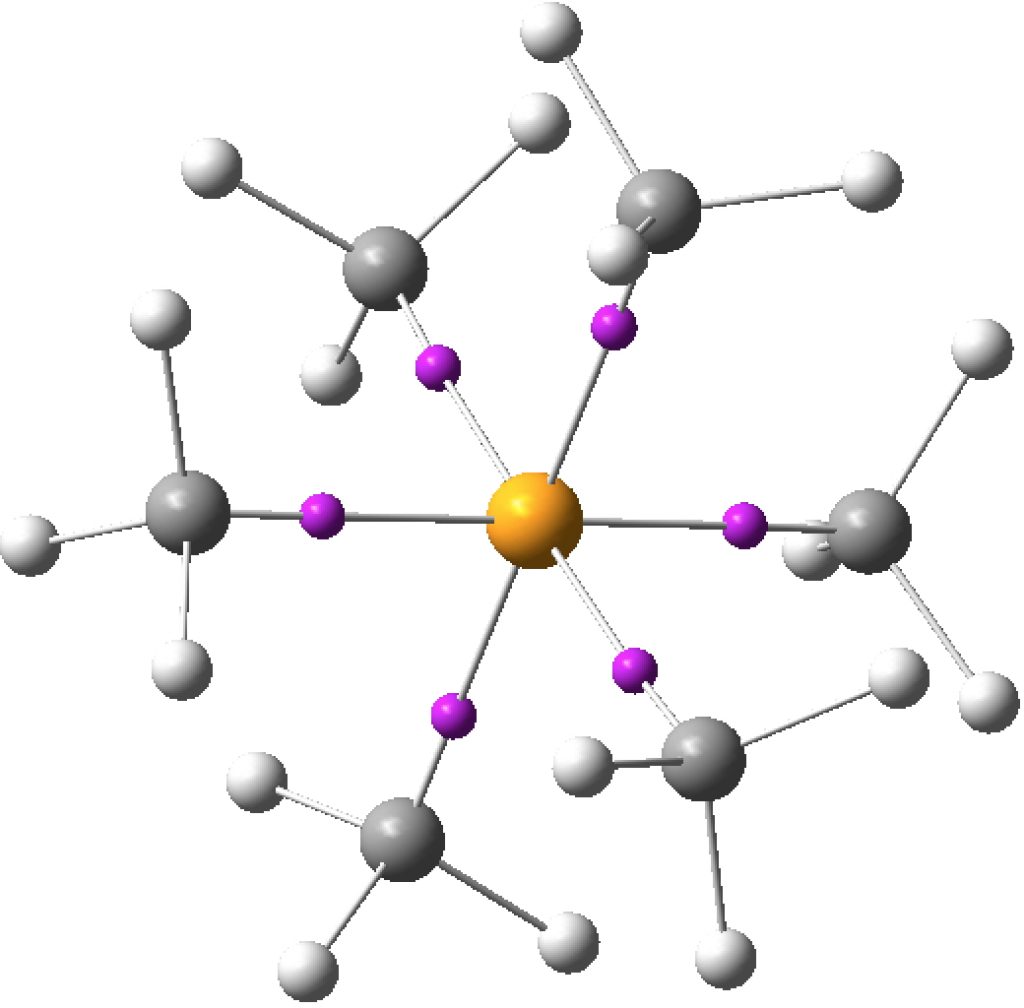
    One thread that runs through this blog is that of hypervalency. It was therefore nice to come across a recent review of the concept[cite]10.1039/c5sc02076j[/cite] which revisits the topic, and where a helpful summary is given of the evolving meanings over time of the term hypervalent. The key phrase “it soon became clear that the two principles of the 2-centre-2-electron bond and the octet rule were sometimes in conflict” succinctly summarises the issue. Two molecules that are discussed in this review caught my eye, CLi6 and SeMe6. The former is stated as “anomalous in terms of the Lewis model“, but as I have shown in an earlier post, the carbon is in fact not anomalous in a Lewis sense because of a large degree of Li-Li bonding. When this is taken into account, the Lewis model of the carbon becomes more “normal”. Here I take a look at the other cited molecule, SeMe6.

    I should start by summarising what I think are two fundamental ways in which electrons can be added to the valence shell of a main group element.

    • If an s/p basis only is used for the (main group) valence shell, then once eight electrons have populated the four bonding molecular orbitals constructed from this basis, additional electrons can then go into the four antibonding orbitals. This simple concept is often taught as an explanation for why the bond orders across the range N≡N, O=O, F-F and Ne…Ne decrease regularly (in fact one could also add CC to the left of this series, which is thought to have a weak quadruple bond). The Lewis octet is maintained throughout.
    • The second fundamental possibility is to expand the valence shell basis set to s/p/d or s/s/p/p (the second s or p-shell is the Rydberg level, i.e. 3s for carbon) or even s/s/p/p/d. That would be a true Lewis octet expansion, which depends on identifying significant Rydberg occupancy. This latter is in fact very rare, and few examples have been conclusively identified. One such as been discussed on this blog  and more examples were presented at the Aachen bond Slam in September 2017. Unlike the first mechanism (which reduces bond orders), this one actually increases bond orders and any bonds where the atomic orbital contributions have a significant Rydberg component can be considered as “Hyperbonds“.

    One can then address the issue of hypervalency (and any octet expansion) by analysing the basis set contributions of the orbitals. These orbitals can be either canonical molecular orbitals or localised (NBO) orbitals. If a single determinant wavefunction is appropriate, then the orbitals would be doubly occupied (for closed shell species). If the molecule has multi-reference character, then of course fractional electron occupancy of these orbitals may be required (as would e.g. be the case for ozone, O3, another molecule asserted in the review as hypervalent[cite]10.1039/c5sc02076j[/cite]).

    There are other ways of analysing the wavefunction. The one discussed at length in the review[cite]10.1039/c5sc02076j[/cite] is from an atomic charge map, but also mentioned is an ELF partitioning. This derives not from an orbital population but from the distribution of a function (ELF) calculated from the electron density itself. It was this latter method that was cited for SeMe6. The ELF method partitions electrons into so-called basins, which can be monosynaptic (lone pairs and ionic bonds), disynaptic (covalent bonds) and more rarely trisynaptic (3-centre bonds). Using this analysis, six disynaptic octahedrally-arranged ELF basins were located for  SeMe (“in which the Se–C bonds are relatively non-polar, can have electron populations exceeding 8 at the central atom”[cite]10.1039/c5sc02076j[/cite]) and for which the total integration cames to 11.34e (FAIR Data DOI for this calculation can be see at 10.14469/hpc/3219).

    The key phrase is “non-polar”, since the Lewis concept relates to shared electron pair or covalent hypervalency. It was this aspect that I focused on seven years back in looking at whether e.g. IF7 was hypervalent (along with I(CN)7). These were too ionic to reveal disynaptic covalent ELF basins. So in an effort to reduce the polarity, I tried II7 and At.At7, on the grounds that these homonuclear molecules might be less polar. The seven I-I or At-At ELF disynaptic basins integrated to totals of 6.55 and 6.47e respectively; there was no evidence of “octet expansion” for either central halogen. Instead of course, the six electrons in the octet-excess needed to create seven I-I bonds actually populate I-I antibonding orbitals, as per method 1 above. Accordingly the I-I bond orders reduce from 1.0 to e.g. 0.47 for the axial substituents and 0.37 for the five equatorial groups.
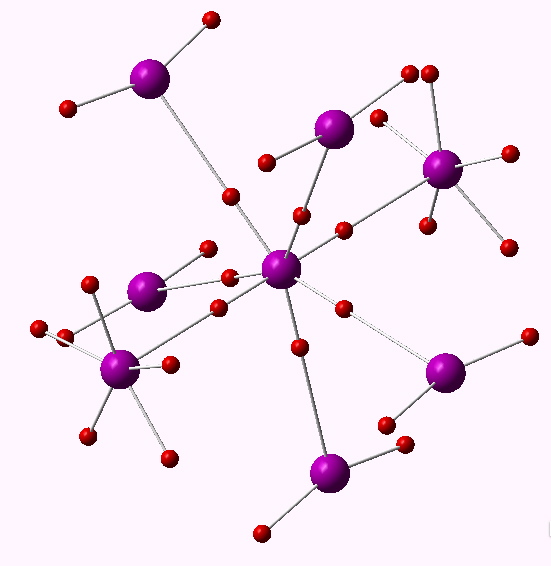
    One interesting property of the centroid of the ELF basins is that you can infer the polarity of the bond from its position along the bond axis. For II7, the centroids are displaced towards the central iodine, indicating it is more electronegative, and away from the terminal iodine, indicating it is the electropositive partner. I mention this since the ELF basins for SeMe6 show the centroids to be strongly displaced towards the carbon and away from the Se (0.38/0.62), indicating that this molecule is in fact polar and NOT non-polar as was asserted. 

    To follow-up this latter observation, I did an NBO analysis of the wavefunction for SeMe6 (FAIR Data DOI: 10.14469/hpc/3220). This reveals the following properties.

    • Se populations: [core]4S( 1.30)4p( 3.04)4d( 0.06)5p( 0.01) of which Rydberg = 0.06516, natural charge on Se, 1.60224
    • C populations:  [core]2S( 1.20)2p( 3.65)3S( 0.01)3p( 0.01) of which Rydberg = 0.01838, natural charge on C -0.86670
    • H populations:  1S( 0.80)
    • Total Rydberg population: 0.20556
    • Wiberg Se-C bond orders:  0.6689
    • Wiberg bond indices:  Se 4.0431, C 3.8252,  H 0.9621

    So according to this orbital-based analysis, SeMe6 is in effect a partially ionic compound with no evidence of significant Rydberg occupancies and hence no evidence of any octet expansion at Se. Thus we see two different interpretations emerging, depending on the analytical method used:

    1. SeMeis a polar molecule with no hypervalent attributes as judged using orbital analysis.
    2. As a polar molecule, it has six methyl carbanion-like substituents in which the carbon “lone pairs” all point towards the Se, manifesting as disynaptic ELF basins and indicating a total valence-basin octet-expanded population of 11.34e at Se. Even though this octet expansion originates mostly from the carbon atomic orbitals, the disynaptic nature of these valence basins means that the Se could indeed be defined as hypervalent.

    Well, SeMe6 has turned out to be rather less clear-cut than implied by the assertion “in which the Se–C bonds are relatively non-polar”. There are however possible modifications to SeMe6 that might yet make it less polar. These may be the subject of a follow-up post.

  • The di-anion of dilithium (not the Star Trek variety): Another “Hyper-bond”?

    Early in 2011, I wrote about how the diatomic molecule Be2 might be persuaded to improve upon its normal unbound state (bond order ~zero) by a double electronic excitation to a strongly bound species. I yesterday updated this post with further suggestions and one of these inspired this follow-up.

    The standard molecular orbital diagram for Be2 below shows two electrons in both the 2s Σg and Σu levels, the first being considered bonding and the second antibonding. By exciting the two electrons from the Σu into the Πu MO to form a triplet, one converts one antibonding occupancy into two bonding occupancies, in the process changing the total formal bond order from zero to two.


    The triplet excited state of diberyllium

    You can see the results of my playing with these ideas both in my appended comments to the original post and the table below. This shows that the calculated bond order for the excited triplet state of Be2 is actually closer to 1.50 rather than to two, but definitely not zero!

    System Wiberg bond order Bond length FAIR Data
    Be2 singlet 0.15 2.805 10.14469/hpc/3082
    Be2 excited triplet 1.50 1.785 10.14469/hpc/3075
    Be22+ 1.00 2.135 10.14469/hpc/3076
    Be22- triplet 0.89 2.242 10.14469/hpc/3074
    Be22- excited singlet 3.00 1.817 10.14469/hpc/3083

    The games above represent isoelectronic substitutions and here I try one more, namely that Li22- is isoelectronic with Be2. Unlike the latter, there is no need to force an electronic excitation (ωB97XD/Def2-QZVPPD/SCRF=water) to achieve the required occupancies with Li22-.

    System Wiberg bond order Bond length FAIR Data
    Li22- triplet 1.501 2.381 10.14469/hpc/3087

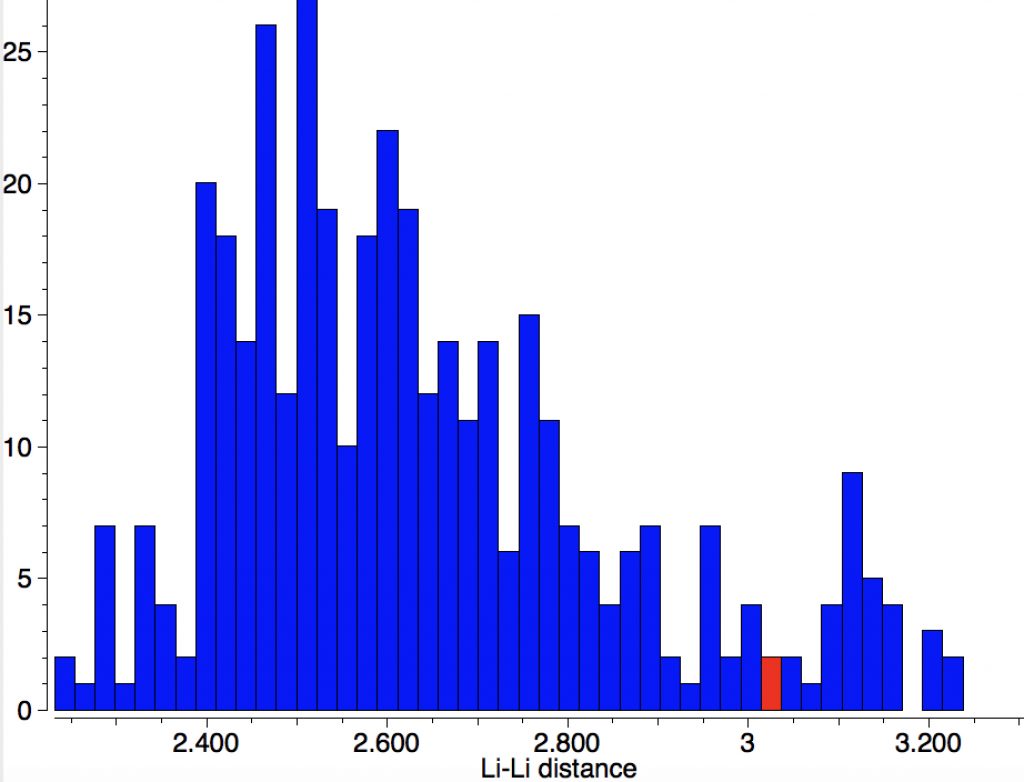
    I also checked what crystal structures could tell us about Li-Li bonds and it seems 2.38Å is about as short as they get.

    At this point, the NBO analysis of the Li22- localised orbitals alerted me to another feature, which is that the Rydberg occupancy amounted to 2.18e. This in turn reminded me of the previous post which dealt with such occupancy in another small molecule, CH3F2-, but here the Rydberg occupancy involved the 3s/3p AOs of the carbon and the fluorine. With Li22- triplet, it is of the lithium 2p AO (2.18e) and only a tiny occupancy of 3d (0.03). By definition, for alkali metals such as Li the normal valence shell is just 2s, whereas 2p occupancy is considered a Rydberg state; a hypervalent state if you will. So Li22- triplet has a Li-Li hyper-bond! Of course, by this definition most Li compounds are then hypervalent, since many have populated 2p shells.

    Even if use of the term hyper-bond to describe Li22- triplet is rather artificial, this example does reveal the games one can play with the first row elements Li-B (see table above). Given that most introductory text books on bonding normally only explain the diatomics formed from N-Ne (occasionally including C), I might suggest that these earlier elements are equally instructive and fun to play with.


    This species is 36.0 kcal/mol higher in free energy than two separated Li anions.

  • First, hexacoordinate carbon – now pentacoordinate nitrogen?

    A few years back I followed a train of thought here which ended with hexacoordinate carbon, then a hypothesis rather than a demonstrated reality. That reality was recently confirmed via a crystal structure, DOI:10.5517/CCDC.CSD.CC1M71QM[cite]10.1002/anie.201608795[/cite]. Here is a similar proposal for penta-coordinate nitrogen.

    First, a search of the CSD (Cambridge structure database) for such nitrogen. There are only three hits[cite]10.1039/A700132K[/cite], [cite]10.1002/zaac.19946200711[/cite], [cite]10.1021/ic00127a034[/cite] all of which relate to RN bonded to four borons as part of a boron cage. There are none which relate to RN bonded to four carbon atoms. 

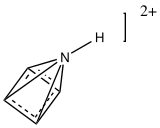
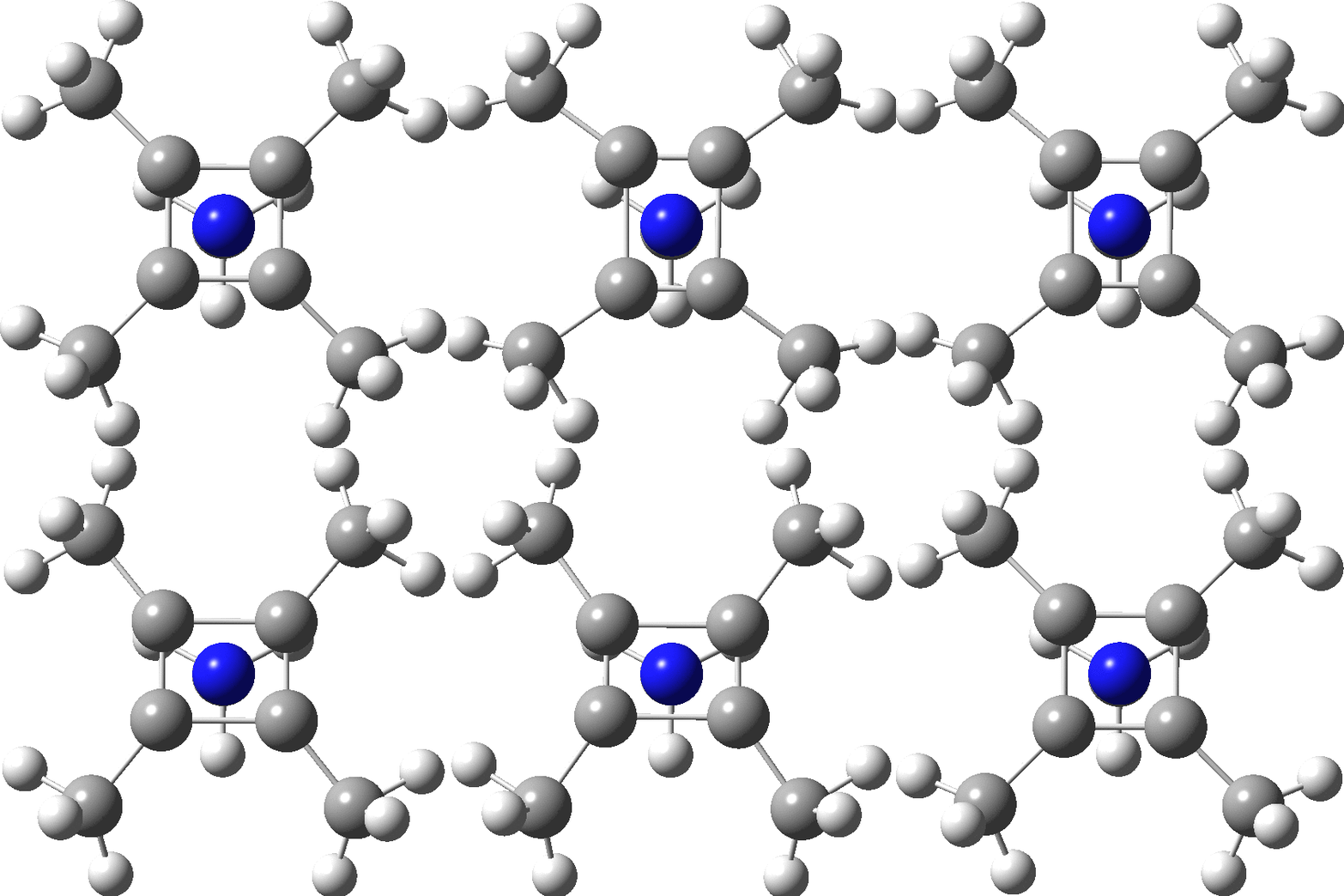
    The original argument was based on cyclopentadienyl anion and its symmetric coordination to RC3+ to achieve six coordination for one carbon. Morphing C to the iso-electronic Ngets one to the ligand RN4+ and this can now be coordinated to the di-anion of cyclobutadiene, also iso-electronic in the 6π sense to cyclopentadienyl mono-anion.

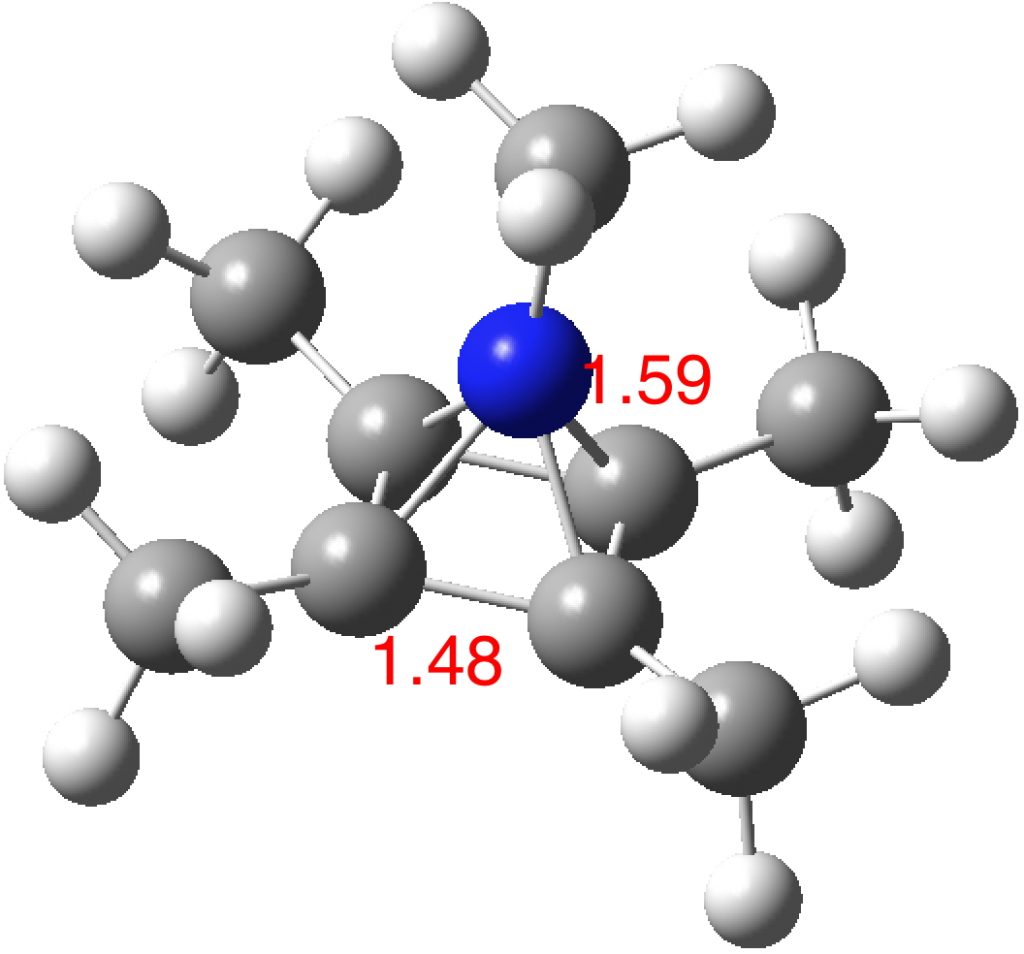
    The optimised structure of the methylated system (ωB97XD/Def2-TZVPP) as shown below (DOI: 10.14469/hpc/2348) is a true minimum and reveals a 5-coordinate nitrogen. It is the dication of an isomer of pentamethyl pyrrole.

    One of the normal modes for this molecule is the so-called Kekule vibration, which elongates two C-C bonds and shortens the other two. The value (1266 cm-1) is typical of aromatic systems.

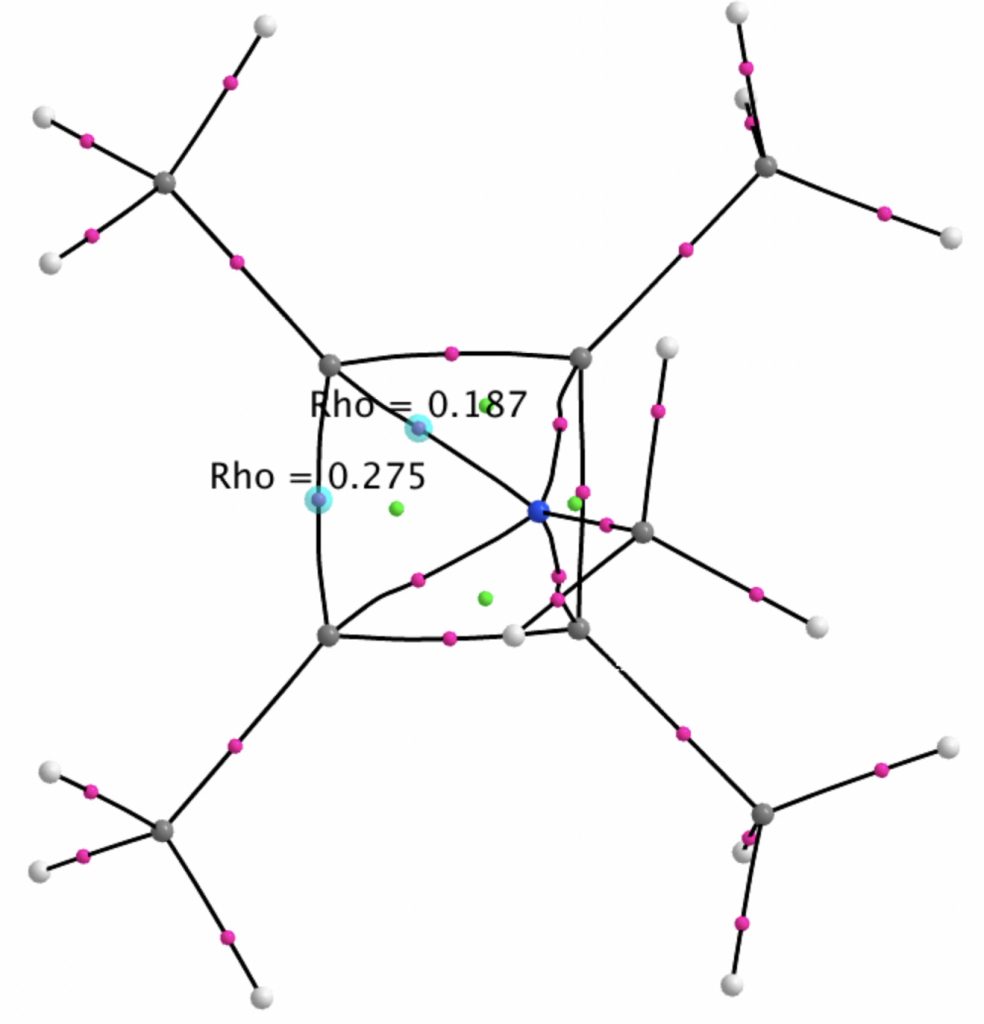
    A QTAIM analysis shows four line (bond) critical points (LCP, magenta) connecting the 4-carbon base of the system and four further LCPs connecting each carbon to the nitrogen. Significantly, the four carbons are not themselves characterised by a ring critical point (RCP, green), these being confined to the rings formed between two carbons and the nitrogen. The value of the electron density ρ(r) at the basal bond is typical of a single bond; the value to the nitrogen indicates the bond has a smaller order.

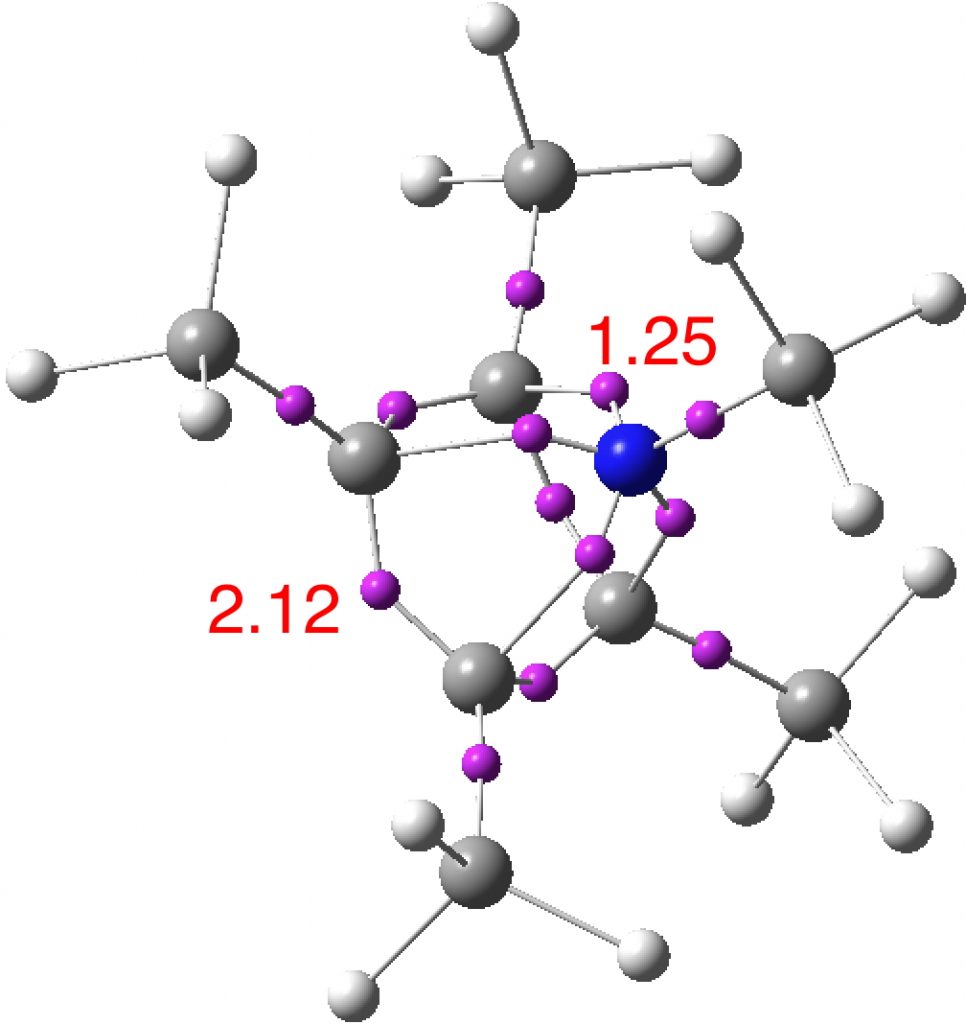
    An ELF (electron localisation function) analysis is similar, showing basal C-C electron basins of 2.12e and C-N basins of 1.25e.

    In hunting for examples of hyper-coordination in the second row of the periodic table, the focus has tended largely towards identifying carbon examples. Perhaps that might now right-shift to the adjacent element nitrogen?

  • How does methane invert (its configuration)?

    This is a spin-off from the table I constructed here for further chemical examples of the classical/non-classical norbornyl cation conundrum. One possible entry would include the transition state for inversion of methane via a square planar geometry as compared with e.g. NiH4 for which the square planar motif is its minimum. So is square planar methane a true transition state for inversion (of configuration) of carbon?

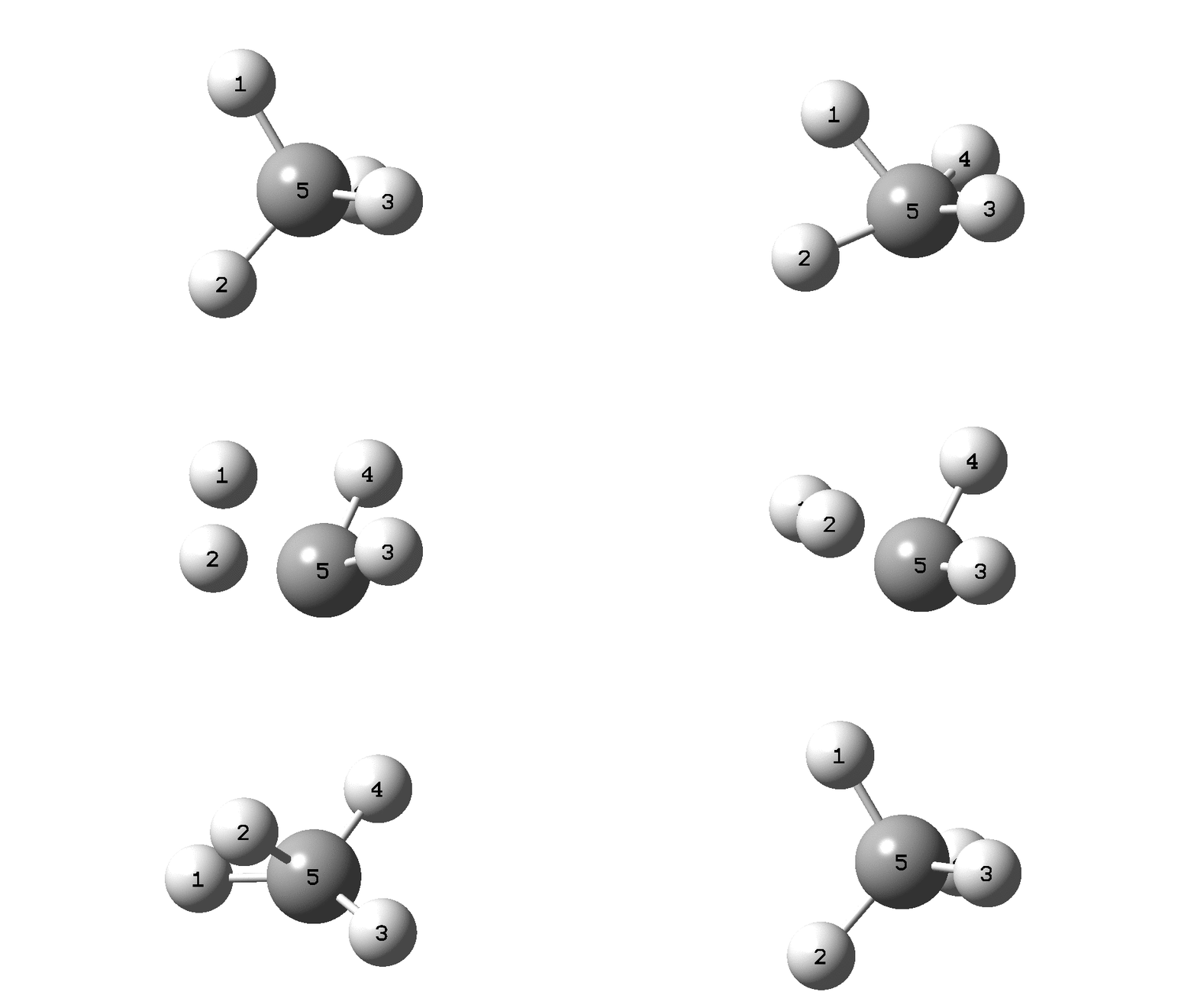
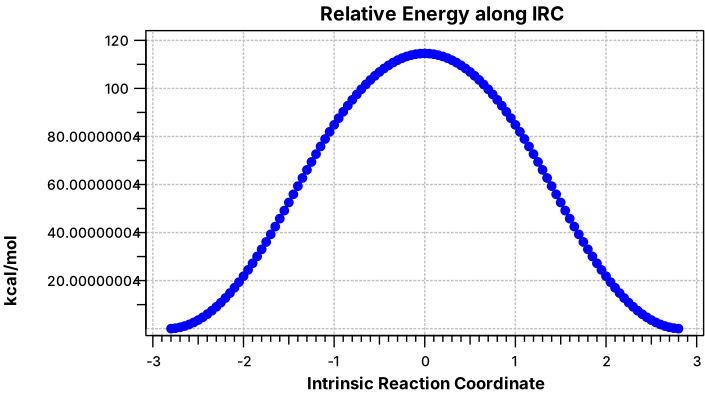
    The history of this topic is nicely told as far back as 1993[cite]10.1021/ja00069a056[/cite], when square planar methane was shown to be a 4th-order saddle point (i.e. four negative force constants) and not the first order one required of a transition state. A true transition state was located, and here I show it as part of an animated IRC (intrinsic reaction coordinate). Go to DOI: 10.14469/hpc/2288 for the calculation outputs.

    To convince yourself that the configuration really does invert, focus on the CIP rule. With atom 1 pointing behind, atoms 2 → 3  → 4 rotate in a clockwise direction. Now focus on the final point at the end of the IRC, when 2 → 3  → 4 rotate anti-clockwise. The configuration has inverted! The barrier as can be seen below is ~118 kcal/mol. At this value the half-life for the process would be far longer than the age of the universe.

    The process can be described as an interesting variation on pseudorotation, for which the classic example is of course PF5. Alternatively it can be thought of as the partial extrusion of H2 to give carbene, followed by re-addition of the H2 to reform methane. Partial because the extrusion is never fully achieved.

    I have to say I did not expect anything quite so interesting to be associated with methane;  one can learn from the simplest of molecules!


    It was not entirely trivial to recover appropriate coordinates for recomputing this TS from the article. But it is in fact an easy one to find from scratch. Hopefully with the files at 10.14469/hpc/2288 to help, this will not be an issue here.

    There are many kinds of pseudo-rotations. For others see here.[cite]10.1021/ic0519988[/cite] and [cite]10.1021/ic062473y[/cite]

  • The smallest C-C-C angle?

    Is asking a question such as “what is the smallest angle subtended at a chain of three connected 4-coordinate carbon atoms” just seeking another chemical record, or could it unearth interesting chemistry?

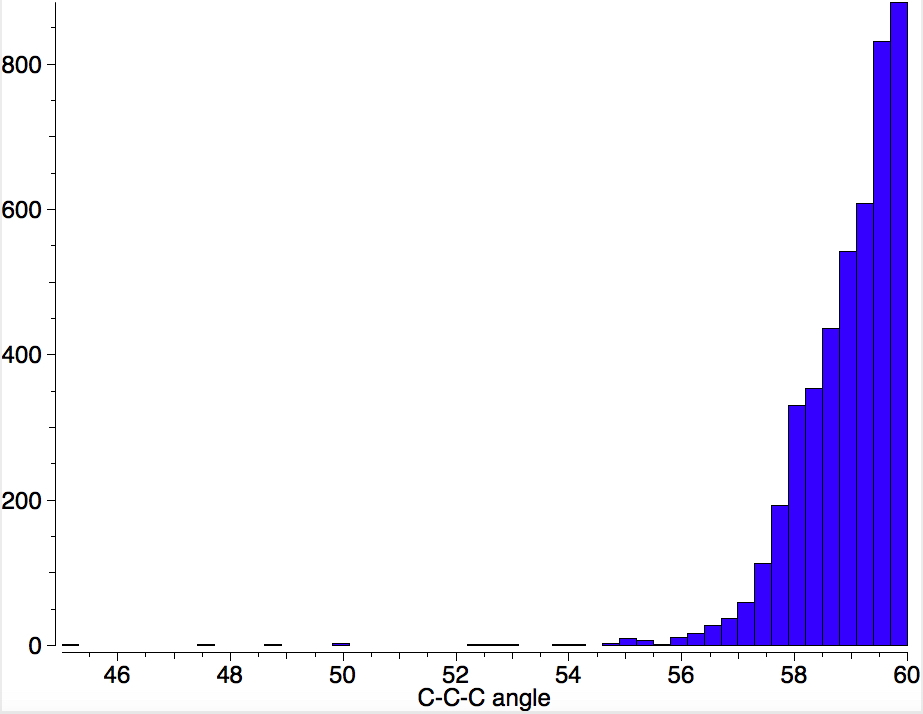
    A simple search of the Cambridge structure database for a chain of three carbons, each bearing four substituents (sp3 hybridized in normal paralance) reveals the following distribution:

    ccc

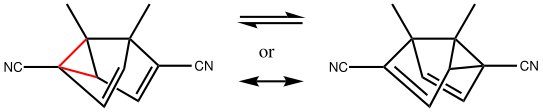
    The value 60° is of course a three-membered cyclopropane ring. The tail of the distribution is very small, and there are a few small outliers with values of < 54°. Most of the time such outliers are in fact simple errors, but here we see that they are in fact semibullvalenes, of the type shown below, with the small angle subtended at the central of the three carbon atoms coloured in red.

    cazfue

    In this diagram I have added my own semantic interpretation of what is going on. Let me itemise this:

    • These molecules can undergo very rapid [3,3] sigmatropic rearrangements, shifting a σ-bond away from the 3-ring to create another such ring.
    • This process elongates one of the C-C bonds and of neccessity this reduces the angle at the associated carbon.
    • I have drawn two types of arrow connecting the two structures. The first is an equilibrium arrow, which implies a transition state connecting the two species. This transition state will have equal bond lengths for the forming/breaking C-C bond, and the transition state will have a rate constant which is slower than the time taken for one molecular vibration (~10-15s)
    • It is also possible however that the second arrow is the correct one, and this implies an electronic resonance rather than a nuclear motion. This would have a rate constant comensurate with electron dynamics (~10-18 s) rather than nuclear vibrations.

    What does x-ray crystallography measure? Well the diffraction of photons by electrons. In order to obtain a diffraction pattern, enough photons have to be diffracted to be measured, and even with most modern instruments this still takes minutes or hours. During this period, all the various nuclear positions encountered as a result of vibrations or equilibria are sampled. So if the rate constant for the [3,3] sigmatropic rearrangement is fast, x-ray diffraction will measure the average of the two sets of nuclear positions, which can be distinguished only with some difficulty (if at all) from the structure implied instead by electronic resonance.

    If the equilibrium arrow applies, then the small angles of <54° are merely the average of the normal value for a 3-membered ring and a smaller value for a structure where one of the C-C bonds has been removed. In my opening sentence, I noted that the three carbon carbon atoms had to be connected in a chain. This is no longer true; the goalposts have been moved (a lot)!

    If its an electron resonance, then the three carbon atoms are still connected, albeit one of the two C-C bonds is no longer a single bond but rather weaker and hence longer. The goalposts have merely been slightly shifted!

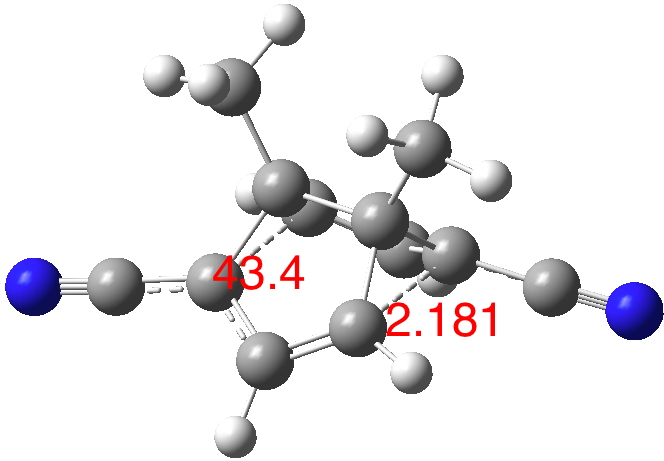
    A calculation (B3LYP/Def2-TZVPP+D3 dispersion, doi: 10.14469/hpc/1850, [cite]10.14469/hpc/1850[/cite]) of the structure KUZFUE [cite]10.1021/ja00186a064[/cite] shows the C2-symmetric species shown below, with an elongated C-C bond and hence a reduced C-C-C angle, as being a true minimum (a resonance) rather than a transition state (an equilibrium). The vibration which shortens one C-C bond and lengthens the other has the real calculated wavenumber 244 cm-1. But the boundary between the two possibilities (often referred to as the boundary between a single and a double minimum in a potential energy surface) is notoriously difficult to capture using calculations.

    cazfue

    How could experiment definitively settle the issue? Well, the SLAC beam is a unique instrument. Its source of X-rays is so intense that you can get an analysable diffraction pattern from a crystal on a timescale so short that during this period no nuclear motions occur (not even vibrations). Those nuclear positions capture the true equilibrium positions of the atoms in the molecule. Now, how does one get beam time on the SLAC?


    Click on the image above to see an animation of this normal mode. If you are running the macOS Safari browser, make sure Preferences/Security/Plug-in settings/Java has the site ch.ic.ac.uk or ch.imperial.ac.uk set to on. If you do not do this, the somewhat unhelpful message You do not have Java applets enabled in your web browser, or your browser is blocking this applet. will appear. Note also that new system installations might tend to switch these settings to off.

  • The geometries of 5-coordinate compounds of group 14 elements.

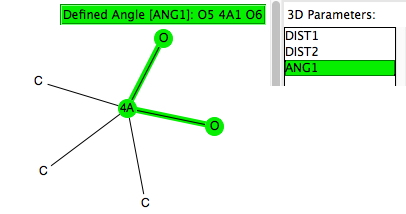
    This is a follow-up to one aspect of the previous two posts dealing with nucleophilic substitution reactions at silicon. Here I look at the geometries of 5-coordinate compounds containing as a central atom 4A = Si, Ge, Sn, Pb and of the specific formula C34AO2 with a trigonal bipyramidal geometry. This search arose because of a casual comment I made in the earlier post regarding possible cooperative effects between the two axial ligands (the ones with an angle of ~180 degrees subtended at silicon). Perhaps the geometries might expand upon this comment?

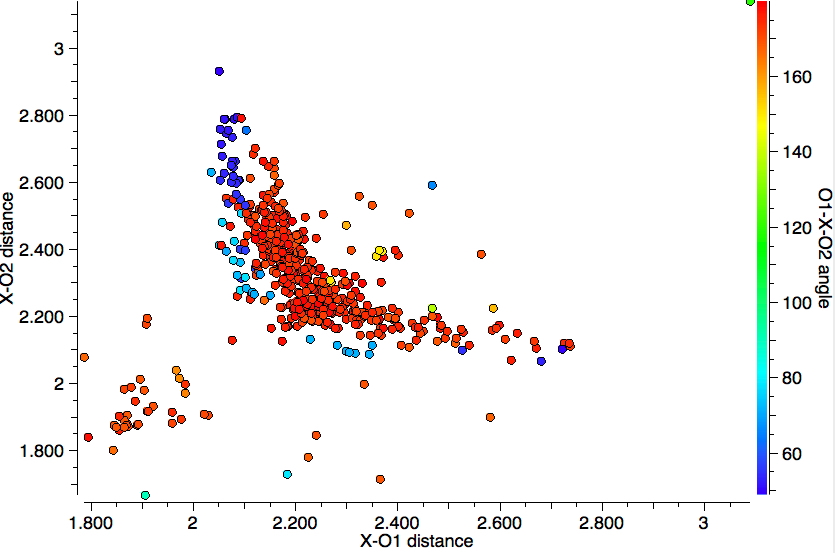
    The search query is shown above results in 394 hits (May 2016) and is presented with the three variables in the query plotted as below, with the O-4A-O angle indicated by colour (red ~ 180°; blue ~90° and green ~120°).

    1. The cluster at distances of 4A-O of ~1.9Å represents silicon compounds, and tends to suggest that the pair of distances 4A-O are quite similar in value. The angles correspond to a di-axial arrangement around the silicon. In this scenario, one might imagine a stereoelectronic effect similar to the anomeric effect when 4A = C operates and which has the potential to strengthen both di-axial oxygens.
    2. The bulk of the points come at higher 4A-O distances of > 2.1Å and consist mostly of 4A = Sn. There are two a clear-cut distributions, one for angles of ~180° and a separate one for angles of ~90° and both are qualitatively different from the Si distribution. The 180° set corresponds to a di-axial arrangement for the oxygens, whereas the 90° set suggests an axial-equatorial geometry. Both distributions have prominent tails which reveal that as one 4A-O distance shortens, the other lengthens, equivalent to asymmetric anomeric effects at  O-C-O.
    3. Noticeably absent are any green points; these would correspond to bond angles of ~120° and hence would correspond to di-equatorial ligands.

    This quick exploration (with potential variations that I have not explored above) can be added to the collection of "ten minute explorations" I have described elsewhere.[cite]10.1021/acs.jchemed.5b00346[/cite]