A staple of introductory undergraduate teaching in organic chemistry is Markovnikov’s rule, which states: “the addition of a protic acid HX to an alkene results in the acid hydrogen (H) becoming attached to the carbon with fewer alkyl substituents and the halide (X) group to the carbon with more alkyl substituents“. Shortly thereafter, students are exposed to the “anti-Markovnikov” addition of borane to e.g. 2-methylpropene. In order to achieve a consistent explanation for both reactions, I normally show students the following mechanism. Here I introduce a “reality check” to the first component of that mechanism (for the oxidative step, see this post).
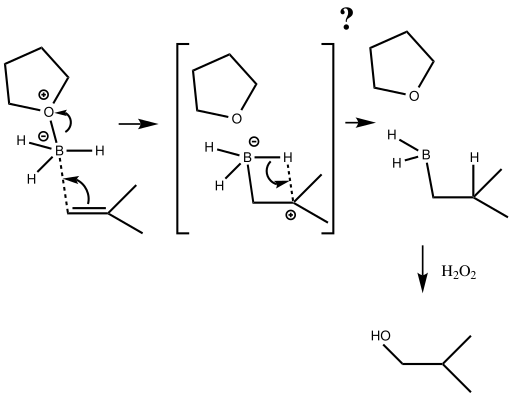
The premise of this mechanism is that electronically at least, both the Markovnikov and the anti-Markovnikov additions actually arise from the same effect, which is to produce predominantly the more highly substituted intermediate carbocation. So the issue now is whether this intermediate, as might be invoked above for hydroboration, is real or whether it is simply an expediency to enable students to recognise the single electronic origin of both types of reaction (? above). Enter the ωB97XD/6-311G(d,p)/SCRF=thf procedure. Firstly, I note that the reaction is normally done with “stabilized” borane, via pre-coordination to thf.
Starting from either Markovnikov or anti-Markovnikov orientations, only one transition state could be found[cite]10.6084/m9.figshare.949678[/cite], meaning that the anti-Markovnikov preference is determined entirely by this transition state. The exit trajectories can presumably lead to either product, but favouring anti-Markovnikov. The transition state shown here was also used by Singleton[cite]10.1021/ja807666d[/cite] for a molecular dynamics study of the hydroboration of propene with BH3.thf. There, dynamics were invoked to explain why 10% of the product goes Markovnikov.
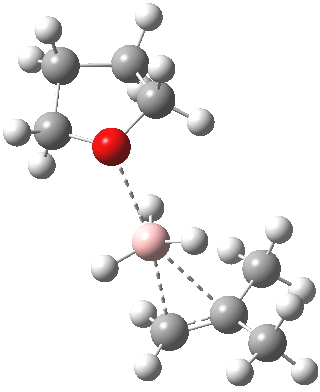
The reaction with thf clearly occurs in two stages.[cite]10.6084/m9.figshare.949689[/cite] The first stage subsumes the transition state and is an SN2 like nucleophilic displacement at boron by the alkene, liberating thf as the leaving group. The second stage reveals an excellent example of a “hidden intermediate“, which could be described as the zwitterionic carbocation shown in the scheme above. Perhaps instead it is less classical than this, being closer to a non-classical bridged species involving an asymmetric π-complex between the borane and the alkene. At any rate, at IRC ~8, this hidden intermediate now decides to transfer a hydride to form the alkyl borane rather than to become an explicit intermediate.
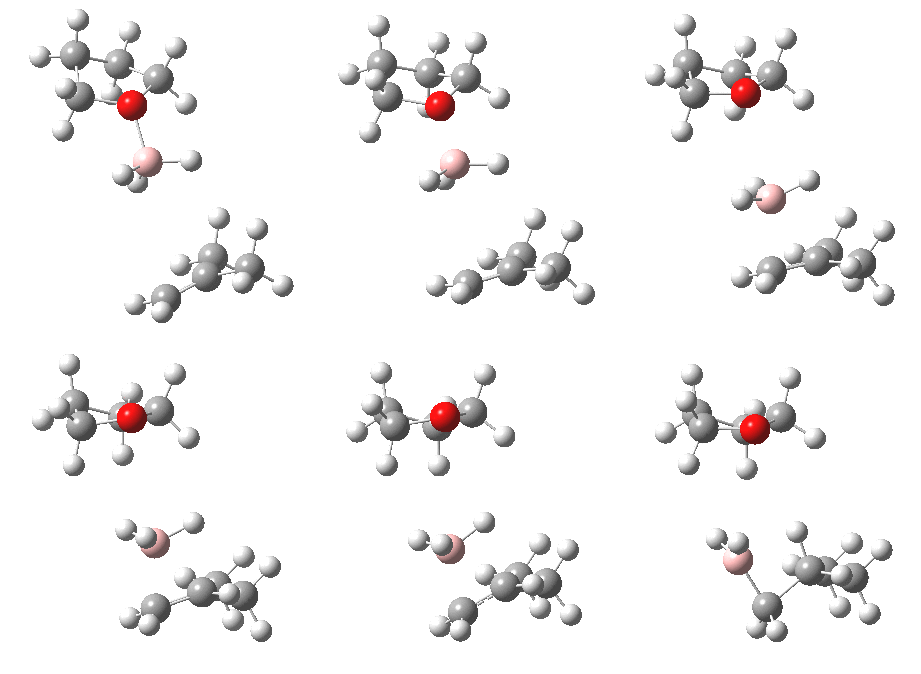
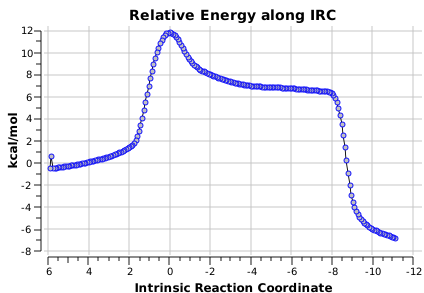
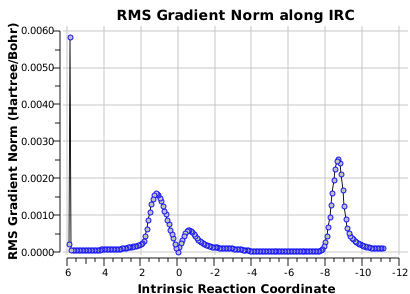

So ? turns out to be a hidden intermediate rather than an explicit one in this model. This hidden intermediate plays the role of the conventional transition state in its presumed determination of the regioselectivity of the hydroboration reaction. The IRC of course is a single trajectory; molecular dynamics will give a more statistical indication of the product distribution. Certainly, these “hidden intermediates” as key structures in mechanistic pathways are starting to turn up in more and more classical reactions.


Leave a Reply