Continuing my hunt, here is a candidate for a strong(est?) halogen bond, this time between Se and I.[cite]10.1021/ic50038a006[/cite]. 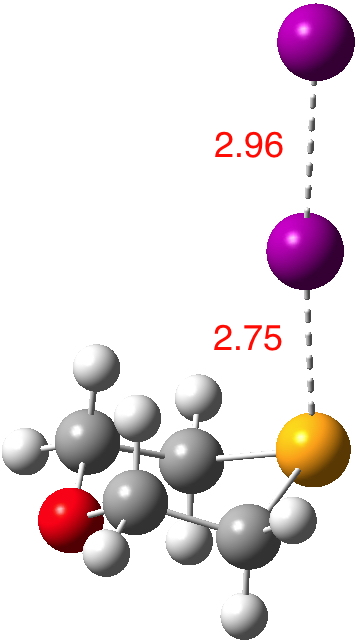 The features of interest include:
- The six-membered ring is in the chair conformation.
- The (relatively enormous) I…I substituent is axial!
- It is attached to the Se rather than the O.
- The Se…I distance is 2.75Å, some 1.13Å shorter than the combined atom ver der Waals radii (1.90 + 1.98 = 3.88)
- The Wiberg bond index is 0.42 for the Se-I bond and 0.63 for the I-I bond (at the crystal geometry). It is tending towards a symmetrical disposition of the central iodine (a feat also achieved by the iodine in the NI3 complex).
- The NBO E(2) perturbation involving donation from the Se lone pair into the I-I antibond is 77 kcal/mol, almost twice the value of the one involving DABCO…I-I and way above the values found for the related hydrogen bond.
- The B3LYP+D3/Def2-TZVPP+PP(I) optimised structure expands the Se-I bond distance to 3.04 and contracts the I-I distance to 2.81Å indicating (as with DABCO…I-I) that there may be compression of this bond induced by the lattice.
-
The NCI surface shows a classical "strong" interaction between Se and I (blue), but significant additional features arising from the axial hydrogens that might account for the axial orientation of the Se…I-I group.
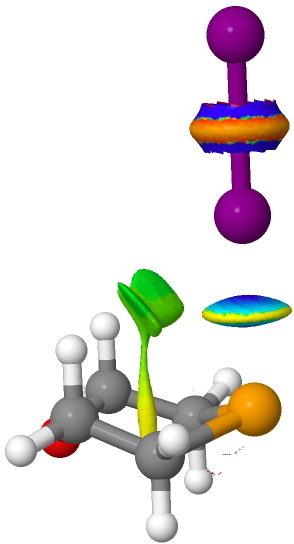
Click for 3D -
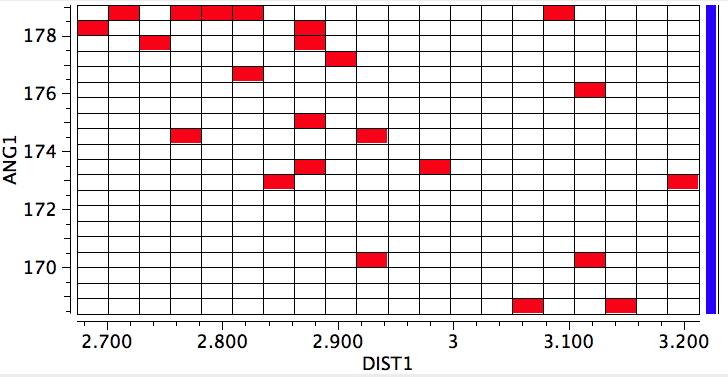
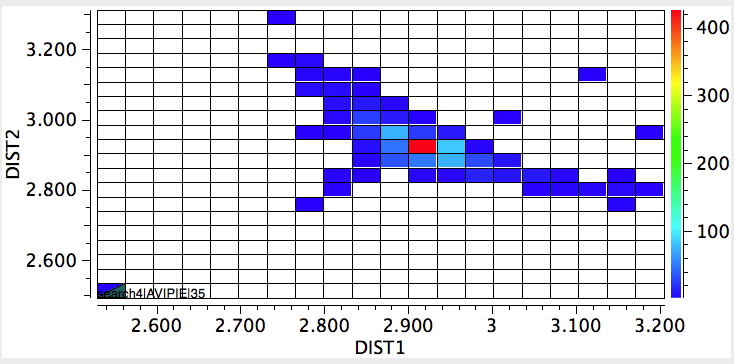
For good measure, here is the complete crystal structure search, defining any non-bonded contact between any element of group six and group seven that is <0.5Å shorter than the van del Waals contact. Our candidate is on the left hand edge of the plot.



Leave a Reply