Tag: Historical

  • Computers 1967-2013: a personal perspective. Part 5. Network bandwidth.

    In a time of change, we often do not notice that Δ = ∫δ. Here I am thinking of network bandwidth, and my personal experience of it over a 46 year period.

    I first encountered bandwidth in 1967 (although it was not called that then). I was writing Algol code to compute the value of π, using paper tape to send the code to the computer. Unfortunately, the paper tape punch was about 10 km from that computer. The round trip (by van) took about a week, the outcome being often merely to discover that the first line of the code contained a compilation error. I think I got to computing π after about six weeks. That is a bandwidth of about 18 characters (108 bits) in 3628800 seconds, or 0.00003 bits per second.

    I did my undergraduate work in 1969, when the distance between the card punch and the computer had reduced to about 50m, and instant turnaround involved circulating in a loop between the punch and the line printer, hoping that neither suffered a paper-wreck. The bandwidth had certainly gone up. On a good day, you could make 20 or so circuits, which did leave one feeling faintly dizzy. 

    The next improvement came in 1972, when I was solving non-linear equations for kinetic rate constants, using a 110 bits per second (baud) or ~ 18 characters per second using the 6-bit computers of that era) teletypewriter. This was about 50m from the lab where the kinetic measurements were made (using, if you are interested a scintillation counter. Yes, I was mildly radioactive for most of my PhD, but I do not believe I glowed in the dark). This bandwidth was in fact fine for uploading kinetic data, and receiving the computed rate constant and its standard error. You might note however that this teletypewriter was the only one in the building I occupied, and yet demand for it was small (I was pretty much its only user). 

    The next increment occurred in Texas 1974-1977, where I was now doing quantum chemical calculations. Back in time to the card punch and the lineprinter (Texas is big, and so now the distance between them was a 10 minute walk). But in my last year there, a state-of-the-art 300 baud teletypewriter was installed! This was now fast enough to play a computer game (something to do with Dragons and Dungeons I think), and so now there was competition to use it. Particularly from one of my friends, who shall be called George, and who on one occasion spent about 48 virtually contiguous hours trying to get to the last level. The rest of us returned to the card punch to submit the calculations. It was also during this period that the first emails started to be exchanged, but only really as a curiosity: “it would never catch on” was the opinion of most.

    Back in the UK by 1977, I was overwhelmed by the speed of the 9.6 kbaud graphics terminal I now had access to, 32 times faster. And the rate continued to multiply, by a further 1000 to attain 10 Mbaud in 1987. But another change occurred during this period. The previous eras had involved transmitting the data no more than ~200m, from one point in the campus to another. But by 1986, if one tried hard enough,† one could reach ARPANET. And that was 5000 km away! My first use of such distances was to reach California and download Apple’s system 5.0 for the Macs in the department (I have described elsewhere the role the Mac’s printer port played in this). From then on, we always did have the latest operating system installed on most of the machines (although not always did this subterfuge address the intended issue, which was to stop the computer crashing as often).

    These speeds however did not reach beyond the university. Back home, around 1983, I was back to using a 300 baud modem, with an acoustic coupler to the land line. Our young daughter, aged 3 at the time, joined in the data transmission with gusto. Her joyful shrieks were invariably picked up by the acoustic coupler, and translated into a jumble of characters, which were then interleaved into the numbers coming back from quantum calculations. It was sometimes difficult to tell them apart! These domestic modems gradually got faster, probably attaining 9.6 kbaud by about 1993 (during the course of which the acoustic component was replaced by electronics, and oddly, our daughter stopped shrieking in quite the same way). 

    Back in the university in 1993, the first 100 megabits per second (100Mbps ≅100 Mbaud) ethernet lines and switches were being installed, but the national and international backbones were still a lot slower. It was in this year that I was approached to be part of a SuperJanet project. We were going to do a molecular videoconference from London to Cambridge and Leeds; a three-way connection, and this needed ~ 20Mbps to transmit the signal from the video camera as well as the 3D images of molecules in real-time (compression techniques were not so advanced in those days). Because BT was sponsoring the project, they naturally wanted some publicity, and so we even got to appear on the national television news that night. But we came within about 1 minute of a disaster. Our 20Mbps connection went through the SuperJanet national backbone, the capacity of which was, you guessed, ~ 20 Mbps. The network operators (located at the Rutherford-Appleton laboratories), who we had not had the foresight to pre-warn, came within 1 minute of isolating Imperial College from the national network because of our bandwidth hogging. I met them a month or so later, and they told me this. I feel I was lucky to escape with my life and body intact from that meeting (or to put it another way, they were not happy bunnies). 

    By about 2000, I had achieved 1 Gbps to my desktop computer (and there it has stayed for the past 13 years). What about home? Well, to cut the story short, I recently benchmarked the domestic WiFi connection between a laptop and “the world” at about 65 Mbps (download) and 18 Mbps (upload), a little less than 1 million times greater than 30 years earlier and a 12 orders of magnitude greater than in 1967. I gather however that some lucky inhabitants of Austin Texas (the scene of my 1974-1977 experiments), courtesy of Google, can get 1 Gbps!‡

    I will end by quoting Samuel Butler, writing in 1863: I venture to suggest that … the general development of the human race to be well and effectually completed when all men, in all places, without any loss of time, at a low rate of charge, are cognizant through their senses, of all that they desire to be cognizant of in all other places. … This is the grand annihilation of time and place which we are all striving for, and which in one small part we have been permitted to see actually realised” (Quoted in George Dyson, “Darwin amongst the Machines, The Evolution of Global Intelligence”, Addison-Wesley, N.Y., 1997. ISBN 0-201-400649-7).


    ‡ I just benchmarked my office computer (using only solid-state memory and that 1Gbps connection) and got 58Mbps (download)/75Mbps (upload).

    † The standard program was NCSA Telnet if  I remember. You made a connection from the computer (using its printer port) to the ARPANET node at University College London (not a widely advertised service), and thence to an Apple FTP site where one could initiate an anonymous file transfer back to one’s computer.  System 5 was about half a Mbyte then, and this took about 1-2 hours to retrieve (unless the connection went down, in which case one started again).
  • Another Woodward pericyclic example dissected: all is not what it seems.

    Here is another example gleaned from that Woodward essay of 1967 (Chem. Soc. Special Publications (Aromaticity), 1967, 21, 217-249), where all might not be what it seems.

    W

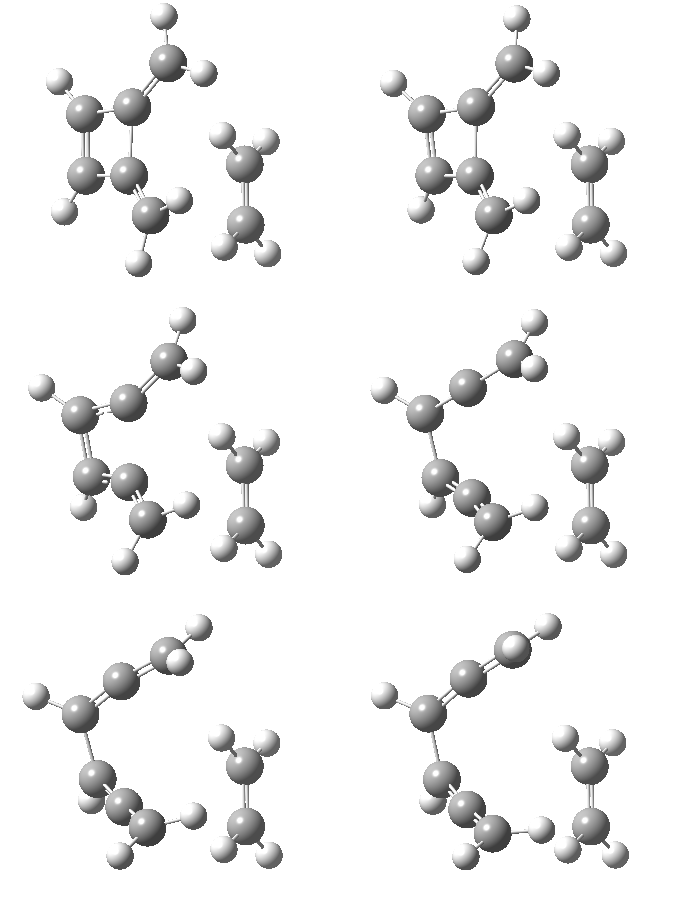
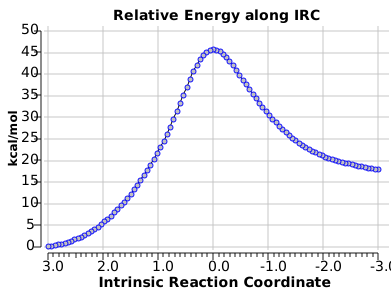
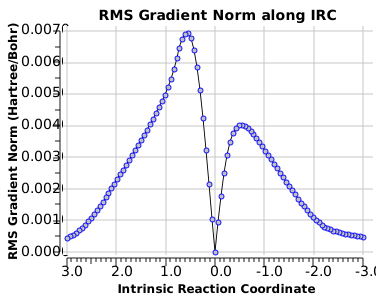
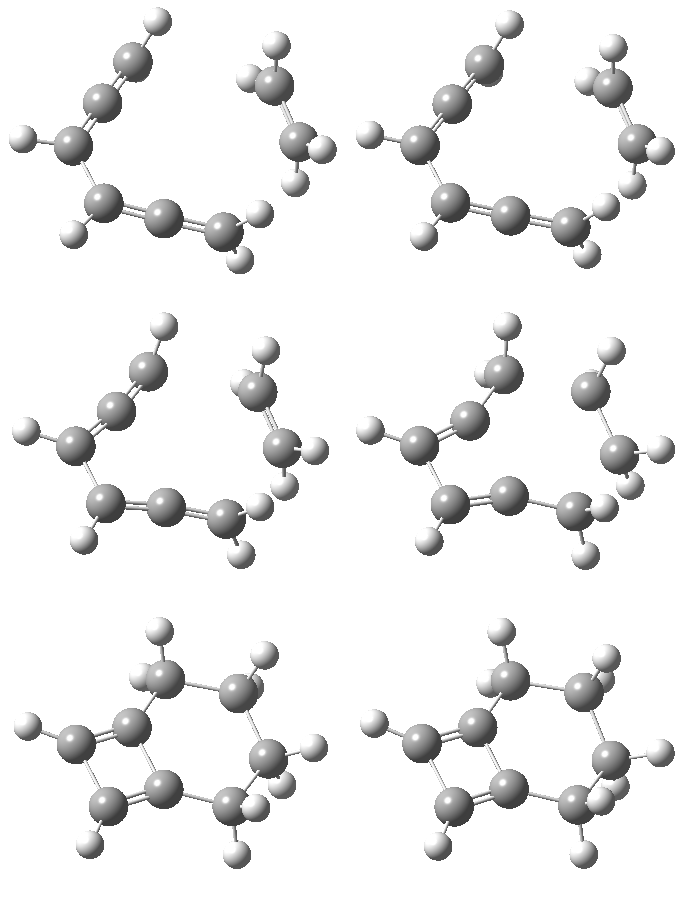
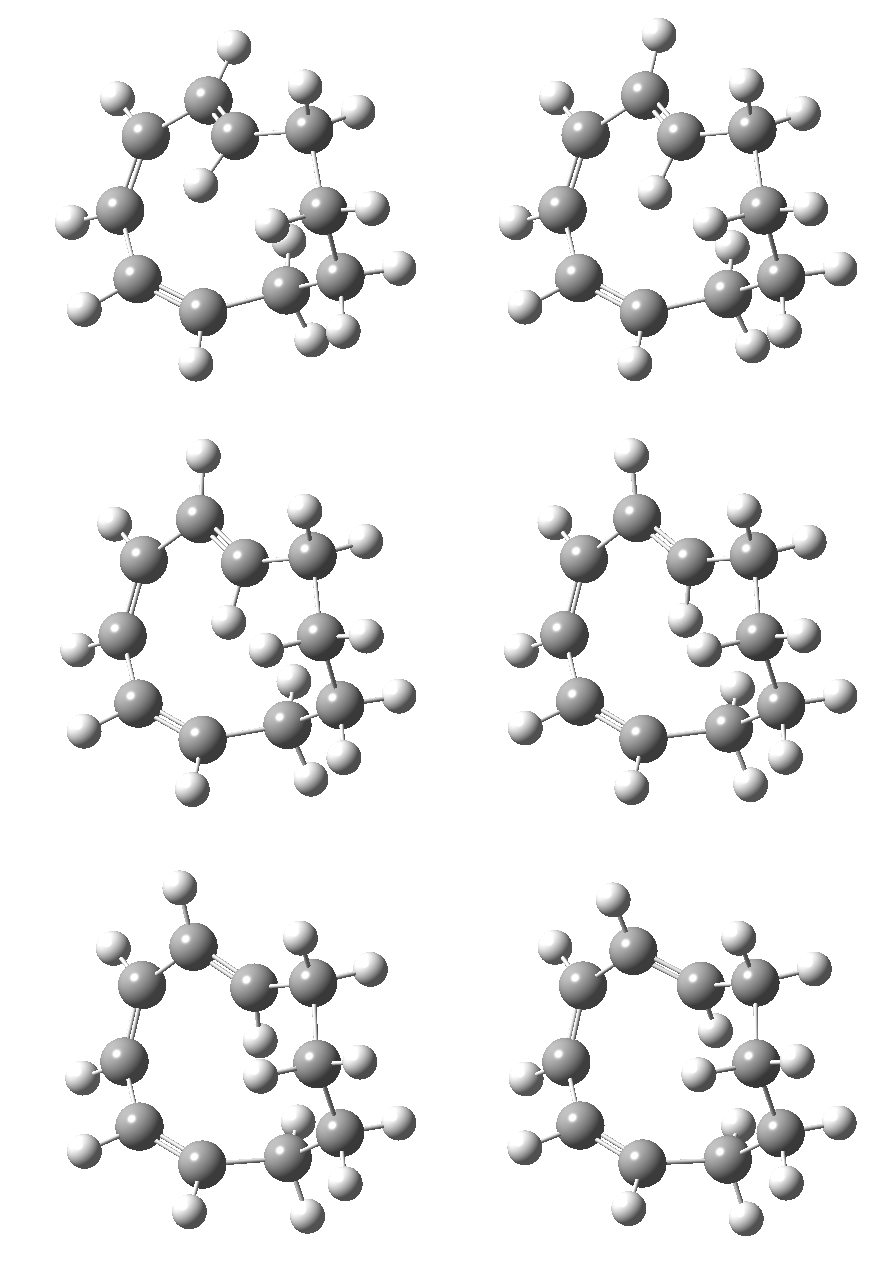
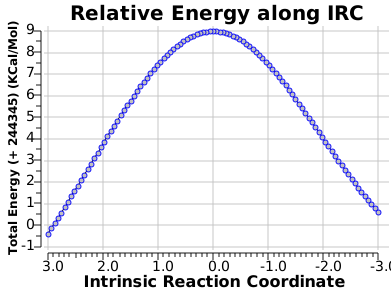
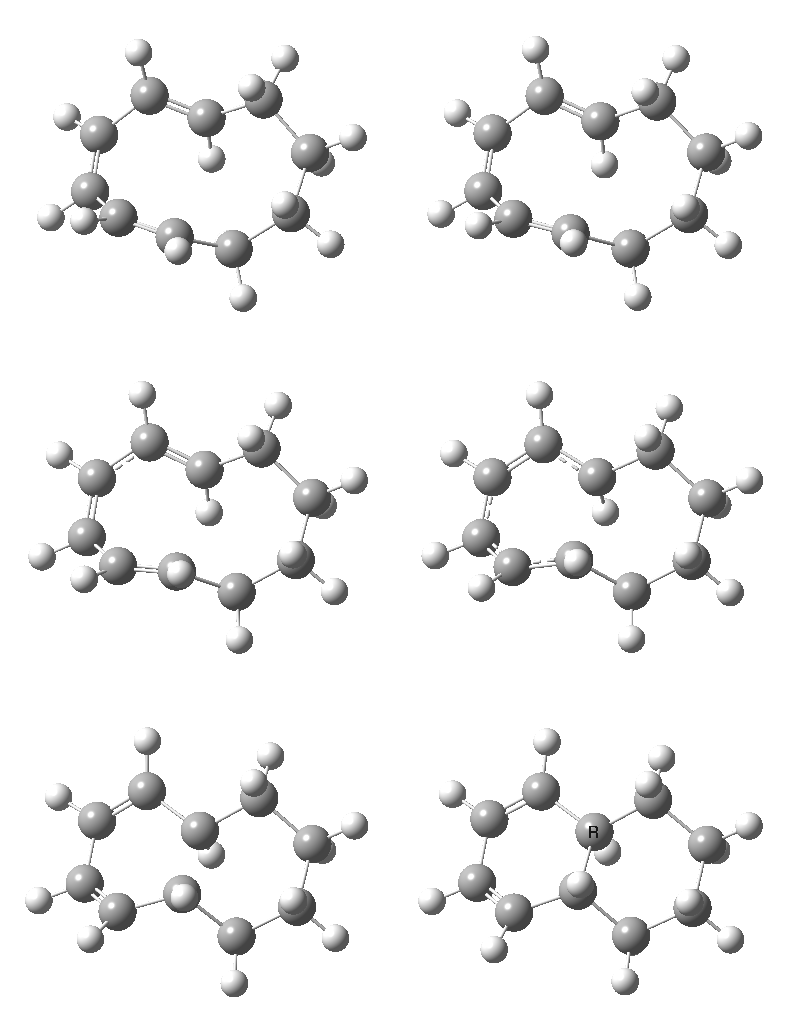
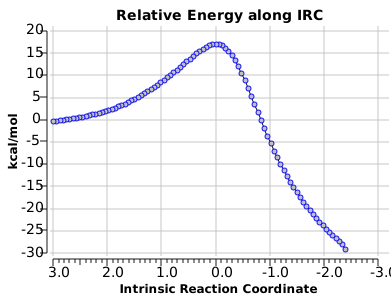
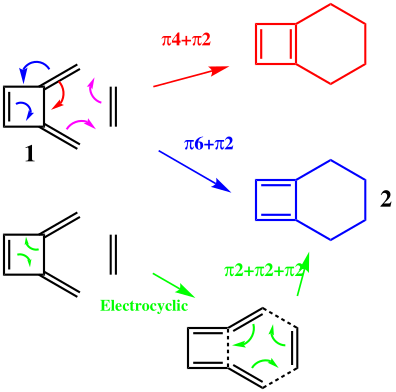
    Woodward notes that the reaction between the (highly reactive) 1 does not occur. This is attributed to it being a disallowed Ï€6 + Ï€2 cycloaddition (blue + magenta arrows) rather than an allowed Ï€4 + Ï€2 cycloaddition (red + magenta arrows). So what does quantum mechanics say? Well, a disallowed reaction can be broken down into several stages, each involving fewer electrons, and this is what happens. The first of these stages becomes instead an electrocyclic ring opening (green arrows) in which one σ-bond from the cyclobutene is “borrowed” to form a bis-allene intermediate, before being returned to the original bond in the second stage.

    Electrocyclic ring opening[cite]10.6084/m9.figshare.705831[/cite]
    we
    w-e w-eG
    2+2+2 cycloaddition[cite]10.6084/m9.figshare.705830[/cite]
    w2+2+2
    w2+2+2 w2+2+2G

    The first transition state for ring opening proceeds in the appropriate Woodward-Hoffmann conrotatory mode, and has a free energy barrier of ~ 45 kcal/mol. This is still 46.1 kcal/mol lower than the very unfavourable second step, which involves a 2+2+2 cycloaddition. Both are formally symmetry-allowed reactions, they just have very high barriers to reaction which accounts for the non-occurance experimentally. Of course, one interpretation of the WH rules is that any pericyclic with a high barrier could be regarded as forbidden, but in this case not on the grounds of symmetry.

  • Woodward’s symmetry considerations applied to electrocyclic reactions.

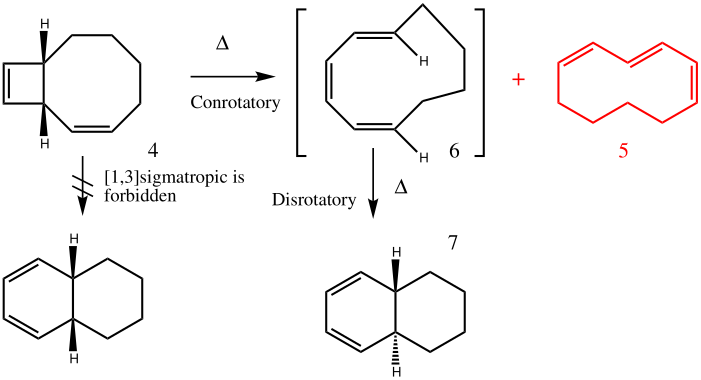
    Sometimes the originators of seminal theories in chemistry write a personal and anecdotal account of their work. Niels Bohr[cite]10.1007/BF01326955[/cite] was one such and four decades later Robert Woodward wrote “The conservation of orbital symmetry” (Chem. Soc. Special Publications (Aromaticity), 1967, 21, 217-249; it is not online and so no doi can be given). Much interesting chemistry is described there, but (like Bohr in his article), Woodward lists no citations at the end, merely giving attributions by name. Thus the following chemistry (p 236 of this article) is attributed to a Professor Fonken, and goes as follows (excluding the structure in red):
    wood

    A search of the literature reveals only one published article describing this reaction[cite]10.1021/jo00238a023[/cite] by Dauben and Haubrich, published some 21 years after Woodward’s description (we might surmise that Gerhard Fonken never published his own results). In fact this more recent study was primarily concerned with 193-nm photochemical transforms (they conclude that “the Woodward-Hoffmann rules of orbital symmetry are not followed”) but you also find that the thermal outcome of heating 4 is a 3:2 mixture of compounds 5 and 6, and that only 6 goes on to give the final product 7. It does look like a classic and uncomplicated example of Woodward-Hoffmann rules.
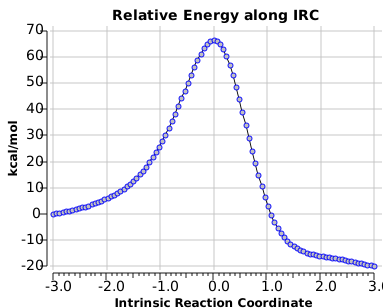
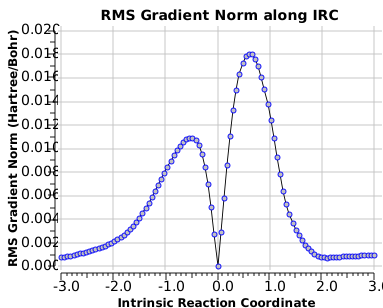
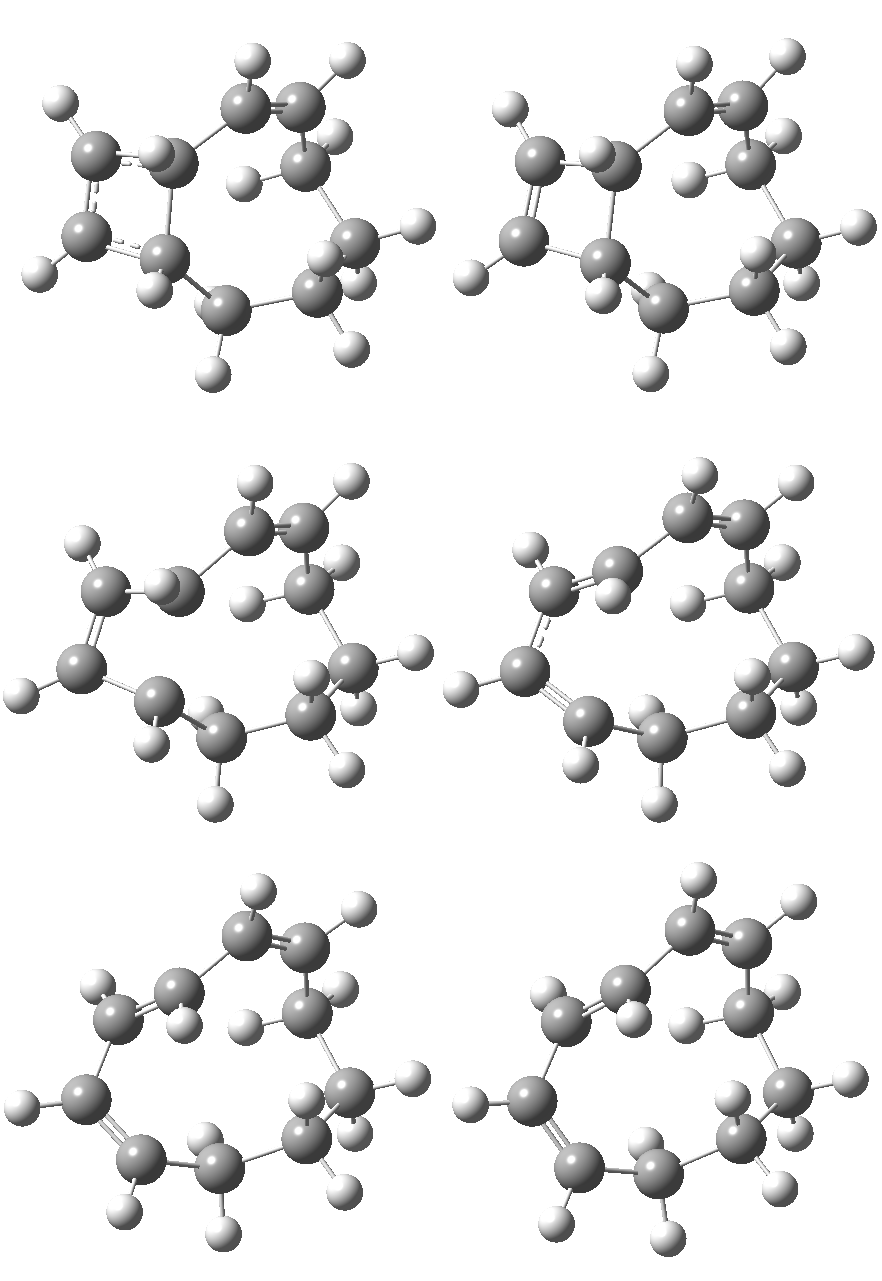
    So let us subject this system to a “reality check” (ωB97XD/6-311G(d,p) calculations). The transform of 4 → 5 rotates the two termini of the cleaving bond in a direction that produces the stereoisomer 5, with a trans alkene straddled by two cis-alkenes[cite]10.6084/m9.figshare.704833[/cite]. The two carbon atoms that define the termini of the newly formed hexatriene are ~ 4.7Ã… apart; too far to be able to close to form 7.

     4 → 5  4 → 6
    8 8

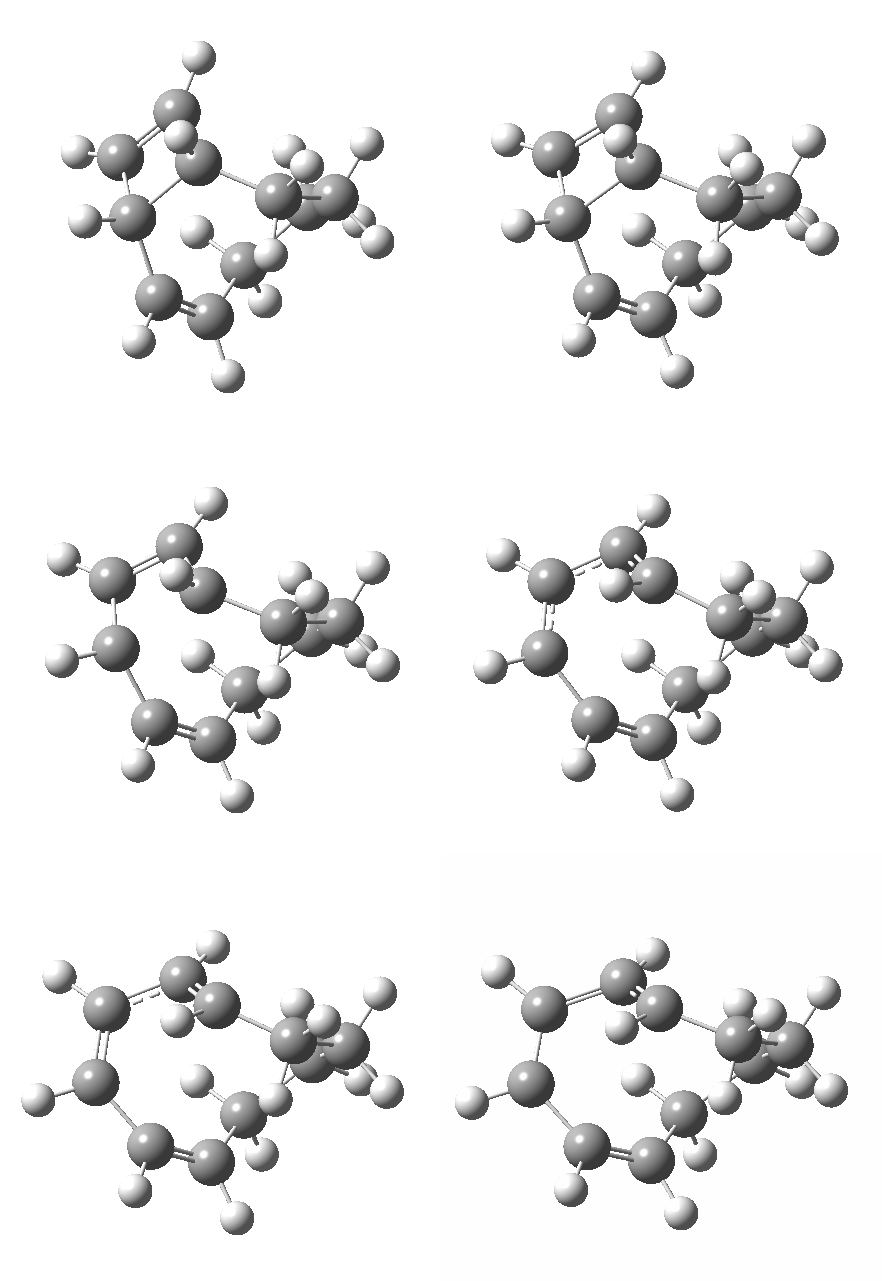
    But with any electrocyclic reaction, two directions of rotation are always possible, and it is a rotation in the other direction that gives 4 → 6[cite]10.6084/m9.figshare.704834[/cite], ending up with a hexatriene with the trans-alkene at one end and not the middle (for which the free energy of activation is 3.1 kcal/mol higher in energy). Now the two termini of the hexatriene end up ~3.0Å apart, much more amenable to forming a bond between them to form 7.

    It is at this point that the apparently uncomplicated nature of this example starts to unravel. If one starts from the 3.0Å end-point of the above reaction coordinate and systematically contracts the bond between these two termini, a transition state is found leading not to 7 but to the (endothermic) isomer 8.[cite]10.6084/m9.figshare.704755[/cite]This form has a six-membered ring with a trans-alkene motif (which explains why it is so endothermic). 

    wood1
    6 ↠ 8
    8 wood2

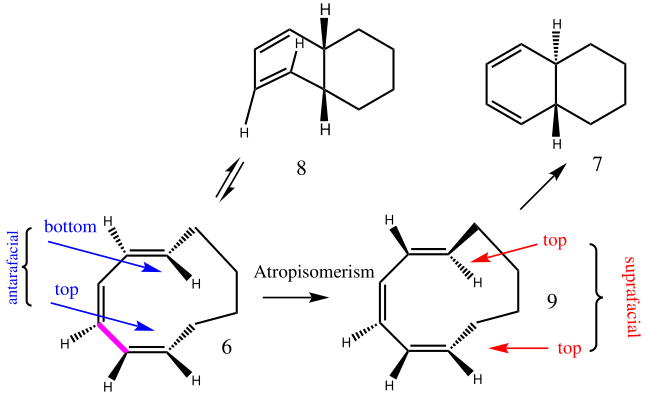
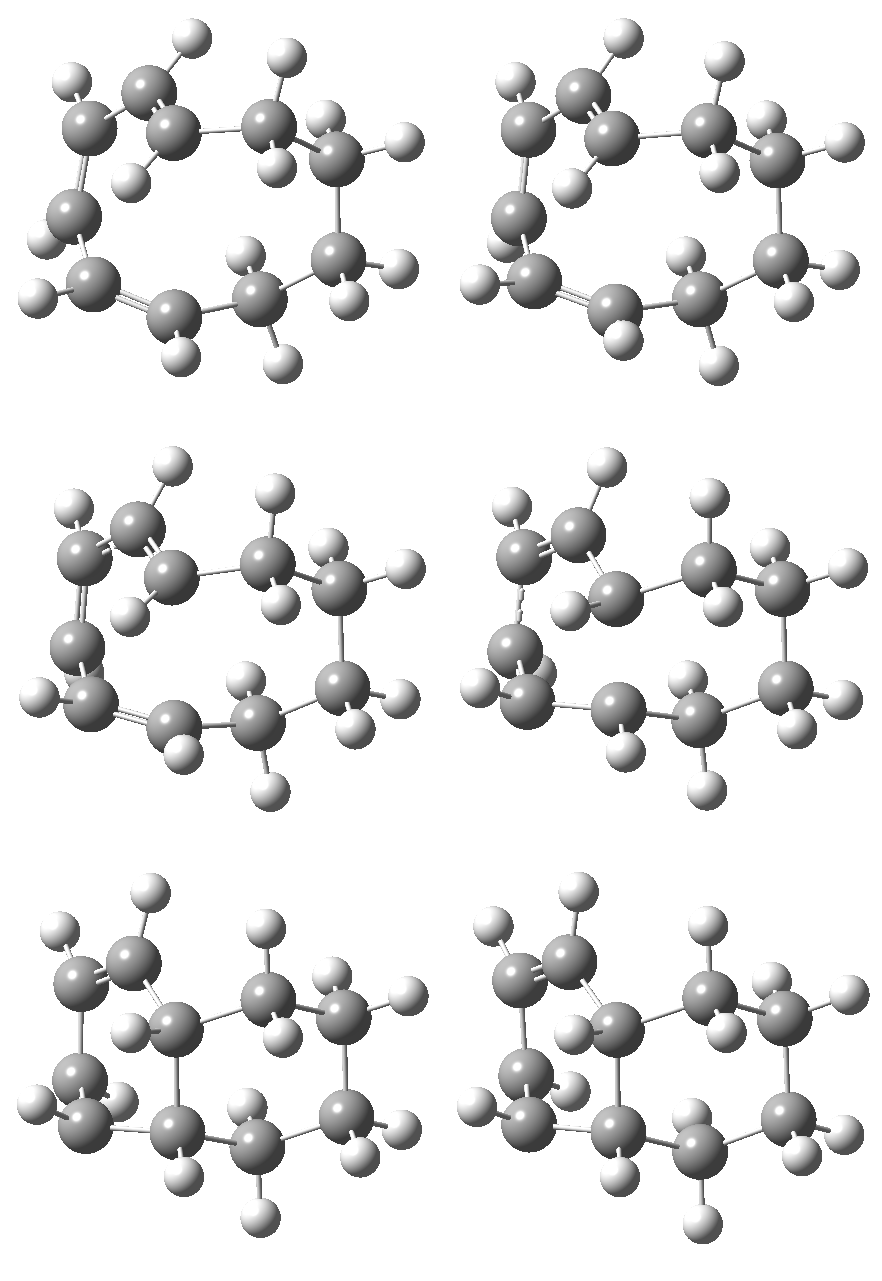
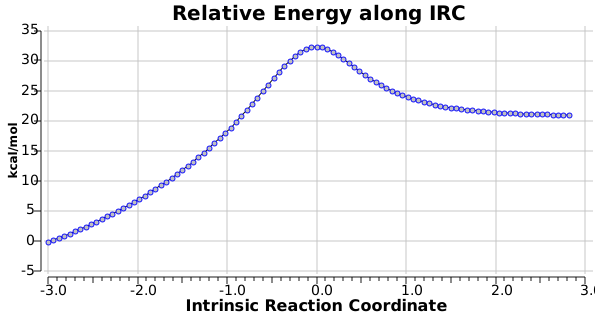
    Before discussing the implications of this transition state, I illustrate another isomerism that 6 can undertake; a low-barrier atropisomerism[cite]10.6084/m9.figshare.704754[/cite] to form 9, followed by another reaction with a relatively low barrier, 9 ↠  7[cite]10.6084/m9.figshare.704844[/cite]to give the product that Woodward gives in his essay.

    6 ↠ 9
    6-atrop 6-atrop
    9 ↠ 7
    9to7a 9to7a

    We can now analyse the two transformations 6 ↠ 8 and 9 ↠  7. The first involves antarafacial bond formation (blue arrows) at the termini and an accompanying 180° twisting about the magenta bond which creates a second antarafacial component[cite]10.6084/m9.figshare.704841[/cite]. So this is a thermally allowed six-electron (4n+2) electrocyclisation with a double-Möbius twist[cite]10.1039/b510508k[/cite]. The second reaction is a more conventional purely suprafacial version[cite]10.6084/m9.figshare.704995[/cite] (red arrows) of the type Woodward was certainly thinking of; it is 18.0 kcal/mol lower in free energy than the first (the transition state for 6 ↠ 9 is 10.8 kcal/mol lower than that for 9 ↠ 7).

    I hope that this detailed exploration of what seems like a pretty simple example at first sight shows how applying a “reality-check” of computational quantum mechanics can cast (some unexpected?) new light on an old problem. We may of course speculate on how to inhibit the pathway 6 ↠ 9 ↠ 7 to allow only 6 ↠ 8 to proceed (the reverse barrier from 8 is quite low, so 8 would have to be trapped at very low temperatures). 

  • Au and Pt Ï€-complexes of cyclobutadiene.

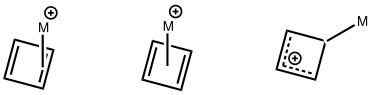
    In the preceding post, I introduced Dewar’s π-complex theory for alkene-metal compounds, outlining the molecular orbital analysis he presented, in which the filled Ï€-MO of the alkene donates into a Ag+ empty metal orbital and back-donation occurs from a filled metal orbital into the alkene Ï€* MO. Here I play a little “what if” game with this scenario to see what one can learn from doing so.

    Au+cbd

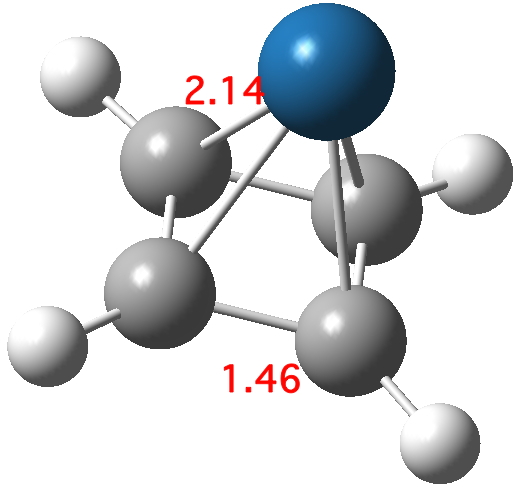
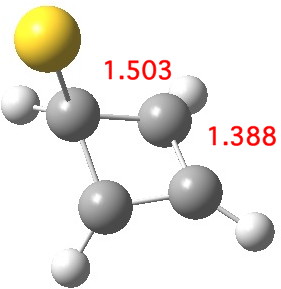
    Firstly, I will use Au+ instead of Ag+, so as to make a comparison with Pt2+ a little more direct. The electronic configurations are of course [Xe].4f14.5d10.6s0 and [Xe].4f14.5d8.6s0 respectively. I will also replace a simple ethene with cyclobutadiene, the intent here being that this cyclo-diene is a very much better π-donor due to its anti-aromatic character. It also now has the possibility of acting as a four or a two-electron donor. I started with M=Pt+[cite]10.6084/m9.figshare.703546[/cite] by adding another double bond to the structure of the ethene complex. 

    Pt-cbd

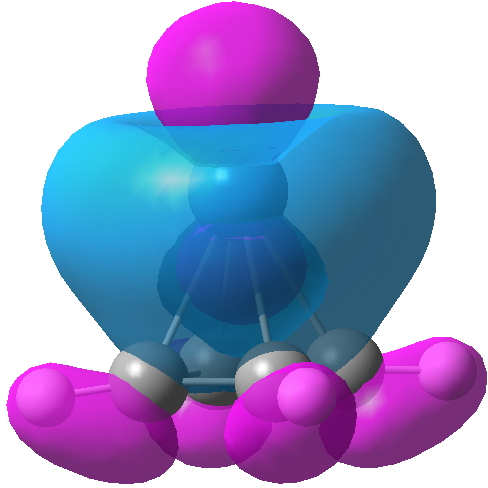
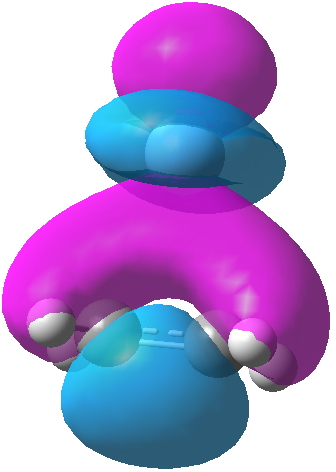
    Optimising this starting structure in fact moves the metal and the final geometry has C4v symmetry; in other words the metal is bound symmetrically to all four carbons. The four C-C lengths are all the same (1.46Å) and strongly suggest that four electrons from the cyclobutadiene are participating in bonding; the Pt2+ is clearly capable of accepting four electrons, two into 6s0 and two into 5d8. In the process, the cyclobutadiene looses its antiaromaticity. The molecular orbitals of this species are all lovely; I illustrate just one below.

    Click for  3D.
    Click for 3D.

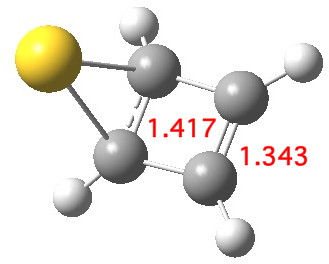
    If the Pt in this C4v structure is mutated into Au+, the resulting optimised stationary point exhibits a negative force constant characteristic of a transition state[cite]10.6084/m9.figshare.703547[/cite]. As the d-shell is already fully, the Au can only accept two electrons, and this is therefore a nice illustration of the “18-electron” rule in operation. So, the Au+ complex must exist in at least one lower energy form. For example, one where the Au+ is coordinated to only one alkene is 94 kcal/mol lower in free energy.[cite]10.6084/m9.figshare.703576[/cite] This form results in electrons from the coordinated alkene being donated into the 6s Au orbital, and this action reduces the anti-aromaticity of the cyclobutadiene ring.

    Au-cs

    Another isomer also achieves this result, resulting in a further lowering in free energy of 11.0 kcal/mol[cite]10.6084/m9.figshare.703577[/cite] The anti-aromaticity this time is eliminated by forming an allyl cation on the ring. I have described this mode in another post, commenting on the effect when a guanidinium cation interacts with cyclobutadiene.Au-cs1

    We have learnt that cyclobutadiene has many modes for eliminating 4n-electron antiaromaticity and other destabilising influences upon the ring. It can accept four electrons from a suitable acceptor (Pt2+), or two electrons from Au+ in two different ways.

  • The Ï€-complex theory of metal-alkene compounds.

    The period 1951–1954 was a golden one for structural chemistry; proteins, DNA, Ferrocene (1952) and the one I discuss here, a bonding model for Zeise’s salt (3).

    Zeise

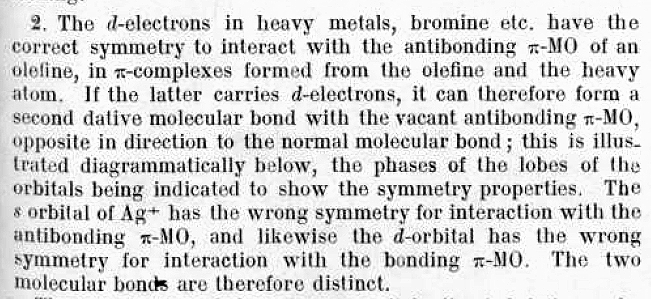
    In “A review of Ï€ Complex Theory”,  Bull. Soc. Chim. Fr., 1951, 1 8 , C79 (it is not online) M. J. S. Dewar sets out his theory of the role of Ï€-complexes in (mostly) organic chemistry. The paper derives from an international colloquium held in Montpellier, in which audience responses to the presentation are included as an annex to the article itself. It is as a footnoted response (to P. Bartlett) that Dewar presents his theory of the alkene-metal π-complex, of which the best known example is Zeise’s salt (3).

    Dewar-symmetryDewar1

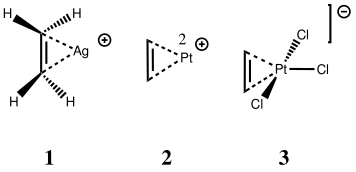
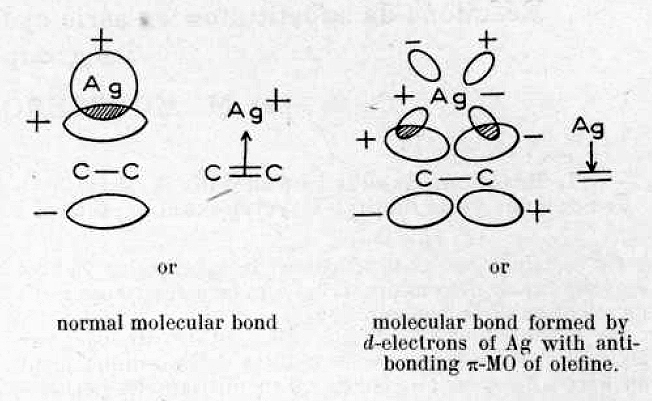
    This diagram illustrates the binding of a silver cation Ag+ to ethene (1). Dewar uses group theory to show how the molecular orbitals from ethene can be combined with the atomic orbitals on the metal. Two filled and two empty orbitals combine to give two new combinations, with a total occupancy of four electrons defining the interaction between alkene and metal. Dewar regards this four-electron-three-centre interaction as distinctive from simply the formation of two single metal-C bonds (a metallacyclopropane).

    Zeise’s salt itself derives from Pt2+ by addition of three chloride anions to give PtCl3. To compare this with Dewar’s Ag+ example, I use here just the naked metal cations 1-2.‡ I went about this analysis as follows:

    1. I did ωB97XD/Dev2-SVP calculations, optimising the geometry into C2v symmetry.
    2. The electronic configuration of Ag+ is [Kr].4d10.5s0 and Pt2+ is [Xe].4f14.5d8.6s0.
    3. The two metals therefore do differ; Ag+ can only accept electrons into a 5s atomic orbital (AO), whilst the Pt2+ can accept electrons into either the 6s or the empty 5d AO.
    4. The molecular orbitals identified for discussion here at 17, 13 and 11 (this is a pseudopotential calculation) of which 17 is doubly occupied for Ag+  and unoccupied for Pt2+. Why three when Dewar’s analysis above describes only two? All (might) become clear shortly!
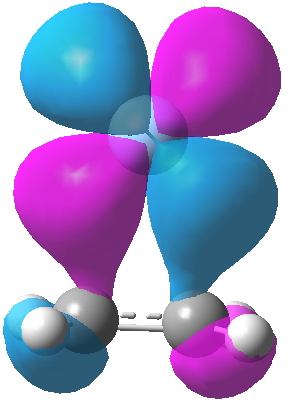
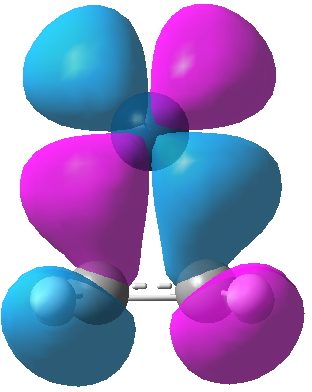
    5. Firstly, I start with the “back-bonding” orbital as shown on the right in Dewar’s diagram. This is the interaction of the filled metal dxz orbital with the alkene Ï€* empty anti-bonding orbital and the combination emerges as orbital 13 of the three considered here. It is antisymmetric with respect to rotation about the axis of symmetry and one of the two planes of symmetry, and is given the label (irreducible representation) B1. Map Dewar’s “-“ sign to blue and “+” sign to purple to match them up. But also notice that the Pt orbital is rather more anti-bonding in the C-C region than Ag analogue. The C-C computed length (1.423Ã…) is indeed longer than that for the Ag complex (1.363Ã…, click on the images below to see a rotatable model of these orbitals). You will also notice that this orbital is “contaminated” with contributions from the C-H bonds; no longer are the π- and σ- electrons orthogonal as they are in ethene itself. This mixing of components from other parts of the molecules is what makes a clear-cut analysis of such systems trickier than you would infer by looking at Dewar’s diagram above! This also happens from the ligands on the metal (Cl in Zeise’s salt for example).
      Ag Pt
      Ag-13 Pt-13.
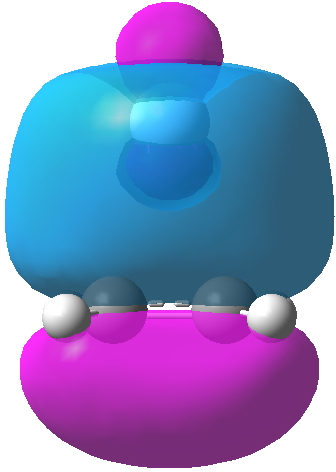
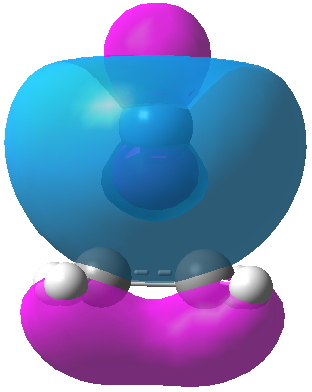
    6. Let us now go hunting from the second of Dewar’s orbitals, which he describes as the interaction between the filled alkene π-MO and an empty Ag s-AO. Orbital 17 closely resembles Dewar’s sketch on the left, although additional lobes can be seen. It is symmetric with respect to all three elements of symmetry (axis and two planes) and hence is labelled A1. Where Dewar writes that the two molecular bonds are distinct, he means that they have different symmetries and hence cannot interact with each other (they are orthogonal). But hang on; although this orbital is doubly occupied for Ag, it is unoccupied for Pt! So does that mean that Dewar’s argument cannot hold for Zeise’s salt itself (the bonding in this molecule is often referred to as the Dewar-Chatt-Duncanson model[cite]10.1039%2FJR9530002939[/cite]). No. It turns out that for Ag, the alkene π-MO is interacting not with a pure unhybridised Ag s-AO, but with an s+dz2 hybrid (albeit with rather more s and rather less dz2). This creates two modified hybrid AOs, one of which interacts with the alkene π-MO to give orbital 17. This is what those extra lobes are about, the contribution from the 4dz2 AO on Ag. Because this combination on Pt is empty, the Ag complex has a shorter C-C bond than Pt.
      Ag Pt
      Ag-17 Pt-17
    7. Well, Pt still needs explaining, since we have only found one of Dewar’s two interactions. I mentioned that s+dz2 hybrids could be created, and here the second of these interacts with the bonding alkene π-MO to give another A1 instance  11, again with the same symmetry properties with respect to the three elements of symmetry present (but this time with rather more dz2 than s). It is this orbital which is now occupied for Pt.
      Ag Pt
      Ag-11

      Ag-11


    The famous Dewar π-complex model of alkene-metal interaction as applied to the Ag+ cation describes one “normal molecular bond” and a second bond “opposite in direction to the first”, what we now call a back-bond. What has emerged however is that two “normal molecular bonds” can be identified for Ag+ based purely on their symmetry but only one for Pt2+ (which of course has two valence electrons less) and both exhibit one back-bond.  The diagram above must absorb a further pair of electrons from a formally non-bonding filled dz2 orbital, whilst recognising that hybridisation may allow it too to take on some bonding role.

    You might ask what the missing orbitals 12, 14-16 are?  Well, formally they derive from the other occupied four metal d-orbitals, but in fact mixed heavily with the C-H bonds of the ethene. I have to conclude that a molecular orbital analysis of e.g. Zeise’s salt (with additional orbital mixing from the three chlorides) ends up being pretty complex! But despite this complexity, Dewar’s original hypothesis, produced in response to a question from the audience, certainly started something. It is worth reminding that the 1952 Nobel-prize winning suggestion for the structure of Ferrocene[cite]10.1021/ja01128a527[/cite] includes no group theoretical orbital analysis of the bonding on a par with Dewar’s 1951 insights.


    ‡ In fact, the MOs turn out to be pretty sensitive to the ligands surrounding the metal, and so those presented here for the naked cations will differ from those for “real molecules” such as Zeise’s salt.


  • A (very) short history of shared-electron bonds.

    The concept of a shared electron bond and its property of an order is almost 100 years old in modern form, when G. N. Lewis suggested a model for single and double bonds that involved sharing either 2 or 4 electrons between a pair of atoms[cite]10.1021/ja02261a002[/cite]. We tend to think of such (even electron) bonds in terms of their formal bond order (an integer), recognising that the actual bond order (however defined) may not fulfil this value. I thought I would very (very) briefly review the history of such bonds.

    1. 1916: G. N. Lewis[cite]10.1021/ja02261a002[/cite] proposed a model for carbon involving a cube with one electron at each corner, thus making an octet.‡ A single bond would be created by two atoms sharing a common edge (= 2 shared electrons), and a double bond by sharing a common face (= 4 shared electrons). The recognition that the formal bond order of two could be partitioned into one electron pair of σ symmetry and one of Ï€ was not achieved until ~1929 (by Hückel). It is also now recognised that whilst most bonds of order 1 are of type σ, a rare few can be π (these are called homo or “suspended” bonds).
    2. 1916: Lewis also speculates about a rather less well-known model comprising “eight electrons in which pairs are symmetrically placed about a center gives … the model of the tetrahedral carbon atom.” He then points out that two tetrahedra, attached by one, two or three corners each would represent the single, the double and the triple bond. The latter “represents the highest possible degree of union between two atoms“. He chooses acetylene as an example, representing it as H:C:::C:H and two “tautomers” (we would now call them valence bond isomers)† with lower bond orders, these being what we now call a bis-carbene and a biradical:Lewis
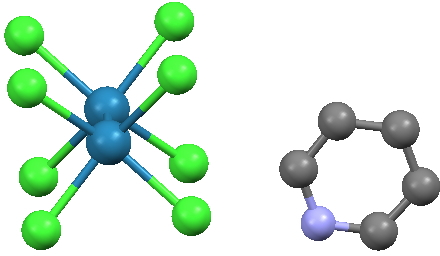
    3. 1965: It took a remarkable wait of 49 years (a span which encompasses the development and maturity of quantum mechanics) to extend the “highest possible degree of union” to the quadruple bond, identified by Cotton in the previously known compound [Re2Cl8]2-.[cite]10.1021/ic50025a016[/cite].
      Click for  3D
      Click for 3D

      In fact, Mulliken had drawn a quadruple bond between the two carbons in C2 back in 1939[cite]10.1103/PhysRev.56.778[/cite] (see Table 1, p 779) but he probably thought of it as a very high energy excited state and that it did not merit further discussion. The latest thoughts are that C2  does indeed have (a weak) fourth bond[cite]10.1002/anie.201208206[/cite] in its ground electronic state.

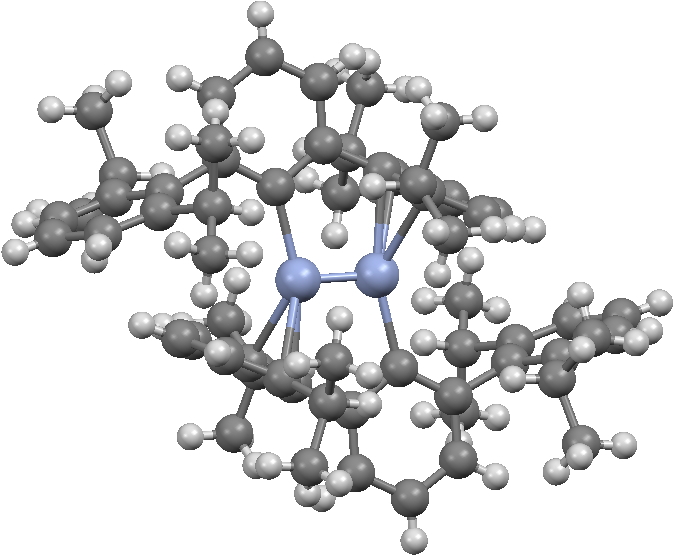
    4. 2005: Another 40 years elapsed before quintuple or “fivefold” bonding was discovered by Power[cite]10.1126/science.1116789[/cite] in ArCrCrAr. There has been a bit of a race since to discover the shortest example of this genre.
      Click for  3D
      Click for 3D
    5. 2013: Unlike the lower bond orders, where direct structural data for larger molecules is available, speculation about sextuple bonds is limited largely to theoreticians, who have been at it for quite a while. The latest thinking is summarised here[cite]10.1039/C2CP43559D[/cite] (also doi: 10.1039/C2CP43559D). The current best candidates for a sextuple bond include Mo2 and W2.
    6. What is the limit of the formal integer bond order? I do not believe anyone thinks that septuple or octuple bonds (formal or otherwise) will be discovered (or even speculated upon) any time soon, but there is no fundamental law which would prohibit them.[cite]10.1038/446276a[/cite] Quite possibly if we get beyond element 120 in the periodic table, examples might emerge!

    ‡A formula for predicting the filled electron shells is 2(N+1)2, which gives the values 2, 8, 18, 32[cite]10.1126/science.54.1386.59[/cite],[cite]10.1002/anie.200604198[/cite] 50. It is also, as it happens, the rule for 3D aromaticity in clusters.

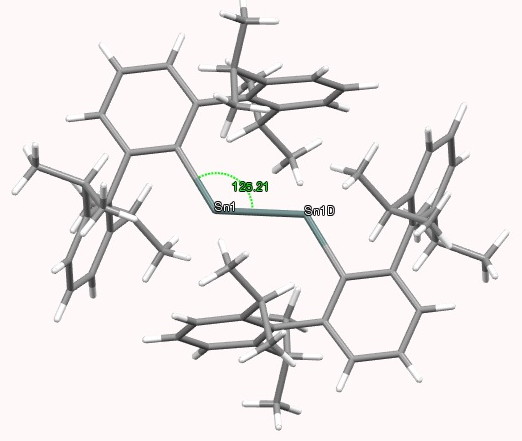
    †A bis-carbene form, whilst not appropriate for carbon, may indeed become more realistic as one proceeds down column 14 of the periodic table. Thus [cite]10.1021/ja0257164[/cite], where Ar-Sn≡Sn-Ar has a C-Sn-Sn bond angle of 125°.

    Click for 3D.
    Click for 3D.

    Or perhaps an even better example[cite]10.1039/c0sc00240b[/cite] with a C-Sn-Sn angle of 98°. There is also an example of C-Pb-Pb[cite]10.1021/ja993346m[/cite] with an angle of 94°.


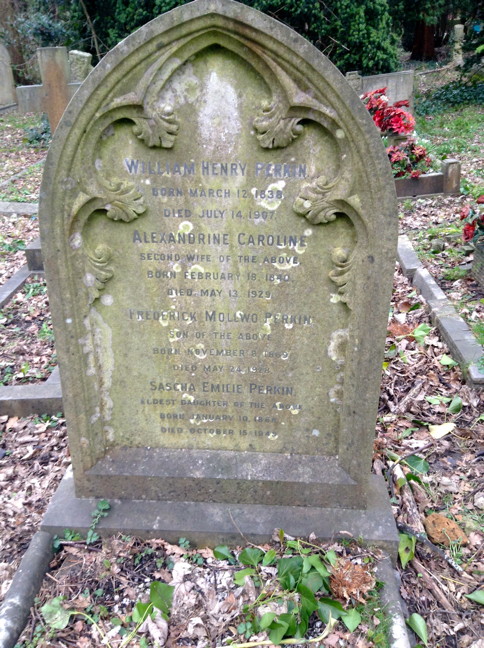
  • William Henry Perkin: The site of the factory and the grave.

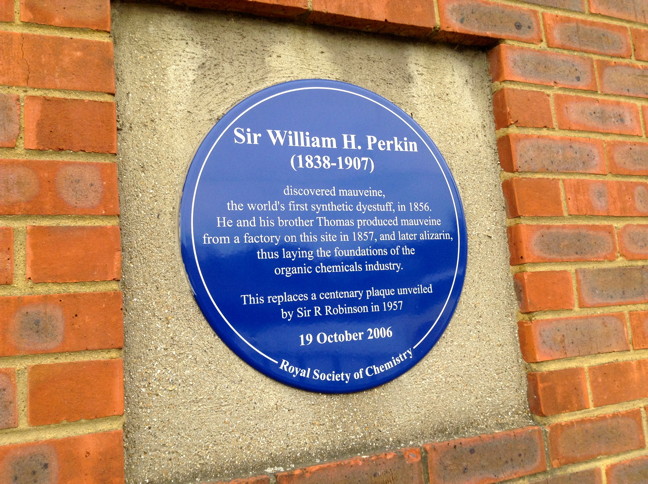
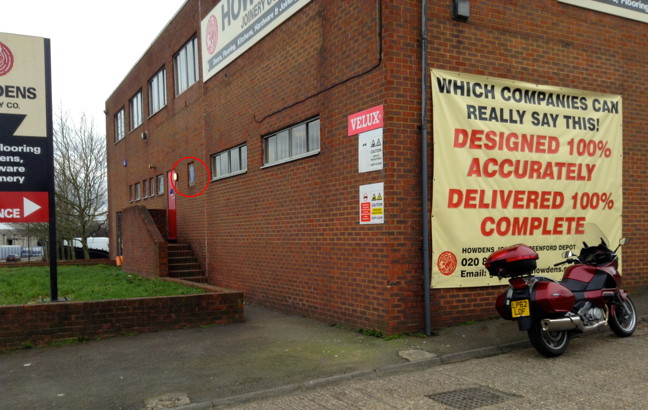
    William Henry Perkin is a local chemical hero of mine. The factory where he founded the British (nay, the World) fine organic chemicals industry is in Greenford, just up the road from where we live. The factory used to be close to the Black Horse pub (see below) on the banks of the grand union canal. It is now commemorated merely by a blue plaque placed on the wall of the modern joinery building occupying the location (circled in red on the photo).


    View Larger Map

    Perkin-Factory-plaquePerkin-Factory

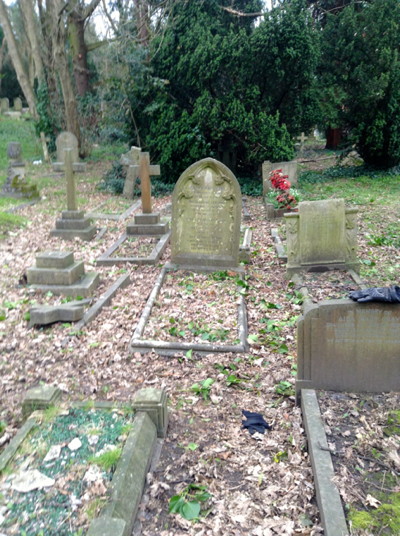
    But when BBC TV contacted me to ask where his grave was, a little detective work was needed to track it down to the cemetery in Christchurch, Roxeth (near Harrow-on-the-Hill). 


    View Larger Map

    Perkin's_GravestoneWide-shot-of-grave

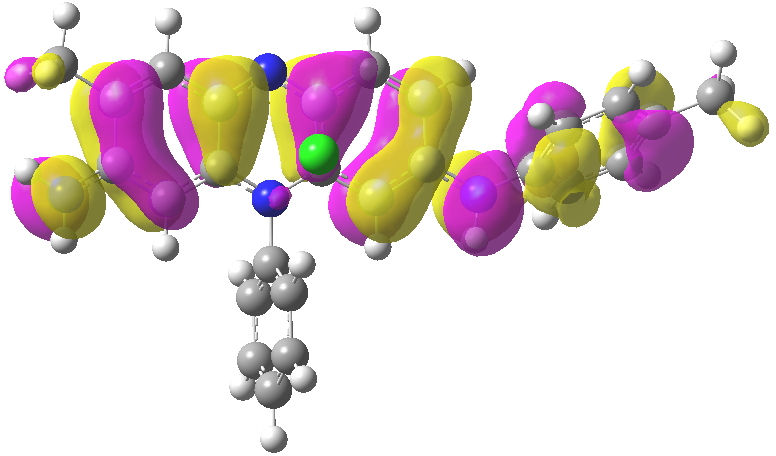
    And if you ever need to track me down, my office window is the one with the translucent image of a mauveine molecular orbital.


    View Larger Map

    Click for  3D
    Click for 3D
  • Why is the carbonyl IR stretch in an ester higher than in a ketone?

    Infra-red spectroscopy of molecules was introduced 110 years ago by Coblentz[cite]10.1103/PhysRevSeriesI.20.273[/cite] as the first functional group spectroscopic method (” The structure of the compound has a great influence on the absorption spectra. In many cases it seems as though certain bonds are due to certain groups.“). It hangs on in laboratories to this day as a rapid and occasionally valuable diagnostic tool, taking just minutes to measure. Its modern utility rests on detecting common functional groups, mostly based around identifying the nature of double or triple bonds, and to a lesser extent in differentiating between different kinds of C-H stretches[cite]10.1002/chem.201200547[/cite] (and of course OH and NH). One common use is to identify the environment of carbonyl groups, C=O. These tend to come in the form of aldehydes and ketones, esters, amides, acyl halides, anhydrides and carbonyls which are part of small rings. The analysis is performed by assigning the value of the C=O stretching wavenumber to a particular range characteristic of each type of compound. Thus ketones are said to inhabit the range of ~1715-1740 cm-1 and simple esters come at ~1740-1760 cm-1, some 20-30 cm-1 higher. Here I try to analyse how this difference arises.

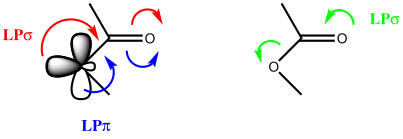
    The analysis is based on trying to understand how the components of an ester interact with each other, and in particular how the alkyl oxygen interacts with the carbonyl group. Three electronic interactions in particular can be focused on (below). The first two of these weaken the C=O bond; the last strengthens it. So which effect wins out?

    s-cis-ester1

    1. The donation of an in-plane σ lone pair (Lpσ) on the alkyl oxygen into the C=O σ* acceptor (red arrows) 
    2. The donation of an out-of-plane π lone pair (Lpπ) into the C=O π* acceptor (blue arrows)
    3. The donation of an in-plane σ lone pair (Lpσ) on the acyl oxygen into the C-O σ* acceptor (green arrows) 

    I will start with computational models, which have the advantage that one can dissect how the vibrations arise. The first two rows show a comparison of the experimental gas phase values[cite]10.1063/1.461230[/cite] with a standard “medium level” ωB97XD/6-311G(d,p) calculation. The discrepancy amounts to ~100-114 cm-1. 

    The carbonyl stretch in esters and ketones
    Method: Ester Ketone
    Expt (gas phase)[cite]10.1063/1.461230[/cite] 1761‡ 1737‡
    Harmonic ωB97XD/6-311G(d,p) 1860 1851
    Anharmonic ωB97XD/6-311G(d,p) 1832† 1828†
    Harmonic ωB97XD/aug-cc-pvQZ 1836 1831
    Harmonic CCSD(T)/6-311G(d,p) 1826 1792
    Corrected CCSD(T)/6-311G(d,p) ~1774 ~1749
    Expt (gas phase) 1761 1737
    Reduced CCSD(T)/6-311G(d,p) 1764 1743

    There are several possible causes for such errors:

    1. The calculation is for harmonic frequencies; whereas those measured are anharmonic. 
    2. DFT-level force constants at modestly sized basis set levels are known to be too large compared with a complete basis set calculation (CBS). It used to be the practice in fact to routinely scale the force constants down by ~10% to correct for this effect.
    3. The correlation treatment in a DFT approach is incomplete (an error which may in fact be also absorbed into the 10% correction noted above).

    So to really get to the root of why an observed ester carbonyl stretch is higher than that of the equivalent ketone, we have to get a handle on these effects above. 

    1. One can calculate cubic and quartic force constants to get an estimate of the effect of anharmonicity on the (harmonic/quadratic) values, which emerges as 23-28 cm-1 
    2. Upping the level of the basis set to aug-cc-pVQZ (close to, but not quite a CBS) reveals further corrections of 20-24 cm-1 . 
    3. Replacing the DFT method with a CCSD(T)-level treatment of the dynamic correlation gives corrections of 34 and 59 cm-1 respectively for ester and ketone. Assuming the corrections can be treated additively, one can apply the first two to the third, producing “corrected” CCSD(T)/6-311G(d,p) values which are only about 12-13 cm-1 higher than the observed value. This remaining discrepancy is probably due to the difference between aug-cc-pvQZ and a complete basis set (CBS) and any remaining errors in the correlation modelled by CCSD(T). We can be assured now that our theory is reproducing experiment very well.

    Now that we can assess the accuracy of our computational methods, we need to try to relate the results to the C=O bond itself. Does turning a ketone into an ester really make it stronger? To directly compare the C=O bond of two different molecules, we need to eliminate the effects of mixing the C=O normal stretching mode with similar energy modes arising from other parts of the molecule. A simple way of estimating this is to set the mass of all but two of the atoms to a very small value (0.00001), leaving only the masses of the C and O as normal; this is shown as a reduced frequency in the table above. The harmonic CCSD(T)/6-311G(d,p) C=O “pure” mode reduces to 1764 for methyl ethanoate and 1743 cm-1 for propanone. So after all of this, at least we now know that the force constant for the C=O stretch really is stronger for an ester. The green arrows seem to win out over the blue/red ones.

    One calculation too many? The (Wiberg) bond order for the C=O bond can be derived from the wavefunctions. Its value is 1.635 for ester, and 1.681 for ketone (CCSD/6-311G(d,p)) or 1.766/1.848 (ωB97XD/aug-cc-pvQZ). This is the opposite to that inferred from the carbonyl stretch, and hence favours the blue/red arrows over the green arrows. I set out in this post to try to bring clarity to how an adjacent oxygen influences how we think of the properties of the C=O functional group, but as happens quite often, the answer you get depends on the measurement you make.


    ‡ The solution values in e.g. acetonitrile are reduced by ~20 cm-1, reaching the values often quoted in text books for these functional groups. † The effect on C-H values is greater, e.g. a reduction from 3186 to 2967 cm-1.


    Acknowledgments

    This post has been cross-posted in PDF format at Authorea.

  • Why is N,O-diphenyl hydroxylamine (PhNHOPh) unknown?

    If you search e.g. Scifinder for N,O-diphenyl hydroxylamine (RN 24928-98-1) there is just one literature citation, to a 1962 patent. Nothing else; not even a calculation (an increasing proportion of the molecules reported in Chemical Abstracts have now only ever been subjected to calculation, not synthesis). A search of Reaxys also offers only one hit[cite]10.1016/S0040-4039(01)90757-9[/cite] reporting one unsuccessful attempt in 1963 to prepare this compound. Again, nothing else. Yet show this structure to most organic chemists, and I venture to suggest few would immediately predict this (unless they are experts on benzidine rearrangements).‡

    PhNHOPh

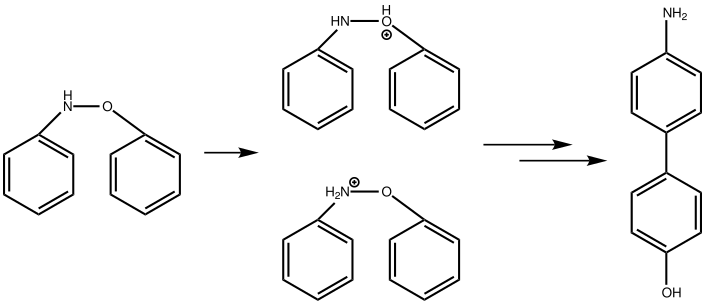
    The eagle-eyed reader of this blog may have noticed my noting in previous posts that the benzidine rearrangement proper is normally promoted by double protonation, and that reaction via monoprotonation has a significantly higher barrier. So what are the corresponding predicted reaction barriers for PhNHOPh? I start in fact with catalytic monoprotonation. The calculations are at ωB97XD/6-311G(d,p)/SCRF=water (closed shell) level.

    System N-protonated O-Protonated‡
    Reactant  0.0  11.3
    TS N-O  7.3  17.4
    π-complex  2.1  6.0
    TS C-C  4.8  13.2
    ‡Relative to N-protonated reactant, in kcal/mol.

    So it seems that even monoprotonation (on nitrogen) results in a very small ΔG298‡ barrier to the formation of a π-complex and its subsequent facile breakdown to form a C-C bond. I had noted in the earlier post that Ghigo and co-workers[cite]10.1002/ejoc.201001636[/cite] had found that with diprotonated diphenyl hydrazine, the resulting π-complex has some open shell (biradical) character. The calculations reported here on the monoprotonated system are done as closed shell, but any biradical character this might have will only serve to even further reduce the barriers seen in the table. So we may confidently conclude that even monoprotonated N,O-diphenyl hydroxylamine will rapidly rearrange. A follow-up investigation for the diprotonated route hardly seems necessary!

    But here is a challenge: if one were able to prepare PhNHOPh in thoroughly deprotic conditions, might it be isolable? There is precedent; the keto form of phenol can indeed be isolated under such conditions.[cite]10.1021/ja00951a064[/cite].

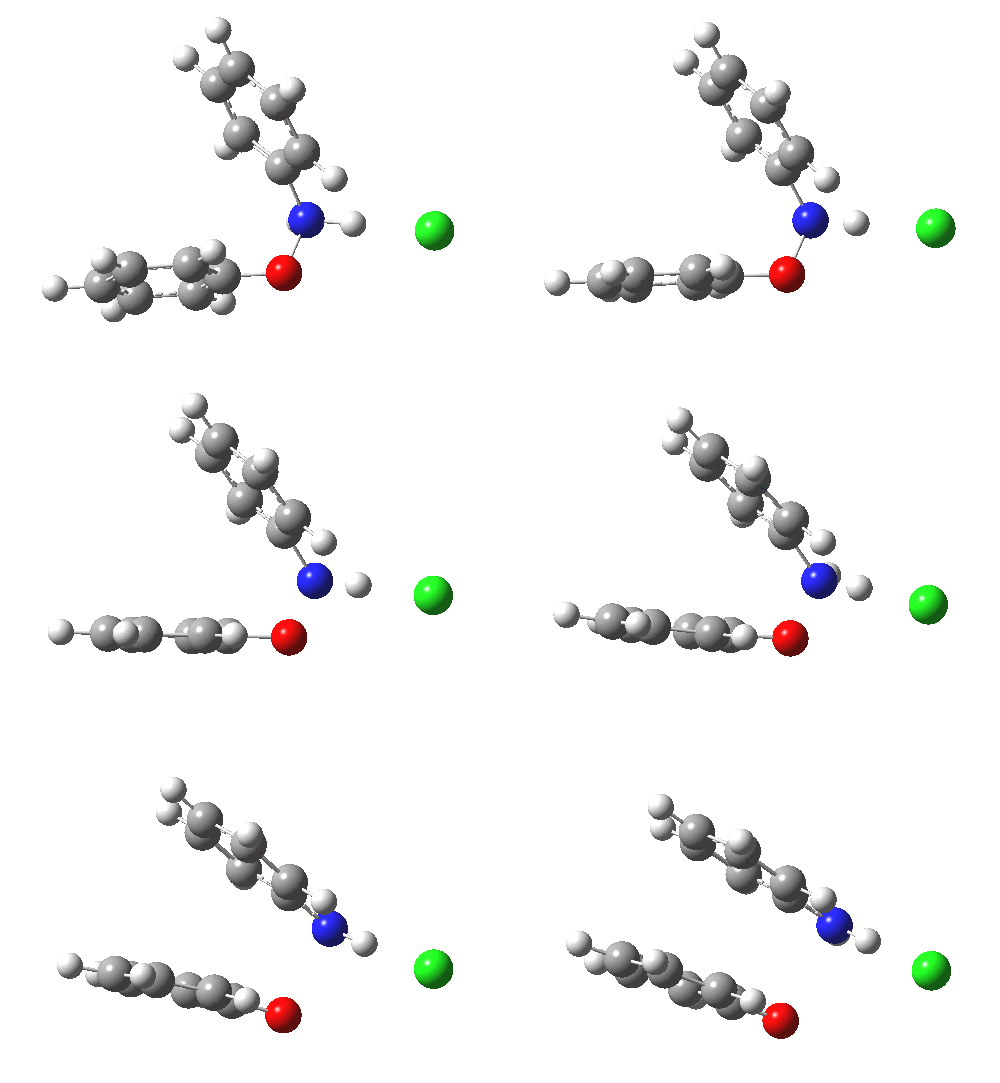
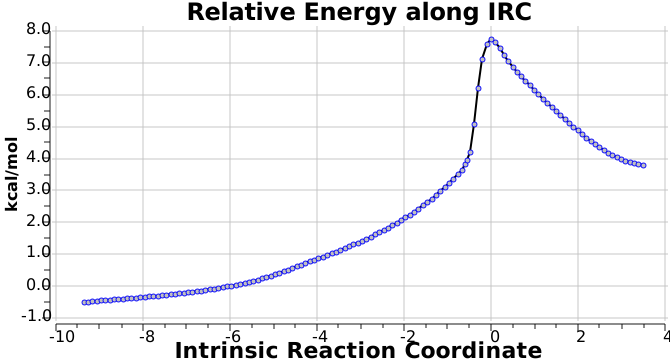
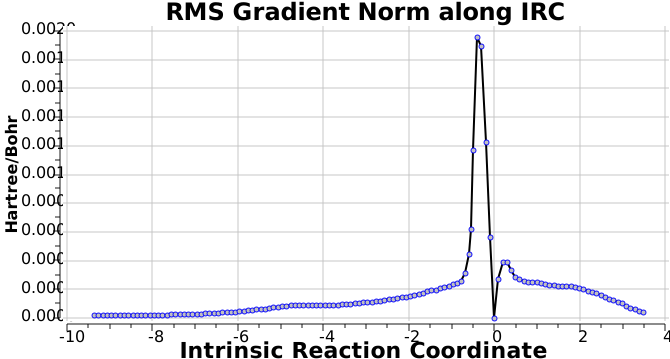
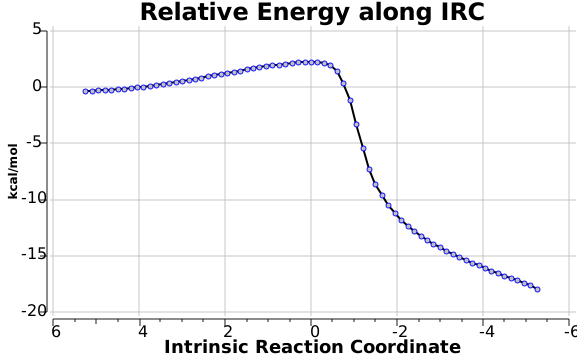
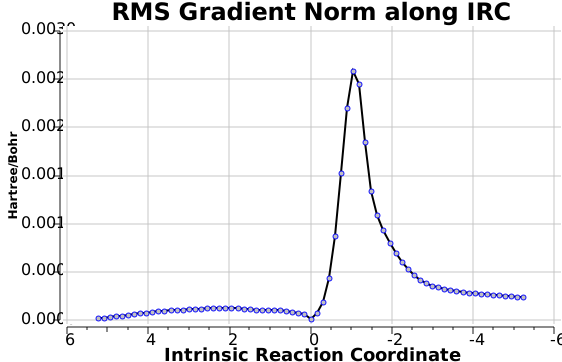
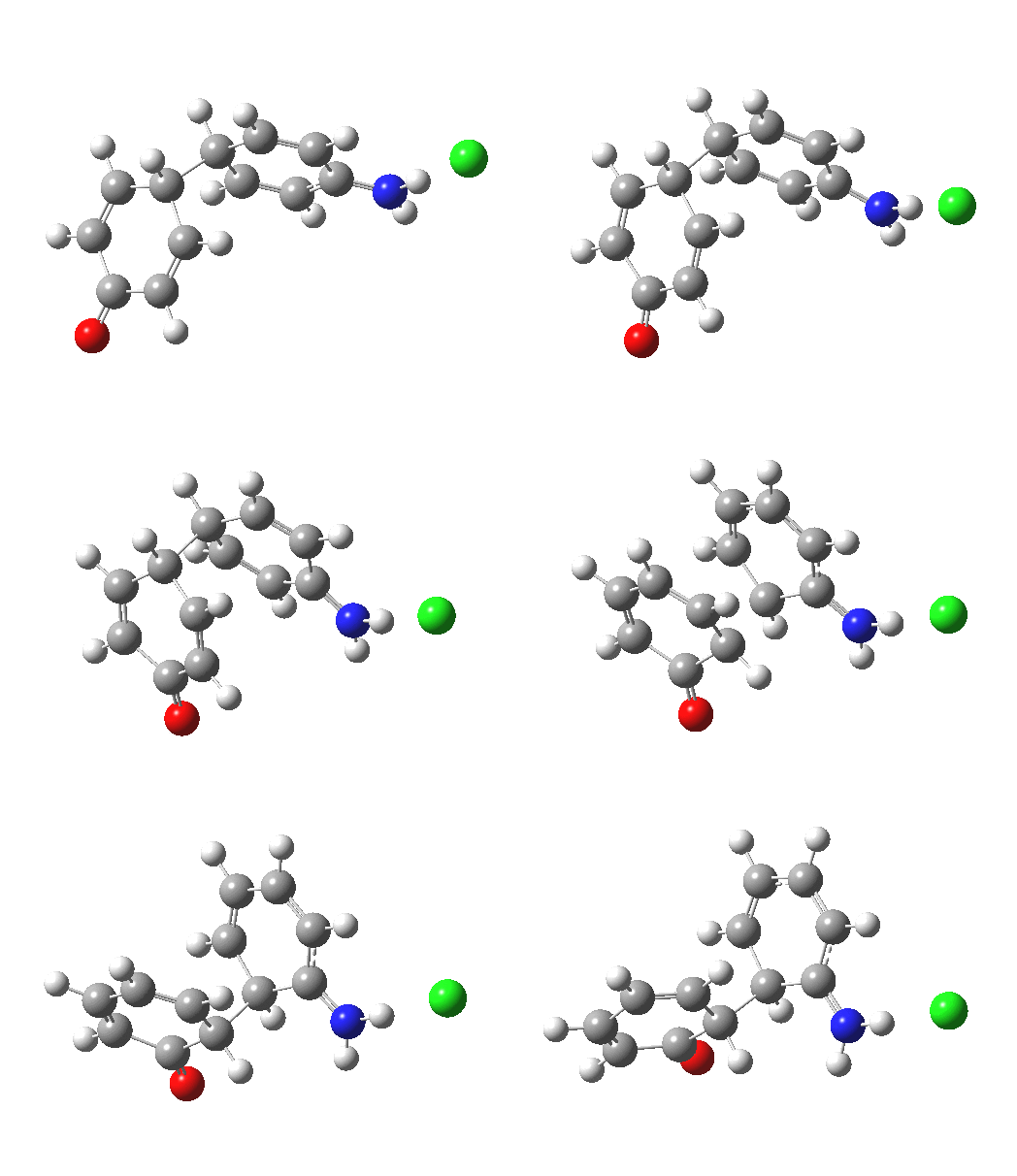
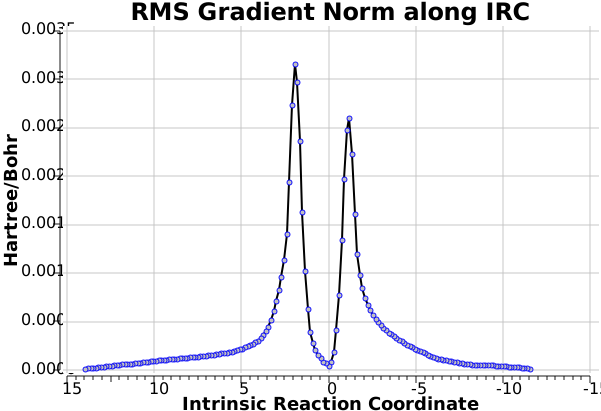
    Here are some intrinsic reaction coordinates to finish with. Firstly, for the formation of the  π-complex from N-protonated precursor:

    PhNH2OPh-NO
     PhNH2OPh-NO PhNH2OPh-NOG 

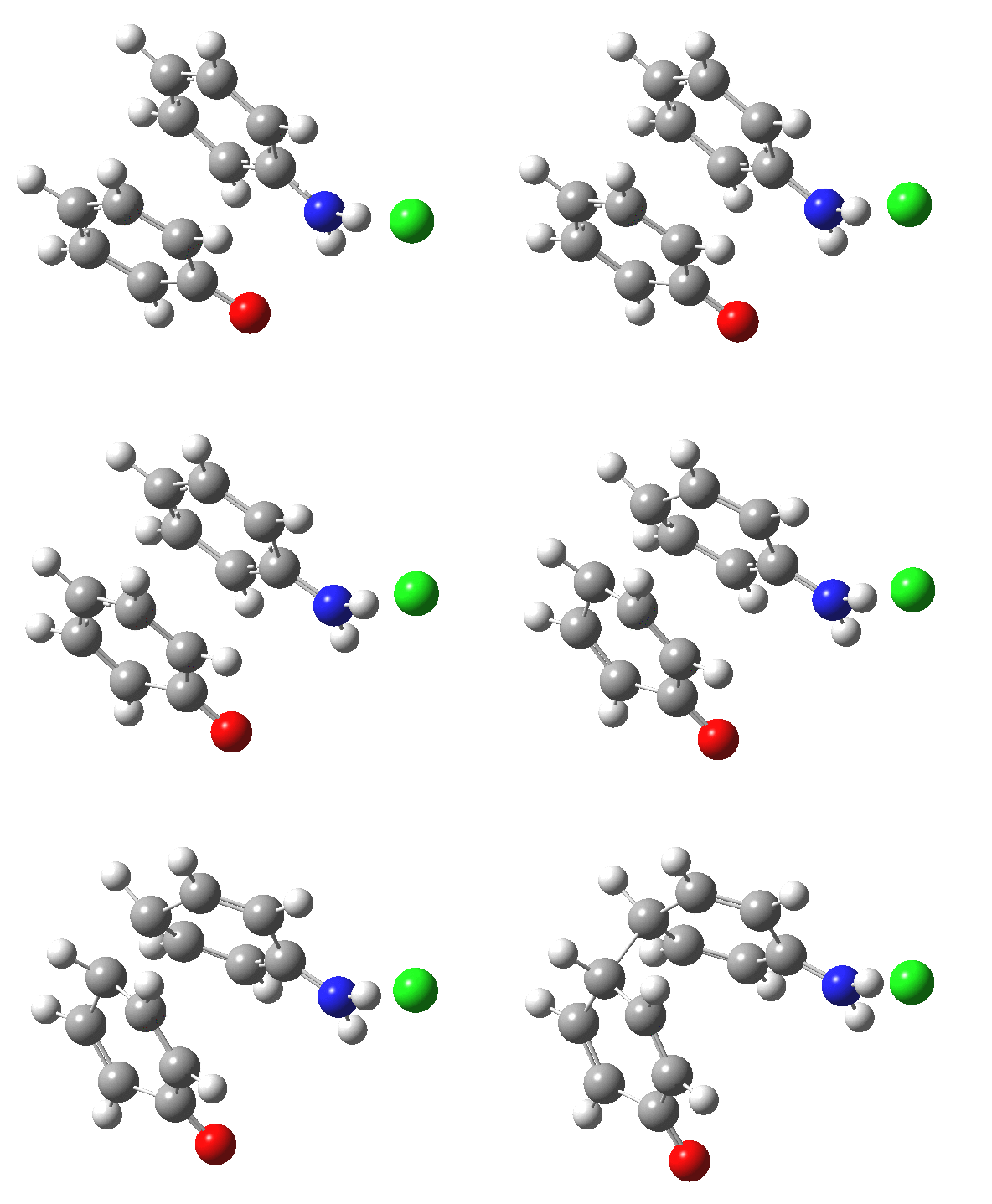
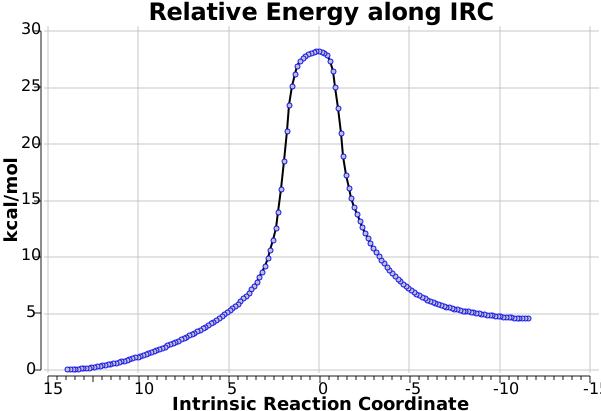
    Once formed, the  π-complex collapses readily to the 4,4′-coupled biphenyl. 

    PhNH2OPh-pi2p
     PhNH2OPh-pi2p PhNH2OPh-pi2pG 

    There may be another pathway which collapses to the 1,1′-coupled biphenyl which I have not found yet. A [3,3] sigmatropic rearrangement converting the 4,4′ to the 1,1′-biphenyl is higher in energy, but still just about accessible thermally.

    PhNH2OPh-o2p
     
    PhNH2OPh-o2p
    PhNH2OPh-o2pG
     

    To end, here is a question. Could one systematically identify “gaps” in the distribution of known molecules; species which appear as if they should exist, but have never been reported? Of these, the majority will no doubt be absent from the record simply because they uninteresting. But some, as here, are absent because they are too unstable to exist, unless (extreme?) precautions are taken to remove the factors responsible for their instability (in this case, protons). Cyclobutadiene was one such famous example (stabilised by coordination to a metal). Certainly, computation nowadays can help identify conditions for how such molecules might be isolated.


    ‡In contrast, PhNHSPh (N-Phenylbenzenesulfenamide) is a well known species[cite]10.1107/S1600536808019491[/cite].