Tag: Historical

  • Reductive ozonolysis: the interesting step.

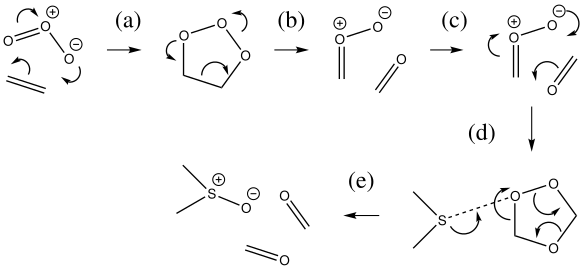
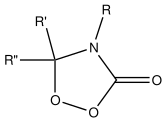
    The mechanism of the reaction of alkenes known as ozonolysis was first set out in its modern form by Criegee. The crucial steps, (a), (b) and (d), are all pericyclic cycloaddition/eliminations. The last step (e) is known as reductive ozonolysis, and this step is often treated as an afterthought, part of the work-up of the reaction if you like (it is not illustrated in Criegee’s review for example). Here, I will attempt to show that it is actually a very interesting mechanistic step.
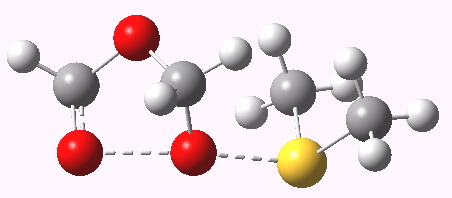
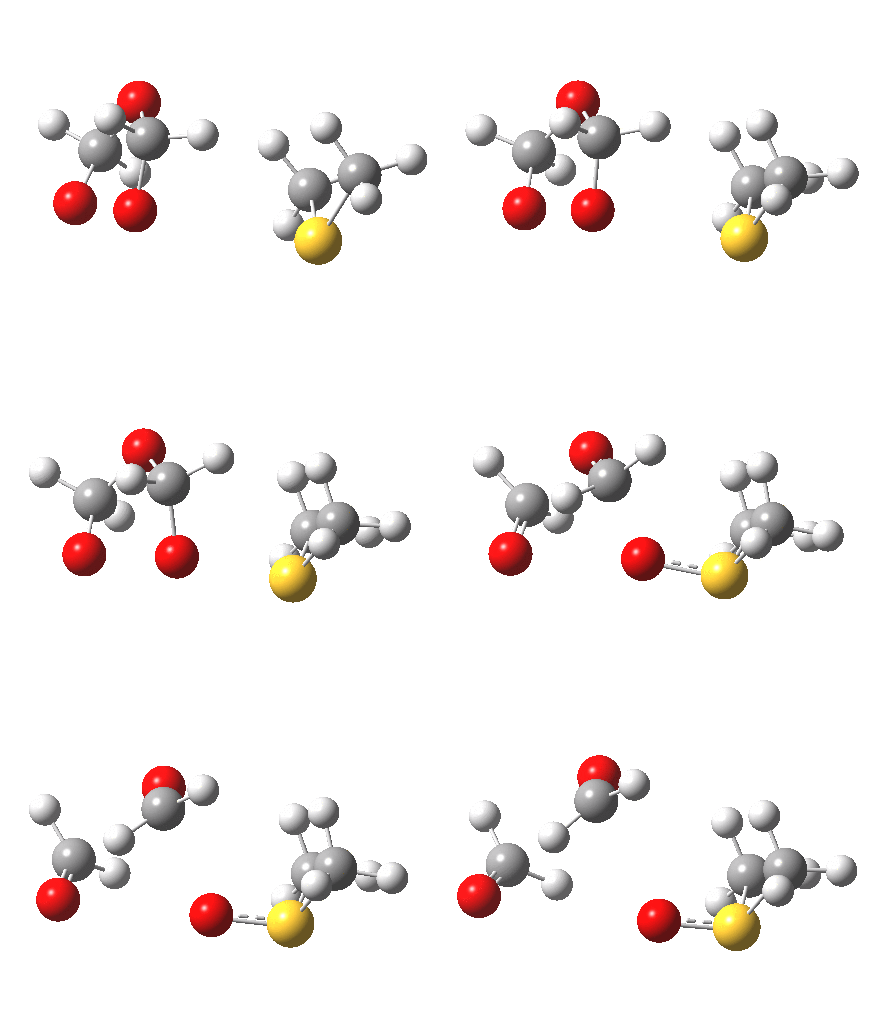
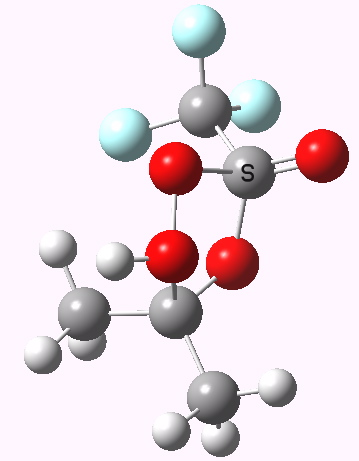
    Step (e) reminded me of a mechanism we had recently investigated, involving desulfurization of epidithiodioxopiperazine fungal metabolites in which an S-S bridge is reduced by one sulfur atom by the action of triphenyl phosphine. Dimethyl sulfide in turn is used to reduce a O-O fragment of the trioxolane intermediate produced from ozonolysis by one oxygen. The transition state for path (e) is shown below (ωB97XD/6-311G(d)/SCRF=dichloromethane).

    Transition state geometry for step (e). Click for 3D.

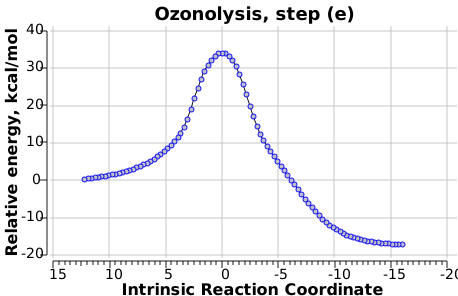
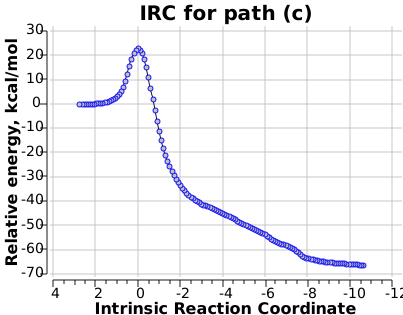
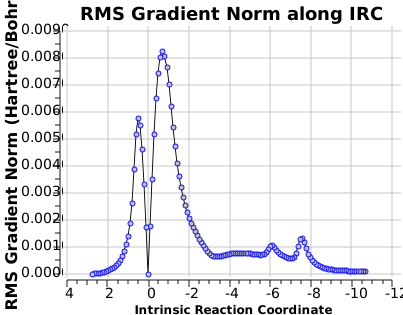
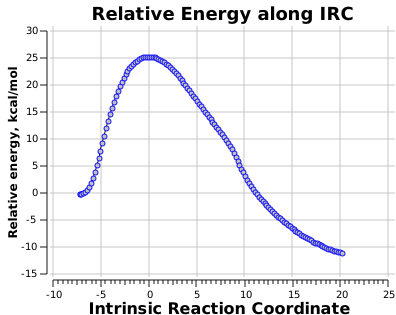
    The reaction IRC for this step is shown below

    1. Notice how the sulfur atom approaches more or less along the axis of the O-O bond.
    2. At the transition state (IRC=0) the three atoms are almost collinear. This might have some steric consequences for sterically congested alkenes.
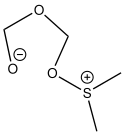
    3. At IRC = -4, cleavage of the O-O bond is almost complete, an the system is starting to resemble the zwitterion shown below (the calculation is done with a solvent continuum field applied, to help stabilise any ionic intermediates that might form). One might be tempted to ask how this species could be stabilised to the extent of having a less transient existence.
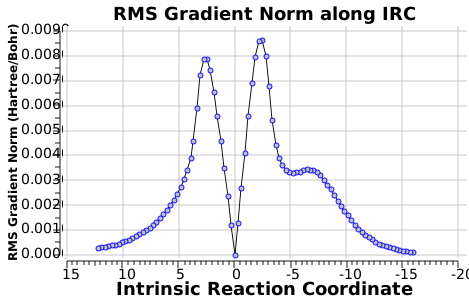
    4. Still, it is highly transient, since there is no actual minimum in the IRC energy profile. Instead, between IRC -4 and -15, the remaining bonds cleave to form the final product shown in the scheme above. As with the previous post, which illustrated the Baeyer-Villiger rearrangement, this reductive elimination is also very asynchronous, with the pair of C-O bonds cleaving after the O-O.

    This again illustrates the reactions where several bonds are either forming or cleaving, the relative dynamics can be quite unpredictable. It may even be strongly influenced by substituents and solvation. All text books of organic chemistry  I know of rarely if ever address this aspect of mechanism. With new generations of interactive and dynamic text books about to spring upon us, it might be time to rethink what goes into them. I would hope it is not just a rehash of  what one might call the classical arrow pushing representations of mechanism.

  • The mechanism of the Baeyer-Villiger rearrangement.

    The Baeyer-Villiger rearrangement was named after its discoverers, who in 1899 described the transformation of menthone into the corresponding lactone using Caro’s acid (peroxysulfuric acid). The mechanism is described in all text books of organic chemistry as involving an alkyl migration. Here I take a look at the scheme described by Alvarez-Idaboy, Reyes and Mora-Diez[cite]10.1039/b712608e[/cite], and which may well not yet have made it to all the text books!

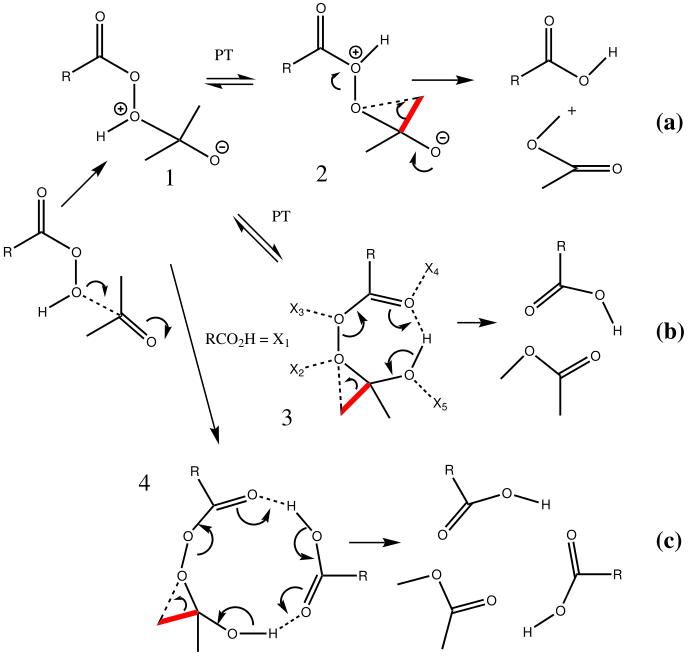
    The text-book mechanism involves pathway (a, R=CF3) via species 1 and 2. A characteristic feature of many a mechanism of this type is the need for a step often labelled just PT (proton transfer). Very often, a proton will find itself attached to the wrong atom, and before the mechanism can be completed, it must be transferred to the correct location. Confusingly, there can be many ways of doing this, differing in the timing of the proton choreography. Deciding that running order can be perplexing to new students of chemistry. Tutors often will say that since PTs are very fast, it does not matter when this step occurs, since in effect all paths will lead to the final product. But we might imagine that the energies of all the various pathways can be (in principle) obtained from quantum calculations and that one will prevail over the others.

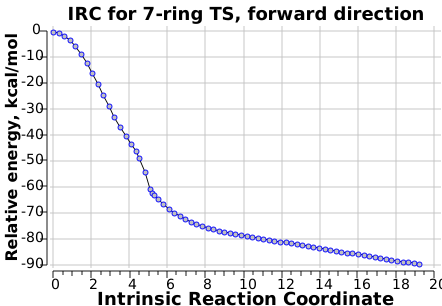
    Path (b) is just one such variation, but with a twist, since it involves starting from 3 and proceeding via a cyclic transition state in which the migrating alkyl group (shown in red above) moves in concert with the relocating proton. I have repeated the original calculations (from 2007) using a somewhat updated procedure, much in the same way that the transition state for the aldol reaction was. A ωB97XD/6-311G(d,p)/SCRF=dichloromethane calculation[cite]10.14469/ch/13926[/cite] of step (b) gives the transition state and associated intrinsic reaction coordinate (IRC) shown below.

    Cyclic 7-ring mechanism for the Baeyer-Villiger. Click for 3D.
    IRC for 7-ring TS, forward direction only.

    Choreographically, this transition state is quite complex. Five bonds, all different in some aspect, are changing in asynchronous concert.

    1. Following the transition state[cite]10.14469/ch/13929[/cite] towards the product, between IRC=0 and +4, we see the cleavage of the O-O bond occurring in synchrony with the migration of the alkyl (methyl) group towards the oxygen (think of it as an SN2 reaction at oxygen). Notice the antiperiplanar stereoelectronic alignment of the migrating (methyl) and the axis of the O-O bond, which strongly differentiates which of the two alkyl groups migrates. The non-migrating group is essentially orthogonal to the O-O bond.
    2. At IRC = +5 we see a sudden abrupt feature, which corresponds to transfer of the proton, and which is complete by IRC = +6. Protons, being light, do tend to move quickly when they decide to.
    3. The final noteworthy feature from IRC=+6 to >20 is the rotation of the newly formed methoxy group, starting from orthogonality with the carbonyl group (~IRC +6) to co-planarity (IRC > 20). The origins of this effect are associated with the same orthogonal/antiperiplanar stereoelectronic alignments that determined which alkyl group migrated earlier.
    4. Notice a minor feature, which is the rotation of the methyl groups to set up weaker stereoelectronic interactions.

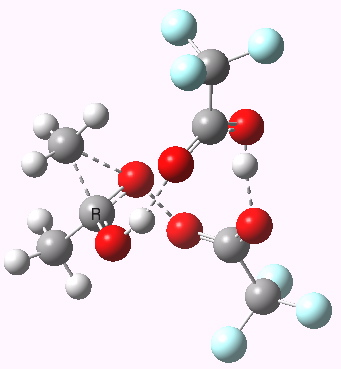
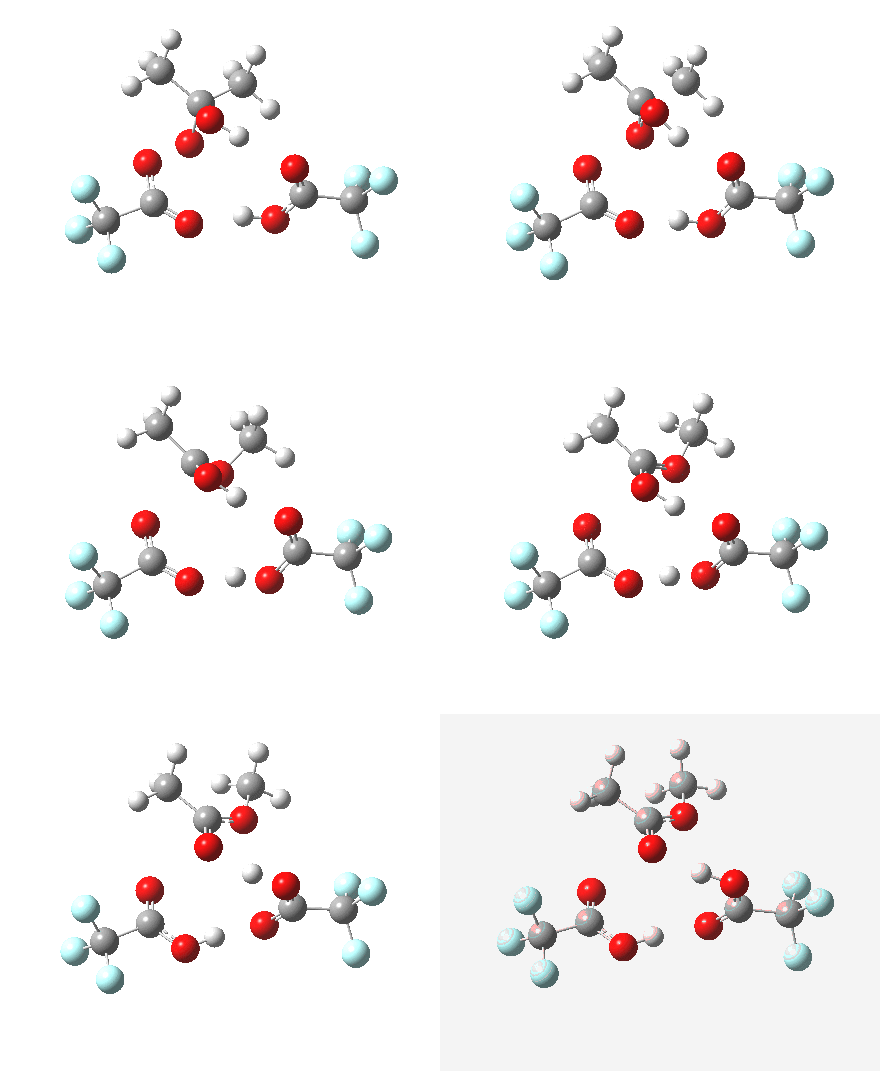
    Path (c) is another variation, where an extra molecule of acid (X1, 4) helps catalyse the reaction, this time by creating an 11-membered ring 4 leading to a transition state with potentially two proton transfers as well as the alkyl migration.[cite]10.14469/ch/13927[/cite] By involving an additional second molecule of acid as catalyst, we now have seven participating bond changes. Whilst the original path (b) six endo and two exo electrons move in a cycle which is tantalisingly close to but not quite pericyclic (?), path (c) extends this by four electrons. It might be tempting to try to apply a selection rule here (such as 4n+2) but I am not sure it would be justified. 

    Baeyer-Villiger, 11-ring transition state. Click for 3D
    1. IRC +3 represents the starting tetrahedral intermediate 4 hydrogen bonded to an extra (trifluoroacetic) acid molecule.
    2. The transition state occurs at IRC =0.
    3. By IRC -2, O-O cleavage and methyl migration are essentially complete, but no protons have moved.
    4. From IRC -2 to -5, the methoxy group rotates to adopt the planar conformation of an ester.
    5. Only after this rotation does the first proton transfer start, at IRC -6, and this is then followed in rapid succession by a second at  -7 to complete the reaction to form ethyl ethanoate and two molecules of (trifluoroacetic) acid. This is a reversal of the sequence seen with path (b). Because no intermediates are discernible in the IRC, one must describe this as a concerted rearrangement, but in fact the bond choreography is far from synchronous. This is one aspect which conventional  arrow pushing does not capture.

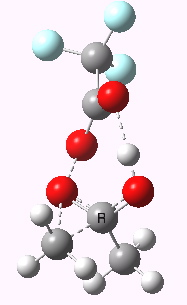
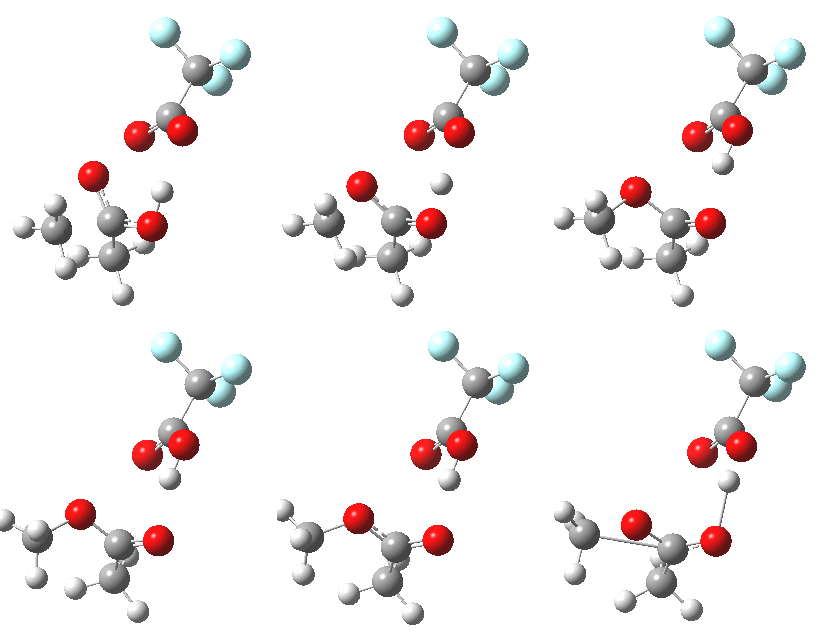
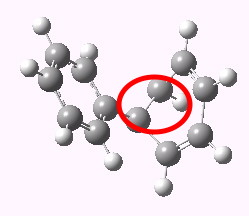
    To directly compare the energies of paths (b) and (c), we can repeat (b) with the addition of a more passive acid catalyst, in four new positions 3, X2 – X5. None of these are lower than 4 itself. There is one more surprise. Species 1 is not actually a minimum, but rearranges to e.g. the cyclic ring shown below. Its free energy is still higher than that of 3.

    I will end with the following speculation. The point of interest to most students of the Baeyer-Villiger reaction is not the nature of the actual transition state, but deciding which of the two possible alkyl groups will migrate (in the example above both are methyls, but if one were e.g. phenyl it would migrate in preference to the methyl). The transition state teaches us that the group antiperiplanar to the O-O bond migrates. Can a system be devised where the antiperiplanar preference takes precedence over the migratory aptitude? For example, based on the following[cite]10.1039/p19940003295[/cite] (click to see 3D structure below in which one R group is clearly pre-disposed to migrate in preference to the other).

  • The Dieneone-phenol controversies.

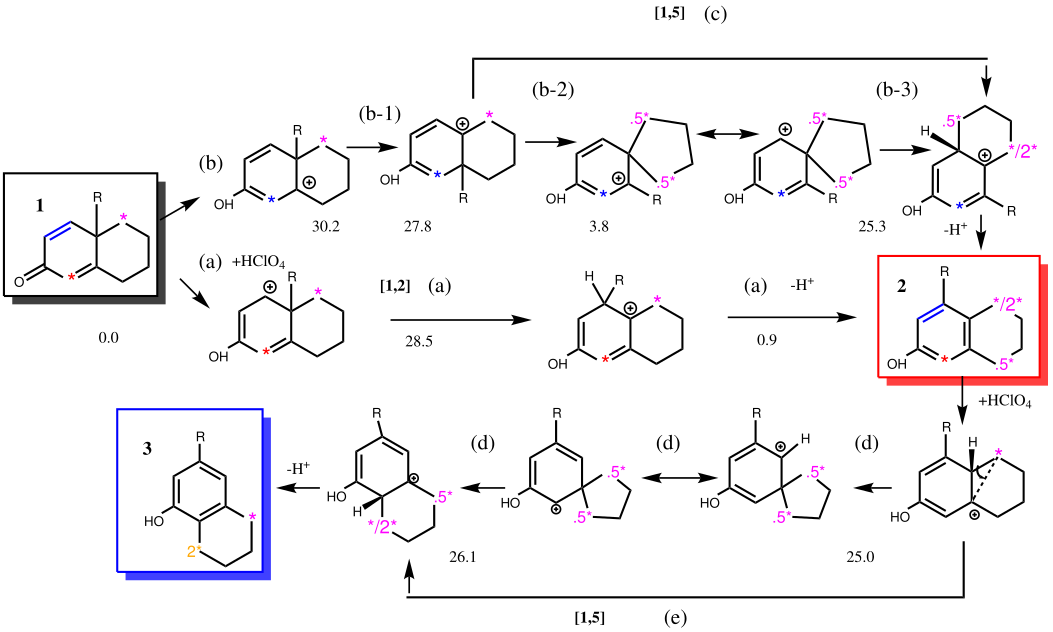
    During the 1960s, a holy grail of synthetic chemists was to devise an efficient route to steroids. R. B. Woodward was one the chemists who undertook this challenge, starting from compounds known as dienones (e.g. 1) and their mysterious conversion to phenols (e.g. 2 or 3) under acidic conditions. This was also the golden era of mechanistic exploration, which coupled with an abundance of radioactive isotopes from the war effort had ignited the great dienone-phenol debates of that time (now largely forgotten). In a classic recording from the late 1970s, Woodward muses how chemistry had changed since he started in the early 1940s. In particular he notes how crystallography had revolutionised the reliability and speed of molecular structure determination. Here I speculate what he might have made of modern computational chemistry, and in particular whether it might cast new light on those mechanistic controversies of the past.

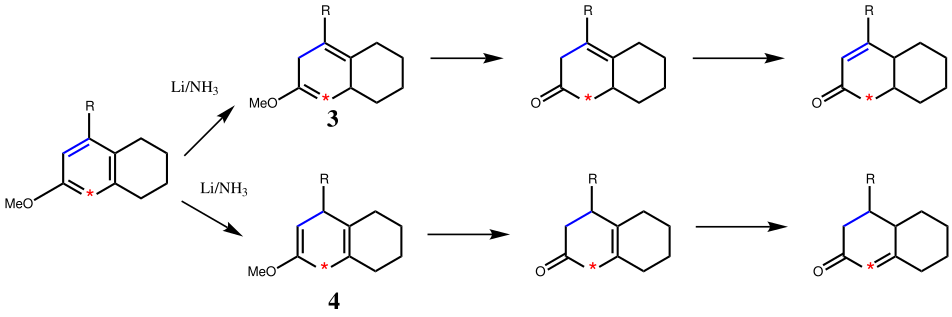
    Charting the mechanistic pathway connecting 1 and 2 was first done by Capsi[cite]10.1016/S0040-4039(01)90679-3[/cite] using 14C labels (* in the diagram above, on a steroid derivative),  when after claimed selective Birch reduction of the blue double bond in 2, alkene ozonolysis and decarboxylative loss of *, all the radioactivity ended up in the CO2. This showed[cite]10.1021/ja01066a032[/cite] that the mechanism involved path (a). For paths (b) or (c), the label would have ended up at * and hence not oxidatively lost as CO2. Futaki[cite]/10.1016/S0040-4039(00)90831-1[/cite] did the experiment in a different way, putting his 14C label in the position * where he found that only about half of the label was retained in this position (and then lost when he specifically degraded 2 by oxidatively removing that carbon). This now strongly implicated path (b), and also seemed to disprove not only path (a) but also mechanism (c), where a [1,5] shift should have retained the label at the original position (and caused all of it to be lost upon decarboxylation). It was these two apparently contradictory results that helped ignite the controversies.

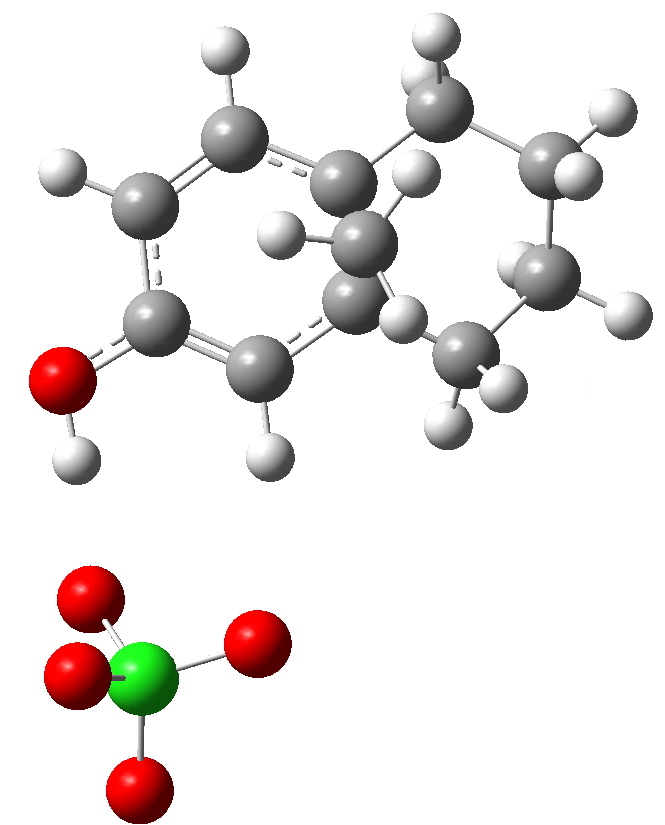
    All the routes (a)-(e) above involve pericyclic sigmatropic reactions, the understanding of which was about to be revolutionised by Woodward (with Hoffmann) in the mid 1960s. In fact, the mechanism here comprises a mixture of [1,2] cationic sigmatropic migrations and [1,5] neutral sigmatropic migrations. To balance one against the other, can computational chemistry come to the rescue? I first note that the mechanisms above are all shown as cations. Until recently, a computational chemist would simply set the charge on their model to +1 and proceed onwards and upwards. But now we can do a bit better. We can (arguably we always should) include the counterion, and so in my own exploration, I have included a perchlorate anion, and the whole study then becomes one of a neutral system (charge =0), a zwitterion. A B3LYP/6-311G(d,p) model with SCRF=water continuum solvent was employed. Let us see what emerges:

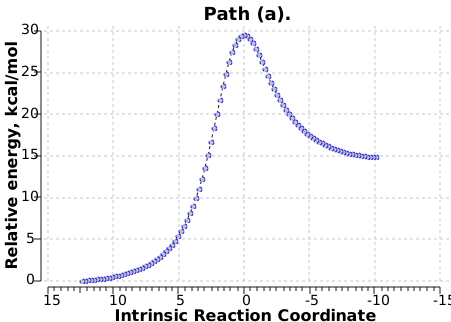
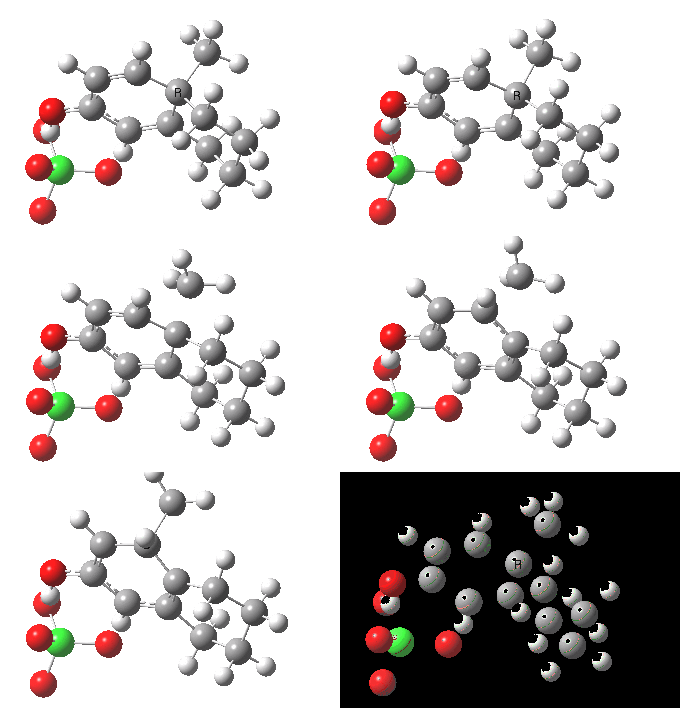
    1. Path (a) involves a [1,2] angular methyl (R=Me) migration, which turns out to have ΔG28.5 kcal/mol. The IRC for this migration is shown below. 

      The (Wheland) intermediate then loses a proton to give 2.

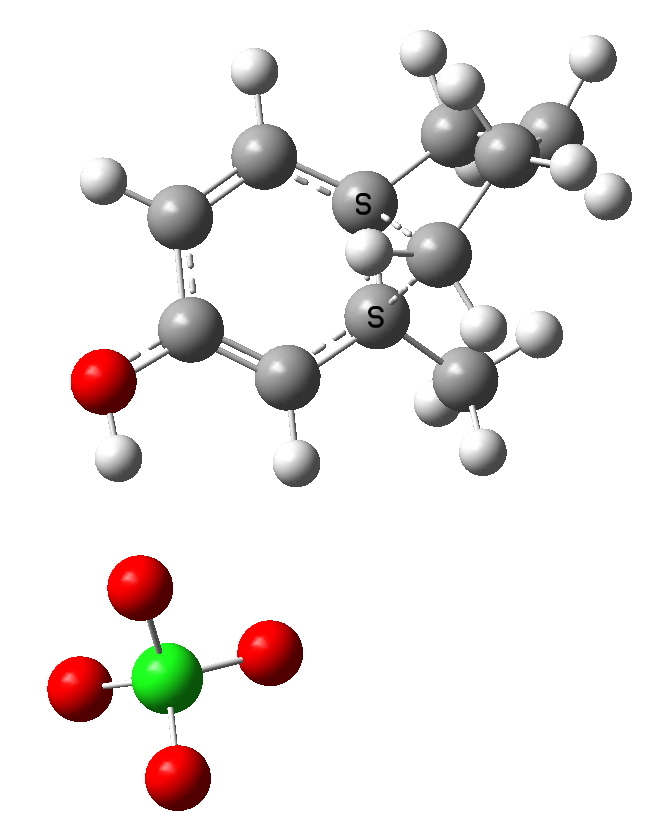
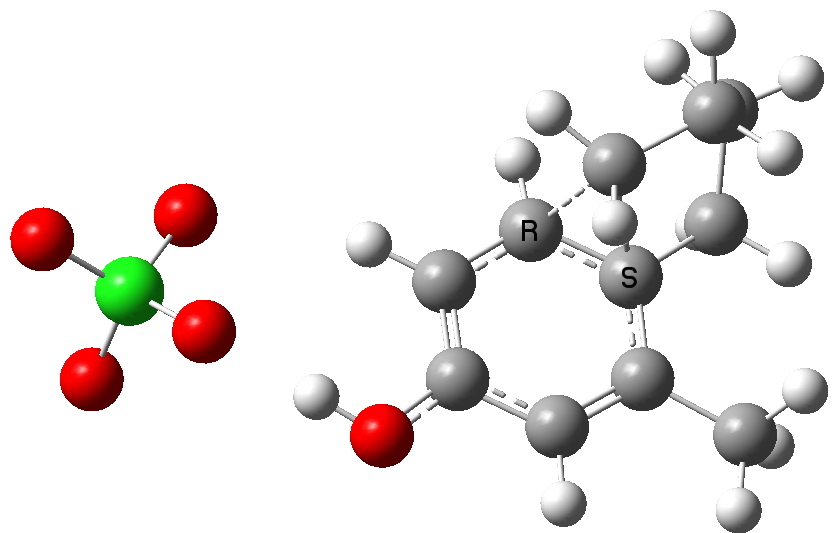
    2. Path (b) involves an alternative rate-limiting migration of the angular methyl, ΔG30.2 kcal/mol, followed by two lower energy [1,2] migrations of the ring ΔG27.8 and 25.3via a spiro-ring Wheland intermediate (relative energy +3.8 kcal/mol), and deprotonation to again give 2.
      Path b-1. Click for 3D
      Path b-2. Click for 3D
      Path b-3. Click for  3D

      Notice how the perchlorate counterion is relatively free to change its position relative to the substituents, and not all these positions have been explored here. This stochastic problem is an issue with counter ions (more accurately, this problem is almost always massaged away by simply ignoring this counterion. But if its ultimate positioning does matter, then one must argue that its inclusion is essential in order to build a good model). 

    3. The energy of path (a) is thus seen to be 1.7 kcal/mol lower than (b/c), which is sufficient to favour positioning of most of the 14C tracer on * rather than and which seems to favour the Capsi mechanism over the Futaki one, although clearly the balance between the two is a fine one. The  Capsi mechanism does seem to hinge on the observation that  Birch reduction of  1 reduces the blue bond entirely specifically, and the evidence for this does need to be reviewed (in an informatics sense, this evidence is buried in a string of logically connected semantic inferences, each of which may well be contained as a passing comment in a different article).
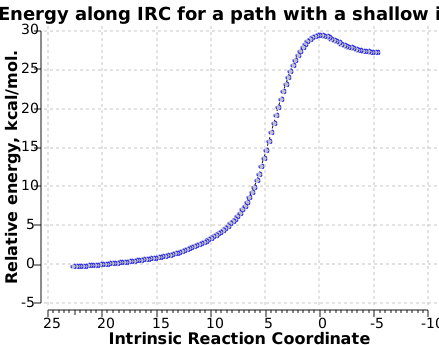
    4. Regarding the matter of whether path (b) or  path (c) is the better representation, this goes to the heart of whether the path is respectively stepwise or concerted. The barriers for escape out of the spiro-ring intermediate defining the steps in path  (b) are key. The IRC for a reaction path with a shallow intermediate  is shown below. If the depth of the well it finds itself in imparts sufficient lifetime for it to lose all  (dynamic) memory of where it came from, then the probability of the  * label remaining in its original position is only 50%, since the other (symmetrically equivalent but unlabeled) position may also migrate in the next step. This seems to be the case for path (b), where the intermediate is in quite a deep well (21.5 kcal/mol for escape), and this is consistent with Futaki’s experiment. If the intermediate however were to be in only in a shallow minimum (2-4 kcal/mol), the momentum it[cite]10.1021/ja026230q[/cite] inherits from the previous transition state may carry it over to the second stage without scrambling the isotope. For systems such as these, we do encounter a serious limitation of simple transition state theory, and must start to adopt a molecular dynamics approach. This might also apply to the positioning of the counterion, although perhaps less so for the relatively heavy perchlorate. It may also be an interesting issue of electron dynamics. Path (c) formally involves six electrons, path (b) only two. In a previous post, I speculated whether the electronic pack size for proton transfer was 4,6 or 8 electrons. Perhaps one day it will be possible to either measure (attosecond spectroscopy) or compute the preferred dynamics.
    The points made in the last section come to the fore in a result obtained by Hopff and Drieding (he of the models). They confirmed[cite]10.1002/anie.196506901[/cite] the formation of 2 from 1, and also reported that at 80°C in 70% perchloric acid, 2 was itself then converted in two hours to 3. The debate again turns to whether this is accomplished via path (d) involving 2-electron shifts or path (e) involving a 6-electron shift. No radio-labelling experiments have been reported on this system. 
     
    Well, as suspected perhaps, the computational analysis of the dienone-phenol rearrangements has shown the system to be poised on a knife-edge (of chaos). Tiny changes might swing things one way or the other. Adding two further (steroid rings) to  1 might of itself change the balance between e.g. path (a) and  path (b). So too might a change of counterion, or indeed solvent. One needs to identify the evidence that selective reduction of 2 reduces just the blue bond. If computational chemistry has not (yet) provided a clear-cut resolution to the chemistry of this system, at least it can identify new experiments that might.

    Postscript: I posed the question above about Capsi’s identification of the reduction product of 2. The two possible products would give different outcomes for whether the * label would be lost upon subsequent oxidation or not.

    If the reaction is thermodynamically controlled, then the relative free energies of 3 and 4 would determine the outcome. A B3LYP/6-311G(d,p) calculation (in ethanol as solvent, which has a very similar dielectric to liquid ammonia) predicts 4 is about 0.3 kcal/mol lower than 3. This does not suggest that the reaction is going to be particularly regioselective, and of course Capsi’s interpretation depends on the product being entirely 4, with no 3 formed.

  • Stereoselectivities of Proline-Catalyzed Asymmetric Intermolecular Aldol Reactions.

    Astronomers who discover an asteroid get to name it, mathematicians have theorems named after them. Synthetic chemists get to name molecules (Hector’s base and Meldrum’s acid spring to mind) and reactions between them. What do computational chemists get to name? Transition states! One of the most famous of recent years is the Houk-List.

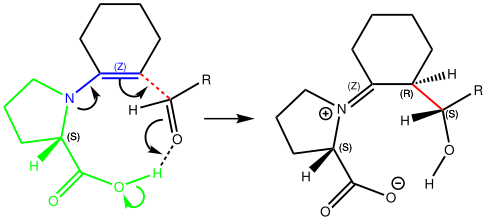
    In the last 12 years or so, the area of enantioselective organocatalysis has blossomed, and an important example involves the asymmetric amino acid (S)-proline (below, shown in green). As its enamine derivative (below, shown in blue), it can catalyse the aldol condensation with an aldehyde or ketone to form two new adjacent stereogenic centres resulting from C-C bond formation (shown below as (R) and (S) as attached to the carbons connected to the red bond).

    The Houk-List transition state was located for this reaction, and as a useful model for rationalising the stereospecificity of this reaction it has become justly famous (although to be fair, other models have also been proposed). The challenge is to identify the factors selecting for just one stereoisomer (S,R in this case) over the other three (a similar challenge is described in this post for the heterotactic polymerisation of lactide). Houk, List and co-workers constructed their model (the example shown below is for R=isopropyl)  as follows.

    1. They employed a B3LYP/6-31G(d) density functional model.
    2. The geometry of the transition state was located for all four diastereomeric transition states using this method. Importantly, this geometry was for the gas phase, which provided a value for ΔG298.
    3. These free energies were then corrected for the (relative) solvation energies of the four transition states. This was essential, since in the mechanism shown above, a neutral reactant gives a zwitterionic product, via a partially ionic transition state (indeed, the dipole moment of these transition states is around 10D). 
    4. The resultant Houk-List model then predicted that of the four isomeric transition states, the lowest was (as shown above) the (S,R) diastereomer.
    5. This particular transition state geometry has an interesting feature involving a 9-membered ring, large enough to accommodate a linear proton transfer without strain, by virtue of a trans double bond motif (the C=N bond). The (S,S) and (R,S) isomers have a cis motif instead at this location.
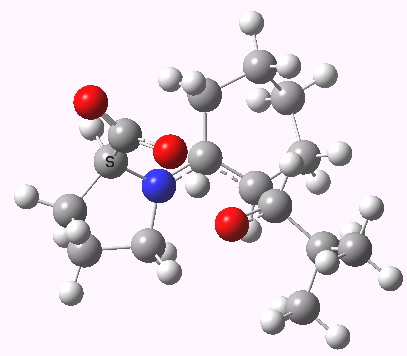
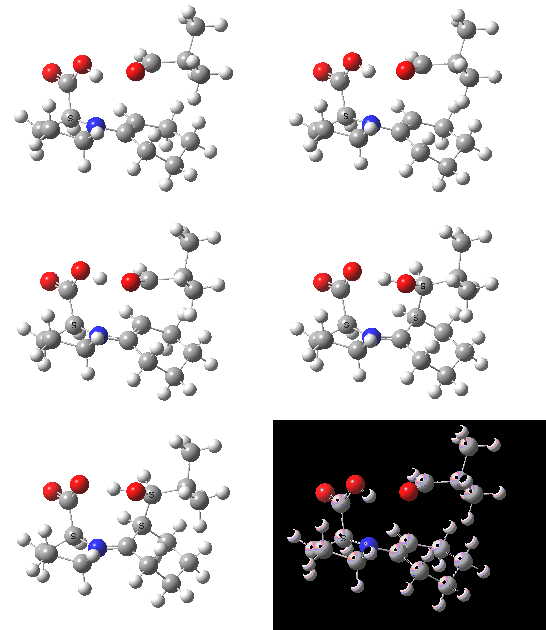
      Houk-List transition state. Original geometry.

    Well, this transition state is now nine years old. Unlike asteroids, or mathematical theorems, or indeed molecules and their reactions, a transition state is a slightly more ephemeral object. Its features and properties do rather depend on the particular quantum model used to construct it. There is one feature of the model, necessary in 2003, but no longer so in 2012. This was the use of a gas-phase optimised geometry, augmented at that geometry with a so-called single-point solvation energy correction. Nowadays, the solvation correction is included in the energy used in the geometry optimisation, which now properly reflects the effect of the solvation. Re-optimisation with this inclusion, at the ωB97XD/6-311G(d,p)/SCRF=dmso level thus updates the original Houk-List geometry.

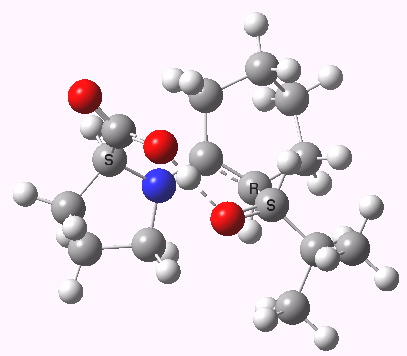
    (S,R) Houk-List transition state, updated geometry. Click for 3D
    1. The most significant changes involve the O…H—O bond lengths. Respectively 1.13/1.31Å in the original, they change to 1.06/1.40Å at the new level.
    2. The forming C-C bond changes in length from 1.89 to 2.05Å (the latter, it has to be said, being a much more “normal” value for a transition state). 
    3. Whilst these might not seem very great changes, we do not yet know how they might impact upon the relative free energies of the four transition states. Houk and List reported the (S,R), (R,R), (S,S) and (R,S) relative free energies as 0.0, 6.7, 7.8 and 4.6 kcal/mol. The updated values for (S,R), (R,R), (S,S) and (R,S) [click on preceding links to view models] are 0.0, 6.0, 5.7 and 5.4 kcal/mol [click on preceding links to view calculation archives], which represent only minor changes to these energies.
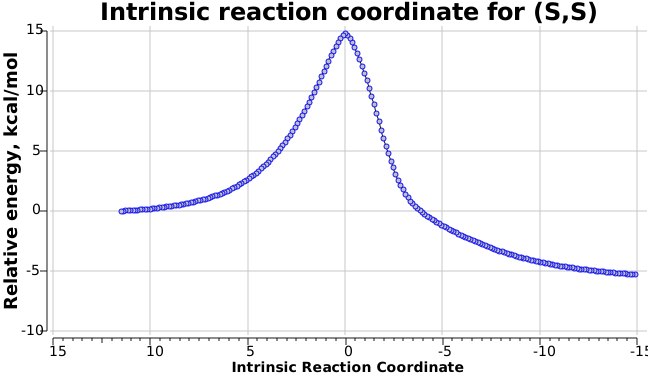
    4. The (S,S) diastereoisomer is an interesting outlier. The transition state normal mode wave numbers are -373, -481, -815 and -402 cm-1 respectively and the O…H…O bond lengths for (S,S) are 1.18 and 1.20Å, a rather more symmetrical proton transfer than the other three.

    Which brings us to the main point; what is the origin of the diastereoselectivity? An NBO analysis can compare the total steric exchange energy (due to Pauli bond-bond repulsions) of the four isomers, which  turns out to be respectively 1214, 1221, 1235 and 1229 kcal/mol. In other words, the favoured isomer has the smallest steric exchange energy. Of course this one term is not the only contributing factor, and a more elaborate analysis will no doubt provide further insight.

    So an update to the Houk-List transition state reveals the general characteristics are intact and it is still a very useful model for analysing stereoselectivity in proline organocatalysis.

    Postscript:  The Intrinsic reaction coordinate  (for (S,S) ) is shown below.


  • Perbromate. A riddle, wrapped in a mystery, inside an enigma; but perhaps there is a key.

    Chemists love a mystery as much as anyone. And gaps in patterns can be mysterious. Mendeleev’s period table had famous gaps which led to new discovery. And so from the 1890s onwards, chemists searched for the perbromate anion, BrO4. It represented a gap between perchlorate and periodate, both of which had long been known. As the failure to turn up perbromate persisted, the riddle deepened. Finally, in 1968, the key was found, but talk about sledgehammer to crack a nut! It was done by alchemical-like radioactive transmutation of selenium into bromine:

    Se83O42- → Br83O4 + β

    Once the psychological barrier had been surmounted, a chemical synthesis provided enough perbromic acid to show it was a stable, high boiling liquid. So, the failure to make it was not because it was unstable!

    XeF2 + NaBrO3 → NaBrO4

    Once quantities were available, the thermodynamic and redox properties could be measured. This did little to solve the riddle. Although it was found to be a better oxidant than periodate, this was not considered enough to explain why it had proved so elusive. The theoreticians got in on the act, but their article too did little to resolve matters; the calculations merely verified the experimental measurements.

    To this day, little perbromate has been made, and so much of its chemistry remains a mystery. Only in 2011 has a synthesis appeared which could potentially result in large and hence cheap quantities, by formation through the carefully controlled reaction of hypobromite and bromate ions in an alkaline sodium hypobromite solution.

    Periodate has found much utility in organic synthesis as an oxidant, and perchlorate is a very interesting non-coordinating counter ion in metal catalysis. Who knows what use might transpire for perbromate!

    So, unlike the gaps in the periodic table, plugging the perbromate gap has not yet resulted in unexpected discoveries. But it is worth speculating why any given compound may be non-existent. It may be thermodynamically unstable, and hence have too short a lifetime to be isolated (not the case for perbromate). Or all of the possible kinetic pathways to its formation may have unfeasibly large barriers. The key here is the word all; if one searches long enough, a route that works will probably be found.

    The other side of the coin is novel types of compounds that may well exist, but no-one has anticipated trying to make them precisely because they are so novel. I am thinking here of the wonderfully entitled article “Mindless Chemistry” where systematic exploration of ALL possible minima for a given molecular formula revealed a whole zoo of species which the speculative chemist would never have dreamt of trying to make (in other words, they did not manifest as obvious gaps in the patterns that constitute our present chemical knowledge). I do often think about all of these undiscovered molecules, and if they could indeed be synthesised and their properties studied. One such occurred in silicon chemistry; truly the existence of an isomer of hexasilabenzene was not predicted before it was made, and its properties (aromaticity) did indeed prove fascinating and new.

    Too long the focus of synthetic chemistry has been to try to make molecules that nature has already synthesized. Perhaps we should focus as well on molecules that nature has never deigned to make, but which are nevertheless entirely viable (as was the case for perbromate).

  • A golden age for (computational) spectroscopy.

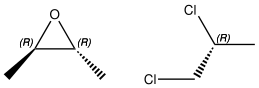
    I mentioned in my last post an unjustly neglected paper from that golden age of 1951-1953 by Kirkwood and co. They had shown that Fischer’s famous guess for the absolute configurations of organic chiral molecules was correct. The two molecules used to infer this are shown below.


    Using the theory Kirkwood had developed, the prediction for the optical rotation at the sodium D line for the (R,R) enantiomer of epoxybutene (Kirkwood did not use this R,R notation, which was still in the future) was +43°. The measured value was [α]D +59°. The (R,R) enantiomer did indeed correspond to Fischer notation.

    QED.

    A postscript is that a modern equivalent of Kirkwood’s result, using the ωB97XD/6-311+G(d,p) method gives +67° for the gas phase and +57° for solution (in CCl4). The experimental value relates to the pure liquid. In fact, Kirkwood had been very aware that solvation can influence the measured value of an optical rotation, and so even today, a match between experiment and calculation of ± 16 ° is considered a good fit.

    But when it comes to the second molecule, (R)-1,2-dichloropropane, we are in a different ball park. In fact, most of Kirkwood’s article is devoted to unravelling this second system. This is because it was realised that it is conformationally flexible. Two conformations (this term was then often used interchangeably with configuration, which might confuse a modern audience) called trans and skew (now called anti and gauche) were considered and it was realised that the relative populations would be influenced by temperature and particularly, the solvent. I quote here the final conclusion: We have assigned the absolute configuration of Fig. 2 to the dextrorotatory isomer of 1,2-dichloropropane. This was done without any experimental data concerning the optically active forms of the molecule, using only the calculated dependence of the rotatory power on conformation (Table II) and the information about the potential of internal conformation obtained from the electron diffraction and dipole moment measurements.

    Non trivial then! Perhaps this is why these techniques were not immediately picked up by synthetic chemists to verify the absolute configuration of their own molecules. But my point is that the use of such techniques now seems to be growing exponentially, which is why this post is headed the golden age of computational spectroscopy. So what of such a modern take on  (R)-1,2-dichloropropane (in heptane, which corresponds to the measured value of +20 to +30, and -21° for the (S) enantiomer). Well, there are in fact three viable conformations, not two as Kirkwood supposed. He did not know that the gauche stereoelectronic effect favoured two of them despite the greater steric encumbrance. The calculated rotations are +53 (anti), +96 (gauche) and -182° (second gauche conformer). Such dependence on conformation is sadly not unusual, and it means you have to know the Boltzmann population very accurately indeed to infer an observed value. This might in part explain the rather circuitous argument used by  Kirkwood for dichloropropane!

    Fortunately, nowadays optical rotation (more accurately referred to as optical rotatory power, or ORP) is just one of a growing armoury of spectroscopic measurements that can be computed to the accuracy required to draw firm conclusions. These include ORD (optical rotatory dispersion, or variation with the frequency of the polarised light used), ECD (electronic circular dichroism) and VCD (vibrational circular dichroism). It is still not absolutely routine, but these techniques are now found in an increasing number of synthetic chemists’ toolkits.

    And my final reflection is to ponder that the golden age of pharmaceutical synthesis (lets say  1950 – 2000, but  I know I may get dissent), in which certainty about the separate physiological effects of both enantiomers of chiral drugs became mandatory, would not have been possible without Kirkwood’s pioneering article, along of course with Bijvoet’s independent result.

  • Violations. There are none!

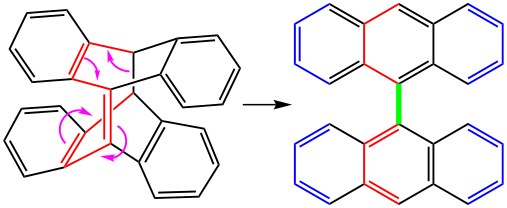
    Thus famously wrote Woodward and Hoffmann (WH) in their classic monograph about the conservation of orbital symmetry in pericyclic reactions. But they also note that the “fantastic” hydrocarbon (number 85 in their review) shown below presents a situation of great interest in having a half life of ~30 minutes at 353K (a free energy barrier of ~ 26.2 kcal/mol). Here I investigate if it might actually be such a violation.

    I should first note that WH expect that violating reactions are likely to comport themselves via a non-concerted reaction path involving discrete intermediates.1 Which in the above case would be a biradical. But why is it an interesting example? Because, as a 4n (n=2) electron electrocyclic reaction (involving the bonds shown in red above), it must involve one antarafacial component. This is apparently rendered impossible (so WH claim) by the very rigid geometry of the system. However, an alternative, and geometrically more viable reaction involving only suprafacial components would indeed be be a violation according to their definition, if it were to be concerted, without (biradical) intermediates. So if a concerted pathway with no antarafacial components could be found, it would constitute a violation.

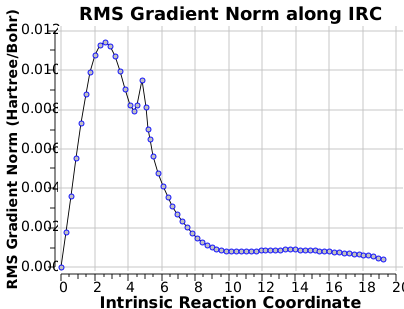
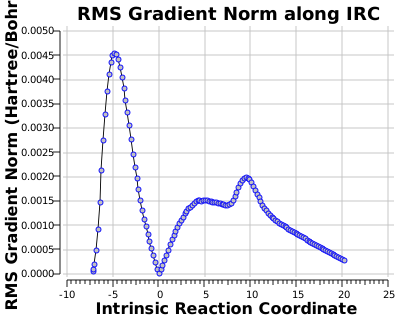
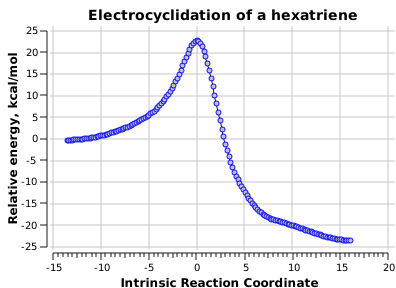
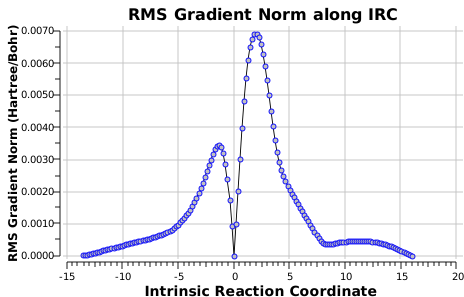
    To model this system, the benzo groups (blue) are first removed. A transition state for the reaction is found [ωB97XD/6-311g(d)] with ΔG 21.5 kcal/mol and an intrinsic reaction coordinate (IRC) that shows a concerted profile, albeit one with quite unusual features revealed in the gradient norm along the IRC.

    1. One might first note that the calculated barrier is similar to that measured for the real reaction (albeit with benzo groups). Although this does not prove that a lower energy process (such as involving biradicals) does not occur, it does at least suggest that the concerted pathway is not unreasonable given the observed kinetics of the reaction.
    2. The geometry up to the transition state (IRC=0.0 above) retains a plane of symmetry, and there is no hint of any axis of symmetry developing that might be associated with twisting due to an antarafacial component (click on the graphic below to inspect this geometry). However, the length of the cleaving bond (2.85Å) is unusually long for a transition state involving C-C cleavage, and the double bond (green above) is still intact (1.33Å). There is however an asymmetry developing, in which one of the 6-rings is moving faster than the other.
    3. At an IRC value of +5 (well past the transition state), something unexpected starts to happen; it is best seen as a very prominent feature in the gradient norm. Only now does the C=C bond start to lengthen to that typical of a pericyclic transition state (~1.40Å).
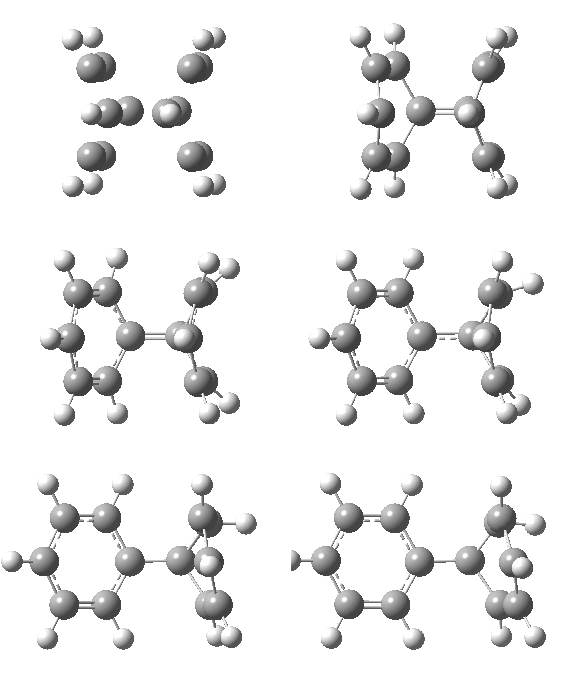
    4. By IRC +8, the erstwhile C=C bond has reached 1.43Å, but the geometry still retains most of its plane of symmetry. At IRC +10, this suddenly and abruptly breaks, and one trans alkene starts to form in the rhs ring. You can see this in the animation below, where one hydrogen suddenly accelerates its motion to fully assimilate the trans position (this phenomenon is a feature of so-called valley-ridge inflection points) and the other reverses its own motion. Prior to this, the trans component had been divided amongst two C=C bonds in the forming product, thus preserving the plane of symmetry.
      Animation of the geometry along the IRC. Click for 3D.
    5. The product of this IRC is thus a biphenyl where one of the phenyl rings sustains a trans component, a Möbius benzene in fact! Appropriately, the bond lengths in this (antiaromatic) ring alternate, whereas they are all equal in the other (aromatic) ring.
      Click to invoke Jmol Rotate with mouse
      A Möbius benzene. Click for 3D
    6. Well, what a journey, in which most of the interesting action occurred AFTER the transitions state, controlled by the subsequent forces (dynamics) acting on the potential. It turned out to be a concerted reaction with a reasonable barrier. At the transition state itself, it was looking as if it might actually be a violation in the WH sense. But the requisite – better late than never – antarafacial component was indeed incorporated into the final product
    The above is only a model of the real molecule 85, which has additional benzo groups. At the transition state, these benzo groups might still be added without the need for any severe geometrical distortions. Of course the resulting twisting after the transition state to form a Möbius ring would be inhibited by their presence. It is clear that the final word is not yet said about what WH called the fantastic hydrocarbon.

    WH argued that violations of their rules would be avoided by the reacting system adopting a stepwise, non-concerted pathway. It may be that the dynamics of reactions would also allow avoidance to occur by adopting concerted, but asynchronous geometrical distortions such as those seen here.2


    1 “When I use a word,” Humpty Dumpty said in rather a scornful tone, “it means just what I choose it to mean – neither more nor less.” I add this quote, since the WH approach is based on an orbital picture deriving from a single determinantal SCF solution of the Schroedinger equation. In so-called multi-configurational treatments (MCSCF), molecular orbitals for a single configuration no longer occupy such a central position in the theory.

    2 For example, it could be argued that a violation of the WH rules for 2πs + 2πs thermal cycloadditions can be avoided by a trapezoidal distortion, DOI: 10.1039/A805668D.

  • So near and yet so far. The story of the electrocyclic ring opening of a cyclohexadiene.

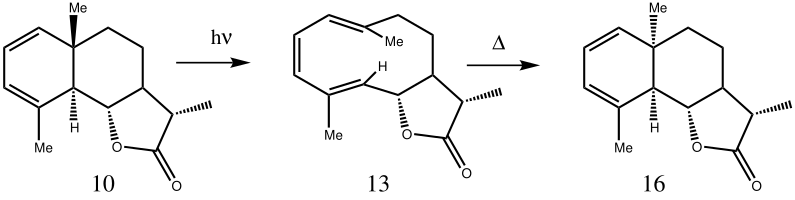
    My previous three posts set out my take on three principle categories of pericyclic reaction. Here I tell a prequel to the understanding of these reactions. In 1965, Woodward and Hoffmann[cite]10.1021/ja01080a054[/cite] in their theoretical analysis (submitted Nov 30, 1964) for which the Nobel prize (to Hoffmann only of the pair, Woodward having died) was later awarded. But in the same year, Elias Corey[cite]10.1021/ja00952a037[/cite] reported the conclusion of a project started several years earlier (first reported (DOI: 10.1021/ja00907a030, Nov 1, 1963) to synthesize the sesquiterpene dihydrocostunolide.

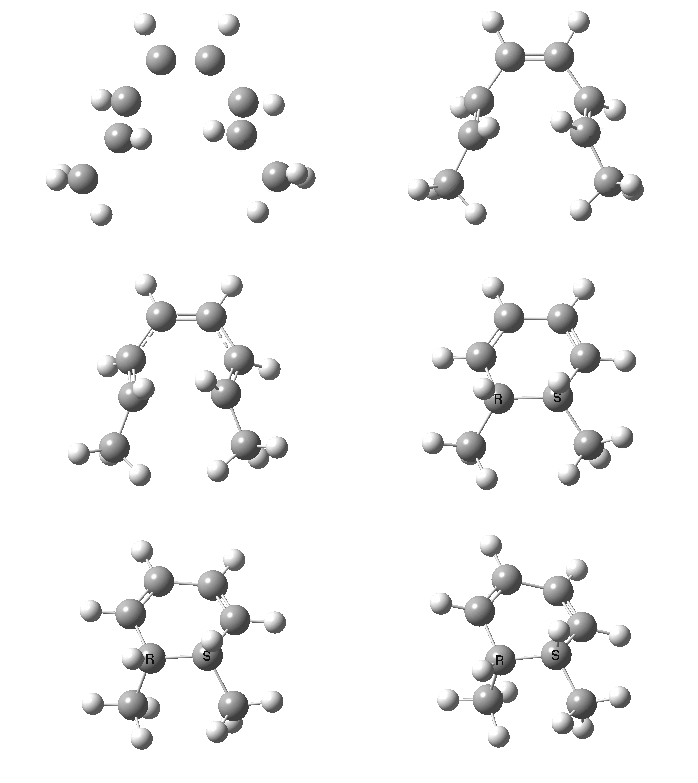
    The key element of this synthesis is described as the photochemical ring-opening of 10 to give a thermally unstable ten-membered ring compound 13, which at room temperature recyclizes to 16. These two reactions constitute perfect examples of the Woodward-Hoffmann rules, a modern statement of which is that a 4n+2 electron photochemical pericyclic reaction (for the above example, n=1) normally proceeds with one antarafacial component whilst a thermal one proceeds with only supra facial components (a more recent extension of this statement would be the rule for two antarafacial components). To illustrate this, shown below is the thermal cyclisation of dimethylhexatriene as a model for 13. The IRC shows one interesting conformational feature at ~+8, which is the rotation of the two methyl groups to replace the eclipsed by a gauche orientation. Clearly visible is the suprafacial component (the new bond forms on the bottom face of both termini of the triene) and in the example of 1316 resulting in the observed stereochemistry.

    Thermal electrocyclic reaction of a dimethyl-hexatriene. Click for 3D.

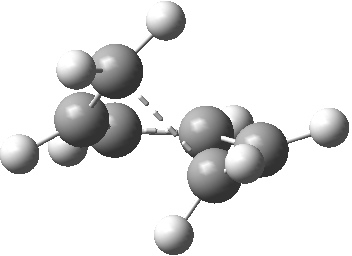
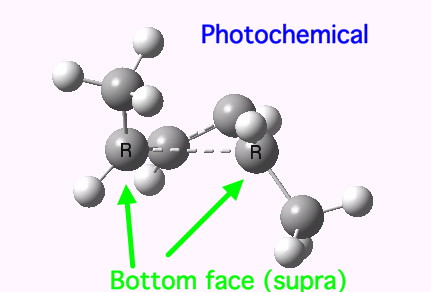
    The photochemical reaction of 10 can be illustrated by the nature of the conical intersection where the singlet (S0/S1) surfaces touch. The antarafacial component is clearly seen (bottom face of lhs of the triene, top face of the rhs of the other end of the triene), leading to the observed stereochemistry of the photochemical product 13.

    Geometry of a conical intersection for photochemical electrocyclisation of hexatriene. Click for 3D.

    So Corey had in his hands in 1963 an unambiguous and clear cut example of stereoselection operating in a pericyclic reaction, and an opportunity in 1965 (if not earlier) to infer and declare a general guiding principle from that reaction. In fact that opportunity was not taken by Corey, and he was (DOI: 10.1021/jo049925d) left to rue decades later on what might have been!

  • A modern take on the pericyclic electrocyclic ring opening of cyclobutene.

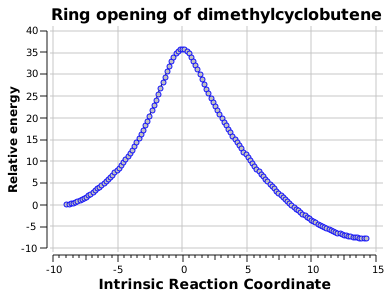
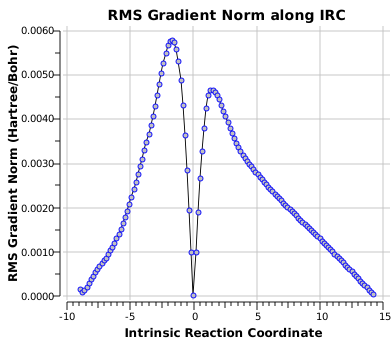
    Woodward and Hoffmann published their milestone article  “Stereochemistry of Electrocyclic Reactions” in 1965. This brought maturity to the electronic theory of organic chemistry, arguably started by the proto-theory of Armstrong some 75 years earlier. Here, I take a modern look at the archetypal carrier of this insight, the ring opening of dimethylcyclobutene.

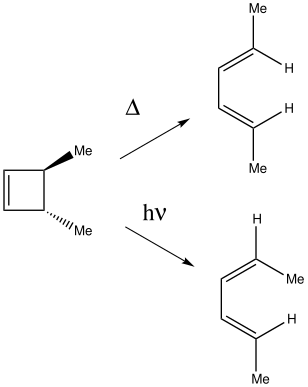
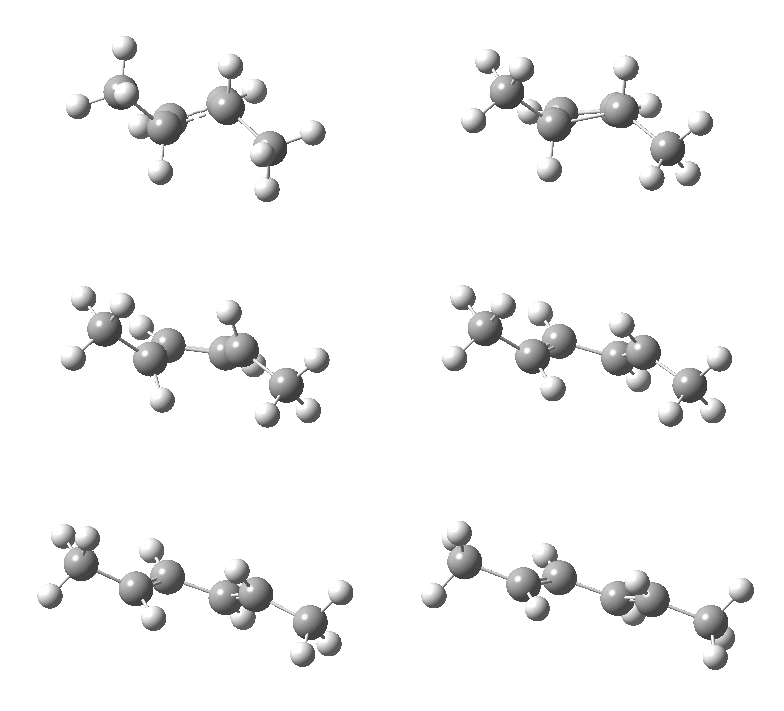
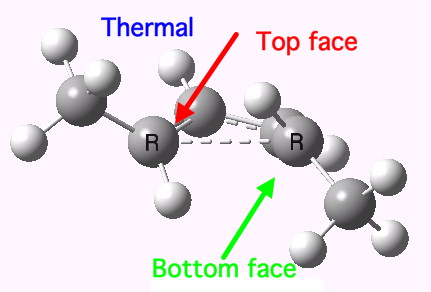
    The thermal (Δ) reaction is defined by the transition state. The remarkable feature noted by Woodward and Hoffmann was the stereospecificity of pericyclic reactions. In this example, the breaking σ-bond in the transition state is defined by its connectivity to the top face of one terminus (the red arrow) and the bottom face of the other terminus (the green arrow). The technical name for this is antarafacial, and this is also associated with a C2 axis of symmetry for (this particular) example. The modern theoretical explanation for this is a Möbius-aromatic transition state resulting from a total of 4n circulating electrons (note the methyl flags waving).

    IRC for Electrocylic ring opening of dimethyl cyclobutene. Click for 3D.

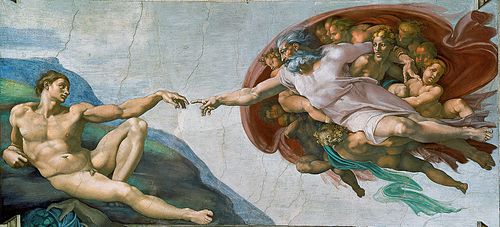
    The concept of aromatic (or anti-aromatic) transition states is a very useful one for thermal reactions, but this transition state becomes a little less helpful for the photochemical (hν) version. Instead, a new concept is introduced of a conical intersection between the (thermal) ground state and the (photochemical) excited state. Think of it in terms of the famous painting showing God (in an exalted state) touching Adam (very much on the ground).

    A schematic conical intersection.

    The conical intersection is the geometry at which a photochemically excited molecule leaves the S1 state and returns to the ground S0 state. It is this point that determines the resulting stereochemistry. That for dimethyl-cyclobutene (casscf(12,8)/6-31g(d,p) model) is shown below. On the right hand side of the molecule, the σ-bond region looks very similar to that of the thermal transition state shown above; the bond is associated with the bottom face of the molecule. However, the left hand side is rotated clockwise relative to the thermal reaction, and this rotation now presents the bottom face for connection to the σ-bond (rather than the top face as for the thermal case). The  σ-bond is thus connected suprafacially.

    The conical intersection for the photochemical reaction of dimethylcyclobutene. Click for 3D
    When the rules are presented to students, the photochemical case is often defined as the inverse of the thermal rule. Thus for the same electron count (4n in this case), a thermal reaction is antarafacial and the photochemical one suprafacial. A more fascinating question is whether the aromaticity associated with the key geometry should also be inverted. Thus the thermal reaction corresponds to a Möbius-aromatic (topological linking number =1π) transition state. Should the photochemical reaction rule be inverted to refer to a Hückel-aromatic(topological linking number = 0π) conical intersection?

    I am unaware of any formal studies of the aromaticity of conical intersections specifically, but it would be nice to know if this analogy has any reality. Watch this space.

  • The dawn of organic reaction mechanism: the prequel.

    Following on from Armstrong’s almost electronic theory of chemistry in 1887-1890, and Beckmann’s radical idea around the same time that molecules undergoing transformations might do so via a reaction mechanism involving unseen intermediates (in his case, a transient enol of a ketone) I here describe how these concepts underwent further evolution in the early 1920s. My focus is on Edith Hilda Usherwood, who was then a PhD student at Imperial College working under the supervision of Martha Whitely.1

    The doctoral degree itself had only been introduced into British universities in 1919,1 and so Usherwood was very much a forerunner of the modern system of training.The academic staff and students at Imperial totalled 30, making it one of the largest research schools in UK chemistry at the time. Usherwood’s project was on tautomers, or isomers of molecules which differ only in the position of a labile hydrogen atom. The then quite novel electron-pair symbolism introduced by G. N. Lewis’ in 1916 was adopted to represent two tautomeric equilibria (the supposed mobile or tautomeric hydrogens being enclosed in […])2

    1. [H]C:::N ⇔ C::N[H]
    2. [H]C:::CH ⇔ C::CH[H]

    or in our more modern representation (in which lines replace colons, and charges are used to ensure the octet rule is adhered to when possible):

    1. H-C≡N ⇔ C≡N+-H
    2. HC≡CH ⇔ :C=CH2

    Modern structural techniques such as electron diffraction or microwave spectroscopies not yet existing, the problem was tackled using specific heat measurements as a function of temperature. This method suggested to Usherwood that for e.g. equilibrium 2, the concentration of iso-acetylene (we now call this vinylidene) was insignificant at ordinary temperatures, but it became appreciable between 200-300°C. Further evidence was claimed for the formation of the “unseen” vinylidene by observing ketene as a by-product of the oxidation of acetylene. This article very much set the trend of (an almost mandatory) speculation on the outcome of (nowadays much more complex) reactions by the need to formulate a reaction mechanism in which various (otherwise undetected but) plausible intermediates are involved.

    Moving on some 90 years, and how might one approach such a problem nowadays? Well, I have oft argued on this blog that a good place to obtain an immediate reality check on a proposed mechanism is a calculation. It will come as no surprise that a very accurate calculation can be done on the systems shown above. For example, CCSD(T)/cc-pVTZ will yield a free energy for the equilibria with a pretty small error (< 1 kcal/mol). We use ΔG = -RT Ln K to inter-convert free energies and equilibrium constants. If we are generous and state that in order to observe an appreciable concentration of a minor species, the equilibrium constant can be no smaller than 10-3, its energy cannot be greater than 4 kcal/mol above the more abundant isomer. Our reality check will be to see if the free energy of vinylidene is indeed no more than 4 kcal/mol greater than acetylene. Well, CCSD(T)/cc-pVTZ predicts vinylidene is 41.3 kcal/mol higher @298K, reduced to 33.8 @2000K (and before you ask, these results took a total of perhaps 30 minutes to obtain).

    In 1924, the concept of calculating the relative energies of two species using first principles was not even a glimmer on the horizon. The nature of mechanisms was slowly and often painfully established by recourse to experiments alone. And many of the unseen intermediates often remained just such, their existence only inferred indirectly from the models one constructed (of specify heats in Usherwood’s case). It is perhaps no great surprise that these models do not always stand the test of time. In this case, within a year of Usherwood’s publication, Partington was suggesting that the model for the specific heats of acetylene should have included allowance for polymer formation.3 The modern take, armed with the calculation I note above, might in fact side with Partington after all. As for the formation of ketene by oxidation, it is indeed known that (peracid) oxidation of an alkyne will produce ketene, but the modern mechanism (an interesting exercise in arrow pushing for a student) does not involve vinylidene intermediates.

    I will add at this point that Hilda Usherwood was married to Christopher Ingold, and the pair of them subsequently published many of the seminal articles in what became known as physical organic chemistry. That legacy continues to this day with (as I noted above) the almost mandatory speculation about the mechanism of any new reaction. But it is only in the last five years or so that these speculations have started to be increasingly tested against reliably accurate computation. A new era is underway.


    1 My post was inspired by reading W. H. Brock, “The case of the Poisonous Socks”, chapter 28, RSC Publishing, 2011, 978-1-84973-324-3.

    2 These representations are taken from ref 1, p 225 (and include a correction of replacing C:C as drawn there by C::C. The original article apparently appeared in the proceedings of the British Association of 1924, which is not yet available online.

    3 Brock, in ref 1, p226, suggests that Usherwood stood her ground on this one, and won her case by showing that Partington’s evidence for polymerization was valid for only a small part of the temperature range she had investigated. I have not managed to track down the original sources for this exchange.