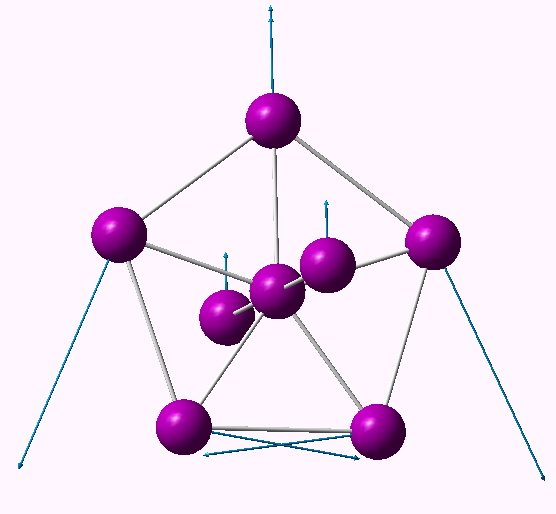
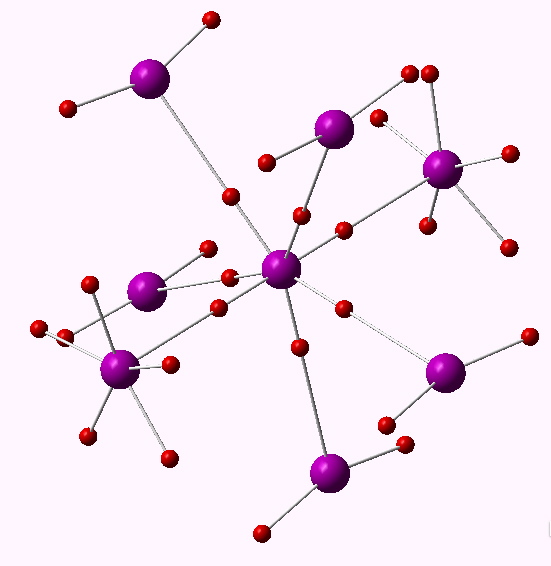
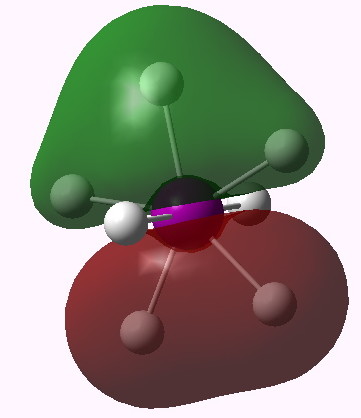
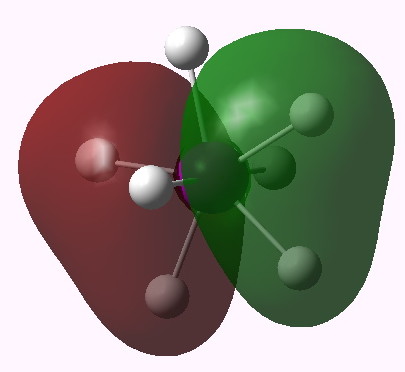
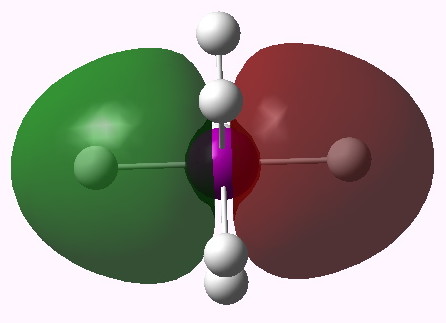
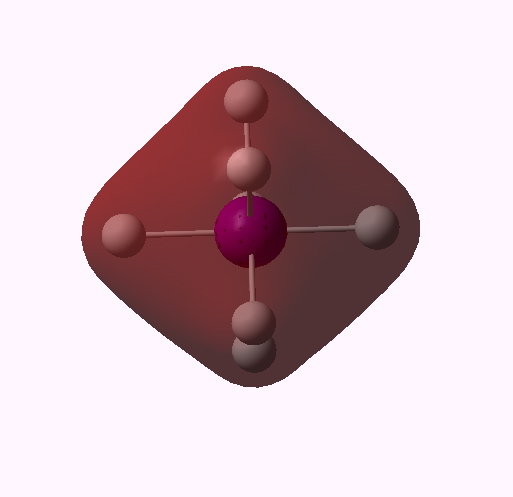
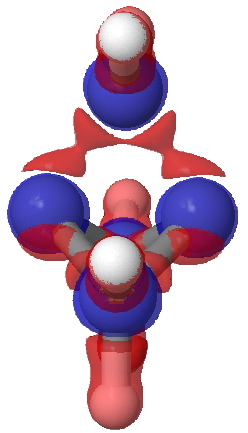
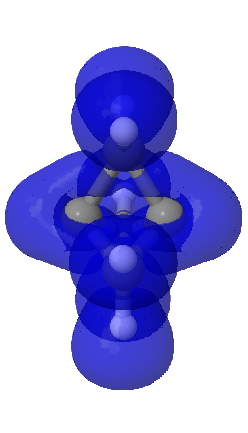
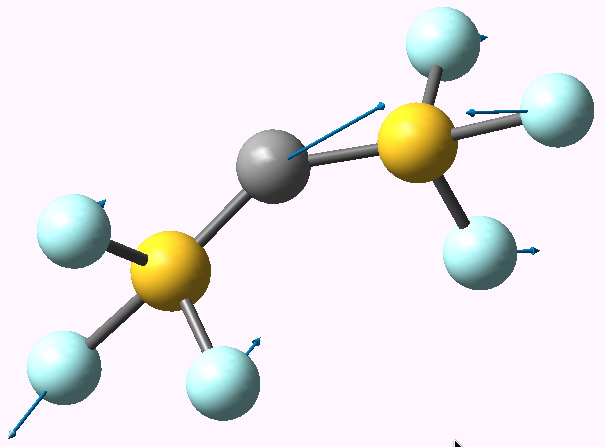
One approach to reporting science which is perhaps better suited to the medium of a blog than a conventional journal article is the opportunity to follow ideas in unexpected, even unconventional directions. Thus my third attempt, like a dog worrying a bone, to explore hypervalency. I have, somewhat to my surprise, found myself contemplating the two molecules I8 and At8. Perhaps it might be better to write them as I(I)7 and At(At)7. This makes it easier to relate both to the known molecule I(F)7. What led to these (allotropes) of the halogens? Well, as I noted before, hypervalency is a concept rooted in covalency, albeit an excess of it! And bonds with the same atom at each end are less likely to be accused of ionicity. I earlier suggested that the nicely covalent IH7 was not hypervalent, with all the electrons which might contribute to hypervalency actually to be found in the H…H regions. The next candidate, I(CN)7 ultimately proved a little too ionic for comfort. So we arrive at II7. At the D5h geometry, it proves not to be a minimum, but a (degenerate) transition state for reductive elimination of I2 (I note parabolically that the 2010 Nobel prize for chemistry was awarded for reactions which involve similar reductive elimination of Pd and other metals to form covalent C-C bonds). Thus I8 is useful only as a thought experiment molecule, and not a species that could actually be made.
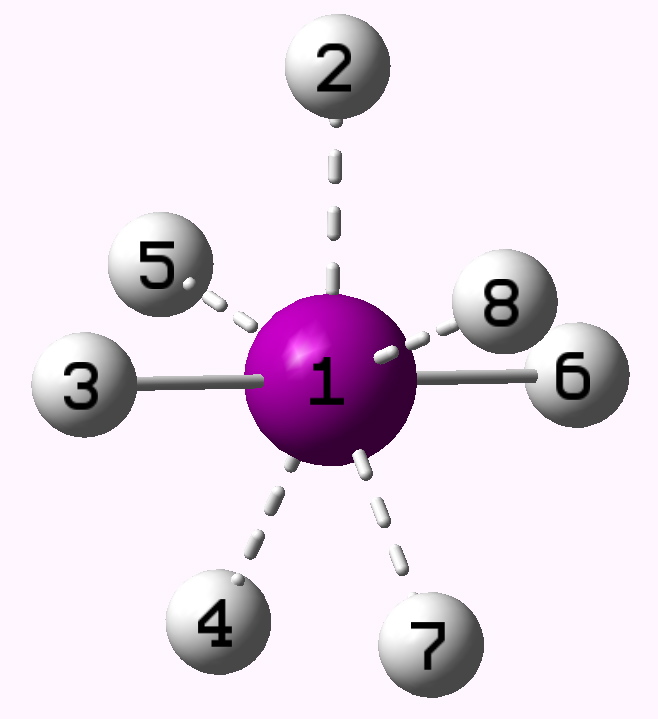
I8, showing as a transition state for reductive elimination of iodine. Click for 3D
The Wiberg bond index (B3LYP/Def2-TZVPP basis+pseudopotential) of the central iodine comes out at 2.81; that of the two axial iodines is 1.05 and that of the five equatorial atoms is 1.50. Well, the axial iodines are clearly monovalent, the equatorial ones are higher because of I…I interactions around the 5-ring. The central iodine is clearly again, not hypervalent. The individual Wiberg bond orders radiating form the central atom are 0.47 for the axial and 0.374 for the equatorial atoms. The I…I bond orders between the five equatorial atoms are 0.336 for adjacent atoms. This latter observation matches with the frequency analysis, since any individual I-I bond is already 1/3 formed, just asking to be eliminated.
What of that other technique for finding electrons, ELF?
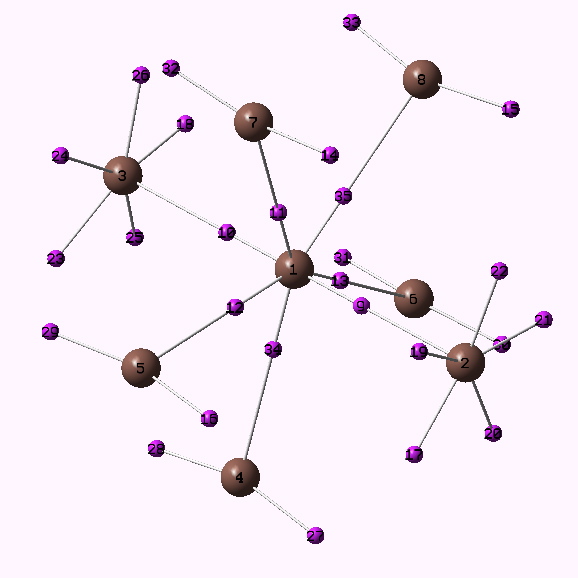
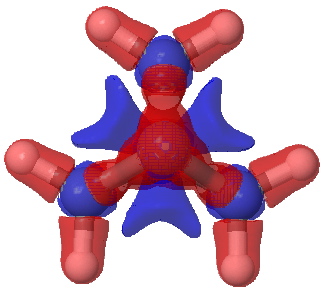
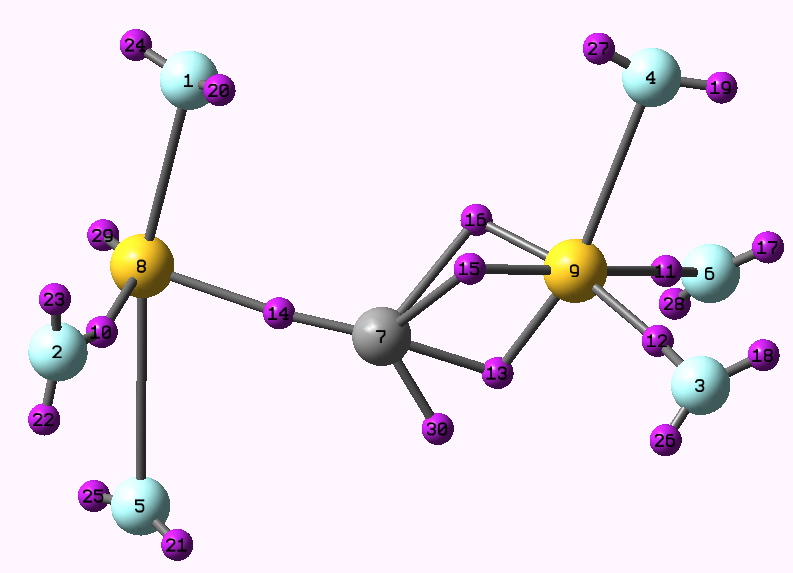
ELF analysis for I8. Click for 3D
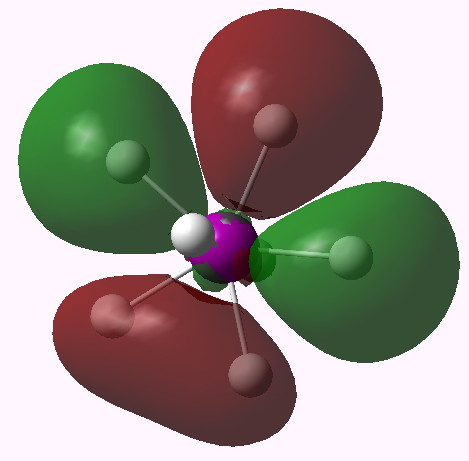
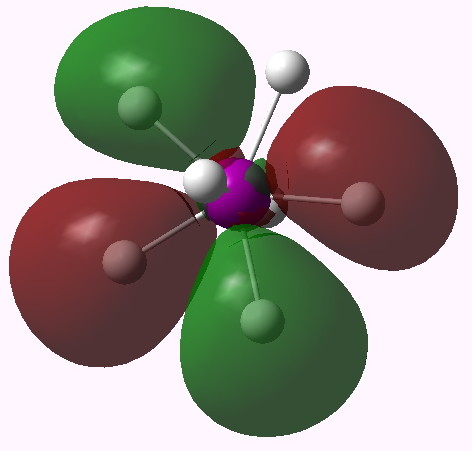
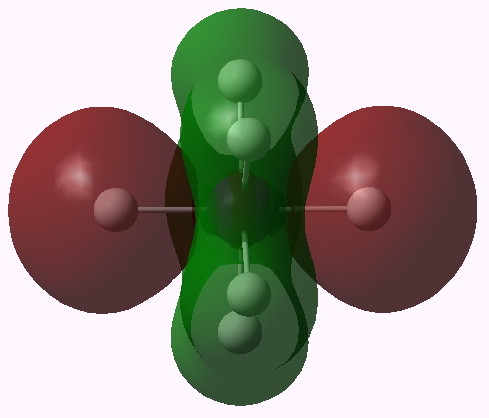
All the I-I bonds radiating from the centre have well-defined disynaptic basins (the same is NOT true for e.g. IF7by the way, which comes out as ionic in ELF). The two axial covalent bonds have basins integrating to 1.35 electrons, and the five equatorial covalent bonds 0.77. The central iodine has a total of 6.55 electrons in bonds surrounding it. The five equatorial iodines have 7.7 electrons in two lone pairs, whilst the two axial iodines have 8.05 electrons in five monosynaptic basins. In summary, all eight iodines in this compound exhibit valence shells filled with an octet of electrons. Now, beyond any ambiguity, we can say this is NOT hypervalent.
Oh, for good measure, At8. The Wiberg index at the central atom is 2.77, the bond index is 0.46 for axial and 0.37 for equatorial At. The ELF basin integrations are 0.65 for equatorial, and 1.61 for axial, the former decreasing and the latter increasing compared to iodine.
In the last post, IH7 was examined to see if it might exhibit true hypervalency. The iodine, despite its high coordination, turned out not to be hypervalent, with its (s/p) valence shell not exceeding eight electrons (and its d-shell still with 10, and the 6s/6p shells largely unoccupied). Instead, the 14 valence electrons (7 from H, 7 from iodine) fled to the H…H regions. Well, perhaps H is special in its ability to absorb electrons into the H…H regions. So how about I(CN)7? (the species has not hitherto been reported in the literature according to CAS). The cyano group is often described as a pseudohalide, but the advantage of its use here is that it is about the same electronegativity as I itself, and hence the I-C bond is more likely to be covalent (than for example an I-F bond). As noted in the earlier blog, if the potentially hypervalent atom is very ionic, it can be difficult to know whether the electrons are truly associated with that atom, or whether they are in fact in lone pairs associated with the other electronegative atom (e.g. F). It is also important to avoid large substituents, otherwise steric interactions will cause problems around the equator.
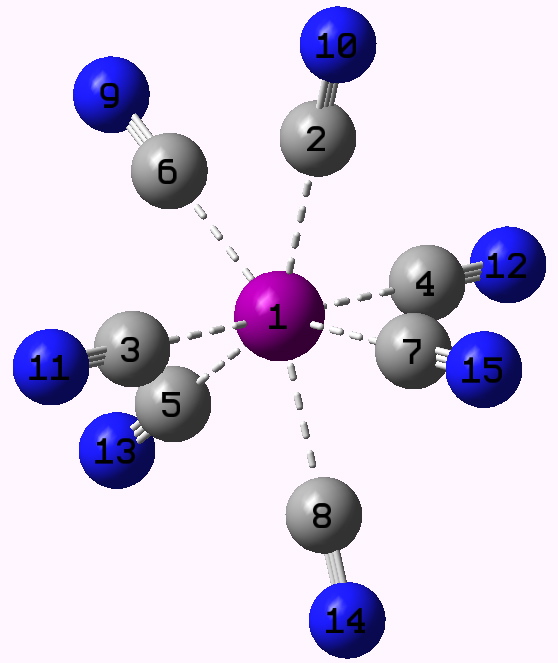
I(CN)7. Click for 3D
The calculated (B3LYP/Def2-TZVPP) geometry for I(CN)7 is similar to IH7, having essentially D5h symmetry. The C-I bond lengths range from 2.20Å (equatorial) to 2.10Å (axial); the Wiberg bond orders for these are respectively 0.482 and 0.609. The total bond orders are 3.94 (iodine), 3.91 (carbon) and 3.14 (nitrogen). The total carbon bond order for e.g. atom 2 is made up of 0.482 to I, 2.939 to N, 0.110 to C6, C7, 0.049 to C5, C8 and 0.040 to C3, C4. As with IH7, the erstwhile hypervalent iodine electrons have in fact departed from that atom, and taken up residence in the C…C regions. The NBO analysis confirms the electrons as originating from an effective iodine core (28), explicit I,C,N cores (46), 69.3 valence and 0.7 Rydberg (outer shell) electrons. The molecular orbitals are shown in this post.
Finally, for good measure, ELF analysis (on top of an effective core of 28) integrates to an outer core of 17.78 on iodine and a valence shell which includes 17.5 electrons distributed in seven explicit C-I disynaptic basins of ~2.5 electrons each. These 17.5 electrons can be considered as originating from ~10 (non-bonding?) electrons corresponding to the filled iodine 5d-shell, and ~7.5 shared bonding electrons in the iodine 5s/5p shell (the ELF procedure cannot distinguish between the 5d and 5s/5p electrons). There is no indication from these integrations that the iodine valence shells are expanded (i.e. from 10 for the 5d or from 8 for the 5s/5p).
As with IH7, this molecule shows absolutely no evidence of being hypervalent! So, if hypervalency is to survive as a concept, the hunt must surely be on for one unambiguous, as yet to be found, example of the phenomenon in the main group.
The Wikipedia page on hypervalent compounds reveals that the concept is almost as old as that of normally valent compounds. The definition there, is “a molecule that contains one or more main group elements formally bearing more than eight electrons in their valence shells” (although it could equally apply to e.g. transition elements that would contain e.g. more than 18 electrons in their valence shell). The most extreme example would perhaps be of iodine (or perhaps xenon). The normal valency of iodine is one (to formally complete the octet in the valence shell) but of course compounds such as IF7 imply the valency might reach 7 (and by implication that the octet of electrons expands to 14). So what of IF7? Well, there is a problem due to the high electronegativity of the fluorine. One could argue that the bonds in this molecule are ionic, and hence that the valence electrons really reside in lone pairs on the F. Thus the apparently hypervalent PF5 could be written PF4+…F–, in which case the P is not really hypervalent after all. We need a compound with un-arguably covalent bonds. Well, what about IH7? One might probably still argue about ionicity (for example H+…IH6–) but that puts electrons on I and not H, and hence does not change any hypervalency on the iodine. Surely, if hypervalency is a real phenomenon, it should manifest in IH7?
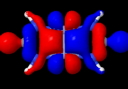
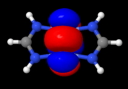
IH7. A true hypervalent molecule? Click for 3DA reasonably high level calculation (B3LYP/Def2-TZVPP with pseudopotential on I to absorb relativistic effects) shows the molecule to be a minimum, with D5h symmetry. An NBO analysis shows 46 core (i.e. non-valence) electrons. These arise from a Kr core (=36) plus a filled iodine 5d shell of 10 electrons. So, only the 5s/5p orbitals can be used for valence bonding. The total minimal basis which one can construct valence molecular orbitals from is thus I 5s, 5p and H 1s, a total of eleven AOs, into which 14 electrons must pair up into 7 doubly-occupied molecular orbitals. Now, the real issue is whether this occupancy corresponds to seven I-H covalent single bonds, each with a two-electron Lewis pair. If so, the molecule is hypervalent! The occupied MOs are shown below.
MO 16 (E2'). Click for 3D
MO 15 (E2')
MO 14 (A1')
MO 13 (E1')
MO 12 (E1')
MO 11 (A2'')
MO 10 (A1')
One notices that whilst orbitals 10-14 are clearly bonding in the I-H region, orbitals 15-16 seem antibonding in that region (there is a node along the I-H bond). We are seeing much the same phenomenon that occurs when the bond order of 3 in N2 is reduced to 1 in F2 due to occupancy of anti-bonding orbitals. Can this be quantified? NBO (5.9) analysis reveals the following.
The effective (pseudopotential) core has 28 electrons, and the outer core 18. The valence orbitals contain 13.79, and only 0.21 electrons are Rydberg (higher shell). So little occupancy of e.g. 6s/6p then!
The Wiberg bond index indicates each H has a total bond order of very close to 1 (its natural valence state), whilst I is 3.45. Remember that the maximum total bond index of a covalently bound atom using a pure octet of valence electrons is 4 (8/2, think carbon). The iodine is NOT hypervalent!
So why, if its not hypervalent, is it so strongly hypercoordinate? Well, there are 14 valence electrons, but they do NOT all occupy the I-H regions, which have bond orders between 0.46 (equatorial) or 0.57 (axial). The only other place they can be is in the H-H regions! Consider the bond order values between say hydrogen 2 to the four other equatorial atoms 4,5,7,8. They are respectively 0.05, 0.15, 0.05, 0.15. So each hydrogen has a total bond order of 1, but only slightly more than half of this comes from the I-H, the rest comes from H-H. To put it another (approximate) way, of the 14 valence electrons, ~8 might be considered to be associated with I-H bonds, and ~6 with H-H bonds. The hypervalency has been in effect absorbed into the H-H regions. This means no atom in this molecule is at all hypervalent.
Well, if the iodine is not hypervalent, and some of its valence electrons occupy I-H anti-bonding orbitals, why is it stable at all (in the sense that all the vibrations are real, and it’s clearly a minimum in the potential energy surface). Here, I merely speculate. Iodine has a large core charge, and hence the inner core electrons are starting to exhibit relativistic contractions. This effect stabilizes the outer 5s/5p electrons, and so occupancy of anti-bonding MOs generated from such AOs is not so unfavourable as one might expect. Perhaps, the hypercoordination shown by IH7 is after all a relativistic effect rather than a hypervalent effect? In which case, what will AsH7 show?
So, what might have been an archetypal covalent hypervalent molecule is no such! IH7 shows entirely normal valencies, one for H and the iodine does not even reach four (if anything, its sub-valent rather than hypervalent). One may be entitled to ask if ANY main group element exhibits hypervalency!
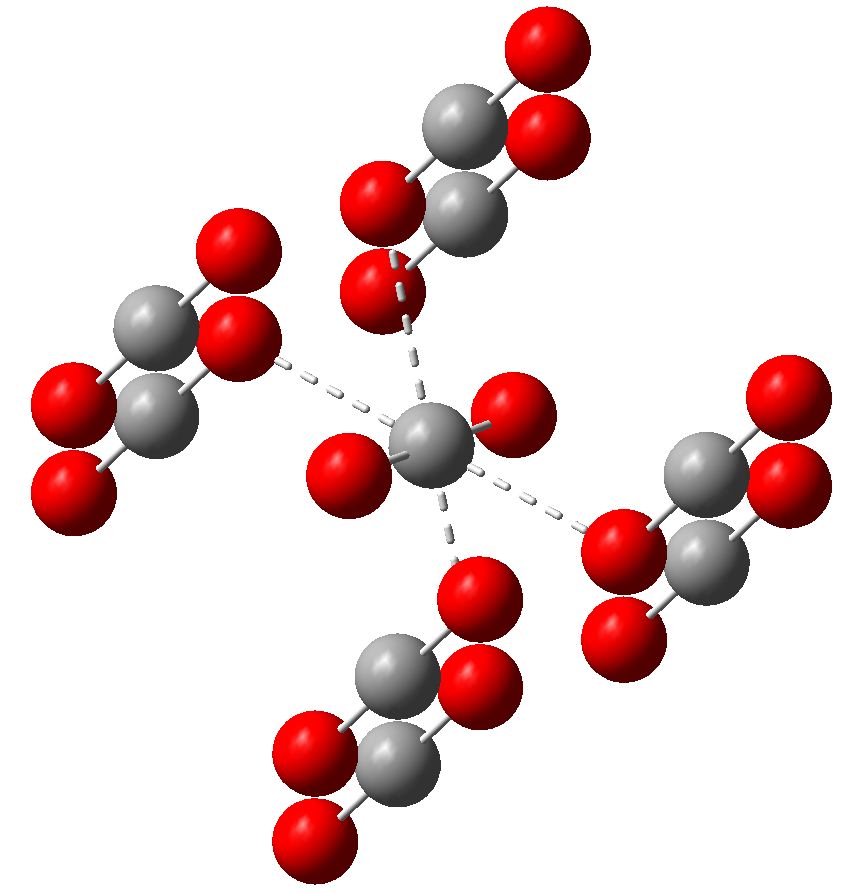
Carbon dioxide is much in the news, not least because its atmospheric concentration is on the increase. How to sequester it and save the planet is a hot topic. Here I ponder its solid state structure, as a hint to its possible reactivity, and hence perhaps for clues as to how it might be captured. The structure was determined (DOI 10.1103/PhysRevB.65.104103) as shown below.
The structure of solid carbon dioxide. Click for 3DThe two nominal double bond distances are 1.33Å, whilst a further four O…C contacts in the shape of a square complete the coordination (2.38Å each). All would probably agree that the central carbon is best described as hexa-coordinated. This is also a hot topic. For example, note the claim made recently to have created a hexa-coordinated carbon species by design (Synthesis and Structure of a Hexacoordinate Carbon Compound, DOI: 10.1021/ja710423d) based on a motif derived from an allene:
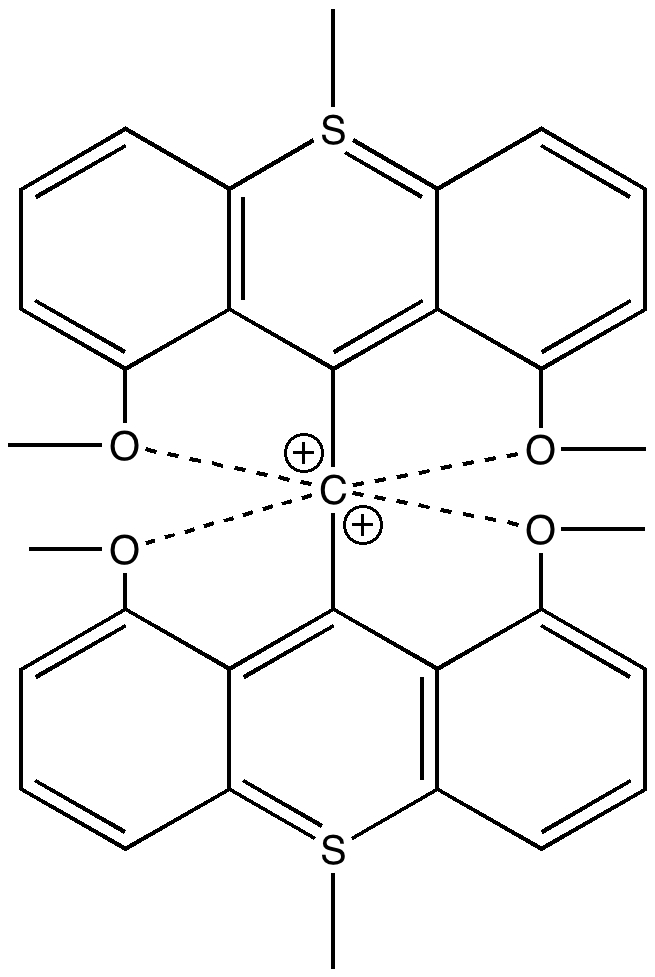
Designed hexacoordinate carbon. Click for 3DThis claim was supported by an unusual measured property, the electron density ρ(r) and its Laplacian in the putative O…C region. These two properties are one of those (relatively rare) meetings between experiment and quantum mechanics, and their usefulness has been noted in this blog on previous occasions. However, note that in this designed structure, the O…C distances are merely 2.65-2.7Å, significantly longer than in solid carbon dioxide! So carbon dioxide, in a form many of us are familiar with (solid), can certainly be justified as being described as having a hexacoordinate carbon (although we might draw the line at describing it as having hexavalent carbon).
If oxygen atoms can approach the carbon in CO2 to within ~2.4Å, an interesting question can be posed. How close can another carbon get to CO2 without actually reacting and forming a new molecule? C-C bonds, even weak ones, are so much more interesting than C-O bonds! It would have to be a particularly nucleophilic carbon, of course. A search of the August 2010 version of the Cambridge structural database (CSD) reveals no really close approaches of another carbon to CO2. Only about 8 weak examples are found, and here the C-C distances are ~3.0-3.2Å, with the O=C=O angle in the CO2 never less than 170°. In this context, there is an intriguing and very recent report (which has not yet made it into the searchable CSD) of the structure of CO2 trapped in a cavity next to what was claimed to be a molecule of 1,3-dimethyl cyclobutadiene, or CBD (see 10.1126/science.1188002 and the discussion of this article in my earlier blog post). The focus in that report was on the “Mona Lisa of organic chemistry”, namely the CBD unit. One feels that the structure of the adjacent CO2 was of lesser interest to the authors. According to a visual image of this system, the CBD and CO2 pair show quite an intimate approach via their carbon atoms (a ghostly C-C bond is clearly represented). This raises the interesting question of whether the description of this pair should be of two intimate but nevertheless separate and relatively unperturbed molecules not connected by a covalent bond (“more indicative of a strong van der Waals contact than of covalent bonding“) or of a pair fully bound by a covalent C-C bond between them?
The issue of what is an interaction, and what is a bond continues to raise its often controversial head. And quantum theory continues to provide a multitude of interpretations as well.
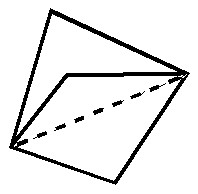
In this post, I will take a look at what must be the most extraordinary small molecule ever made (especially given that it is merely a hydrocarbon). Its peculiarity is the region indicated by the dashed line below. Is it a bond? If so, what kind, given that it would exist sandwiched between two inverted carbon atoms?
1.1.1 Propellane
One (of the many) methods which can be used to characterize bonds is the QTAIM procedure. This identifies the coordinates of stationary points in the electron density ρ(r) (at which point ∇ρ(r) = 0) and characterises them by the properties of the density Hessian at this point. At the coordinate of a so-called bond critical point or BCP, the density Hessian has two negative eigenvalues and one positive one. The sum, or trace of the eigenvalues of the density Hessian at this point, denoted as ∇2ρ(r), provides in this model a characteristic indicator of the type of bond, according to the following qualitative partitions:
ρ(r) > 0, ∇2ρ(r) < 0; covalent
ρ(r) ~0, ∇2ρ(r) > 0; ionic
ρ(r) > 0, ∇2ρ(r) > 0; charge shift
The third category of bond was first characterised by Shaik, Hiberty and co. using valence-bond theory1 and they went on to propose [1.1.1] propellane (above, along with F2) as an exemplar of this type.2 Matching the conclusions drawn from VB theory was the value of the Laplacian. As defined above, for the central C-C bond, both ρ(r) and ∇2ρ(r) have been calculated to be positive, supporting the identification of this interaction as having charge-shift character.3
The Laplacian represents one of those properties where quantum mechanics meets experiment, in that its value (and that of ρ(r) itself) can be measured by (accurate) X-ray techniques.4 This was recently accomplished for propellane,5with the same conclusion that the Laplacian in the central C-C region has the significantly positive value of +0.42 au. The electron density ρ(r) at this point was measured as 0.194 au. Calculations5 at the B3LYP/6-311G(d,p) level report ρ(r) as ~0.19 and ∇2ρ(r) as +0.08 au. Whilst the former is in good agreement with experiment, the latter is calculated as rather smaller than expected. This was originally interpreted as indicating that the “the experimental bond path has a stronger curvature [in ρ(r)] than the theoretical” although more recent thoughts are that both experimental and theoretical uncertainty may account for the discrepancy.5,6 An experiment worth repeating?
A hitherto largely unexplored aspect of characterising a bond using the Laplacian is whether the value at the bond critical point is fully representative of the bond as a whole. The Laplacian is related to two components of the electronic energy by the Virial theorem;
2G(r) + V(r) = ∇2ρ(r)/4; H(r) = V(r) + G(r)
where G(r) is the kinetic energy density, V(r) is the potential energy density and H(r) the energy density. Charge-shift bonds exhibit a large value of the (repulsive) kinetic energy density, a consequence of which is that ∇2ρ(r) is more likely to be positive rather than negative. The relationships above hold not just for the specific coordinate of a bond critical point, but for all space. Accordingly, another way therefore of representing the Laplacian ∇2ρ(r) is to plot the function as an isosurface, including both the negative surface (for which |V(r)| > 2G(r)) and the positive surface [for which |V(r)| < 2G(r)].
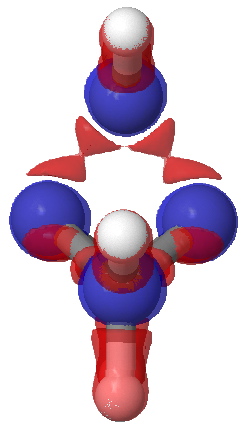
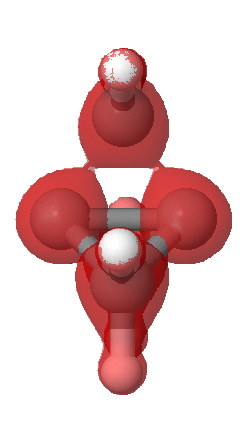
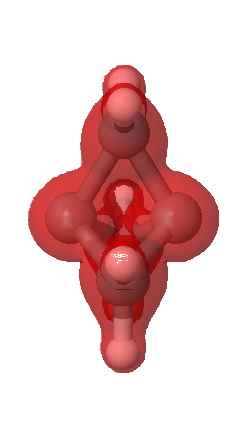
Such an analysis is the purpose of this post, using wavefunctions evaluated at the CCSD/aug-cc-pvtz level (see DOI: 10042/to-5012). The values of ρ(r) and ∇2ρ(r) at the bcp for the central bond are 0.188 and +0.095 au, which compares well with previous calculations. The values for the wing C-C bonds are 0.242 and -0.491 respectively (and were measured5 as 0.26 and -0.48). Laplacian isosurfaces corresponding to ± 0.49 (the value at the wing C-C bcp), ± 0.47 and ± 0.2 (which reveals prominent regions of +ve values for the Laplacian) can be seen in the figures below (and can be obtained as rotatable images by clicking).
Laplacian isosurface contoured at ± 0.49
–
Laplacian isosurface contoured at ± 0.47. Red = -ve, blue= +ve.
Laplacian isosurface contoured at ± 0.20
A significant feature is the isosurface at -0.47, which corresponds to the lowest contiguous Laplacian isovalued pathway connecting the two terminal carbon atoms (and which coincidentally is similar in magnitude to that reported5 as measured for these two atoms). Three such bent pathways of course connect the two carbon atoms. The energy density H(r) shows a minimum value of -0.21 au along any of these pathways. It is significantly less negative (-0.13) for the direct pathway taken along the axis of the C-C bond.
Energy density H(r) @-0.21
Energy density H(r) @-0.13
ELF isosurface @0.7
A useful comparison with this result is the ELF isosurface. This too is computed at the correlated CCSD/aug-cc-pVTZ using a new procedure recently described by Silvi.7 Contoured at an isosurface of +0.7, the ELF function is continuous between the two terminal atoms, much in the manner of Laplacian. Significantly, the ELF function at the bcp appears at the very much lower threshold value of 0.54, and forms a basin with a tiny integration for the electrons (0.1e). Since both methods provide a measure of the Pauli repulsions via the excess kinetic energy, the similarity of the Laplacian to the ELF function is probably not coincidental.
The issue then is whether a bond must be defined by the characteristics of the electron density distribution along the axis connecting that bond, or whether other, non-least-distance pathways can also be considered as being part of the bond.8 The former criterion defines a pathway involving a positive Laplacian (+0.095) and would be interpreted as indicating charge shift character for that bond. The latter involves three (longer) pathways for which the Laplacian is strongly -ve, and which would therefore per se imply more conventional covalent character for the interaction. Considered as a linear (straight) bond, it has charge shifted character; considered as three “banana” bonds, it may be covalent. Weird!
Shaik, S.; Danovich, D.; Silvi, B.; Lauvergnat, D. L.; Hiberty, P. C., “Charge-Shift Bonding – A Class of Electron-Pair Bonds That
Emerges from Valence Bond Theory and Is Supported by the Electron Localization Function Approach,” Chem. Eur. J., 2005, 11, 6358-6371, DOI: 10.1002/chem.200500265 and references cited therein.
W. Wu, J. Gu, J. Song, S. Shaik, and P. C. Hiberty, “The Inverted Bond in [1.1.1]Propellane is a Charge-Shift Bond,” Angew. Chem. Int. Ed., 2008,
DOI: 10.1002/anie.200804965; 10.1002/cphc.200900633
S. Shaik, D. Danovich, W. Wu & P. C. Hiberty, “Charge-shift bonding and its manifestations in chemistry”, Nature Chem, 2009, 1, 443-3439. DOI: 10.1038/nchem.327
P. Coppens, “Charge Densities Come of Age”, Angew. Chemie Int. Ed., 2005, 44, 6810-6811. DOI: 10.1002/anie.200501734
M. Messerschmidt, S. Scheins, L. Grubert, M. Pätzel, G. Szeimies, C. Paulmann, P. Luger. “Electron Density and Bonding at Inverted Carbon Atoms: An Experimental Study of a [1.1.1]Propellane Derivative, Angew. Chemie Int. Ed., 2005, 44, 3925-3928. DOI: 10.1002/anie.200500169
L. Zhang, W. Wu, P. C. Hiberty, S. Shaik, “Topology of Electron Charge Density for Chemical Bonds from Valence Bond Theory: A Probe of Bonding Types”, Chem. Euro. J., 2009, 15, 2979-2989. DOI: 10.1002/chem.200802134
F. Feixas , E. Matito, M. Duran, M. Solà and B. Silvi, submitted for publication. See also this abstract.
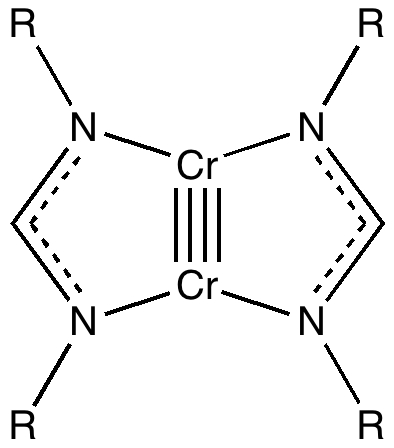
In the previous post, I ruminated about how chemists set themselves targets. Thus, having settled on describing regions between two (and sometimes three) atoms as bonds, they added a property of that bond called its order. The race was then on to find molecules which exhibit the highest order between any particular pair of atoms. The record is thus far five (six has been mooted but its a little less certain) for the molecule below
A molecule with a Quintuple-bond
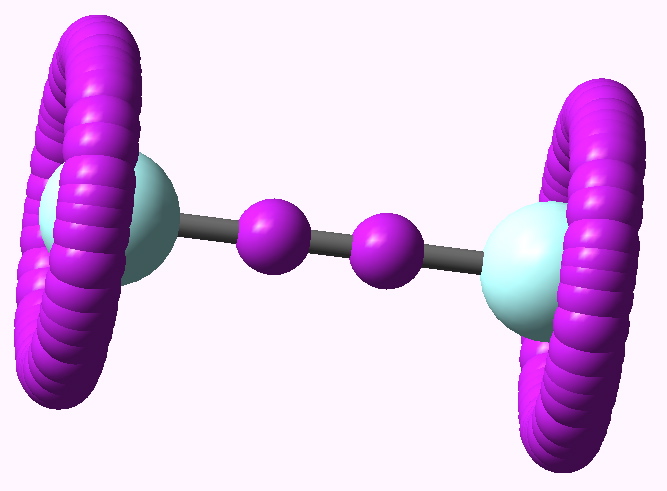
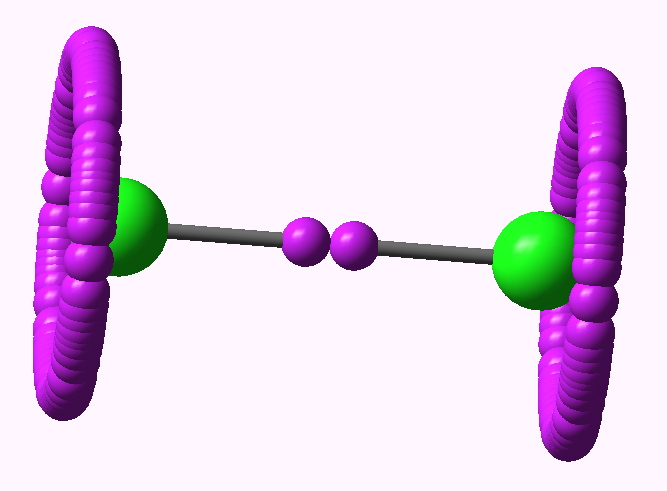
There are many ways of describing the electronic behaviour in that region called a bond, one being the ELF (Electron localization function) technique, which certainly sounds as if it is describing a bond! The ELF function for the molecule above however was distinctly odd, and this was attributed to the Cr-Cr bond being not so much a covalent bond, but another (much less recognized type) known as a charge-shift bond. In particular, two of the ELF basin centroids did not occupy the central region between the two atoms, but had in effect fled that region, and in the process had also each split into two. Other ELF basins did not much look like bonds, but retained much of their core-electron (i.e. non bonding) character. The issue now becomes whether the ELF method is sensible, or simply an artefact. In other words, it needs calibrating against other (homonuclear) molecules which might exhibit charge-shift behaviour.
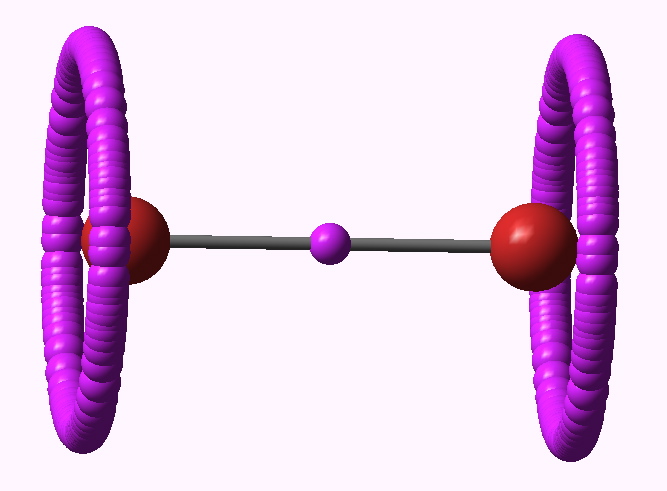
Three such molecules are in fact the halogens, F2, Cl2, Br2 as discussed by Shaik, Hiberty and co (DOI: 10.1002/chem.200500265). So lets take a look at what an ELF analysis shows for these, and how it compares with the chromium quintuple bond.
ELF analysis for F2
ELF analysis for Cl2
ELF analysis for Br2
At the B3LYP/6-311G(d) level, the ELF function shows the (valence) electrons located in two regions. Firstly, what we might call the lone pairs are located in a torus surrounding each halogen atom (i.e. the molecule must be axially symmetric). The remaining electrons are in basins with centroids along the axis of each bond. The Br2 centroid is a single conventional disynaptic basin, with an integration of 0.77 electrons. With Cl2 however, something odd happens (and the effect was described in DOI: 10.1002/chem.200500265 ); the disynaptic basin splits into a close pair, each integrating to 0.33 electrons, and looking as if the two parts want to run away from one another. This was interpreted as indicating that the purely covalent description of the halogen bond is in fact repulsive and not attractive! The effect is enhanced for F2, with two very much split basins, each integrating to 0.08 electrons. This serves to remind us of how odd a bond the F-F one truly is (and how easily it is homolyzed)!
Now that we have our calibration, does it match to the Cr-Cr quintuple bond? Very much so! Again, the valence basins show very low integrations (compared to the nominal bond order), and again they appear to have split and run away from each other. Most of the valence electrons in that species prefer instead to masquerade as core-electrons. So we can conclude that by the ELF criterion, the Cr-Cr bond is not quintuple, and not covalent but charge shifted. Of course, this does seem at odds with the Cr-Cr internuclear distance, which is indeed very short! This shortening probably arises from electrostatic attractions in the charge-shifted valence bond forms. It simply goes to show that what the nuclei get up to and what the electrons do may not be one and the same thing!
Climbers scale Mt. Everest, because its there, and chemists have their own version of this. Ever since G. N. Lewis introduced the concept of the electron-pair bond in 1916, the idea of a bond as having a formal bond-order has been seen as a useful way of thinking about molecules. The initial menagerie of single, double and triple formal bond orders (with a few half sizes) was extended in the 1960s to four, and in 2005 to five. Since then, something of a race has developed to produce the compound with the shortest quintuple bond. One of the candidates for this honour is shown below (2008, DOI: 10.1002/anie.200803859) which is a crystalline species (a few diatomics which exist in the gas phase are also candidates; for other reviews of the topic see 10.1038/nchem.359, 10.1021/ja905035f and 10.1246/cl.2009.1122).
A molecule with a Quintuple-bond
(OK, its shown as a quadruple bond, but Chemdraw cannot handle five!). The Cr…Cr length is 1.74Å (R=aryl). It was also reported that DFT calculations (BP86/triple-ζ) reproduce this length well. The five highest occupied molecular orbitals are all centred around the Cr-Cr region, and the bonding is formally described as five pairs of electrons filling 1σ, 2π, and 2δ type molecular orbitals.
So the electron pair bond, approaching its 100th birthday, is alive and well? But it does seem worth asking if those ten electrons really do cram together to occupy the region between the two Cr atoms. The stalwarts in these blog posts, AIM and ELF will be deployed to see if they too verify this simple concept. Firstly, AIM (calculated at the BP86/6-311G(d) level, DOI: 10042/to-4181 for a model system with R=H).
Quintuple bond complex, AIM analysis. Click for 3D
The Cr…Cr region has the requisite bond critical point, and the value of ρ(r) at this point has the large value (for Cr) of 0.313 au, indeed hinting at a large bond order. The Laplacian ∇2ρ(r) has the more extraordinary value of +1.45 at this point, which makes it the strongest charge-shift bond ever noted (typically, ∇2ρ(r) is ~+0.5 for other examples of homonuclear charge-shift bonds, see DOI: 10.1038/nchem.327).
This charge-shift character perhaps hints that this quintuple bond is no ordinary bond. Charge-shift bonds are characterized by valence bond structures where the covalent form may actually be repulsive, and the bond is stabilized instead by resonance with charge-shifted ionic valence bond forms. So given this, the ELF perhaps comes as no surprise.
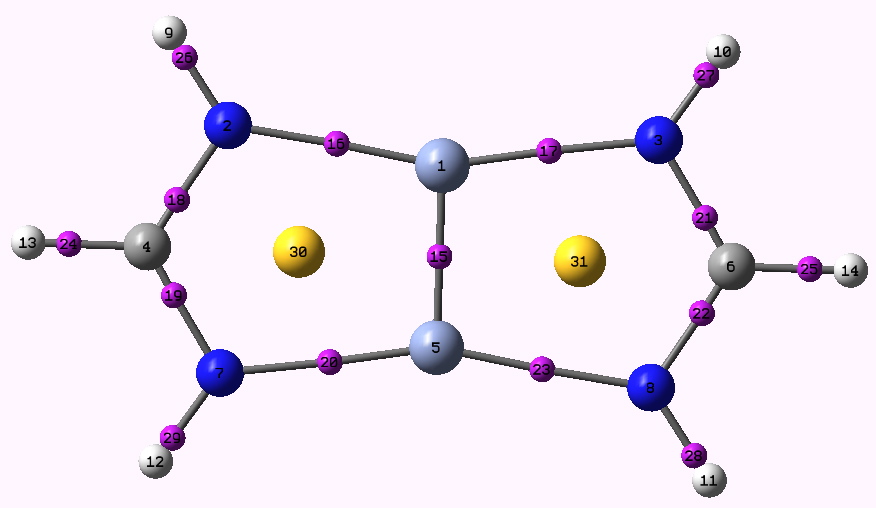
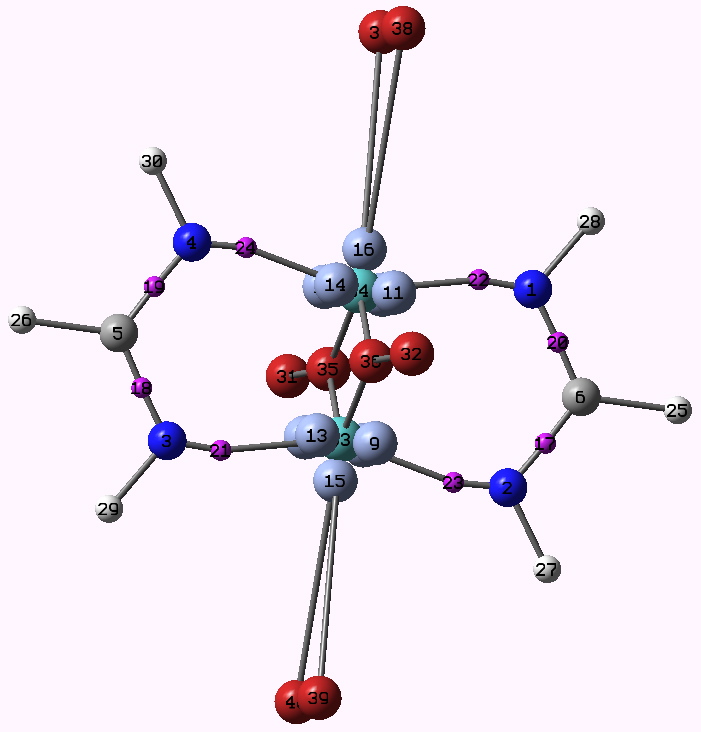
Quintuple bond. ELF analysis
This diagram needs some explanation. The colour code is as follows: purple spheres represent the centroids of conventional disynaptic ELF basins. The only interesting ones are the four connecting the nitrogens to the Cr (21-24) which integrate to 3.35 electrons each. The cyan spheres (shown as 3,4 above) are the inner core-electrons of the Cr atoms (10.2 electrons of a neon core) and surrounding them are five further basins for each Cr integrating to 12 electrons per Cr. These include 8 of the outer-core (3s,3p) and four of the valence (3d, 4s) electrons, leaving ~2 valence Cr electrons not accounted for. Some of these final electrons are to be found in the basins represented by red spheres. The very diffuse (39, 40) basins far from the centre have a tiny electron integration (~0.003) and more missing Cr valence electrons are found in the bridging basins (32,36; 0.56 and 0.25 electrons each). Added to the 2*3.35 electrons found in the Cr-N bond, this suggests the 3d/4s shell of the Cr is occupied by ~11.5 electrons. The 3d-shell is thus full, and the system is indeed an 18-electron (8+10) system with some occupancy of the 4s shell as well. An alternative view of the ELF surface can be seen below, showing the unusual environment surrounding the Cr pair.
Quintuple bond, showing ELF isosurface. Click for 3D
It seems that AIM (the topology of the electron density) and ELF (the topology of the electron localization function) are giving us quite different pictures of the quintuple bond. The latter does seem to indicate that the conventional covalent shared electron pair picture of this bond is not really what is going on, and that the idea of a quintuple bond as sharing five electron pairs in the bonding region between the two Cr atoms is not really realistic. It may be of course that the ELF concept also is not really applicable for such bonds (it is after all essentially an empirical function, the deeper significance of which is debatable). Nonetheless, the quintuple bond clearly has some surprises for us, and it would itself be no surprise to find out that controversy about the meaning of such a bond continues apace.
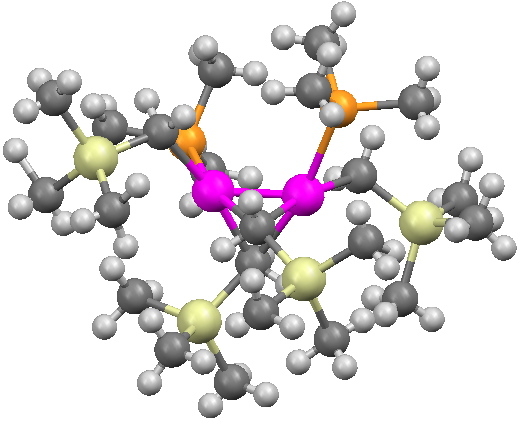
So ingrained is the habit to think of a bond as a simple straight line connecting two atoms, that we rarely ask ourselves if they are bent, and if so, by how much (and indeed, does it matter?). Well Hursthouse, Malik, and Sales, as long ago as 1978, asked just such a question about the unlikeliest of bonds, a quadruple Cr-Cr bond, found in the compound di-μ-trimethylsilylmethyl-bis-[(tri-methylphosphine) (trimethylsilylmethyI)chromium(II)(DOI: 10.1039/dt9780001314[cite]10.1039/dt9780001314[/cite]). They arrived at this conclusion by looking very carefully at how the overlaps with the Cr d-orbitals might be achieved.
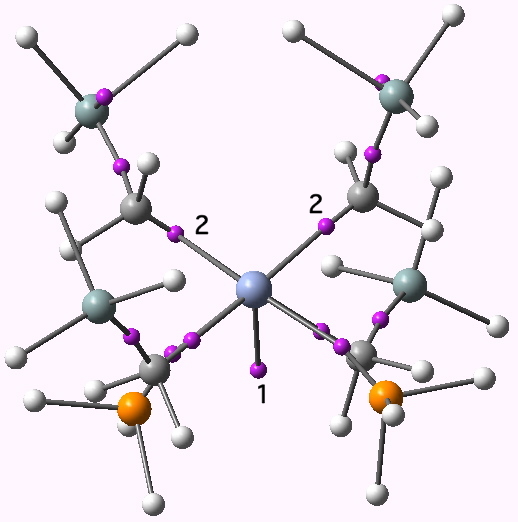
A system with a bent Cr-Cr quadruple bond. Click for 3D
One would indeed instinctively think that whilst the relatively weak single bond (about which rotation is easily possible) might be bendable, it seems less intuitive to imagine that something as apparently strong as a quadruple bond could be so. What might the measurable consequences be? Well, Girolami et al 16 years later (DOI: 10.1021/om00017a023[cite]10.1021/om00017a023[/cite]) pointed out that such compounds exhibit restricted rotation about the Cr-CH2 bonds in the system, with quite significant barriers. This, it was felt, was due to an agostic CH…Cr interaction, which might in turn have induced bending of the Cr-Cr bond itself. There the story sort of peters out; no-one else has discussed bent quadruple bonds, or indeed exactly how bent they actually are.
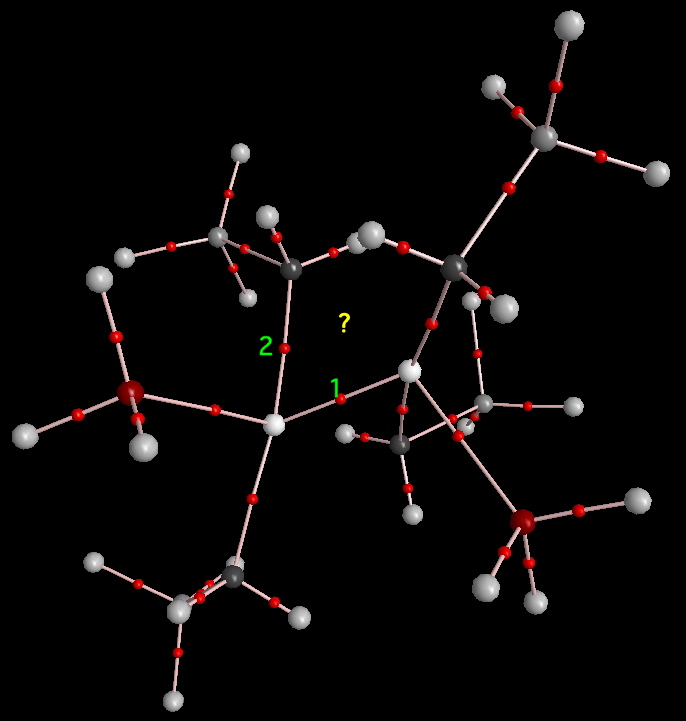
Well, another 16 years has passed, and now we have a rather better set of tools with which to answer such questions, yes you guessed (if you have read my earlier posts), AIM and ELF. Lets start with AIM, shown below (B3LYP/6-311G(d) calculation, for a somewhat reduced model compared to the real system).
AIM analysis. Click for 3D
The bond critical point labelled 1 is the Cr-Cr interaction. It has a ρ(r) of 0.142, really very modest for a purportedly quadruple bond. The ∇2ρ(r) is +0.39, which is the wrong sign for a simple covalent bond, and indeed matches the criteria for the (homonuclear) charge shift category popularized by Shaik and Hibberty. Point 2 is the Cr-CH2(si) bond (of calculated length 2.157Å), ρ(r) 0.078 and with an ellipticity ε of 0.34. This latter value compares to e.g. a value of 0.0 expected for a single (rotatable) bond and ~0.4 for a double bond, and seems to match very well with the observation of restricted rotation about this bond. So far, so good! Surprising however is the absence of any BCP in the region marked with a ?, given that the Cr-C length in this region is 2.257Å (only slightly longer than than that for point 2 and surely a good candidate for some sort of Cr-C bond!). There is no sign of any bending of the Cr-Cr bond in this type of analysis (i.e. point 1 lies along the Cr-Cr axis), or indeed of any evidence for α CH…Cr agostic bonding.
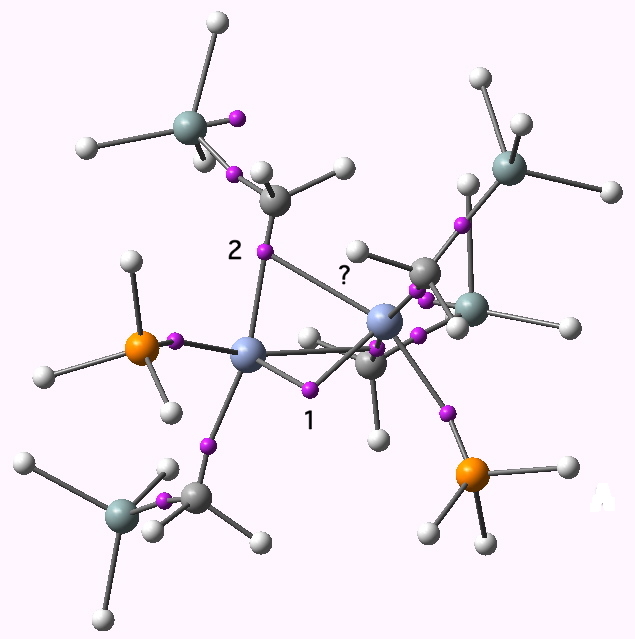
Time then for ELF (below). Well, in one regard, a similar picture to the earlier AIM is obtained. Points 1 and 2 sort of match, and again, no point is found in the region marked with a ?. However, there the similarities end.
ELF basin centroids for Cr-Cr system. Click for 3D
Thus, point 1 (the apparent quadruple bond) integrates to only 1.04 electrons! But wait for it, it lies well off the straight line connecting the two chromium atoms. Wow! So the bond really is bent! And, because it is contains only 1.04 electrons, that might explain why it can bend so easily! Well, if the Cr-Cr bond does not contain the electrons, where have they gone? The mystery is solved when point 2 is inspected (there are of course two of them, the molecule having C2 symmetry). These each correspond to 1.92 electrons. The ELF analysis furthermore tells us that point 2 is actually trisynaptic, covering both chromium atoms and the carbon. We have found 4.88 electrons associated with the Cr-Cr bond after all (and this is not bad, since one rarely finds the full quota directly in such regions using ELF). To indicate this, point 2 above is actually shown connected to three atoms.
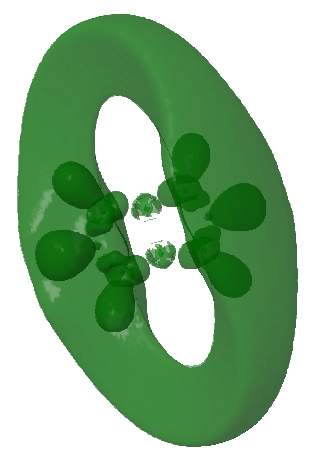
So to summarise, our Cr-Cr quadruple bond in the ELF analysis occupies three different synaptic basins, arranged in a triangle around the C-Cr axis (as shown below), and with the straight line between the Cr-Cr not entertaining any basin. That certainly is bent!
View showing the three synaptic basins comprising the Cr-Cr bond
ELF of course gives only one interpretation of the bonding; there are others. But this interpretation certainly seems to give an interesting and unusual insight into this remarkable (and largely ignored) phenomenon.
This blog has DOI: https://doi.org/10.14469/hpc/12424
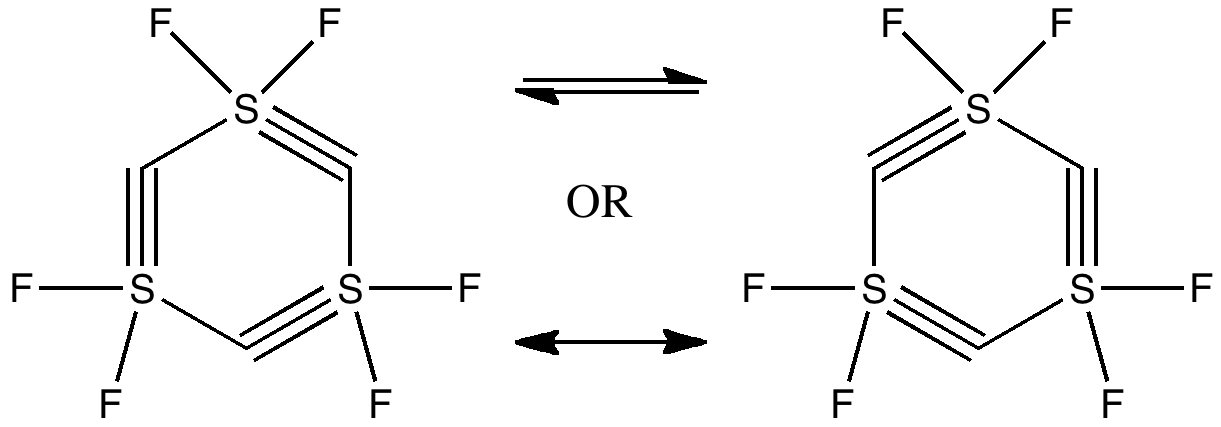
In the previous post, the molecule F3S-C≡SF3 was found to exhibit a valence bond isomerism, one of the S-C bonds being single, the other triple, and with a large barrier (~31 kcal/mol, ν 284i cm-1) to interconversion of the two valence-bond forms. So an interesting extension of this phenomenon is shown below:
A cyclic form of the SCS Motif. Click for 3DIf the same type of valence bond isomerism were to occur, we would now have three C≡S triple bonds swapping places with three CS single bonds, a sort of super version of the notation normally shown for benzene itself. If the barrier to this swapping is finite, then the interconversion shown above would be a proper equilibrium (the top arrows), but if there is no barrier, then the interconversion would be a proper resonance (the bottom double-headed arrow). Another way of posing the question is whether the so-called Kekulé vibrational mode (which in effect represents the motions implied above) has a negative force constant or a positive one respectively for the two sets of arrows shown.
A B3LYP/cc-pVTZ calculation (DOI: 10042/to-3646) reveals that the optimized geometry exhibits six equal SC bonds, all 1.616Å long. Typically, a single SC bond is around 1.82Å, a double 1.65Å and a triple is about 1.5Å at the same level of theory, so this C=S bond is clearly at least a double one. A NICS(0) calculation at the centroid has the value of -14.6 ppm, which indicates aromaticity. We conclude the appropriate arrow above is the bottom resonance one, rather than the top equilibrium one. This is confirmed by finding that the Kekulé vibrational mode has a strongly positive force constant (ν 1083 cm-1, animated in 3D model above), which contrasts with the negative value (ν 284i cm-1) found for bond shifting in F3S-C≡SF3 itself. Again, comparison indicates that a C≡S triple bond has a frequency of around 1400 cm-1 and a double around 1200 cm-1 (the degenerate C=S non–Kekulé vibrational mode for this system is indeed calculated at around 1225 cm-1). So to summarise; a single F3S-C≡SF3 unit reveals very strong bond alternation, and negative force constant (transition state) for interconversion of the two bond forms, but a cyclic form reveals the opposite behaviour, with no alternation and instead strong aromaticity.
In part this difference in behaviour must be due to the constraints on the geometry of the cyclic form. F3S-C≡SF3 interconverts via a highly twisted geometry with C2 symmetry, and this twisting is not exactly possible if you create a cyclic equivalent. In part it is also due to the aromatic stabilisation energies. In the resonance above, you should be able to count a total of 12 electrons involved! Nominally, if you try to apply the 4n+2 aromaticity rule, it does not fit, until you realise that in fact you must be dealing with two sets of 6 electrons. The system in fact is a classic double-aromatic, in which six electrons circulate in the plane of the molecule (the σ-set) and six above and below (the π-set; the MOs for the molecule confirm exactly this interpretation). Notice how this itself contrasts with a similarly aromatic system, the atom swapping in three nitrosonium cations, where the Kekulé mode force constant was strongly negative.
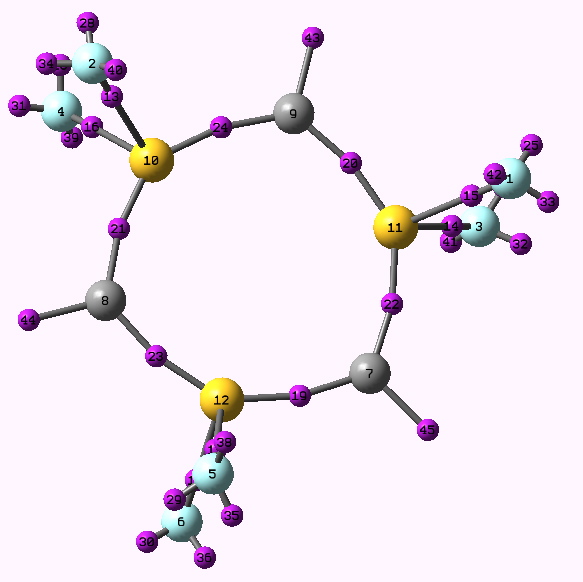
ELF Analysis for F6S3C3. Click for 3DTo complete the analysis, the ELF basins (above) reveal the six SC regions to each contain 2.7 electrons, together with three carbon carbene monosynaptic basins. For comparison, a system with a high degree of SC triple character (HCS+) has around 3.8 in the SC region. Perhaps a better model is TfOSCH (for which the carbon also has a carbene lone pair), which has 2.6e in the CS region. The carbene lone “pair” for the present molecule integrates to 2.6e each, which totals to a nice octet of electrons around each carbon and to around 7 for each S, confirming that whilst the S is hypervalent, its valence octet is not expanded!). This ELF picture does rather tend to confirm the original resonance structure representation shown at the top.
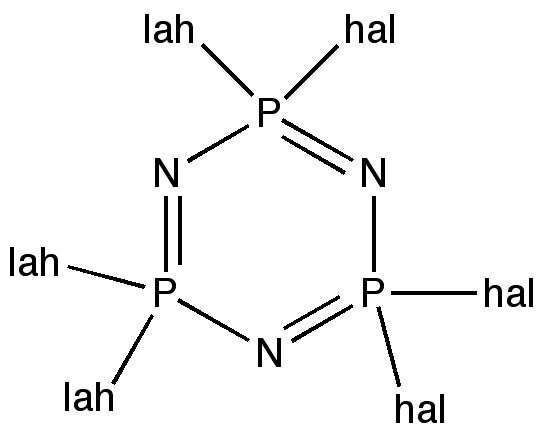
All that is needed is is for someone to make this molecule to confirm its properties. Perhaps by trimerising F2SC, itself formed by cheletropic elimination? It is worth noting that the iso-electronic P/N (e.g. of S/C) analogues are very well known.
A previous post posed the question; during the transformation of one molecule to another, what is the maximum number of electron pairs that can simultaneously move either to or from any one atom-pair bond as part of the reaction? A rather artificial example (atom-swapping between three nitrosonium cations) was used to illustrate the concept, in which three electron pairs would all move from a triple bond to a region not previously containing any electrons to form new triple bonds and destroy the old. Here is a slightly more realistic example of the phenomenon, illustrated by the (narcisistic) reaction below of a bis(sulfur trifluoride) carbene. Close relatives of this molecule are actually known, with either one SF3 of the units replaced by a CF3 group or a SF5 replacing the SF3 (DOI: 10.1021/ja00290a038 ).
F3SCSF3 and the nature of its S-C bonds
The two C-S bonds in this molecule are not the same (and similarly for the CF3 analogue), one being long (single), the other short (assumed triple), and the angle subtended at the central carbon is around 150° (B3LYP/cc-pVTZ calculation, DOI: 10042/to-3643). The transition state for interconverting one form to the other would presumably correspond to the concerted movement of two pairs of electrons from one CS region to the other as shown above, not so much a Ménage à trois, as a Ménage à deux! The transition state itself (DOI: 10042/to-3644) has C2 symmetry, with a calculated free energy barrier of 31 kcal/mol and ν 284i cm-1 for the bond shifting process.
Transition state for bond equalisation. Click for animation
The molecule above does have a further point of interest; one of the sulfur atoms (the triply bonded one) is approximately tetrahedral in coordination, whilst the other has a “T-shape”. An inorganic chemist would describe one sulfur as tetravalent (oxidation state IV), the other as hexavalent (oxidation state VI) and the equilibrium between them a dismutation of the two oxidation states. Does this have any reality? The ELF method has been mentioned a number of times in these posts, and it is applied here to seek an answer. The ELF basin centroids are shown below.
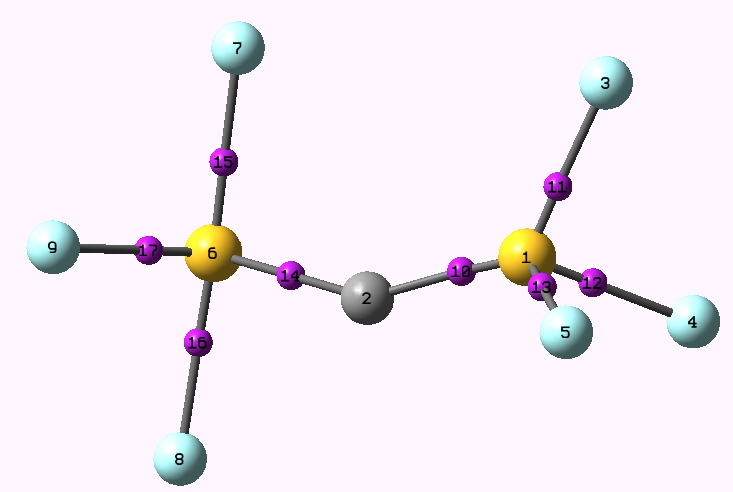
ELF basins for F3SCSF3. Click for 3D
The integrations are as follows: 14 = 2.24 (a single C-S bond), 30=1.66 (an incipient carbene forming, as implied above), 13+15+16 = 4.34 (a reasonably persuasive triple bond, comprising, unusually, three separated basins). The fluorines 2, 3 and 6 all exhibit bonding basins to the S (respectively 2.17, 2.17 and 2.09), but fluorines 1,5 and 4 do not! Sulfur 8 additionally has a lone pair, 29=2.31, but sulfur 9 does not. One aspect of this analysis is the nature of the triple bond between S9-C7. Because the three basins are separate, does that mean that the bond cannot rotate about its axis?
AIM Analysis of F3SCSF3
An alternative AIM analysis is shown above. Now, the CS triple bond is reduced to a single bond critical point (BCP), labelled 10. AIM allows a property known as bond ellipticity to be computed at that BCP. Typically, single and triple bonds have ellipticities close to zero, whilst double bonds have a value of around 0.4 to 0.5. That for point 10 is 0.18, which seems to support the ELF analysis above. Pretty unsual bonding it would have to be agreed!
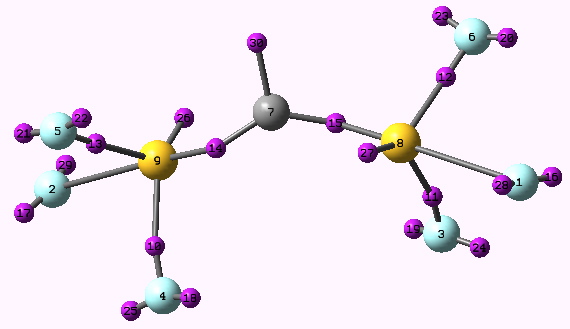
ELF centroids for transition state for dismutation.
But what of the original question posed at the start in the diagram; do two pairs of electrons move away together from one triple bond to form another. A further ELF analysis at the transition state for this process reveals that in effect the two pairs do different things. One localizes onto the carbon, to form a proper carbene, the other becomes a sulfur lone pair. So the valence dismutation involves three pairs of electrons, not two as shown at the start, with each pair doing its own thing.
Six-electron model for valence isomerism in F3SCSF3