Tag: Hypervalency

  • Capturing penta-coordinate carbon! (Part 2).

    In this follow-up to the previous post, I will try to address the question what is the nature of the bonds in penta-coordinate carbon?

    This is a difficult question to answer with any precision, largely because our concept of a bond derives from trying to define what the properties of the electrons located in the region between any two specified atoms are. Such a local picture is somewhat at variance with the idea of electrons being delocalized across the entire molecule. Two procedures for analyzing the local electronic behaviour which we have been using recently are AIM (Atoms-in-Molecules) and ELF (the topology of the Electron localization function). There are many useful published articles which elaborate these concepts; if you want to read some of them, start at DOI 10.1021/ct8001915 and follow the cited articles.

    Firstly, the AIM analysis of the system below, where X=cyclopentadienyl anion and Y=CN.
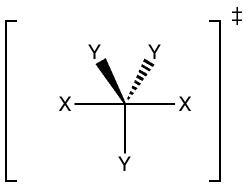
    The Sn2 transition state
    The Sn2 transition state

    This is shown below. If you click on the image, you will see a rotatable version of this diagram. The coloured (red, yellow and green) dots represent so-called critical points in the curvature of the electron density function ρ(r). The red dots are known as bond critical points, or BCPs. These (almost) always are found along the line connecting two atoms which we tend to refer to as a bond. You will see two that have been circled in the diagram below, and these appear to show a bond connecting the central 5-coordinate carbon atom and a carbon of each of the cyclopentadienyl rings (which themselves are revealed as rings by the presence of a yellow dot). Indeed, that central carbon atom does seem to have five red dots radiating out along lines connecting it to five carbon atoms.
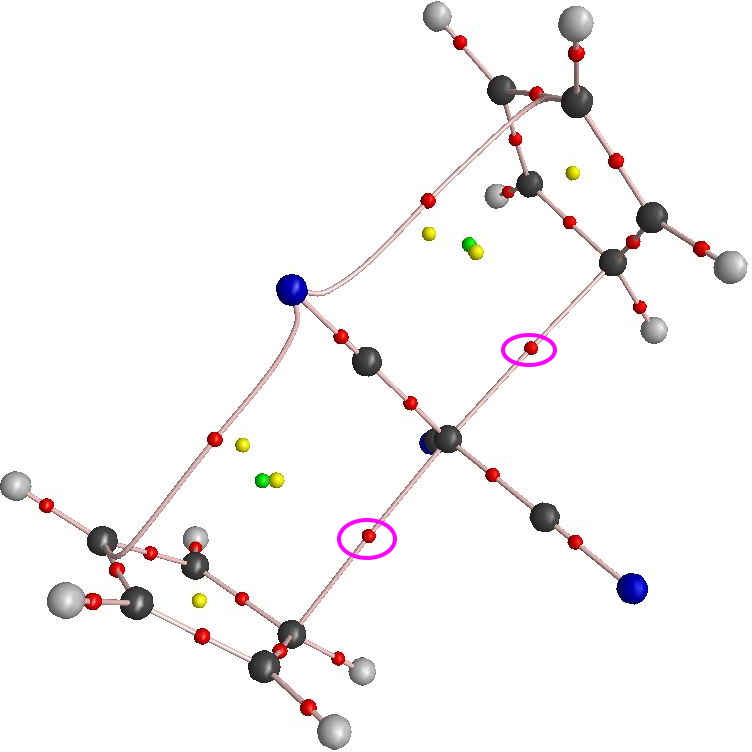
    AIM analysis (red = bond critical points, yellow = ring, green = cage)
    AIM analysis (red = bond critical points, yellow = ring, green = cage)
    So is the case proven for pentavalent carbon? Well, no. Firstly, one has to inspect the value of ρ(r) at the circled red dot. This has a (calculated) value of 0.022 au and a calculated bond length of ~2.7Å. We need to calibrate this against a real system as reported in DOI: 10.1021/ja710423d (below):

    Hexa-coordinate carbon
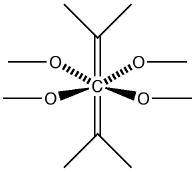
    Hexa-coordinate carbon. Click for 3D model
    Here, the electron density ρ(r) was actually measured using X-ray diffraction, and found to be ~0.017 for bond critical points found connecting the central carbon and each of the four oxygen atoms. The length of these “bonds” was measured as  ~2.7Å. The agreement with our frozen transition state is quite striking.

    One can go a little further and inspect the (2nd) derivative of the electron density at the bond critical point, termed the Laplacian, or ∇2ρ, which tells what kind of “bond” one might have. The measured value of ∇2ρ for the system above was ~0.06 au, and the calculated value for our pentacoordinate system is 0.04 au, which again suggests we are dealing with a very similar interaction in both systems (one hypothetical and calculated, the other real and measured). The use of the term  interaction was deliberate.  It is less loaded than the term  bond. Thus the value of ρ(r) for an undisputed C-C single bond is around 0.28 au, around ten times higher than our putative bonds. Since we do not really wish to grace a ρ(r) value of 0.022 with the term decibond (or any other fraction of a single bond) perhaps it is best to call it just an interaction, and leave open the question of how strong that interaction is! So, despite the  AIM analysis  finding a bond critical point, we shall settle for interpreting that merely as an interaction, and not a bond!  Well, is an interaction (or come to that, a decibond) worthy of counting towards a coordination?  Perhaps!

    So AIM can provide information about the curvature and density of the electrons in the region of a bond/interaction. But it does not provide any information about another simple question which the term bond implies. How many electrons might be involved? Ever since  G. N. Lewis coined the term two-electron bond in 1916,  we have become used to interpreting bonds in terms of simple (often integer) numbers of electrons.  A carbon-carbon single bond shares two electrons; a double bond four electrons, and so on. We use this concept all the time in the technique known  as arrow-pushing, which helps us delineate mechanisms of reactions. Might it be possible to  identify how many electrons are involved in bonds/interactions of the captured  SN2 species above? Enter the ELF technique. It would not be appropriate to delve into the theory of this method here; suffice to say that  (approximately), the  bond-critical-point of the  AIM analysis in this case would map to a disynaptic basin for ELF. Thus a two-electron single bond will reveal a disynaptic basin (the centroid of which approximately matches the position of the  AIM BCP), which can be integrated to approximately two electrons. Shown below are the centroids of the disynaptic basins calculated for our SN2 species:
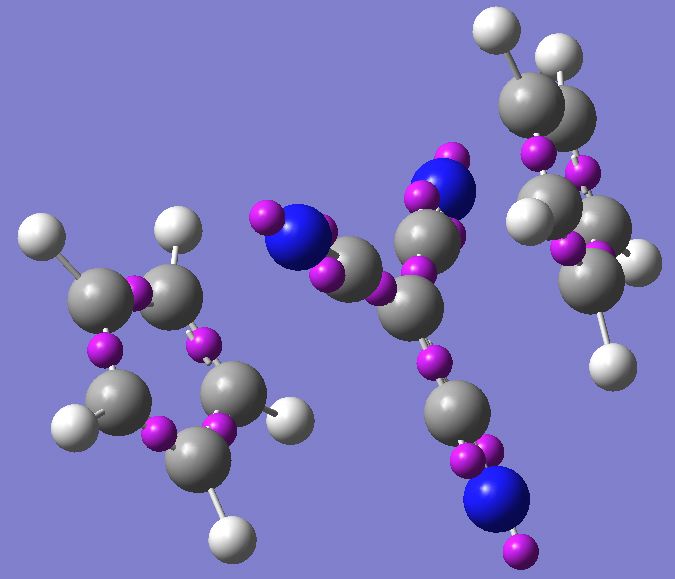
    ELF basins (purple dots) for the SN2 system
    ELF basins (purple dots) for the SN2 system. Click for 3D model
    The most striking difference with the AIM analysis is that that the central carbon is surrounded only by three, not five disynaptic basins. The BCPs found for the two di-axial interactions have no counterpart in synaptic basins. Of course, that does not mean that there are no electrons that can be integrated in that region, just that the curvature of the density in that region is not sufficiently well defined to define a bounded volume of space which can be clearly integrated. Perhaps that condition is what we might mean by a bond!

    The three disynaptic basins that do surround the central carbon integrate to a total of 7.85 electrons, which is close enough to 8 for us to say that this carbon is NOT hypervalent!

    So what is our final conclusion? The frozen SN2 species is not hypervalent. It could reasonably be said to be coordinated by three bonds, and two diaxial substituents that interact with the central carbon weakly. Perhaps rather than penta-coordinate, the central carbon could be described as pentacoordinaloid!
  • Capturing penta-coordinate carbon! (Part 1).

    The bimolecular nucleophilic substitution reaction at saturated carbon is an icon of organic chemistry, and is better known by its mechanistic label, SN2. It is normally a slow reaction, with half lives often measured in hours. This implies a significant barrier to reaction (~15-20 kcal/mol) for the transition state, shown below (X is normally both a good nucleophile and a good nucleofuge/leaving group, such as halide, cyanide, etc.  Y can have a wide variety of forms).

    The Sn2 transition state
    The Sn2 transition state

    This transition state is normally regarded as the only situation in which carbon can sustain penta-coordination (there are some exceptions), and this is often contrasted with the analogous situation for silicon, which demonstrates an abundance of stable penta- (and hexa-)coordinate (crystal) structures. Perhaps inevitably therefore, chemists have set themselves the goal of capturing a penta-coordinate carbon, not as a transition state with fleeting lifetime, but as a stable (and perchance crystalline) species.  The best strategy is to explore potential systems computationally, and the latest report of such an exploration has some suggestions for synthesis (Pierrefixe, S. C. A. H.; van Stralen, S. J. M.; van Strale, J. N. P.; Guerra, C. F.; Bickelhaupt, F. M., “Hypervalent Carbon Atom: “Freezing” the SN2 Transition State,” DOI: [cite]10.1002/anie.200902125[/cite]). Their suggestion corresponds to Y=CN and X=At (Astatine), a rather esoteric combination it has to be said.  In the manner of the blogosphere, Steve Bachrach has noted this report in his own blog, where a discussion has opened up on the origins of why carbon can be regarded as abnormal (at least compared to silicon), and more particularly whether such a species should be regarded as merely hypercoordinate, or as Bickelhaupt and co-workers suggest, hypervalent.

    In fact, such reports are not new. As I note in the discussion of Steve’s blog, a crystalline structure of a hexa-coordinate carbon compound was reported in 2008 (DOI: [cite]10.1021/ja710423d[/cite] (below), and it is also tentatively described as possibly hexavalent near the end of the article! I shall return to this compound in the second part of this post.

    Hexa-coordinate carbon
    Hexa-coordinate carbon

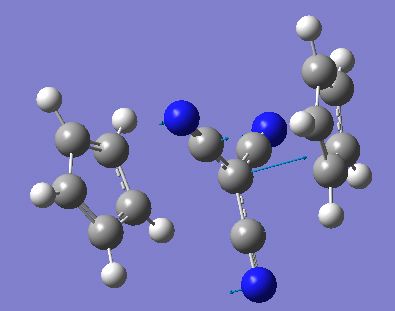
    The astatine system reported above is unusual, and it really only contains three carbon-carbon bonds surrounding the pentacoordinate carbon. The compound above contains only two such C-C “bonds”. It would be perhaps more interesting to ask if one could design a compound with five C-C bonds surrounding the putative pentacoordinate atom. Whilst mulling over Steve’s post, and pondering my contribution to that blog, a colleague in my department wandered into my office (my door is almost always open) and without saying a word, he wrote a structure on my blackboard (yes, I really do have such).  He then walked out (almost;  I believe he did mutter perhaps two words before leaving). He had sketched the key feature of an article by Ethan L. Fisher and Tristan H. Lambert entitled Leaving Group Potential of a Substituted Cyclopentadienyl Anion Toward Oxidative Addition (DOI: [cite]10.1021/ol901598n[/cite]). This triggered the following question in my mind: could the aromatic cyclopentadienyl anion act as the X group in the pentacoordinate carbon example above? The essential property of group X is that it must be big!  Well, cyclopentadienyl can be made big! It would also achieve the purpose of forming a penta-coordinate carbon with  five  C…C bonds.

    So in it goes for a B3LYP/6-311+G(2df) calculation. Surely, the life of a computational chemist is an easy one; all one  has to do is wait a few hours (or, with a large basis set, days) for an answer. The result is shown below.

    The SN2 reaction captured with cyclopentadienyl anion
    The SN2 reaction captured with cyclopentadienyl anion

    The key vibrational mode (which you can see animated if you click on the image above) has a wavenumber of 194 cm-1 (B3LYP/6-311+G(2df); other basis sets show similar values). It corresponds to the SN2 mode,  and is what we normally think of as the  transition or reaction normal mode for this reaction. But  in this case, it is not an imaginary mode, but a real mode!  The SN2 has been (virtually) captured for a penta-coordinate carbon with five C…C interactions. How does it compare with the astatine system noted in [cite]10.1002/anie.200902125[/cite]? Well, unfortunately, the umbrella-mode for that system  is only reported as a force constant without mass weighting, so it cannot be compared to the mass-weighted value we have here. The calculation is digitally archived (e.g. as 10042/to-2407 or 10042/to-2415) so you can analyze it for yourself!

    An obvious question to ask is what the nature of the  axial bonds for X=cyclopentadienyl is. Is the central carbon hypercoordinate, or hypervalent, or both? But this blog is quite long enough already, and so this will all be discussed in part 2, to follow shortly.

    Oh, one final comment. The issue of hypervalency and hypercoordination of carbon has previously been discussed largely in conventional scientific publications (for which DOIs are provided above). The forum moved to Salt Lake  City in the  USA, where some of the results were presented orally at the ACS spring conference in 2009.  Now that it  has been formally published, it has been taken up by Bachrach in his blog, where some of the discussion has continued. So where should I have presented the present result?  In the primary scientific literature? Or perhaps another ACS meeting? Well, here it is in another blog (I have been variously told I am either brave or very foolish for doing so!). And as I write this, of course it is not peer reviewed (but there is nothing to stop people from commenting on this of course, as has happened in Bachrach’s blog). Will it “count” here – in other words, does it (yet) have any scientific respectability? Should  blogs report new scientific results, or merely be reserved for commenting on such results which have been reported in the “proper scientific manner”? Will indeed this result appear in the future in the scientific literature under different authorship, but with no accreditation for this blog? If I do choose to “write it up properly” (assuming the journals now let me), can I cite this blog in the way one can cite the ACS conferences? I do not suppose many people know what the answers are to all these questions. Perhaps the appearance of this post might provide some?