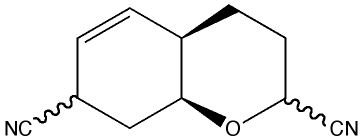
Chemistry can be very focussed nowadays. This especially applies to target-driven synthesis, where the objective is to make a specified molecule, in perhaps as an original manner as possible. A welcome, but not always essential aspect of such syntheses is the discovery of new chemistry. In this blog, I will suggest that the focus on the target can mean that interesting chemistry can get over-looked (or if observed, not fully exploited in subsequent publications). Taking a synthesis-oriented publication at (almost) random entitled Synthesis of 1-Oxadecalins from Anisole Promoted by Tungsten (DOI: 10.1021/ja803605m) which appeared in 2008, the following molecule appears as one of the (many) intermediates.
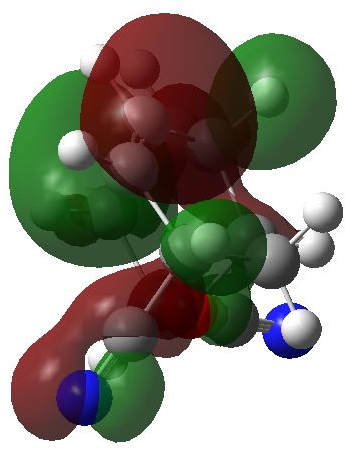
An inspection of the molecular orbitals for the di-axial isomer reveals that the HOMO involves interaction of the alkene π-MO with the C…CN bond (top) and the HOMO-1 involves interaction of the oxygen lone pair with the C…CN bond (bottom). This sort of interaction is a classical anomeric effect!
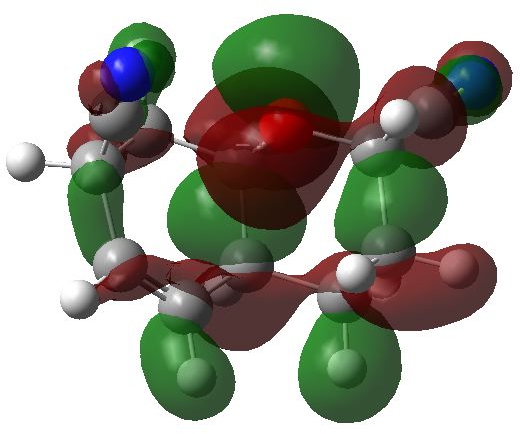
Inspection of the HOMO shows an almost identical interaction between the C…CN bond and the alkene, implying that here it is the electrons from an alkene that are the donor. This combination, of an alkene as donor and a C…CN group as an acceptor has (to my knowledge) never been suggested as an anomeric effect pair. It is not as strong as before (C…CN 1.47Å) and perhaps in this case, it adopts the axial position because the alternative equatorial conformation is disfavoured for other reasons.
But, and this is the point of this blog, the structure of compound 22 in the synthesis project above has some interesting aspects, which perhaps can lead to new insights and even new chemistry. One can but wonder how many reported compounds have properties which are perhaps more interesting than their authors realize, and how much new chemistry is lurking in the literature which has not (yet) been noticed. With more than 50,000,000 compounds now reported in Chemical Abstracts, there is surely lots out there to discover. However, will it be humans who will increasingly do so in the future, or automatons scouring the Semantic Web? But here we digress to a new topic!


Leave a Reply