Here is a challenge: what is the longest C-C bond actually determined (in which both carbon termini are sp3 hybridised)? I pose this question since Steve Bachrach has posted on how to stabilize long bonds by attractive dispersive interactions, and more recently commenting on what the longest straight chain alkane might be before dispersive interaction start to fold it (the answer appears to be C17).
A search of the Cambridge database (the following conditions apply; structure determined at less than 160K, no errors, no disorder, and a minimum separation of 1.7Å) reveals only 7 entries longer than 1.7A. The reference codes for these are FIBBOI, HOLKOI, LAGHOQ01, RIRTUH, RUNHOY, XIQRIZ, BATSIA, the latter having a value of 1.731Å (T=123K, R=4.44%, DOI: 10.1246/cl.2012.541). Of course, a very close inspection of the crystallography would also be needed to determine if these values are to be taken at face value.
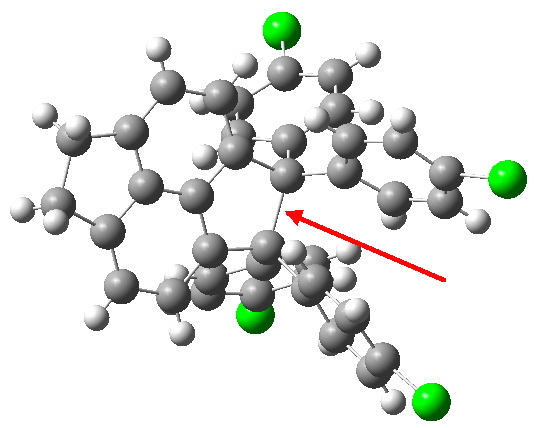
If one relaxes the temperature constraint for measurement, CAZFUE01 has a claimed C-C length of 1.99Å (R=4.5%, DOI: 10.1246/cl.2012.541). This however represents the so-called frozen transition state for a [3,3] sigmatropic rearrangement. A ωB97XD/6-311G(d,p)/SCRF=dichloromethane calculation seems to indicate that this species is in fact a transition state for the [3,3] reaction, and hence that the crystal structure may in fact correspond to the mean position of the two end points of the reaction, and so be an artefact. More on this in a later post.
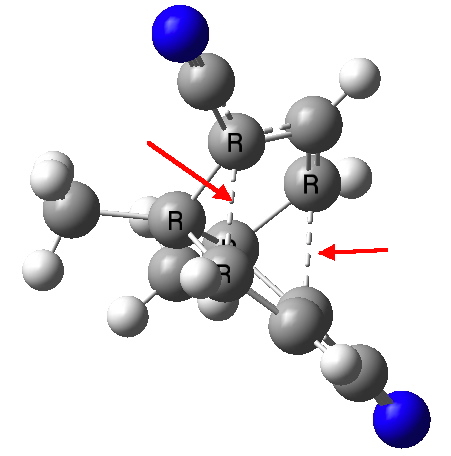
And I suppose one should ask what the shortest such single bond is as well as the longest. This is currently claimed to be 1.436Å for KAVKUO (10.1002/anie.200501605) and 1.434Å for WUDKAH (10.1016/S0040-4020(02)00695-6). The origins of this contraction also deserve to be more fully explored in a later post.
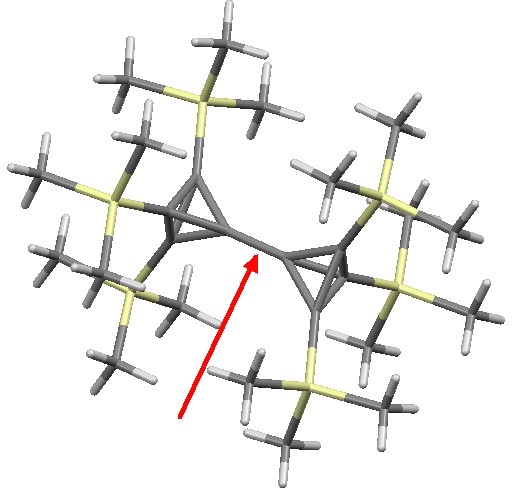
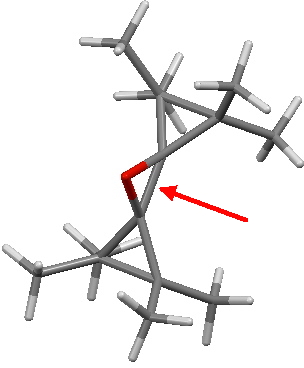
Certainly, the (sp3)C-C(sp3) bond does seem to be capable of a large range of values ranging from 1.44 to at least 1.73 and possibly 1.99Å.


Leave a Reply