My previous posts have covered the ionization by a small number of discrete water molecules of the series of halogen acids, ranging from HI (the strongest, pKa -10) via HF (weaker, pKa 3.1) to the pseudo-halogen HCN (the weakest, pKa 9.2). Here I try out some even stronger acids to see what the least number of water molecule needed to ionize these might be.
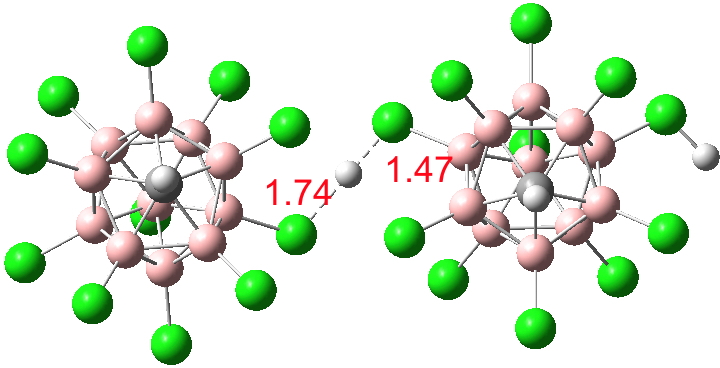
Firstly what must surely be the ultimate acid H(CHB11Cl11), discovered by Christopher Reed[cite]10.1021/ja058581l[/cite] in 2006. This is so strong that it appears that it can even largely ionize itself; the form on the right (below) is the cationic acid, the form on the left is its anionic base. The proton itself is bridged[cite]10.5517/CCNBRWL[/cite] between the two in a manner similar to the structure of one form of HCl.4H2O reported in the earlier post on the topic.
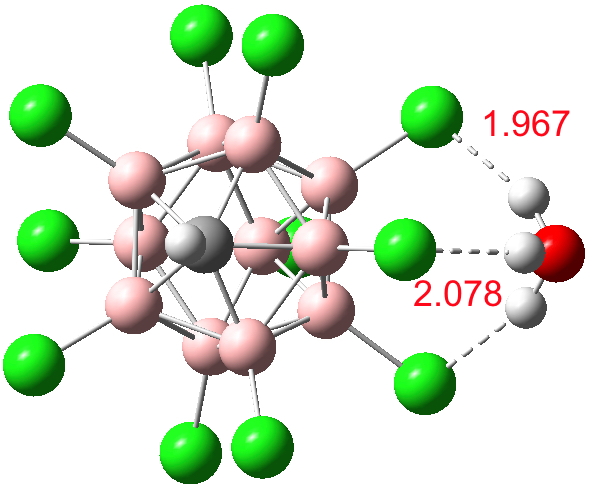
So it comes as no surprise‡ to find[cite]10.14469/ch/191134[/cite] that just one water molecule can also ionize H(CHB11Cl11) to the anionic form (CHB11Cl11)–.
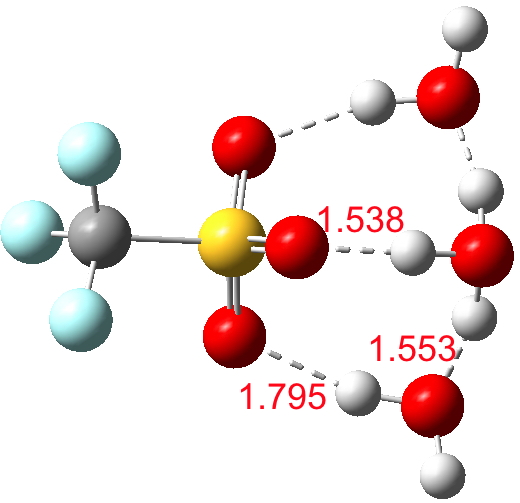
How about triflic acid, CF3SO2OH, pKa -16), which is also a fair bit more acidic than HI? Here, only three waters are needed (ωB97XD/6-311++G(2d,2p) prediction) to ionise to triflate anion.[cite]10.14469/ch/191129[/cite]
So, if there a system which is ionised by precisely two water molecules I will record it here.
‡Perhaps also no surprise is that one H2S molecule can also perform this ionisation.[cite]10.14469/ch/191135[/cite] This leads us into another exploration, using molecules other than water to perform these ionisations.


Leave a Reply