Category: Historical

  • Pierre and Marie Curie.

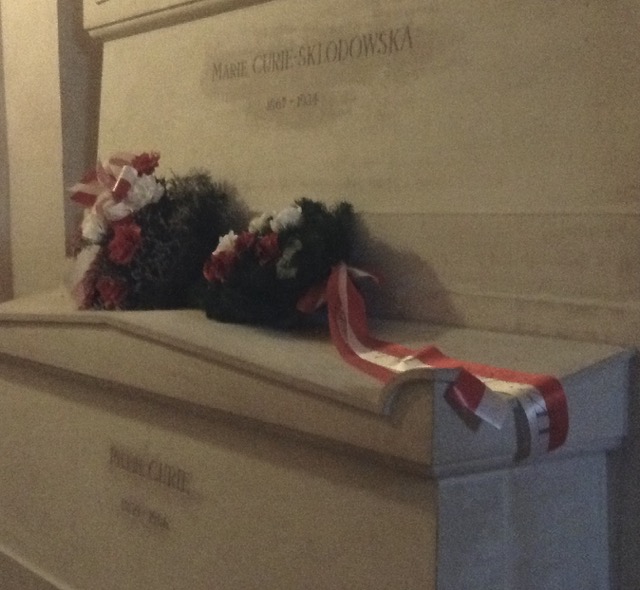
    I have previously shown the grave of  William Perkin, a great british organic chemist. On a recent visit to  Paris, I went to see the crypt in the Panthéon, the great french secular necropolis. What a contrast to Perkin! 

    curie2

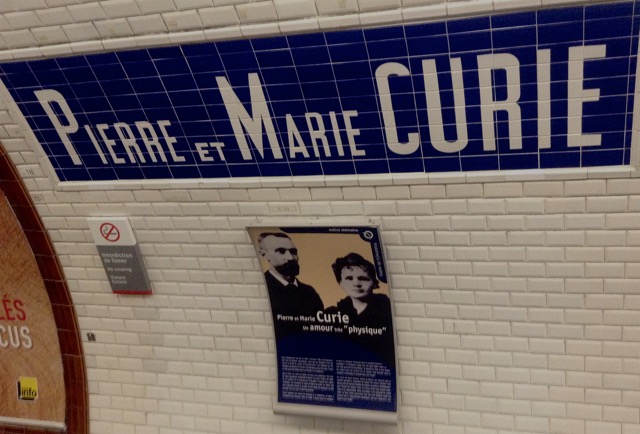
    The Curies have a crypt all to themselves (VII), and other great french scientists such as Bertholet and Langevin as well as mathematicians such as Lagrange who are also interred in other crypts. It is surprising in fact how exclusive admission to the Pantheon is (and how much space for new tombs there still is); whilst many of the graves relate to famous soldiers dating from the french revolution and not a few politicians of course as well as famous literary figures, science and chemistry are very well represented! The French have even named a metro station after the Curies …

    curie1

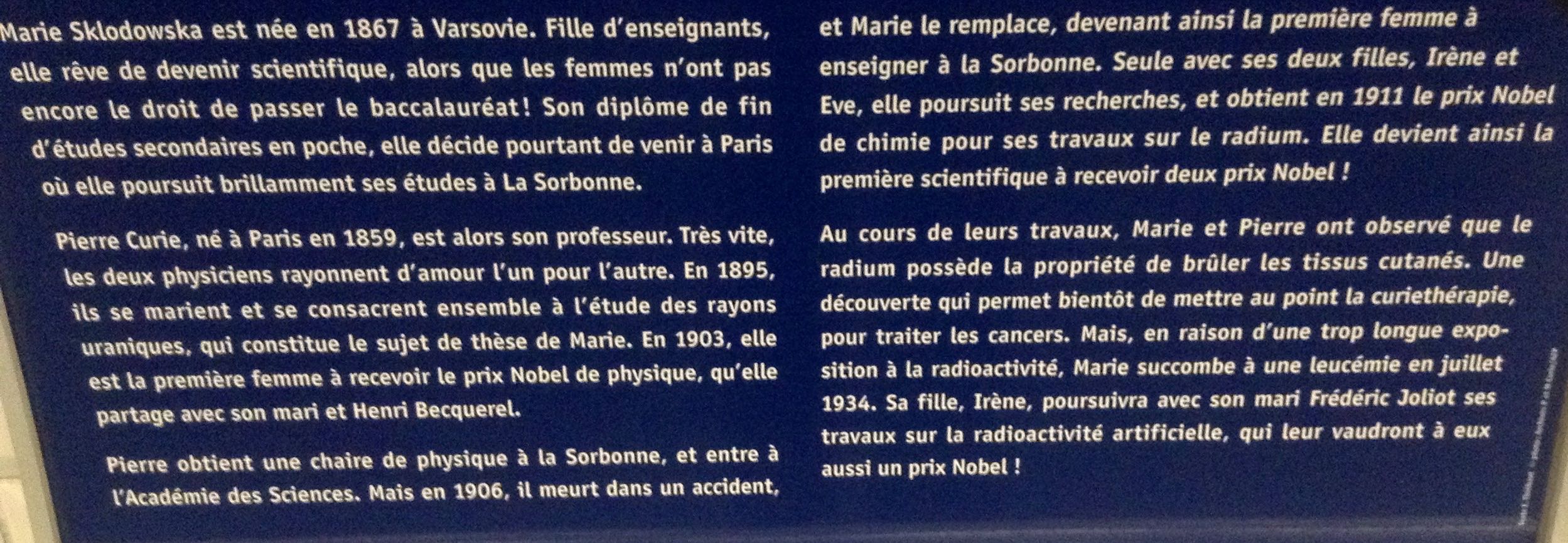
    with a  caption that makes nice reading for the passengers whilst waiting for a train.

    curie3

    A highly readable description of their work can be found in Oliver Sacks’ book Uncle Tungsten. And if you ever visit Paris, remember to ask to go to Gay-Lussac’s lab (who is not interred in the Panthéon), preserved in a time-warp from 100 years ago.

  • Impressions of China 2: The colour of porcelain.

    In Jingdezhen an Imperial Kiln was built in 1369 to produce porcelain that was “white as jade, thin as paper, bright as a mirror and tuneful as a bell”. It’s the colours of the glazes that caught my eye, achieved by a combination of oxidative and reductive firing in the kiln, coupled with exquisite control of the temperature.

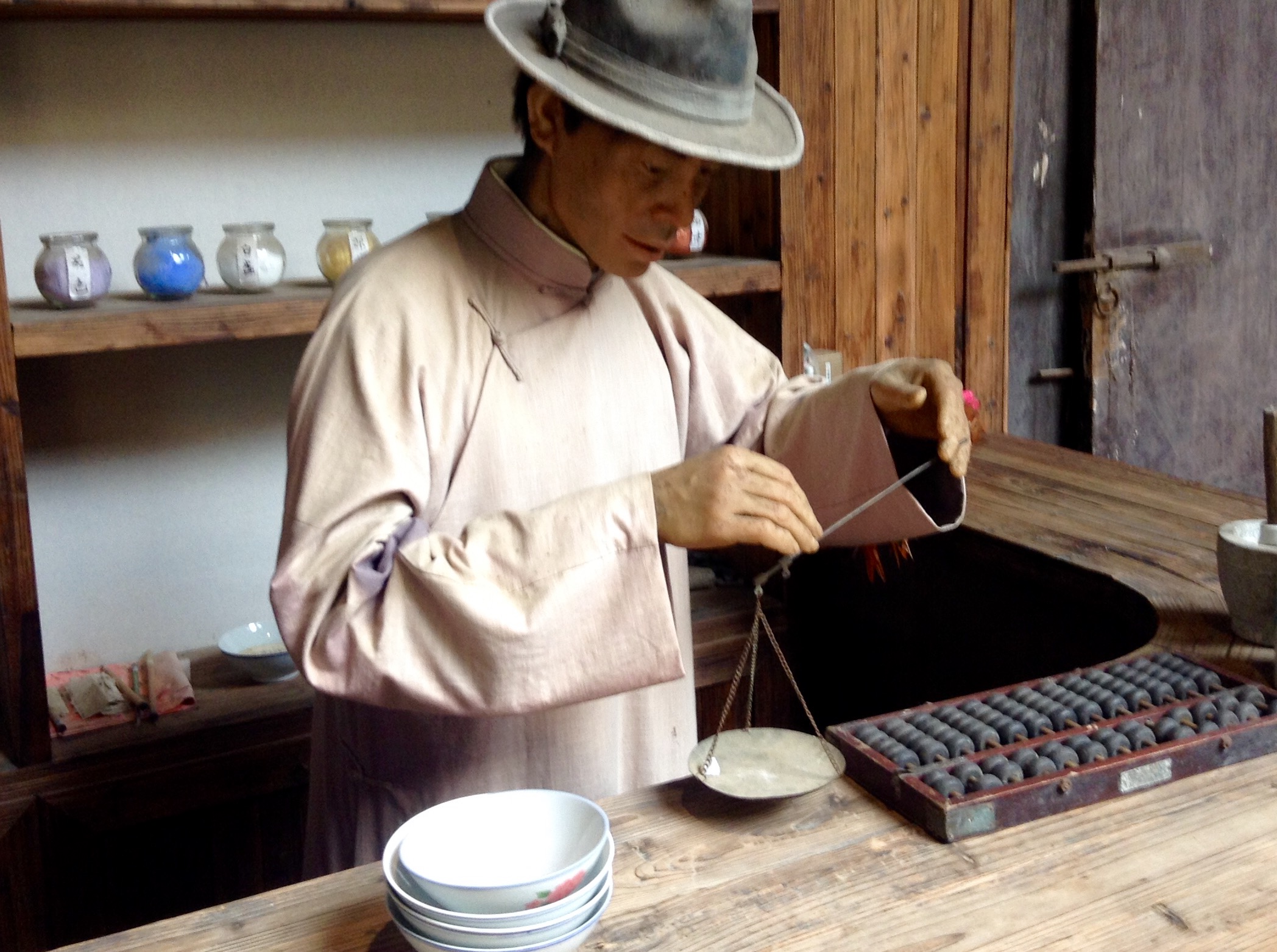
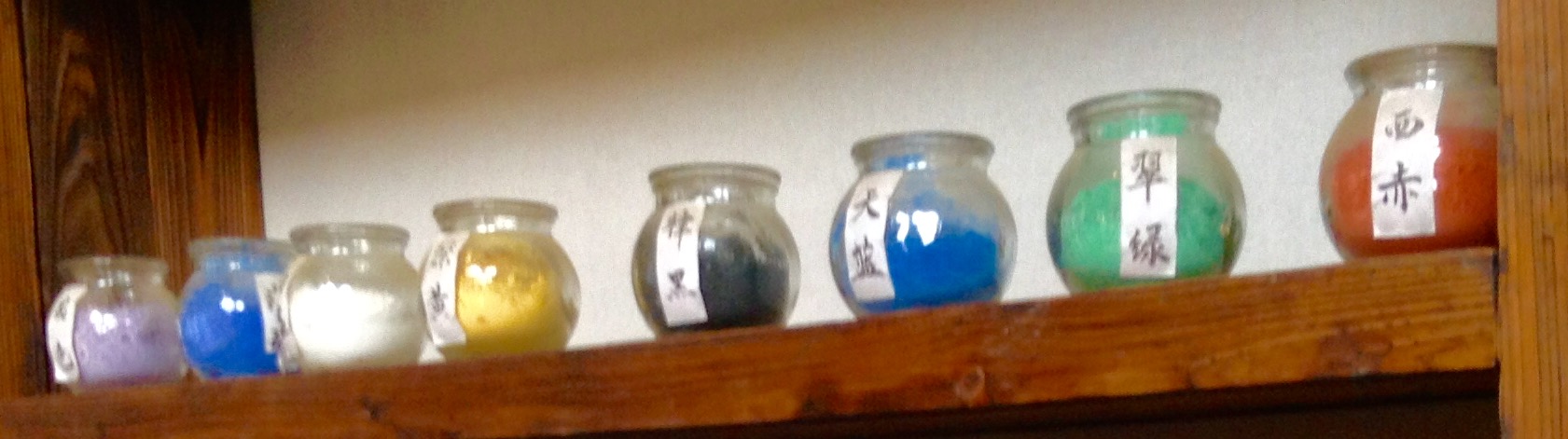
    The photo below represents the glaze master weighing out the transition metal salts required to produce the colours, with abacus to hand! The labels on the bottles are not translated (I forgot to load up the camera-based translator onto my iPad, which I am using to write this post). Question: what colours does oxidative or reductive firing with vanadium salts produce?

    image

    image

    And in Tunxi in the old village of Xidi the bridge made famous by the film Crouching Tiger, Hidden Dragon. image

  • The chemical Web at 22 and where it might go.

    This post is prompted by the appearance of a retrospective special issue of C&E news, with what appears to be its very own Website: internet.cenmag.org. It contains articles and interviews with many interesting people, along with several variations on the historical (albeit rather USA-centric) perspectives and a time-line covers many of the key innovations (again, from a USA-perspective). Some subjects are covered in greater depth, including computational chemistry. The periodic table too gets coverage, but surprisingly that is not of Mark Winter’s WebElements, which carries the impressive 1993-2015 continuous timeline (hence 22 in the title!).  

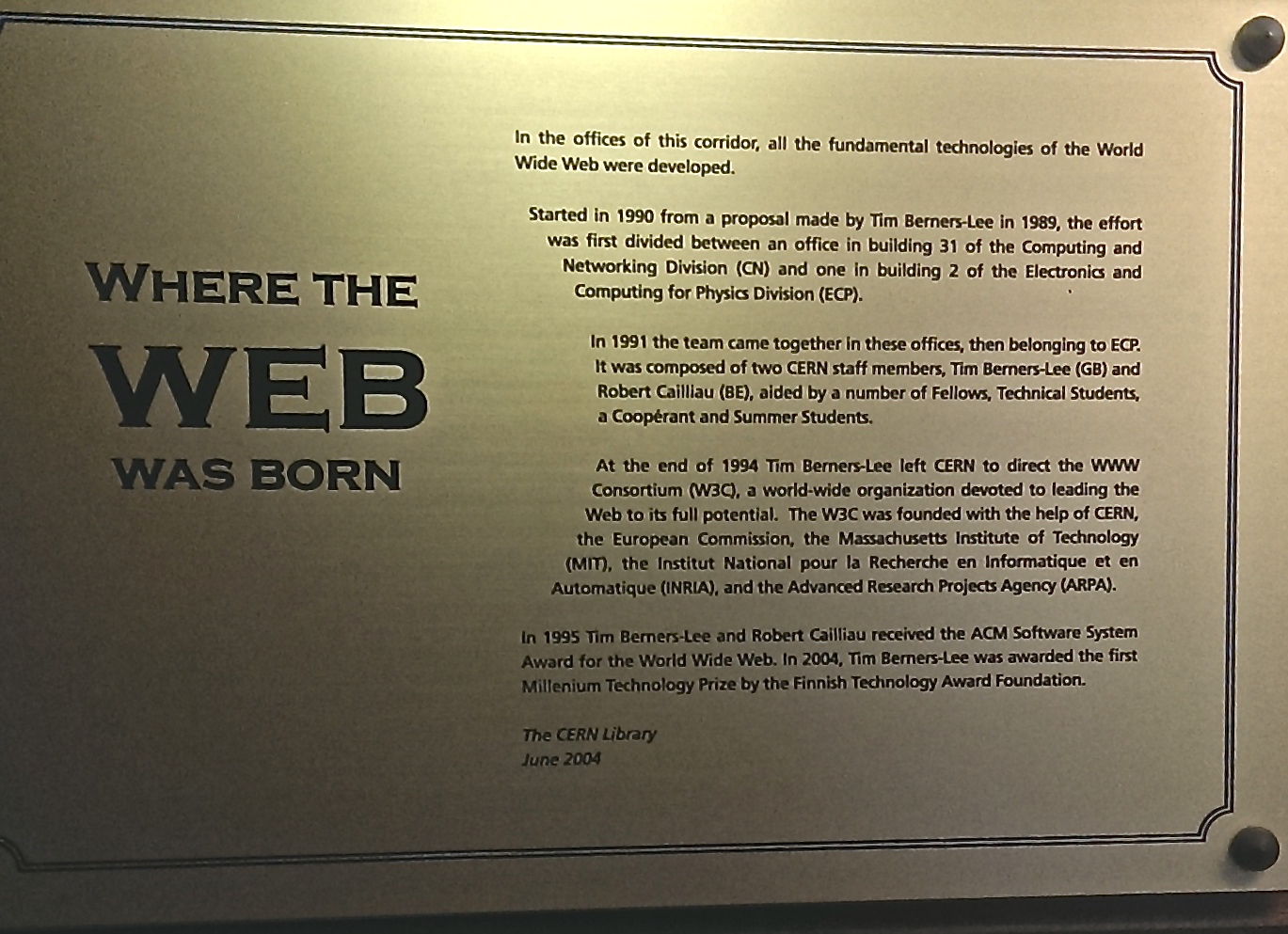
    You can find mention of Tim Berners-Lee at the CEN site (but no interview with Sir Tim), so here I contribute to the historical record by showing the plaque placed in the corridor of offices at CERN where TiMBL and Robert Cailliau worked to set the Web up in 1991.

    Click to expand
    Click to expand

    What is not really given much prominence in the C&E news article is DATA. Which arguably is the reason why TimBL set things going back in 1989! Zenodo is (just like the Web before it) a spin-off from the activities at CERN, but now handling just data. Or Code. Or indeed almost any useful outcome of the research process that might be useful to someone else or to posterity. And to put it into context, it comes in two parts:

    1. The data store itself (which CERN are especially good at, since the Large Hadron Collider generates a great deal of data). They add the A to FAIR (Findable, Accessible, interoperable and Reusable). And also a certain confidence that this store will be enduring, not here today and gone tomorrow.
    2. The metadata describing the data, which in fact turns out is stored somewhere else, at DataCite. This organisation serves to add the F to FAIR.

    And to show how this works in practice I can do no better than give this link: search.labs.datacite.org/help/examples which shows how you can benefit from the metadata.

    I have already demonstrated the use of Zenodo for archiving some old computer code of mine for calculating kinetic isotope effects, but of course it is so much more than that. If the first CERN spin-out, the Web, is already 22 years old (for chemists), then I am confident in asserting that facilities such as Zenodo will play an increasingly important role over the next 22 years (indeed a much shorter timescale than that). 


    A personal souvenir can be seen here.

  • The structure of naphthalene: 1890-1925, and a modern twist.

    This is a little historical essay into the electronic structure of naphthalene, presented as key dates (and also collects comments made which were appended to other posts).

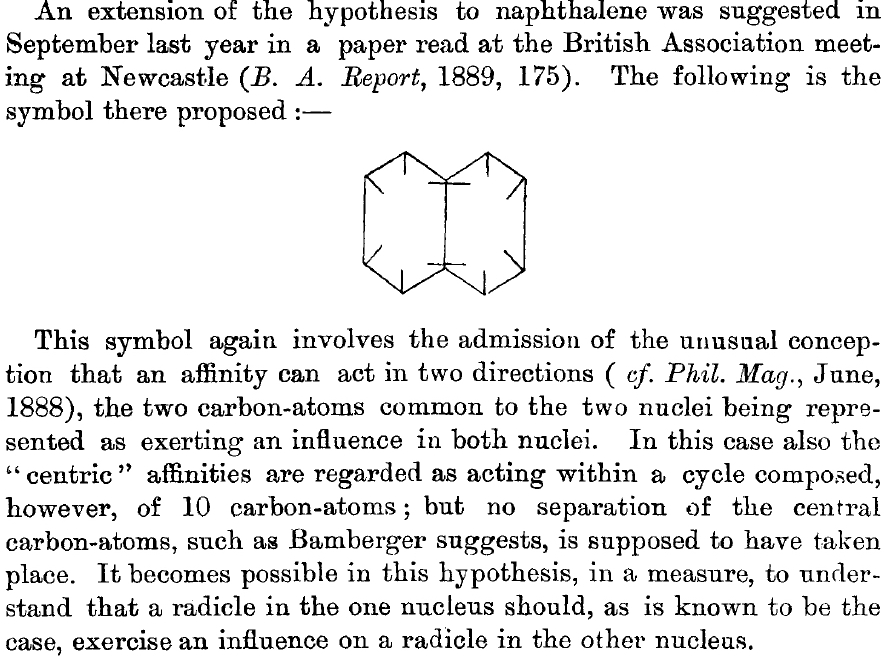
    1. 1890[cite]10.1039/pl8900600095[/cite]: Henry Armstrong presents the following structure of naphthalene. Three words need translation into modern usage. Where he uses the word nuclei the closest translation now might be rings. Secondly, the term affinity is nowadays replaced by electron. This latter term was first coined by Stoney[cite]10.1080/14786449408620653[/cite] one year after Armstrong wrote this article to mean a then hypothetical “atom of electricity”. Oddly Armstrong never updated his own usage even after Thomson actually discovered the electron in 1897. Radicle is a substituent on the ring, and the origin perhaps of the generic R used nowadays.

      arm1


      Notice that Armstrong talks about a cycle of ten carbons in which ten affinities/electrons act (he had previously accounted for the 22 affinities associated with what we would now call the 11 C-C σ-bonds) and is adamant that no separation of the central carbon atoms takes place as Bamburger had suggested. In modern parlance the central C-C bond has a σ-bond and he is describing a [10]annulene. The last sentence above presages the modern term delocalisation


      arm2


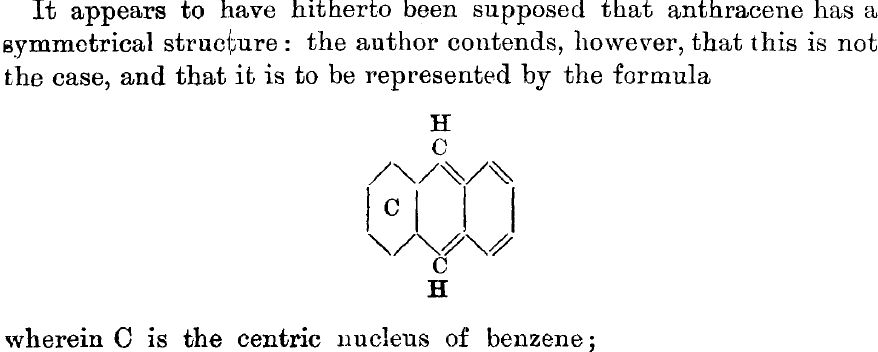
      Armstrong next considers anthracene (above) and replaces the line representation of the affinities by a circle, abbreviated C (which represents six cyclic affinities, or electrons) and by four conventional double bonds, recovering 14 of what nowadays designate as π-electrons. What he does NOT do is consider the equally valid structure where his C is shown in the right hand ring, and then apply Kekule’s hypothesis to in effect average them on a chemical time scale. It is noteworthy that overall,  Armstrong has discussed 6, 10 and 14 electrons, just a hint of the  4n+2 rule yet to come.

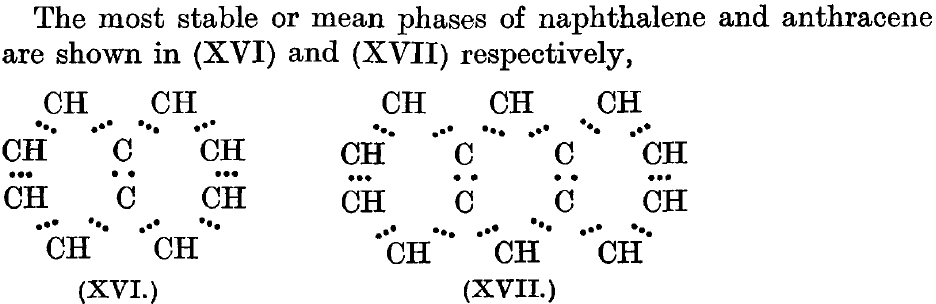
    2. 1922[cite]10.1039/ct9222100427[/cite]:The next example comes from Robert Robinson, future Nobel prize winner, who collected all 32 electrons in naphthalene (excluding CH) into the representation show as XVL. This is an averaging (mean) that Armstrong did not do, of what we would nowadays call two resonance forms. Whereas Armstrong had clearly recognised two sets of electrons (22 and 10), this distinction is lost in this 1922 representation of the 32 ring electrons in naphthalene.

      rob1


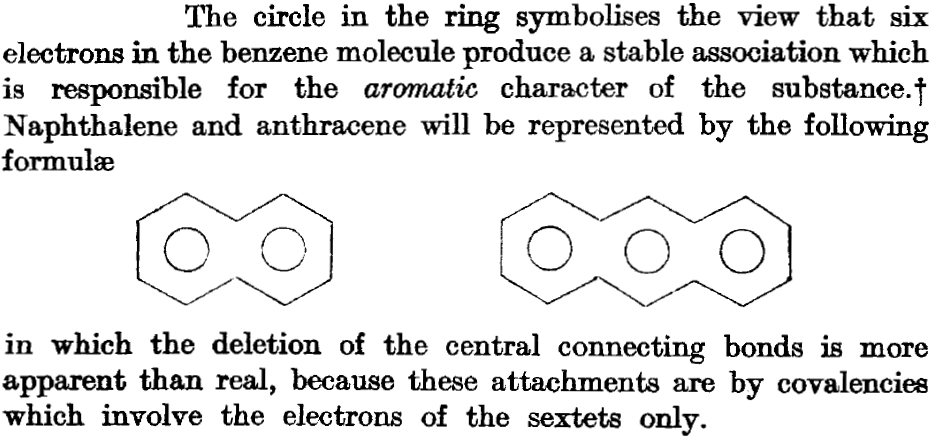
    3. 1925[cite]10.1039/CT9252701604[/cite]Just three years later Robinson (re?)discovers the magic of six π-electrons (the term π was not yet coined) and decides to reapply it to naphthalene. Rather than average two equivalent structures, each with just six cyclic π-electrons (Armstrong’s C) he uses two such rings with twelve π-electrons. This means that he implies only 20 σ electrons (32-12=20), because to balance his count he has to remove two from the central C-C bond. When he writes that the deletion of the central connecting bond(s) is more apparent than real, he is really describing for the first time what we nowadays call a homo-π-bond, one with no underlying σ-bond (also called a suspended π-bond). On the premise one can never have too much of a good thing, he also applies this to anthracene.

      rob2


    4. 2015: Posterity has now decided that Robinson’s 1922 effort has more or less survived and his 1925 effort has not. But one might ask whether this ill-fated suggestion could in fact inspire modern chemistry? Well, crystalline examples of such suspended π-bonds are now indeed known[cite]10.1002/anie.201204440[/cite] and there are probably many more out there. I too have been inspired by the fun and games Robinson had with those two electrons;

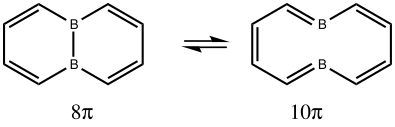
      BB


      I have forcibly removed two electrons from the system by replacing the two central carbon atoms with boron. And now playing Armstrong and Robinson’s games leaves either only an 8π periphery with a central B-B σ-bond[cite]10.14469/ch/191378[/cite] or one can raid the two B-B electrons to top the π-periphery up to 10 electrons.[cite]10.14469/ch/191380[/cite]

      • The first isomer, as a 8π-electron system is according to modern knowledge antiaromatic. A ωB97XD/6-311G(d) calculation shows this is not a stable minimum, with negative energy force constants showing a twisting motion trending to a Möbius ring? It never reaches this, since further C-B bonds are ultimately formed to create an unrelated structure[cite]10.14469/ch/191379[/cite].
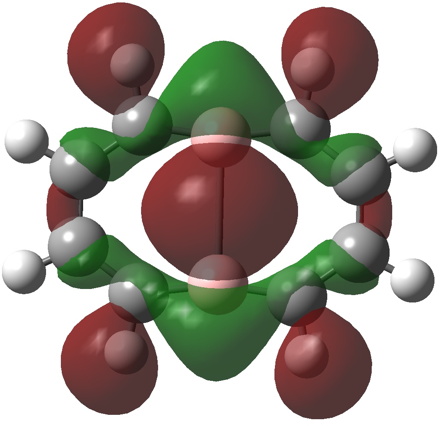
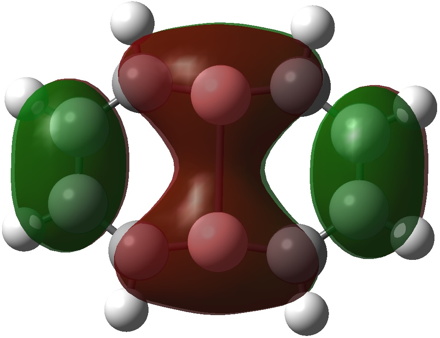
      • a 10π form is 35.7 kcal/mol lower than the first and reveals five π MOs, the highest energy of which is shown below with a suspended π-bond between the two central boron atoms and a LUMO corresponding to an empty B-B σ-bond.

        BB-open-LUMOBB-open-HOMO


    I hope this illustrates how science often iterates to final solutions, but that even the incorrect oscillations can still teach us chemistry.

  • R-X≡X-R: G. N. Lewis’ 100 year old idea.

    As I have noted elsewhere, Gilbert N. Lewis wrote a famous paper entitled “the atom and the molecule“, the centenary of which is coming up.[cite]10.1021/ja02261a002[/cite] In a short and rarely commented upon remark, he speculates about the shared electron pair structure of acetylene,  R-X≡X-R (R=H, X=C). It could, he suggests, take up three forms. H-C:::C-H and two more which I show as he drew them. The first of these would now be called a bis-carbene and the second a biradical.

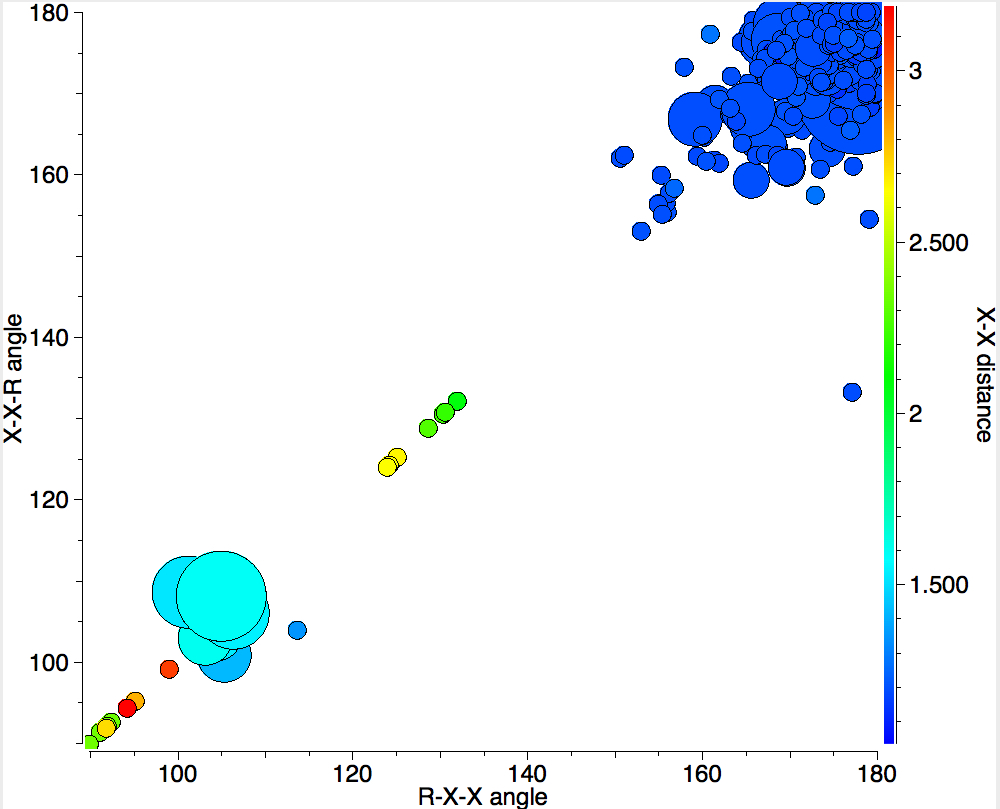
    In 1916, it was too early for Lewis to speculate what the geometries of such species might be, and in particular the C…C (or generalising, X…X) distance, and the two angles, one for each X. Well, we do not need to speculate, we can perform a search of the crystal structure database. Here it is (R < 0.05, no errors, no disorder):
    Lewis-CC4

    A little more explanation of this 4-dimensional plot is needed:

    1. The two angles are plotted as X and Y.
    2. The X…X distance is plotted as colour, with red representing the longest distances and blue the shortest
    3. The size of each “bin” is represented by the radius of the circle; small circles represent few examples, larger circles represent more examples in each “bin” defined by a regular range of angles.

    There are one or two off-diagonal  “outliers”, each of which probably deserves individual inspection. But dealing just with the obvious clusters, the overwhelmingly largest is for both angles of ~180°, and these are the triple bonds we know and love. As far as I know, Lewis was the first to propose a triple bond between two atoms, but if anyone reading this blog knows of an antecedent, do let me know. The next cluster is for angles of ~109° and these are clearly bis-carbenes. These all occur when X ≠ C. There are two small clusters worthy of note; one ~130° and one ~90°. The latter are mostly Pb-Pb and Sn-Sn, where the bonding is unhybridised pure p.

    One of the limitations of searching for crystal structures is that the spin state of each molecule is never given. The biradical structure given by Lewis could well have a triplet ground state, and perhaps that might have very characteristic angles (~130° ?). It would be great to identify a genuine example of this biradical form!

    As usual, the search itself took around 10 minutes, and it provides much interesting food for thought; not bad for a 100-year-old idea!


    Acknowledgments

    This post has been cross-posted in PDF format at Authorea.
  • Fine-tuning a (hydrogen) bond into symmetry.

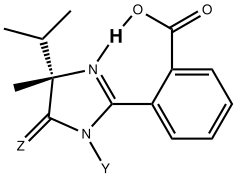
    Sometimes you come across a bond in chemistry that just shouts at you. This happened to me in 1989[cite]10.1039/C39890001722[/cite] with the molecule shown below. Here is its story and, 26 years later, how I responded.

    JAZCOC

    To start at the beginning, there was a problem with the measured 1H NMR spectrum; specifically (Y=H, Z=O) there are supposedly 16 protons, but only 15 could be located. What had happened to the 16th? To understand how one proton had been “lost”, you should appreciate that on most FT-NMR instruments, one has to specify a spectral window to collect data, and normally for protons, that window ranges from ~14 to -2 ppm. So the standard response to lost signals is to expand the window. When that was done, the offending proton appeared at 19 ppm! You should understand that this is an unusual chemical shift for a proton, and is normally taken as indicating very high acidity. But carboxylic acid protons are not regarded as particularly acidic? The mystery was resolved by recording the crystal structure at low temperatures, and this revealed that this hydrogen was (almost) symmetrically disposed between the oxygen and the nitrogen. The N-H distance was 1.32Å and the OH 1.17Å. Whilst such symmetric disposition is not that unusual between two atoms of the same type (O-H-O or N-H-N) it was quite unexpected between two different heteroatoms. And such symmetry alone is sufficient to induce very high chemical shifts; acidity per se does not come into it.

    That bond clearly shouted at me; so much so that in the text of the original article, we wrote “it is interesting to speculate whether these characteristics could be fine tuned by modification of the pKa values with suitable ring substitution“. What I had in mind was whether the position of the H could be made perfectly symmetric by adjusting the substituents. But for 26 years this idea lay dormant. Until this post! Rather than make lot of compounds (1-3 years!) I will do it with (lots of) computation (2 days!!).

    So to start we need a reality check. I am using the pbe1pbe/tzvp/scrf=chloroform method (this functional is often used for hydrogen bonds) and the collected results are shown in the table below.

    1. For Y=H, Z=O, the calculation predicts single minimum, with the hydrogen closer to O. Starting from an NH bound hydrogen ends with it on O. It is what is called a single well potential. The disposition of that H is not quite correct, but the computed 1H NMR shift is pretty close to experiment, and so I will take this method as reasonably good.
    2. With Y=Li, the polarisation of the N-Li bond enhances the basicity of the second N, and the H now ends up on this atom rather than O (even if it starts on O). Another single well potential. We now know that any symmetric species must occur somewhere between Y=H and Y=Li in terms of the electronegativity of the substituent Y.
    3. Unsurprisingly, Y=Na does not bracket Y=H/Li and the H moves even closer to the N. Again a single well potential.
    4. Y=Li.1H2O or 2H2O do not help either (surprisingly?)
    5. Y=BeH brackets Y=H/Li, but we also see new behaviour with a double-well potential; the H can be attached to either O or N and the former is slightly more stable by 0.22 kcal/mol in ΔG. The barrier is tiny, well below the energy of the first vibrational level, and so experimentally this system will manifest as the average of these two isomers and the H will similarly manifest with its most probable position being at the average of the two minima, N-H ~1.30, O-H ~1.3Å. Success!  At this point, the NMR shift is at its greatest.
    6. Y=BH2 continues the trend as a double minimum, this time with the H-O species the more stable by ΔG 0.68 kcal/mol; we are now past the symmetric point.
    7. By Y=SiH3, the single-well minimum (with H-O) is restored and we emerge with the same result as Y=H.
    8. And to complete the scan, Y=H, Z=S is the same as Z=O.
    9. Some second order tuning can be tried by changing the substituent on Y=BeH to Y=BeF, again a double minimum with HO more stable than NH by 0.30 kcal/mol in ΔG, and with a ΔG298 barrier from O to N of only 0.02 kcal/mol! The fine-tuning is again towards symmetrisation.

    I will stop at that point. Unfortunately of course the Y=BeF derivative is unfeasible synthetically and hence unlikely to be tested.

    Y N-H, Å O-H, Å δ, ppm FAIR Data Citation
    H (expt) 1.32 1.17 19.0 [cite]10.1039/C39890001722[/cite]
    H (calc) 1.48 1.04 18.6 [cite]10.14469/ch/189475[/cite]
    Li 1.06 1.52 16.5 [cite]10.14469/ch/189475[/cite]
    Na 1.05 1.55 15.6 [cite]10.14469/ch/189477[/cite]
    Li.H2O 1.06 1.52 16.6 [cite]10.14469/ch/189478[/cite]
    Li.2H2O 1.06 1.52 16.6 [cite]10.14469/ch/189480[/cite]
    BeH 1.11 1.39 20.6 [cite]10.14469/ch/189476[/cite]
    BeH 1.49 1.04 18.7 [cite]10.14469/ch/189492[/cite]
    BH2 1.06 1.56 16.6 [cite]10.14469/ch/189479[/cite]
    BH2 1.53 1.03 17.6 [cite]10.14469/ch/189492[/cite]
    SiH3 1.48 1.04 18.8 [cite]10.14469/ch/189481[/cite]
    Z=S 1.50 1.03 18.8 [cite]10.14469/ch/193726[/cite]
    BeF 1.12 1.38 20.9 [cite]10.14469/ch/189489[/cite]
    BeF (TS) 1.15 1.32 22.5 [cite]10.14469/ch/193727[/cite]
    BeF 1.48 1.04 18.7 [cite]10.14469/ch/189488[/cite]

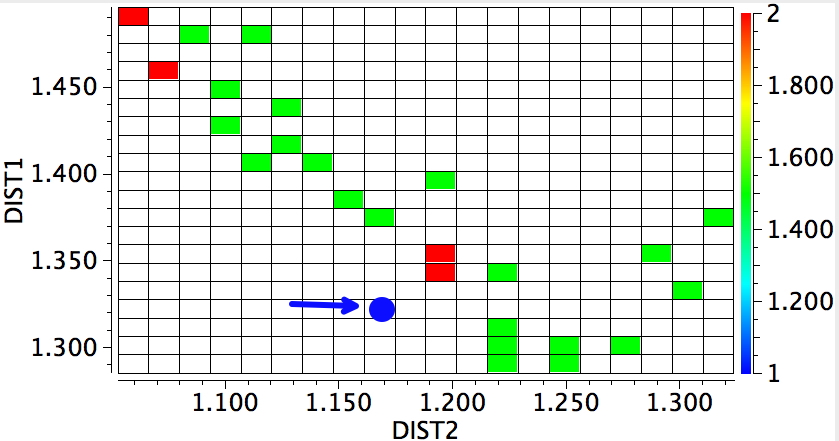
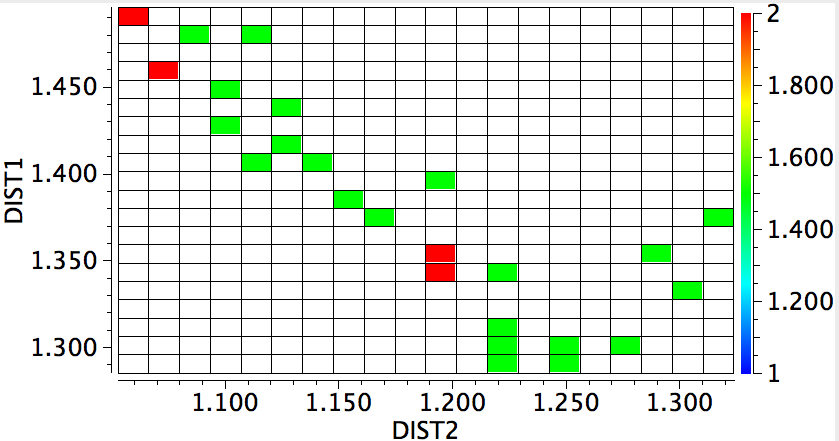
    Another reality check, a search of crystal structures. DIST2 = OH, DIST1 = NH, for structures recorded below 140K, R < 0.05%, no errors, no disorder. The structure above is shown as a blue dot. They do tend to show asymmetry, but it is interesting how many such structures have emerged since our own 1989 report; the effect is not that rare any more.
    H-bond

    The above plot shows lots more systems that might be subjected to the sort of tuning above, and who knows one of them may even yield to experimental validation.


    DOI: 10.14469/hpc/10731


    Acknowledgments

    This post has been cross-posted in PDF format at Authorea.
  • Chemistry in the early 1960s: a reminiscence.

    I started chemistry with a boxed set in 1962. In those days they contained serious amounts of chemicals, but I very soon ran out of most of them. Two discoveries turned what might have been a typical discarded christmas present into a lifelong career and hobby.

    The first was 60 Stoke Newington High Street in north London, the home of Albert N. Beck, Chemist (or his son; my information comes from a historical listing of the shops present on the high street in 1921). I would set out from our home in London SW6 on the #73 bus route (top deck) and it would take about an hour to arrive. On entering the shop, I ventured down a set of stairs into the basement to replenish the chemicals with sensible stocks, and purchase the odd glassware, filter paper, etc. And then venture back across London carrying the proceeds of many weeks, possibly months worth of hoarded pocket-money (apart that is from 1 shilling every two weeks which I reserved for football at Craven Cottage). At some stage, health and safety legislated against 12-year-old boys (and certainly also girls) purchasing chemicals in this manner! However, I can assure you all that I never came to any harm with anything I purchased at A. N. Beck and Sons. Apart that is from giving my parents a good fright.

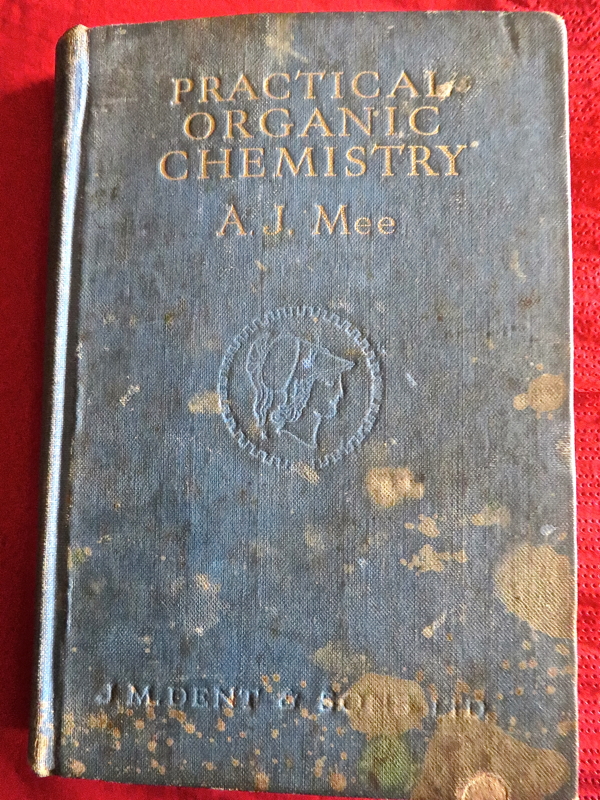
    The second was coming across this book by A. J. Mee. I had thought it was well and truly lost; imagine my delight when I recently found it at home, complete with chemical stains, and dated as from a reprint in 1959.

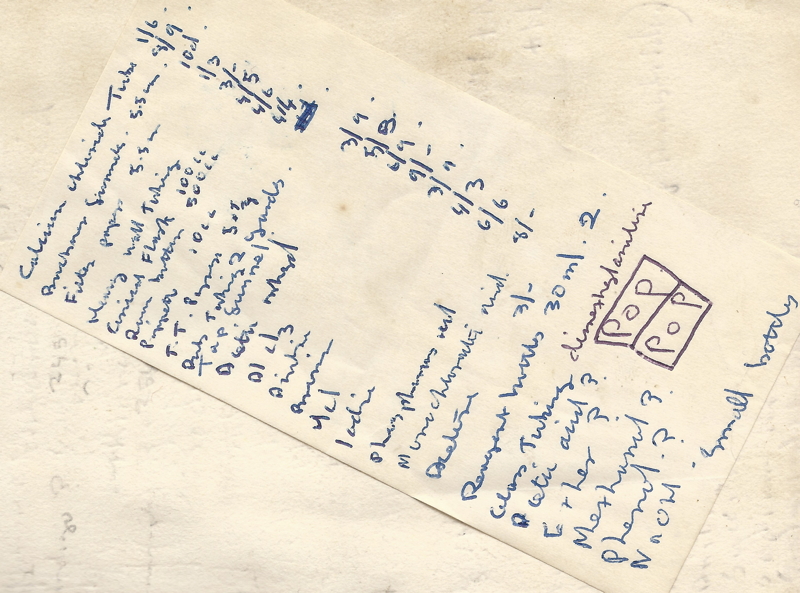
    IFOn the inside cover, I found one shopping list from my expeditions to A. N. Beck and Sons. The price 1/6 is the representation of one shilling and six pence (more than the price of a football match, or perhaps £50 in today’s money? I think football was much cheaper then! Oh, 1/6 is 7.5p in the decimal currency of today, or £0.075). Note that iodine was one of the items purchased. And note the wish list at the bottom! I was clearly starting to do organic chemistry.

    shopping-list

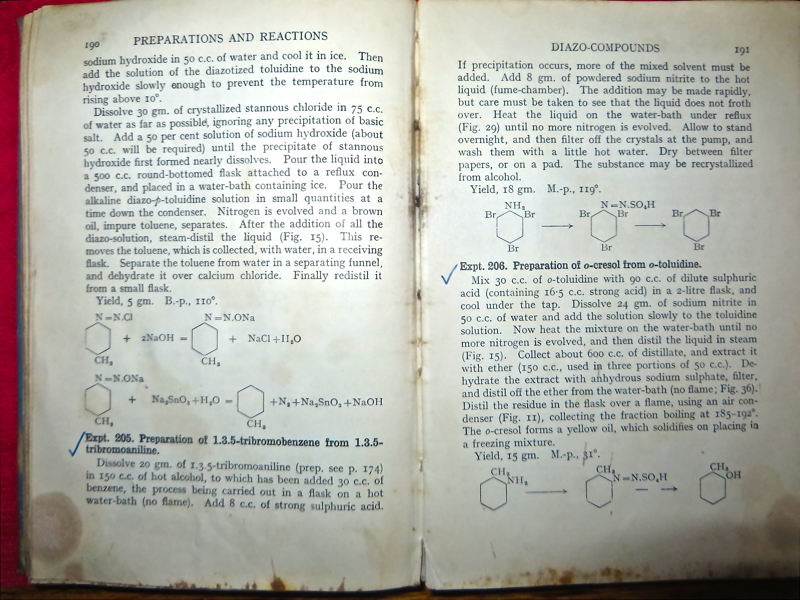
    The pages of this book list 289 experiments, and I assiduously recorded a tick against all the ones I actually did. This is a typical page (click to expand).

    IFThus expt 205 is the preparation of 1,3,5-tribromobenzene from 1,3,5-tribromoaniline (ticked), followed by that of o-cresol from o-toluidine (ticked). You can see how all the aromatic rings are still represented by what now looks like cyclohexane. This book gave me many hours of delightful recreation (I have not counted the ticks, but I think I attempted around half the experiments). Note in particular the huge scale these experiments were done at; 18g of product (I suspect I must have scaled them down a fair bit in order to preserve pocket money). Expt 198 was that of benzidine, of which I do recollect preparing  ~2g. No warnings then about the extremely carcinogenic nature of this substance! Chemistry has certainly changed since then.

    Lost unfortunately is the laboratory book where I recorded my results, but one or two samples still exist!

  • Blasts from the past. A personal Web presence: 1993-1996.

    Egon Willighagen recently gave a presentation at the RSC entitled “The Web – what is the issue” where he laments how little uptake of web technologies as a “channel for communication of scientific knowledge and data” there is in chemistry after twenty years or more. It caused me to ponder what we were doing with the web twenty years ago. Our HTTP server started in August 1993, and to my knowledge very little content there has been deleted (it’s mostly now just hidden). So here are some ancient pages which whilst certainly not examples of how it should be done nowadays, give an interesting historical perspective. In truth, there is not much stuff that is older out there!

    1. This page was written in May 1994 as a journal article, although it did have to be then converted into a Word document to actually be submitted.[cite]10.1039/C39940001907[/cite] Because it introduced hyperlinks to a chemical audience, we wanted to illustrate these in the article itself! Hence permission was obtained from the RSC for an HTML version to be “self-archived” on our own servers where the hyperlinks were supposed to work (an early example of Open Access publishing!). I say supposed because quite a few of them have now “decayed”. We were aware of course that this might happen, but back in 1994, no-one knew how quickly this would happen. What is interesting is that the HTML itself (written by hand then) has survived pretty well! I will leave you to decide how much the message itself has decayed.
    2. This HTML actually predates the above; it was written around November 1993 and represented the very first lecture notes I converted into this form (on the topic of NMR spectroscopy). A noteworthy aspect is the scarce use of colour images. At the start of 1994, the bandwidth available on our campus was pretty limited (the switches were 10 Mbps only) and a request went out to reduce the bit-depth of any colour images to 4-bits to help conserve that bandwidth! I rather doubt anyone took much notice however, and the policy was forgotten just a few months later.
    3. In 1996, I had two visitors to the group, Guillaume Cottenceau, a french undergraduate student, and Darek Bogdal, a Polish researcher who wanted to learn some HTML. Together they produced this, which was an interactive tutorial to accompany the NMR lecture notes previously mentioned. These pages introduce the Java applet (yes, it was very new in 1996), which Guillaume had written and which Darek then made use of. And hey, what do you know, the applet still works (although you might have to coerce your browser into accepting an unsigned applet).
    4. Here is a programming course that I had been running with Bryan Levitt for a few years, now recast into HTML web pages some time in 1994-5. This particular project I still hold dear, since it expanded upon the NMR lectures by getting the students to synthesize a FID (free induction decay) using the program they wrote, and then perform a Fourier Transform on it. I even encouraged students to present their results in HTML (I cannot now remember how many did). This link is to the computing facilities we offered students in 1994 for this project, ah those were the times! In 1996, the programming course was replaced by one on chemical information technologies, and here students were most certainly expected to write HTML. Some of the best examples are still available. And to illustrate how things happen in cycles, that course itself is now gone to be replaced by, yes, a programming course (but using Python, and not the original Fortran).
    5. In tracking down the materials for the programming course described above, I re-discovered something far older. It is linked here and is (some of) the Fortran source code I wrote as a PhD student in 1974 1972.[cite]10.5281/zenodo.19061[/cite] So I will indulge in a short digression. My Ph.D. involved measuring rate constants, and the accepted method for analysing the raw kinetic data was using graph paper. For first order rate behaviour, this required one to measure a value at time=∞, which is supposed to be measured after ten half-lives. I was too impatient to wait that long, and worked out that a non-linear least squares analysis did not require the time=∞ value; indeed this value could be predicted accurately from the earlier measurements. So in 1974, I wrote this code to do this; no graph paper for me! Also for good measure is a least squares analysis of the Eyring equation. And you get proper standard deviations for your errors. In retrospect I should have commercialised this work, but in 1974, almost no-one paid money for software! What a change since then. I must try recompiling this code to see if it still works! And for good measure, here is a Huckel MO program I wrote in 1984 or earlier (I did compile this recently and found it works) and here is a little program for visualising atomic orbitals.
    6. In January 1994, I was asked to create a web page for the WATOC organisation. This certainly predated the web sites for e.g. the RSC, the ACS, indeed famous sites such as the BBC and Tesco (a large supermarket chain) which only started up in mid 1994. The WATOC site itself moved a few years ago.
    7. This is one of those wonderfully naive things I started in 1994, and which did not last long (in my hands). Nowadays, the concept lives on as MOOCs. Note again the almost complete expiry of the hyperlinks.
    8. This is a project we also started in 1994, Virtual reality[cite]10.1016/0263-7855(95)00053-4[/cite],[cite]10.1016/S0166-1280(96)90535-7[/cite]. The idea was that if HTML was text-markup, VRML was going to be 3D markup. VRML itself never quite caught on, but it is having a new life as a 3D printing language!
    9. And by 1995, I felt confident enough in my ability to (edit) HTML, that we started a virtual conference in organic chemistry (we did four of them in the end). I remember the first one involved contributors sending me a Word version of their poster, and I did all the work in converting it into HTML. Such virtual conferences still run, but in truth most participants still prefer to travel long distances to go drink a beer with their chums, rather than hack HTML.

    I am going to stop now, since this is far too much wallowing in the past. But at least all this stuff is not (yet) lost to posterity.

  • Kekulé’s vibration: A modern example of its use.

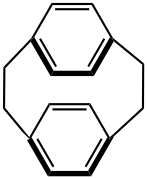
    Following the discussion here of Kekulé’s suggestion of what we now call a vibrational mode (and which in fact now bears his name), I thought I might apply the concept to a recent molecule known as [2.2]paracyclophane. The idea was sparked by Steve Bachrach’s latest post, where the “zero-point” structure of the molecule has recently been clarified as having D2 symmetry.[cite]10.1002/chem.201304972[/cite]

    pc
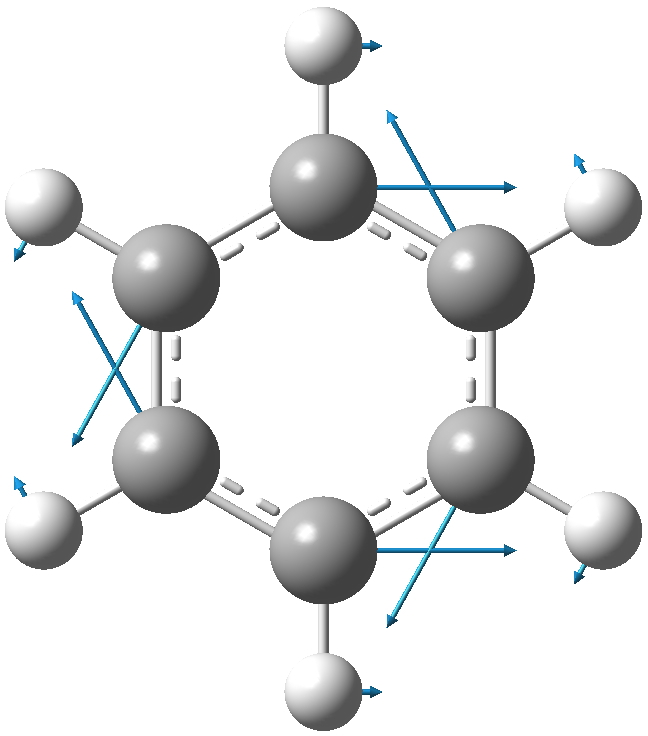
    Let me start with a ωB97XD/6-311G(d,p) calculation of this mode. Because the mode is a mixture of C and H motions (which differ according to the molecule), I am going to try to normalise the mode by reducing the mass of the all atoms except the core six to effectively zero. The mode itself looks as below with the H-weighting applied. The hydrogens are riding, massless, on each of the six carbons.kekule-mode

    The results are presented in the table below for the paracyclophane, in three different spin states.

    System Mass-weighted modes, s, a Reduced mass, sym Reduced mass, asym DOI
    Benzene, singlet 1342 1318 [cite]10042/30857/cite]
    paracyclophane, singlet 1335, 1330 1257 1237 [cite]10042/30858[/cite]
    paracyclophane, singlet 1335, 1330 1257 1237 [cite]10042/30858[/cite]
    paracyclophane, triplet 1413, 1418 1403 1394 [cite]10042/30859[/cite]
    paracyclophane, quintet 1566, 1563 1521 1522 [cite]10042/30860[/cite]

    There are three effects which manifest.

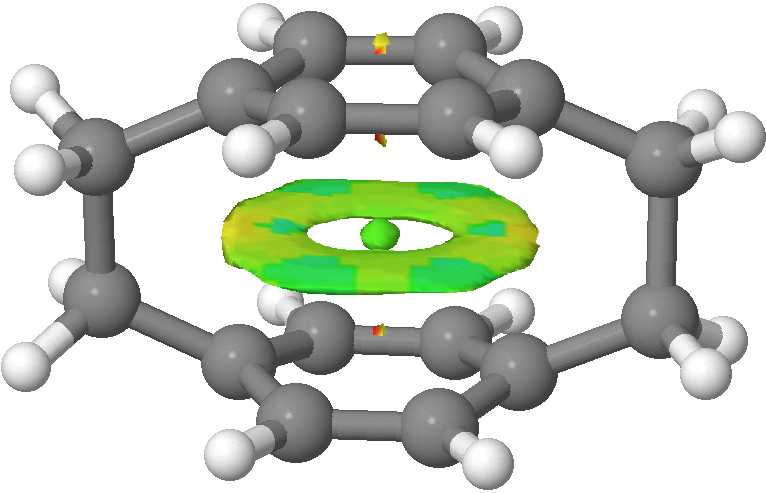
    1. The first is that the Kekulé mode is depressed in the cyclophane compared to benzene itself. I have previously discussed how even in benzene this mode is depressed from its expected value because of the natural tendency of the π-system to adopt a localised cyclohexatriene motif (a tendency that is overcome by the σ-framework). So we conclude that this tendency (famously highlighted by Shaik, Hiberty and co[cite]10.1021/cr990363l[/cite]) is even slightly stronger in [2.2]paracyclophane. One might presume that the two π-clouds, in an enforced proximity which is certainly repulsive, co-operate to enhance the effect (see below).
      Click for  3D
      NCI surface showing π-repulsions (yellow). Click for 3D

      Perhaps this cooperation would be even stronger were it not from the distinct distortion from planarity that the cyclophane bridges enforce, and which might discourage the π-tendency to form cyclohexatriene.

    2. The interaction between the two π-clouds splits the Kekulé mode into a symmetric and antisymmetric pair, by either 5 or 20 cm-1 depending on the mass weighting.
    3. As one promotes the π-electrons into antibonding orbitals (triplet, then quintet) one increasingly weakens the π-resistivity. The π-electrons no longer want to collect into double bonds and so resist the symmetrising tendency of the σ-electrons less. The splitting of the  Kekulé mode also decreases.

    My point with this post was to show how interesting new effects can be teased out of systems of contemporary interest by invoking Kekulé’s famous (vibrational) mode. Whether this corresponds to what the man himself had in mind is quite another matter of course.

  • Benzene: an oscillation or a vibration?

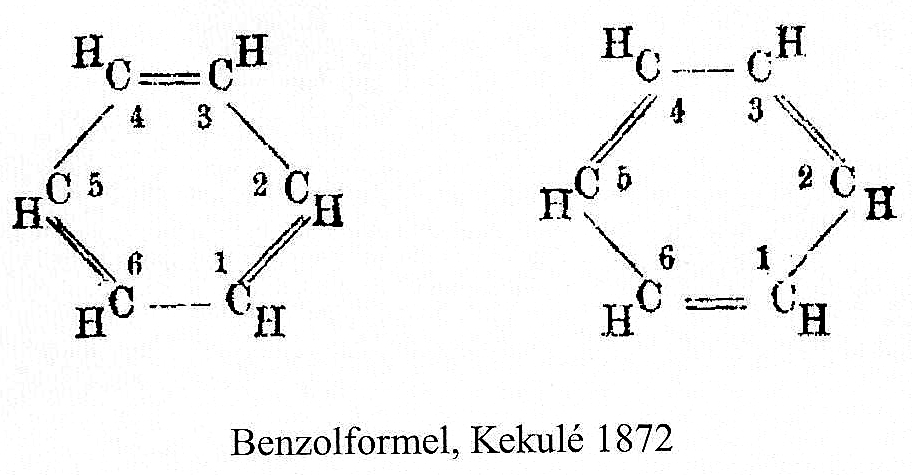
    In the preceding post, a nice discussion broke out about Kekulé’s 1872 model for benzene.[cite]10.1002/jlac.18721620110[/cite] This model has become known as the oscillation hypothesis between two extreme forms of benzene (below). The discussion centered around the semantics of the term oscillation compared to vibration (a synonym or not?) and the timescale implied by each word. The original article is in german, but more significantly, obtainable only with difficulty. Thus I cannot access[cite]10.1002/jlac.18721620110[/cite] the article directly since my university does not have the appropriate “back-number” subscription. So it was with delight that I tracked down an English translation in a journal that I could easily access.[cite]10.1039/JS8722500605[/cite] Here I discuss what I found (on pages 614-615, the translation does not have its own DOI).

    The oscillation hypothesis
    The bent bond formula

    The translation is by no other than Henry Armstrong, whose own contributions I have documented elsewhere. The pertinent points (it’s a long explanation) seem to be:

    1. Kekulé does not use the word oscillation anywhere. This seems to have been added by subsequent commentators.
    2. He does describe the atoms as being in continuous movement, actually using the very modern term intramolecular motion (as translated of course).
    3. He also describes this motion as returning to a mean position of equilibrium, and the separate atoms as possessing rectilinear motion, striking and recoiling against adjacent partners.
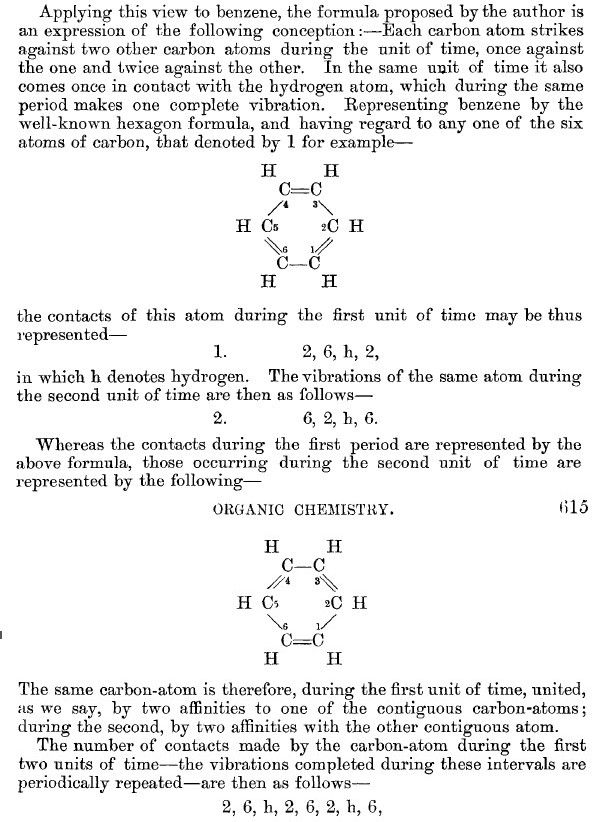
    4. He finally concludes by describing at some length what happens during two units of time involving what we would regard as one complete vibration to return the atoms to their starting point. This description is couched in words, and refers to what we would now call a normal (vibrational) mode evolving in time. You can see that written description below for yourself (in translation). It IS quite verbose; if ever a case could be made for replacing 1000 words with one picture, this is it!
    The oscillation hypothesis
    Armstrong’s translation

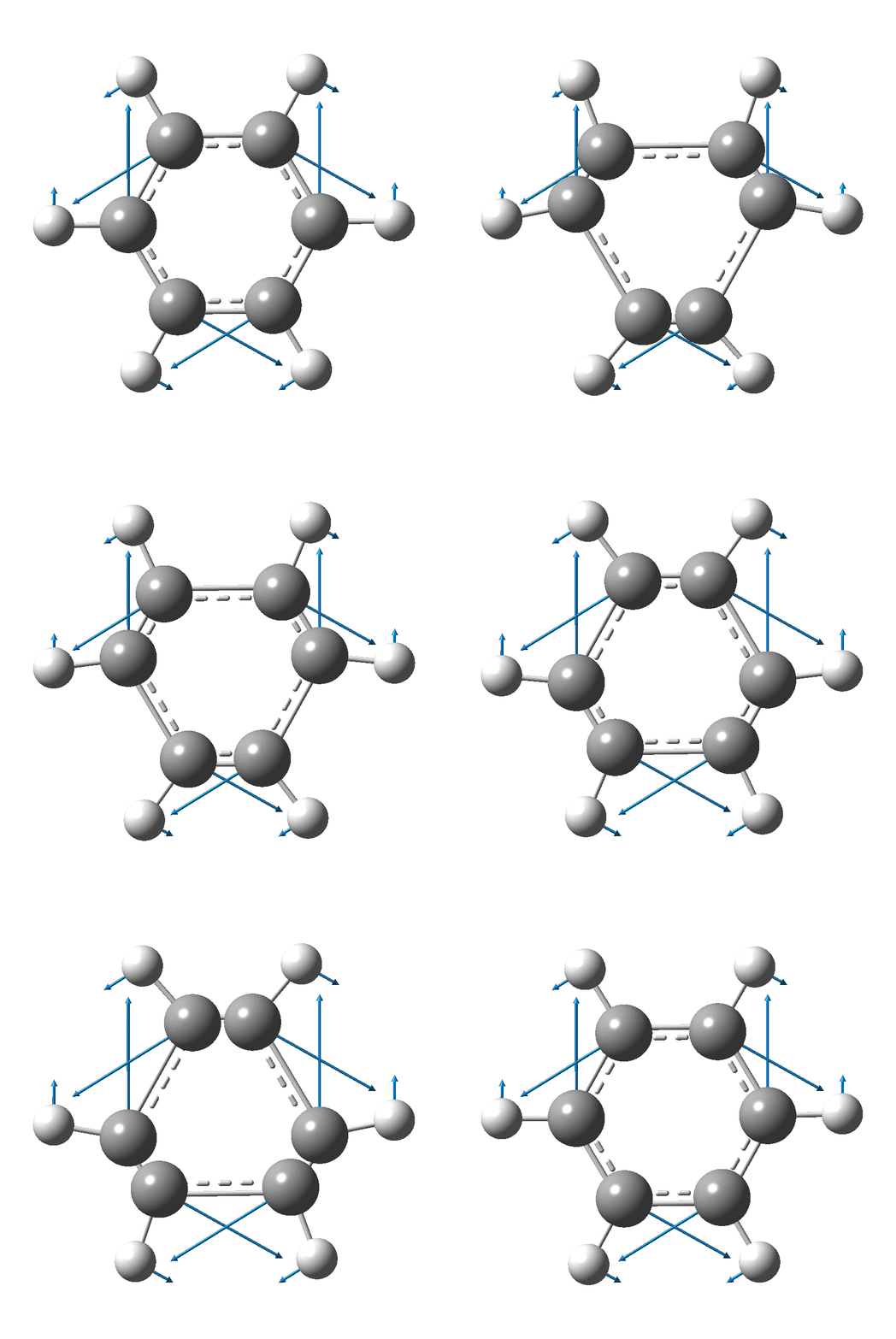
    Perhaps I can attempt to replace the (1000?) words above with that one picture (below). Here, I think Kekulé does manage to complicate things by including a hydrogen (h) as part of his scheme. Carbon C1 is described as contacting C2, and then immediately a hydrogen (although since he does not number the hydrogens it is not absolutely clear he means the hydrogen on carbon 2 at this stage). The modern equivalent below shows relatively little motion from the (light) hydrogen atoms, and certainly no obvious contact between e.g. C1 and any hydrogen other than the one it is bonded to.

    1318
    We now replace the description above by using far more concise vectors to describe the movement of the atoms with respect to time. And of course Kekulé had no real idea of how long his cycle took (only that it must be short as inferred from the laboratory observation of not being able to isolate geometric isomers, perhaps shorter than 100 seconds?); we now know that it is about 10-14 s. Commentators to this day describe this as Kekulé’s oscillation hypothesis, but since Kekulé did not use the term at all but did use (thrice) the word vibration we really should call it his vibration hypothesis, as indeed Paul Schleyer noted in his comment on the original post.


    There is little doubt that historical researches have become severely endangered by the increasing lack of access to older issues of many journals. In some cases, older can mean as little as ten years!