Blog

  • Gravitational fields and asymmetric synthesis

    Our understanding of science mostly advances in small incremental and nuanced steps (which can nevertheless be controversial) but sometimes the steps can be much larger jumps into the unknown, and hence potentially more controversial as well. More accurately, it might be e.g. relatively unexplored territory for say a chemist, but more familiar stomping ground for say a physicist. Take the area of asymmetric synthesis, which synthetic chemists would like to feel they understand. But combine this with gravity, which is outside of their normal comfort zone, albeit one we presume is understood by physicists. Around 1980, one chemist took such a large jump by combining the two, in an article spectacularly entitled Asymmetric synthesis in a confined vortex; Gravitational fields and asymmetric synthesis[cite]10.1021/ja00521a067[/cite]. The experiment was actually quite simple. Isophorone (a molecule with a plane of symmetry and hence achiral) was treated with hydrogen peroxide and the optical rotation measured.
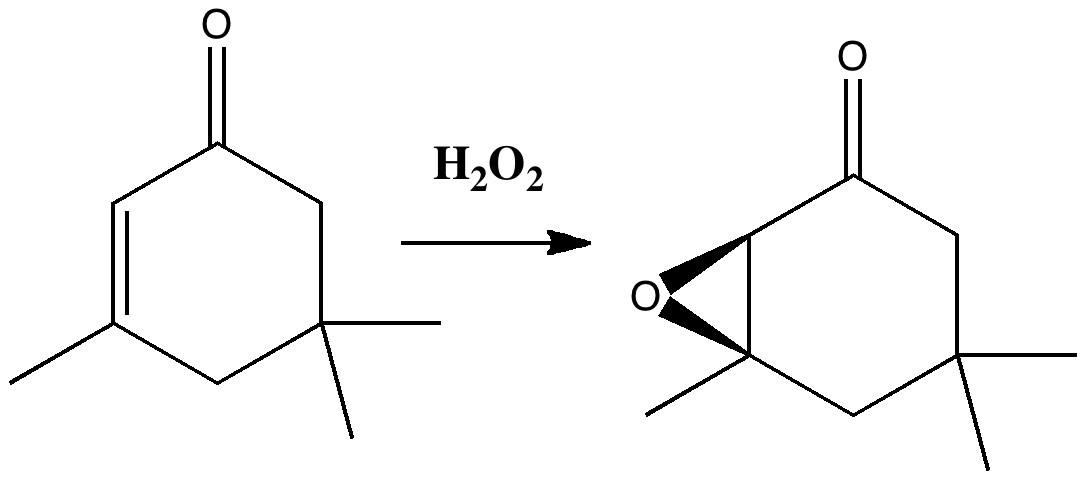
    Asymmetric synthesis of Isophorone oxide

    Conventional wisdom is that the oxygen can be delivered with equal probability to either face of the alkene, resulting in a racemic (equal) mixture of the two enantiomers of the epoxide. But if one enantiomer is formed in slightly greater amount than the other, the reaction is said to proceed asymmetrically, and the product will exhibit an optical rotation. Normally, such asymmetry is induced by carrying out the reaction in the presence of a chiral molecule or catalyst. Light too can be chiral, but these brave chemists decided to use gravity. More specifically, the earth’s gravitational field. In the Northern Hemisphere. The reaction was conducted in a centrifuge in three ways. With the spun tube horizontally, and then vertically spinning clockwise or anticlockwise. The first of these produced product which exhibited no optical rotation within experimental error (e.g +0.2 ± 0.3 mdeg). The second gave results with a positive rotation (e.g. 12.8 ± 0.3 mdeg) and the third a negative rotation (-2.2 ± 0.2 mdeg). They considered that the reaction was occurring in e.g. a clockwise vortex constituting a P-helix (the vortex in other words was chiral) interacting with the earth’s coriolis force.  They speculated (but did not do the experiment) that the reverse effect would be seen in the Southern Hemisphere. Their paper concluded with the grand speculation that prebiotic organic synthesis could have been partially asymmetric as a result of being conducted in a chiral gravitational field (nothing like aiming high!).

    Shortly after this was published, a rebuttal appeared[cite]10.1021/ja00544a051[/cite] penned not by a synthetic chemist but a physicist. In truth, most of the four-paragraph article presents arguments few chemists are familiar with (and probably do not understand). Only one sentence, the very last, made the impact (and it sounds as if it was added as a throw-away afterthought). It simply stated that the magnitude of the earth’s field (in so-called natural units) suggested that a parameter ω related to the spinning velocity was ~10-21 and that the corresponding value that would be required to induce the asymmetry observed (which can be computed from e.g. ΔG = -RT Ln K) was 10-14. Put in rather plainer English, the earth’s magnetic field was seven orders of magnitude too weak to have the effect claimed for it. That last sentence on its own pretty much sunk the theory, and it is no longer thought that gravitational fields can induce asymmetry in reactions. I tell this story (which, as it happened thirty years ago is now largely forgotten), since seven orders of magnitude is quite a large mismatch! Chemists rarely have the opportunity to be so spectacularly wrong when they propose a theory. In reality, even two orders of magnitude is unusual.

    It’s when you approach factors of say less than one order of magnitude (the nuances) that arguments about which interpretation is correct may break out. So which category might the subject of this post belong to? As I there noted, it’s all about whether the two carbon atoms separating carbon dioxide and cyclobutadiene in a crystalline lattice by a distance of 1.5Å are interacting by a covalent bond, or a van der Waals attraction. In terms of energies, most chemists agree that these differ by around two orders of magnitude. This, I suggest, does not come into the category of nuance!

    A nice review of asymmetric synthesis under physical field[cite]10.1021/cr970096o[/cite].
  • Can a cyclobutadiene and carbon dioxide co-exist in a calixarene cavity?

    On 8th August this year, I posted on a fascinating article that had just appeared in Science[cite]10.1126/science.1188002[/cite] in which the crystal structure was reported of two small molecules, 1,3-dimethyl cyclobutadiene and carbon dioxide, entrapped together inside a calixarene cavity. Other journals (e.g. Nature Chemistry[cite]10.1038/nchem.823[/cite] ran the article as a research highlight (where the purpose is not a critical analysis but more of an alerting service). A colleague, David Scheschkewitz, pointed me to the article. We both independently analyzed different aspects, and first David, and then I then submitted separate articles for publication describing what we had found. Science today published both David’s thoughts[cite]10.1126/science.1195752[/cite] and also those of another independent group, Igor Alabugin and colleagues[cite]10.1126/science.1196188[/cite]. The original authors have in turn responded [cite]10.1126/science.1195846[/cite]. My own article on the topic will appear very shortly[cite]10.1039/C0CC04023A[/cite]. You can see quite a hornet’s nest has been stirred up!

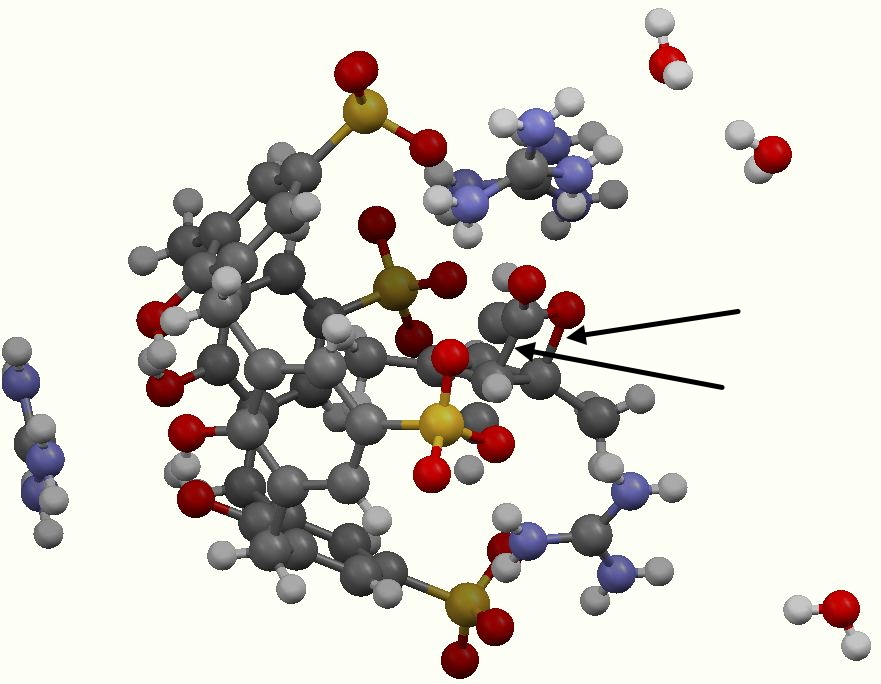
    At issue is whether the two bonds (indicated with arrows below) are best described as normally covalent, or very much weaker van der Waals contacts, or essentially non-interacting atoms. The last two interpretations would sustain the claim that 1,3-dimethyl cyclobutadiene and carbon dioxide can co-exist as separate species inside the cavity. The first would argue that they have reacted to form a different molecule. You can inspect the 3D coordinates by clicking on the diagram below.

    Reported X-Ray structure. Click for 3D
    Barboiu et al originally argued that these two bonds were strong van der Waals contacts, with C-C and C-O distances of 1.5 and 1.6Å respectively, and with a OCO angle of  120°. The various responses to this claim tend to the view that these distances/angles clearly represent new covalent (or partially ionic-covalent) bonds, and that the combined species cannot be described as 1,3-dimethyl cyclobutadiene and carbon dioxide. There is obviously much more to it than that (including a detailed analysis of the errors present in a partially disordered crystal structure). So make your own minds up based on the articles cited above and if it helps, the  original 3D coordinates, for your convenience made available above!

  • A historical detective story: 120 year old crystals

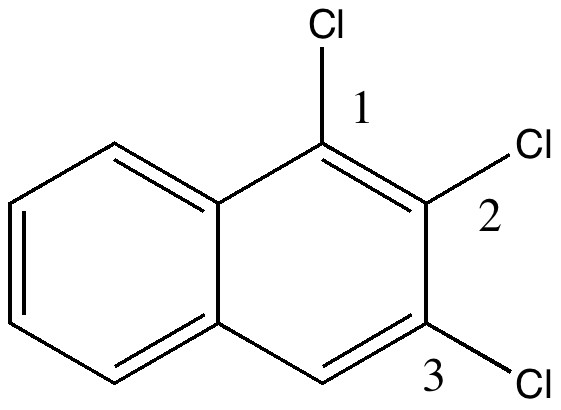
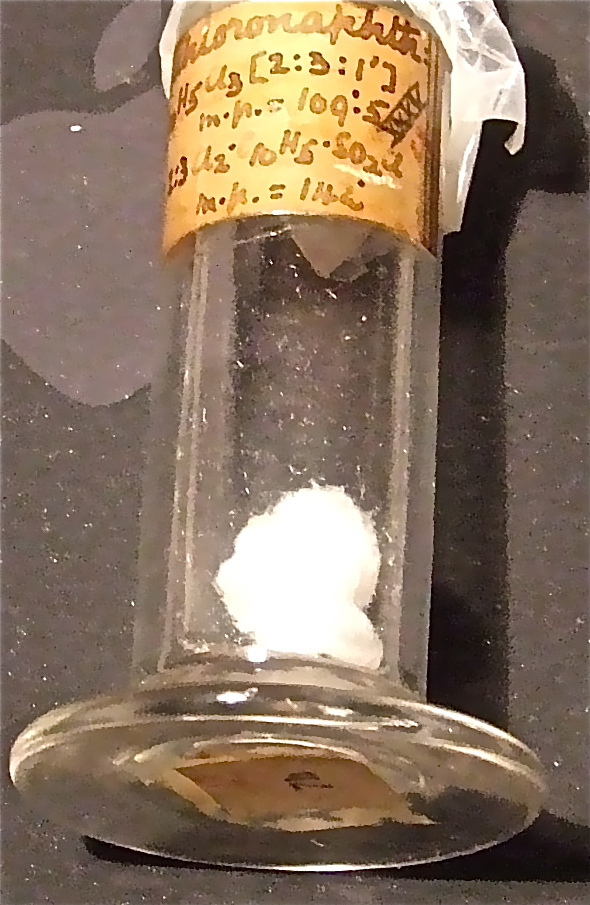
    In 1890, chemists had to work hard to find out what the structures of their molecules were, given they had no access to the plethora of modern techniques we are used to in 2010. For example, how could they be sure what the structure of naphthalene was? Well, two such chemists, William Henry Armstrong (1847-1937) and his student William Palmer Wynne (1861-1950; I might note that despite working with toxic chemicals for years, both made it to the ripe old age of ~90!) set out on an epic 11-year journey to synthesize all possible mono, di, tri and tetra-substituted naphthalenes. Tabulating how many isomers they could make (we will call them AW here) would establish beyond doubt the basic connectivity of the naphthalene ring system. This was in fact very important, since many industrial dyes were based on this ring system, and patents depended on getting it correct! Amazingly, their collection of naphthalenes survives to this day. With the passage of 120 years, we can go back and check their assignments. The catalogued collection (located at Imperial College) comprises 263 specimens. Here the focus is on just one, specimen number number 22, which bears an original label of trichloronaphthalene [2:3:1] and for which was claimed a melting point of 109.5°C. What caught our attention is that a search for this compound in modern databases (Reaxys if you are interested, what used to be called Beilstein) reveals the compound to have a melting point of ~84°C. So, are alarm bells ringing? Did AW make a big error? Were many of the patented dyes not what they seemed?

    1,2,3-trichloronaphthalene

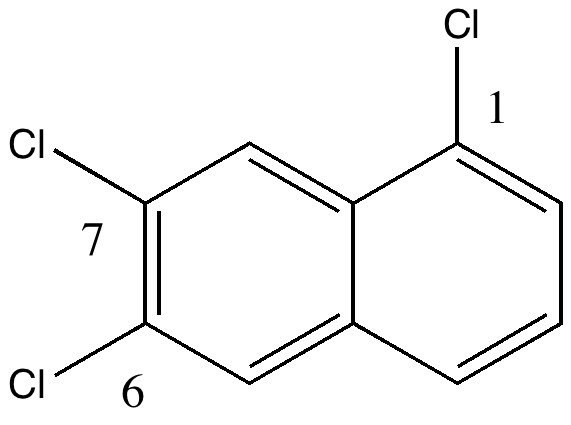
    The story starts to get murky when Reaxys reports the earliest literature for this compound as being 1941 (DOI: 10.1039/JR9410000243), the authority being Wynne himself (now a sprightly 80). The collection of 263 specimens was thought to go back to the 1890s, so how could it contain a compound only made about 50 years later? Time to do an X-ray determination. Remarkably, the 120 year old crystals of specimen 22 were still in good shape, but the determined structure held an initial surprise. The compound was in fact 1,6,7-trichloronaphthalene, quite a different species from the label.

    1,6,7-trichloronaphthalene

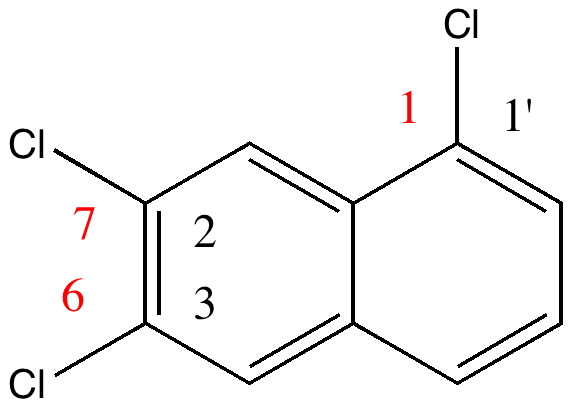
    So, did AW get things badly wrong, and were all those patents based on these structures potentially invalid? A little more detective work using Reaxys reveals that the 1,6,7 isomer melts at 109.5°C, the same as reported by AW in 1890 (Chem. News J. Ind. Sci., 1890 , 61, p. 273). So how did the 1,6,7-compound come to be mistaken for a 1,2,3,-isomer? The culprit turns out to be one prime (‘).

    1,6,7 = 2:3:1' Click for 3D
    Updated (see comment) Click for 3D

    The numbering system in 1890 was different from what it is now. Then, primes were used to distinguish the numbering on each ring. When the collection was catalogued (in the 1990s), the 1′ was mistaken for 1 (you can see the prime on the original label). AW were correct all along, and the patent owners for all those naphthalene dyes can rest easy.

    Sample 22 from AW collection

    What this teaches us is that crystallography on 120 year old organic compounds is perfectly viable. Indeed, can anyone else claim to have solved the structure of such an old compound? And that those old chemists knew what they were doing, despite not having any instrumentation to help them. Oh, and a final comment. Precious few collections of molecules made by the original scientists exist nowadays. Many a collection has literally been skipped because of health and safety concerns. The AW collection itself was rescued from oblivion by the narrowest of margins. And we have permanently lost the opportunity for any detective work of the type described above. You can see that I am very upset by this. Heritage conservation should not just be old buildings, paintings etc, but the chemical heritage collections as well.

    Thanks to Andrew White for the crystal structures (of this and three other samples, but their stories are for another day).

  • Rate enhancement of the Diels-Alder reaction inside a cavity

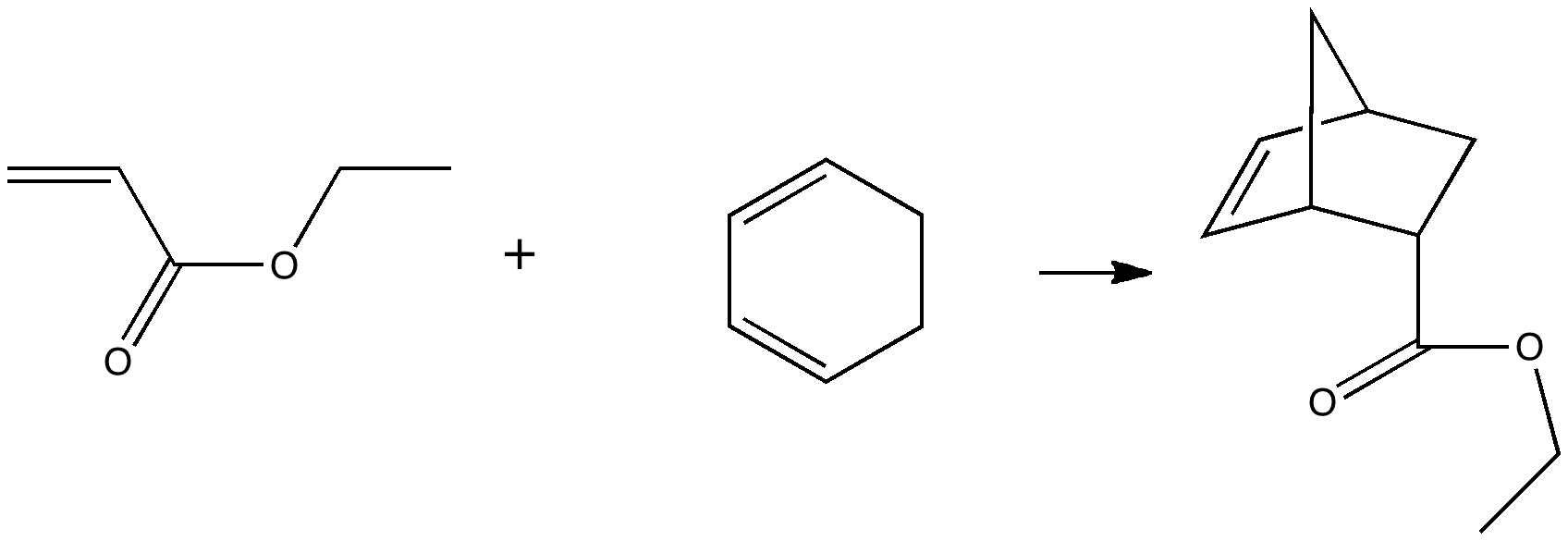
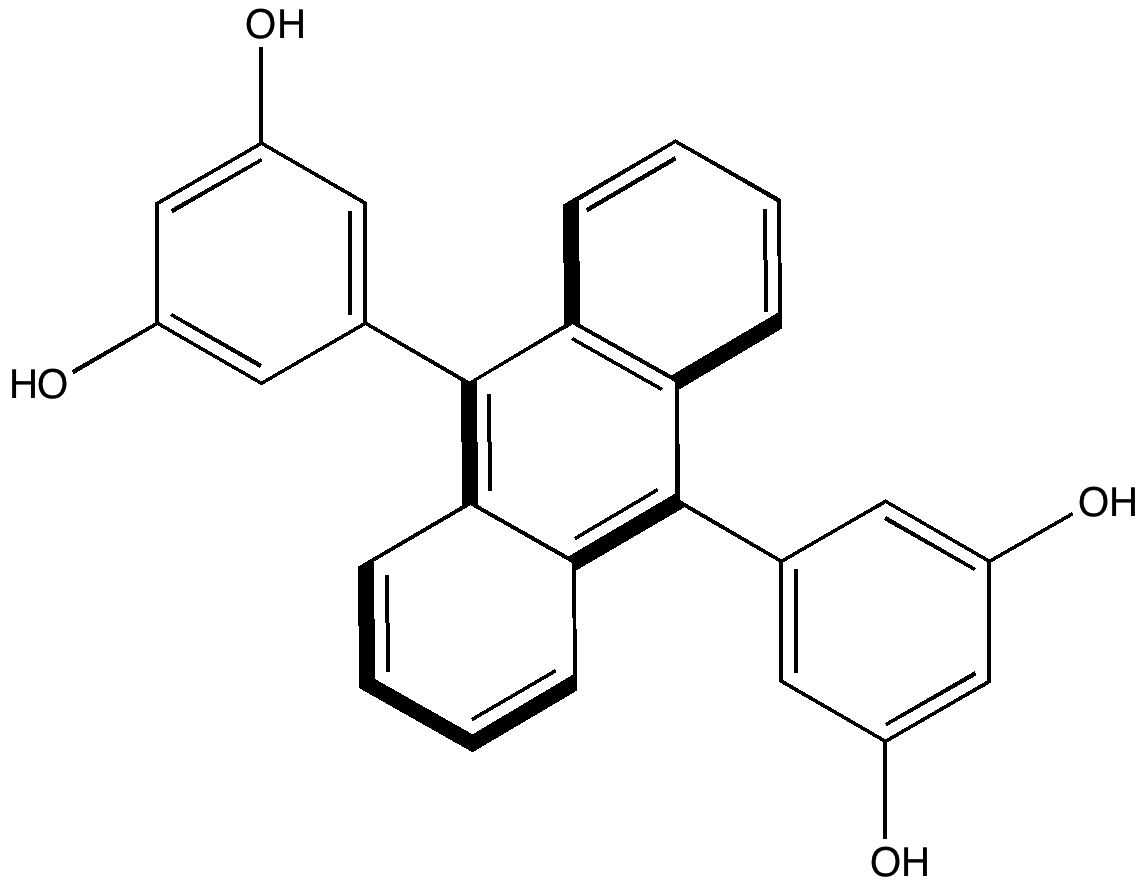
    Reactions in cavities can adopt quite different characteristics from those in solvents. Thus first example of the catalysis of the Diels-Alder reaction inside an organic scaffold was reported by Endo, Koike, Sawaki, Hayashida, Masuda, and Aoyama[cite]10.1021/ja964198s[/cite], where the reaction shown below is speeded up very greatly in the presence of a crystalline lattice of the anthracene derivative shown below.

    A Diels-Alder reaction. Click for animation.
    Organic scaffold based on an anthracene derivative. Click for crystal structure.

    Its difficult to be precise about how much faster, since the kinetics depend on reorganisation of the scaffold, the actual reaction kinetics, and diffusion of the products in and out of the cavity. It does however mean that a poor solution reaction (reflux, many hours, modest yield) can be accomplished in an hour or so at room temperature in high yield.

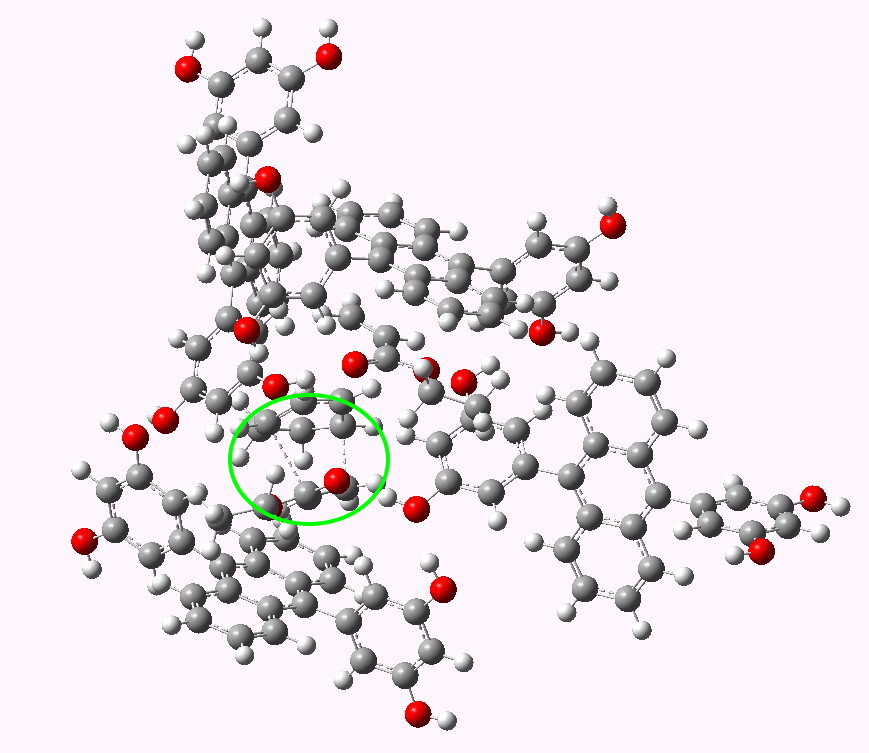
    Some idea of what is going on can be probed using calculation. Because the host and the guest interact though van der Waals or dispersion forces, a new breed of density functional theory which takes these into account is used (ωB97XD). The basic assemblage comprises the reactants shown below, enclosed in a cage formed by four of the anthracene units. A total of 236 atoms. This is a pretty challenging size for a full-blown quantum mechanical calculation. Here, its been done using a reasonable basis set, 6-31G(d) and with a continuum solvation model applied (dichloromethane). If you are interested in this sort of thing, that is 2292 basis functions. I started the calculations in mid September, and its taken more than six weeks to optimise (on 8-processor computers).

    Firstly, the results for a control calculation in dichloromethane. The energies of activation of the two isolated reactants coming together at the transition state are calculated as:
    ΔG298 29.5, ΔH 15.5, T.ΔS  -13.98 kcal mol-1
    (ΔS -46.9 cal K
    -1mol-1)

    which are of course the various contributions to the equation ΔG = ΔH – T.ΔS. Note in particular how the last term increases the free energy barrier by ~14 kcal mol-1! Using the equation
    Ln k/T = 23.76 – ΔG/RT
    one can estimate a rate constant of ~4 x 10⁻⁶ hour-1 at 298K (i.e. very slow at room temperatures). If the unfavourable -T.ΔS term is ignored (ΔG = ΔH), the rate constant increases to ~9 x 10⁴ hour-1 at 298K (i.e. fast), quite a difference. What about the values when the reactants and transition state are surrounded by the host?

    ΔG298 20.0, ΔH 16.5, T.ΔS -3.49 kcal mol-1
    (ΔS -11.7 cal K
    -1 mol-1)

    The key difference is that the last term is now  much smaller, this reduces the free energy of activation and the estimated rate constant at 298K is now ~ 0.01 s-1 (42.5 hour-1).  This magnitude of rate constant corresponds to a reasonably fast reaction at room temperatures.

    Transition state for  Diels Alder inside a cavity. Click for 3D.

    This post demonstrates that the fascinating area of supermolecular chemistry can be just as amenable to computational exploration as the more conventional reaction.


  • Secrets of a university tutor: (curly) arrow pushing

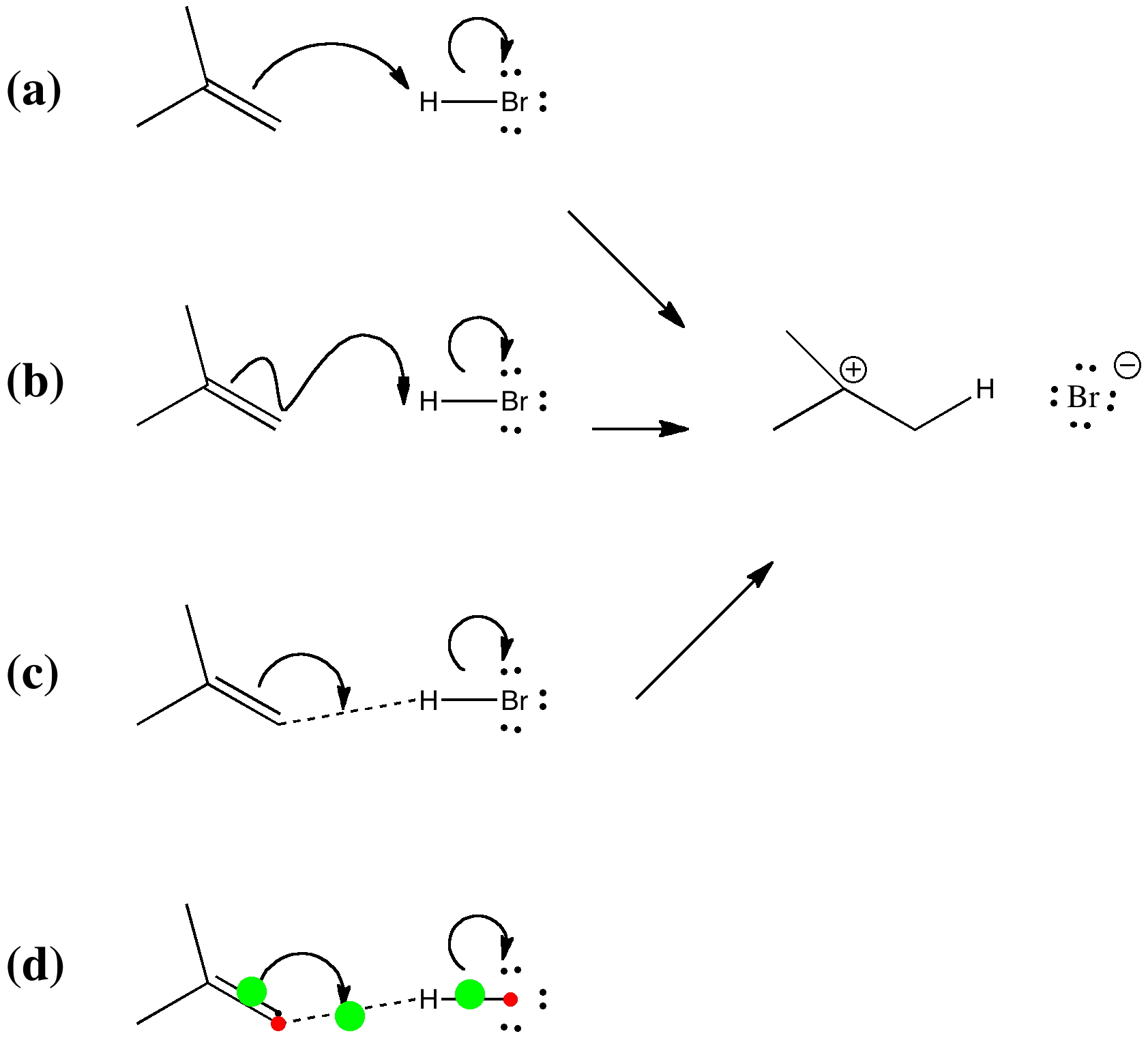
    Curly arrows are something most students of chemistry meet fairly early on. They rapidly become hard-wired into the chemists brain. They are also uncontroversial! Or are they? Consider the following very simple scheme.

    Curly arrow pushing

    It represents protonation of an alkene by an acid. Two products are of course possible, leading to either a tertiary carbocation as shown in (a), or a primary one (not shown). Either involves two arrows, but how to illustrate this (important) difference in the outcome using the arrows. Most textbooks show (a). The lhs arrow starts at the middle of the bond, and ends at the atom of hydrogen. This unfortunately leads to an ambiguity. It does not define which carbon is involved in forming the new C-H bond.

    In recognition of this problem an article has recently appeared[cite]10.1021/ed086p1389[/cite] which attempts to improve model (a) by using what they call bouncing arrows, as in (b). The arrow starts at the mid point of the C=C bond, but then bounces to one end, before heading off to again to end at the H atom. The idea is that the direction of bounce informs which of the two possible bonds will be formed. Leaving aside the (non-trivial) issue of how to persuade e.g. ChemDraw to produce a bouncing arrow, I note that an alternative system has been in use where I teach for many years; (c).

    1. This starts by addressing the problem of which bond to form by immediately drawing a dotted line where you want the bond to go.
    2. The arrow starts as before, at the mid point of a bond, but this time it ends at the mid-point of the dotted line. If nothing else, Chemdraw has no problem with this notation!
    3. Are there any other advantages? Consider (d). The green dots indicate the results of a QTAIM analysis, revealing bond-critical points (BCP) in either the reactants or the products. The first arrow both starts and ends at such a BCP. The second arrow starts at a BCP, and ends at a lone pair (these are not revealed using QTAIM. If instead, ELF synaptic basin centroids were to be used, then all arrows would start or end at such a basin). This therefore gives (c)/(d) some quantum mechanical reality.
    4. Another advantage is that one can formulate check-sumrules. By this I mean extra rules that can be used to check you have gotten things correct. Take a look at the red dots, one on the oxygen, another on the bromine. The metaphor is that these can be regarded as hinges, about which the bond swivels, the course of the swivel following that of the trajectory of the arrow.
      1. For heterolytic (electron pair) arrow pushing in which none of the centres involved changes its valency, the red dots must be located on alternating atoms.
      2. For heterolytic (electron pair) arrow pushing in which a valency change does occur (e.g. formation of a carbene), two red dots must be on adjacent atoms.
      3. In general, no more than one arrow either starts, or ends, at a bond. This used to be thought of as a fairly hard rule, but in fact its not difficult to come up with reactions which break it. For example, this one, where as many as three arrows either start or end at a given bond. And, as a challenge, can you break the rule by formulating arrow pushing for the (concerted) reaction between an alkyne and a per-acid (avoiding the anti-aromatic oxirene, the ring opening of which may conflate with the peroxidation).
      4. One can interrupt the concerted flow of arrows to form intermediates along the way. One famous example of such interruption is aromatic electrophilic substitution, which can however be persuaded to move all of its arrows more or less synchronously.
    5. The metaphor now is one of doors opening and closing, rather than bouncing arrows.

    There must be thousands of tutors around the world, teaching tens of thousands of students the arcane art of arrow pushing. If anyone has yet another schema for doing so, I would be delighted to hear from them.

  • The strongest bond in the universe!

    The rather presumptious title assumes the laws and fundamental constants of physics are the same everywhere (they may not be). With this constraint (and without yet defining what is meant by strongest), consider the three molecules:

    Property 

    (CCSD/aug-cc-pVTZ)

    N≡N (H-N≡N)+ (H-N≡N-H)2+
    NN length, Å 1.0967 1.0915 1.0795
    NN stretch, cm-1 2418.8 2356.4 

    2545.1a/2451.5b

    2226.3/3024.0 

    2688.4a/2567.7b

    ELF NN basin

    integration

    3.57 4.31 4.59
    QTAIM ρ(r)/∇2ρ(r) 0.714/-3.38 0.690/-3.07 0.700/-2.96
    aValue for hydrogen mass of 10,000 bValue for hydrogen mass of 0.001.

    The series explores the effect of protonating dinitrogen (generally considered as strong as a diatomic bond gets).

    1. Firstly, one notes that the N-N distance decreases with mono and then diprotonation, the second protonation having the greater effect. Is shorter stronger?
    2. What about the NN stretching vibration? Here one encounters an annoying feature of vibrations; the modes are not always pure. Thus whilst in N2 itself, there is only one normal mode, and it is as pure as they get, by the time we have di-protonated, we have three stretching modes, two involving H-N and one N-N. They mix and none can now be considered a pure N-N stretch. Thus in H2N2, the highest wavenumber mode of 3024 is a mixture of H-N and N-N, and likewise the 2226 mode, albeit in different proportions. So a trick has to be played. If the mass of each hydrogen is increased to 10,000, modes involving these super-heavy atoms no longer mix with any other mode. Now, the N-N mode becomes pure, and its value is 2688, a significant increase on nitrogen itself. The monoprotonated form also shows a lesser increase.
    3. The ELF disynaptic basins for the three molecules also steadily increase their populations. Electrons that were previously in the terminal nitrogen lone pairs now creep into the N-N region instead, and hence make the bond stronger. The population does not reach six (the nominal value for a triple bond), since the H-N regions still contain more than 2 electrons. But ELF matches the previous two results.
    4. QTAIM measures the electron density ρ(r) at the bond critical point. Here different behaviour is seen, with ρ(r) lower for the monprotonated, and the diprotonated form intermediate between the other two. Perhaps absolute electron densities measured at a single point do not measure bnd strengths after all. The Laplacian, ∇2ρ(r) steadily decreases along the series.

    So is the NN bond in HNNH2+ the strongest bond in the universe? Almost certainly. OK, so bonds with higher formal bond orders (Cr2 for example) exist, but they come nowhere near HN≡NH2+, which is crowned champion.

    Oh, by  the way, another article (DOI: 10.1063/1.1576756) claimed the title in 2003,  but  I make the claim for a stronger bond here!

  • Hypervalency: Third time lucky?

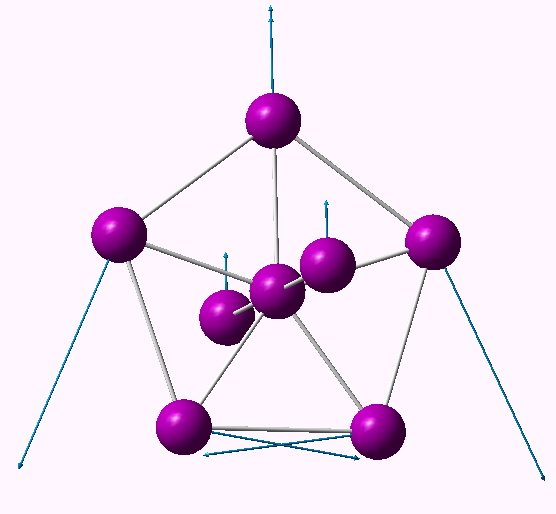
    One approach to reporting science which is perhaps better suited to the medium of a blog than a conventional journal article is the opportunity to follow ideas in unexpected, even unconventional directions. Thus my third attempt, like a dog worrying a bone, to explore hypervalency. I have, somewhat to my surprise, found myself contemplating the two molecules I8 and At8. Perhaps it might be better to write them as I(I)7 and At(At)7. This makes it easier to relate both to the known molecule I(F)7. What led to these (allotropes) of the halogens? Well, as I noted before, hypervalency is a concept rooted in covalency, albeit an excess of it! And bonds with the same atom at each end are less likely to be accused of ionicity. I earlier suggested that the nicely covalent IH7 was not hypervalent, with all the electrons which might contribute to hypervalency actually to be found in the H…H regions. The next candidate, I(CN)7 ultimately proved a little too ionic for comfort. So we arrive at II7. At the D5h geometry, it proves not to be a minimum, but a (degenerate) transition state for reductive elimination of I2 (I note parabolically that the 2010 Nobel prize for chemistry was awarded for reactions which involve similar reductive elimination of Pd and other metals to form covalent C-C bonds). Thus I8 is useful only as a thought experiment molecule, and not a species that could actually be made.

    I8, showing as a transition state for reductive elimination of iodine. Click for 3D

    The Wiberg bond index (B3LYP/Def2-TZVPP basis+pseudopotential) of the central iodine comes out at 2.81; that of the two axial iodines is 1.05 and that of the five equatorial atoms is 1.50. Well, the axial iodines are clearly monovalent, the equatorial ones are higher because of I…I interactions around the 5-ring. The central iodine is clearly again, not hypervalent. The individual Wiberg bond orders radiating form the central atom are 0.47 for the axial and 0.374 for the equatorial atoms. The I…I bond orders between the five equatorial atoms are 0.336 for adjacent atoms. This latter observation matches with the frequency analysis, since any individual I-I bond is already 1/3 formed, just asking to be eliminated.

    What of that other technique for finding electrons, ELF?

    ELF analysis for I8. Click for 3D

    All the I-I bonds radiating from the centre have well-defined disynaptic basins (the same is NOT true for e.g. IF7by the way, which comes out as ionic in ELF). The two axial covalent bonds have basins integrating to 1.35 electrons, and the five equatorial covalent bonds 0.77. The central iodine has a total of 6.55 electrons in bonds surrounding it. The five equatorial iodines have 7.7 electrons in two lone pairs, whilst the two axial iodines have 8.05 electrons in five monosynaptic basins. In summary, all eight iodines in this compound exhibit valence shells filled with an octet of electrons. Now, beyond any ambiguity, we can say this is NOT hypervalent.

    Oh, for good measure, At8. The Wiberg index at the central atom is 2.77, the bond index is 0.46 for axial and 0.37 for equatorial At. The ELF basin integrations are 0.65 for equatorial, and 1.61 for axial, the former decreasing and the latter increasing compared to iodine.

    ELF analysis for At8. Click for 3D.
  • And now for something completely different: The art of molecular sculpture.

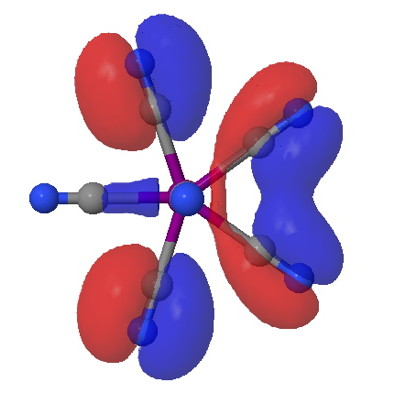
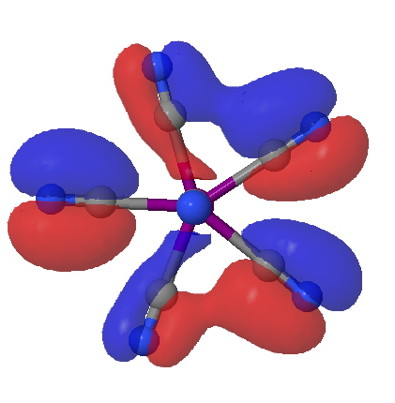
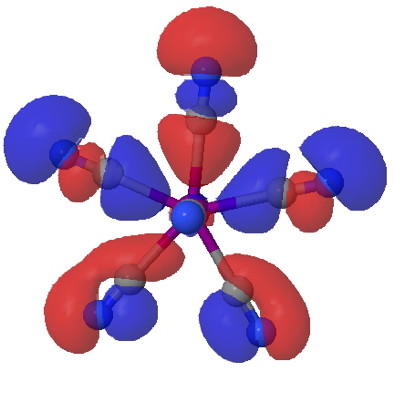
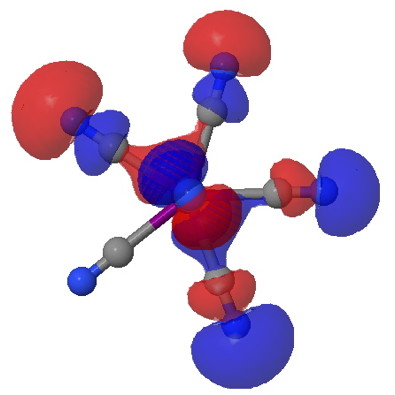
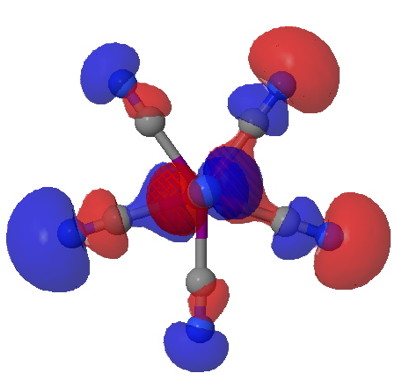
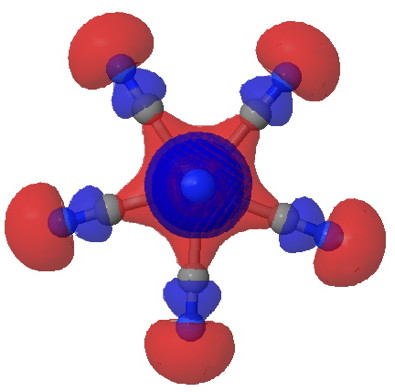
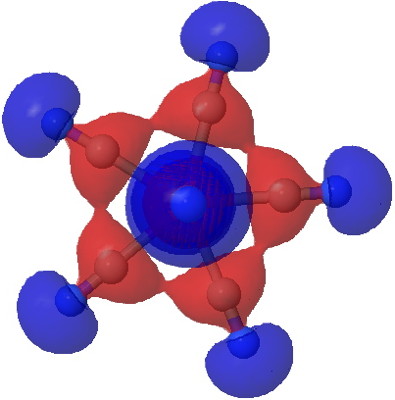
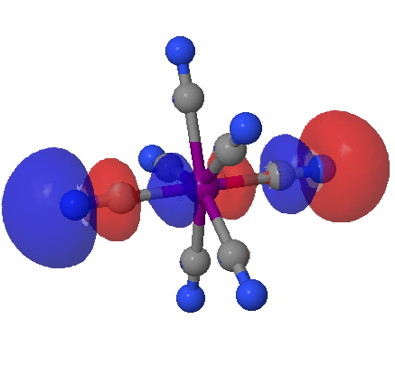
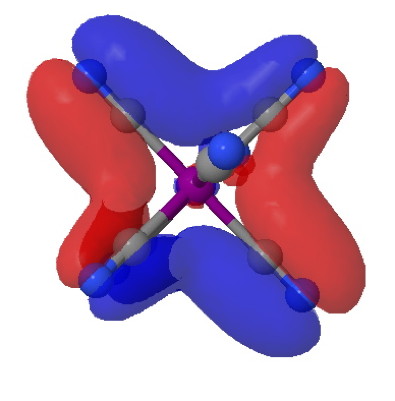
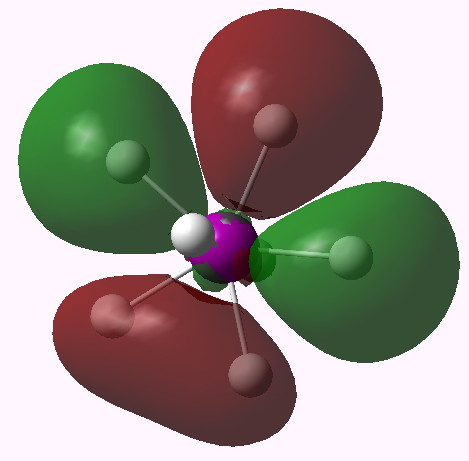
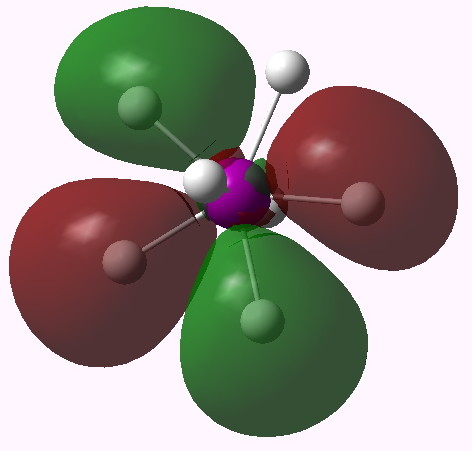
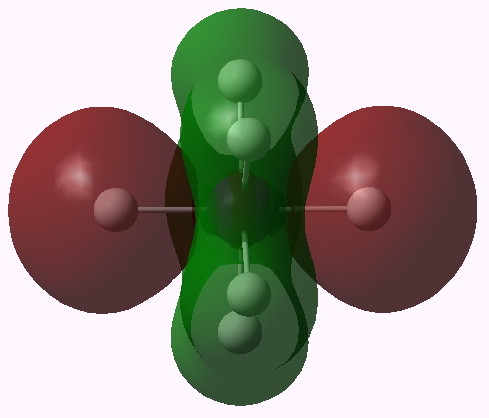
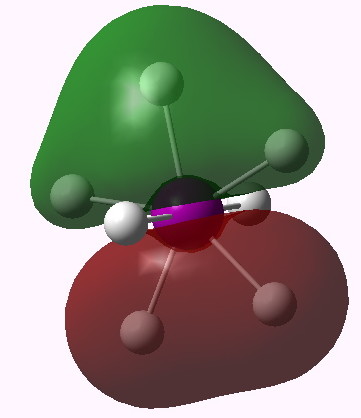
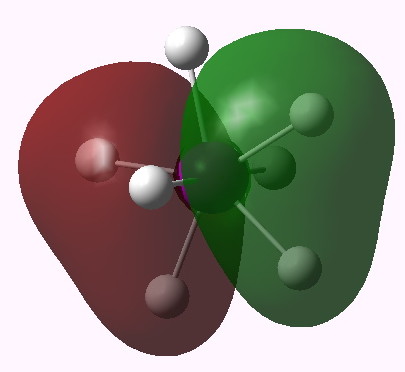
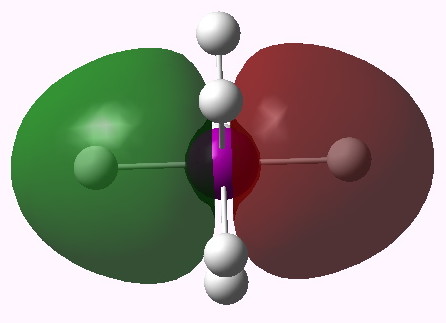
    Chemistry as the inspiration for art! The inspiration was the previous post. As for whether its art, you decide for yourself. Click on each thumbnail for a molecular sculpture (the medium being electrons!).

    MO 54. Click for 3D
    MO 55. Click for 3D
    MO 57. Click for 3D
    MO 46. Click for 3D
    MO 47. Click for 3D
    MO 48. Click for 3D
    MO 38. Click for 3D
    MO 39. Click for 3D
    MO 40. Click for 3D
  • Hypervalency: I(CN)7 is not hypervalent!

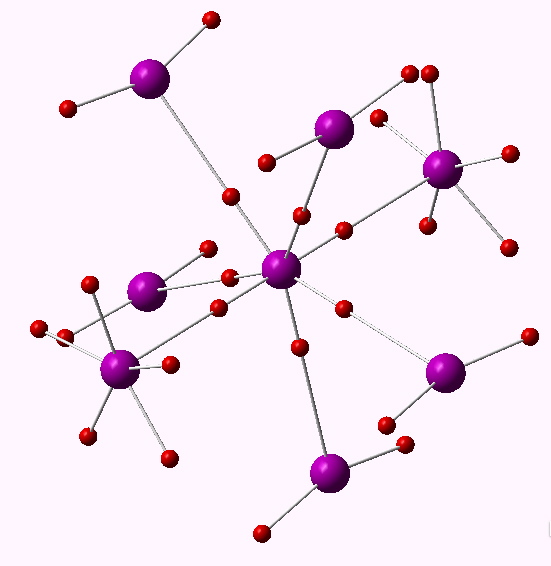
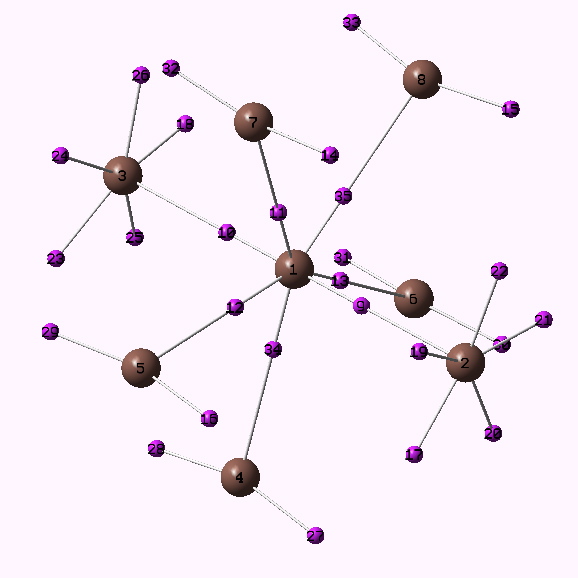
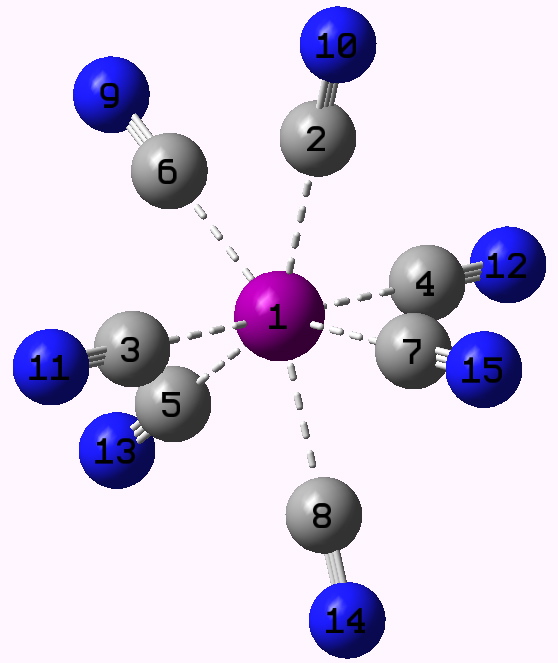
    In the , IH7 was examined to see if it might exhibit true hypervalency. The iodine, despite its high coordination, turned out not to be hypervalent, with its (s/p) valence shell not exceeding eight electrons (and its d-shell still with 10, and the 6s/6p shells largely unoccupied). Instead, the 14 valence electrons (7 from H, 7 from iodine) fled to the H…H regions. Well, perhaps H is special in its ability to absorb electrons into the H…H regions. So how about I(CN)7? (the species has not hitherto been reported in the literature according to CAS). The cyano group is often described as a pseudohalide, but the advantage of its use here is that it is about the same electronegativity as I itself, and hence the I-C bond is more likely to be covalent (than for example an I-F bond). As noted in the earlier blog, if the potentially hypervalent atom is very ionic, it can be difficult to know whether the electrons are truly associated with that atom, or whether they are in fact in lone pairs associated with the other electronegative atom (e.g. F). It is also important to avoid large substituents, otherwise steric interactions will cause problems around the equator.

    I(CN)7. Click for 3D

    The calculated (B3LYP/Def2-TZVPP) geometry for I(CN)7 is similar to IH7, having essentially D5h symmetry. The C-I bond lengths range from 2.20Å (equatorial) to 2.10Å (axial); the Wiberg bond orders for these are respectively 0.482 and 0.609. The total bond orders are 3.94 (iodine), 3.91 (carbon) and 3.14 (nitrogen). The total carbon bond order for e.g. atom 2 is made up of 0.482 to I, 2.939 to N, 0.110 to C6, C7, 0.049 to C5, C8 and 0.040 to C3, C4. As with IH7, the erstwhile hypervalent iodine electrons have in fact departed from that atom, and taken up residence in the C…C regions. The NBO analysis confirms the electrons as originating from an effective iodine core (28), explicit I,C,N cores (46), 69.3 valence and 0.7 Rydberg (outer shell) electrons. The molecular orbitals are shown in this post.

    Finally, for good measure, ELF analysis (on top of an effective core of 28) integrates to an outer core of 17.78 on iodine and a valence shell which includes 17.5 electrons distributed in seven explicit C-I disynaptic basins of ~2.5 electrons each. These 17.5 electrons can be considered as originating from ~10 (non-bonding?) electrons corresponding to the filled iodine 5d-shell, and ~7.5 shared bonding electrons in the iodine 5s/5p shell (the ELF procedure cannot distinguish between the 5d and 5s/5p electrons). There is no indication from these integrations that the iodine valence shells are expanded (i.e. from 10 for the 5d or from 8 for the 5s/5p).

    As with IH7, this molecule shows absolutely no evidence of being hypervalent! So, if hypervalency is to survive as a concept, the hunt must surely be on for one unambiguous, as yet to be found, example of the phenomenon in the main group.

  • Hypervalency: Is it real?

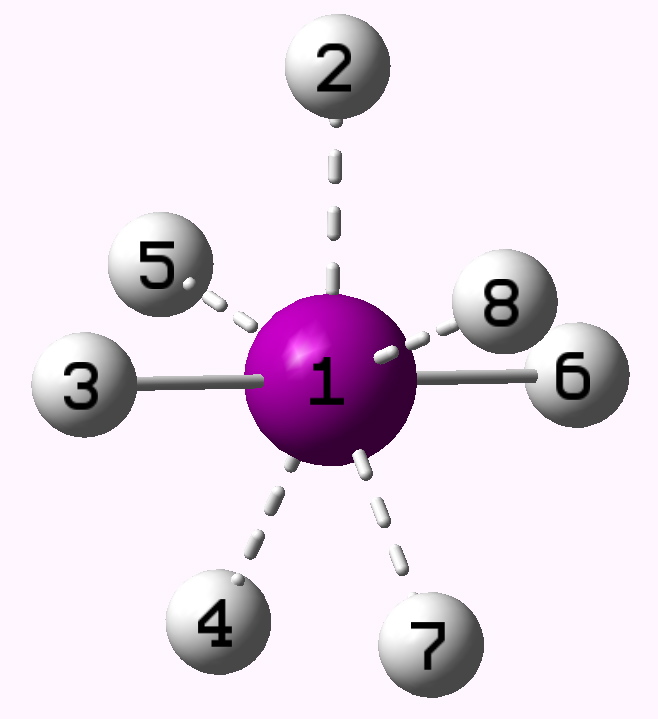
    The Wikipedia page on hypervalent compounds reveals that the concept is almost as old as that of normally valent compounds. The definition there,  is “a molecule that contains one or more main group elements formally bearing more than eight electrons in their valence shells” (although it could equally apply to e.g. transition elements that would contain e.g. more than 18 electrons in their valence shell). The most extreme example would perhaps be of iodine (or perhaps xenon). The normal valency of iodine is one (to formally complete the octet in the valence shell) but of course compounds such as IF7 imply the valency might reach 7 (and by implication that the octet of electrons expands to 14). So what of IF7? Well, there is a problem due to the high electronegativity of the fluorine. One could argue that the bonds in this molecule are ionic, and hence that the valence electrons really reside in lone pairs on the F. Thus the apparently hypervalent PF5 could be written PF4+…F, in which case the P is not really hypervalent after all. We need a compound with un-arguably covalent bonds. Well, what about IH7? One might probably still argue about ionicity (for example H+…IH6) but that puts electrons on I and not H, and hence does not change any hypervalency on the iodine. Surely, if hypervalency is a real phenomenon, it should manifest in IH7?

    IH7. A true hypervalent molecule? Click for 3D
    A reasonably high level calculation (B3LYP/Def2-TZVPP with pseudopotential on I to absorb relativistic effects) shows the molecule to be a minimum, with D5h symmetry. An NBO analysis shows 46 core (i.e. non-valence) electrons. These arise from a Kr core (=36) plus a filled iodine 5d shell of 10 electrons. So, only the 5s/5p orbitals can be used for valence bonding. The total minimal basis which one can construct valence molecular orbitals from is thus I 5s, 5p and H 1s, a total of eleven AOs, into which 14 electrons must pair up into 7 doubly-occupied molecular orbitals. Now, the real issue is whether this occupancy corresponds to seven I-H covalent single bonds, each with a two-electron Lewis pair. If so, the molecule is hypervalent! The occupied MOs are shown below.

    MO 16 (E2'). Click for 3D

    MO 15 (E2')

    MO 14 (A1')

    MO 13 (E1')

    MO 12 (E1')

    MO 11 (A2'')

    MO 10 (A1')

    One notices that whilst orbitals 10-14 are clearly bonding in the I-H region, orbitals 15-16 seem antibonding in that region (there is a node along the I-H bond). We are seeing much the same phenomenon that occurs when the bond order of 3 in N2 is reduced to 1 in F2 due to occupancy of anti-bonding orbitals. Can this be quantified? NBO (5.9) analysis reveals the following.

    1. The effective (pseudopotential) core has 28 electrons, and the outer core 18. The valence orbitals contain 13.79, and only 0.21 electrons are Rydberg (higher shell). So little occupancy of e.g. 6s/6p then!
    2. The Wiberg bond index indicates each H has a total bond order of very close to 1 (its natural valence state), whilst I is 3.45. Remember that the maximum total bond index of a covalently bound atom using a pure octet of valence electrons is 4 (8/2, think carbon). The iodine is NOT hypervalent!
    3. So why, if its not hypervalent, is it so strongly hypercoordinate? Well, there are 14 valence electrons, but they do NOT all occupy the I-H regions, which have bond orders between 0.46 (equatorial) or 0.57 (axial). The only other place they can be is in the H-H regions! Consider the bond order values between say hydrogen 2 to the four other equatorial atoms 4,5,7,8. They are respectively 0.05, 0.15, 0.05, 0.15. So each hydrogen has a total bond order of 1, but only slightly more than half of this comes from the I-H, the rest comes from H-H. To put it another (approximate) way, of the 14 valence electrons, ~8 might be considered to be associated with I-H bonds, and ~6 with H-H bonds. The hypervalency has been in effect absorbed into the H-H regions. This means no atom in this molecule is at all hypervalent.
    4. Well, if the iodine is not hypervalent, and some of its valence electrons occupy I-H anti-bonding orbitals, why is it stable at all (in the sense that all the vibrations are real, and it’s clearly a minimum in the potential energy surface). Here, I merely speculate. Iodine has a large core charge, and hence the inner core electrons are starting to exhibit relativistic contractions. This effect stabilizes the outer 5s/5p electrons, and so occupancy of  anti-bonding MOs generated from such AOs is not so unfavourable as one might expect. Perhaps, the  hypercoordination shown by  IH7 is after all a relativistic effect rather than a hypervalent effect?  In which case, what will  AsH7 show?

    So, what might have been an archetypal covalent hypervalent molecule is no such! IH7 shows entirely normal valencies, one for H and the iodine does not even reach four (if anything, its sub-valent rather than hypervalent). One may be entitled to ask if ANY main group element exhibits hypervalency!