Blog

  • (Almost) 100 years of Lewis structures: are they still fit for purpose?

    The molecule below was characterised in 1996 (DOI: 10.1246/cl.1996.489) and given the name tris(dithiolene)vanadium (IV). No attempt was made in the original article to give this molecule a Lewis structure using Lewis electron pair bonds. This blog will explore some of the issues that arise when this is attempted.1
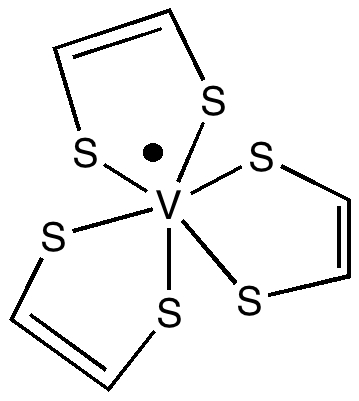
    NAMPOG.

    The name given to the molecule by the chemists who made it reflects the ligand used, which we can represent as cis-HS-CH=CH-SH (via its di-sodium salt and reaction with VCl3). Its entry in the Cambridge crystal database is NAMPOG (which carries only the slightest of semantic or structural information). The chemical name however does carry some further information, namely the designation tris implies three fold symmetry (D3h in this case), and hence that all three ligands are in fact identical (structurally).

    A nominal first stab at a Lewis electron pair representation reflecting this symmetry might be as shown above. At this point we hit a logical problem with the final component of the assigned name; the formal oxidation state of the metal is designated IV. However, three moles of (-)S-CH=CH-S(-) imply the ligands carry a formal charge of 6-, and that therefore the metal must be 6+, or VI. Six however is not an oxidation state normally exhibited by vanadium. Why did the original discoverers designate it IV? Well, because careful electron counting reveals the system as a whole has 161 electrons, of which 71 are designated as valence electrons, and hence it must have one unpaired valence electron. In the representation above, that electron is shown resident on the V atom with a dot, and the ESR spectrum measured for the molecule turns out to be apparently characteristic of V(IV) systems (they do not mention whether they also compared the spectra with those derived from genuine examples of  V(II), see below). This implies (as the authors note) that a total of only 4- must be delocalized over the three dithiolene ligands.

    Returning to our electron counting, of the remaining 70 valence electrons, 24 electrons are implicit above as twelve sulfur lone pairs (which are sometimes shown as double dots, but their explicit inclusion here would cause clutter) and so we presume the remaining 46 electrons must be in Lewis-like electron pair bonds. Well, the structure above implies 24 such bonds (the six C-H lines, as well as the  Hs are also omitted by convention, again to avoid clutter!). We can begin to see why the original article lacks a Lewis structure, since the one above contains too many electrons (48 rather than 46).

    How might one proceed to rescue the situation? Because a great many possible Lewis structures could be drawn, we have to learn a little more about the molecule and seek recourse in the bond lengths measured for the system. The most obvious is the C-C length, which turns out to be 1.36Å, a value significantly longer than expected for a C=C double (i.e. a four electron) bond, but a little shorter than the 3-electron bond found in e.g. benzene.
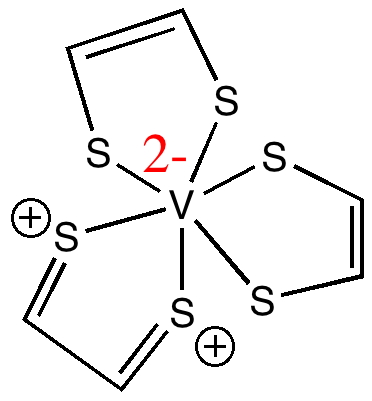
    A second attempt at a Lewis structure

    The Lewis structure (one of three equivalent ones) now has 5 lines in the C-C region, or ~3.3 electrons per C-C bond averaged over three ligands, which seems to match the length a little better. It also has 25 lines representing nominal electron pairs and ten sulfur lone pairs, a total of 70 electrons. The net effect of this representation is to transfer two electrons from the sulfur lone pairs to the vanadium, and hence to reduce the formal charge at the metal from 6+ to 4+, or to V(IV). This sort of behaviour, where electrons can be borrowed from a ligand and used to reduce (or oxidise) the metal they are coordinated to is called non-innocent behaviour. The dithiolene ligand is notoriously non-innocent. It results in this case in our innocent assumptions that bonds are defined by an integer number of electrons [2,(3),4,(5) or 6 as in Lewis’ original classifications] are no longer adequate, and that non-integer descriptors must also be used.

    There is still one counting rule we have not inspected. To complete its valence shell to reach Kr, V needs 18 valence electrons. The representation above gives it 13. So how about the following, which ends up with a valence shell of 17 electrons for vanadium (and an oxidation state of V(II))?
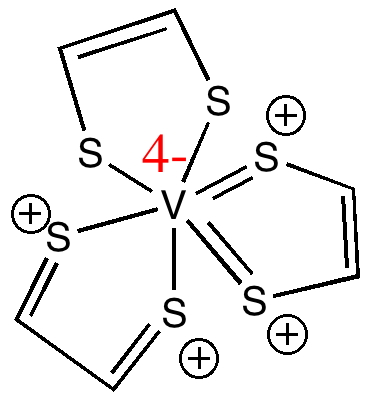
    Third time lucky?

    This implies that the V-S bonds might be a little shorter than normal. Well in NAMPOG its 2.35Å, perhaps slightly shorter than a typical V-S single bond of ~2.4Å, but in fact we are now down at the noise level, and its clear that we have probably reached (if not exceeded) the limit of semantic interpretation of the Lewis model. In this case, only three (of 100s of possible) Lewis structures have been discussed, and of course they were selected only because we had some experimental information to discriminate between them. And we must be aware that whilst Lewis structures are the simplest way of analysing the electron distribution in a molecule, far more sophisticated analyses are nowadays possible. The real question is which analysis can actually result in a greater insight into the molecule? But the least that can be said about molecule NAMPOG is that it causes one to think about the problems of representing bonding (I will draw the line however at using this example in my university admissions interviews!).

    1 I thank J. P. P. (Jimmy) Stewart for drawing this molecule on my blackboard  and hence provoking this blog post.
  • Secrets of a university admissions interviewer

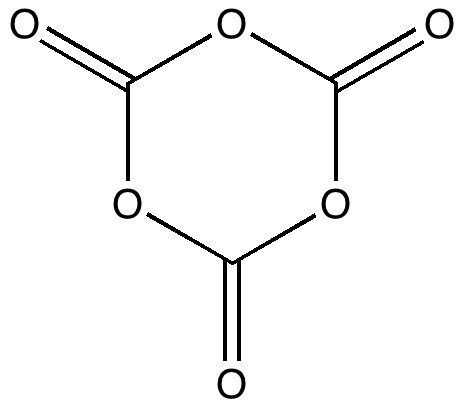
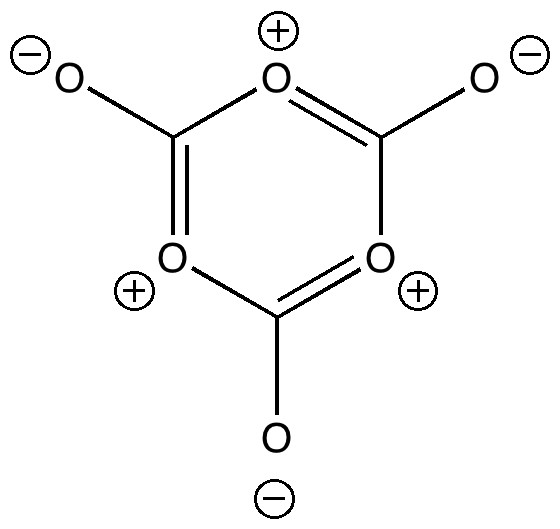
    Many university chemistry departments, and mine is no exception, like to invite applicants to our courses to show them around. Part of the activities on the day is an “interview” in which the candidate is given a chance to shine. Over the years, I have evolved questions about chemistry which can form the basis of discussion, and I thought I would share one such question here. It starts by my drawing on the blackboard (yes, I really still use one!) the following molecular structure.

    Mystery molecule.

    The candidate is then invited to offer their initial impressions of this molecule, and shortly thereafter asked how they might make it[cite]10.1021/acs.joc.6b00647[/cite](or where perhaps they might be able to buy it). This of course floors even the most confident of applicants! But after a moments thought, most students can derive not only a molecular formula, but an empirical formula. From which it becomes apparent that it is actually a trimer of carbon dioxide. In the previous post, I showed the structure of solid CO2 and how an oxygen from one unit came fairly close to a carbon from another. So the next logical question might be to ask if this might lead to a molecule such as shown above. Why a trimer? Well, the aromatic core is also easily perceived, and one might expect some aromatic stabilization to result (which most of the candidates readily spot). Its also ionic, and here perhaps solvation may help stabilize. Finally, armed with Le Chatelier’s principle, one might conclude that pressure too would help. At this point of course, the realization normally dawns that possibly the purchase of a carbonated soft drink in a supermarket might offer perhaps a few molecules of the above. The discussion normally takes about 10 minutes, and is guaranteed to stimulate (and quite possibly exhaust) most students.

    But here in this post, I would like to offer the denouement. What actually are the chances of forming this species? Enter a B3LYP/6-311G(d,p) calculation of the free energy. We can do this for various models:

    1. The trimer energy evaluated in a continuum solvent (water). This works out at  83.4 kcal/mol higher than three monomers (in part due to the entropic requirements of coalescing three molecules into one). So, not many molecules in a fizzy drink then! (just as well perhaps, since e.g. benzene as an aromatic molecule would not be a pleasant additive).
    2. How aromatic is the molecule?  Well, a NICS(1) index of -2.3 ppm suggests little actual aromaticity. The C-O bond length (1.365Å) is certainly short enough. The Kekulé vibrational mode however is quite low (974 cm-1) compared to benzene, which is ~1310 cm-1 (remember, this mode represents how much energy it takes to distort an aromatic ring from a symmetric structure to the bond localized form).
    3. If its not aromatic, then perhaps after all a better representation might be:
      A better resonance structure

      It is worth asking why even this perfectly reasonable form is so much higher in free energy than carbon dioxide itself.

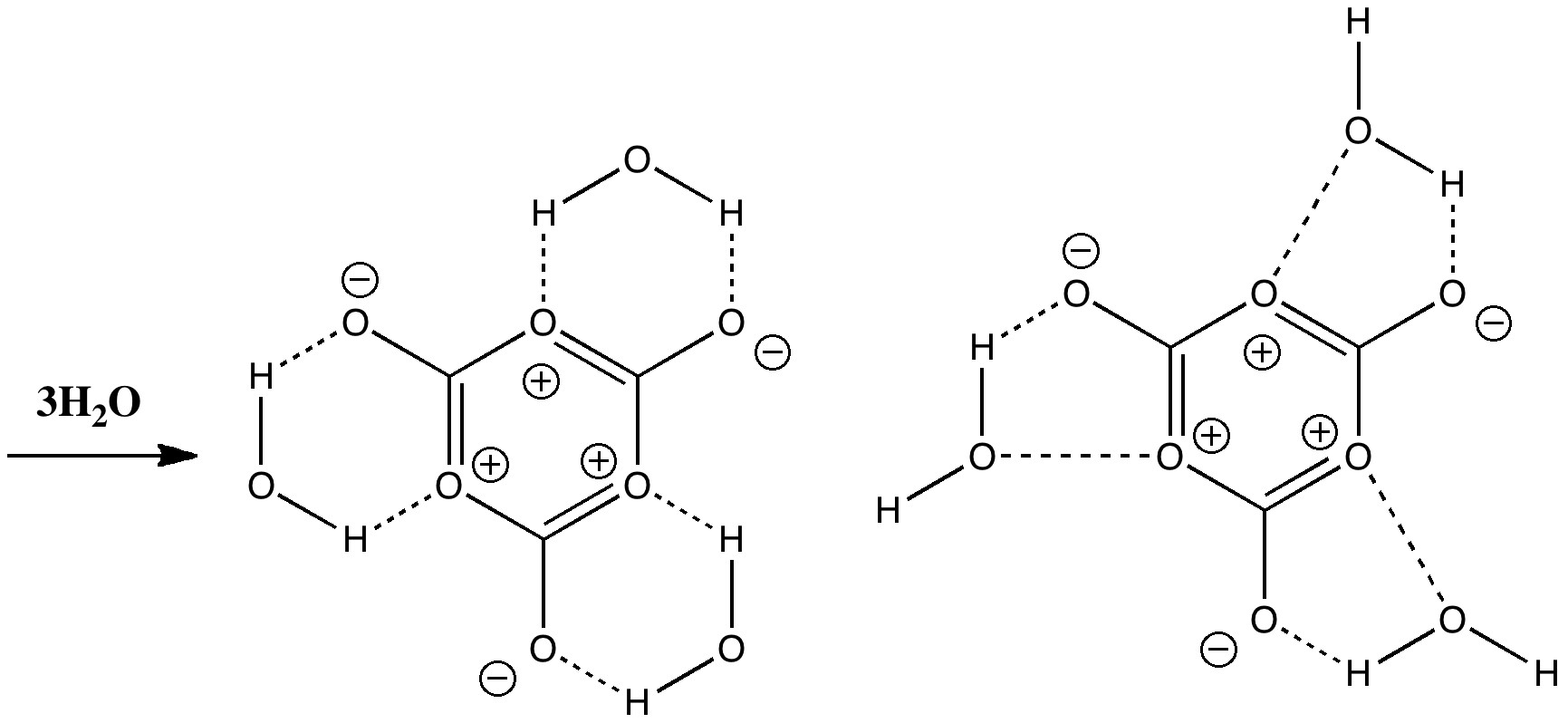
    4. Would solvating the structure with three explicit water molecules help (as per below)? Deciding quite how the hydrogen bonds will form is an interesting exercise in its own right!
      Solvated trimer

      But now the energy is +96.8 kcal/mol compared to the monomers. Its that entropy again!

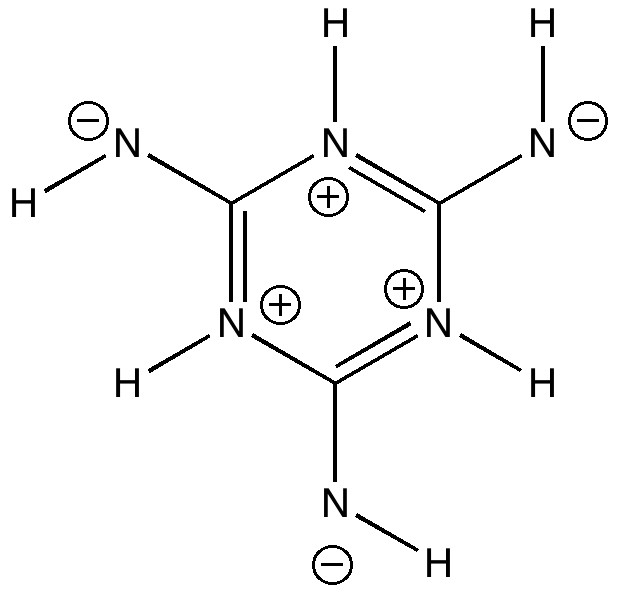
    5. Actually, oxygen is pretty poor at propagating aromaticity. Nitrogen is much better, so what about the following (historically, such s-triazines were in fact much better known than benzene itself in the first half of the 19th century).
      Carbo-diimide trimer

      This is now merely +35.8 kcal/mol higher in free energy compared to three momers. The Kekulé mode is up to 1355 cm-1 (discuss!).

      There are many other facets of this that could be raised. But the main reason for introducing such a molecule for discussion is that just by looking at the structure, so many ideas can be explored. That, by and large, is how chemistry works.

  • Solid carbon dioxide: hexacoordinate carbon?

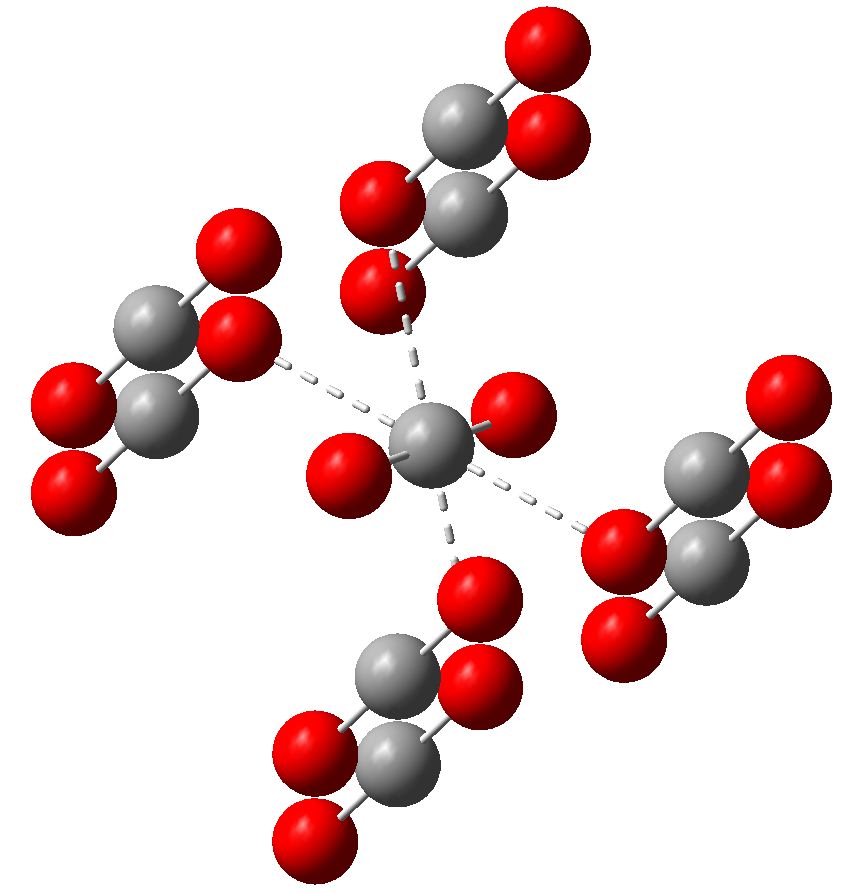
    Carbon dioxide is much in the news, not least because its atmospheric concentration is on the increase. How to sequester it and save the planet is a hot topic. Here I ponder its solid state structure, as a hint to its possible reactivity, and hence perhaps for clues as to how it might be captured. The structure was determined (DOI 10.1103/PhysRevB.65.104103) as shown below.

    The structure of solid carbon dioxide. Click for 3D
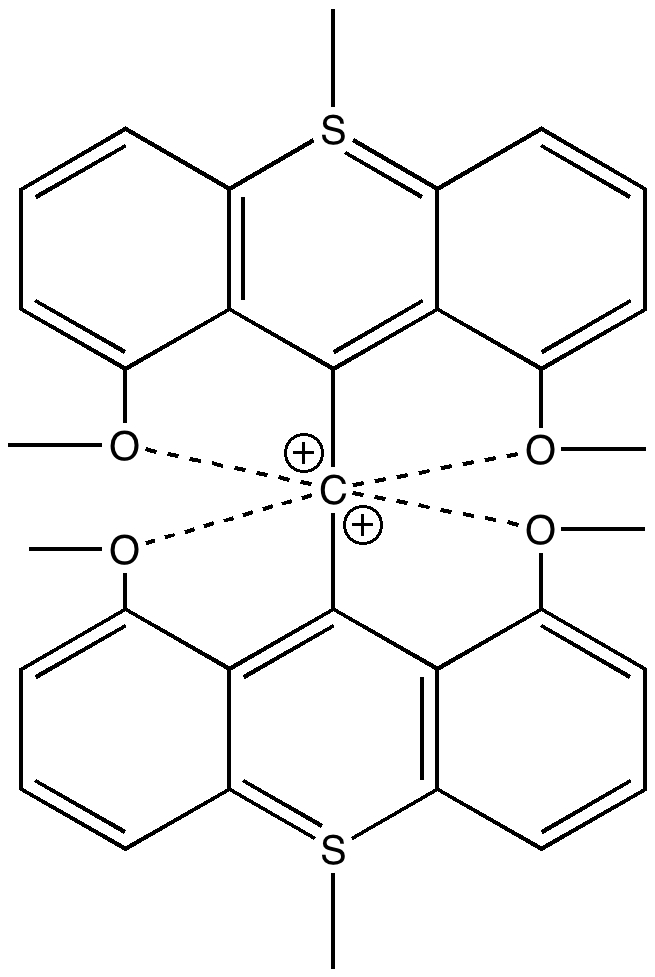
    The two nominal double bond distances are 1.33Å, whilst a further four O…C contacts in the shape of a square complete the coordination (2.38Å each). All would probably agree that the central carbon is best described as hexa-coordinated. This is also a hot topic. For example, note the claim made recently to have created a hexa-coordinated carbon species by design (Synthesis and Structure of a Hexacoordinate Carbon Compound, DOI: 10.1021/ja710423d) based on a motif derived from an allene:

    Designed hexacoordinate carbon. Click for 3D
    This claim was supported by an unusual measured property, the electron density ρ(r) and its Laplacian in the putative O…C region. These two properties are one of those (relatively rare) meetings between experiment and quantum mechanics, and their usefulness has been noted in this blog on previous occasions. However, note that in this designed structure, the O…C distances are merely 2.65-2.7Å, significantly longer than in solid carbon dioxide! So carbon dioxide, in a form many of us are familiar with (solid), can certainly be justified as being described as having a hexacoordinate carbon (although we might draw the line at describing it as having hexavalent carbon).

    If oxygen atoms can approach the carbon in CO2 to within ~2.4Å, an interesting question can be posed. How close can another carbon get to CO2 without actually reacting and forming a new molecule? C-C bonds, even weak ones, are so much more interesting than C-O bonds! It would have to be a particularly nucleophilic carbon, of course. A search of the August 2010 version of the Cambridge structural database (CSD) reveals no really close approaches of another carbon to CO2. Only about 8 weak examples are found, and here the C-C distances are ~3.0-3.2Å, with the O=C=O angle in the CO2 never less than 170°. In this context, there is an intriguing and very recent report (which has not yet made it into the searchable CSD) of the structure of CO2 trapped in a cavity next to what was claimed to be a molecule of 1,3-dimethyl cyclobutadiene, or CBD (see 10.1126/science.1188002 and the discussion of this article in my earlier blog post). The focus in that report was on the “Mona Lisa of organic chemistry”, namely the CBD unit. One feels that the structure of the adjacent CO2 was of lesser interest to the authors. According to a visual image of this system, the CBD and CO2 pair show quite an intimate approach via their carbon atoms (a ghostly C-C bond is clearly represented). This raises the interesting question of whether the description of this pair should be of two intimate but nevertheless separate and relatively unperturbed molecules not connected by a covalent bond (“more indicative of a strong van der Waals contact than of covalent bonding“) or of a pair fully bound by a covalent C-C bond between them?

    The issue of what is an interaction, and what is a bond continues to raise its often controversial head. And quantum theory continues to provide a multitude of interpretations as well.

  • The oldest reaction mechanism: updated!

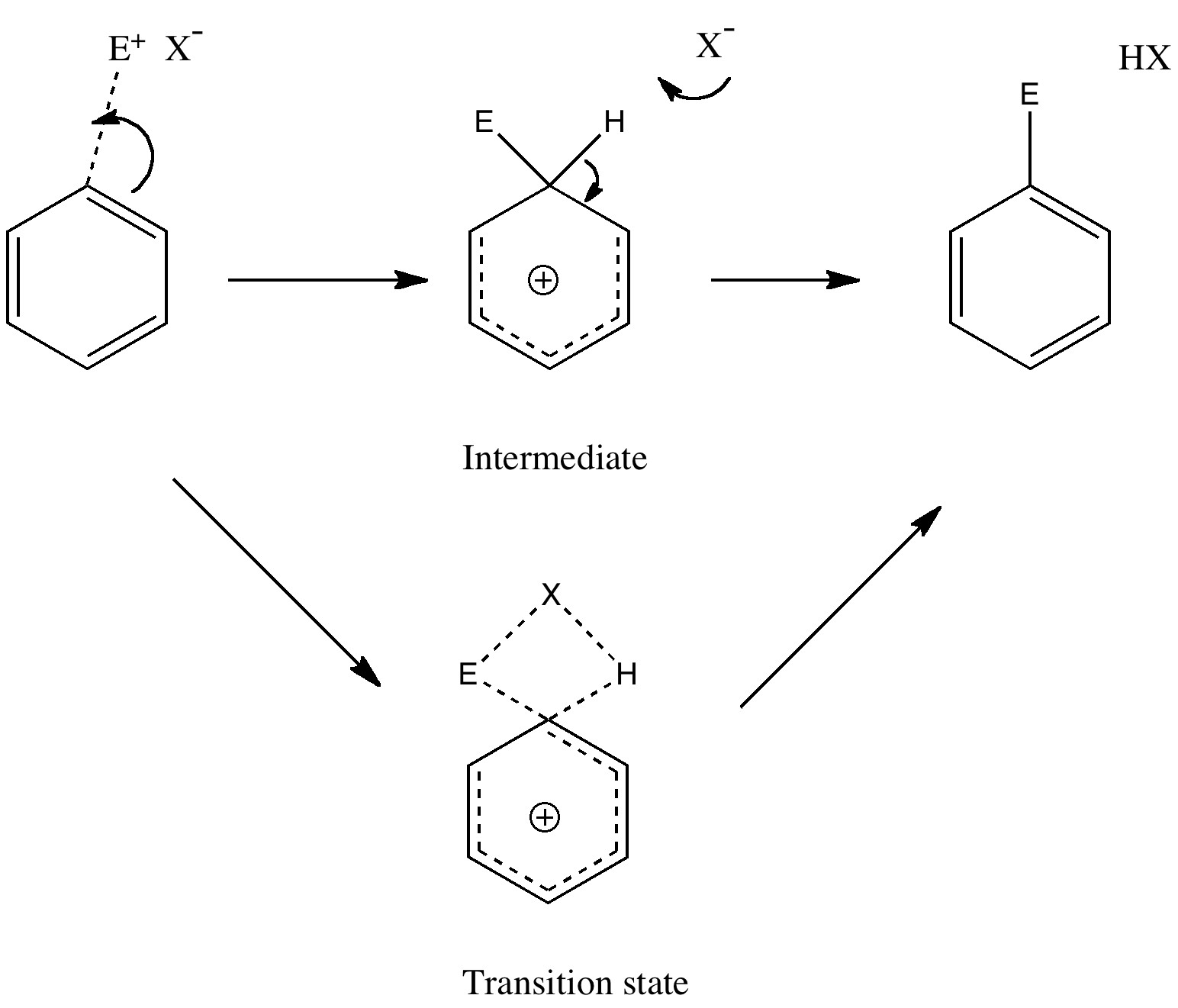
    Unravelling reaction mechanisms is thought to be a 20th century phenomenon, coincident more or less with the development of electronic theories of chemistry. Hence electronic arrow pushing as a term. But here I argue that the true origin of this immensely powerful technique in chemistry goes back to the 19th century. In 1890, Henry Armstrong proposed what amounts to close to the modern mechanism for the process we now know as aromatic electrophilic substitution [cite]10.1039/PL8900600095[/cite]. Beyond doubt, he invented what is now known as the Wheland Intermediate (about 50 years before Wheland wrote about it, and hence I argue here it should really be called the Armstrong/Wheland intermediate). This is illustrated (in modern style) along the top row of the diagram.

    The mechanism of aromatic electrophilic substitution

    In 1887, Armstrong had tabulated the well known ortho/meta/para directing properties of substituents already on the ring towards this reaction[cite]10.1039/CT8875100258[/cite]. He even offered an explanation, which is not entirely wrong, given that in 1890, the electron had not yet been discovered! That did not stop Armstrong, who invented an entity he called the affinity for the purpose of developing his theories (in this theory, benzene had an inner circle of six affinities, which had a tendency to resist disruption). Armstrong’s description of the properties of the affinity matches that of the (yet to be discovered) electron very closely! But that is enough of history. The mechanism shown above emerged in its present representation (and naming) during the heyday of physical organic chemistry between 1926 – 1940, and of course is an absolute staple of all text books on organic chemistry. But, sacrilege, is it correct? Could what is referred to as an intermediate instead be a transition state? (shown in the bottom pathway of the scheme).

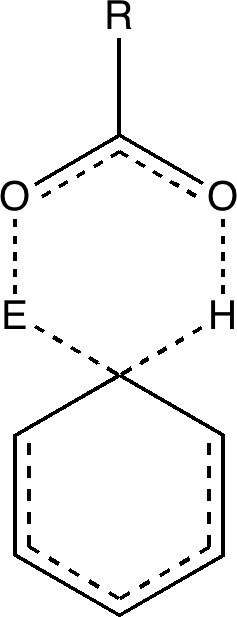
    Consider instead the following, in which X is replaced by an acetic acid motif;

    Transition state alternative to the Wheland

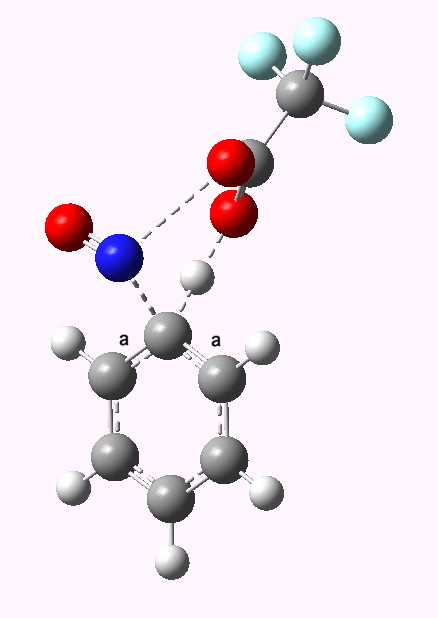
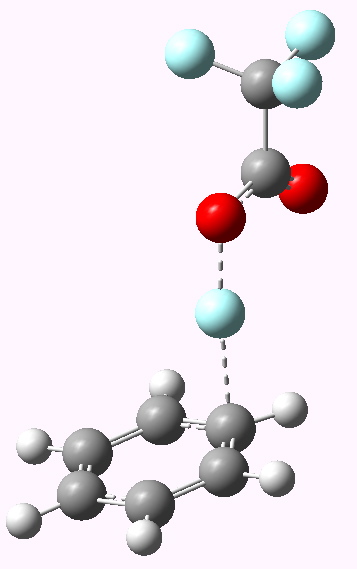
    The two steps, a bond formation between the benzene and E, and the proton abstraction from the benzene by X, are now synchronized into a single step, and the intermediate is now transformed into a transition state. Time to put this theory to the test. X is going to be made trifluoroacetate (R=CF3) and we are going to test it with E= NO+ and F+ (yes, trifluoroacetyl hypofluorite is a known chemical, and it really does fluorinate1 aromatic compounds at -78C). Firstly, E= NO+. A B3LYP/6-311G(d,p) calculation[cite]http://doi.org/10042/to-5172[/cite]  run in a solvent simulated as dichloromethane, reveals the mid point to indeed be a transition state and NOT an intermediate![cite]10.1021/ja021152s[/cite].

    Wheland as a transition state. Click image for animation

    There is one crucial aspect to this transition state that Armstrong himself made a point of. In the Wheland intermediate proper, the aromaticity of the benzene ring must be disrupted. As a transition state, it need not be (at least not completely). Thus the two bonds labeled as a have calculated lengths of ~1.415Å, only slightly longer than the aromatic length, and certainly not single bonds as implied by the Wheland intermediate! Notice also the significant motion by the hydrogen, which implies the reaction would be subject to a kinetic isotope effect (this would normally be interpreted in terms of the second stage of the stepwise reaction shown along the top a being rate limiting, but this result shows this need not be so). Thus, if the structure is favourable, this veritable old mechanism can be redesigned to give a new, 21st century look to a 19th century staple! By the way, the free energy of activation for this reaction is calculated as ~22 kcal/mol, a perfectly viable thermal reaction. No doubt, by suitable design of the group X, this might be reduced.

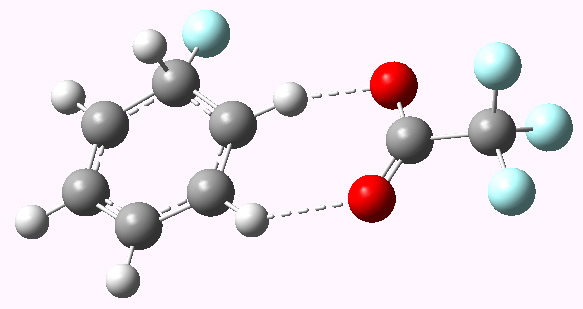
    Now on to E=F+[cite]http://dx.doi.org//10042/to-5171[/cite]. This looks a little different. F+ is now a much more voracious electrophile than the nitrosonium cation, and it therefore jumps ahead of the second mechanistic step, with no motion of the hydrogen being involved at this stage (one might also imagine making X a better base to swing things the other way).

    Transition state E=F+ leading to Wheland Intermediate. Click for  3D model.
    Genuine Wheland intermediate for E=F+ Click for 3D model

    Now a full blown Armstrong/Wheland intermediate does indeed form (10042/to-5174); an intimate ion pair if you will, even in the relatively non polar dichloromethane as modelled solvent. The structure  (shown above) is rather unexpected.  This reaction has ΔG of ~5 kcal/mol,  which is significantly lower than for the E=NO+ system.

    Chemistry is full of surprises, and it is always a wonder how a slightly different take on even the oldest of reactions can reveal something new.

    Reference.

    <

    p>1. Umemoto, T.; Mukono, T.. 1-Acylamido-2-fluoro-4-acylbenzenes. Jpn. Kokai Tokkyo Koho  (1986), Patent number JP61246156.

  • Reactions in supramolecular cavities – trapping a cyclobutadiene: ! or ?

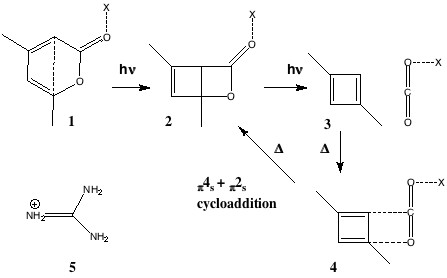
    Cavities promote reactions, and they can also trap the products of reactions. Such (supramolecular) chemistry is used to provide models for how enzymes work, but it also allows un-natural reactions to be undertaken. A famous example is the preparation of P4 (see blog post here), an otherwise highly reactive species which, when trapped in the cavity is now sufficiently protected from the ravages of oxygen for its X-ray structure to be determined. A colleague recently alerted me to a just-published article by Legrand, van der Lee and Barboiu (DOI: 10.1126/science.1188002) who report the use of cavities to trap and stabilize the notoriously (self)reactive 1,3-dimethylcyclobutadiene (3/4 in the scheme below). Again sequestration by the host allowed an x-ray determination of  the captured species!

    Scheme for production of 1,3-dimethylcyclobutadiene 3 and CO2.

    The colleague tells me he has himself already penned an article on the topic and submitted this to a conventional journal. However, their rules decree that whilst it is being refereed, I could not discuss the article here, or indeed even name its author. Assuming his article is published, I will indeed reveal his identity, so that he gets the credit he deserves! Meanwhile, I will concentrate in this blog purely on two other aspects of this reaction which caught my own eye after he brought the article to my attention.

    The reaction involves imobilising a precursor 1 in a crystalline calixarene network as shown above, and then in situ photolysis to form the Dewar lactone 2. Further photolysis then results in extrusion of carbon dioxide and the formation of 1,3-dimethyl cyclobutadiene 3 and CO2, both still trapped in the host crystals. Thus imobilised, here they both apparently remain (at 175K) for long enough for their X-ray structure to be determined. What attracted me to this chemistry was the potential of this reaction as a nice example of a Diels Alder reaction occuring in a cavity. The first example of such catalysis was reported by Endo, Koike, Sawaki, Hayashida, Masuda, and Aoyama (DOI: 10.1021/ja964198s) and I have used this in my lectures for many years. This latter example however illustrates the promotion of a cycloaddition, which inside a cavity is accelerated by a factor of ~105, rather than of the reverse cycloelimination. I explain this to students by invoking entropy. Normally, when two molecules react together, there is an entropic penalty, which can add 8 or more kcal/mol to the free energy of activation of a bimolecular reaction in the absence of the cavity.

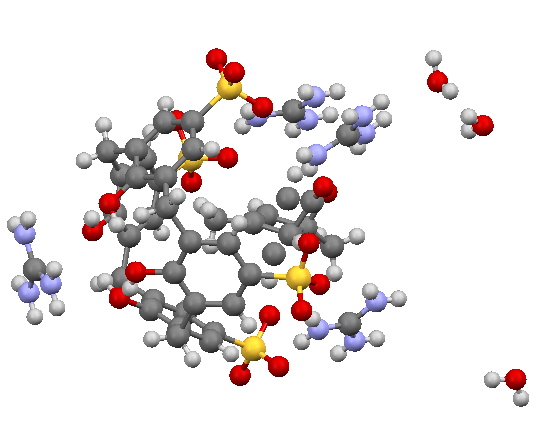
    Structure of entrapped 1,3-dimethylcyclobutadiene, obtained from the CIF file provided via DOI: 10.1126/science.1188002

    By a strange coincidence, my name is also on a recently published article (DOI: 10.1021/ol9024259) with other colleagues on the use of (Lewis) acid catalysts to accelerate a type of reaction known as the Prins. This involves the addition of an alkene to a carbonyl group. Now as it happens, the reaction in the scheme above showing 42 happens to combine these features; it is both a Diels-Alder cycloaddition and also involves an alkene adding to a carbonyl compound! It is therefore noteworthy that the claimed reaction 123 + CO2 is done in the presence of a strong acid catalyst, the guanidinium cation 5, which is itself part of the structure of the calixarene-based host. It is represented as X in the scheme above, and can also be identified in the above 3D model via the light blue atoms.

    There are however crucial differences between these two earlier examples I quoted and the reaction of 23; the latter is in fact a cycloelimination and not a (cyclo)addition. In other words, according to literature precedent, the guanidinium cation-based cavity should act to accelerate the reverse cycloaddition 42 rather than the forward cycloelimination. Since the isomerisation 34 is thought to be fast, the question arises: how rapid is the reverse reaction 42? In particular, is it slow enough to allow X-ray diffraction data to be collected for 3/4 over the necessary period of 24 hours or more? Legrand, van der Lee and Barboiu do not address this point in their article. Nor is there discussion there of how the cavity and the acid catalyst might influence the position of the equilbrium 23 + CO2.

    This is where calculations can help. At the B3LYP/6-311G(d,p) level four different models were selected.

    1. Model A is a simple gas phase calculation for the singlet state, which reveals the free energy barrier for 42 is already quite modest for a Diels-Alder reaction (more typical values are ~22 kcal/mol), due no doubt to the instability/reactivity of the cyclobutadiene. However, at 175K, that would still be quite sufficient to prevent the reverse reaction from occurring to any extent over the period of X-ray data collection.
    2. Model B adds a condensed phase (water) to the model. This serves in part to simulate the condensed crystal environment (which is pretty ionic being a tetra ion-pair). The barrier drops to 12.1 kcal/mol.
    3. Adding one guanidinium cation to both these models (C and D) which simulate the Prins conditions, drops the barrier to 8.3 kcal/mol (model 4).
    4. You can inspect details of any of the calculations by clicking on the digital repository entry (shown as dr in the table), where full data is available.

    None of these models includes the entropic effects of full constraint in a cavity (which I estimated above as capable of reducing the free energy barrier for reaction by ~8 or more kcal/mol). If this correction is applied to model D, it would reduce the barrier to ~0 kcal/mol! The calculations also reveal that the reverse reaction 42 is exothermic, and this exothermicity is enhanced by the acid catalyst 5. It would be further enhanced by reducing the entropy of reaction by pre-organizing the reactants in the cavity. The tendency must therefore be for 3/4 to revert to 2 on purely thermodyamic grounds, and only the presence of a significant kinetic barrier would allow them to exist as separate species. This barrier, as one might infer from the calculations shown in the table below, may not be a large one. Even a barrier of 8 kcal/mol might require cooling to significantly lower than 175K to render the reaction slow on a ~24 hour timescale.

    Model ΔG4 → 2
    kcal/mol
    ΔGreac 4 → 2 Singlet-triplet
    separation
    A. Gas phase,X=none dr ts 16.8 dr -3.5dr +5.7 dr
    B. Continuum solvent (water),X=none dr ts 12.1dr -6.0 dr +7.7 dr
    C. Gas phase,X=guanidinium+ dr ts 6.1 dr -19.5dr +2.1dr
    D. Continuum solvent (water),X=guanidinium+ dr ts 8.3 dr -10.1 dr +7.7 dr

    So I end my own speculations here on the nature of the reaction reported by Legrand, van der Lee and Barboiu by asking: are the products they claim (1,3-dimethylcyclobutadiene and carbon dioxide) capable of existing as separate species for long enough inside their cavity, even at 175K, to allow for the collection of X-ray data for a structure determination?

    I tend to think probably not (? rather than !). But do decide for yourselves.


    Archived as http://www.webcitation.org/5rpkn2Z5S on 08/08/2010. See also this post.
  • Bio-renewable green polymers: Stereoinduction in poly(lactic acid)

    Lactide is a small molecule made from lactic acid, which is itself available in large quantities by harvesting plants rather than drilling for oil. Lactide can be turned into polymers with remarkable properties, which in turn degrade down easily back to lactic acid. A perfect bio-renewable material!

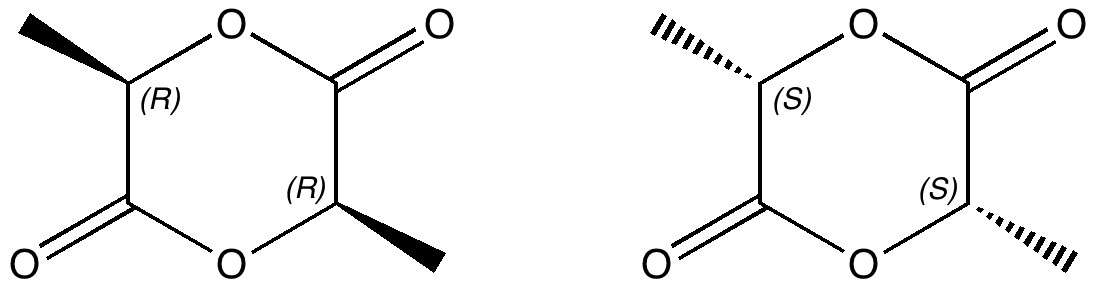
    Lactide

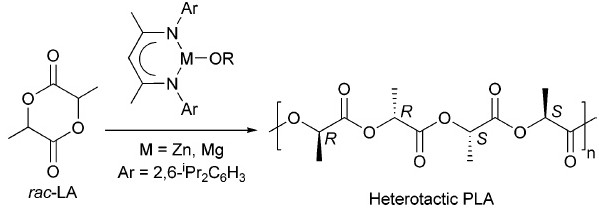
    The starting point for ring opening polymerisation is racemic lactide, or rac-LA. This is an equal mixture of the R,R and S,S enantiomers, and it is now treated with a catalyst based on a metal M. If M=Mg, there is a rather remarkable stereochemical outcome for the resulting polymer. The catalyst selects alternating enantiomers for the assembly, resulting in a chain (R,R),(S,S),(R,R),(S,S), etc, the name for which is a heterotactic polymer. It could instead have created a blend of equal proportions of (R,R),(R,R),(R,R) and (S,S),(S,S),(S,S) which is an isotactic polymer. Needless to say, these two polymers have quite different properties, and it very much matters which is formed. Without such a catalyst, a random atactic polymer is created rather than a stereoregular arrangement.

    Poly (lactic acid)

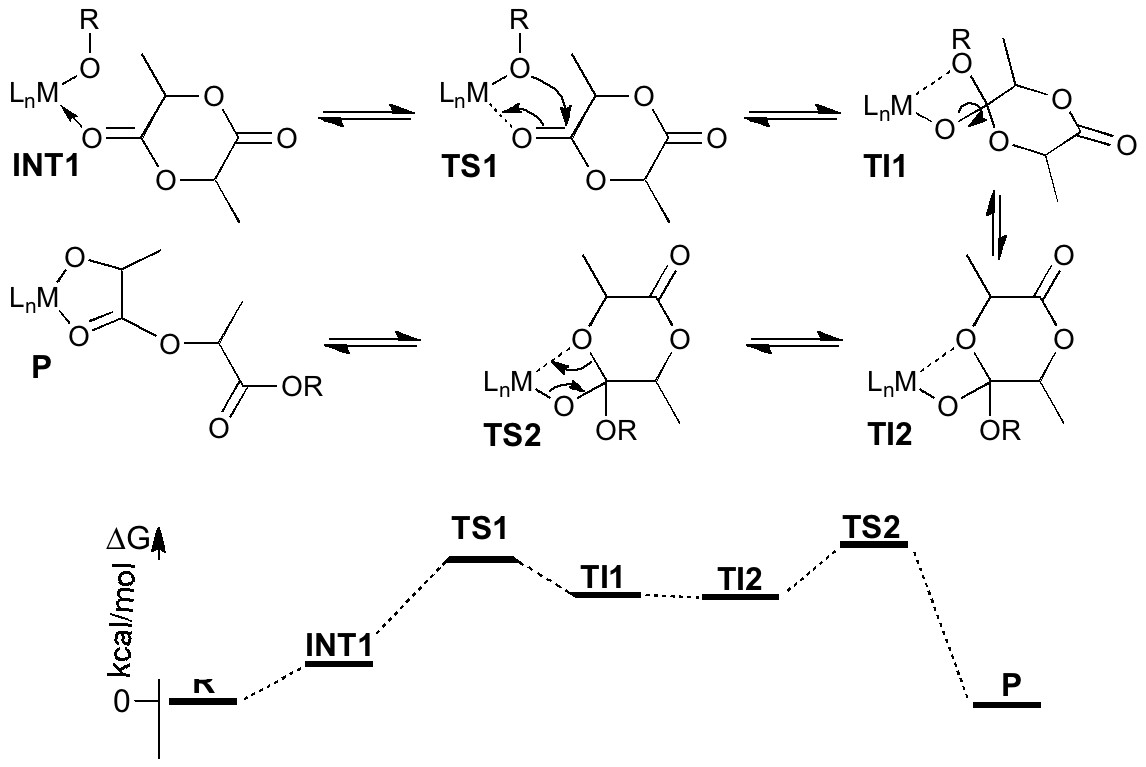
    The question is how does the catalyst manage to assemble the polymer with such stereoinduction? The origins of this depend on a detailed understanding of the mechanism of the reaction, and in 2005 we suggested one which offered an explanation for the stereospecificity (see E. L. Marshall, V. C. Gibson, and H. S. Rzepa, DOI: 10.1021/ja043819b and an interactive storyboard).

    Mechanism for stereoregular polymerisation

    The key features of this rational were:

    1. Two possible transition states may control the reaction, TS1 and TS2. Which one depends on which is the higher in energy.
    2. The smallest model for this process involves loading two molecules of lactide onto the catalyst. The first has already been ring opened, and will control the stereochemistry of the second, which is the one suffering the ring opening bond formations/breakings shown above (the first is lurking in the group R).
    3. This leads to four different possibilities, (R,R)-(R,R)*, (S,S)-(S,S)*, (R,R)-(S,S)*, and (S,S)-(R,R)* (where the * denotes the reacting lactide, as in the diagram above). These are all diastereomers, and hence will be different in energy. If one of the first two is the lowest, then isotactic polymer will result; if the latter two then a heterotactic polymer.

    Back in 2004, we had constructed a model based on B3LYP and of necessity a mixed basis set, being 6-311G(3d) on the Mg, 6-31G on the lactide and only STO-3G on the catalyst. This was done because the complete system was actually rather large. Even so, a transition state calculation would regularly take at least 10 days to find using the fastest computers available to us at that time. Using this procedure, we found that the rate limiting kinetic step  was in fact TS2 for all four possibilities noted above. Of these, the (R,R)-(S,S) transition state turned out to represent the lowest energy pathway, thus confirming the observed heterotacticity for this particular catalyst.
    Well, times have moved on:

    1. Six years later, computers are around 20 times faster! We can now afford to improve the basis set to 6-31G(d,p) on all the atoms, including the catalyst (the Mg stays at 6-311G(3d) however; improving it to 6-311G(3d,2f) makes little difference).
    2. We can now include the solvent (thf) as a continuum field.
    3. In the last five years the B3LYP functional has been shown to underestimate the energies of globular molecules. A modern functional such as ωB97XD, which includes dispersion energy corrections, should be expected to do much better.

    It is the purpose of this blog to report an update to the modelling. Quoting relative free energies (including the solvation correction), the results come out as;

    1. (R,R)-(S,S) 0.0 kcal/mol for the TS1 geometry (see DOI: 10042/to-4950)
    2. (S,S)-(S,S) 1.8 for the TS2 geometry
    3. (S,S)-(R,R) 5.5 for the TS1 geometry
    4. (R,R)-(R,R) 9.1 for the TS1 geometry.

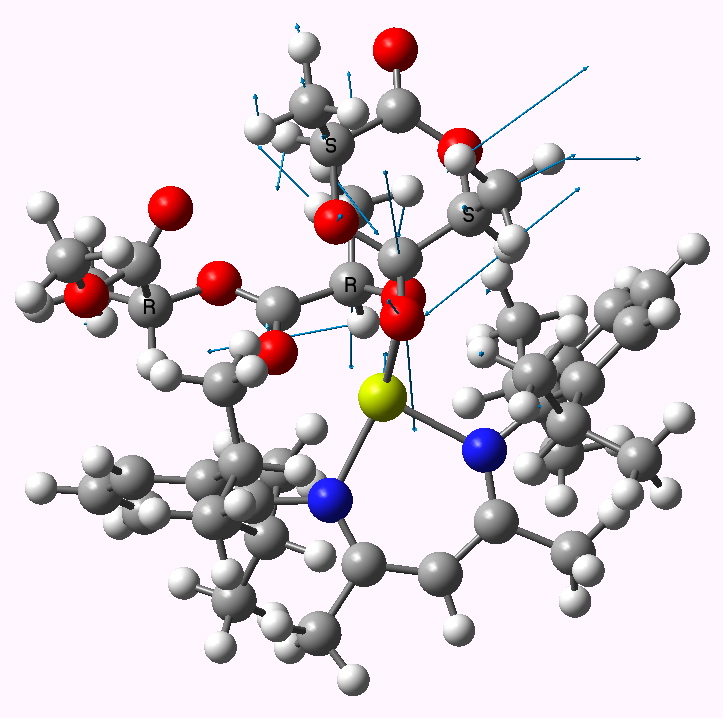
    Well, there are surprises! Using the gas phase B3LYP model the key transition state was TS2; now its TS1 (for in fact three of the four possible transition states). The bottom line (almost) is that the same stereoisomer as before comes out the winner! The take home lesson is that in six years of progress, modelling can now encompass solvent and dispersion corrections. Many mechanisms with > ~100 atoms investigated in the past without inclusion of these effects could probably do with a re-investigation, especially if the transition states are “globular” in nature. Any by now you are probably wondering what the transition state looks like. Well, here it is (and see it in all its glory by clicking on the diagram below).

    (R,R)-(S,S) Transition state for stereoregular lactide polymerisation. Click for animation

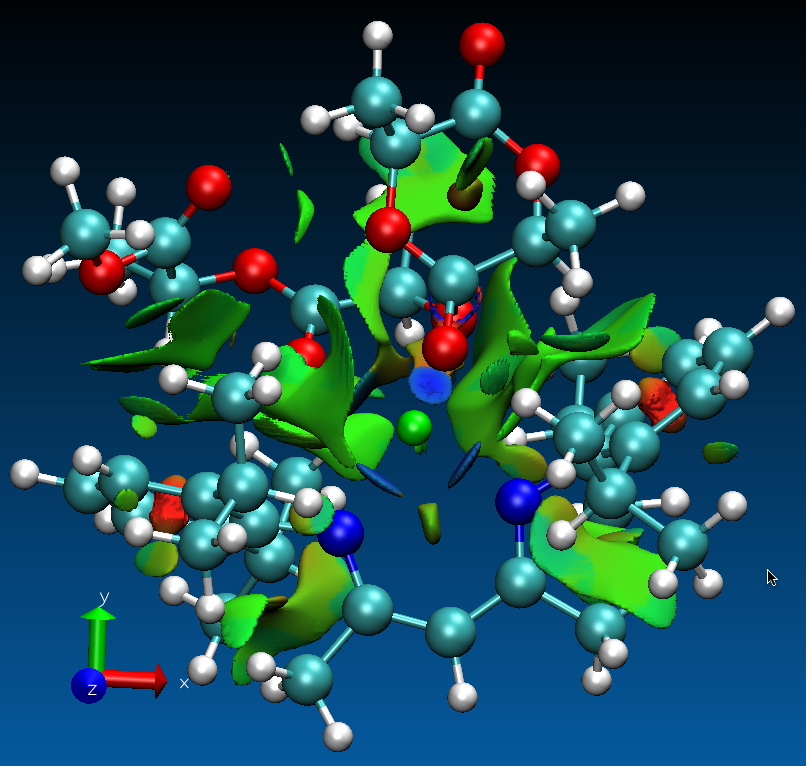
    And if you are also wondering how one might proceed to analyse the origins of the stereoinduction, the NCI interaction surfaces (as described in this post) are shown below. Note how the extensive degree of green interaction surface is associated with the globular nature referred to above.

    Non-covalent interaction (NCI) surfaces for the (R,R)-(S,S) transition state. Click for 3D
  • The weirdest bond of all? Laplacian isosurfaces for [1.1.1]Propellane.

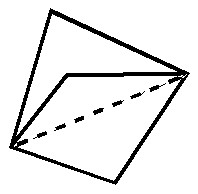
    In this post, I will take a look at what must be the most extraordinary small molecule ever made (especially given that it is merely a hydrocarbon). Its peculiarity is the region indicated by the dashed line below. Is it a bond? If so, what kind, given that it would exist sandwiched between two inverted carbon atoms?

    1.1.1 Propellane

    One (of the many) methods which can be used to characterize bonds is the QTAIM procedure. This identifies the coordinates of stationary points in the electron density ρ(r) (at which point ∇ρ(r) = 0) and characterises them by the properties of the density Hessian at this point. At the coordinate of a so-called bond critical point or BCP, the density Hessian has two negative eigenvalues and one positive one. The sum, or trace of the eigenvalues of the density Hessian at this point, denoted as ∇2ρ(r), provides in this model a characteristic indicator of the type of bond, according to the following qualitative partitions:

    1. ρ(r) > 0, ∇2ρ(r) < 0; covalent
    2. ρ(r) ~0, ∇2ρ(r) > 0; ionic
    3. ρ(r) > 0, ∇2ρ(r) > 0; charge shift

    The third category of bond was first characterised by Shaik, Hiberty and co. using valence-bond theory1 and they went on to propose [1.1.1] propellane (above, along with F2) as an exemplar of this type.2 Matching the conclusions drawn from VB theory was the value of the Laplacian. As defined above, for the central C-C bond, both ρ(r) and  ∇2ρ(r) have been calculated to be positive, supporting the identification of this interaction as having charge-shift character.3

    The Laplacian represents one of those properties where quantum mechanics meets experiment, in that its value (and that of ρ(r) itself) can be measured by (accurate) X-ray techniques.4 This was recently accomplished for propellane,5 with the same conclusion that the Laplacian in the central C-C region has the significantly positive value of +0.42 au. The electron density ρ(r) at this point was measured as 0.194 au. Calculations5 at the B3LYP/6-311G(d,p) level report ρ(r) as ~0.19 and ∇2ρ(r) as +0.08 au. Whilst the former is in good agreement with experiment, the latter is calculated as rather smaller than expected. This was originally interpreted as indicating that the “the experimental bond path has a stronger curvature [in ρ(r)] than the theoretical” although more recent thoughts are that both experimental and theoretical uncertainty may account for the discrepancy.5,6 An experiment worth repeating?

    A hitherto largely unexplored aspect of characterising a bond using the Laplacian is whether the value at the bond critical point is fully representative of the bond as a whole. The Laplacian is related to two components of the electronic energy by the Virial theorem;

    2G(r) + V(r) = ∇2ρ(r)/4; H(r) = V(r) + G(r)

    where G(r) is the kinetic energy density, V(r) is the potential energy density and H(r) the energy density. Charge-shift bonds exhibit a large value of the (repulsive) kinetic energy density, a consequence of which is that ∇2ρ(r) is more likely to be positive rather than negative. The relationships above hold not just for the specific coordinate of a bond critical point, but for all space. Accordingly, another way therefore of representing the Laplacian ∇2ρ(r) is to plot the function as an isosurface, including both the negative surface (for which |V(r)| > 2G(r)) and the positive surface [for which |V(r)| < 2G(r)].

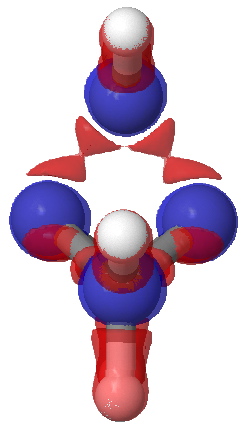
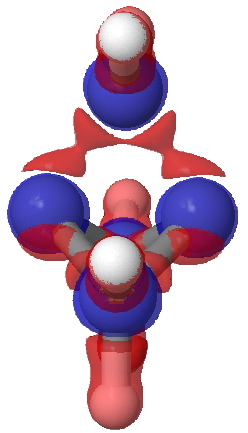
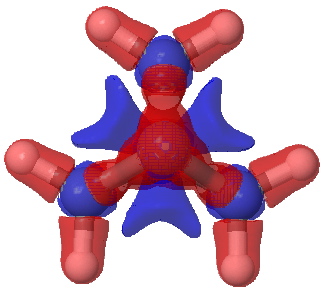
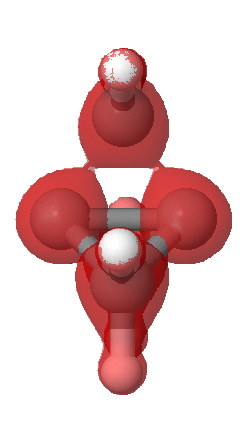
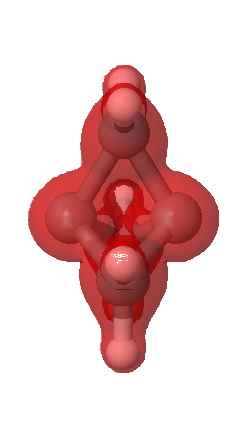
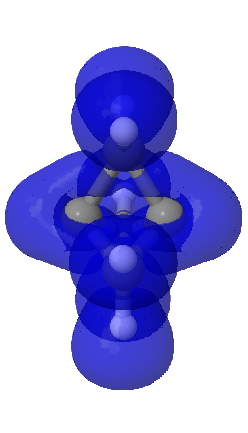
    Such an analysis is the purpose of this post, using wavefunctions evaluated at the CCSD/aug-cc-pvtz level (see DOI: 10042/to-5012). The values of ρ(r) and ∇2ρ(r) at the bcp for the central bond are 0.188 and +0.095 au, which compares well with previous calculations. The values for the wing C-C bonds are 0.242 and -0.491 respectively (and were measured5 as 0.26 and -0.48). Laplacian isosurfaces corresponding to ± 0.49 (the value at the wing C-C bcp), ± 0.47 and ± 0.2 (which reveals prominent regions of +ve values for the Laplacian) can be seen in the figures below (and can be obtained as rotatable images by clicking).


    Laplacian isosurface contoured at ± 0.49

    Laplacian isosurface contoured at ± 0.47. Red = -ve, blue= +ve.

    Laplacian isosurface contoured at ± 0.20

    A significant feature is the isosurface at -0.47, which corresponds to the lowest contiguous Laplacian isovalued pathway connecting the two terminal carbon atoms (and which coincidentally is similar in magnitude to that reported5 as measured for these two atoms). Three such bent pathways of course connect the two carbon atoms. The energy density H(r) shows a minimum value of -0.21 au along any of these pathways. It is significantly less negative (-0.13) for the direct pathway taken along the axis of the C-C bond.

    Energy density H(r) @-0.21

    Energy density H(r) @-0.13

    ELF isosurface @0.7

    A useful comparison with this result is the ELF isosurface. This too is computed at the correlated CCSD/aug-cc-pVTZ using a new procedure recently described by Silvi.7 Contoured at an isosurface of +0.7, the ELF function is continuous between the two terminal atoms, much in the manner of Laplacian. Significantly, the ELF function at the bcp appears at the very much lower threshold value of 0.54, and forms a basin with a tiny integration for the electrons (0.1e). Since both methods provide a measure of the Pauli repulsions via the excess kinetic energy, the similarity of the Laplacian to the ELF function is probably not coincidental.

    The issue then is whether a bond must be defined by the characteristics of the electron density distribution along the axis connecting that bond, or whether other, non-least-distance pathways can also be considered as being part of the bond.8 The former criterion defines a pathway involving a positive Laplacian (+0.095) and would be interpreted as indicating charge shift character for that bond. The latter involves three (longer) pathways for which the Laplacian is strongly -ve, and which would therefore per se imply more conventional covalent character for the interaction. Considered as a linear (straight) bond, it has charge shifted character; considered as three “banana” bonds, it may be covalent. Weird!

    1. Shaik, S.; Danovich, D.; Silvi, B.; Lauvergnat, D. L.; Hiberty, P. C., “Charge-Shift Bonding – A Class of Electron-Pair Bonds That
      Emerges from Valence Bond Theory and Is Supported by the Electron Localization Function Approach,” Chem. Eur. J., 2005,
      11, 6358-6371, DOI: 10.1002/chem.200500265 and references cited therein.
    2. W. Wu, J. Gu, J. Song, S. Shaik, and P. C. Hiberty, “The Inverted Bond in [1.1.1]Propellane is a Charge-Shift Bond,” Angew. Chem. Int. Ed., 2008,
      DOI: 10.1002/anie.200804965; 10.1002/cphc.200900633
    3. S. Shaik, D. Danovich, W. Wu & P. C. Hiberty, “Charge-shift bonding and its manifestations in chemistry”, Nature Chem, 2009, 1, 443-3439. DOI: 10.1038/nchem.327
    4. P. Coppens, “Charge Densities Come of Age”, Angew. Chemie Int. Ed., 2005, 44, 6810-6811. DOI: 10.1002/anie.200501734
    5. M. Messerschmidt, S. Scheins, L. Grubert, M. Pätzel, G. Szeimies, C. Paulmann, P. Luger. “Electron Density and Bonding at Inverted Carbon Atoms: An Experimental Study of a [1.1.1]Propellane Derivative, Angew. Chemie Int. Ed., 2005, 44, 3925-3928. DOI: 10.1002/anie.200500169
    6. L. Zhang, W. Wu, P. C. Hiberty, S. Shaik, “Topology of Electron Charge Density for Chemical Bonds from Valence Bond Theory: A Probe of Bonding Types”, Chem. Euro. J., 2009, 15, 2979-2989. DOI: 10.1002/chem.200802134
    7. F. Feixas , E. Matito, M. Duran, M. Solà and B. Silvi, submitted for publication. See also this abstract.
    8. See for example the work of R. F. Nalewajski

    Rzepa, Henry S. The weirdest bond of all? Laplacian isosurfaces for [1.1.1]Propellane. 2010-07-21. URL:http://www.ch.ic.ac.uk/rzepa/blog/?p=2251. Accessed: 2010-07-21. (Archived by WebCite® at http://www.webcitation.org/5rOFp6EuM)

  • Non-covalent interactions (NCI): revisiting Pirkle

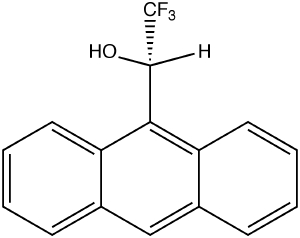
    NCI (non-covalent interactions) is the name of a fascinating new technique for identifying exactly these. Published recently by Johnson, Keinan, Mori-Snchez, Contreras-Garca, Cohen and Yang, it came to my attention at a conference to celebrate the 20th birthday of ELF when Julia Contreras-Garcia talked about the procedure. It is one of those methods which may seem as if it merely teases out the obvious about a molecule, but it is surprising how difficult seeing the obvious can be sometimes. I have blogged about this previously, in discussing the so-called Pirkle reagent. On that occasion, I used the QTAIM technique to identify so-called critical points in the electron density. NCI goes one stage further in identifying surfaces of interaction rather than just single points, the idea being that this focuses attention on regions in molecules which are primarily responsible for binding, stereoselection and other aspects of molecular selectivity.

    The Pirkle reagent
    The Pirkle reagent

    So I was intrigued as to whether the NCI method might find something that my analysis using the QTAIM procedure might have missed. The required program is available for download. I will not go into the theory behind the program, but like AIM, it uses the properties of the electron density via a combination of the first and second derivatives to concentrate on the non-bonded or weakly interacting regions of a molecule.

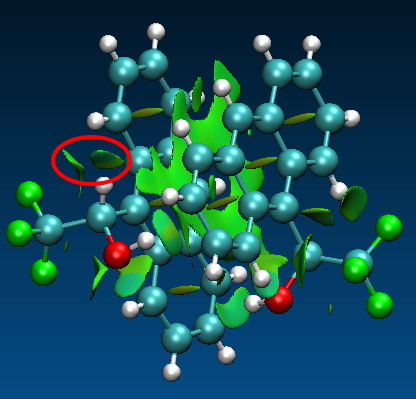
    NCI interactions in the Pirkle reagent

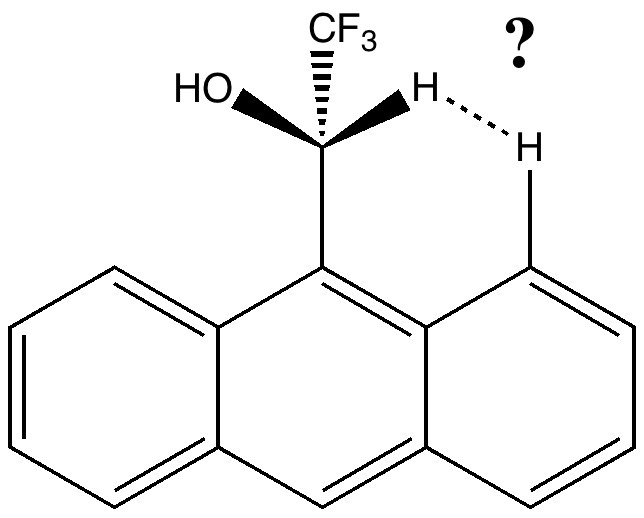
    The results of the analysis (using the SCF option in the program, and a B3LYP/6-31G calculation) are displayed using VMD, and I cannot pull my usual trick of displaying the surface within the page of a blog via Jmol (although it seems Jmol with some effort could probably be persuaded to also render the information). So the above cannot be rotated. I have therefore circled one (there are others) interesting region in red. This encloses two surfaces. I should explain the colour coding adopted by the program. Red would be a repulsive interaction, and blue attractive. Weak interactions are shown in green. In the diagram above, these include the π-π stacking and various hydrogen bonds. But concentrating on the two surfaces inside the red circle, one occurs between the two hydrogens shown below. It catches the eye because there is a blue-tinge to the colour coding! This might mean it is a bit stronger than just “weak”.

    A Weak interaction in the Pirkle reagent

    The NCI method I do not think is meant to provide a definitive answer to the question; is that interaction real/strong? It serves, as I noted earlier, to spike interest. Here, it does that, since this particular interaction had indeed never previously been identified for attention (the obvious had been missed!). Highlighting such potential regions of a molecule and perhaps then helping in the design of experiments to test if the interactions are real is what the NCI program is meant to do (IMHO)!

  • Tunable bonds looked at in a different way

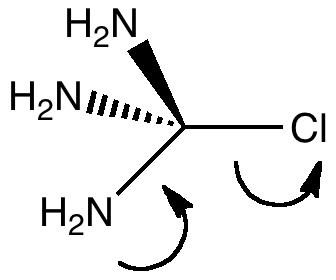
    The title of this post merges those of the two previous ones. The tunable C-Cl bond brought about in the molecule tris(amino)chloromethane by anomeric effects will be probed using the Laplacian of the electronic density.

    Laplacian @0.67 for tris(amino)choromethane. Click for 3D

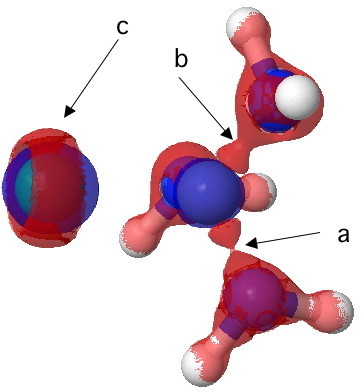
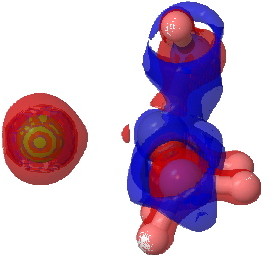
    The figure above shows the Laplacian for a conformation of tris(amino)chloromethane with one of the nitrogen lone pairs antiperiplanar to the C-Cl bond, and the other two lone pairs antiperiplanar to C-N bonds. The features visible at an isosurface of ± 0.67 include

    1. (a) The Laplacian here has a value of -0.67 (= red isosurface), which indicates an accumulation of (covalent) shared density along the C-N bond (underneath this surface, you can see the blue sphere representing depletions from the nitrogen atomic region). This bond has the lone pair antiperiplanar to a C-N bond.
    2. (b) Contrast this with the C-N bond which is antiperiplanar to the C-Cl bond. A greater volume of the covalent C-N region is bounded by this isosurface. More of the N lone pair on this atom is donating into the C-N, as more conventionally represented below.
    3. Notice how the red isosurface associated with the N lone pair and the region associated with the C-N bond are in fact contiguous, and not separated basins!

      Anomeric donation
    4. (c) represents the lone pairs on the chlorine, which have been augmented by the donation from the nitrogen. Notice how they come out as a torus rather than the conventional double dot representations!
    5. Notice the absence of any features along the C-Cl bond! This would be typical of a fully or even partially ionic bond, but it also illustrates that with a property such as the Laplacian, one does not get a complete picture by inspecting at just one isosurface value.

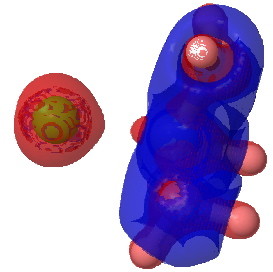
    The next isosurface chosen is 0.3. At this lower value, more depletions (blue = electrophilic regions) are seen and a tiny feature now appears along the C-Cl bond, which is the covalent accumulation of that bond, a feature that grows @ 0.2. This nicely illustrates the variable covalency/ionicity of the C-Cl bond. Notice also how the lhs is all red (anionic) and the rhs is mostly blue (cationic), showing the formation of in effect an ion pair.

    tris(amino)chloroethane @ 0.3

    tris(amino)chloroethane @ 0.2

    There are many other features which can be explored in these Laplacian maps, but I leave those for the reader to indulge in. Just click on any of the diagrams above,and start your exploration.

  • Looking at bonds in a different way: the Laplacian.

    The Cheshire cat in Alice’s Adventures in Wonderland comes and goes at will, and engages Alice with baffling philosophical points. Chemical bonds are a bit like that too. In the previous post, we saw how (some) bonds can be tuned to be strong or weak simply by how a lone pair of electrons elsewhere in the molecule is oriented with respect to the bond. Here I explore another way of looking at bonds. To start, we must introduce a quantity known as ∇2ρ(r), henceforth termed the Laplacian of the electron density ρ(r).

    Firstly, a recipe: obtain a description of the electron density distribution in the molecule; we will call this the wavefunction (and programs such as Gaussian can write this out in something called a wavefunction file, or .wfn). In a cube of space enclosing the molecule, at each point obtain the second derivatives of ρ(r) with respect to the x, the y and the z coordinate of the point, and populate a (3,3) matrix with the values. Diagonalize the matrix, and add the three eigenvalues of the matrix at that point together to get ∇2ρ(r). Repeat this procedure at regular intervals for all the other points in the cube of space (typically ~200 points in each of the three directions). You will end up with a cube of (in this case 8 million) Laplacian values for the molecule.

    Typically (in atomic units), any one value may range from ~-1.0 to ~+1.0, but more meaningful insight is obtained by a (local-virial theorem) expression which relates the Laplacian to a sum of the potential and kinetic energy densities (see. eg here for more detail). A negative Laplacian is dominated by a lowering of the (negative) potential energy at that point in space, whereas a positive Laplacian arises by a domination of the (positive) excess kinetic energy. Measured at the ~mid-point of a (homonuclear) bond, the former indicates an attractive covalent bond, whereas the latter will indicate either an ionic bond or a third type known as charge-shift in which the covalent term (in the valence-bond description of the bond) is repulsive rather than attractive (the actual bond binding energy arises from resonance terms between the covalent and ionic structures). A -ve Laplacian is describing local accumulations or concentrations of (bonding) electron energy densities, whereas a +ve value is describing local depletions. The former can also be used to identify a Lewis base or nucleophilic region, and the latter a Lewis acid or electrophilic region.

    Now that we have a cube of points describing the Laplacian for the molecule, we can look at the surface defined by any particular (positive or negative) value of the function to see what insight, if any, can be obtained. Time for some pictures.

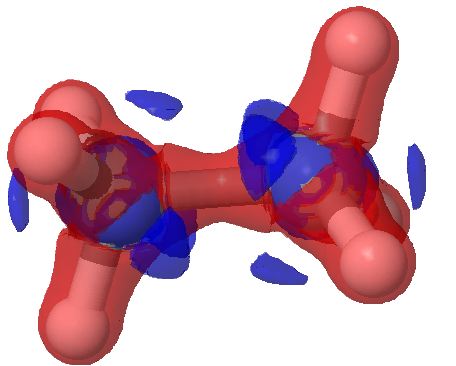
    Ethane. Laplacian isosurface +/- 0.3 Click for 3D

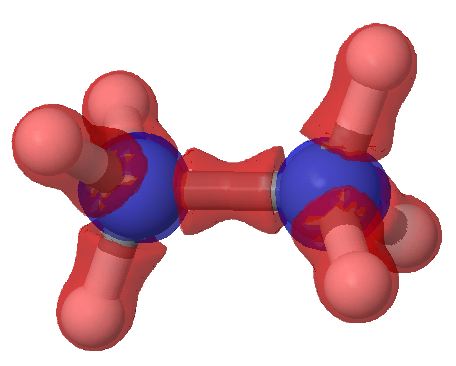
    The above is ethane, contoured at a Laplacian isosurface value of either -0.3 (red surface) or +0.3 (blue surface). Interpreted simply, all seven bonds in this molecule coincide with the red components, which can be taken as typical covalent interactions. The blue spheres represent the valence atomic orbital regions, which have been depleted at the expense of the bond. Nicely intuitive thus far. Let us contour the Laplacian at a rather lower value of +/- 0.2.

    Ethane, Laplacian isosurface +/- 0.2 Click for 3D

    New blue features have appeared which correspond to +ve Laplacian values. Close inspection reveals them to coincide with what we might describe as the anti-bonding regions of each bond (eight in all). They have been named σ-holes.  Indeed, one might reasonably expect a depletion from just those regions in favour of the bonding regions (one might also regard it an electrophilic region, susceptible to eg nucleophilic attack). Well, we could explore both lower and higher values of the Laplacian (for example, a value of either -0.511 or -0.869 happens to have special significance for the C-C or C-H bonds of ethane) but to keep this blog short, I will move on to (and conclude with) benzene, another iconic molecule.

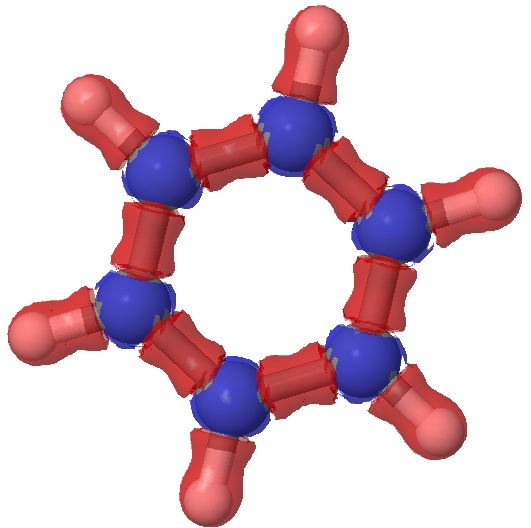
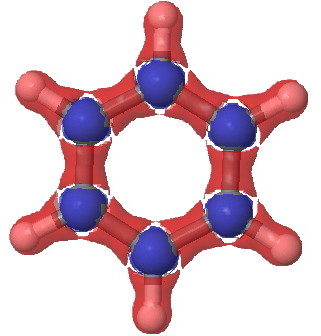
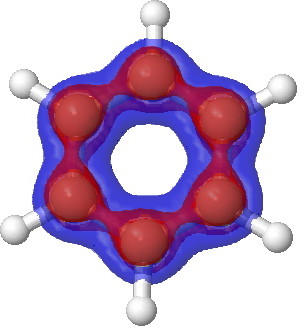
    Benzene. Laplacian isosurface +/- 0.3 Click for 3D
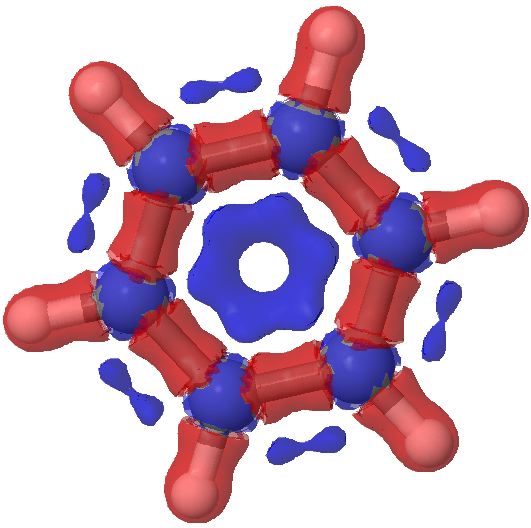
    Benzene. Laplacian isosurface +/- 0.2 Click for 3D

    Again, the +/- 0.3 isosurface has the expected red bonds, and at the lower value, further blue regions (it is tempting, but we really should not call them anti-bonds!) materialize. Look at the central region of the ring, where depletion seems to have happened.

    I close with a musing. Firstly, it is noteworthy that the Laplacian can actually be measured, it is not merely a theoretical concept (although the experiments are in fact pretty difficult, and need very specialised apparatus) but a real observable. Secondly, (at certain values) the Laplacians do seem to recover the simple picture of covalent bonding. The issue really is how far to push the analogy and whether in fact it results in any significant additional insight compared to more conventional ways of representing bonds. At least the pictures are pretty!

    Postscript: One can use  a sub-set of electrons to calculate the Laplacian.  Shown below is benzene calculated for just the σ and π-electrons.

    Benzene, σ-manifold
    Benzene. π-manifold

    Notice how the σ set does not differ much from the total set, but the π-set shows accumulation above and below the plane, at the expense of depletion in the plane (one must be aware that integration of the  Laplacian over all space should yield the value of zero). This explains the unusual features of the total set at the  0.2 theshold above.