Blog

  • Tunable bonds

    Car transmissions come in two types, ones with fixed ratio gears, and ones which are continuously variable. When it comes to chemical bonds, we tend to think of them as being very much of the first type. Bonds come in fixed ratios; single, aromatic, double, triple, etc. OK, they do vary, but the variations are assumed as small perturbations on the basic form. Take for example the molecule shown below. The bonds as shown are all clearly single (the wedge and hashed bond are merely stereochemical notations). No-one would really think of drawing this molecule in any other way, and this idea of the transferability of bonds between molecules (all double bonds react in specific ways which are different from single bonds, and they also have characteristic spectroscopic properties, etc) is what allows molecules to be classified.
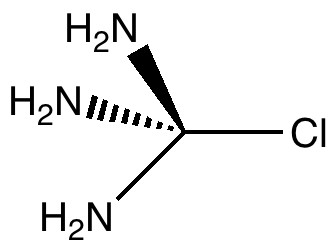
    A Highly tunable molecule

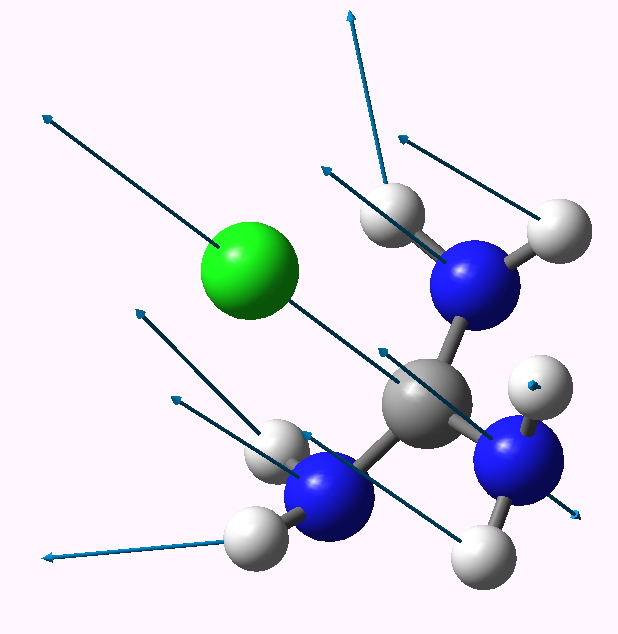
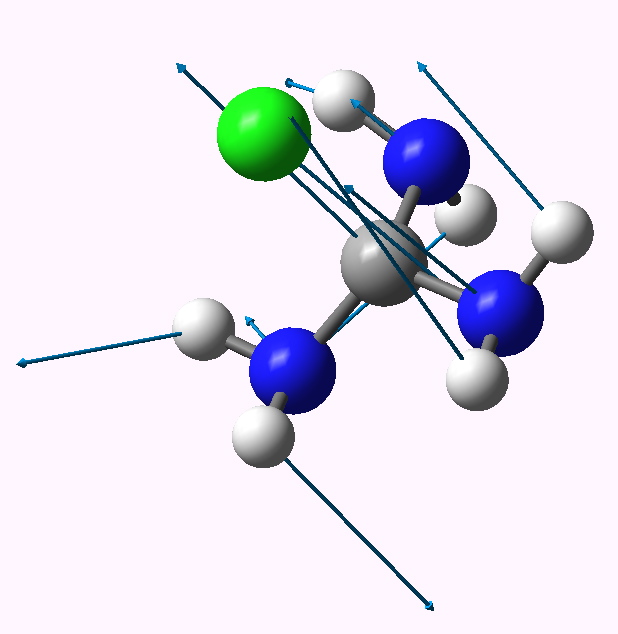
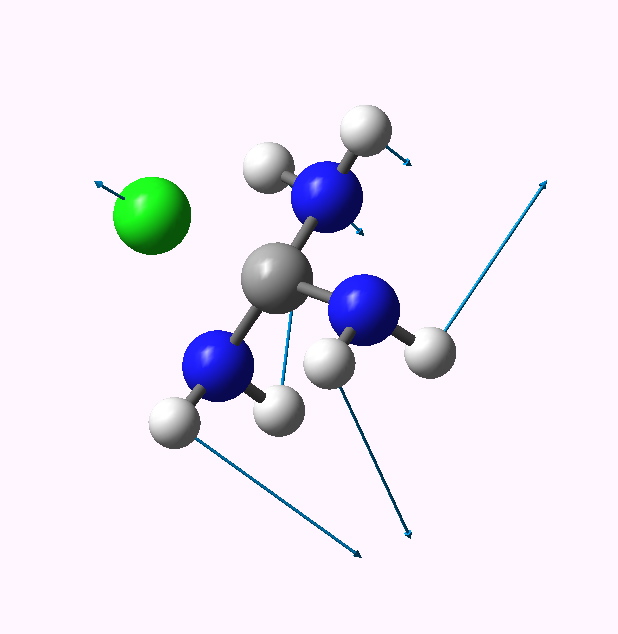
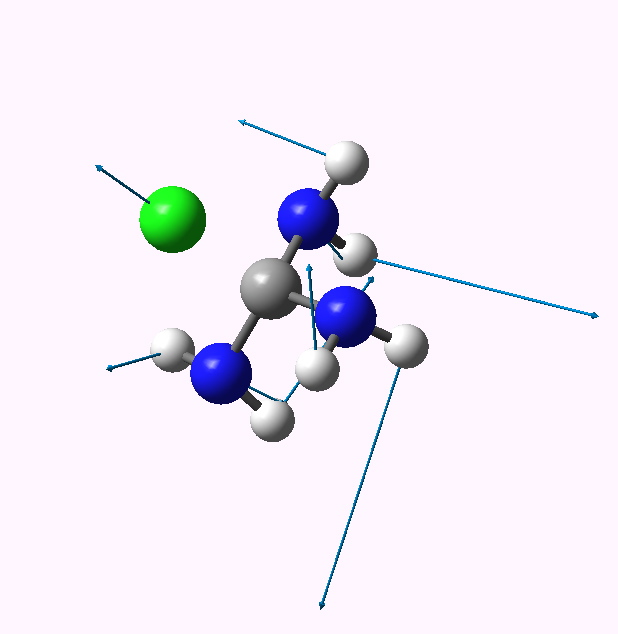
    With this molecule however, there really is an elephant in the room; the three electron lone pairs associated with each nitrogen atom (not shown above, but most chemists are trained to recognize their implicit presence). Where are they? Well, each lone pair will tend to orient itself such that it is aligned with an adjacent σ-bond. It has two such bonds to choose from, an adjacent C-N bond or a C-Cl bond. One might now envisage the following permuations; all three N lone pairs gang-up on the C-Cl bond, or perhaps only two do, or only one, or none. What happens in each of these scenarios? The table below shows these permutations calculated using B3LYP/6-31G(d).

    app lone pairs
    to C-Cl
    Relative free
    energy, kcal/mol
    C-Cl bond
    length, Å
    ν C-Cl, cm-1
    3 0.0 2.542 158
    2 4.2 2.099 221
    1 7.3 1.937 352
    0 14.4 1.869 441

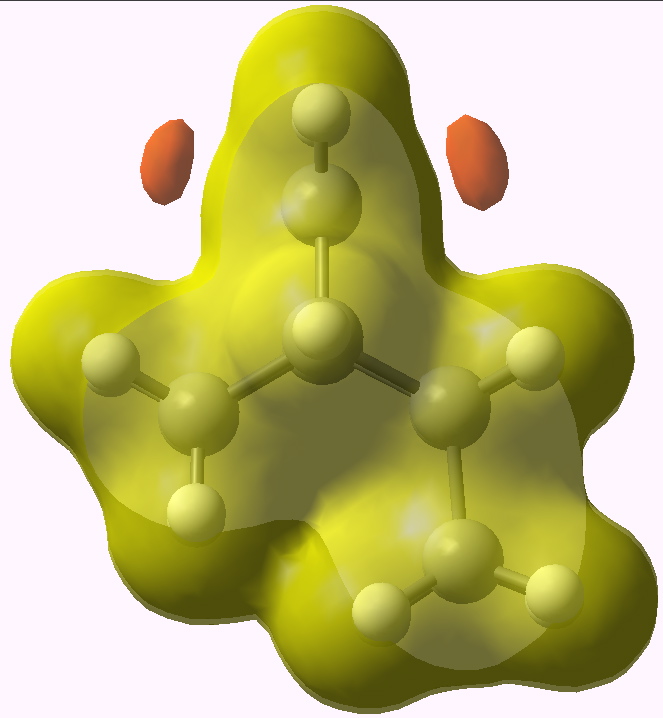
    3 app lone pairs. Click for animation

    2 app lone pairs. Click for animation

    1 app lone pairs. Click for animation

    0 app lone pairs. Click for animation

    The C-Cl bond length changes from a normal single bond length (1.87Å) when none of the nitrogen lone pairs are antiperiplanar to the C-Cl bond, to a very abnormal 2.54Å when all three are, and the C-Cl stretching mode decreases in wavenumber from 441 to 158 cm-1. There is lots of other fun to be had inspecting the geometries and vibrations, but  I will leave that for you to explore rather than discuss it here. Click on the thumbnails above to start.

    This effect does have a name, sugar chemists call it the anomeric effect. But this one is supercharged! It would be quite reasonable to say that at some stage, the C-Cl single bond turns from being covalent to being ionic (and indeed, repeating the calculation using an applied solvent field certainly accelerates this process). Whilst this might be a contrived example and hence an extreme example, it does serve to remind us that on occasion, molecules may come with continuously variable transmissions rather than with fixed ratio gears!

    And a postscript. I mentioned the nitrogen lone pairs ganging up on the C-Cl bond. How might one go even one step further? A standard trick to enhance the donating power of a nitrogen lone pair is to replace the NH2 group with a hydrazine group, H2N-NH. The lone pair derived from the second nitrogen buttresses the first. This too has a name, it is called the α-effect.
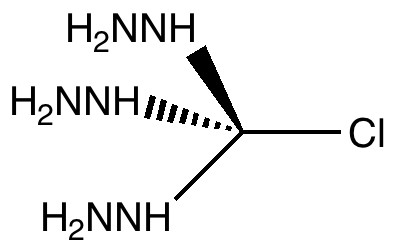
    An anomeric effect on steroids

    For this example (see digital repository), the C-Cl bond length lengthens even further to 2.90Å, which interestingly, is the same value as for the SN1 transition state!
  • The mysteries of stereoinduction.

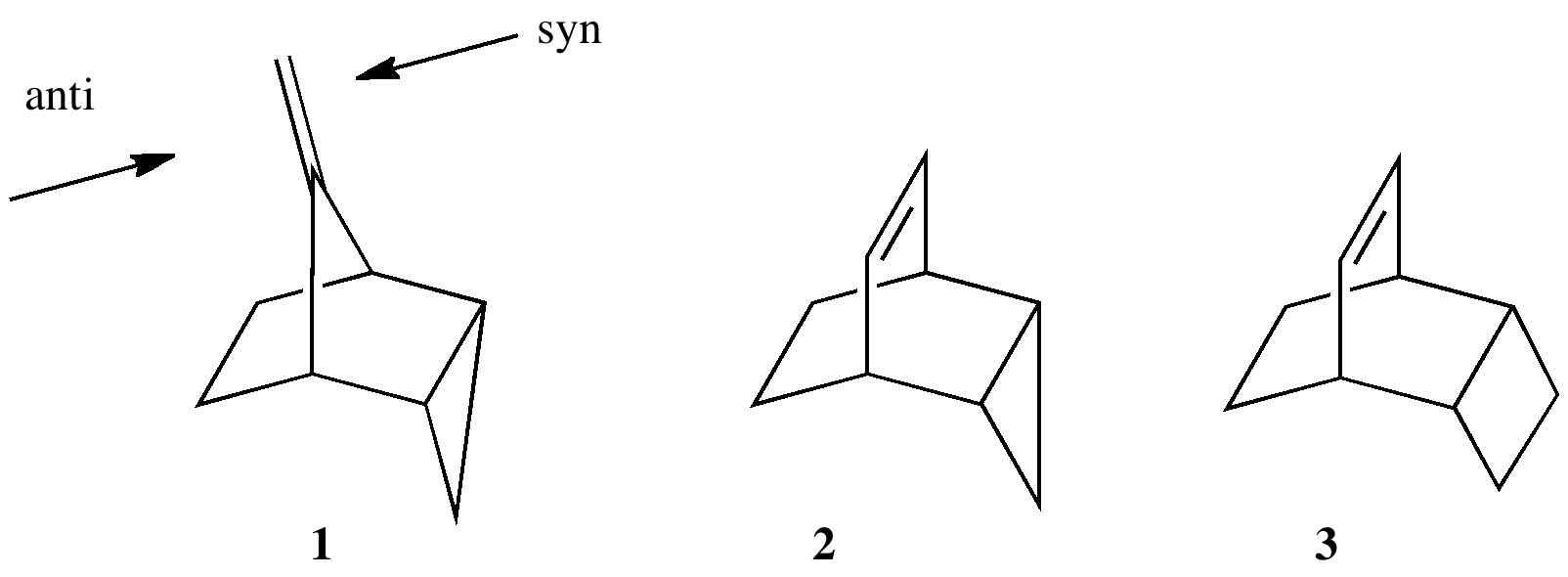
    Stereo-induction is, lets face it, a subtle phenomenon. The ratio of two stereoisomers formed in a reaction can be detected very accurately by experiment, and when converted to a free energy difference using ΔG = -RT Ln K, this can amount to quite a small value (between 0.5 – 1.5 kcal/mol). Can modelling reproduce effects originating from such small energy differences? Well one system that has been argued about now for several decades is shown below as 1.

    Norbornene systems

    Way back in 1992, we thought that the explanation for attack by an electrophile on the alkene from the syn face was electrostatic (although it did depend on the nature of the electropile; thus we concluded that attack by Hg(OH)2 was electrostatic, but by BH3 was orbital controlled). Recently, a different explanation has emerged, relating to how the fundamental normal vibrational modes of the molecule interact with the transition normal mode for the reaction. A new example of this, relating to reaction of the isomeric 2 with a peracid has recently been discussed on Steve Bachrach’s blog. Here, the peroxide of the peracid is thought to act as an electrophile (although one must bear in mind that it does bear two electron lone pairs!). The conclusion was pretty clear cut; the experimental preference for syn (92%) over the anti isomer (8%, ΔΔG = 1.4 kcal/mol) was NOT due to electrostatic effects, but due to distorsional asymmetry in the vibrational mode that couples/forms the transition state mode.

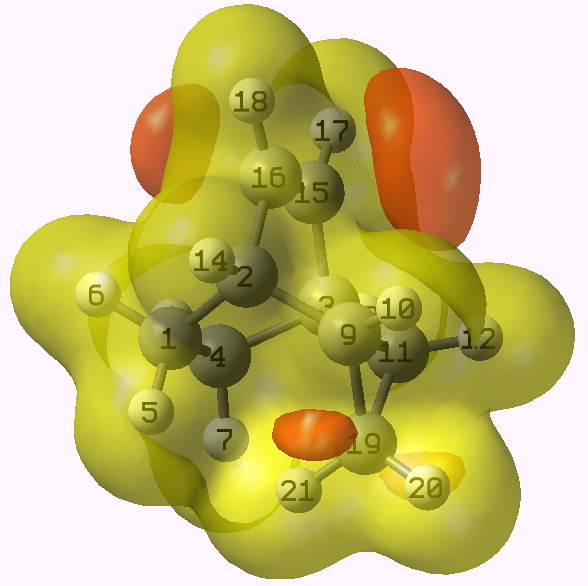
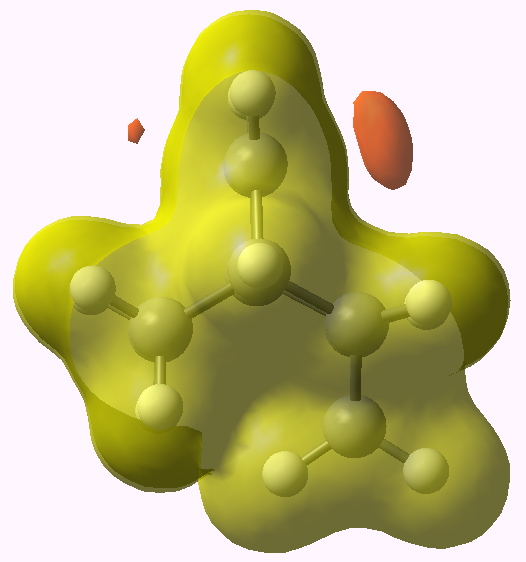
    I could not resist revisiting this system. As in 1992, a molecular electrostatic potential was calculated for 2. The method used was wB97XD/aug-cc-pvdz, and if you want the archive of this calculation to evaluate it yourself, see here).

    MEP for 2. Click on diagram for 3D.
    A very clear electrostatic bias for syn attack emerges (orange = attractive to a proton=electrophile). This electrostatic picture is not directly related to any distortional asymmetry, although of course both could arise from the same electronic factors. They may indeed be different manifestations of the same underlying nature of the wavefunction. But I would claim here that to make the clear statement that electrostatic effects are NOT responsible for the discrimination in this reaction is perhaps too simplistic (electrostatic potentials were not reported in the original article). The control experiment is 3, which is known to be far less selective. The calculated electrostatic potential likewise shows much less discrimination.

    The norbornene with a four-membered ring
    Is there another take on 2? Well, how about an NBO (natural bond order) analysis? The interaction energy between the filled C1-C2 orbital and the antibonding C15-C16 π* bond is 3.24. This could be regarded as pushing electrons into the anti-periplanar syn face of the alkene. The corresponding C2-C9/C15-C16 interaction resulting in an anti-preference is less at 2.55 kcal/mol. This effect arises because the C1-C2 bond (localised as an NBO) is a better donor (E=-17.8eV) than C2-C9 (E=-18.1eV). Because C2 is common to both, it must be the difference between C1 and C9 (i.e. the hybridization of each). Perhaps it’s an orbital effect after all?

    Norbornene electrostatic potential

    I would conclude by saying that it can be ferociously difficult to identify the fundamental origins of stereo-induction. But I leave the argument in the hands of the reader now. What do you think?

  • Chemistry with a super-twist: A molecular trefoil knot, part 2.

    A conjugated, (apparently) aromatic molecular trefoil might be expected to have some unusual, if not extreme properties. Here some of these are explored.

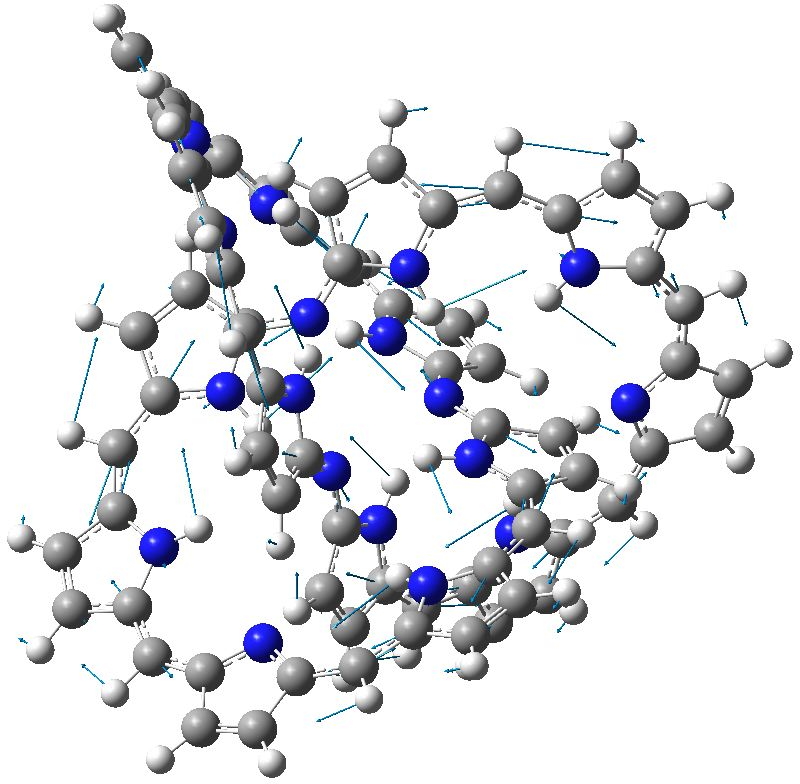
    1. The first is the vibrational spectrum. With 144 atoms for this molecule, it has 426 vibrational modes, but one is highlighted below. This is the mode that moves the atoms in accord with the Kekulé resonance. If real, this mode resists such alternation. The mode has a value of ~ 1310 cm-1 for benzene, although this is accepted as being lower than expected due to the phenomenon of π-distortivity (DOI: 10.1039/b911817a and also this post). The mode shown below has the value of 1650 cm-1, which is a good deal higher than for benzene. The significant coupling of the CH wagging motions with the C-C/C-N stretching (Duschinsky coupling) makes the interpretation more complex (it also occurs for benzene itself), but the Kekulé mode (there are in fact several) is surprisingly large for so many π-electrons. Perhaps the large degree of writhe noted in the previous post might have something to do with it?
      Molecular trefoil: the Kekulé mode for bond alternation. Click for animation.
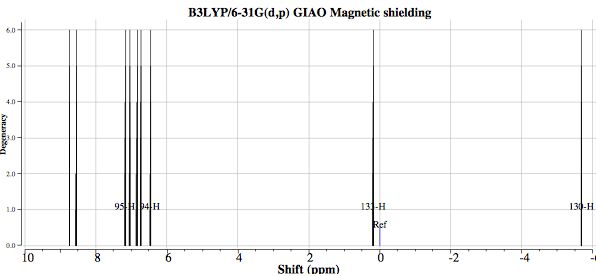
    2. The NICS (nucleus independent chemical shift) at the centroid of the trefoil is -16.4 ppm. This is clearly an aromatic value, and confirms our inference that the system is a 4n+2 aromatic molecule. In this example, the aromaticity is not only three-dimensional, but helical as well. The predicted 1H NMR spectrum (below) shows three regions. The upfield region (~ -5 ppm) corresponds to protons pointing directly inwards to the centre, whilst the lowfield region (~ 8ppm) corresponds to protons at the outside edge.

      Predicted 1H NMR spectrum
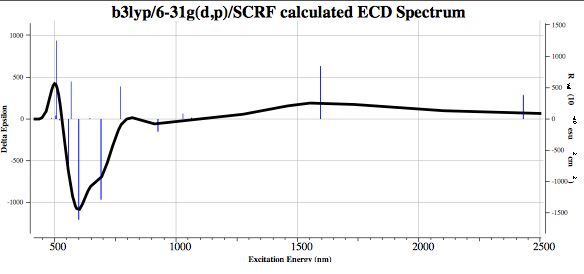
    3. Shown below is the calculated electronic circular dichroism (ECD) spectrum. It shows a large Cotton effect due to the chiral nature of the trefoil. The electronic transitions extend beyond ~1500nm, approaching the near infra-red. The phase of the Cotton effect at ~600nm calculated for the chiral isomer shown in the 3D model above would certainly suffice to assign the absolute configuration of the system should the experimental spectrum be measurable.
      Calculated Electronic circular dichroism spectrum for the base trefoil.

      The spectrum above shows maximum absorption at ~600nm, which means optical rotation at the sodium D-line (589 nm) cannot be measured (light has to get through to measure its rotation). However, the region of 880nm (the highest value available on commercial spectrometers) is reasonably transparent for such measurement. Calculations may not be much help, since the linear CPHF equations appear unstable. Thus [α]880 shows an enormous dependence on the precise DFT method chosen to compute it (~ +8763°@CAM-B3LYP but the very different -59898°@B3LYP).


    Henry Rzepa. Chemistry with a super-twist: A molecular trefoil knot, part 2.. . 2010-06-02. URL:http://www.ch.ic.ac.uk/rzepa/blog/?p=2084. Accessed: 2010-06-02. (Archived by WebCite® at http://www.webcitation.org/5qC4NiFsM)


  • Chemistry with a super-twist: A molecular trefoil knot, part 1.

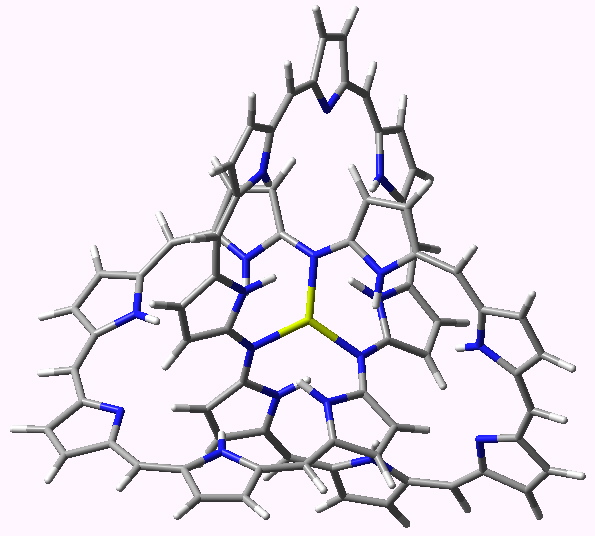
    Something important happened in chemistry for the first time about 100 years ago. A molecule was built (nowadays we would say synthesized) specifically for the purpose of investigating a theory. It was cyclo-octatetraene or (CH)8, and it was made by Willstätter and Waser[cite]10.1002/cber.191104403216[/cite] to try to find out if benzene, (CH)6, was an aromatic one-off or whether it might be a member of a series, envisaged as (CH)n. Of course, a hell of a surprise was in store for Willstätter and Waser[cite]10.1002/cber.191104403216[/cite]! Prior to this synthesis, (CH)8 had never existed; nature had not gotten there first. In that sense, chemistry became much like mathematics had before it; it was OK to make molecules because they might be interesting, and for the purpose of investigating possible patterns in nature. So it is in this spirit that I suggest an interesting molecule here. It is a molecular trefoil, constructed by joining 15 pyrrole units together into a ring with appropriate linkers and in effect tying a knot in that ring. A trefoil knot to be specific.

    A molecular trefoil knot, shown with a Mg at the centre. Click to view in 3D

    Why might such a molecule be interesting? These are ten reasons:

    1. It would make an interesting ligand for a metal
    2. It has lots of interesting groves and dimples for transition states to nest in
    3. It would be an extended porphyrin (a pentadecaphyrin to be precise). Nature likes to make molecules out of tetraphyrins (chlorophyll, haemoglobin, etc), and so we are pushing beyond nature’s own boundaries. Both a penta and a hexadecaphyrin have already been made[cite]10.1002/chem.200701909[/cite],[cite]10.1002/chem.200701909[/cite],[cite]10.1021/ja005588o[/cite]
    4. The trefoil knot is a most interesting object in a branch of mathematics called knot theory, and it is also related to another fascinating object, the Möbius band.
    5. The pyrrole units in such a molecule are conjugated via the π-system, and the molecule above is potentially fully conjugated across its entire length. This could make it aromatic, and hence it is interesting for the same reason that Willstätter[cite]10.1002/cber.191104403216[/cite] found cyclo-octatetraene so.
    6. The system above, if carefully counted, would have 74 π-electrons in cyclic conjugation. This would make it a 4n+2 aromatic (n=18), just like benzene, but not at all like (CH)8 (which as Willstätter and Wases[cite]10.1002/cber.191104403216[/cite] found, is not aromatic).
    7. It seems highly twisted. Indeed the title of this post is super-twisted. But is it really? We learn from topology that twist is not the only property that cyclic bands or strips can have. They can also exhibit writhe. So is it writhed as well as twisted?
    8. Aromatic molecules have one rather mysterious behaviour. The ring bonds in in such systems resemble neither double nor single bonds, but aromatic bonds, and in this they have a length intermediate between the single and the double, and this applies to all of the bonds. The origins of this delocalization continue to provoke controversy (see this post). Thus it is thought that only (planar) carbon rings with around 26 or less π-electrons can exhibit such equal lengths (boron rings can apparently go much further.[cite]10.1039/B911817A[/cite]. More than that, and distortion sets in which makes the lengths alternate. The molecule above has 74 π-electrons. What will its bonds do, and is what they do related to the twist (or the writhe) of the system?
    9. The trefoil is chiral. It cannot be superimposed upon its mirror image. But how chiral (whatever that means)?
    10. The system has many design handles, including the number of pyrrole (or thiophene) units, the number of N-H vs =N motifs, and the scope for templating using a metal cation (Mg in the example above).

    So what might be the properties of our trefoil knot? I am going to list only two here.

    1. A theorem emerged from mathematics in the 1970s known as the White, Cãlugãreanu, Fuller Theorem. It defines the topological properties of bands in terms of a quantity known as the linking number (Lk). The theorem states that: Lk = Tw + Wr, where Lk is an integer, being the sum of two properties Tw (the total twist of the band) and Wr (the total writhe of the band). This theory was recently extended to the analysis of twisted conjugated molecular rings[cite]10.1021/ja710438j[/cite], for which Lk adopts integer values (in units of π). Thus a conjugated Möbius π-cycle has a value Lk = 1π (specifically when describing the band formed by the π-electrons). Most of this value is composed of twist rather than writhe. What of our molecule? Well, it has Lk =6π, and this comprises Tw = ~-0.8π and Wr ~+6.8π (yes the two can be either positive or negative, and do not have to be the same sign). The surprise is that it is (overall) hardly twisted! The knot is composed almost entirely of writhe. So much for the title of this post!
    2. What about the bond lengths? The best way of analyzing these[cite]10.1021/ol703129z[/cite] is to compare pairs of so-called meso-bonds, being the coupler unit connecting any two pyrrole rings. Around the cycle, all the C-C meso-pairs are ~1.4Å and the C-N pairs are both ~1.34Å. That characteristic of benzene, in having all its (C-C) bonds equal, seems true here as well (at least at the B3LYP/6-311G(d,p) level, see e.g.10042/to-2109. There are reasons for thinking that in fact the B3LYP method does predict this behaviour more or less realistically). By the way, a molecule with a π-linking number of six is indeed classified by the same selection rule as benzene, ie 4n+2 (odd numbers of  Lk are governed by a 4n rule instead).[cite]10.1016/j.comptc.2014.09.028[/cite]

    It is tempting to conclude that perhaps the extended conjugation of this molecule (shown by the bond length equality) is somehow connected to the dominance of writhe over twist in this trefoil.

    I will follow this post up with another relating to the predicted chiro-optical properties. For now, I leave its synthesis to be contemplated by a present day Willstätter or Waser.


    Webcite archive:. Chemistry with a super-twist: A molecular trefoil knot, part 1. . 2010-06-01. URL:http://www.ch.ic.ac.uk/rzepa/blog/?p=2046. Accessed: 2010-06-01. (Archived by WebCite® at http://www.webcitation.org/5qA81X8qW)

  • Anatomy of an asymmetric reaction. The Strecker synthesis, part 2.

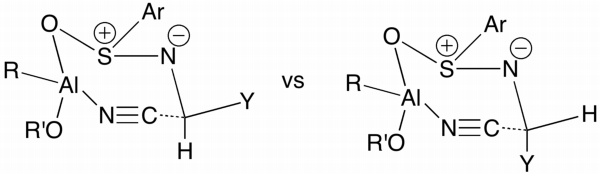
    In the first part of the post on this topic, I described how an asymmetric sulfoxide could be prepared as a pure enantiomer using a chiral oxygen transfer reagent. In the second part, we now need to deliver a different group, cyano, to a specific face of the previously prepared sulfoxide-imine. The sulfoxide is now acting as a chiral auxilliary, and helps direct the delivery of the cyanide group to specifically one face of the imine rather than the other. After removal of the aluminum carrier for the cyano group and hydrolysis of the cyano group to a carboxylic acid group, we end up with an enantiomerically pure amino acid.

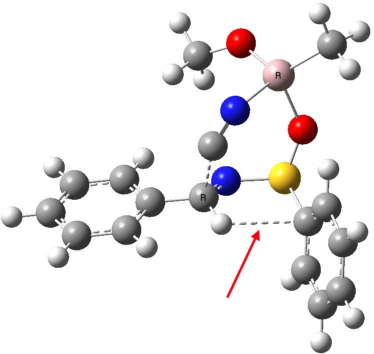
    The Strecker synthsis: asymmetric delivery of cyanide anion. Click for 3D model of transition state
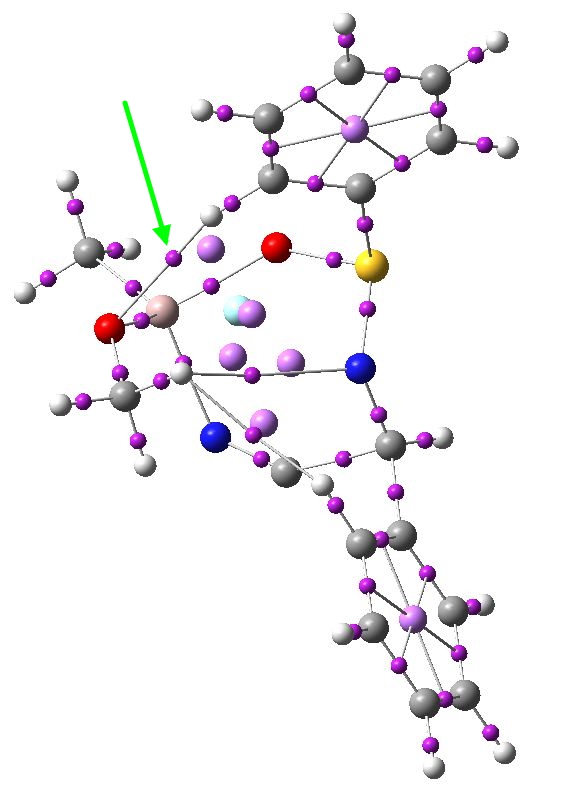
    Two transition states can be computed (ωB97XD/6-311G(d,p)/SCRF[dichloromethane], see DOI 10042/to-4927) and the S,S(S) diastereomer is found to be  1.35 kcal/mol lower in total free energy than the R,S(S) isomer. This agrees with the observed specificity. Again, a reason for the specificity needs identifying, and again we use  AIM.

    AIM analysis for the asymmetric delivery of cyanide to an imine, S,S(S) form.
    In the favoured diastereomer, a BCP or bond-critical-point (green arrow above) can be found connecting a hydrogen from an aryl group to the oxygen of the Al-OMe group  via a weak hydrogen bond (H…O distance 2.25Å). In the disfavoured form, this interaction vanishes, and is instead replaced by a repulsive close N=CH…C-aryl contact of 2.49Å (for which there is no  BCP, red arrow below).

    Disfavoured transition state. R,S(S) form.

    The take home message from these two posts is that quite unusual interactions may often be responsible for asymmetric induction in a stereospecific reaction, and that helpful clues to these interactions may well be derived from an AIM analysis. Indeed, anyone doing stereospecific synthesis in the lab should be familiar with these methods! You have to be a jack-of-all-trades nowadays to keep up!

  • Anatomy of an asymmetric reaction. The Strecker synthesis, part 1.

    The assembly of a molecule for a purpose has developed into an art form, one arguably (chemists always argue) that is approaching its 100th birthday (DOI: 10.1002/cber.191104403216) celebrating Willstätter’s report of the synthesis of cyclo-octatetraene. Most would agree it reached its most famous achievement with Woodward’s synthesis of quinine (DOI: 10.1021/ja01221a051) in 1944. To start with, the art was in knowing how and in which order to join up all the bonds of a target. The first synthesis in which (relative) stereocontrol of those bonds was the primary objective was reported in 1951 (10.1021/ja01098a039). The art can be taken one step further. It involves control of the absolute stereochemistry, involving making one enantiomer specifically (rather than the mirror image, which of course has the same relative stereochemistry). Nowadays, a synthesis is considered flawed if the enantiomeric excess (of the desired vs the undesired isomer) of such a synthesis does not achieve at least ~98%. It is routine. But ask the people who design such syntheses if they know exactly the reasons why their reaction has succeeded, you may get a less precise answer (or just a lot of handwaving; chemists also like to wave their hands as well as argue).

    Here I set out one such asymmetrically stereospecific scheme, which is the first part of a reaction used to make both natural and un-natural configurations of aminoacids; the Strecker synthesis.

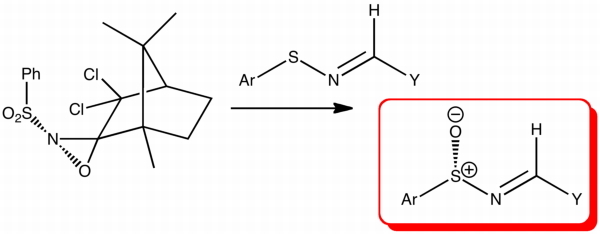
    The asymmetric synthesis of an S(S) sulfoxide. Click for 3D model

    It makes use of a natural product based on the camphor ring system which nature provides as a single enantiomer. It is converted to an oxaziridine, and this reagent is now used to transfer one oxygen atom to an imino-thioether (DOI: 10.1021/ja00030a045). The result is the formation of a single S(S) enantiomer (the enantiomeric excess is > 98%) of a sulfoxide. In the second stage, cyanide is then delivered asymmetrically (i.e. to one face rather than the other) of the C=N group, the precursor to forming a pure enantiomer of an amino acid. Here we will probe why the first reaction, the asymmetric oxygen atom delivery, is so specific. It would be fair to say that this reaction was probably originally designed with no fundamental understanding of how it might achieve its magic asymmetric delivery. For example, those two chlorine atoms on the camphor ring look as if they were selected by trial-and-error. What indeed IS their role? Steric? Electronic? Other?

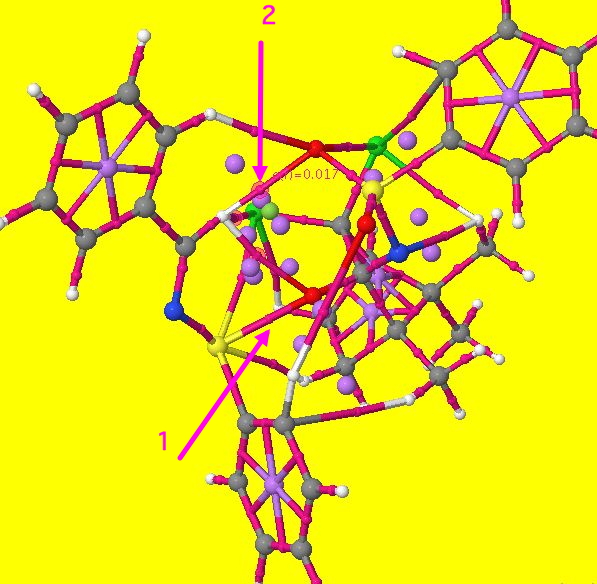
    If you click on the diagram above, a rotatable 3D model should appear (a static version is shown below). This is an AIM (atoms-in-molecules) analysis of the curvature of the electron density in this transition state (see DOI: 10042/to-4929). To help you navigate, arrow 1 is pointing to the small purple sphere representing the BCP (bond critical point) for the forming S…O bond. Three more purple spheres are highlighted with a halo. One of these is pointed to by arrow 2 below (to see the other two, you really will need the 3D model). This represents a BCP which appears between the hydrogen of the N=CH group and one of the oxygen atoms of the sulphone group. The label indicates the electron density at that point (0.017 au). This is characteristic of a hydrogen bond, albeit an unusual C-H…O type (a type that is too rarely invoked when explanations of stereospecificity are sought), and the density indicates its a reasonably strong one!

    AIM analysis of Transition state for oxygen transfer

    In fact, two more BCPs can be located between this H and other groups, and they too are marked with halos. The first leads to the oxygen atom being transferred, and the second to specifically one of the two chlorine atoms (there are other interactions to the chlorines as well). Now, it turns out that these interactions are largely absent for the alternative transition state (which would form the enantiomeric R(S) sulfoxide). Since a C-H…O hydrogen bond can easily be worth ~2 kcal/mol, it is no surprise to find that the energy of the favoured transition state is overall 2.4 kcal/mol lower in free energy compared to the isomer not formed. This represents (@300K) a ratio of 60:1 in the predicted ratio of the two species, or indeed an ee ~98%.

    Armed with this insight, one could design further experiments to test the hypothesis. For example, it appears only one of the two chlorines plays an active role. Replacing the passive chlorine with e.g. hydrogen might make little difference. Suppressing the hydrogen bonds by changing the N=CH to e.g. N=CF should have a big effect. The two oxygens of the sulfone also do not play equal roles. Perhaps this can be tested with a sulfoxide in place of the sulfone? All these hypotheses can of course first be tested with calculations. Of course, coming up with synthetic strategies for these new molecules might be tricky. But these experiments may give confidence (or demolish it) in the AIM technique used here to analyse the stereospecificity of this reaction.

    So the next time you hear a synthetic chemist proudly announce a new enantioselective synthesis, ask them what their deeper understanding of why their reaction works is. And be prepared to run away fast if they growl at you!

  • A Digital chemical repository – is it being used?

    In this previous blog post I wrote about one way in which we have enhanced the journal article. Associated with that enhancement, and also sprinkled liberally throughout this blog, are links to a Digital Repository (if you want to read all about it, see DOI: 10.1021/ci7004737). It is a fairly specific repository for chemistry, with about 5000 entries. These are mostly the results of quantum mechanical calculations on molecules (together with a much smaller number of spectra, crystal structure and general document depositions). Today, with some help (thanks Matt!), I decided to take a look at how much use the repository was receiving.

    1. The first entry in the log dates from 2008-02-05.
    2. The repository is now receiving about 1200 accesses via handle resolutions each day, which comprises
    3. ~150 unique client IPs, and
    4. ~900 unique handles accessed daily

    Whilst most of the hits are coming from web spiders by auto-discovery, a fair number (perhaps ~300) of the 5000 entries have also been linked to via journal articles, and of course this blog, and some hits may be presumed to be the result of non-random ping-backs. A breakdown of a typical day (2010-02-10) when 839 unique handles were accessed shows access by, amongst others, five universities, Google/Yahoo, several other information corporations and Microsoft. I had no idea Microsoft was interested in calculations on molecules! You saw that here first!!

    Other anecdotal feedback regarding the repository: I often use it to exchange calculations with collaborators, sending them the handle instead of a vast checkpoint or log file. Some collaborators, it has to be said are baffled by the interface presented to them (which was designed in large measure by DSpace, not by us).

    It is early days in many ways, and being pretty much the only standards-compliant digital repository operating in chemistry in this manner means that awareness is still low. If anyone reading this blog knows of significant others, please comment.

  • Semantically rich molecules

    Peter Murray-Rust in his blog asks for examples of the Scientific Semantic Web, a topic we have both been banging on about for ten years or more (DOI: 10.1021/ci000406v). What we are seeking of course is an example of how scientific connections have been made using inference logic from semantically rich statements to be found on the Web (ideally connections that might not have previously been spotted by humans, and lie overlooked and unloved in the scientific literature). Its a tough cookie, and I look forward to the examples that Peter identifies. Meanwhile, I thought I might share here a semantically rich molecule. OK, I identified this as such not by using the Web, but as someone who is in the process of delivering an undergraduate lecture course on the topic of conformational analysis. This course takes the form of presenting a set of rules or principles which relate to the conformations of molecules, and which themselves derive from quantum mechanics, and then illustrating them with selected annotated examples. To do this, a great many semantic connections have to be made, and in the current state of play, only a human can really hope to make most of these. We really look to the semantic web as it currently is to perhaps spot a few connections that might have been overlooked in this process. So, below is a molecule, and I have made a few semantic connections for it (but have not actually fully formalised them in this blog; that is a different topic I might return to at some time). I feel in my bones that more connections could be made, and offer the molecule here as the fuse!

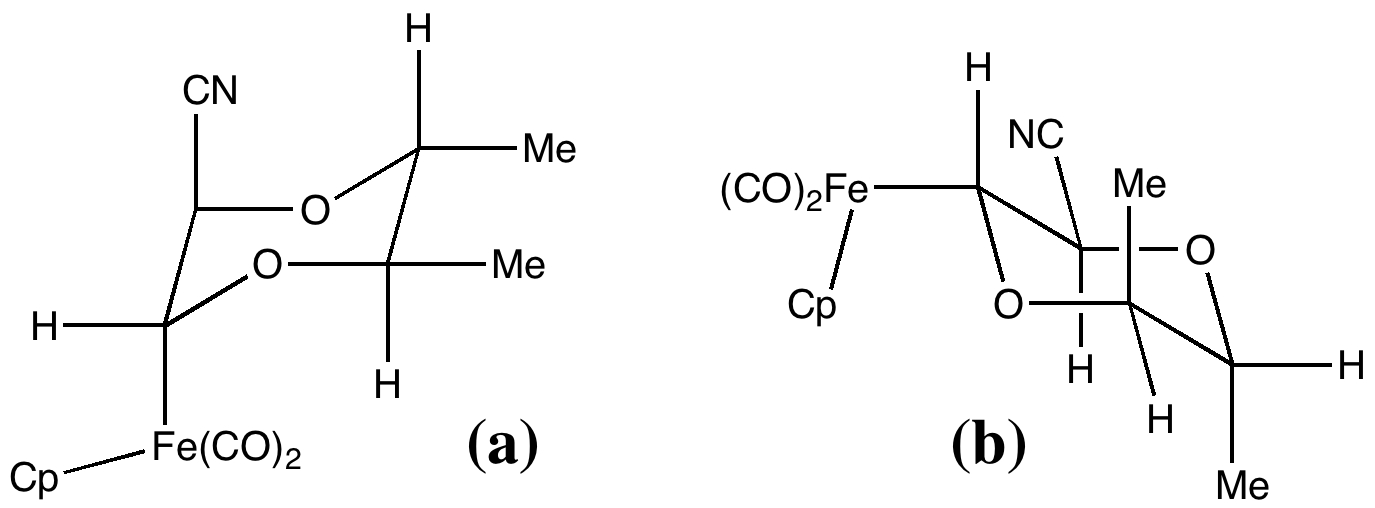
    Two chair conformations of the molecule DULSAE. Click here for 3D. Note the (attractive) short H…H contacts.

    To list all the likely semantics that a chemist would perceive in the graphic above would take far too long (by the time one would have finished, a text book would have been written). So here is a very very short summary in the context of conformational analysis.

    1. The molecule has a six membered ring as its backbone
    2. which can adopt two possible chair conformations
    3. which can interconvert by exchanging the axial and equatorial group pair for each of the four carbon atoms in the ring.
    4. An organic chemist will immediately notice a very unusual group, Fe(CO)2Cp, which itself is a semantic goldmine,
    5. but for the purposes here we will regard merely as a C-Fe bond!

    The (semantic) question to be posed is “which of the two conformations shown above is the most stable“? That too of course has an abundance of implicit semantics, but most human chemists will probably know that this refers to asking which of the two geometries represents the lowest thermodynamic free energy (and we leave aside the issue of what medium the molecule is in, i.e. solid, solution or gas). A far trickier question is “why”?

    So to (some interim) answers. Well, a ωB97XD/6-311G(d) calculation (wow, think of what is implied in that concise notation) predicts conformation (a) to be more stable by 2.3 kcal/mol (2.1 in ΔG, see DOI: 10042/to-4911). Now to the why. What connections would someone well versed in conformation analysis spot?

    1. The molecule has two methyl groups on adjacent atoms. They may prefer to be di-axial rather than di-equatorial to avoid excessive steric repulsions (whatever we mean by that!). That might prefer (b).
    2. The molecule has one carbon with both a cyano and an ether linkage. Well, that is susceptible to an anomeric effect (although, as I pointed out in an earlier post here, this connection has in fact often NOT been made in the literature). Only in conformation (a) is one of the oxygen lone pairs aligned anti-periplanar to the axis of the C-CN bond. The reasons why this is important are outlined in my Lecture course.
    3. Having spotted the last, the human might ask whether there is any possibility of an anomeric effect between an oxygen lone pair and the axis of the C-Fe bond? Well, I rather think that not a single human ever has asked that question! (I cannot know that of course, and perhaps someone has speculated upon this in the literature; this is where a full semantic web would help. That question could be posed of it! The reason  I suspect the connection might not have been made is that the anomeric effect is the domain of the organic chemistry, and  C-Fe bonds are those of the organometallic chemist. They do tend to see the chemical world rather differently, these two groups of chemists). If there was such an effect, it would favour (a).
    4. Then we have an X-C-C-Y motif. Depending on the nature of X and Y, the molecule might actually prefer a gauche conformation, i.e the dihedral angle XCCY would be around 60°. There are several such motifs one can detect; X=Y=O (twice). It might be that other permutations such as X=CN, Y=Fe(CO)2Cp, favour anti-periplanar. There are other permutations whose orientational preference may not even be recorded (in text books). Suddenly its gotten complicated!
    5. There are a number of short (~2.4Å) H…H contacts
    6. We are starting to understand that to unravel the conformation of this molecule, one may have to identify quite a number of different “rules”, and then to quantify each, and add up the numbers to get the final result. That energy of 2.3 kcal/mol may be composed of the result of applying quite a number of different rules. Hence the title of this post, a semantically rich molecule!

    Well, I will leave it here for this post, without giving answers to the six points listed above, or really answering my main question posed above. That would make the post too complex (but I will follow this up!). I do want to end by planting the idea that answering this question involves making a great many chemical connections about the properties of this molecule, and then identifying quantitative ways (algorithms) in which an answer can be formulated. The molecule above is presented as a challenge for the Semantic Web to address!

  • WebCite and Jmol

    Since I have gotten into the habit of quoting some of my posts in other contexts, I have started to also archive them using WebCite. One can quote the resulting archive as:

    Rzepa, Henry. Quintuple bonds.  2010-04-18. URL:http://www.ch.ic.ac.uk/rzepa/blog/?p=1722. Accessed: 2010-04-18. (Archived by WebCite® at http://www.webcitation.org/5p5BtuzSH)

    There is one issue though.  Many of my posts expose molecules via a  Jmol popup.  WebCite cannot archive that aspect; the Jmol applet fails to run (it would be surprising, since WebCite would have to archive a local copy of  Jmol to create a new sandbox). Anyone got any thoughts?

  • Carbobenzene: benzene with a difference

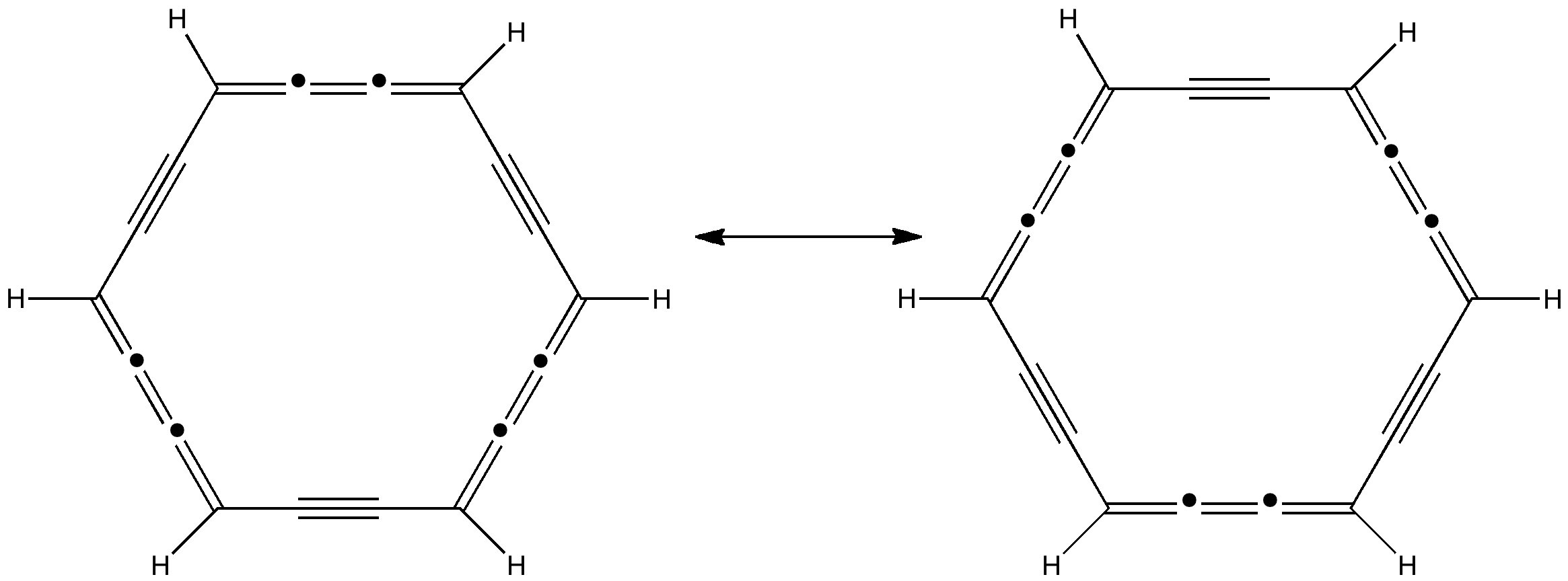
    Some molecules, when you first see them, just intrigue. So it was with carbobenzene, the synthesis of a derivative of which was recently achieved by Remi Chauvin and co-workers (DOI: 10.1002/chem.200601193). Two additional carbon atoms have been inserted into each of the six C-C bonds in benzene.

    Carbobenzene

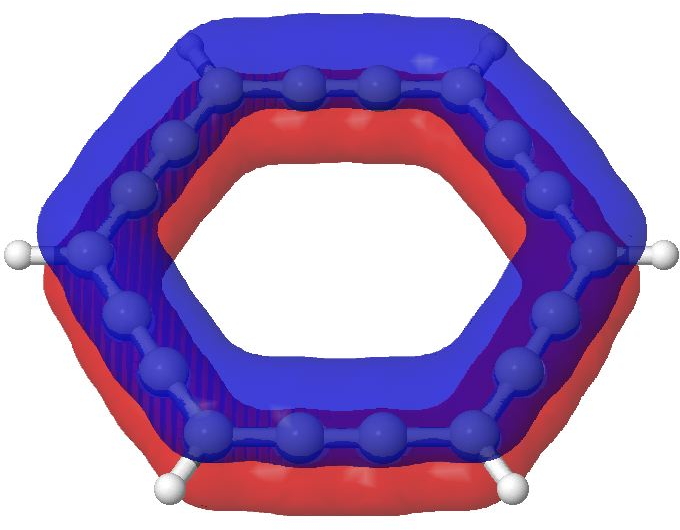
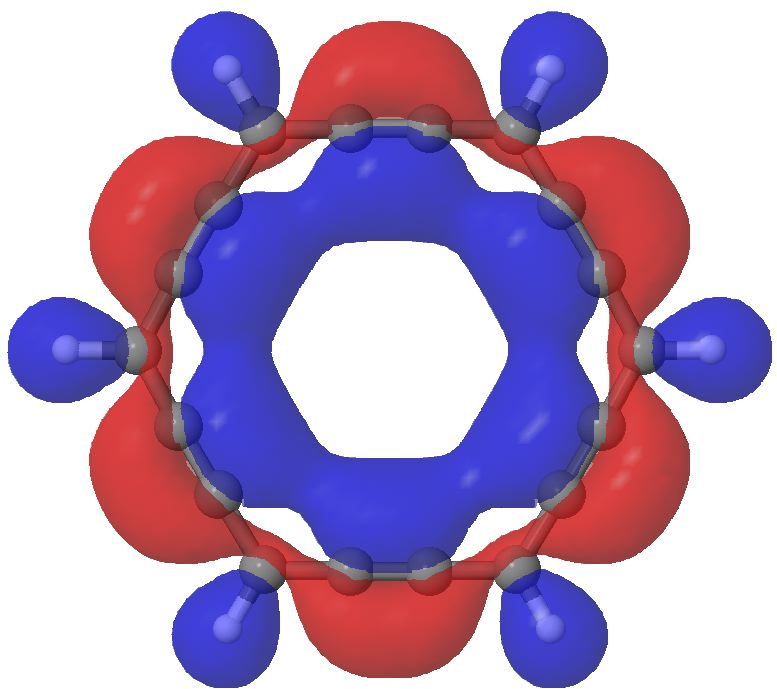
    The structure shows two resonance forms, which remind one of Kekulé and of course benzene itself. Counting reveals 18π-electrons in the conventional π sense, but with a further set of 12 π-electrons located in the plane of the ring, and orthogonal to the first set. Since both could be cyclically conjugated, we can say that the first set belongs to a 4n+2 count, and should set up diatropic ring currents resulting in aromaticity, whilst the second set would belong to the 4n category, and might set up paratropic ring currents in the plane of the system. The lowest occupied molecular orbitals of each set look as follows.

    The lowest MO for the 18π-electron set. Click for 3D

    Lowest occupied molecular orbital for the 12π-electron set. Click for 3D

    Experimentally, the molecule is found to be aromatic. One way of quantifying this is via the so-called dissected NICS magnetic response index (DOI: 10.1021/ol016217v). At the ring centroid, NICS(0,1,2,3)zz (respectively 0,1,2,3Å above the plane of the ring) are found to be -49, -46, -38 and -28 ppm (DOI: http://10042/to-4878).  The un-dissected NICS (which includes all σ-current contributions) were -18, -16.6, -13 and -9 ppm. This both confirms diatropicity (for which NICS is strongly negative) and also suggests that the 12-electron π-framework is opposing the 18-electron π-framework.

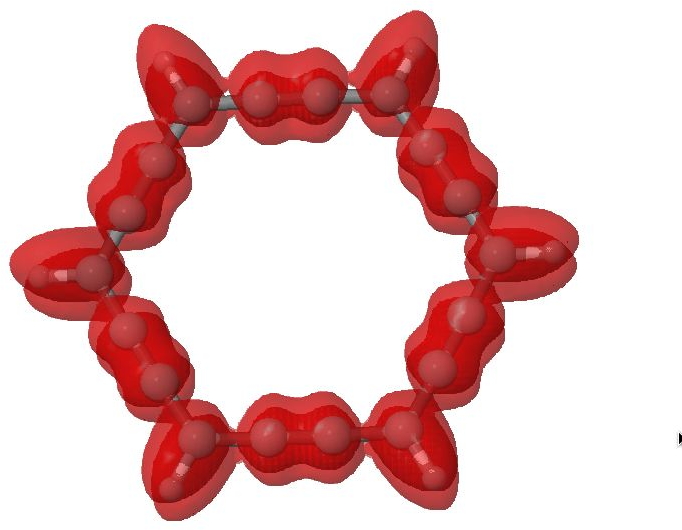
    Another, less common way to study the aromaticity is to look at the delocalization of the electrons using the ELF technique.

    ELF function evaluated using only the 18 π electrons. Click for 3D

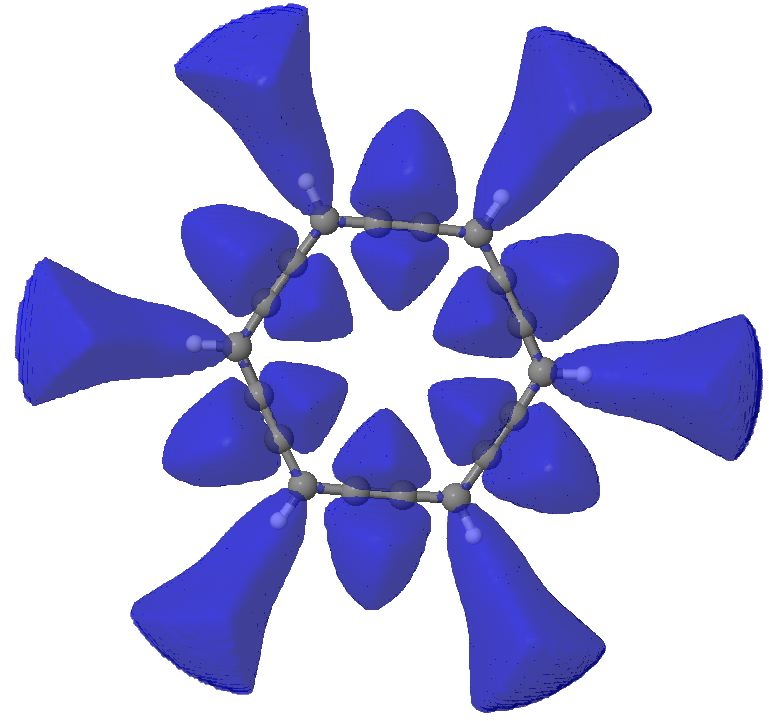
    ELF function evaluated using only the 12 σ-electrons. Click for 3D

    The 18-electron set bifurcate (break up into smaller basins), at the threshold of 0.87 shown above (the ELF function has a maximum of 1.0 and a minimum of 0.0), a high value which is typical of aromatic systems (benzene bifurcates at ~0.9). In contrast, the 12-electron set break up well before a value of 0.1 (shown), a low value which tends to indicate anti-aromaticity.

    There are many other ways of exploring the properties of such aromatic molecules, but the two above tend to suggest that carbobenzene has two personalities, one aromatic, the other antiaromatic, and with the former dominant. This gives it an interesting twist on benzene itself, and makes one wonder whether this dual Janus-like personality could be exploited in some interesting fashion.