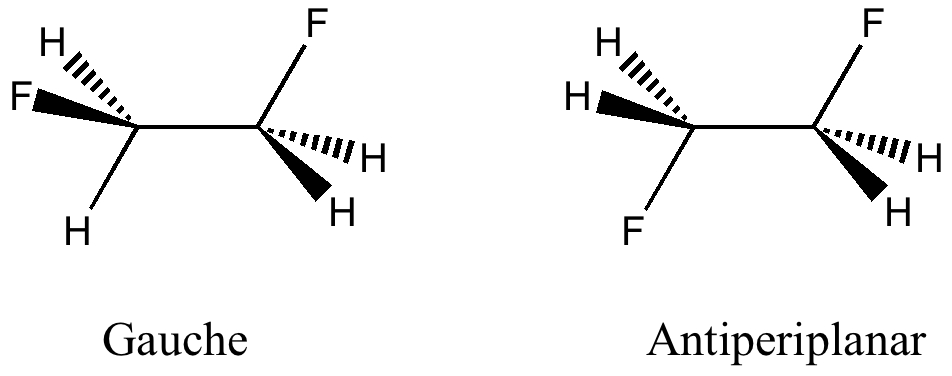
Here I offer another spin-off from writing a lecture course on conformational analysis. This is the famous example of why 1,2-difluoroethane adopts a gauche rather than antiperiplanar conformation. The gauche and antiperiplanar conformations of 1,2-difluoroethane
One major contribution to the greater stability of the gauche is the stereoelectronic interactions, and this is best probed using the NBO (Natural Bond Orbital) approach of Weinhold (DOI: 10.1021/ja00501a009). The process is approximately described as first reducing the wavefunction down to a set of orbitals which have been localized (using appropriate algorithms) down to two or one centres (corresponding to two-centre covalent bonds, or one-centre electron lone pairs). Perturbation theory is then used to evaluate the interaction energy between any filled and any empty combination. For the molecule above, six such combinations are inspected, involving any one of the six filled C-H or C-F σ-orbitals, and the best-overlapping σ* orbital which turns out to be located on the C-H or C-F bond anti-periplanar to the filled orbital.
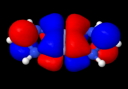
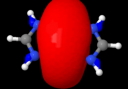
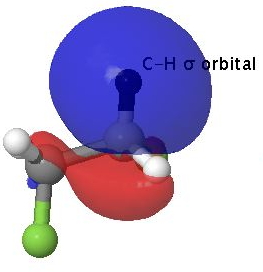
Filled C-H NBO orbital. Click for 3D to superimpose empty C-F anti bonding orbital.
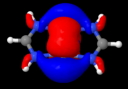
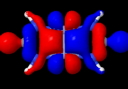
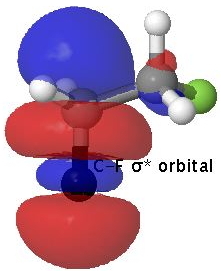
Empty C-F antibonding NBO orbital. Click for 3D
A filled C-H orbital is shown above on the left, accompanied by an empty C-F σ* orbital on the right which is anti-periplanar to the first. This alignment allows the phases of the two orbitals to overlap maximally (blue-blue on the top, red-red beneath).
The interaction energy between this pair is determined not only by the efficacy of the overlap, but by the energy gap between the two. The smaller the gap, the better the interaction energy (referred to as E2, in kcal/mol). For the gauche conformation, the six pairs of orbitals have the following interaction energies; two σC-H/σ*C-F interactions (illustrated above), 4.9; two σC-H/σ*C-H 2.6 and two σC-F/σ*C-H 0.8 kcal/mol. For the anti-periplanar conformation, the terms are four σC-H/σ*C-H 2.5 and two σC-F/σ*C-F 1.8 kcal/mol. The two totals (16.6 vs 13.6) indicate that gauche is stabilized more by such interactions.
There is of course a bit more to this story, but I have documented the above here, since I can include an explicit (and rotatable) illustration of the orbitals involved (which I have not seen elsewhere). If you want a recipe for generating these orbitals, go here.
Acknowledgments
This post has been cross-posted in PDF format at Authorea.
One of the (not a few) pleasures of working in a university is the occasional opportunity that arises to give a new lecture course to students. New is not quite the correct word, since the topic I have acquired is Conformational analysis. The original course at Imperial College was delivered by Derek Barton himself about 50 years ago (for articles written by him on the topic, see DOI 10.1126/science.169.3945.539 or the original 10.1039/QR9561000044), and so I have had an opportunity to see how the topic has evolved since then, and perhaps apply some quantitative quantum mechanical interpretations unavailable to Barton himself.
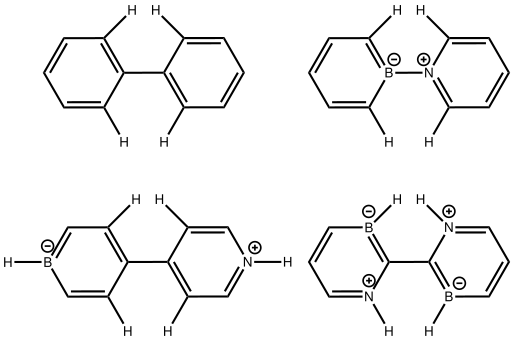
The example I have chosen to focus on here is biphenyl (a derivative of which also happens to be the first structure shown by Barton in his 1970 Science article noted above), but modified with iso-electronic B/N substitution for carbon for a particular reason.
Four hydrogen atoms are highlighted in the above drawings by virtue of how close they might approach each-other, and what impact this will have on the conformation of each species. Such close approaches are normally defined with reference to the so-called van der Waals radius of the element concerned. For hydrogen, this radius is either 1.2Å (if the contact is to another hydrogen) or 1.1Å (if its to any other element, see DOI: 10.1021/jp8111556). An interpretation of this value is that the van der Waals attraction due to to dispersion or long range correlation effects reaches a maximum for two non-bonded hydrogen atoms at ~2.4Å. Significantly, a slightly closer approach than this value might still be mildly attractive, but it would be generally agreed that any distance less than ~2.1Å now represents a genuine repulsion between the hydrogens (see also this post). This represents a somewhat more quantitative judgement on what used to be called steric interactions.
With the scene set, let me introduce the results of a calculation (wB97XD/6-31G(d,p), a DFT method selected because it treats the long range correlation effects with a specific correction)
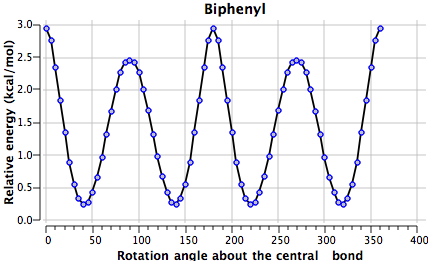
Conformational analysis of biphenyl 1
One can see here minima at ~45, 135, 225 and 315° for 1 (see DOI 10042/to-4853). Due to symmetry, the first and last are identical as are 2nd and 3rd, and the 1st and 2nd minima are in fact enantiomers of each other (the symmetry is D2, which is chiral). Two different transition states connect these minima, one with angles of 0/180 and the other slightly lower energy at 90/270°.
The non-bonded H…H distance are as follows: 1.95Å@0°, 2.39Å@45° and 3.54Å@90°. We may conclude that the first of these is repulsive, the second attractive and the third non interacting. Counterbalancing this effect is of course resonance due to π-π-overlaps across the central bond, which decreases to zero as the angle moves to 90°. The conformational minimum @45° is such because of the maximal H…H dispersion attraction and the still significant π-π-overlap. This brief analysis suggests however that these two effects are finely balanced, and so the next question is whether one might be able to perturb the system to distort the balance. The perturbation chosen is to replace one or two pairs of carbon atoms with the iso-electronic combination B+N.
The first perturbation is to replace the central rotating bond by a B-N combination 2 (DOI: 10042/to-4854).
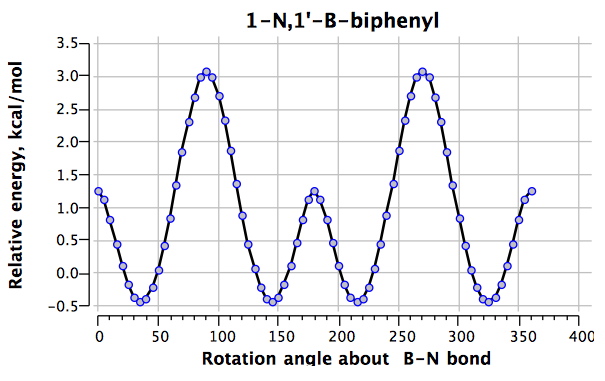
Rotation about the B-N bond in 2
For this species, the H…H distances are 2.02Å@0°, 2.36Å@45° and 3.61Å@90°, the only significant difference with 1 emerging as the 0° conformation being around 1 kcal/mol lower relative to the other two. It is tempting to attribute this to the longer H…H separation for this rotamer in 2 due to the B-N bond being longer (1.562Å) than the C-C bond it replaced (1.496Å)
The next perturbation is to relocate the N/B pair as in 3 (DOI: 10042/to-4855). If one imagines that this will be a minor perturbation, take a look at the profile below.
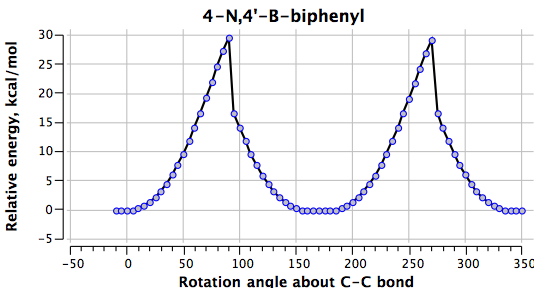
Rotation about central C-C bond in 3.
The world has been turned upside down. What were transition states @0° and @180° are now minima and the reason is easy to find. The central C-C bond is now only 1.400Å long, having acquired substantial double bond character, and being accordingly very much more difficult to twist (the barrier being ~30 kcal/mol). The π-π-overlap has won out completely, and in the process has forced the H…H distance down to a presumably repulsive 1.918Å. The penalty for this is that the overall energy of 3 is some 22.8 kcal/mol higher than 2.
Added in proof (as the expression goes): If the above profile is conducted with full geometry optimization in a solvent field (water), which helps stabilise charge separations, the profile changes to the below. The solvation reduces the barrier to rotation considerably, the energy maxima now reveal a proper stationary point (rather than the cusp), the minima are very slightly non-planar, but the basic inversion of the potential energy surface compared to 1 or 2 is still observed.
Rotation about the C-C bond for 3, with solvation correction
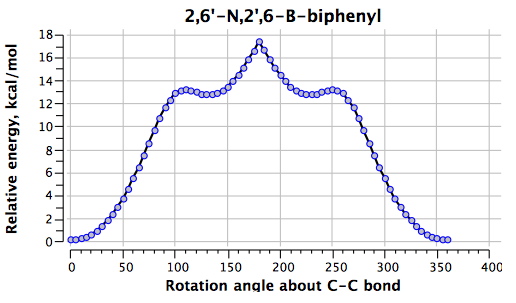
The final perturbation is 4 (DOI: 10042/to-4856) with the following rotational profile. Another surprise:
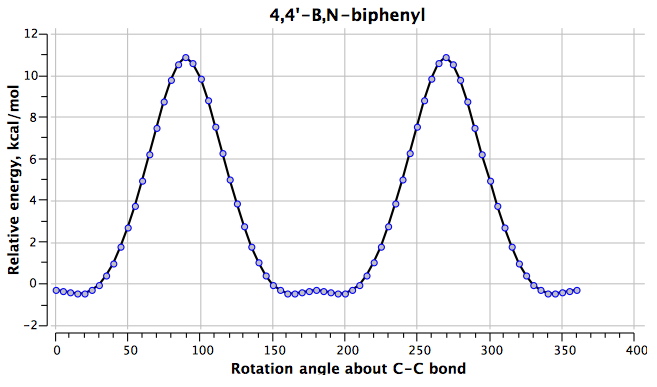
Rotation about the central C-C bond in 4.
The H…H distances are 1.930Å@0°, 1.789/2.275Å@180°. The difference from 1 is that the hydrogens now have opposite polarity for the N-H (which is positive) and the B-H (which is negative). At the rotation angle of 0°, two H(+)…(-)H style dihydrogen bonds (see also this post) are established (these are presumed to be very attractive); at an angle of 180°, the H(+)…(+)H and H(-)…(-)H interactions are presumed to be very repulsive. The difference between the two is ~18 kcal/mol.
We have learnt that conformational analysis for molecules such as these is a fight between π-π-overlaps, which themselves can have unexpected outcomes, weak van der Waals dispersion interactions between “neutral” non-bonded hydrogen atoms, and strong electrostatic attractions and repulsions between “ionic” hydrogens. Now perhaps the reason for the choice of the wB97XD DFT method can be seen; it is capable (at least in theory) of balancing these forces properly.
So the world of conformational analysis can be turned upside down, and analysing what happens from this topsy-turvy viewpoint can teach a lot!
Acknowledgments
This post has been cross-posted in PDF format at Authorea.
One future vision for chemistry over the next 20 years or so is the concept of having machines into which one dials a molecule, and as if by magic, the required specimen is ejected some time later. This is in some ways an extrapolation of the existing peptide and nucleotide synthesizer technologies and sciences. A pretty significant extrapolation, suitable no doubt for a grand future challenge in chemistry (although the concept of tumbling a defined collection of atoms in a computer model and seeing what interesting molecules emerge, dubbed with some sense of humour as mindless chemistry, is already being done; see DOI: 10.1021/jp057107z).
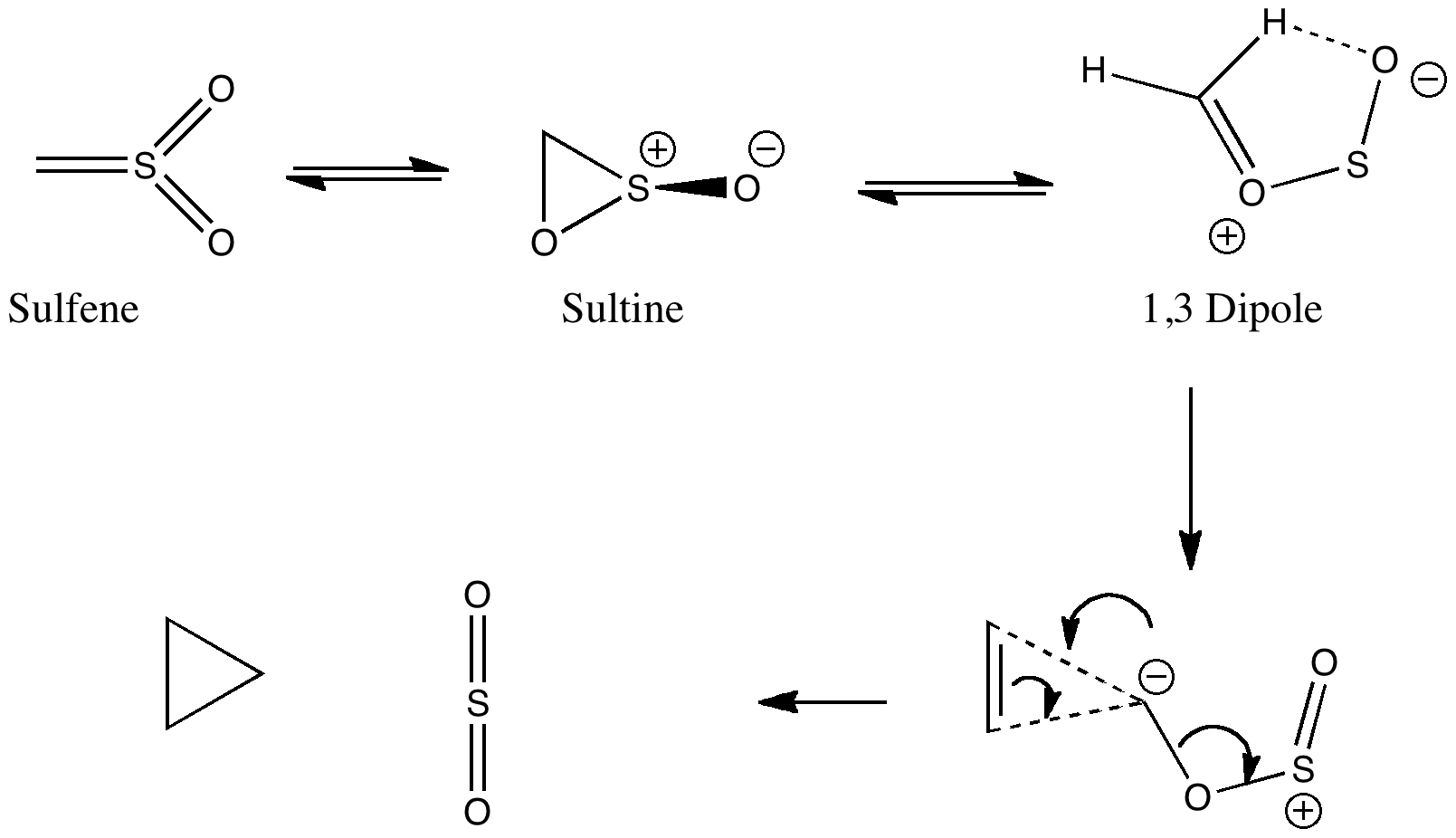
A possible carbene transfer reagent
Well, let us return to present day reality (I know it was a little unfair to capture your attention with such a grand title!). Consider the sequence above. Sulfenes are known simple elaborations of sulfur trioxide, with one oxygen replaced by a CH2 group. They can exist as isomeric rings, known as sultines (and which are of similar energy to the sulfenes, see DOI: 10.1016/j.theochem.2007.10.035). Few people have speculated upon what might be done with this small collection of atoms. It struck me (I am unaware it has struck anyone else, but I am happy to be corrected) that it might be useful as a reagent for delivering a carbene. The precedent is that oxaziridines (in which the SO unit is replaced by e.g. NR) can be used to transfer either oxygen or NR to alkenes, and dioxiranes (in which the SO unit is replaced by an oxygen) are very useful reagents for oxygen transfer to an alkene. In the example of the sultine, loss instead of carbene (CH2) would result in the thermodynamically stable sulfur dioxide. Also apparent is that the sultine is asymmetric (chiral) and so perhaps there is also a prospect of delivering that carbene asymmetrically (a reaction normally done with the help of metal catalysts). As shown above, the carbene is also nucleophilic, rather than electrophilic, which may also be useful in some contexts.
Enter the computer, which will be used to see if these simple ideas can be turned into the design of a new reaction. Firstly, the assertion that the reaction producing cyclopropane and sulfur dioxide is exothermic is easily tested (B3LYP/cc-pVTZ); it comes out as exothermic in free energy by -26.6 kcal/mol (some of which of course is due to entropy). Next, the transition state for the delivery.
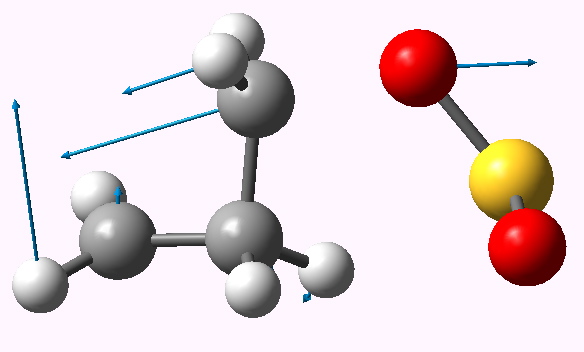
Transition state for carbene transfer from sulfine
This emerges (DOI: 10042/to-4476) with a free energy barrier of 37.4 kcal/mol relative to the sultine. Rather too high a barrier to constitute a useful synthetic reaction! But there is something interesting to be learnt from this transition state. Whilst the product is clearly cyclopropane and sulfur dioxide, the reactant is not the sultine but appears to be another species, labelled above as the 1,3 dipole (DOI: 10042/to-4487), a species which is 13 kcal/mol higher in free energy than the sultine itself (but does it have to be formed first, or is it merely on the reaction path?). There are other noteworthy aspects of the transition state. The carbene cycloaddition is a 4n electron process, with an apparent antarafacial component, this mapping onto inversion at the carbene centre. The bond formation at the alkene is very asynchronous, and the SO2 unit clearly does appear to act as a chiral auxilliary. Also these aspects would have to be factored into the eventual design.
We now enter an optimization stage of the process, in which we try to reduce the activation barrier in order to produce a viable reaction. Replacing CH2 by CF2 however increases the barrier to 42.5 kcal/mol, whilst substituting Se for S induces a barrier of 40.6 kcal/mol. More variation of the various substituents (including the alkene) will be needed to see if such a reaction could actually be carried out, but this is relatively routine process, not attempted here (perhaps not entirely routine; thus predicting what might happen is easy compared to analyzing what does not happen, see DOI: 10.1002/anie.200801206). So, there is certainly no claim here that a new reaction has been designed. Rather a tentative hint at the kind of processes that might be involved, eventually, in dialing a molecule.
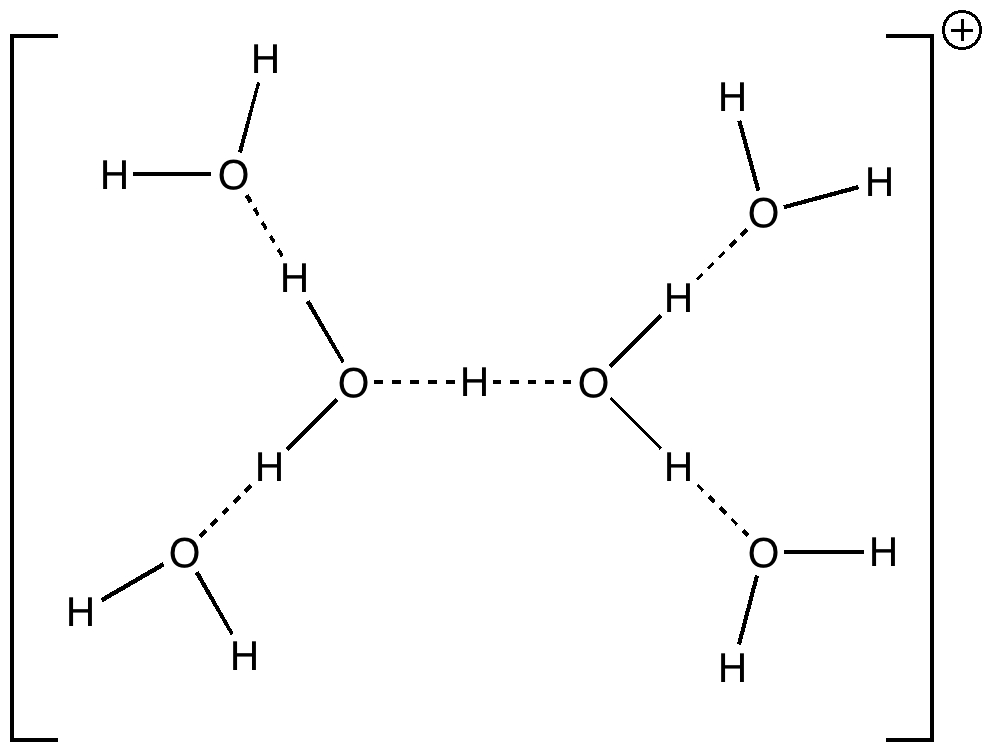
Stoyanov, Stoyanova and Reed recently published on the structure of the hydrogen ion in water. Their model was H(H2O)n+, where n=6 (DOI: 10.1021/ja9101826). This suggestion was picked up by Steve Bachrach on his blog, where he added a further three structures to the proposed list, and noted of course that with this type of system there must be a fair chance that the true structure consists of a well-distributed Boltzmann population of a number of almost iso-energetic forms.
The proposed structure of the hydrated proton in water
The evidence for the structure above comes from IR spectra. These operate on a fast enough scale to freeze-out individual forms, and therefore represent the instantaneous species rather than time averaged environments. A lively debate started on Steve’s blog, starting with Steve’s observation that the original article had reported only experimental results and no theoretical modelling of the proposed structure. It emerged that one way of modelling such species was within a cavity surrounded bv a continuum field modelling the bulk solvent (water in this case), and in particular one must properly optimize the structure and calculate the force constants within this field. When this is done, one significant difference between a simple gas-phase model of the structure above and its continuum-field structure emerges. In the former, the central O…H…O motif is symmetric (indeed the entire molecule is C2-symmetric). When the solvent field is applied, this unit desymmetrizes, ending up with one short (1.118Å) and one long (1.295Å) bond. I have transferred discussion of this from Steve’s blog to this one so that the resulting vibrations of this species can be shown here in animated form (its not possible to post animations in the comment field of a blog).
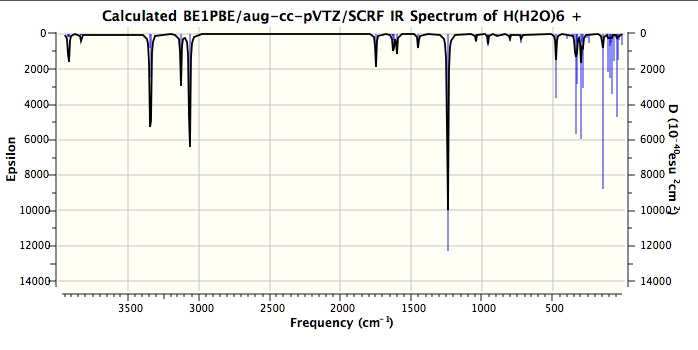
Firstly, the model. It is a PBE1PBE/aug-cc-pVTZ (the DFT method being the same as Steve used in his modelling, the basis set being rather better) and the continuum field applied was as SCRF(CPCM,solvent=water). The complete calculation can be inspected at DOI: 10042/to-4261. It is also important to remember that the force constants are harmonic. The resulting vibrations with the highest calculated intensities are tabled below.
Obs
1H freq
Intensity
2H freq
–
338
481
?
654
476
429
438
1202
1242
3837
942
1746
1749
599
1284
2816
3065
2829
2268
–
3127
913
2253
3134
3341
2018
2462
3134
3347
668
2424
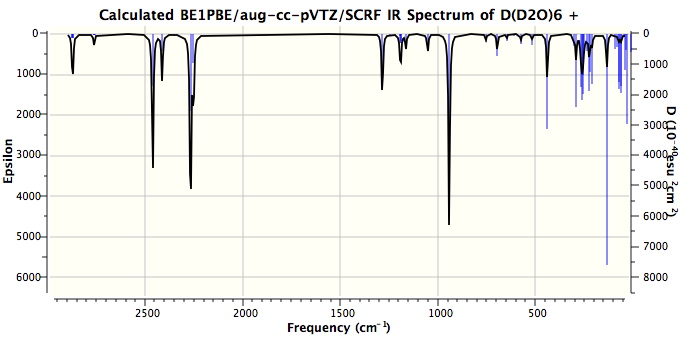
One might note that the vibrations in the range 3100-3300 always tend to be over-estimated using theory, in part because of incomplete basis sets, and in part because the harmonic frequencies are always 200 or more wavenumbers higher than the observed anharmonic values. The match for the mid range vibrations (1746, 1202) seems remarkably good. Only the low range value (654) is significantly out, and this may be another anharmonic effect. Added for good measure are the closest matches to each vibration when the system is fully substituted with deuterium (because of mode mixing, the modes do not always map exactly; thus the mode at 338 appears to have no exact deuteriated analogue).
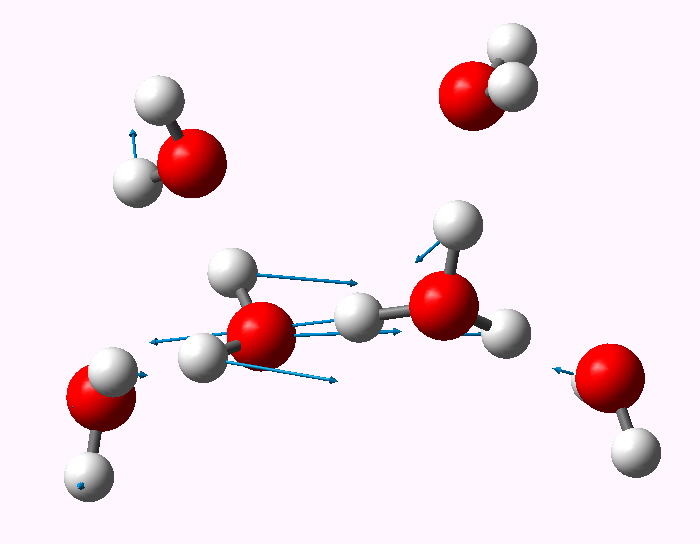
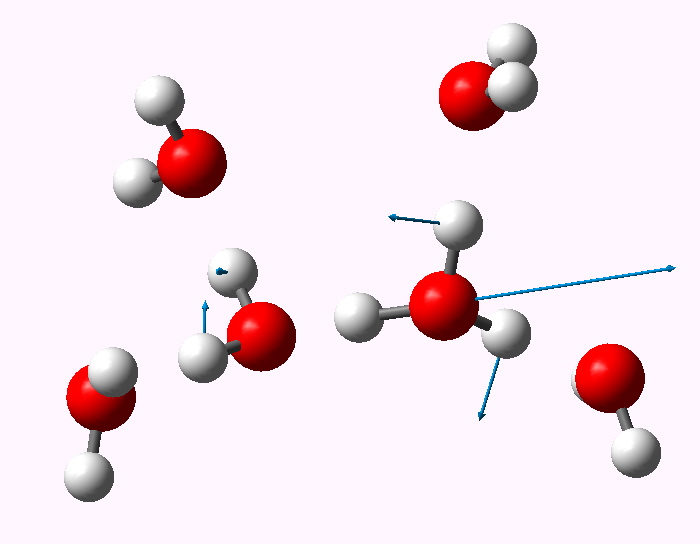
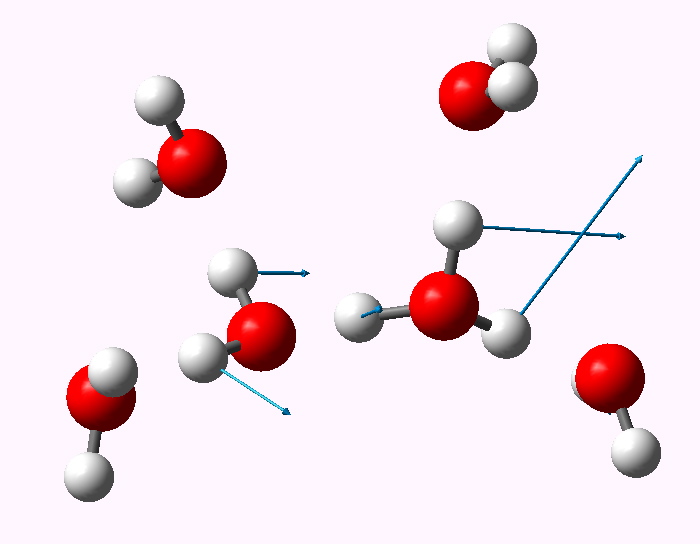
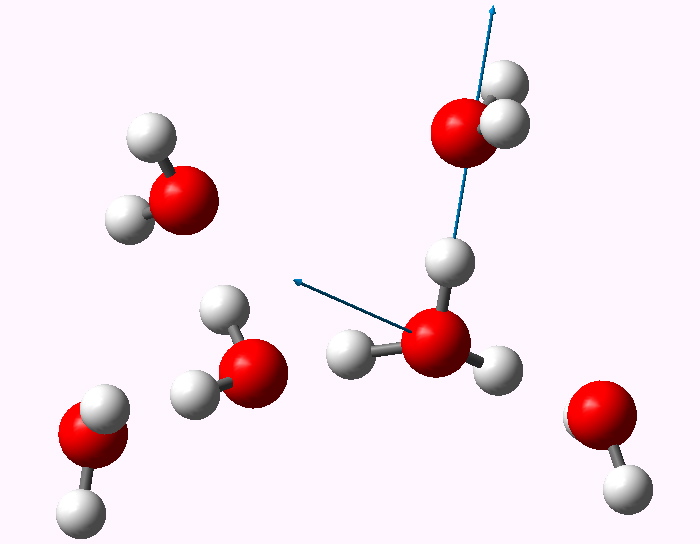
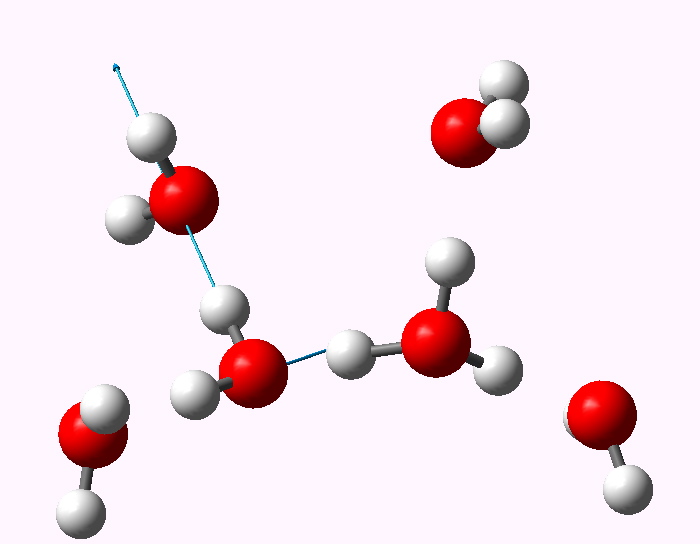
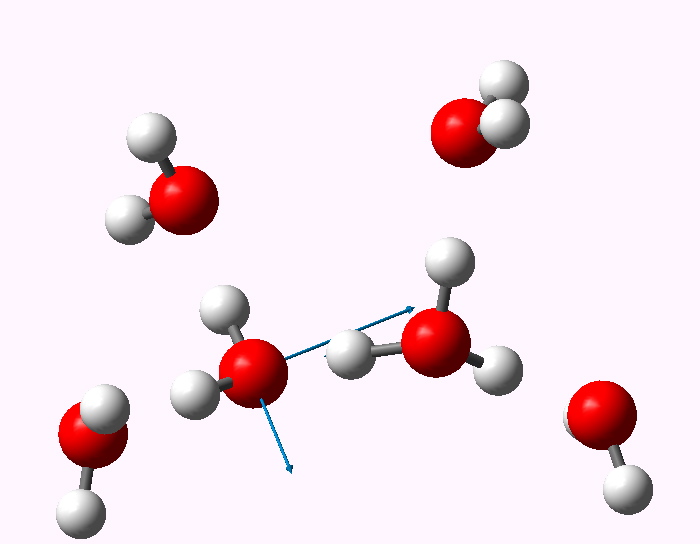
The displacement vectors are shown below (click on each picture to obtain an animation).
Normal mode 476 cm-1.
Normal mode 1242.
Normal mode 1749
Normal mode 3065
Normal mode 3341
Normal mode 3347
Calculated IR spectrum for H(H2O)6 +Calculated IR spectrum for D(D2O)6 +
The overall conclusion does seem to be that the structure shown above for the solvated proton does seem to match the observed IR peaks rather well, and that further more accurate modelling of this species might be a worthwhile endeavour.
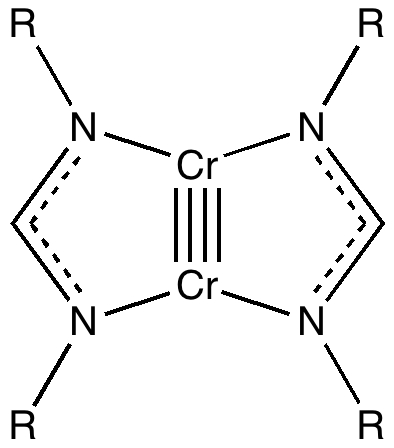
In the previous post, I ruminated about how chemists set themselves targets. Thus, having settled on describing regions between two (and sometimes three) atoms as bonds, they added a property of that bond called its order. The race was then on to find molecules which exhibit the highest order between any particular pair of atoms. The record is thus far five (six has been mooted but its a little less certain) for the molecule below
A molecule with a Quintuple-bond
There are many ways of describing the electronic behaviour in that region called a bond, one being the ELF (Electron localization function) technique, which certainly sounds as if it is describing a bond! The ELF function for the molecule above however was distinctly odd, and this was attributed to the Cr-Cr bond being not so much a covalent bond, but another (much less recognized type) known as a charge-shift bond. In particular, two of the ELF basin centroids did not occupy the central region between the two atoms, but had in effect fled that region, and in the process had also each split into two. Other ELF basins did not much look like bonds, but retained much of their core-electron (i.e. non bonding) character. The issue now becomes whether the ELF method is sensible, or simply an artefact. In other words, it needs calibrating against other (homonuclear) molecules which might exhibit charge-shift behaviour.
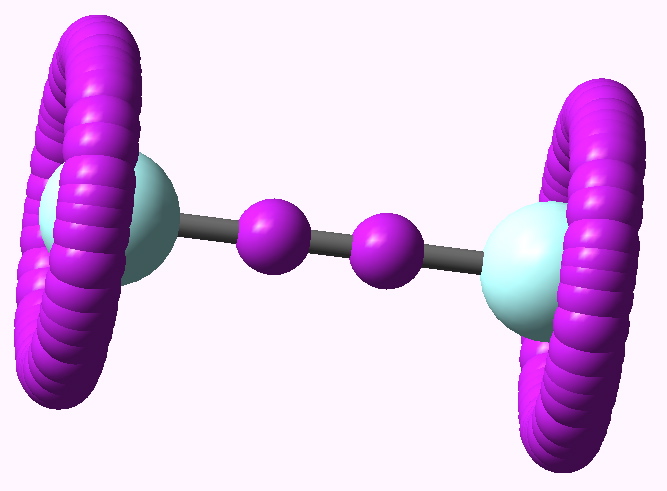
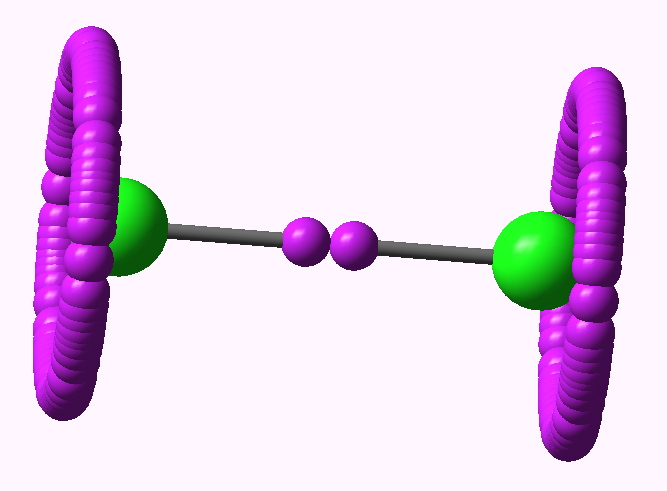
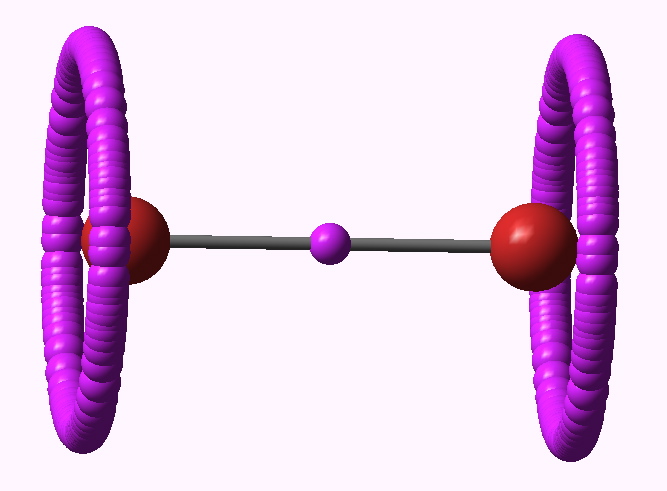
Three such molecules are in fact the halogens, F2, Cl2, Br2 as discussed by Shaik, Hiberty and co (DOI: 10.1002/chem.200500265). So lets take a look at what an ELF analysis shows for these, and how it compares with the chromium quintuple bond.
ELF analysis for F2
ELF analysis for Cl2
ELF analysis for Br2
At the B3LYP/6-311G(d) level, the ELF function shows the (valence) electrons located in two regions. Firstly, what we might call the lone pairs are located in a torus surrounding each halogen atom (i.e. the molecule must be axially symmetric). The remaining electrons are in basins with centroids along the axis of each bond. The Br2 centroid is a single conventional disynaptic basin, with an integration of 0.77 electrons. With Cl2 however, something odd happens (and the effect was described in DOI: 10.1002/chem.200500265 ); the disynaptic basin splits into a close pair, each integrating to 0.33 electrons, and looking as if the two parts want to run away from one another. This was interpreted as indicating that the purely covalent description of the halogen bond is in fact repulsive and not attractive! The effect is enhanced for F2, with two very much split basins, each integrating to 0.08 electrons. This serves to remind us of how odd a bond the F-F one truly is (and how easily it is homolyzed)!
Now that we have our calibration, does it match to the Cr-Cr quintuple bond? Very much so! Again, the valence basins show very low integrations (compared to the nominal bond order), and again they appear to have split and run away from each other. Most of the valence electrons in that species prefer instead to masquerade as core-electrons. So we can conclude that by the ELF criterion, the Cr-Cr bond is not quintuple, and not covalent but charge shifted. Of course, this does seem at odds with the Cr-Cr internuclear distance, which is indeed very short! This shortening probably arises from electrostatic attractions in the charge-shifted valence bond forms. It simply goes to show that what the nuclei get up to and what the electrons do may not be one and the same thing!
Climbers scale Mt. Everest, because its there, and chemists have their own version of this. Ever since G. N. Lewis introduced the concept of the electron-pair bond in 1916, the idea of a bond as having a formal bond-order has been seen as a useful way of thinking about molecules. The initial menagerie of single, double and triple formal bond orders (with a few half sizes) was extended in the 1960s to four, and in 2005 to five. Since then, something of a race has developed to produce the compound with the shortest quintuple bond. One of the candidates for this honour is shown below (2008, DOI: 10.1002/anie.200803859) which is a crystalline species (a few diatomics which exist in the gas phase are also candidates; for other reviews of the topic see 10.1038/nchem.359, 10.1021/ja905035f and 10.1246/cl.2009.1122).
A molecule with a Quintuple-bond
(OK, its shown as a quadruple bond, but Chemdraw cannot handle five!). The Cr…Cr length is 1.74Å (R=aryl). It was also reported that DFT calculations (BP86/triple-ζ) reproduce this length well. The five highest occupied molecular orbitals are all centred around the Cr-Cr region, and the bonding is formally described as five pairs of electrons filling 1σ, 2π, and 2δ type molecular orbitals.
So the electron pair bond, approaching its 100th birthday, is alive and well? But it does seem worth asking if those ten electrons really do cram together to occupy the region between the two Cr atoms. The stalwarts in these blog posts, AIM and ELF will be deployed to see if they too verify this simple concept. Firstly, AIM (calculated at the BP86/6-311G(d) level, DOI: 10042/to-4181 for a model system with R=H).
Quintuple bond complex, AIM analysis. Click for 3D
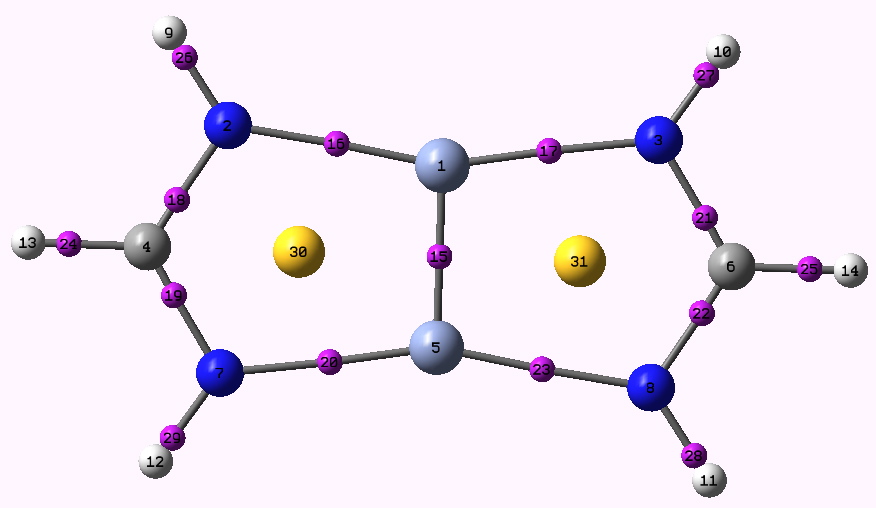
The Cr…Cr region has the requisite bond critical point, and the value of ρ(r) at this point has the large value (for Cr) of 0.313 au, indeed hinting at a large bond order. The Laplacian ∇2ρ(r) has the more extraordinary value of +1.45 at this point, which makes it the strongest charge-shift bond ever noted (typically, ∇2ρ(r) is ~+0.5 for other examples of homonuclear charge-shift bonds, see DOI: 10.1038/nchem.327).
This charge-shift character perhaps hints that this quintuple bond is no ordinary bond. Charge-shift bonds are characterized by valence bond structures where the covalent form may actually be repulsive, and the bond is stabilized instead by resonance with charge-shifted ionic valence bond forms. So given this, the ELF perhaps comes as no surprise.
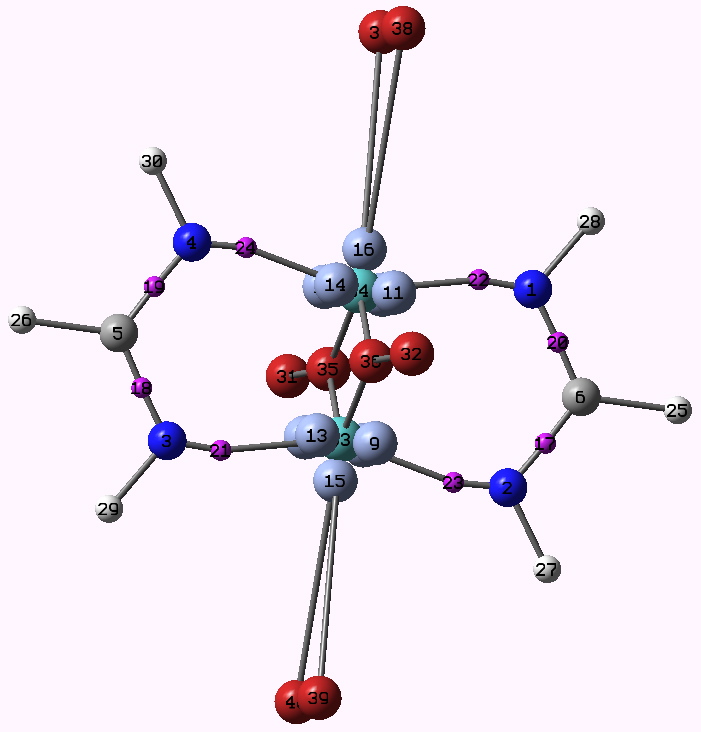
Quintuple bond. ELF analysis
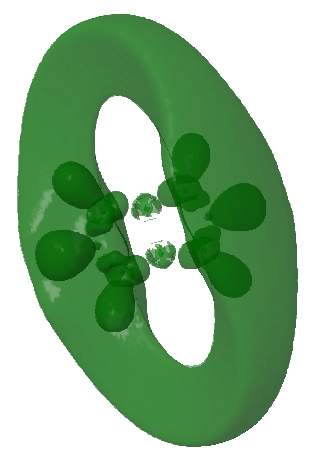
This diagram needs some explanation. The colour code is as follows: purple spheres represent the centroids of conventional disynaptic ELF basins. The only interesting ones are the four connecting the nitrogens to the Cr (21-24) which integrate to 3.35 electrons each. The cyan spheres (shown as 3,4 above) are the inner core-electrons of the Cr atoms (10.2 electrons of a neon core) and surrounding them are five further basins for each Cr integrating to 12 electrons per Cr. These include 8 of the outer-core (3s,3p) and four of the valence (3d, 4s) electrons, leaving ~2 valence Cr electrons not accounted for. Some of these final electrons are to be found in the basins represented by red spheres. The very diffuse (39, 40) basins far from the centre have a tiny electron integration (~0.003) and more missing Cr valence electrons are found in the bridging basins (32,36; 0.56 and 0.25 electrons each). Added to the 2*3.35 electrons found in the Cr-N bond, this suggests the 3d/4s shell of the Cr is occupied by ~11.5 electrons. The 3d-shell is thus full, and the system is indeed an 18-electron (8+10) system with some occupancy of the 4s shell as well. An alternative view of the ELF surface can be seen below, showing the unusual environment surrounding the Cr pair.
Quintuple bond, showing ELF isosurface. Click for 3D
It seems that AIM (the topology of the electron density) and ELF (the topology of the electron localization function) are giving us quite different pictures of the quintuple bond. The latter does seem to indicate that the conventional covalent shared electron pair picture of this bond is not really what is going on, and that the idea of a quintuple bond as sharing five electron pairs in the bonding region between the two Cr atoms is not really realistic. It may be of course that the ELF concept also is not really applicable for such bonds (it is after all essentially an empirical function, the deeper significance of which is debatable). Nonetheless, the quintuple bond clearly has some surprises for us, and it would itself be no surprise to find out that controversy about the meaning of such a bond continues apace.
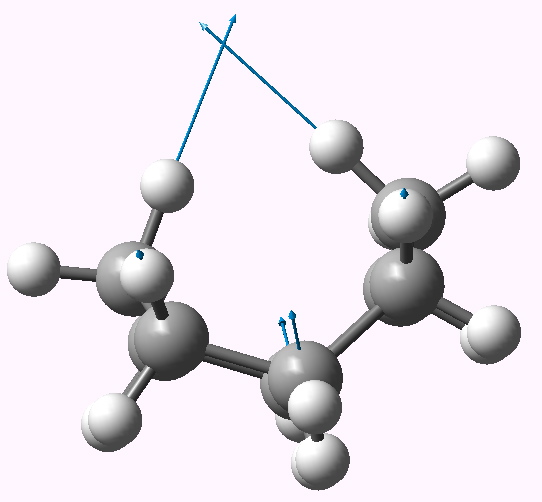
In an earlier post, I re-visited the conformational analysis of cyclohexane by looking at the vibrations of the entirely planar form (of D6h symmetry). The method also gave interesting results for the larger cyclo-octane ring. How about a larger leap into the unknown?
Let us proceed as follows. One fun game to play in chemistry is to invoke iso-electronic substitutions. In this case, we can subtitute a nitrogen and a boron atom for a pair of carbons. Thrice invoked, it leads to a molecule known as cyclotriborazane.
Cyclotriborazane.
This species is in fact very well known, and a crystal-structure was determined some time ago (DOI: 10.1021/ja00786a022). It is worth considering some of its properties.
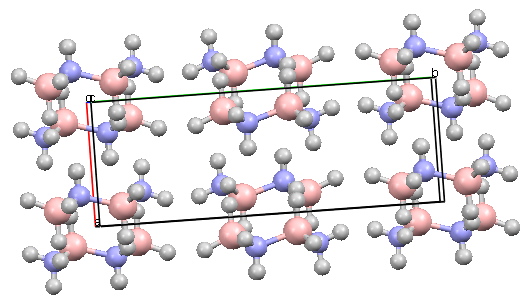
The species is crystalline, and sublimes rather than melts. Contrast this with the iso-electronic cyclohexane, which melts at around 6C (itself a surprisingly high value).
The parent H3BNH3 also has a very high melting point of > 100C, which is attributed to an extensive array of so-called dihydrogen bonds in the crystal lattice, in which a positively charged hydrogen deriving from an NH is attracted to a negatively charged hydrogen deriving from a BH. Such dihydrogen bonds have been shown to be quite strong due to this electrostatic interaction, and are responsible for the extraordinary elevation of the melting point compared to the iso-electronic ethane.
The chair form of cyclotriborazane aligns the three hydrogens shown in either blue or red in the axial positions. The three red hydrogens might be expected to be all negatively charged, and the three blue ones positively charged. So in the chair conformation, might we expected the electrostatic repulsions between either the blue or the red hydrogens to destabilize these axial positions, and hence perhaps even destabilize the chair conformation itself?
The crystal structure however shows clearly that the chair is still the favoured conformation. Equally intriguing, one might expect the three blue hydrogens to stack up to attract electrostatically to the three red hydrogens. But you can see from the crystal packing if you activate the model below that this does not happen!
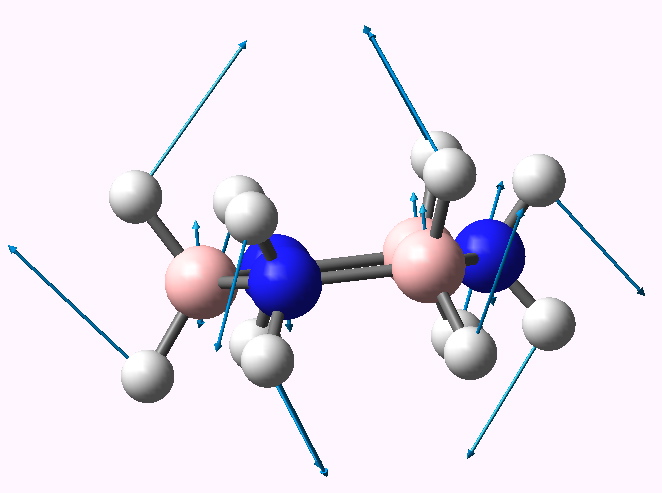
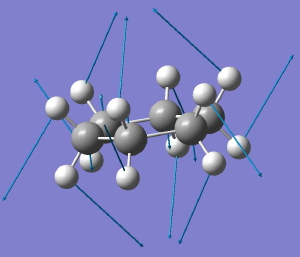
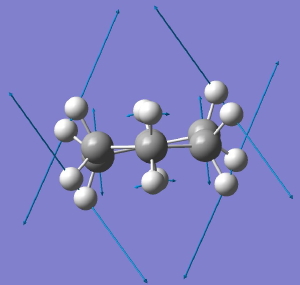
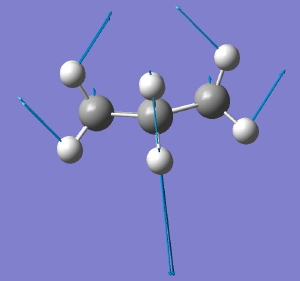
Cyclotriborazane Crystal structure. Click for 3DWhat of the vibrational analysis, conducted as it was for cyclohexane itself (DOI: 10042/to-4170). Well, just as before, for the planar geometry, three imaginary modes are calculated (A2“, E”) and just as before, they distort the geometry in the direction of a chair (Cs symmetry), a C2-disymmetric twist boat (with a predicted optical rotation of -54°) and a boat respectively (the latter, as before, being a transition state connecting the two C2-enantiomers).
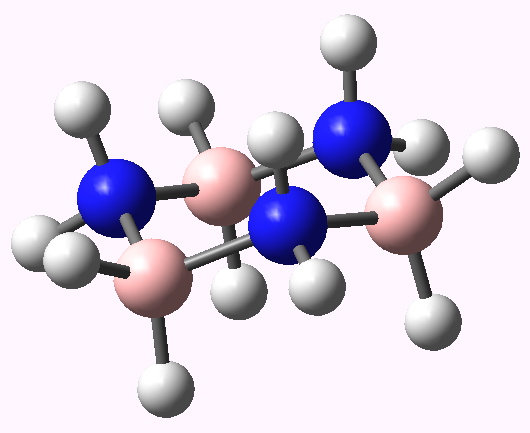
Planar cyclotriborazane distorting to chair.But here we get a surprise! According to the B3LYP/6-311G(d,p) model, the final resting energy for the chair is almost the same (indeed 0.2 kcal/mol higher in free energy) as the twist-boat. Perhaps that blue/red repulsion did have an effect after all! If you look at the calculated structure, you can indeed see that the blue/red hydrogens are splayed-out, avoiding each other!
Calculated geometry of the chair form of cyclotriborazaneThis is one of those molecules where one might have expected surprises. In the end, it is surprising at how similar cyclotriborazane is to its iso-electronic cousin cyclohexane.
Scientists write blogs for a variety of reasons. But these do probably not include getting tenure (or grants). For that one has to publish. And I will argue here that a blog is not currently accepted as a scientific publication (for more discussion on this point, see this article by Maureen Pennock and Richard Davis). For chemists, publication means in a relatively small number of high-impact journals. Anything more than five articles a year in such journals, and your tenure is (probably) secure (if not your funding).
Can one do both? Post a blog item, and then publish a follow-up in a high-impact journal? Well, yes and no.
I had better explain. A blog post is more often then not catalysed by reading an article, viewing another blog, or discussing something with a colleague. One posts in the hope of getting some feedback, from which one’s ideas might mature, develop, or indeed collapse! Scientists have long done this of course, albeit with a colleague down the corridor, at conferences or seminars. The ideas thus cast forth may also of course also get stolen, and so these traditional mechanisms for floating ideas are often very short on detail. Sometimes, returning to the idea of blogs, one post can lead to another, and the nature of the blog means the ideas can evolve, mutate very rapidly. Eventually, one might wish to take a good overview of all the various efforts. At this point, one is now considering publishing a journal article, since currently at least, the longevity of a journal is considered longer than that of a blog (see this post here for more ruminations on that theme). There are other good reasons for then choosing a journal rather than one’s blog. The QA (quality assurance) necessary to get an article accepted in a good journal is, let’s face it, rather greater than that of a blog (although to be fair, it is only motivation that limits the quality of the latter). Apart from adding all those control experiments/calculations that may be missing from the blog, one also must be far more fastidious in citing the literature correctly.
I do speak from (thus far one) experience. The story starts here, this being the initial post on a story that broke on Steve Bachrach’s blog about a compound with a potentially pentavalent carbon; Steve’s own post was based on an original article on the theme. Several more blog posts followed as the logical theme gradually developed. I eventually decided that telling how this set of logical connections came about was almost as interesting as the specific molecules it covered. The story had also evolved from discussing the element Astatine to speculating about the rare gas Helium, a somewhat less than obvious connection path (and how to discover connections between disparate and apparently unconnected concepts is a different story). Where should the story about how astatine was connected to helium be told? I decided it should indeed be in a formally published journal article. But it was also important to tell the story more or less as it happened, and particularly to include the role that the blogs themselves had played.
In fact, as soon as I started this undertaking, I realised that more calculations, and at a rather higher theoretical level, needed to be done in order to persuade the referees of the article that the science was sound, and also that it advanced our knowledge significantly. In the event, although the calculations were repeated, enhanced, or evolved in some manner or other, and new ideas injected, none of the original assertions was proven wrong (and of course its now not just me that thinks this, but the 2-3 referees who also commented). Ultimately, I would estimate I ended up spending perhaps ten times as much time on the journal article as on the sum of the initial blog posts on the topic. It an interesting question as to whether the motivation needed to put in this amount of care and attention could also have been generated with blog as the sole output medium (see my opening remarks).
The article is now published (DOI: 10.1038/nchem.596). Of course, you can only read it if your institution (or you personally) has a subscription to the journal (although, like this blog, the article can be located using public search facilities such as Google Scholar). There is another aspect of both the blog and the article worth mention. Both contain data. The blogs contain the molecular coordinates of all the molecules discussed, as well as the DOIs for the digital repository where the calculations are archived. So does the article, in the form of an interactive table, although again access to this table may or may not require a journal subscription (in this regard I note that whereas an earlier article I wrote for this publisher, see DOI 10.1038/nchem.373, is protected from non-subscribers, the interactive table which is part of the article is openly accessible. The journal deserves full credit for allowing this data to be on public access).
There is another aspect of the blog and the article, which was alluded to above. I introduced the theme of linking concepts together. This very blog post (and all the others) have been subjected to analysis using the calais archive tagger. This automatically determines appropriate tags to annotate each post with, and then declares them using standard methods (which include RDF). The published article is similarly tagged by the publisher. In theory at least, this collection of materials, the blogs and their tags, and the article and indeed commentaries about both, should be reconcilable using appropriate semantic searches. But at this point, I feel that this topic deserves separate attention and I will close here.
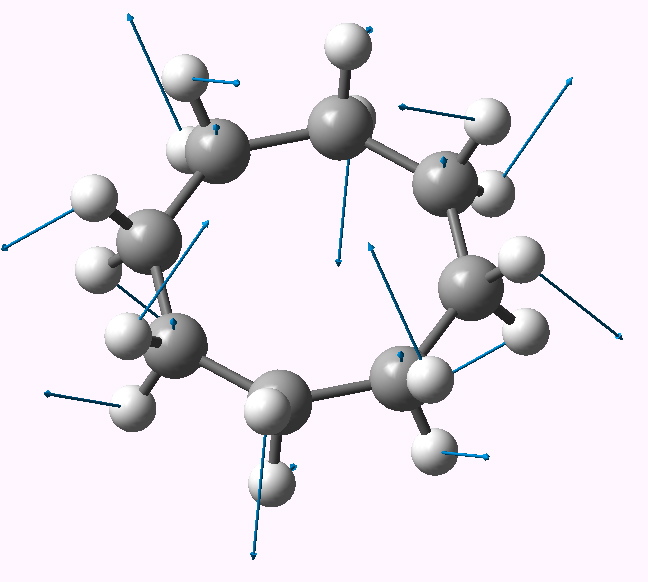
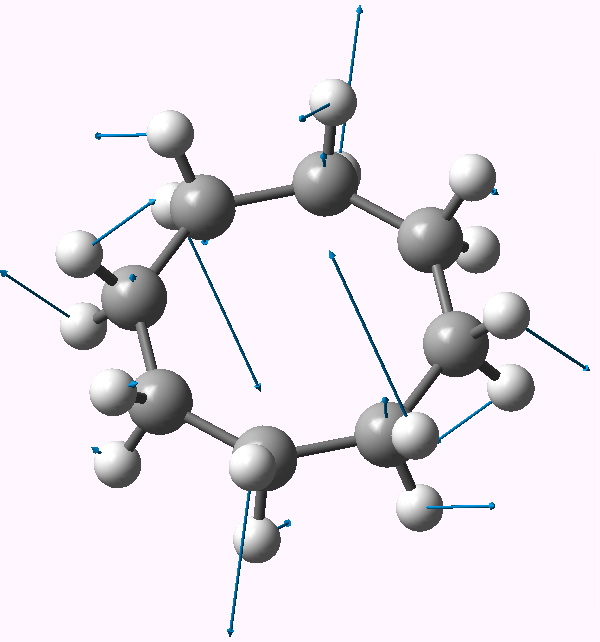
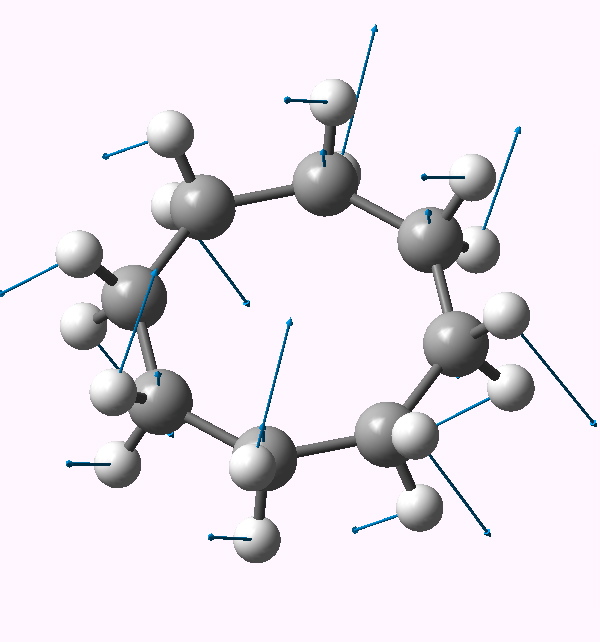
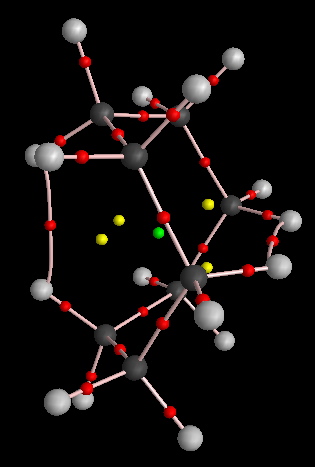
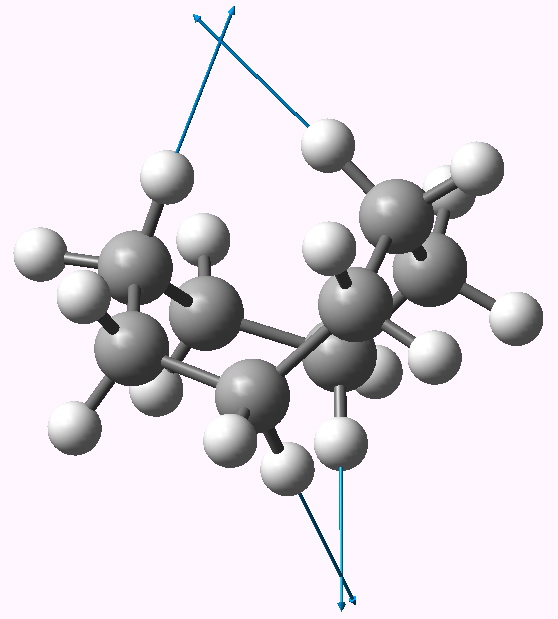
In the previous post, I suggested that inspecting the imaginary modes of planar cyclohexane might be a fruitful and systematic way in which at least parts of the conformational surface of this ring might be probed. Here, the same process is conducted for cyclo-octane. The ring starts with planar D8h symmetry, and at this geometry (B3LYP/6-311G(d,p), DOI: 10042/to-3742) five negative force constants (corresponding to imaginary modes) are calculated. The most negative is non-degenerate, and gives directly the crown conformation of D4d symmetry (DOI: 10042/to-3738). The remaining four modes comprise two degenerate pairs. Following either of the E2u eigenvectors downhill leads to another conformation, D2d (DOI: 10042/to-3741), with a geometry which is noteworthy for exhibiting a pair of unusually close non-bonded H…H contacts (1.908Å). This value is about 0.3Å shorter than the sum of the Wan der Waals radii (DOI: 10.1021/jp8111556). We can debate whether such a close approach or inter-penetration of two hydrogens is a bond or not (an AIM analysis appears at the bottom of this post).
D8h, +82.8 kcal/mol
Follow B2u 467i
Follow E3g 404i
Follow E2u 230i
to D4d +0.8
to Ci 131i (Au), +7.5
to D2d +3.6
B2u
E3g
E2u
Cs 0.0
C2 +1.6
–
Following the remaining E3g mode leads to a stationary point of Ci symmetry (DOI: 10042/to-3743). This is a valley-ridge potential, since this point turns out to be a transition state itself, and following the Au imaginary mode at this point results in another, this time stable conformation, of chiral C2 symmetry (DOI: 10042/to-3744). This has a calculated optical rotation [α]D of 72° (at 589nm in chloroform).
Are these three conformations all there are? Well, a thorough analysis of the conformational space has in fact identified six minima (DOI: 10.1002/(SICI)1096-987X(19980415)19:5<524::AID-JCC5>3.0.CO;2-O), of which the most stable has Cs symmetry (the so-called chair-boat conformation, and the one most frequently found in crystal structures of cyclo-octanes). Where is that one in the above analysis? It arrives by a distortion of the D4d form (DOI: 10042/to-3747) via a transition state of no symmetry (DOI: 10042/to-3752)
Whilst the full potential surface clearly has many more features, following the modes of the planar conformation of cyclo-octane is a simple and rapid way of establishing four of the six limiting stable conformations (the two remaining forms have D2 and S4 symmetry, see DOI 10.1016/0166-1280(88)80008-3).
AIM analysis of D2d cyclo-octane.
Finally as promised, the AIM analysis of the D2d conformer (above). The ρ(r) value at the interesting H…H critical point is 0.015, which is pretty high in comparison to most normal hydrogen bonds, and would be conventionally taken to indicate attraction. The Laplacian ∇2ρ(r) is +0.05. The “bond” ellipticity ε has a value of 0.29. Single bonds are close to zero, and C=C double bonds are ~0.4, so this is pretty high (see also DOI: 10.1002/anie.200805751).
The two highest C-H stretching vibrations for this conformation are well separated from all the others (ν 3095, 3103 cm-1 for the symmetric A1 and antisymmetric B2 combinations, below for animations). These vibrations serve to both decrease and increase the H…H distances as part of the atomic (harmonic) displacements, and clearly doing so takes more energy than vibrating any of the other C-H bonds. It seems unlikely that the C-H bonds are themselves stronger, so does that mean that the H…H interaction is attractive or is it repulsive? In this context, it is worth noting that the symmetric vibration (both H…H distances decrease/increase at the same time) is lower in wavenumber than the mode which decreases one and increases the other.
Like benzene, its fully saturated version cyclohexane represents an icon of organic chemistry. By 1890, the structure of planar benzene was pretty much understood, but organic chemistry was still struggling somewhat to fully embrace three rather than two dimensions. A grand-old-man of organic chemistry at the time, Adolf von Baeyer, believed that cyclohexane too was flat, and what he said went. So when a young upstart named Hermann Sachse suggested it was not flat, and furthermore could exist in two forms, which we now call chair and boat, no-one believed him. His was a trigonometric proof, deriving from the tetrahedral angle of 109.47 at carbon, and producing what he termed strainless rings.
Whilst the chair form of cyclohexane now delights all generations of chemistry students, the boat is rather more mysterious. Perhaps due to Sachse, it is still often referred to as a higher energy form of the chair (Barton, in the 1956 review that effectively won him the Nobel prize, clearly states that the boat is one of only two conformations free of angle strain, DOI: 10.1039/QR9561000044). Over the last 30 years or so, and especially with the advent of molecular modelling programs, the complexity of the conformations of cyclohexane has become realised. A nice recent illustration of that complexity is by Jonathan Goodman using commercial software. Here a slightly different take on that is presented.
The starting point is the flat Baeyer model for cyclohexane. Like benzene, it has D6h symmetry. When subjected to a full force constant analysis using a modern program (in this instance Gaussian 09), this geometry is revealed (DOI: 10042/to-3708) to have three negative force constants, which in simple terms means it has three distortions which will reduce its energy. The eigenvectors of these force constants are shown below, and each set of vectors acts to reduce the symmetry of the species. Such symmetry-reduction is a well known aspect of group theory, and its analysis in the Lie symmetry groups is used in many areas of physics and mathematics, but it is a less used in chemistry.
348i cm-1 (B2g)
244i (E2u)
244i (E2u)
D6h to C2h for cyclohexane. Click for animation.
D6h to D2. Click for animation.
D6h to C2v. Click for animation.
The first of these symmetry-reducing vibrations (the B2g mode) converts the geometry immediately to the chair conformation of cyclohexane. So in some ways, this use of symmetry is a modern equivalent of the trigonometry used by Sachse to prove his point.
The next two modes are degenerate in energy, and the first of these reduces the symmetry to D2. The result is what we now call the twist-boat. It is interesting, because the D2 group is one of the (relatively few) chiral groups, and the twist-boat exhibits disymmetric symmetry. In other words, following the vibrational eigenvectors in one direction leads to one enantiomer of the twist boat, and in the other direction to the other enantiomer. So (in theory only), one might actually be able to produce chiral cyclohexane (the experiment and resolution would have to be done at very low temperatures!). It is also interesting that theory nowadays could quite reliably calculate the optical rotation of this species (and its circular dichroism spectrum), so we certainly would know what to look out for.
The second component of the degenerate E imaginary mode leads directly to a species of C2v symmetry, which we recognize as Sachse’s second possible form of cyclohexane. The symmetry-reductions of D6h to C2h, D2 and C2v all have paths on the grand diagram of the 32 crystallographic point groups and their sub groups, and is an interesting application of group theory to a mainstream topic in organic chemistry.
But the story is not quite complete yet. The C2v boat is not the final outcome of the last distortion! It too is a transition state, connecting again the two D2 forms. So the path from D6h to C2v is NOT a minimum energy reaction path, but a rather different type of path known as a valley-ridge inflection path. An example of such a surface can be seen for the dimerisation of cyclopentadiene (DOI: 10.1021/ja016622h) and effectively it connects one transition state to a second transition state, without involving any intermediates on the pathway. At some stage, the dynamics of the system takes over, and the symmetry breaks without the system ever actually reaching the second transition structure. This final aspect of the potential energy surface of cyclohexane was not discussed by Jonathan Goodman in his own article on the topic.
So symmetry-breaking is the topic of this blog, and its connection to physics and mathematics. And, I might add that the same approach can be taken for looking at the conformations of cyclobutane, pentane, heptane and octane. But that will be left for another post.
 Four hydrogen atoms are highlighted in the above drawings by virtue of how close they might approach each-other, and what impact this will have on the conformation of each species. Such close approaches are normally defined with reference to the so-called van der Waals radius of the element concerned. For hydrogen, this radius is either 1.2Å (if the contact is to another hydrogen) or 1.1Å (if its to any other element, see DOI: