Blog

  • The chirality of Möbius annulenes

    Much like climbing Mt. Everest because its there,  some hypothetical molecules are just too tantalizing for chemists to resist attempting a synthesis. Thus in 1964, Edgar Heilbronner  speculated on whether a conjugated annulene ring might be twistable into a  Möbius strip. It was essentially a fun thing to try to do, rather than the effort being based on some anticipated  (and useful) property it might have. If you read the original article (rumour has it the idea arose during a lunchtime conversation, and the manuscript was completed by the next day), you will notice one aspect of these molecules that is curious by its absence. There is no mention (10.1016/S0040-4039(01)89474-0) that such Möbius systems will be chiral. By their nature, they have only axes of symmetry, and no planes of symmetry, and such molecules therefore cannot be superimposed upon their mirror image; as is required of a chiral system (for a discussion of the origins and etymology of the term, see 10.1002/chir.20699).
    The 16-annulene synthesized by Herges and his team.
    The 16-annulene synthesized by Herges and his team. Click for 3D.
    Heilbronner’s little vignette had little overt effect on the synthetic community until around 2003, when Rainer Herges announced that a crystalline annulene following this recipe had been rationally synthesized (10.1038/nature02224). This time, the chemical community really sat up and took notice. The synthesis was hailed as a major achievement, ranking (chemically) as similar to climbing Everest. But if you read Herges’ article carefully, yet again you will note the absence of any discussion of the chirality of their molecule. Their synthesis was of course racemic, in other words an equal proportion of both enantiomers was made. Indeed, it is not obvious how a non-racemic synthesis could be carried out, although resolution of the product might be an easier task. So in the absence of any pure enantiomer of this molecule, can one speculate on its chiral properties? One obvious such property is the optical rotation, and in particular the [α]D value in chloroform. Most optically pure molecules with molecular weights of < 500 Daltons  tend to have rotations also < 500°. Few molecules have values > 1000°. Now it should be said at the outset that a molecule with a large optical rotation is not more chiral than a molecule with a smaller value; indeed it seems generally agreed that the question “how chiral is this molecule” is either fairly, or even completely meaningless. But it seems a useful task of having a value to hand which is at least approximately accurate, so that some idea of whether any attempted resolution of the enantiomers has produced optically pure product or not. Fortunately, in the last decade or so, computing a value for [α]D has been entirely viable using the standard programs (see 10.1002/chir.20466 and 10.1021/jo070806i for a discussion). This is also useful for two reasons:


    1. If the magnitude of the rotation is > 100°, then the sign of this rotation can be very reliably matched to either enantiomer. This allows the absolute configuration to be assigned with a lot of confidence, and probably much more easily than trying to do it by other methods.
    2. The magnitude itself can be reliably predicted to within 10% of the true value if the molecule is conformationally rigid. However, if it has any rotatable groups (and that even includes e.g. OH groups), then the result can be enormously sensitive to that conformation (or Boltzmann mixture of conformations). Put the other way, calculating the optical rotation could be regarded as a very sensitive way of determining conformations!

    So what of the 16-annulene synthesized by Herges and co-workers. Well at the B3LYP/6-311G(2df,2pd) and SCRF(CPCM,solvent=chloroform) level of theory (which is reasonably accurate, although one can do better of course), the enantiomer shown by clicking on the graphic above is predicted to have a rotation of -1355° (for the digital repository entry for the calculation, see 10042/to-2176). That is indeed a large value for such a relatively small molecule, and is probably more reliable because of the lack of conformational ambiguity. Well, you saw the prediction here! Anyone up for testing it experimentally?

  • A molecule with an identity crisis: Aromatic or anti-aromatic?

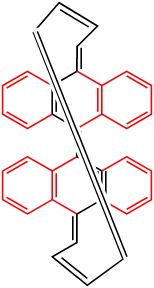
    In 1988, Wilke[cite]10.1002/anie.198801851[/cite] reported molecule 1

    A [24] annulene. Click on image for model.
    A 24-annulene. Click for 3D.

    It was a highly unexpected outcome of a nickel-catalyzed reaction and was described as a 24-annulene with an unusual 3D shape. Little attention has been paid to this molecule since its original report, but the focus has now returned! The reason is that a 24- annulene belongs formally to a class of molecule with 4n (n=6) π-electrons, and which makes it antiaromatic according to the (extended) Hückel rule. This is a select class of molecule, of which the first two members are cyclobutadiene and cyclo-octatetraene. The first of these is exceptionally reactive and unstable and is the archetypal anti-aromatic molecule. The second is not actually unstable, but it is reactive and conventional wisdom has it that it avoids the undesirable antiaromaticity by adopting a highly non-planar tub shape and hence instead adopts reactive non-aromaticity. Both these examples have localized double bonds, a great contrast with the molecule which sandwiches them, cyclo-hexatriene (i.e. benzene). The reason for the resurgent interest is that a number of crystalline, apparently stable, antiaromatic molecules have recently been discovered, and ostensibly, molecule 1 belongs to this select class!

    So is 1 actually anti-aromatic? Let us look at some of the ways in which this might be estimated.

    1. One can inspect the bond lengths, measured from X-ray analysis. The longest is 1.463Å, labelled a above, and it corresponds to a single bond (value from the crystal structure).
    2. If the molecule had a bond alternating structure, the adjacent bonds would be expected to be much shorter, in the region of 1.32Å. In fact, they are rather longer, at 1.37Å. Indeed, in the cycloheptatriene part of the molecule, the alternation is much less than one might expect of an anti-aromatic molecule, oscillating between 1.37 and 1.43Å.
    3. One can also inspect aromaticity via a variety of magnetic indices. The simplest of these is the NICS probe. Placed at a ring centroid, a negative value of this index of around -10ppm indicates aromaticity (this is the value for benzene), whilst a strongly positive value (of up to +20 ppm) indicates anti-aromaticity. Molecule 1 has two potential centroids, one placed at the absolute centre of the system, and one placed at the centroid of the ~6-membered ring completed using bond b (in reality, the centroids were computed from the positions of ring critical points obtained from an AIM analysis). The NICS values at these two positions are both ~-4.4 ppm (See DOI: 10042/to-2156 for details of the calculation). These values does not indicate antiaromaticity! They could even be described as mildly aromatic. So what is going on?
    4. What about the chemical shifts of the other protons? All the hydrogens attached to sp2 carbons are predicted to resonate at around 6.7ppm (unfortunately Wilke does not report the experimental spectrum), which is typical of an aromatic system (anti-aromatic systems have high upfield shifts for such protons, at around 2ppm or even -2 ppm, see [cite]10.1021/ol703129z[/cite] for examples). The two protons of the methylene bridges are also quite different; 2.9 and 0.8 ppm. The latter is the proton endo to the cycloheptatrienyl ring, and is typical of a proton placed in the anisotropic magnetic shielding region of e.g. benzene. Thus the cycloheptatrienyl ring is itself behaving as if it were aromatic, whereas the overarching 24-annulene ring is certainly not behaving as if it were antiaromatic.

    One possible explanation involves a concept known as homoaromaticity. The bond marked as b could be regarded as completing the 6π-electron local aromaticity of that ring (it would be formally considered as a 1π-electron bond, with no underlying σ-framework, see [cite[10.1021/ct8001915[/cite] for further detail). Well characterised examples of such neutral homoaromatics are in fact very rare indeed; the phenomenon is thought to manifest mostly through cationic homoaromatics (i.e. the homotropylium cation, see [cite]10.1021/jo801022b[/cite] for discussion). So has the case been made for 1 being the first clear cut example of a neutral homoaromatic molecule, containing no less than four rings exhibiting this type of aromaticity?

    There is one further concept that can be introduced. Clar (for a discussion, see DOI: [cite]10.1021/cr0300946[/cite] proposed that benzenoid 6π-electron local aromaticity is preferred to less local or more extended cyclic conjugations, if the two compete. Many examples in a type of compound known as polybenzenoid aromatics are known where the most favourable resonance structure is that which maximises the number of Clar rings. More recently, quite a few ostensibly antiaromatic molecules have been shown to attenuate this unfavourable effect by forming instead groups of aromatic Clar islands containing delocalized benzene like rings (discussion of this point can be found at [cite]10.1039/b810147g[/cite]. In molecule 1, we could have a new phenomenon; a homoClar ring, formed to avoid antiaromaticity.

    For further discussion, see the comment posted to Steve Bachrach’s blog.

  • Conformational analysis and enzyme activity: models for amide hydrolysis.

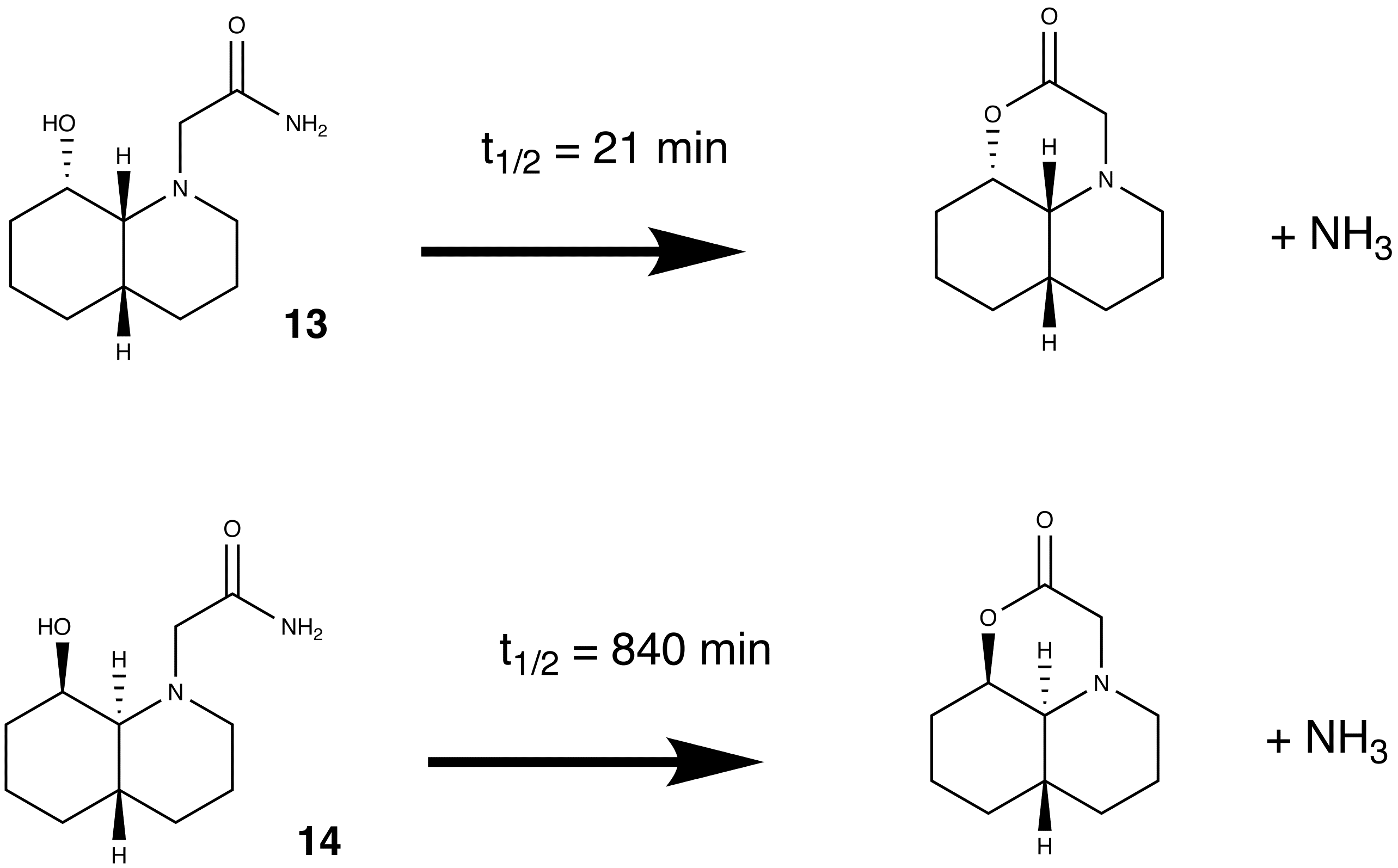
    The diagram below summarizes an interesting result recently reported by Hanson and co-workers (DOI: 10.1021/jo800706y. At ~neutral pH, compound 13 hydrolyses with a half life of 21 minutes, whereas 14 takes 840 minutes. Understanding this difference in reactivity may allow us to understand why some enzymes can catalyze the hydrolysis of peptides with an acceleration of up to twelve orders of magnitude.

    Models for peptide cleavage.
    Models for peptide cleavage.

    The secret to understanding this behaviour lies in a technique known as conformational analysis, for which Derek Barton was awarded a Nobel prize. Indeed, the very molecules for which he first developed his technique were the decalins, of which molecule  13 is an example of a cis-decalin and 14 a trans-decalin. Barton’s insight was to recognize that both types of ring prefer to exist in chair conformations rather than the alternative boat shape.

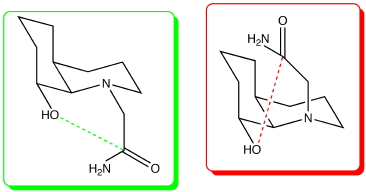
    The technique pioneered by Barton for estimating the energies of these various conformations is called Molecular Mechanics, and can be used to explain the difference in reactivity. Considering first molecule 13, one can calculate its molecular mechanics energy for two conformations, differing in whether the N-alkyl sidechain is equatorial (left) or axial (right).

    Cis amide
    Cis amide. Click for Equatorial 3D.
    The equatorial form (green box) comes out about 5 kcal/mol lower in energy than the axial (red box). One can also calculate the energy of the product, which arises from the OH attacking the carbon of the amide (dashed lines), evicting ammonia, and forming a cyclic lactone. Here, the most stable product (by ~10 kcal/mol) is again that resulting from the green bond forming. From the simple relationship ΔG = -RT Ln K (where K describes the position of the equatorial/axial equilibrium), one can conclude that the ratio equatorial/axialis ~4000, i.e. the favoured reaction arises from the most abundant reactant.

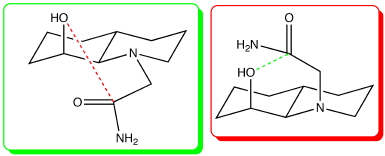
    Trans amide
    Trans amide. Click for 3D.
    With the trans amide, the equatorial conformation (green box) is around 3 kcal/mol lower than the axial (red box), but now the most stable lactone product (by ~ 3 kcal/mol) arises (green bond) from the less stableaxial reactant. For reaction to occur, the equatorial reactant has to first isomerise to the axial, which imposes a ~3 kcal/mol penalty on the reaction. This is enough to slow the rate of the reaction significantly compared to the un-penalised cis-decalin reaction.


  • How do molecules interact with each other?

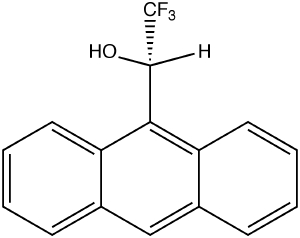
    Understanding how molecules interact (bind) with each other when in close proximity is essential in all areas of chemistry. One specific example of this need is for the molecule shown below.

    The Pirkle reagent
    The Pirkle reagent

    This is the so-called Pirkle Reagent and is much used to help resolve the two enantiomers of a racemic mixture, particularly drug molecules. The reagent binds to each enantiomer of a racemic drug differently, and this difference can be exploited by using e.g. column chromatography to separate the two forms. The conventional wisdom is that such chiral recognition occurs via a three-point binding model. In other words, at least three different interactions must occur between the Pirkle reagent and the drug to allow such chiral recognition.

    So how do we identify where these bindings might occur? A good place to start is to look at the self-binding of the Pirkle reagent, in other words, how does it interact with itself in the crystal state? An X-ray structure of the pure enantiomer of the Pirkle reagent shows that it binds with itself to form a loose dimer. We are now in a position to analyze exactly how this binding occurs. To do this, we are going to invoke a technique known as Atoms-in-molecules or AIM. This effectively looks at the curvature of the electron density in the dimer, and from the characteristics of this curvature, identifies a series of so called critical points, or regions where the first derivative of the electron density (referred to as ρ(r) ) with respect to the geometry is zero. These critical points come in four varieties only;

    1. A nuclear critical point, which almost exactly corresponds to where the nuclei are
    2. A bond critical point, which is the key to understanding not only where actual bonds are in the molecule, but also a range of weaker interactions which are conventionally not graced with the term bond, but which nevertheless can be essential in understanding how to molecules interact weakly with each other.
    3. The remaining two types of critical point relate to rings and cages, and we will not be concerned further with them here.

    The electron density required for this analysis could in principle come from the X-ray measurements themselves, but it is not easy to acquire this to the required accuracy (although it can be done). In this case, it is easier (and probably no less accurate) to calculate the density from a DFT-based quantum mechanical calculation. The result of this is shown below.

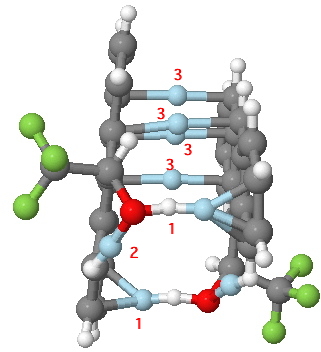
    Pirkle dimer. Click on image to obtain model
    Pirkle dimer. Click for 3D.

    The light blue spheres show the position of selected bond critical points or BCPs in the AIM analysis. So what do they tell us about how two molecules of Pirkle molecule interact with each other? Three different points labelled 1-3 are highlighted for discussion.

    1. Points 1 connect the hydrogen of the OH group with the carbons of the π-face of the anthracene ring (the left ring of the molecule as shown above). This is an unusual type of interaction known as a π-facial hydrogen bond, and it has only been recognized as such in the last 30 years. Note that this interaction is not restricted to occur just between a pair of atoms, but can involve more (in this case almost a whole benzene ring). By finding the value of the electron density ρ(r) at this BCP, one can estimate the energy of interaction resulting from its formation. In this case, ρ(r) ~ 0.014 au, and comparison with other types of hydrogen bond suggests that this value corresponds to an interaction energy of around 2.5 kcal/mol. This is a little weaker than a conventional OH…O hydrogen bond, but is still quite significant. Two of these interactions occur in this Pirkle dimer.
    2. Points 2 are equally unexpected. They connect the oxygen of the same OH group involved in the previous interaction, and one of the ring C-H groups. Again, that C-H…O groups can interact has only been recognized relatively recently. The value of ρ(r) of ~ 0.018 indicates a hydrogen bond strength of ~3 kcal/mol, again hardly insignificant.
    3. There are four specific interactions of the final type 3. These occur in the region of overlap of the two anthracene rings, and these are referred to as π-π stacking interactions. Again, the ρ(r) of ~ 0.005, calibrated against known systems, suggests that each is individually worth around 1 kcal/mol.

    So adding up all eight interactions indicates that the two molecules of the Pirkle reagent have an interaction energy of around 15 kcal/mol resulting just from these weak bonds (there are other types of interactions between two molecules known as dispersion forces, which also contribute), and which together provide more than enough free energy to overcome the entropy required to bring the two molecules together.

    Armed with tools such as AIM, one can now be more confident in analyzing the various terms that contribute to two molecules interacting with each other, and in the case of chiral molecules, how these interactions may result in chiral recognitions.

  • Aromatic electrophilic substitution: a different way of predicting regiospecificity


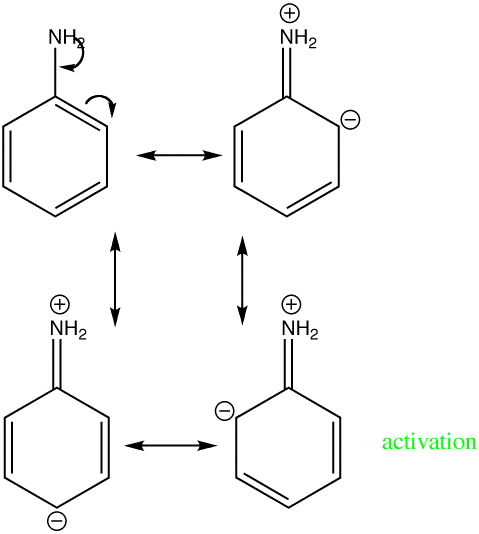
    Every introductory course or text on aromatic electrophilic substitution contains an explanation along the lines of the resonance diagram shown below. With an o/p directing group such as NH2, it is argued that negative charge accumulates in those positions as a result of the resonance structures shown.

    groups1
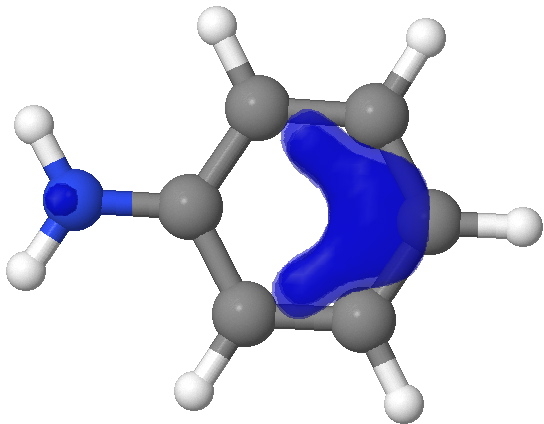
    MEP for PhNH2. Click for 3D.
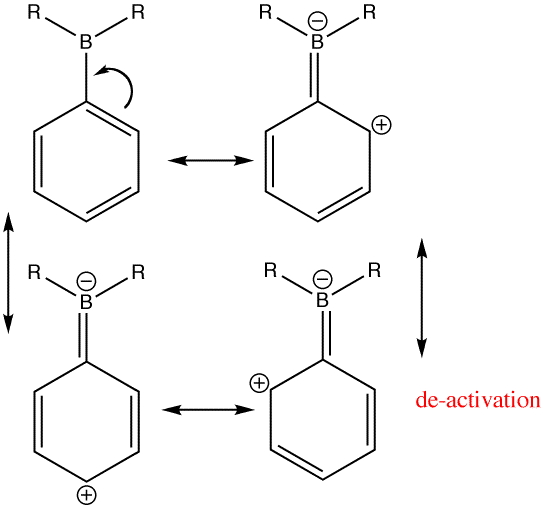
    The opposite occurs for electron withdrawing groups. Shown below is a group such as BR2, a somewhat unusual choice it has to be said (and indeed rather un-represented in the literature as well).

    groups2
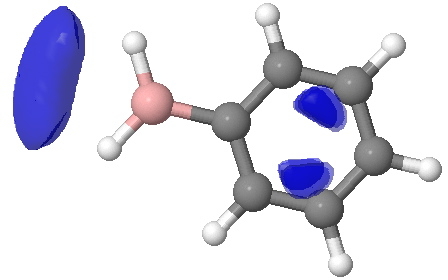
    MEP for PhBH2. Click for 3D.

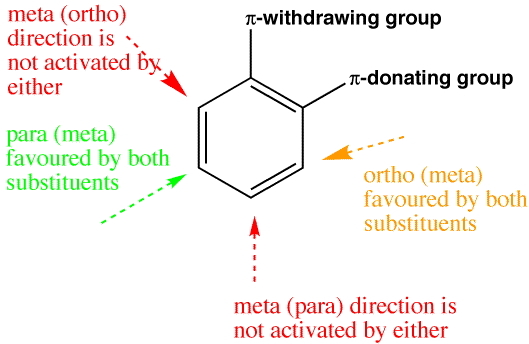
    But stick with me for a little while on this one, since we are now going to pose the question: what the result of combining both groups onto the same aryl ring, as below?

    mixed2
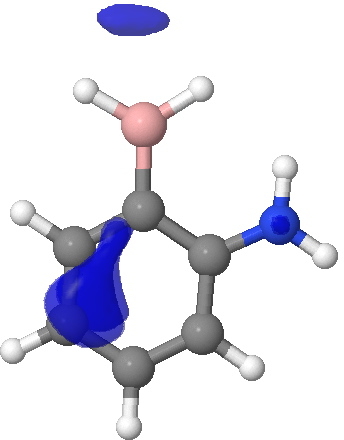
    MEP for PhBH2NH2. Click for 3D.

    The conventional outcome, based on the resonance forms shown in the first two diagrams, is that the two positions annotated with red text are disfavoured, and the two positions labelled with green or orange text are both favoured. Thus far, we are still in “exam question territory”. Reality however intrudes. When a similar combination of electron withdrawing and donating groups is tried out in the lab, only the green outcome is observed, and not the orange. So finally, the point of this blog. Is there any other tool we can use to (correctly) predict the outcome of this particular reaction?

    One way of mapping where charge in a molecule accumulates or decreases is a property known as the molecular electrostatic potential (see 10.1021/ja973105j and references cited there for details). Put simply, it measures how attractive (blue) or repulsive (red) any region of the molecule is to a proton placed at any point surrounding the molecule. Mapping these regions produces so-called iso-surfaces, where the measure of repulsion or attraction is the same everywhere on this surface.

    So now, if you click on the first diagram, you will see this MEP. Notice how it is blue close to the o or p positions, and does its best to avoid the m position.

    Molecular electrostatic potential
    Molecular electrostatic potential

    Clicking on the second diagram will reveal the opposite.

    Molecular electrostatic potential
    Molecular electrostatic potential

    Thus far this simple picture is in perfect accord with the simple resonance diagrams we started with. But the advantage of this MEP method is that the effects of two (or indeed more) substituents can be properly combined to give an overall effect. Thus in the third diagram, you can now see that the blue accumulates only over the green-text region, and not at all over the orange-text region!

    Molecular electrostatic potential
    Molecular electrostatic potential

    OK, one can derive a resonance structure in 5 seconds in an exam. One can hardly compute a MEP under such conditions. But what this example shows is that sometimes, quantum mechanics produces results which cannot be simply reduced to memorable rules, but must be applied natively to get the correct result.

  • A lab in a backpack

    We recently developed a new computational chemistry practical laboratory here at Imperial College. I gave a talk about it at the recent ACS meeting in Salt Lake City. If you want to see the details of the lab, do go here. The talk itself contains further links and examples. Perhaps here I can quote only the final remark, namely that computational chemistry can now provide chemical accuracy for many problems, including spectroscopy and mechanism, and that the basic tools for doing it can easily be carried around in a backpack! Or, perhaps in the not to distant future, an iPhone!

  • On the importance of Digital repositories in Chemistry

    The preceeding blog entries contain stories about chemical behaviour. If you have clicked on the diagrams, you may even have gotten a Jmol view of the relevant molecules popping up. But if you are truly curious, you may even have the urge to acquire the relevant 3D information about the molecule, and play with it yourself. Even after 15 years of the  (chemical) Web, this can be distressingly difficult to achieve (or can it be that it is only myself who wishes to view molecules in their  native mode?).  Thus the standard mechanism is to seek out on journal pages that disarming little entry entitled  supporting information and to hope that you might find something useful embedded there.  Embedded is the correct description, since the information is often found within the confines of an Acrobat file, and has to be extracted from there.  Indeed, that is what  I had to resort to in order to write one of the blog entries below. I ground my teeth whilst doing so. 
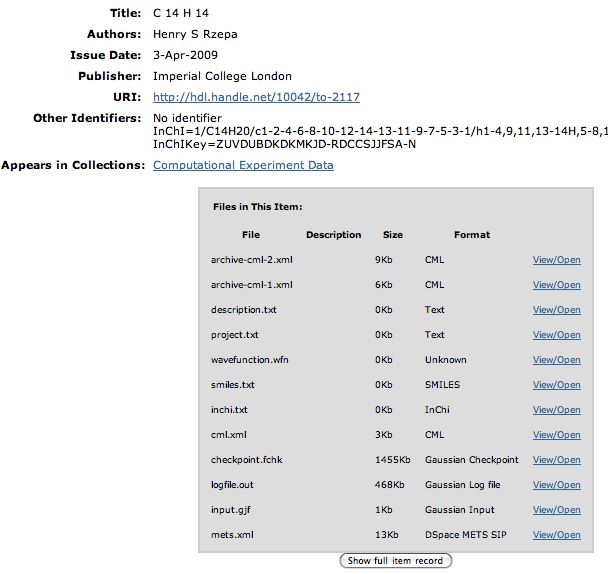
    blog11
    So is there a better way? We think so! The  digital repository. If you click on this you should see the entry directly. What can you do there? Well, if you have suitable programs, you can download eg a Checkpoint file of the calculation that created the molecule model and re-activate it there. Or you can download just the CML file for viewing in any CML-compliant program (such as e.g. Jmol). Or you can check up on the InCHi string or the InChI Key of the molecule.

    What about the specific entry above? Well, it corresponds to the calculation for the π4 + π2 cycloaddition described in the blog entry below. You can now verify for yourself the assertions made in that entry, ie that the rotation mode is disrotatory, or that the bond is forming antarafacially. You do not need to take my word for it! If the Digital repository is too much trouble for you, click on the graphic instead to get a similar result.

    We now regularly put such links into journal articles, in the form of Web-enhanced tables and figures, so that it is literally just one click away from such an article to having a vibrant molecule dancing in front of you. All (chemistry) journals should do this. If they do not yet, then contact their editor in chief when you next submit an article and ask them why not!

    See also the blog by Peter Murray-Rust.

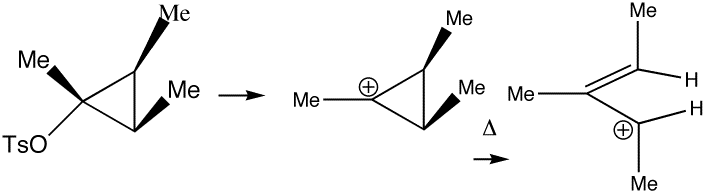
  • Pericyclic assistance for SN-1 solvolysis

    Pericylically assisted solvolysis. Click above to see model.
    Click on diagram to see model.

    The reaction above is ostensibly a very simple pericyclic ring opening of a cyclopropyl carbocation to an allyl cation, preceeded by a preparatory step involving SN-1 solvolysis. As a 2-electron thermal process, the second step proceeds with disrotation of the terminii. Can this stereochemistry be illustrated with a computed model for the transition state for this process? Well, starting with a naked cation, its actually quite tricky to find such a transition state. In reality such cations are always solvated in real reactions, and a gas phase model is actually somewhat artificial. A much better bet is to also include in the model the SN-1 step that is presumed to preceed the actual pericyclic ring opening. Here we have included a simple protonated water molecule as the leaving group, rather than the tosyl group shown in the diagram above. Now when attempts are made to locate the ring opening transition state, it turns out that the SN-1 reaction and this ring opening are strongly coupled together. The ring opening helps to evict the water, or alternatively, one can look on it as the departing water helping to open the ring.


    Such an intimate coupling of one mechanistic type (a pericyclic reaction) with another (SN-1 solvolysis) is a relatively unrecognized aspect of reaction mechanisms (although of course it is one of the characteristics of enzyme-catalysed reactions). I will cover several other examples of such synchrony in mechanisms in future entries in the blog.


    DOI: 10.14469/hpc/11096


  • A Disrotatory 4n+2 electron anti-aromatic Möbius transition state for a thermal electrocyclic reaction.

    Mauksch and Tsogoeva have recently published an article illustrating how a thermal electrocyclic reaction can proceed with distoratory ring closure, whilst simultaneously also exhibiting 4n electron Möbius-aromatic character[cite]10.1002/anie.200806009[/cite]. Why is this remarkable? Because the simple Woodward-Hoffmann rules state that a disrotatory thermal electrocyclic reaction should proceed via a Hückel-aromatic 4n+2 electron transition state. Famously, Woodward and Hoffmann stated there were no exceptions to this rule. Yet here we apparently have one! So what is the more fundamental? The disrotatory character, or the 4n/Möbius character in the example above? Mauksch and Tsogoeva are in no doubt; it is the former that gives, and the latter is correct.

    So inevitably one has to ask; are there other examples? Well, during the annual updating of my own lecture notes on pericyclic reactions, I had decided to revisit a fascinating reaction, which we had first looked at years ago (below).

    Electrocylization of [14] annulene
    Electrocylization of 14 annulene. Click above to obtain model

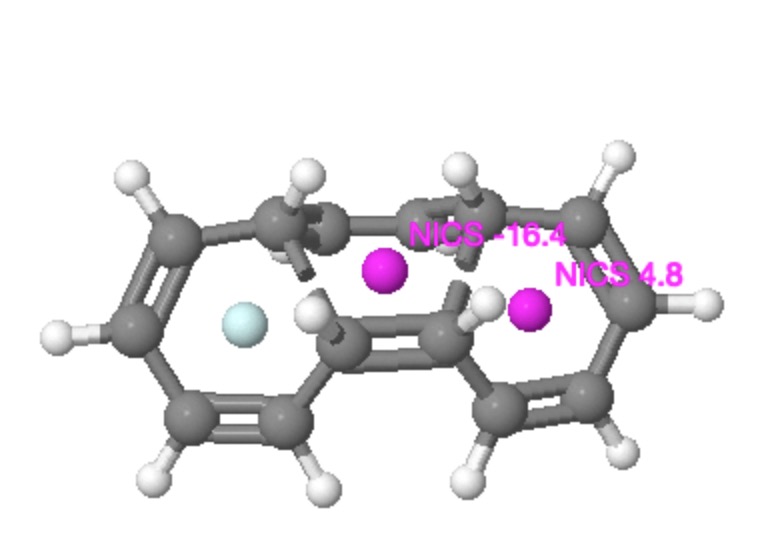
    Let us focus specifically on the last reaction, which involves cyclization of a [14] annulene. The pedagogic interest was to challenge the students as to whether this was a π4+π2 endo cycloaddition, or two 6-electron electrocyclizations. The answer of course was that either way of considering this reaction was equally valid and both modes were presumed to proceed via Hückel-aromatic transition states. I had said as such in my lectures for many years. This year, I finally decided to evaluate the NICS index to verify this long stated hypothesis. NICS is a magnetic index which yields a negative value (of -10 to -16 ppm) for aromatic rings, and positive values for antiaromatic rings.

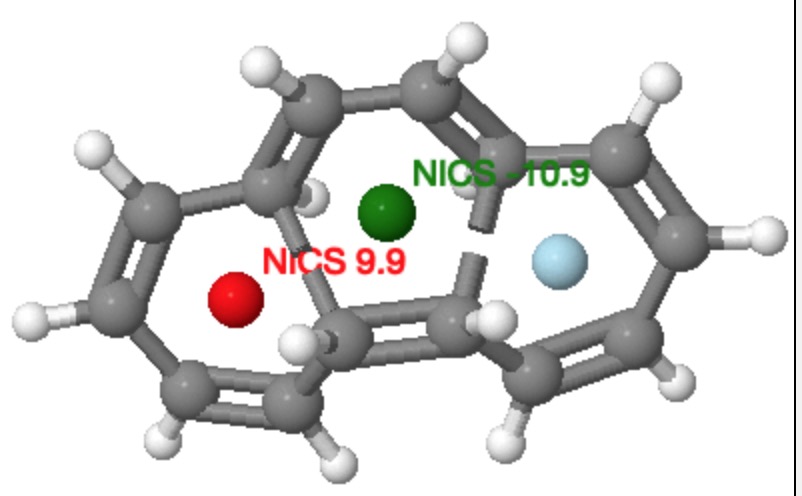
    I was fully expecting to get negative values for all three rings at the transition state. Of course, this result was not obtained! Instead, whilst the central ring did have a negative value (of -16.4 ppm), the two outer rings had the initially mystifying value of +4.8! In other words they were antiaromatic. The electron count was in no doubt, ie 4n+2 (six). The transition state stereochemistry was clearly disrotatory. But the resulting transition state ring was antiaromatic and not aromatic! Well, close (and this is why it helps to have models) inspection reveals that despite the disrotation, the bond which is being formed actually does so antarafacially, and that the topology of this transition state is actually Möbius and not Hückel. A little more thought reveals that a thermal Möbius transition state with 4n+2 electrons must be antiaromatic. So we conclude by saying that a second example of how a disrotatory reaction can actually have Möbius character has now been revealed. Unlike the example shown by Mauksch and Tsogoeva, this Möbius transition state is actually anti-aromatic, the first example of such which has been postulated.

    That the disrotatory mode is not the fundamental here is shown by the alternative exo cycloaddition isomer of this transition state. The antarafacial nature of the bond formation is retained in the electrocyclisation region, but now the disrotation is replaced by conrotation. The two electrocyclic rings however retain their anti-aromaticity, as appropriate for a 4n+2 conrotatory electrocyclic reaction. Notice also how for both the examples, the bond lengths in the aromatic central cycloaddition ring are fully delocalized (equalized, ~1.4Å), whereas for the two outside rings, they are full localized (with long ~1.480Å and short ~1.345Å bond lengths). These two properties are of course characteristic for aromatic and antiaromatic rings.

    Let’s also take a look at the example preceeding the  [14] annulene, which is the analogous reaction of a [16] annulene. This reaction takes the phenomenon one stage further. The central ring is formed by a π4a + π4s cycloaddition via a Möbius aromatic transition state, whilst the two outer rings are again Möbius antiaromatic transition states, but now with conventional conrotation rather than disrotation.

    Oh, there are other reactions in the above scheme. They, it turns out, are equally fascinating. But I will leave analysis of that to another day.

    (See also Steve Bachrach’s blog)