Blog

  • Capturing penta-coordinate carbon! (Part 2).

    In this follow-up to the previous post, I will try to address the question what is the nature of the bonds in penta-coordinate carbon?

    This is a difficult question to answer with any precision, largely because our concept of a bond derives from trying to define what the properties of the electrons located in the region between any two specified atoms are. Such a local picture is somewhat at variance with the idea of electrons being delocalized across the entire molecule. Two procedures for analyzing the local electronic behaviour which we have been using recently are AIM (Atoms-in-Molecules) and ELF (the topology of the Electron localization function). There are many useful published articles which elaborate these concepts; if you want to read some of them, start at DOI 10.1021/ct8001915 and follow the cited articles.

    Firstly, the AIM analysis of the system below, where X=cyclopentadienyl anion and Y=CN.
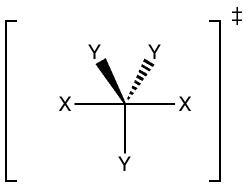
    The Sn2 transition state
    The Sn2 transition state

    This is shown below. If you click on the image, you will see a rotatable version of this diagram. The coloured (red, yellow and green) dots represent so-called critical points in the curvature of the electron density function ρ(r). The red dots are known as bond critical points, or BCPs. These (almost) always are found along the line connecting two atoms which we tend to refer to as a bond. You will see two that have been circled in the diagram below, and these appear to show a bond connecting the central 5-coordinate carbon atom and a carbon of each of the cyclopentadienyl rings (which themselves are revealed as rings by the presence of a yellow dot). Indeed, that central carbon atom does seem to have five red dots radiating out along lines connecting it to five carbon atoms.
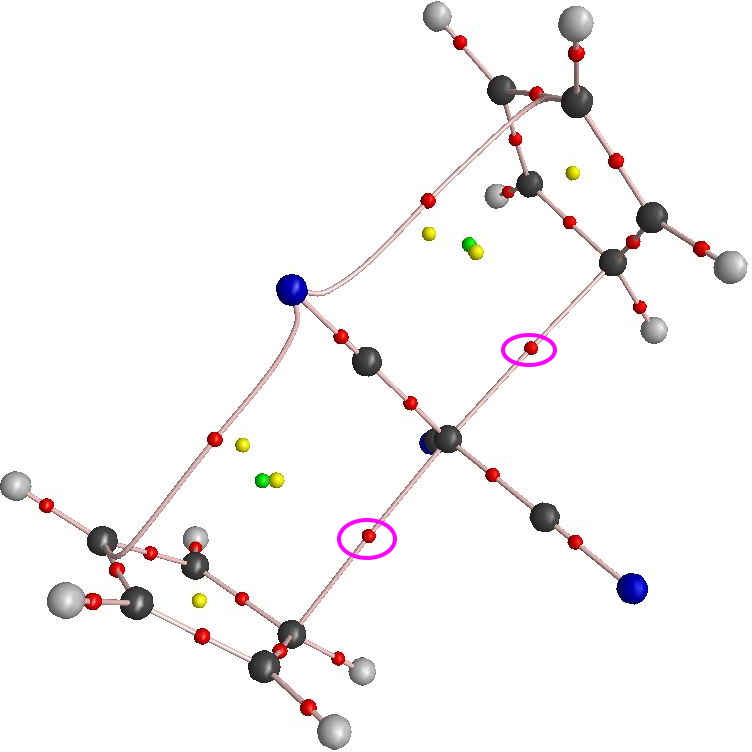
    AIM analysis (red = bond critical points, yellow = ring, green = cage)
    AIM analysis (red = bond critical points, yellow = ring, green = cage)
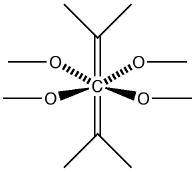
    So is the case proven for pentavalent carbon? Well, no. Firstly, one has to inspect the value of ρ(r) at the circled red dot. This has a (calculated) value of 0.022 au and a calculated bond length of ~2.7Å. We need to calibrate this against a real system as reported in DOI: 10.1021/ja710423d (below):

    Hexa-coordinate carbon
    Hexa-coordinate carbon. Click for 3D model
    Here, the electron density ρ(r) was actually measured using X-ray diffraction, and found to be ~0.017 for bond critical points found connecting the central carbon and each of the four oxygen atoms. The length of these “bonds” was measured as  ~2.7Å. The agreement with our frozen transition state is quite striking.

    One can go a little further and inspect the (2nd) derivative of the electron density at the bond critical point, termed the Laplacian, or ∇2ρ, which tells what kind of “bond” one might have. The measured value of ∇2ρ for the system above was ~0.06 au, and the calculated value for our pentacoordinate system is 0.04 au, which again suggests we are dealing with a very similar interaction in both systems (one hypothetical and calculated, the other real and measured). The use of the term  interaction was deliberate.  It is less loaded than the term  bond. Thus the value of ρ(r) for an undisputed C-C single bond is around 0.28 au, around ten times higher than our putative bonds. Since we do not really wish to grace a ρ(r) value of 0.022 with the term decibond (or any other fraction of a single bond) perhaps it is best to call it just an interaction, and leave open the question of how strong that interaction is! So, despite the  AIM analysis  finding a bond critical point, we shall settle for interpreting that merely as an interaction, and not a bond!  Well, is an interaction (or come to that, a decibond) worthy of counting towards a coordination?  Perhaps!

    So AIM can provide information about the curvature and density of the electrons in the region of a bond/interaction. But it does not provide any information about another simple question which the term bond implies. How many electrons might be involved? Ever since  G. N. Lewis coined the term two-electron bond in 1916,  we have become used to interpreting bonds in terms of simple (often integer) numbers of electrons.  A carbon-carbon single bond shares two electrons; a double bond four electrons, and so on. We use this concept all the time in the technique known  as arrow-pushing, which helps us delineate mechanisms of reactions. Might it be possible to  identify how many electrons are involved in bonds/interactions of the captured  SN2 species above? Enter the ELF technique. It would not be appropriate to delve into the theory of this method here; suffice to say that  (approximately), the  bond-critical-point of the  AIM analysis in this case would map to a disynaptic basin for ELF. Thus a two-electron single bond will reveal a disynaptic basin (the centroid of which approximately matches the position of the  AIM BCP), which can be integrated to approximately two electrons. Shown below are the centroids of the disynaptic basins calculated for our SN2 species:
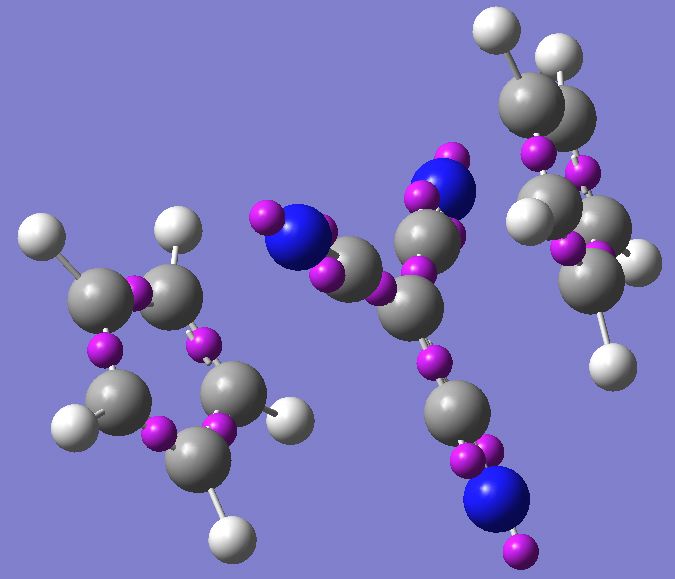
    ELF basins (purple dots) for the SN2 system
    ELF basins (purple dots) for the SN2 system. Click for 3D model
    The most striking difference with the AIM analysis is that that the central carbon is surrounded only by three, not five disynaptic basins. The BCPs found for the two di-axial interactions have no counterpart in synaptic basins. Of course, that does not mean that there are no electrons that can be integrated in that region, just that the curvature of the density in that region is not sufficiently well defined to define a bounded volume of space which can be clearly integrated. Perhaps that condition is what we might mean by a bond!

    The three disynaptic basins that do surround the central carbon integrate to a total of 7.85 electrons, which is close enough to 8 for us to say that this carbon is NOT hypervalent!

    So what is our final conclusion? The frozen SN2 species is not hypervalent. It could reasonably be said to be coordinated by three bonds, and two diaxial substituents that interact with the central carbon weakly. Perhaps rather than penta-coordinate, the central carbon could be described as pentacoordinaloid!
  • Capturing penta-coordinate carbon! (Part 1).

    The bimolecular nucleophilic substitution reaction at saturated carbon is an icon of organic chemistry, and is better known by its mechanistic label, SN2. It is normally a slow reaction, with half lives often measured in hours. This implies a significant barrier to reaction (~15-20 kcal/mol) for the transition state, shown below (X is normally both a good nucleophile and a good nucleofuge/leaving group, such as halide, cyanide, etc.  Y can have a wide variety of forms).

    The Sn2 transition state
    The Sn2 transition state

    This transition state is normally regarded as the only situation in which carbon can sustain penta-coordination (there are some exceptions), and this is often contrasted with the analogous situation for silicon, which demonstrates an abundance of stable penta- (and hexa-)coordinate (crystal) structures. Perhaps inevitably therefore, chemists have set themselves the goal of capturing a penta-coordinate carbon, not as a transition state with fleeting lifetime, but as a stable (and perchance crystalline) species.  The best strategy is to explore potential systems computationally, and the latest report of such an exploration has some suggestions for synthesis (Pierrefixe, S. C. A. H.; van Stralen, S. J. M.; van Strale, J. N. P.; Guerra, C. F.; Bickelhaupt, F. M., “Hypervalent Carbon Atom: “Freezing” the SN2 Transition State,” DOI: [cite]10.1002/anie.200902125[/cite]). Their suggestion corresponds to Y=CN and X=At (Astatine), a rather esoteric combination it has to be said.  In the manner of the blogosphere, Steve Bachrach has noted this report in his own blog, where a discussion has opened up on the origins of why carbon can be regarded as abnormal (at least compared to silicon), and more particularly whether such a species should be regarded as merely hypercoordinate, or as Bickelhaupt and co-workers suggest, hypervalent.

    In fact, such reports are not new. As I note in the discussion of Steve’s blog, a crystalline structure of a hexa-coordinate carbon compound was reported in 2008 (DOI: [cite]10.1021/ja710423d[/cite] (below), and it is also tentatively described as possibly hexavalent near the end of the article! I shall return to this compound in the second part of this post.

    Hexa-coordinate carbon
    Hexa-coordinate carbon

    The astatine system reported above is unusual, and it really only contains three carbon-carbon bonds surrounding the pentacoordinate carbon. The compound above contains only two such C-C “bonds”. It would be perhaps more interesting to ask if one could design a compound with five C-C bonds surrounding the putative pentacoordinate atom. Whilst mulling over Steve’s post, and pondering my contribution to that blog, a colleague in my department wandered into my office (my door is almost always open) and without saying a word, he wrote a structure on my blackboard (yes, I really do have such).  He then walked out (almost;  I believe he did mutter perhaps two words before leaving). He had sketched the key feature of an article by Ethan L. Fisher and Tristan H. Lambert entitled Leaving Group Potential of a Substituted Cyclopentadienyl Anion Toward Oxidative Addition (DOI: [cite]10.1021/ol901598n[/cite]). This triggered the following question in my mind: could the aromatic cyclopentadienyl anion act as the X group in the pentacoordinate carbon example above? The essential property of group X is that it must be big!  Well, cyclopentadienyl can be made big! It would also achieve the purpose of forming a penta-coordinate carbon with  five  C…C bonds.

    So in it goes for a B3LYP/6-311+G(2df) calculation. Surely, the life of a computational chemist is an easy one; all one  has to do is wait a few hours (or, with a large basis set, days) for an answer. The result is shown below.

    The SN2 reaction captured with cyclopentadienyl anion
    The SN2 reaction captured with cyclopentadienyl anion

    The key vibrational mode (which you can see animated if you click on the image above) has a wavenumber of 194 cm-1 (B3LYP/6-311+G(2df); other basis sets show similar values). It corresponds to the SN2 mode,  and is what we normally think of as the  transition or reaction normal mode for this reaction. But  in this case, it is not an imaginary mode, but a real mode!  The SN2 has been (virtually) captured for a penta-coordinate carbon with five C…C interactions. How does it compare with the astatine system noted in [cite]10.1002/anie.200902125[/cite]? Well, unfortunately, the umbrella-mode for that system  is only reported as a force constant without mass weighting, so it cannot be compared to the mass-weighted value we have here. The calculation is digitally archived (e.g. as 10042/to-2407 or 10042/to-2415) so you can analyze it for yourself!

    An obvious question to ask is what the nature of the  axial bonds for X=cyclopentadienyl is. Is the central carbon hypercoordinate, or hypervalent, or both? But this blog is quite long enough already, and so this will all be discussed in part 2, to follow shortly.

    Oh, one final comment. The issue of hypervalency and hypercoordination of carbon has previously been discussed largely in conventional scientific publications (for which DOIs are provided above). The forum moved to Salt Lake  City in the  USA, where some of the results were presented orally at the ACS spring conference in 2009.  Now that it  has been formally published, it has been taken up by Bachrach in his blog, where some of the discussion has continued. So where should I have presented the present result?  In the primary scientific literature? Or perhaps another ACS meeting? Well, here it is in another blog (I have been variously told I am either brave or very foolish for doing so!). And as I write this, of course it is not peer reviewed (but there is nothing to stop people from commenting on this of course, as has happened in Bachrach’s blog). Will it “count” here – in other words, does it (yet) have any scientific respectability? Should  blogs report new scientific results, or merely be reserved for commenting on such results which have been reported in the “proper scientific manner”? Will indeed this result appear in the future in the scientific literature under different authorship, but with no accreditation for this blog? If I do choose to “write it up properly” (assuming the journals now let me), can I cite this blog in the way one can cite the ACS conferences? I do not suppose many people know what the answers are to all these questions. Perhaps the appearance of this post might provide some?

  • Spotting the unexpected: Anomeric effects

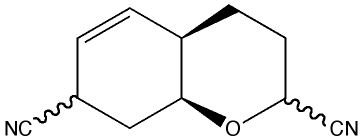
    Chemistry can be very focussed nowadays. This especially applies to target-driven synthesis, where the objective is to make a specified molecule, in perhaps as an original manner as possible. A welcome, but not always essential aspect of such syntheses is the discovery of new chemistry. In this blog, I will suggest that the focus on the target can mean that interesting chemistry can get over-looked (or if observed, not fully exploited in subsequent publications). Taking a synthesis-oriented publication at (almost) random entitled Synthesis of 1-Oxadecalins from Anisole Promoted by Tungsten (DOI: 10.1021/ja803605m) which appeared in 2008, the following molecule appears as one of the (many) intermediates.

    A cyano-substituted cis decalin
    A cyano-substituted cis decalin. Click for 3D
    This molecule has an X-ray structure reported, as a means of confirming the stereochemistry at the various centres, and particularly at the carbons bearing a cyano group. Labelled as compound  22 in the publication, there is no discussion or follow-up on the resulting conformation of this compound, which in fact adopts one with both cyano groups axial (there are three other possibilities of course,  in which the cyano groups can be both equatorial, or one axial and the other equatorial). A B3LYP/6-31G(d,p) calculation of these conformations confirms that the di-axial isomer is indeed the most stable (see for example DOI: 10042/to-2402 for a digital repository entry for the calculation).

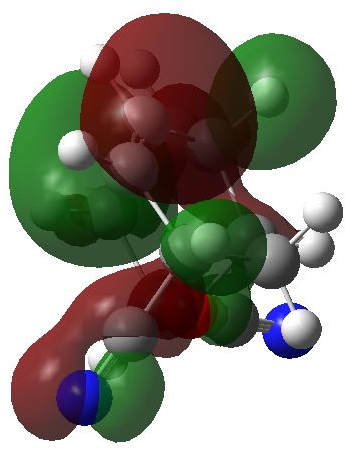
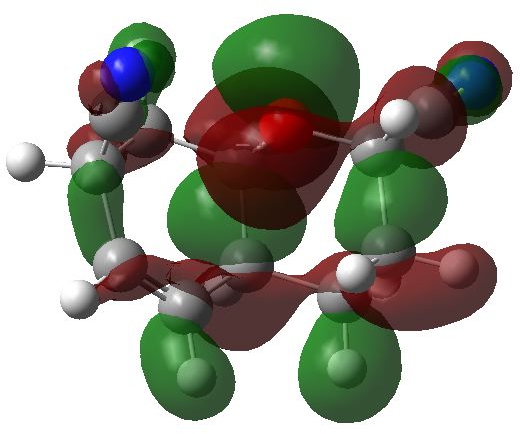
    An inspection of the  molecular orbitals for the di-axial isomer reveals that the HOMO involves interaction of the alkene π-MO with the  C…CN bond (top) and the HOMO-1 involves interaction of the oxygen lone pair with the  C…CN bond (bottom). This sort of interaction is a classical anomeric effect!

    HOMO.
    HOMO with alkene-cyano anomeric interaction. Click for 3D
    HOMO-1  showing anomeric interaction
    HOMO-1 with O-CN anomeric interaction. Click for 3D
    So what is unusual about it? Well, anomeric effects are normally described in text books and lecture courses as involving predominantly oxygen (and nitrogen) as an electron pair donor, and C…O (and C…N and C…F) σ-bonds as the acceptors. The stereoelectronic alignment of course has to be anti-periplanar, and this orientation will control how the anomeric effect operates. What you may not find in the text books is a C…CN bond as the electron acceptor! But if  e.g. C…F  can be one, why not  C…CN (the cyano group is often described as a pseudo-halogen).  If you inspect the  3D model above, you can see that the  C…CN bond associated with the adjacent oxygen is perfectly set up for anti-periplanar alignment with one of the oxygen lone pairs (an arrangement not possible if the  CN group had been equatorial).  The C…CN bond length (1.49 Å) is indeed about  0.02Å longer than one would normally expect of such a bond.

    Inspection of the  HOMO shows an almost identical interaction between the C…CN bond and the alkene, implying that here it is the electrons from an alkene that are the donor. This combination, of an alkene as donor and a C…CN group as an acceptor has  (to my knowledge) never been suggested as an anomeric effect pair. It is not as strong as before (C…CN 1.47Å) and perhaps in this case, it adopts the axial position because the alternative equatorial conformation is disfavoured for other reasons.

    But, and this is the point of this blog, the structure of compound 22 in the synthesis project above has some interesting aspects, which perhaps can lead to new insights and even new chemistry.  One can but wonder how many reported compounds have properties which are perhaps more interesting than their authors realize, and how much new chemistry is lurking in the literature which has not  (yet) been noticed. With more than 50,000,000 compounds now reported in Chemical Abstracts, there is surely lots out there to discover. However, will it be humans who will increasingly do so in the future, or automatons scouring the Semantic Web? But here we digress to a new topic!

  • (Hyper)activating the chemistry journal.

    The science journal is generally acknowledged as first appearing around 1665 with the Philosophical Transactions of the Royal Society in London and (simultaneously) the French Academy of Sciences in Paris. By the turn of the millennium, around 10,000 science and medical journals were estimated to exist. By then, the Web had been around for a decade, and most journals had responded to this new medium by re-inventing themselves for it. For most part, they adopted a format which emulated paper (Acrobat), with a few embellishments (such as making the text fully searchable) and then used the Web to deliver this new reformulation of the journal. Otherwise, Robert Hooke would have easily recognized the medium he helped found in the 17th century.

    In 1994, a small group of us thought that one could, and indeed should go further than emulated paper. We argued [cite]10.1039/C39940001907[/cite] that journals should be activated by delivering not merely the logic of a scientific argument, but also the data on which it might have been based. Of course, we encountered the usual problem; doing this might cost publishers more in production resources, and in the absence of a market prepared to pay the extra, the business model did not make sense (to the publishers). Well, 15 years later, and most publishers are indeed now thinking about how their journals can be enhanced. A number of interesting projects (the RSC’s Project Prospect is one which strives to bring science alive) have emerged. Another is the topic of this blog; the activation of the journal with molecular coordinates and data using the Jmol applet.

    Initially (~2005), this project met with resistance from publishers, and the issue really amounted to what the definitive version of a scientific article should be. Should that definitive version be printable? That model, after all had served the community well for more than 300 years! And journals from the very beginning are still as readable now as when first published. In other words, print lasts! But print is pretty limiting after all. For a start, it is limited to 2D static representations. Molecules, by and large, do their magic in a dynamic three dimensions (4D in an Einsteinian sense). But print is also expensive; not merely to produce, but to transport paper around the world.

    From the turn of the millennium, a number of publishers, amongst them the American Chemical Society, started to evolve the scientific article such that the pre-eminent version would now be considered to be the HTML form (perhaps as a prelude to phasing out print entirely? See an interesting commentary by a journal editor) and perhaps a digital Acrobat form which would be deemed to loose some of its functionality once printed (again see here for how Acrobat can be used to enhance things). Again however, a chicken-and-egg scenario resulted. To enhance the articles with extra functionality (such as data), they would need to find authors prepared to put the extra work into preparing the material. In fact, most authors already do that, but they call it supporting information. This is often highly data rich, covering materials such as spectra, coordinates and other information nowadays provided to researchers for analysis. Unfortunately, what has been missing is the education of authors to provide this information in a proper digital form which can be easily re-used by others, and on a Web page, converted automatically to nice interactive models. Most spectra which form part of the supporting information are in fact still scanned versions of printed spectra!

    Enter computational chemists. Nowadays, they live in a world that truly does not need printing! Almost all of their data is already suitably digital. So perhaps it is no surprise to find that when enhanced journal articles started appearing around 2005, many were produced by this group of chemists. By now perhaps you are wondering what such an article might look like. Well, the remainder of this blog will be devoted to listing some examples. You will also notice that they come exclusively from our own publications. Perhaps someone will find the time to collect a far more representative set to better illustrate the diversity of this form, and how it is evolving. Meanwhile, you might wish to take a look at the following.

    Part 1: The early days: 1994 onwards

    These examples all relied on a browser plugin called Chime, which is no longer with us! Hence the pages designed to invoke it no longer display properly. But the data associated with the articles is still there!

    1. An early 1994 example of (hyper)activating a journal article can be seen here as the preliminary communication and
    2. in 1995 here as the final full article. I am told that this was the article that actually inspired the developers of Chime to enhance (Netscape) with a chemical plugin.
    3. This one from 1998 illustrates how articles can decay in functionality when Chime is no longer available.
    4. An ab initio and MNDO-d SCF-MO Computational Study of Stereoelectronic Control in Extrusion Reactions of R2I-F Iodine (III) Intermediates, M. A. Carroll, S. Martin-Santamaria, V. W. Pike, H. S. Rzepa and D. A. Widdowson, Perkin Trans. 2, 1999, 2707-2714 with the supporting information here.
    5. Huckel and Mobius Aromaticity and Trimerous transition state behaviour in the Pericyclic Reactions of [10], [14], [16] and [18] Annulenes. Sonsoles Martên-Santamarêa, Balasundaram Lavan and H. S. Rzepa, J. Chem. Soc., Perkin Trans 2, 2000, 1415. with the supporting information here.
    6. Peter Murray-Rust, H. S. Rzepa and Michael Wright, “Development of Chemical Markup Language (CML) as a System for Handling Complex Chemical Content”, New J. Chem., 2001, 618-634. DOI: 10.1039/b008780g. This article broke new ground in that the supporting information was something of a misnomer. It was expressed entirely in XML, including all the chemistry data, and used XSLT transforms on the fly to regenerate the article. In that sense, it was actually a superset of the published article. It would be fair to say that this article was rather ahead of its time (although it does seem appropriate to publish it in a new journal!).
    7. M. Jakt, L. Johannissen, H. S. Rzepa, D. A. Widdowson and R. Wilhelm, “A Computational Study of the Mechanism of Palladium Insertion into Alkynyl and Aryl Carbon-Fluorine bonds”, Perkin Trans. 2, 2002, 576-581 and supporting information.
    8. P. Murray-Rust and H. S. Rzepa, chapter in “Handbook of Chemoinformatics. Part 2. Advanced Topics.”, ed. J. Gasteiger and T. Engel, 2003, Vol 1, was not enhanced per se, but did lay out the principles of how it might/should be done.
    9. K. P. Tellmann, M. J. Humphries, H. S. Rzepa and V. C. Gibson, “An experimental and computational study of β-H transfer between organocobalt complexes and 1-alkenes”, Organometallics, 2004, 23, 5503-5513. DOI: 10.1021/om049581h and supporting information.

    Part 2: 2005.

    These four examples all now invoke Jmol, which downloads upon request and hence does not rely on the presence of any browser plugin. The four articles were submited with supporting information in the form of HTML. These were associated with the main article, but were not formal part of that article. In that sense, they represent an incarnation of the traditional model, with all the data firmly resident in the supporting information.

    1. Gibson, Vernon C.; Marshall, Edward L.; Rzepa, H. S. ” A computational study on the ring-opening polymerization of lactide initiated by β-diketiminate metal alkoxides: The origin of heterotactic stereocontrol”, J. Am. Chem. Soc., 2005, 127, 6048-6051. DOI: 10.1021/ja043819b and supporting information.
    2. H. S. Rzepa, Mobius aromaticity and delocalization”, Chem. Rev., 2005, 105, 3697 – 3715. DOI: 10.1021/cr030092l and supporting information.
    3. H. S. Rzepa, “Double-twist Mšbius Aromaticity in a 4n+2 Electron Electrocyclic Reaction”, 2005, Chem Comm, 5220-5222. DOI: 10.1039/b510508k The supporting information is also available directly.
    4. H. S. Rzepa, “A Double-twist Mobius-aromatic conformation of [14]annulene”, Org. Lett., 2005, 7, 637 – 4639. DOI: 10.1021/ol0518333 and supporting information.

    Part 3: 2006 onwards

    The supporting information has now been assimilated into the main body of the article proper, and within these confines contribute components such as enhanced figures or tables (i.e. enhanced with data)

    1. A. P. Dove, V. C. Gibson, E. L. Marshall, H. S. Rzepa, A. J. P. White and D. J. Williams, “Synthetic, Structural, Mechanistic and Computational Studies on Single-Site β-Diketiminate Tin(II) Initiators for the Polymerization of rac-Lactide”, J. Am. Chem. Soc., 2006,128, 9834-9843. DOI: 10.1021/ja061400a The enhancement can be seen in Figure 11.
    2. O. Casher and H. S. Rzepa, “SemanticEye: A Semantic Web Application to Rationalise and Enhance Chemical Electronic Publishing”, J. Chem. Inf. Mod., 2006, 46, 2396-2411. DOI: 10.1021/ci060139e
    3. H S. Rzepa and M. E. Cass, “A Computational Study of the Nondissociative Mechanisms that Interchange Apical and Equatorial Atoms in Square Pyramidal Molecules”, Inorg. Chem., 200645, 3958–3963. DOI 10.1021/ic0519988. Interactive table at 10.1021/ic0519988/ic0519988.html
    4. M. E. Cass and H. S. Rzepa, “In Search of The Bailar Twist and Ray-Dutt mechanisms that racemize chiral tris-chelates: A computational study of Sc(III), V(III), Co(III), Zn(II) and Ga(III) complexes of a ligand analog of acetylacetonate”, Inorg. Chem., 2007, 49, 8024-8031. DOI: 10.1021/ic062473y The enhancement can be seen in Figure 2
    5. H. S. Rzepa, “Lemniscular Hexaphyrins as examples of aromatic and antiaromatic Double-Twist Möbius Molecules”, Org. Lett., 2008, 10, 949-952.DOI:10.1021/ol703129z The enhancement can be seen in Web Table 1.
    6. D. C. Braddock and H. S. Rzepa, “Structural Reassignment of Obtusallenes V, VI and VII by GIAO-based Density functional prediction”, J. Nat. Prod., 2008, DOI: 10.1021/np0705918 and WEO1.
    7. S. M. Rappaport and H S. Rzepa, “Intrinsically Chiral Aromaticity. Rules Incorporating Linking Number, Twist, and Writhe for Higher-Twist Möbius Annulenes”, J. Am. Chem. Soc., 2008, 130,, 7613-7619. DOI: 10.1021/ja710438j and WEO1 to 4
    8. C. S. M. Allan and H. S. Rzepa, “AIM and ELF Critical point and NICS Magnetic analyses of Möbius-type Aromaticity and Homoaromaticity in Lemniscular Annulenes and Hexaphyrins”, J. Org. Chem., 2008, 73, 6615-6622. DOI: 10.1021/jo801022b and WEO1
    9. C. S. M. Allan and H. S. Rzepa, “Chiral aromaticities. Möbius Homoaromaticity”, J. Chem. Theory. Comp., 2008, 4, 1841-1848. DOI: 10.1021/ct8001915 and WEO1
    10. C. S. M Allan and H. S. Rzepa, “The structure of Polythiocyanogen: A Computational investigation”, Dalton Trans., 2008, 6925 – 6932. DOI: 10.1039/b810147g and enhanced Table
    11. H. S. Rzepa, “Wormholes in Chemical Space connecting Torus Knot and Torus Link π-electron density topologies”, Phys. Chem. Chem. Phys., 2009, 1340-1345. DOI: 10.1039/b810301a and enhanced Table.
    12. H. S. Rzepa, “The Chiro-optical properties of a Lemniscular Octaphyrin”, Org. Lett., 2009, 11, 3088-3091. DOI: 10.1021/ol901172g
    13. C. S. Wannere, H. S. Rzepa, B. C. Rinderspacher, A. Paul, H. F. Schaefer III, P. v. R. Schleyer and C. S. M. Allan, “The geometry and electronic topology of higher-order Möbius charged Annulenes”, J. Phys. Chem., 2009, DOI: 10.1021/jp902176a and enhanced table
    14. H. S. Rzepa, “The distortivity of π-electrons in conjugated Boron rings.”, Phys. Chem. Chem. Phys., 2009, DOI: 10.1039/B911817A and enhanced table.
    15. H. S. Rzepa, “The importance of being bonded”, Nature Chem., 2009, DOI: 10.1038/nchem.373 and the exploratorium.
    16. King Kuok Hii, J.L.Arbour, H.S.Rzepa, A.J.P.White, “Unusual Regiodivergence in Metal-Catalysed Intramolecular Cyclisation of γ-Allenols”, Chem. Commun, 2009, DOI: 10.1039/b913295c and enhanced table.
    17. L. F. V. Pinto, P. M. C. Glória, M. J. S. Gomes, H. S. Rzepa, S. Prabhakar, A. M. Lobo. “A Dramatic Effect of Double Bond Configuration in N-Oxy-3-aza Cope Rearrangements – A simple synthesis of functionalised allenes”, Tet. Lett., 2009, 50, 3446-3449. DOI: 10.1016/j.tetlet.2009.02.228 and interactive table.
    18. H. S. Rzepa and C. S. M. Allan, “Racemization of isobornyl chloride via carbocations: a non-classical look at a classic mechanism”, J. Chem. Educ., 2010, DOI: 10.1021/ed800058c and interactive table.
    19. K. Abersfelder, A. J. P. White, H. S. Rzepa, and D. Scheschkewitz “A Tricyclic Aromatic Isomer of Hexasilabenzene”, Science, 2010, DOI: 10.1126/science.1181771 and interactive table.
    20. A. C. Spivey, L. Laraia, A. R. Bayly, H. S. Rzepa and A. J. P. White “Stereoselective Synthesis of cis- and trans-2,3-Disubstituted Tetrahydrofurans via Oxonium−Prins Cyclization: Access to the Cordigol Ring System”, Org. Lett., 2010, DOI 10.1021/ol9024259 and interactive table.
    21. J. Kong, P. v. R. Schleyer and H. S. Rzepa, “Successful Computational Modeling of Iso-bornyl Chloride Ion-Pair Mechanisms”, J. Org. Chem., 2010, DOI: 10.1021/jo100920e and interactive table.
    22. A. Smith, H. S. Rzepa, A. White, D. Billen, K. K. Hii, “Delineating Origins of Stereocontrol in Asymmetric Pd-Catalyzed α-Hydroxylation of 1,3-Ketoesters”, J. Org. Chem., 2010, 75, 3085-3096. DOI: 10.1021/jo1002906 and interactive table.
    23. H. S. Rzepa “The rational design of helium bonds”, Nature Chem.20102, 390-393. DOI: 10.1038/NCHEM.596 and web enhanced table.
    24. P. Rivera-Fuentes, J. Lorenzo Alonso-Gómez, A. G. Petrovic, P. Seiler, F. Santoro, N. Harada, N. Berova, H. S. Rzepa, and F. Diederich, “Enantiomerically Pure Alleno–Acetylenic Macrocycles: Synthesis, Solid-State Structures, Chiroptical Properties, and Electron Localization Function Analysis”, Chem. Eur. J., 2010, DOI: 10.1002/chem.201001087 and interactive figure
    25. H. S. Rzepa, “The Nature of the Carbon-Sulfur bond in the species H-CS-OH”, J. Chem. Theory. Comput., 2010, 49, DOI: 10.1021/ct100470g and interactive table.
    26. H. S. Rzepa, “Can 1,3-dimethylcyclobutadiene and carbon dioxide co-exist inside a supramolecular cavity?”, Chem. Commun., 2010, DOI: 10.1039/C0CC04023A and interactive table
    27. M. R. Crittall, H. S. Rzepa, and D. R. Carbery, “Design, Synthesis, and Evaluation of a Helicenoidal DMAP Lewis Base Catalyst”, Org. Lett., 2011, DOI: 10.1021/ol2001705 and interactive table
    28. H. S. Rzepa, “The past, present and future of Scientific discourse”, J. Cheminformatics, 2011, 3, 46. DOI: 10.1186/1758-2946-3-46 and interactive figure 3, figure 4 and figure 5.
    29. H. S. Rzepa, “A computational evaluation of the evidence for the synthesis of 1,3-dimethylcyclobutadiene in the solid state and aqueous solution”,  Chem. Euro. J., 2013, 19, 4932–4937. DOI: 10.1002/chem.201102942.
    30. J. L. Arbour, H. S. Rzepa, L. A. Adrio, E. M. Barreiro, P. G. Pringle and K. K. (Mimi) Hii, “Silver-catalysed enantioselective additions of O-H and N-H to C=C bonds: Non-covalent interactions in stereoselective processes”, Chem. Euro. J.2012, in press, Web table 1 and Web table 2.
    31. H. S. Rzepa, “Chemical datuments as scientific enablers”, J. Chemoinformatics, 2013, 10.1186/1758-2946-5-6.
    32. A. P. Buchard, F. Jutz, F. M. R. Kember, H. S. Rzepa, C. K. Williams, C.K., “Experimental and Computational Investigation of the Mechanism of Carbon Dioxide/Cyclohexene Oxide Copolymerization Using A Dizinc Catalyst”, in press. Interactivity box
    33. D. C. Braddock, D. Roy, D. Lenoir, E. Moore, H. S. Rzepa, J. I-Chia Wu and P. von R. Schleyer, “Verification of Stereospecific Dyotropic Racemisation of Enantiopure d and l-1,2-Dibromo-1,2-diphenylethane in Non-polar Media”, Chem. Comm., 2012, just published. DOI: 10.1039/C2CC33676F and interactivity box.
    34. K. Leszczyńska, K. Abersfelder, M. Majumdar, B. Neumann, H.-G. Stammler, H. S. Rzepa, P. Jutzi and D. Scheschkewitz, “The Cp*Si+ Cation as a Stoichiometric Source of Silicon, Chem. Comm., 2012, 48, 7820-7822. DOI: 10.1039/c2cc33911k. Cites links to 10042/to-13974, 10042/to-13982, 10042/to-13969, 10042/20028, 10042/to-13973, 10042/to-13985
    35. H. S. Rzepa, “A computational evaluation of the evidence for the synthesis of 1,3-dimethylcyclobutadiene in the solid state and aqueous solution”, Chem. Euro. J., 2013, 4932-4937. DOI: 10.1002/chem.201102942 and WebTable
    36. H. S. Rzepa, “Chemical datuments as scientific enablers”, J. Chemoinformatics, 2013, 4, DOI: 10.1186/1758-2946-5-6. The interactivity box is integrated into the body of the article.
    37. M. J. Cowley, V. Huch, H. S. Rzepa, D. Scheschkewitz, “A Silicon Version of the Vinylcarbene – Cyclopropene Equilibrium: Isolation of a Base-Stabilized Disilenyl Silylene”, 2013, Nature Chem., 5, 876–879. doi:10.1038/nchem.1751 and Webtable.
    38. M. J. S. Gomes, L. F. V. Pinto, H. S. Rzepa, S. Prabhakar, A. M. Lobo, “N-Heteroatom Substitution Effects in 3-Aza-Cope Rearrangements”, Chemistry Central, 2013, 7:94. doi:10.1186/1752-153X-7-94 and Table.
    39. H. S. Rzepa and C. Wentrup, “Mechanistic Diversity in Thermal Fragmentation Reactions: a Computational Exploration of CO and CO2 Extrusions from Five-Membered Rings”, J. Org. Chem., DOI: 10.1021/jo401146k and Table.
    40. D. C. Braddock, J. Clarke and H. S. Rzepa “Epoxidation of Bromoallenes Connects Red Algae Metabolites by an Intersecting Bromoallene Oxide – Favorskii Manifold”, Chem. Comm., 2013, DOI: 10.1039/C3CC46720A and Table.
    41. M. J. Fuchter, Ya-Pei Lo and H. S. Rzepa, “Mechanistic and chiroptical studies on the desulfurization of epidithiodioxopiperazines reveal universal retention of configuration at the bridgehead carbon atoms”, J. Org. Chem., 2013, 78, 11646-11655. doi:10.1021/jo401316a and data
    42. A. Armstrong, R. A. Boto, P. Dingwall, J. Contreras-García, M. J. Harvey, N. Mason and H. S. Rzepa, “The Houk-List Transition states for organocatalytic mechanisms revisited”, Chem. Sci., 2014, 5, 2057-2071. doi:10.1039/C3SC53416B and data, data, data, data, data, data, data, data.
    43. S. Lai, H. S. Rzepa, and S. Díez-González, “N-Heterocyclic Carbene or Phosphine-Containing Copper(I) Complexes for the Synthesis of 5-Iodo-1,2,3-Triazoles: Catalytic and Mechanistic Studies”, ACS Catalysis, 2014, doi:10.1021/cs500326e and data, data, data, data
    44. A. Jana, I. Omlor, V. Huch, H. S. Rzepa, D. Scheschkewitz, “Neutral and Cationic NHC-Coordinated Heavier Cyclopropylidenes”, Angew. Chemie. Intl. Ed., 2014, doi:10.1002/anie.201405238 and data
    45. M. J. Harvey, N. J. Mason and H. S. Rzepa “Digital data repositories in chemistry and their integration with journals and electronic laboratory notebooks”, J. Chem. Inf. Comp., 2014, doi:10.1021/ci500302p and data, data
    46. A. Jana, V. Huch, H. S. Rzepa, and D. Scheschkewitz, “A base-coordinated multiply functionalized Ge(II) compound and its reversible dimerization to the corresponding digermene”, Angew. Chemie., 2014, DOI:10.1002/anie.201407751 and data
    47. A. E. Aliev, J. R. Arendorf, I. Pavlakos, R. B. Moreno, M. J. Porter, H. S. Rzepa and W. B. Motherwell, “Surfing the π-clouds for Non-covalent Interactions: A comparative Study of arenes versus Alkenes”, Angew. Chemie., 2014, 54, 551-555. doi:10.1021/om501286g and data
    48. J. Jana, H. S. Rzepa and D. Scheschkewitz, “A Molecular Complex with Formally Neutral Irongermanide Motif (Fe2Ge2)”, Organometallics, 2015, doi:10.1021/om501286g and data
    49. E. H. Smith, H. S. Rzepa and M. Hii, “Asymmetric epoxidation: a twinned laboratory and molecular modelling experiment”, J. Chem. Ed., 2015, doi:10.1021/ed500398e and data or here
    50. P. Bultinck F. L. Cherblanc, M. J. Fuchter, W. A. Herrebout, Y.-P. Lo, H. S. Rzepa, G. Siligardi, M. Weimar and R. M. Williams, Chiroptical studies on brevianamide B, Org. Chem., 2015, doi:10.1021/jo5022647 and data
    51. T. Lanyon-Hogg, M. Ritzefeld, N. Masumoto, A. I. Magee, H. S. Rzepa and E. W. Tate, Modulation of cis-Trans Amide Bond Rotamers in 5-Acyl-6,7-dihydrothieno[3,2-c]pyridines, Org. Chem., 2015, doi: 10.1021/acs.joc.5b00205

    Acknowledgments

    This post has been cross-posted in PDF format at Authorea.

  • The Fragile Web

    One of the many clever things that clever people can do with the Web is harvest it, aggregate it, classify it etc. Its not just Google that does this sort of thing! Egon Willighagen is one of those clever people. He runs the Chemical blogspace which does all sorts of amazing things with blogs.

    He sent me a message recently, saying that unfortunately, he was not able to do any amazing things to my blog, since it was not failsafe any more. Apparently, deep down in the software he was using to harvest the details of my blog, an error along the lines of Bytes: 0xA0 0x0A 0x49 0x74 was causing grief. This is the sort of message that would make most people quake. In this instance, the excellent W3C comes to the rescue. By putting this blog feed into their RSS Validator , one can narrow down the error. It proved to be on a single line of an earlier blog posting. Remove this line, and all becomes well. In fact, if the line was displayed on a regular text editor, one eventually notices that the end of the line (which looks just like a space) might be the suspect. Remove just that one character, and the RSS Validator is (almost perfectly) happy. I hope that Egon will be too now!

    But the lesson of this little exercise is that a single character can still bring the whole edifice crashing down (or at least my entire blog). Single characters of course have been notorious in the past. One that springs to mind was a single (white) space, inserted by accident into a line of Fortran code. That space subverted the meaning of the code, which in fact was being used to control the navigation of a spacecraft on its way to Jupiter. Result? The probe missed Jupiter by quite a margin, and the entire cost of the mission was lost (around 1$billion!).

    It is also a lesson  in how an individual might operate within the  modern Web.  During the period  1993 to around 2001, most of the content on the  Web was in the form of static  HTML pages. This was written either by hand, or using software tools to do so.  This was scary stuff for most people. Then along came two  social inventions; the Wiki and the  Blog. Each of these hid (most of) the scary  HTML from the user, and allowed pain-free (almost) creation of content.  As time passed, everyone became accustomed to using such tools, and they started to trust them implicitly to produce  valid HTML under the hood. In my case,  I trusted the Blog software (WordPress) to both not produce faulty  HTML,  or at least to detect it if it got in by accident. In this instant, it is more subtle, with an error in the character encoding.  But this is the lesson.  As the skills of olden time (i.e. writing native  HTML) are lost, we will be more and more at the mercy of the modern tools.  Will we even notice the errors, which might propagate out with our name attached?  Or will the software get even smarter and fix the errors before they cause problems?  Will humans become almost entirely redundant?

  • Towards the ultimate bond!


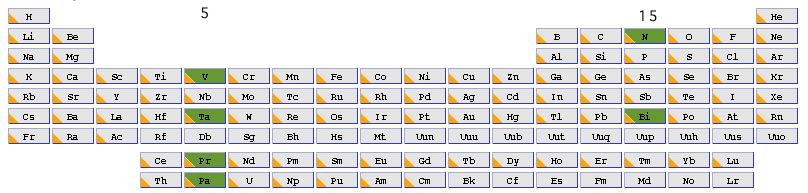
    The 100th anniversary of G. N. Lewis’ famous electron pair theory of bonding is rapidly approaching in 2016 (DOI: 10.1021/ja02261a002). He set out a theory of bond types ranging from 1-6 electrons. The strongest bond recognized by this theory was the 6-electron triple bond, a good example of which occurs in dinitrogen, N2. In terms of valence electrons, nitrogen has an atomic configuration of 2s2, 2p3. Each atom has five electrons in total, some or all of which in principle could be used for forming bonds. An exploration of this motif across the entire periodic table is presented in part one of this blog.
    Elements in Groups 5/15 of the Periodic Table.
    Nitrogen is in the main group 15, and the element at the bottom of this group is Bismuth (also with the same atomic configuration). We can then move to the corresponding column of the transition series, this time occupying group 5. The first examplar in this set, Vanadium has an atomic configuration of 3d3, 4s2, again five valence electrons, but now utilizing the d- rather than the p-shell of valence atomic orbitals (AOs). The final forage across the period table would land us with Pr and Pa, which occupy the lanthanide and actinide series respectively, and which have atomic configurations of 4f3, 6s2 and 5f2, 6d1 and 7s2 respectively. You can now see the theme developing; how does the bonding develop between two atoms that between them have ten valence electrons occupying molecular orbitals constructed from s, and then either p, d or f atomic orbitals. The next in that series, g atomic orbitals, are thought unlikely to have any chemical significance in the presently known periodic table.

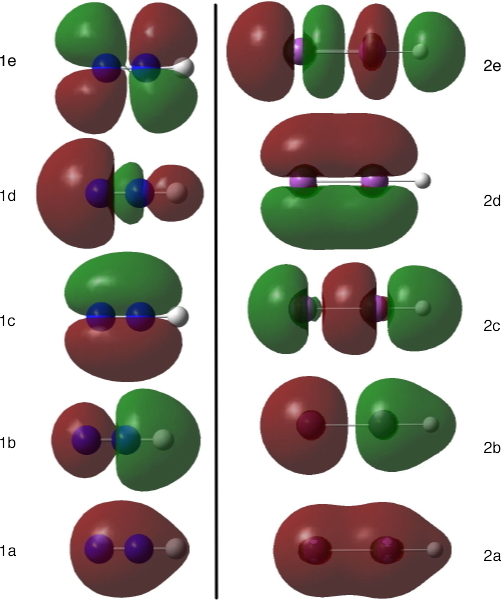
    We are in fact going to study the diatomic molecule comprising two atoms of each element, and further we are going to protonate this species on one of these atoms resulting in the molecule HX2+. So let us start with the two systems HN2+ (Figure 1, 1a-1e) and HBi2+ (Figure 1, 2a-2e).

    Figure 1. The molecular orbitals of HN2(+) and HBi2(+)
    Figure 1. The molecular orbitals of HN2(+) and HBi2(+)

    The two most stable valence molecular orbitals (MOs) for each system (1a and 2a) are the symmetric and antisymmetric combinations of (assumed pure) s-AOs, each populated with two electrons. For Bi (2a/2b) it is fairly clear that this bonding and anti-bonding combination cancel almost exactly. The bond order resulting from these four valence electrons is therefore close to zero. But N is in fact rather odder (and in part, the reason for protonating the systems was to tease out this oddity)! The apparently antibonding 2s-2s combination (1b) actually has electron density along the N-N bond, and the node occurs not along the bond, but at the actual nitrogen atom. So for N, the bonding and anti-bonding σ-bond combinations do not cancel, and the sum of these two may actually lead to a non-zero bond order.

    With Bi, the next most stable MO results from the overlap of two 6p-AOs end on (2c); the anti-bonding combination of these AOs is in fact the 2e (with no occupying electrons). Result: bond order of +1, and this bond is called a σ-bond. The final MO shown (2d) is in fact one of a pair of MOs (only one of which is shown here), resulting from parallel overlap of two 6p-AOs. Result: bond order of +2, and we call these two p-π-bonds. The total bond order is +3, comprising 1 σ-bond and two p-π-bonds. No surprises here yet! For N, the relative order of the π- (1c) and the σ-bonds (1d) is swapped compared to Bi (which might be due to relativistic effects, see below), but one can again argue that these three orbitals together contribute 1 σ-bond and two p-π-bonds to the total bonding. So, to summarize, HBi2+ exhibits a classical triple Bi…Bi bond; HN2+ in contrast may actually exceed the bond order of +3, and a case could be made for arguing it is an abnormally strong bond (there is evidence that the N…N stretching frequency in the protonated species is significantly higher than the simple diatomic nitrogen gas).

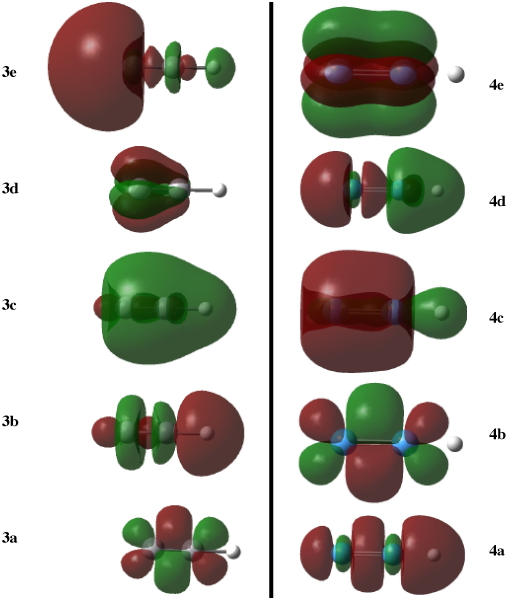
    Let us now move to the combination HV2+ (3) and HTa2+ (4, Figure 2). There are two major differences for V compared to N. Firstly, a 3d rather than 2p -AO is used for the bonding. Secondly, the 3d-AO is actually lower in energy than the 4s-AO, the reverse of the 2s/2p order for eg nitrogen. So what effect does this have on the resulting molecular orbitals?


    Figure 2. Valence molecular orbitals for HV2(+) and HTa2(+)
    Figure 2. Valence molecular orbitals for HV2(+) and HTa2(+). Click image for 3D of Delta orbital

    The difference between N and V turns out to be spectacular, in several regards! The most stable MO (3a) now turns out to be composed of end-on overlaps of two 3d-AOs. There are in fact two of these orbitals (only one is shown in Figure 2), and together they form two 3d-π bonds. The next MO (3b) involves the end-on overlap of a 3dz2-AO, this time forming one 3d-σ-bond. Finally, the 4s-AOs get in on the act, forming now one bonding s-σ-bond (3c). So far, eight of the ten valence electrons have been consumed; two more to go. But now we have a problem. The next MO is formed by parallel overlap of two 3d-AOs (Figure 2, 3d), and in fact there is a pair of these combinations (again, only one is shown in the figure), which are in fact equal (degenerate) in energy. Because they are equal in energy, they must both be populated by an equal number of electrons, but since there are only two valence electrons left, we end up with one electron in each of these two orbitals, resulting in a triplet spin state. Exactly the same phenomenon is responsible for diatomic oxygen also adopting a triplet rather than singlet spin state. This parallel overlap of two 3d-AOs is said to form a 3d-δ-bond. The total bond order in molecule 3 therefore comprises two 3d-π-bonds, one 3d-σ-bond, one 4s-σ and two half 3d-δ-bonds, i.e. five in total and enforces a triplet spin state. So in the sense of formal bond order, the V-V bond in 3 is greater (and perhaps even stronger) than in 1. What a difference from nitrogen!

    How about Ta? This has an atomic electronic configuration of 5d3, 6s2. The molecular orbitals are shown in Figure 2 (right). The significant difference in this region of the periodic table is that so-called relativistic effects start to influence the relative ordering of the atomic orbitals. This so-called relativistic contraction impacts upon s-AOs far more than p, or d or f. Thus orbital 4a (Figure 2, right) comprising a symmetric combination of Ta 5s-AOs is more compact than the corresponding V orbital (3c), and relatively more stable. Next come the end-on overlaps of two 5d-AOs (4b), of which there are two (degenerate) combinations (only one is shown in Figure 2). MOs 4c and 4d are again best described as originating from the 6s Ta AO, but with significant contributions from the 5d-AOs (sd-hybrids if you will). Significantly, the relativistic effect means that the δ-bond formed by parallel overlap of two 5d-AOs (4e) is left vacant. Thus the bonding in 4 comprises an 6s-σ-bond, two 5d-π-bonds, and two sd-σ-bonds (one of which does look rather anaemic) but NO 5d-δ-bond! The consequences of the relativistic effect is the relegation of the δ-bond to unoccupied status and the formation of a singlet rather than a triplet spin ground state.

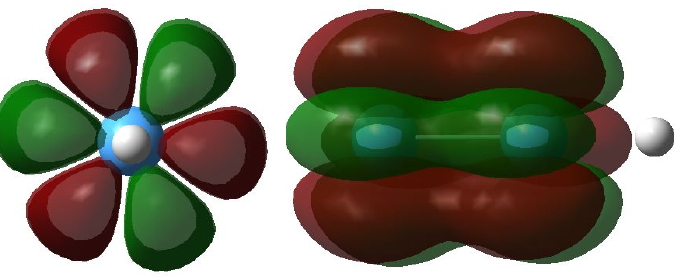
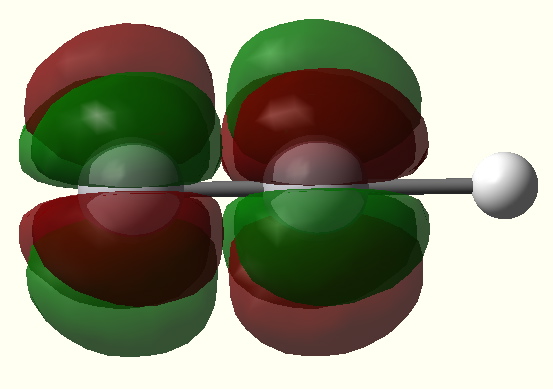
    Given the big differences in bonding which occur upon changing a 2p-valence atomic orbital to 3-5d-AOs, one wonders what will happen with 4-5f-AOs? A π-bond can be formed by the parallel overlap of two p-AOs, or end-on overlap of two d-AOs. A δ-bond can be formed by the parallel overlap of two d-AOs. Could then a δ-bond also be formed by the end-on overlap of two f-AOs? Would a φ-bond be formed by the parallel overlap of two f-AOs? The latter might look something like that shown in Figure 3, shown in two different orientations (these diagrams were obtained by inspecting the unfilled MOs in the V/Ta examples shown here; notice that although the φ bond appears to be bonding, the system has chosen not to occupy it with any electrons!).

    Figure 3. The "phi" bond.
    Figure 3. Two views of a φ bonding MO. Click image for 3D
    Figure 3. The "phi" antibond.
    Figure 4. A φ* antibonding MO. Click image for 3D

    This blog will end by posing the question “can any molecule be devised which supports one or more φ-bonds”, or will the relativistic contraction always scupper such efforts by depriving such bonds of electrons (e.g. Ta above)? Are the systems reported in DOI: 10.1021/ja067281g examples of a 5f-φ bond for uranium (the claim is made in a very low key manner)? This will be investigated in the follow up to this post!

    (For serious geeks/computational chemists only, N was computed at the B3LYP/6-31G(d) level, V at the ROHF/6-31G(d) level, and Bi/Ta at a triple-ζ-pseudopotential level (which incorporates some of the relativistic effects).

  • Molecular toys: Tetrahedral cavities


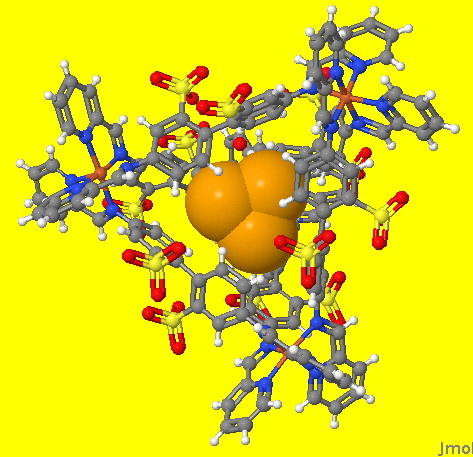
    An earlier post described how a (spherical) halide anion fitted snugly into a cavity generated by the simple molecule propanone, itself assembled by sodium cations coordinating to the oxygen. A recent elaboration of this theme, reminiscent of the children’s toys where objects have to be fitted into the only cavity that matches their shape, Nitschke and co-workers report the creation of a molecule with a tetrahedral rather than a spherical cavity (DOI: 10.1126/science.1175313 ), into which another but much smaller tetrahedral molecule is fitted.  The small molecule is P4, in which each of the three valencies of the P atom is directed to a corner of the tetrahedron. The large molecule  comprises four Fe atoms. These are each octahedrally coordinated with six ligand sites, three of which mimic the P atoms in also being directed towards the remaining three vertices of a tetrahedron.

    P4 inside a  Tetrahedral cavity.

    Needless to say, the properties of the P4 molecule when entrained into this larger container are nothing like that of the free molecule. Now it is quite inert, but this is due purely to the snug fit. For example, the normal reaction of this molecule is to oxidize in air. But such oxidation would now produce a molecule too big to fit into the cavity. Hence no reaction!

    So, now the search is on for a cubic container to include a cubic molecule!

  • Longer is stronger.

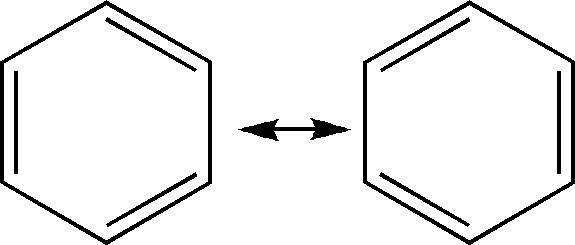
    The iconic diagram below represents a cornerstone of organic chemistry. Generations of chemists have learnt early on in their studies of the subject that these two representations of where the electron pairs in benzene might be located (formally called electronic resonance or valence bond forms) each contribute ~50% to the overall wavefunction, and that the real electronic description is in effect an average of these two (that is the implied meaning of the double headed arrow). This means that the six C-C bonds in benzene must all be of equal length. The diagrams, everyone knows, do not mean that benzene has three short and three long C-C bonds.

    The Kekule structures of benzene.
    The Kekulé structures of benzene. Click for 3D.
    The diagram has much other implied semantics. Thus there is no explicit three dimensional information; the molecule looks (and is) flat, and it is tempting to conclude that the electrons are flat and two dimensional as well. Indeed, up to around 1930 (some 105 years after its first discovery), the electrons in benzene were always represented as all lying in the plane of the molecule. This changed when Hückel announced the principle of σ/π separation. These were the labels he gave to two different symmetries of electrons (actually derived for ethene), one set which did genuinely occupy the plane of the molecule, and a second (π) set for which this plane represented a node (a region of zero probability for the electron density). The π electrons could instead be regarded as occupying the space above and below that plane. Hückel went on to develop a quantum mechanical theory for benzene based purely on those π-electrons, of which there are six. This (now called Hückel) theory predicted that the averaged structure noted above emerged naturally, along with another concept known as π-electron resonance energy. This is the difference in energy between the symmetric form of benzene and a structure in which the six π electrons do not interact as a whole, but which are localized into three pairs located in the regions of the double bonds. Most people interpret this latter as being equivalent to the two Kekulé forms shown above. Symmetrizing the structure (from D3h to the higher D6h symmetry) is accompanied by reducing the π-energy of the system by that resonance term (often estimated as around -152 kJ/mol of stabilization). For benzene in other words, this is the difference in energy between the symmetric species and a (hypothetical) bond localized cyclohexatriene.

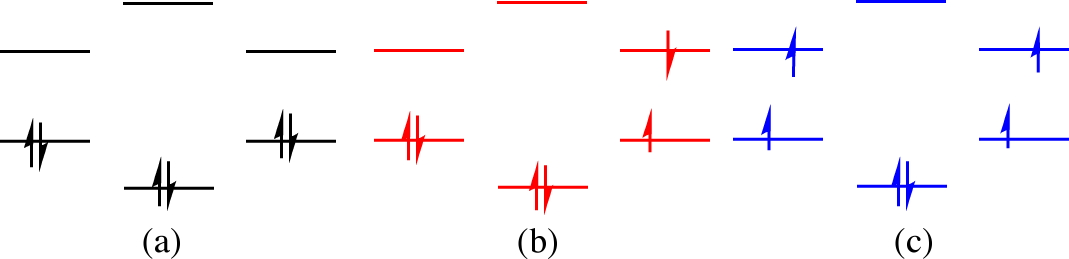
    With such a focus on the π-electrons, it seemed natural to accept that the reason why benzene has six equal C-C lengths is because of the resonance energy gained by the π-electrons when adopting the six-fold symmetric form. Prior to around 1961, no-one would have dissented from that point of view. The first to do so was Berry (see DOI: 10.1063/1.1732256 ), but his was a lone voice at that time. But mysterious and inexplicable observations started to come to light. Perhaps the most direct was a study of the excited state of benzene, in which one π-electron is promoted from a bonding to a higher energy and antibonding π-orbital (known as a π-π* excitation, see DOI 10.1063/1.435193). A schematic illustration of this process is shown below.

    The Hückel Molecular orbital picture for benzene
    The Hückel Molecular orbital picture for ground and excited states of benzene

    Diagram (a) shows the normal population of electrons in the (three lowest) energy levels derived using Hückel’s theory. Diagram (b) shows how this changes in the first excited singlet state, which would be expected to have weaker π-bonds. The vibrational spectrum of a molecule is one way of measuring how strong the bonds in a molecule are. Berry had already implied that one particular vibrational mode, the so-called Kekulé mode (also known as the b2u mode using group theory) seemed unusually low in frequency. In other words, this distorsion was easier than it should have been, and this Berry attributed to the (then almost heretical view) that the π-electrons did not in fact promote a hexagonal form of benzene. This was instead induced by the σ electrons, which occupy the plane of the molecule. This effect prevailed over the π-electrons, which were in fact trying to get benzene to adopt a bond-alternating geometry (managing instead only to lower the energy of the b2u mode). When the vibrational spectrum of the excited state of benzene was analyzed in 1977, it appeared to spectacularly vindicate Berry (DOI 10.1063/1.435193). The Kekulé mode has a value of 1309 cm-1 for the normal ground state of benzene, but an exalted value of 1570 cm-1 in the excited state. This means that as the bonding due to the π-electrons is weakened by placing one of them in an antibonding orbital, their overall ability to distort the geometry is also weakened. As a result, the resistance to such distorsion (the Kekulé mode) is in turn strengthened by an amount corresponding to +261 cm-1. It was evidence such as this, and much else besides that Shaik and his co-workers used to promote the idea of π-distortivity in benzene (DOI: 10.1021/cr990363l). Despite such advocacy, the idea that all the six bonds in benzene are equal despite rather than because of the π-electrons is still rarely taught in introductory organic chemistry.

    But the story of excited benzene is not yet quite finished! In 2006, Blancafort and Sola (DOI: 10.1021/jp064885y) reminded us that the (1B2u) excited state of benzene exhibits a type of geometrical distorsion known as pseudo Jahn-Teller (PJT), the origins of which have nothing to do with any of the previous arguments. The effect instead arises because the promoted electron emerges from a so-called energy degenerate orbital, and jumps into another degenerate orbital (Figure b above). The exaltation of the b2 vibrational mode is in fact strongly coupled with this PJT effect, which complicates disentangling the two effects (PJT and π-distortivity).

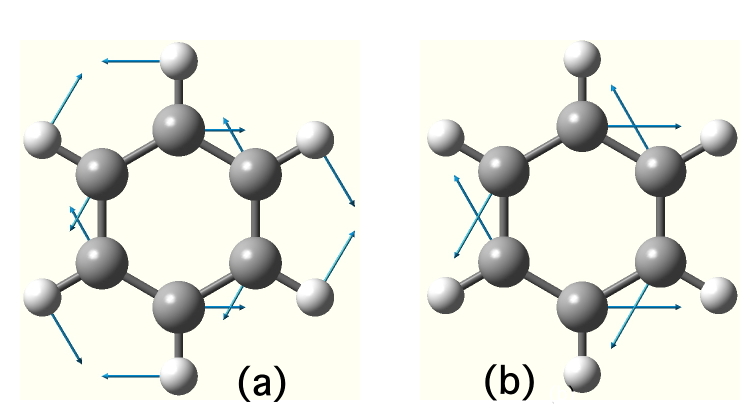
    So another excited state is here proposed which is not susceptible to the PJT effect. Figure (c) above shows a π-quintet state in which two electrons are both promoted to anti-bonding orbitals. Now the π-electron bonding has been well and truly weakened! When the vibrational modes are calculated for the (D6h-symmetric) geometry of benzene at the same level of theory (B3LYP/aug-cc-pvtz) for both singlet ground state and quintet excited state one finds that the b2u vibrational mode has the value of 1332 cm-1 for the former and 1524 cm-1 for the latter. Significantly, the former mode shows a contribution to the motion from the hydrogen atoms. These, being light, tend to increase the wavenumber of the vibrational mode. The same mode in the quintet state however shows motion of the carbon atoms only (Click on the diagram below to view the b2u mode for the quintet state of benzene, and note how little motion of the hydrogen atoms there is). It is a pure Kekulé mode, whereas that for the ground state is not! If the motion of the hydrogens in the ground state of benzene is suppressed by artificially changing the atomic weight of the hydrogen in the mass-weighting scheme to a large value, the calculated b2u vibrational mode drops to around 1317 cm-1. This means the quintet state mode of benzene is exalted by 207 cm-1, and being PJT-free, it is a truer reflection of the effect of the π-electrons. Thus the effect first speculated upon by Berry, and championed by Shaik is spectacularly vindicated (again!).

    The b2u modes in benzene
    The b2u modes in benzene for (a) ground state and (b) quintet state. Click for 3D.
    But what of the title for this post? Well, the C-C length in the singlet ground state of benzene is 1.391Å. In the quintet state, it becomes longer at 1.454Å (which is almost exactly the value that Berry originally suggested should be used for the hypothetical cyclohexatriene geometry). Despite this lengthening, the Kekulé mode clearly gets stronger. Why is this noteworthy? Well, it is almost always assumed that if a bond is shorter, it means stronger. In this case, we have an example of six bonds each getting shorter and weaker (at least as measured by the b2u mode of vibration), or as the title states, longer and stronger in the quintet state of benzene. Oh, and what about that π-resonance energy which we started with? Does it play no role after in the symmetric structure of benzene? Well, in fact it does! The answer is that the π-resonance energy is still at its maximum stabilization at the hexagonal structure of benzene, but it is the total π-energy that achieves its maximum stability at the non-hexagonal structure. These two energies are quite different beasts, and they each prefer a different geometry!


    Acknowledgments

    This post has been cross-posted in PDF format at Authorea.

  • The mystery of the Finkelstein reaction

    This story starts with an organic chemistry tutorial, when a student asked for clarification of the  Finkelstein reaction. This is a simple SN2 type displacement of an alkyl chloride or bromide, using sodium iodide in acetone solution, and resulting in an alkyl iodide. What was the driving force for this reaction he asked? It seemed as if the relatively strong carbon-chlorine bond was being replaced with a rather weaker carbon-iodine bond. But its difficult to compare bond strengths of discrete covalent molecules with energies of ionic lattices. Was a simple explanation even possible?

    All is not as it seems however. The traditional explanation, found by the quick Google search linked above, is that the reaction illustrates Le Chatelier’s principle, whereby an equilibrium is driven over to completion by removal of one of the products (in this case sodium chloride or sodium bromide, which crystallize out of solution). Well, we have replaced one possible (and probably complicated) explanation based on bond strengths and ionic lattices by another based on the solubilities of an ionic material in a moderately polar solvent. But all we have done is ask a different question, which now becomes why is sodium iodide highly soluble in acetone, whereas sodium chloride and bromide are not? The answer to this is less easily found using Google!

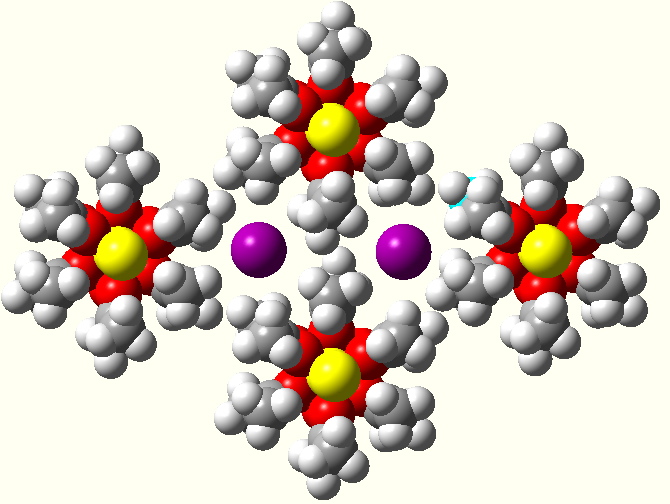
    A good start would be the crystal structure of any complex formed between acetone and sodium iodide. Fortunately, one such does exist, and it is shown below (sodium=yellow, iodine=purple).

    (Acetone)3. NaI
    (Acetone)3+NaI. NAIACE. Click for 3D.

    The formula shows three acetone molecules for each sodium iodide. The carbonyl oxygen has two lone pairs of electrons, and each of these is used to coordinate a (different) sodium cation. This allows each sodium to be coordinated by a total of six lone pairs, giving it octahedral coordination. This sets up what in fact is quite a rigid scaffold, with the unusual feature of an approximately triangular shaped channel running down the lattice (two such are shown above). The size of this hole is determined by the methyl groups of the acetone, and it is into this cavity that the halide ion must fit.

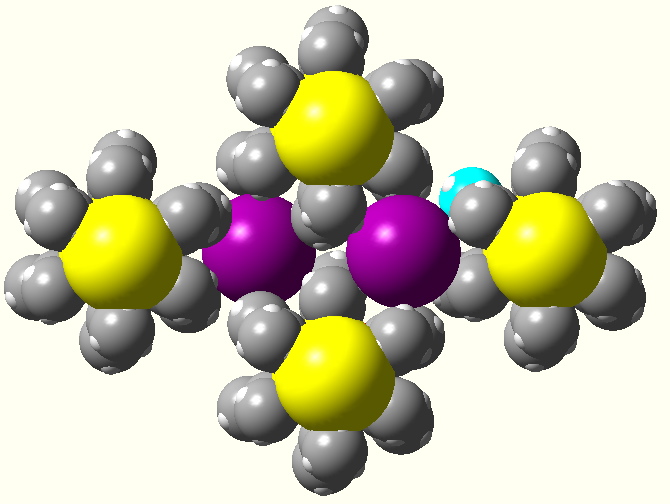
    As it happens, the iodide anion is exactly the right size to produce a perfectly snug fit up against those methyl groups (click on the image above to view this). If a chloride or bromide anion were to be fitted into the cavity, there would be empty space surrounding it. The cavity itself is too rigid to collapse around the halide anion to absorb this space. This means these halide anions are further away from the positively charged sodium than they would like to be such that they minimize their ionic lattice energies. Instead they avoid fraternizing with the acetone at all, and form a pure sodium chloride or sodium bromide lattice (where the two oppositely charged ions CAN approach at optimal distances). The result is that sodium chloride crystallizes out of solution, and the Finkelstein reaction proceeds to completion!

    Acetone. NaI in spacefill mode
    Acetone. NaI in spacefill mode. Click for 3D.

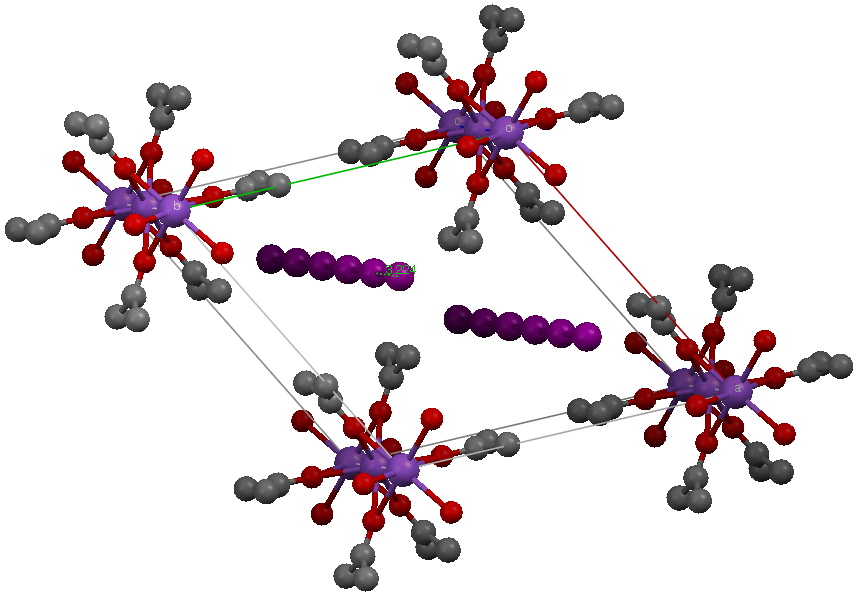
    But that is not quite the end of the story. If you view the acetone.NaI lattice sideways (click on the diagram above to view this aspect), you will find that in fact there is still space in the scaffold after all! Each iodide anion has room above or below it, with space for exactly one more iodine atom to fit without having to change the shape of the scaffold. And indeed such a molecule has been reported[cite]10.1107/S0108270103006395[/cite],[cite]10.5517/CC75TZ5[/cite] but it is an odd one! The stoichiometry is now (acetone)3.NaI2, which implies that the iodide anion has been joined by an iodine atom. I2(-) is called a radical anion, and as such has an unpaired electron. Just like two iodine atoms can couple their unpaired electrons to form a covalent bond, so can two I2 radical anions, forming I42- [or I3.I] or on to infinity as a linear iodine polymer, of formula n[I42-], with all the I…I distances equal at 3.224Å (a system with no Peierls distortion). Straight rod-like polymeric chains of a single element might appear highly unusual, but curiously, another class of elements that exhibits this behaviour is Cu/Ag/Au and Ga,[cite]10.1002/anie.200601726[/cite] the ultimate in thin wires!).

    Acetone. NaI2
    Acetone+NaI2. GADMOO. Click for 3D.

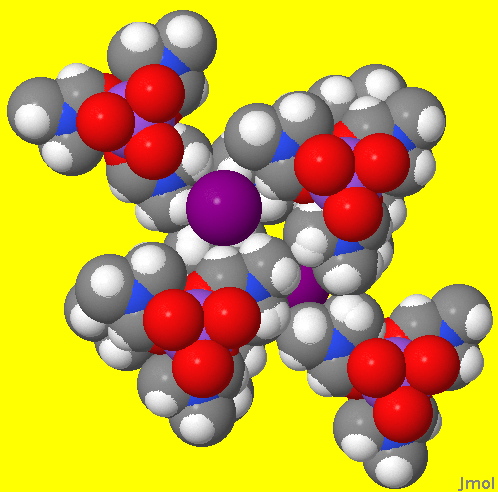
    Finally, it is worth noting that the same phenomenon occurs with the dimethylformamide.NaI complex. In this example, only the NaI and not the NaI2complex has been reported.

    DMF. NaI
    DMF+NaI. Click for 3D.

    Acknowledgments

    This post has been cross-posted in PDF format at Authorea.

  • The Chirality of Lemniscular Octaphyrins

    In the previous post,  it was noted that  Möbius annulenes are intrinsically chiral, and should therefore in principle be capable of resolution into enantiomers. The synthesis of such an annulene by Herges and co-workers was a racemic one; no attempt was reported at any resolution into such enantiomers. Here theory can help, since calculating the optical rotation [α]D is nowadays a relatively reliable process for rigid molecules. The rotation (in °) calculated for that Möbius annulene was relatively large compared to that normally measured for most small molecules.

    Recently, quite a number of cyclopolypyrroles, more commonly called phyrins, have been reported. The conventional number of pyrrole rings in many biological systems is of course four (chlorophyll, haemoglobin, etc), but these extended porphyrins can have anywhere between five and sixteen such rings comprising a larger macrocycle. For those with six-eight such rings, a commonly adopted geometric motif is found to be a figure-eight, or more properly a lemniscular one. Such shapes have recently (10.1021/ol703129z) been recognized as also being Möbius systems, albeit this time with two half twists in the π-electron cycle rather than just the single twist synthesized by Herges. As such, they also follow a simple electronic selection rule, being aromatic if 4n+2 π-electrons circulate around the ring.

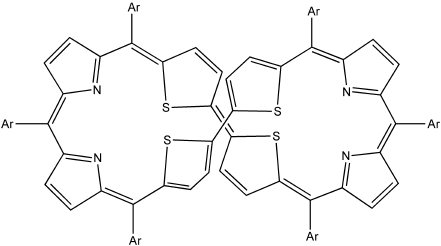
    One such molecule is shown below (10.1039/b502327k), albeit with four of the pyrroles replaced by a thiophene ring.

    A 34-Octaphyrin. Click to see molecule
    A 34-Octaphyrin. Click for 3D.
    Just as with the Herges syntheses, most of these phyrins are also made as racemates. There appears to be only one report of such octaphyrin actually being separated into enantiomers (10.1002/(SICI)1521-3773(19991216)38:24<3650::AID-ANIE3650>3.0.CO;2-F) but no optical rotation could be measured due to its intense colour (in other words, so much light is absorbed by the system that too little remains to measure its rotation). So no-one knows what the magnitudes of the optical rotation values for these figure-eight or lemniscular molecules actually are.

    Here again, theory can come to the rescue. The octaphyrin shown above for example (simplified such that Ar=H), [α]D has the stupendous value of -25517° (See 10042/to-2185). Values above 10,000 are common for this type of molecule! So these relatively small and simple class of molecules are currently easily the record holders for the size of their optical rotations. OK, the latter are merely predictions, but it certainly should serve as an encouragement for experimental measurements of this property.

    Oh, by the way, if you click on the graphic above, you will get to see a molecular orbital calculated for the molecule. It is the most stable of the π-type of MOs, and shows the characteristic features of the lemniscate, namely the π-electrons take the form of a torus link (10.1039/b810301a).