Blog

  • Multi-centre bonding in the Grignard Reagent

    The Grignard reaction is encountered early on in most chemistry courses, and most labs include the preparation of this reagent, typically by the following reaction:

    2PhBr + 2Mg → 2PhMgBr ↔ MgBr2 + Ph2Mg

    The reagent itself exists as part of an equilibrium, named after Schlenk, in which a significant concentration of a dialkyl or diarylmagnesium species is formed. The topic of this blog entry is to analyse the structure and bonding in this latter species.

    First, the structure is shown below (for 2,6-diethylphenyl magnesium). This reveals a dimeric structure with a four membered ring core, comprising two  Mg atoms  connected by two bridging  aryl groups.
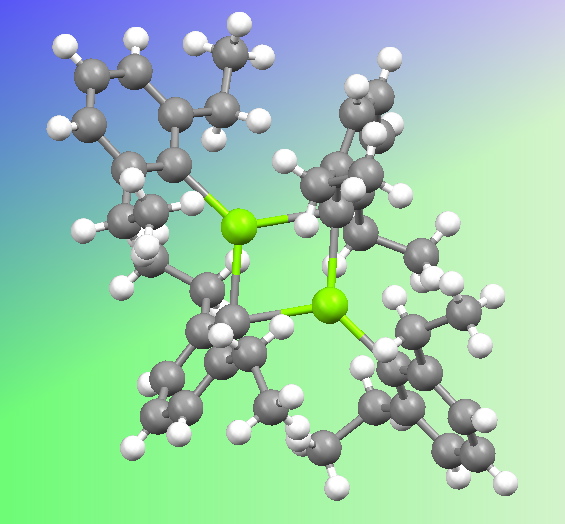
    The crystal structure of a di-aryl magnesium. Click to view 3D
    The crystal structure of a di-aryl magnesium. Click to view 3D
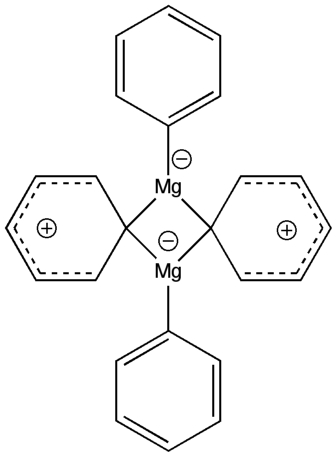
    The question to be addressed here is the nature of the aryl groups. Put simply, it seems as if their bridging role means that one of the six carbons involved in the benzene ring has become sp3 hybridized. This would in turn mean that the cyclic conjugation of the benzene ring is interrupted, and a species akin to the Wheland intermediate is formed in which the aromaticity of two of the benzene rings is no longer sustained. This situation could be depicted thus;

    A Simple bonding representation in  Ph2Mg dimer
    A Simple bonding representation in Ph2Mg dimer

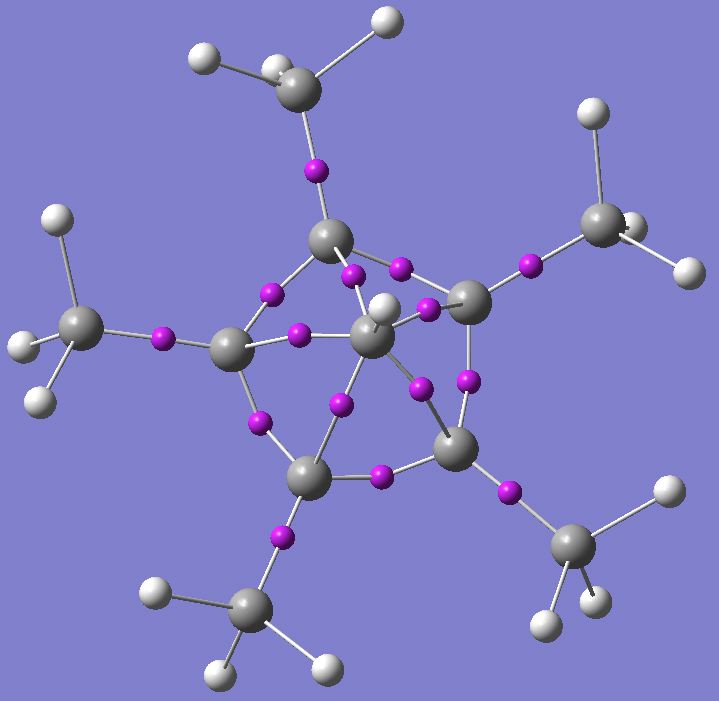
    Is this really the best way of depicting the bonding in this species? A more subtle analysis of the bonding can be achieved using a technique known as ELF (involving analysis of the electron localization function). This reveals bonds as so-called synaptic basins, which come in two varieties; disynaptic basins corresponding to two-centre bonds, and trisynaptic basins which reveal three-centre bonds (there is also a monosynaptic basin which corresponds to electron lone pairs). Such an ELF analysis (based on a B3LYP/6-311G(d,p) computed wavefunction for Ph2Mg dimer) is shown below;
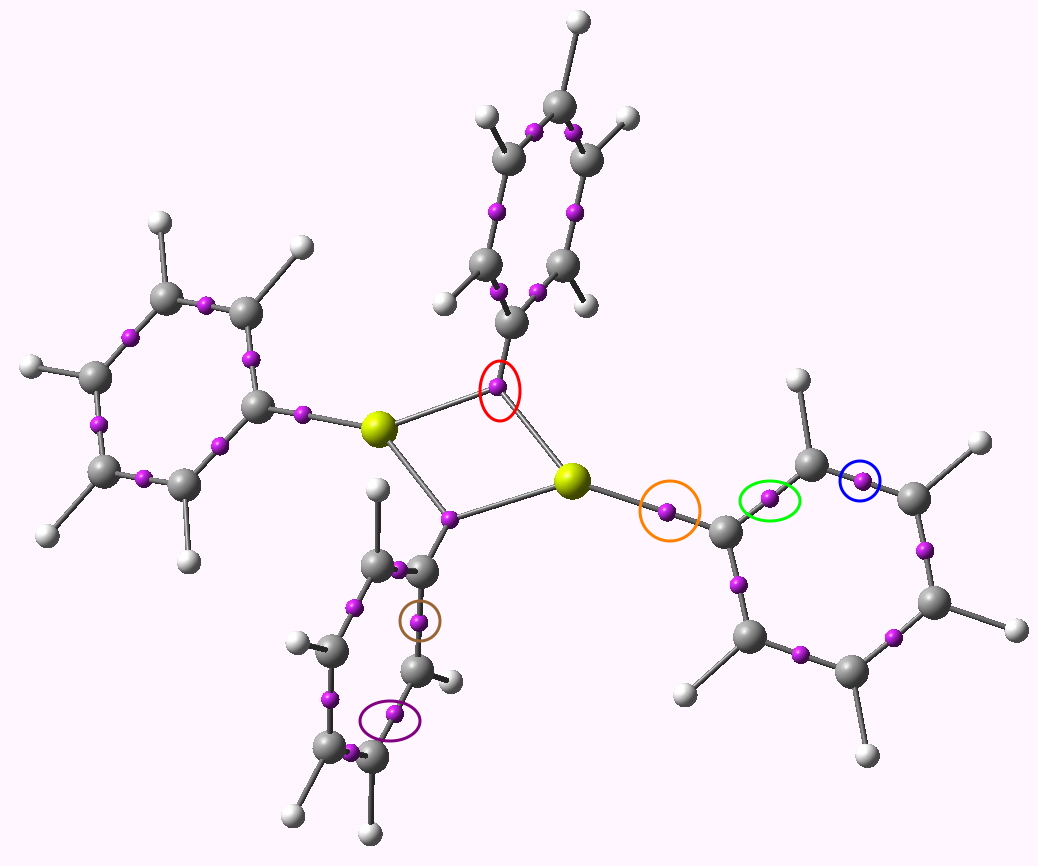
    ELF analysis of the bonding in Ph2Mg dimer
    ELF analysis of the bonding in Ph2Mg dimer. Click for 3D model
    The small purple dots represent synaptic basins. Several of these are circled. The  ones circled in orange are conventional disynaptic forms, and the basins can be integrated to to 2.48 electrons each. The red basin however is clearly revealed as a trisynaptic form (covering both metal centres and the carbon) and integrating to  2.7 electrons. The  three basins surrounding each Mg atom integrate to 7.91 electrons, which reveal the metal to have a conventional octet of electrons in its valence shell. The bonding in the central region could therefore be described as comprising two three-centre-three-electron bonds. The key aspect of this is that the two bridging phenyl groups do not break their aromaticity, ie all four phenyl/aryl groups largely retain their aromaticity! Thus the disynaptic basins for  the normal non-bridging phenyl group and  circled in green integrates to 2.6 electrons and the blue to 2.8 (an ideal aromatic bond would of course integrate to 3.0 electrons), whereas the equivalent basins for the bridging phenyl (brown and purple, 2.5 and  2.8) are virtually the same.

    It is interesting how a veritable mainstay of most taught chemistry courses, the Grignard reagent,  can have such subtle aspects of the bonding surrounding both the metal atom and the aromatic groups, and how rarely this bonding is actually dissected in most text books.
  • The Fine-tuned principle in chemistry

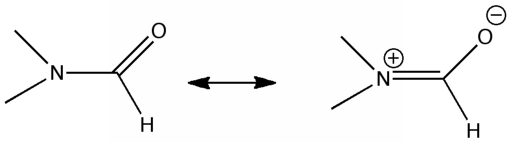
    The  so-called  Fine tuned model of the universe asserts that any small change in several of the dimensionless fundamental physical constants would make the universe radically different (and hence one in which life as we know it could not exist). I suggest here that there may be molecules which epitomize the same principle in chemistry. Consider for example dimethyl formamide. The NMR spectra of this molecule reveal that at room temperature, the two methyl groups are inequivalent, indicating that the rate constant for rotation about the C-N bond has a very particular range of values at the temperatures at which most living organisms exist on our planet.

    Dimethyl formamide
    Dimethyl formamide

    The half-restricted room-temperature rotation about the C-N bond arises from exactly the right amount of resonance contribution from the ionic form shown on the right, and this in turn depends on the relative energies of the nitrogen pair and the π system of the carbonyl group having the correct relationship. It is probably also true that the environment that this grouping finds itself in will alter the contribution (i.e. stabilize the ionic form over the neutral one).   A little less contribution and the C-N bond would rotate much more easily, a little more and it would be much more rigid. Since this peptide bond is an essential and repeated feature of the structure of most biological proteins and enzymes, one might speculate that if that bond could rotate more easily, most enzymes would be much floppier than they are, and may not be easily induced to fold in a repeatable manner into the conformations that enable all the metabolic processes and make them the efficient catalysts they are. If the bond rotated less easily, it might be that the same enzymes would end up being too rigid, and this may prevent them from flexing sufficiently to allow key metabolites to enter or leave the active site.

    Nowadays, the flexing of proteins is commonly studied using techniques of molecular dynamics,  the driving forces for which are specified using molecule mechanics force fields. Here, the rotation about the C-N bond is defined by simple mechanical force constants or torsional barriers. I ask here how sensitive the dynamics of protein folding and catalysis are to the C-N rotational barrier? Is this truly a fine-tuned molecule, or might it be that the existence of life as we know it has a wide tolerance to the strength of the C-N bond?

  • Mechanistic Ménage à trois

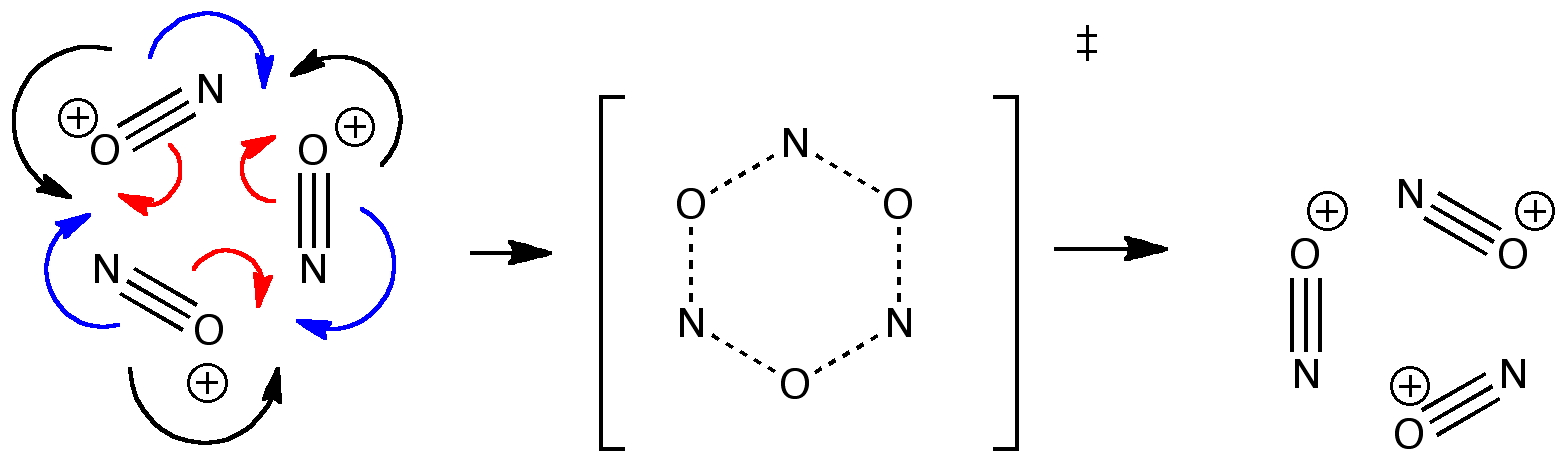
    Curly arrow pushing is one of the essential tools of a mechanistic chemist. Many a published article will speculate about the arrow pushing in a mechanism, although it is becoming increasingly common for these speculations to be backed up by quantitative quantum mechanical and dynamical calculations. These have the potential of exposing the underlying choreography of the electronic dance (the order in which the steps take place). The basic grammar of describing that choreography tends to be the full-headed curly arrow for closed shell systems and its half-barbed equivalent for open shell systems. An effectively unstated and hence implicit rule for closed shell systems is that only one curly arrow is used per breaking or forming bond, i.e. electrons move around bonds in pairs. So consider the following reaction (inspired by a posting on  Steve Bachrach’s blog)

    Oxygen-nitrogen exchange between three nitrosonium cations

    This is very much a hypothetical mechanism, or a thought-experiment if you will. Three nitrosonium cations decide to get together to swap their partners. Each diatomic molecule swaps e.g. one oxygen for another during this exchange reaction (it could easily be studied experimentally of course using isotopic substitution). Three sets of three curly arrows have been used, shown in different colours above.  One set of these arrows at least has plenty of analogy in the real world; representing a π2s+π2s+π2s cycloaddition reaction. The other two sets represents rotation of the  in-plane π-set and the in-plane σ-set. What about the choreography? Can all three sets move at the same time? If so, they would provide an exception to the rule above; three bonds would concurrently change their order from 3 to 0; the other three the reverse of 0 to 3.

    What does quantum mechanics say about this? Well, a well defined, synchronous concerted transition state can indeed be found (B3LYP/6-31G(d), DOI:  10042/to-2905) It has one imaginary frequency (click on the above diagram to view the animation) which does indeed perform the bond transposition function required! It has the form of the so-called Kekule mode (deriving from a mode found in benzene which involves shortening of the lengths of three bonds, and lengthening of the other three, much in the manner of the resonance named after  Kekule; see e.g. DOI: 10.1039/B911817A for more details). Of course, describing it as a change in the bond orders 3 → 0/0 → 3 is simplistic; the bond order in the nitrosonium cation itself is almost certainly somewhat less than three.  But clearly, the implicit rule that  mechanistic arrow pushing should not involve more than one arrow departing from or arriving at any one bond can be broken. I will leave it to the reader of this blog to see what happens when you try to rearrange the choreography of the above reaction. Try pushing first one set of three arrows, then another and a final third. What do you get? (the why of the dance is almost certainly due to electrostatic repulsions between the three nitrosonium cations).

  • The SN1 Reaction- revisited

    In an earlier post I wrote about the iconic SN1 solvolysis reaction, and presented a model for the transition state involving 13 water molecules. Here, I follow this up with an improved molecule containing 16 water molecules, and how the barrier for this model compares with experiment. This latter is nicely summarized in the following article: Solvolysis of t-butyl chloride in water-rich methanol + water mixtures, which (for pure water) cites the following activation parameters

    • ΔH283 = 23.0 kcal/mol
    • ΔG283 = 19.7 kcal/mol
    • ΔS283 = +11.1 cal/mol/K

    But first, a word about how this new transtion state has been obtained. The DFT treatment used is quite standard (B3LYP/6-31G(d) ), and one can indeed locate a transition state using just this approach (this is how the previous model was obtained). One has to work very hard to orient the starting guess for the geometry so that as many hydrogen bonds between the waters themselves, and to the substrate, are created. The previous model took quite a few guesses and attempts! The solvent in such a model is simulated by the explicit water molecules themselves. Of course, the quality of the solvent then depends on how many water molecules are used. A proper solvent field using explicit water molecules is thought to require 100s of water molecules! But a reasonable approximation/compromise may well be 13.

    So how can the model be improved? Well, in many ways, some of which include treating the dynamics of the system. But I will stick just to two.

    1. Firstly, we assume that the water molecules are used to form a bridge between the incoming nucleophile (another water) and the leaving group (the chloride). In the previous model, two such bridges were constructed using the 13 water molecules. But in fact, there is still space between two of the methyl groups to construct a third bridge. This takes the total solvent molecules to 16.
    2. Solvent can also be modelled as a continuum, in which a cavity which the substrate occupies is surrounded by a field generated by the continuum solvent. The problem with these cavity approaches in the past has been that it is not easy to optimize the geometry of the molecule contained within the cavity. Because the cavity was constructed by tesselation, the first derivatives of the energy of the molecule within the cavity were not regular, and as a result, geometry optimization (and particularly transition state optimization) would frequently meander and fail to converge. Darrin York and Martin Karplus came to the rescue (some time ago, it has to be said, DOI: 10.1021/jp992097l) by formulating a smoothed out solvation cavity where the first (and second derivatives) are stable and well behaved. This new algorithm has now been implemented in Gaussian09, and it now allows really easy transition state location within a solvent cavity

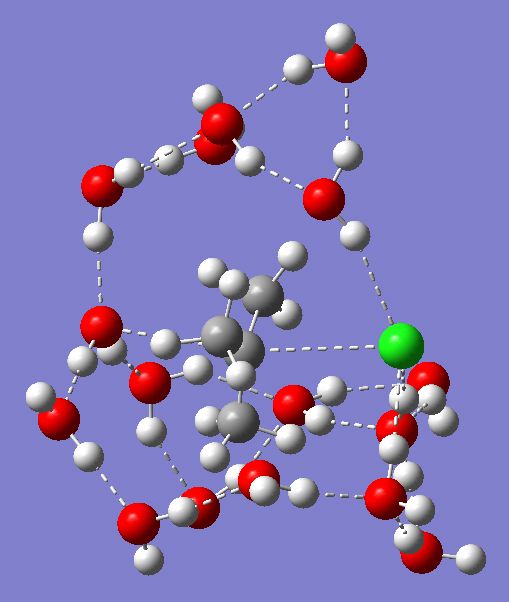
    The result of this optimization is shown below (and can be seen in original form at the following DOI: 10042/to-2894).

    Transition state for  Sn1 solvolysis of  tert-butyl chloride
    Transition state for Sn1 solvolysis of tert-butyl chloride. Click for animation.
    The model has not changed that much compared to before. The reaction (imaginary) mode still clearly shows formation of the C-O bond and cleavage of the C-Cl bond. Also as before, there is a lot of motion of the methyl groups, as the forming cation induces stereo-electronic alignment with the adjacent C-H bonds (and which explains the large secondary deuterium isotope effects measured for this reaction, kH/kD (298) = 2.39, see DOI: 10.1021/ja01080a004). The hydrogen bonding pattern is also retained (despite the surrounding solvent field!). But what of the predicted activation parameters

    • ΔH298 = 17.4 kcal/mol
    • ΔG298 = 18.7 kcal/mol
    • ΔS298 = -4.4 cal/mol/K

    The overall free energy is in great agreement with experiment! But the entropy is the wrong sign!! The calculation is predicting that the transition state is more rigid than the reactant. One can see how this might happen, since the greater ionic character produces very much stronger hydrogen bonds, which strengthen the three solvent bridges. It may be simply that the rigid-rotor-harmonic-oscillator approximation breaks down horribly for the entropy in this calculation. But it is encouraging that the activation barrier is reproducing experiment, which suggests the model cannot be completely wrong!

  • Hypervalency: a reality check

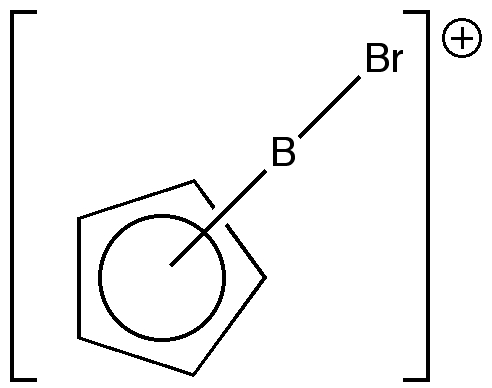
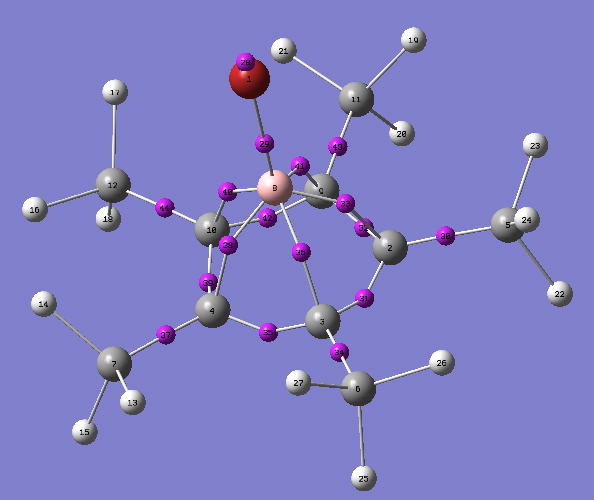
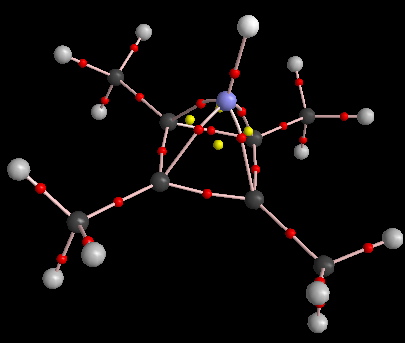
    We have seen in the series of posts on the topic of hypervalency how the first row main group elements such as Be, B, C and N can sustain apparent hypercoordination and arguably hypervalency. The latter is defined not so much by expanding the total valence shell of electrons surrounding the hypervalent atom beyond eight, but in having more than four well defined bonds to it, as quantified by  AIM and ELF analysis. The previous post made the suggestion of how a compound involving hypervalent boron could also sustain a genuine  bond to the rare gas helium. It is surely time to seek evidence that this type of bonding can be sustained in reality. Fortunately, a crystal structure of a reasonably analogous compound IS available (DOI: 10.1016/0022-328X(94)05089-T).

    YOCVIV: Crystal structure of hexacoordinate boron
    YOCVIV: Crystal structure of hexacoordinate boron. Click for 3D
    AIM analysis for  YOCVIV
    AIM analysis for YOCVIV

    The AIM analysis shows five bond critical points in the B-C regions and one in the B-Br region. with ρ(r) values of 0.121 and 0.146 respectively. The corresponding ∇2ρ values were -0.07 and -0.22. These BCPs are matched by equally well defined disynaptic basins in the ELF analysis with electron populations of respectively 0.67 and 2.1 electrons. This compares with ρ(r) values of 0.157 and 0.069, and ELF integrations of 1.22 and 2.0 calculated for the structurally similar proposed B-He compound.

    ELF analysis for YOCVIV
    ELF analysis for YOCVIV. Click for 3D

    The analogy is sufficiently similar to suggest that (in this case boron) hypervalency for such first row main group elements can be reflected in real systems.

  • Uncompressed Monovalent Helium

    Quite a few threads have developed in this series of posts, and following each leads in rather different directions. In this previous post the comment was made that coordinating a carbon dication to the face of a cyclopentadienyl anion resulted in a monocation which had a remarkably high proton affinity. So it is a simple progression to ask whether these systems may in turn harbour a large affinity for binding not so much a H+ as the next homologue He2+?

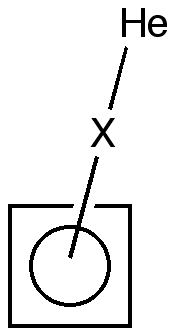
    Inventing the  Helium bond
    Inventing the Helium bond

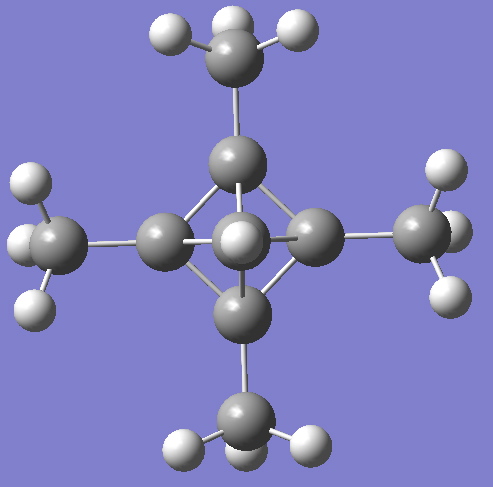
    This possibility is explored with the series X=Be, B, C (tetramethyl substituted, resulting in neutral, +1 and +2 systems overall). The first two emerge as stable in terms of having all positive force constants for C4v symmetry; the last emerges as a transition state and is not discussed further. The specific system X=B has a B-He bond length of 1.317Å/B3LYP/6-311G(d,p), 1.305Å/B3LYP/Def2-QZVPP and 1.290Å/double-hybrid RI-B2GP-B2PLYP/TZVPP, which does seem as if it might be typical of a single bond between these two elements. The ρ(r)B-He AIM value (B3LYP/6-311G(d,p) is 0.069 au, and νB-He of 713 cm-1 (727 for Def2-QZVPP basis) makes it about one third the strength of a C-H bond. The disynaptic basin for the B-He region integrates to 1.99 electrons, whilst the four B-C basins correspond to 1.22 electrons each.

    X Charge ρ(r) X-He C-B ELF
    integration
    νX-He, cm-1 Repository
    Be 0 0.031 1.10 484 10042/to-2443
    B 1 0.069 1.22 713 10042/to-2444

    10042/to-2446

    10042/to-2453

    C 2 0.026 136 10042/to-2445
    AIM for X=B-He
    AIM for X=B-He. Click for 3D
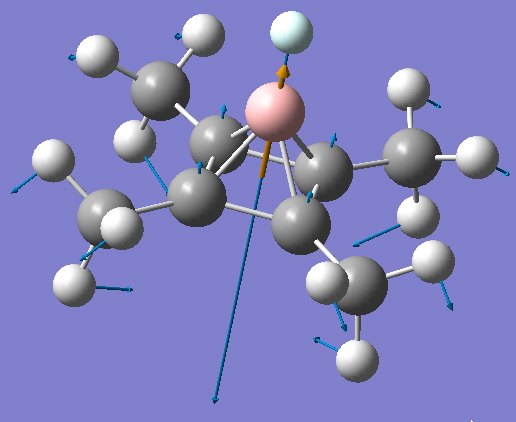
    B-He vibrational stretching mode
    B-He stretching mode. Click to vibrate

    We can conclude that for X=B, this species exhibits not only a pentavalent boron atom, but a monovalent helium atom. The latter bond may indeed be amongst the strongest ever proposed for this element in a ground state, and indeed perhaps is even viable as a solid crystalline compound rather than merely existing in the gas phase. The Cambridge crystal database contains no entries for He or Ne, not even as an encapsulated clathrate (although crystal structures of such complexes for Kr and Ar are known). Theoretical studies of the rare gases in endohedral fullerene-like cages (DOI: 10.1002/chem.200801399) predict that under these compressed circumstances e.g. two helium atoms can approach each other to 1.265Å or less (see also DOI: 10.1002/chem.200700467) but these close approaches were not considered to be chemical bonds as we think of them. Perhaps Merino, Frenking, Krapp and co’s search for the chemistry of helium (they had found it earlier in the gas phase excited states of their molecules, DOI: 10.1021/ja00254a005) might be realised for the ground state of the system described here.

  • Pentavalent nitrogen and boron

    The previous posts have seen how a molecule containing a hypervalent carbon atom can be designed by making a series of logical chemical connections. Another logical step is to investigate whether the adjacent atoms in the periodic table may exhibit similar effects (C2+ ≡ B+ ≡ N3+ ≡ Be ≡ O4+). So here are reported some results (B3LYP/6-311G(d,p) ) for boron, beryllium and nitrogen, for the general tetramethyl substituted system shown below

    Pentavalency across a series
    Pentavalency across a series
    X Charge X-C length, Å ρ(r) C-X ELF integration ν-Trampoline, cm-1 ν X-H, cm-1 Repository
    N 2 1.616 .172 1.14 883 3417 10042/to-2439
    C 1 1.580 .195 1.10 970 3291 10042/to-2438
    B 0 1.649 .136 1.06 949 2746 10042/to-2440
    Be -1 1.817 .064 0.98 797 1887 10042/to-2441

    The systems H, C and B are stable in the sense that the C4v-symmetric calculated geometry has only positive calculated force constants (Be has a small negative frequency). All show bond critical points in the  X-C region (although these bonds are clearly  bent) and X-H region, and significant integrations for the X-C disynaptic basins in the  ELF analysis. The boron analogue is also of interest as being a neutral rather than a charged molecule, and therefore may be a worthy target for synthetic effort.

  • Full circle with carbon hypervalencies

    The previous post talked about making links or connections. And part of the purpose for presenting this chemistry as a blog is to expose how these connections are made, or or less as it happens in real time (and not the chronologically sanitized version of discovery that most research papers are). So each post represents an evolution or mutation from the previous one. To recapitulate, we have seen how the idea of cyclopentadienyl anion as a ligand for a dipositive carbon atom has evolved. Let us move in yet another direction; the cyclobutadienyl dianion.  This ligand has recently been shown to bind Mg2+ (DOI: 10.1002/ejic.200800066), so why not He2+? And picking up again the previous theme, we will then protonate the bound complex. The result now is a monocation, and it has the C4v-symmetric structure shown below (DOI: 10042/to-2438). This bears some resemblance to pyramidane, a neutral  C5H4 compound with hemispherical carbon reported in 2001 (DOI: 10.1021/jp011642r) which is also a stable minimum in the potential energy surface.

    C4-symmetric pentavalent carbon
    C4-symmetric pentavalent carbon

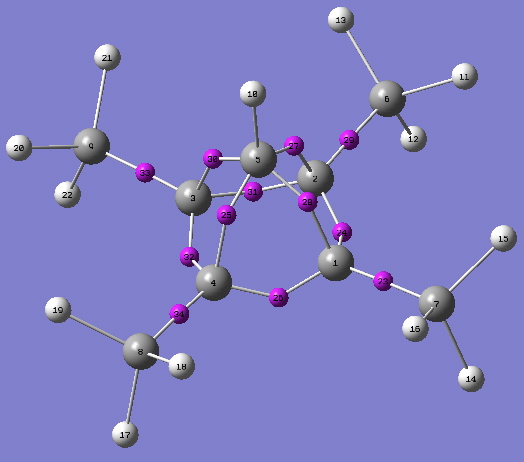
    Now, the apical C-C bonds have shrunk to 1.58Å, the trampoline mode is increased to 970 cm-1 and the apical C-H frequency to 3291 cm-1. The apical C-C value for the AIM bond critical point ρ(r) is up 0.195 au and the disynaptic basin integration in that region is now 1.1 electrons. Replacing the apical C-H by C-F further strengthens the system (DOI: 10042/to-2447); the apical C-C bonds contract slightly to 1.57Å, the bouncing castle/trampoline mode shoots up to ν 1595 cm-1 , ρ(r) reaches 0.201 au and the disynaptic basins 1.25 electrons. With this latter system, the C-F disynaptic basin contains only 1.08 electrons, suggesting it is similar in nature to the other four bonds surrounding the apical carbon, i.e. this carbon is surrounded by five more or less equivalent bonds. The pseudo-halogen CN can also replace the F (DOI: 10042/to-2449) to similar effect (ρ(r)C-C 0.190, ρ(r)C-CN 0.290).

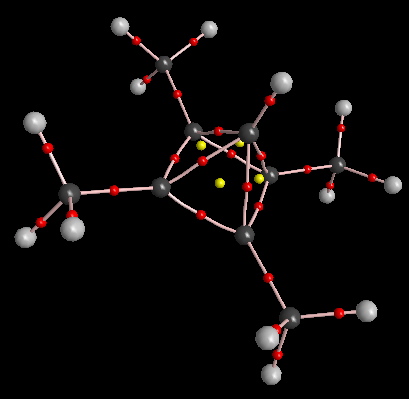
    AIM Analysis
    AIM Analysis
    ELF Basin centroids
    ELF Basin centroids. Click for 3D

    We are back to pentavalent, pentacoordinate carbon again, but we have gradually optimized the properties of the system for five short C-C bonds surrounding one carbon atom, and the largest electron density and disynaptic basin integration. Whilst the sentiments expressed by Hoffmann, Schleyer and Schaefer (DOI: 10.1002/anie.200801206) for more realism in predicting molecules must not be ignored, it is to be hoped that the original suggestions made here will lead to the discovery of realistic and makeable molecules exhibiting true C-C hypervalency.

  • It’s Hexa-coordinate carbon Spock – but not as we know it!

    Science is about making connections. And these can often be made between the most unlikely concepts. Thus in the posts I have made about pentavalent carbon, one can identify a series of conceptual connections. The first, by Matthias Bickelhaupt and co, resulted in the suggestion of a possible frozen SN2 transition state. They used astatine, and this enabled a connection to be made between another good nucleophile/nucleofuge, cyclopentadienyl anion. This too seems to lead to a frozen Sn2 transition state. The cyclopentadienyl theme then asks whether this anion can coordinate a much simpler unit, a C2+ dication (rather than Bickelhaupt’s suggestion of a (NC)3C+ cation/radical) and indeed that complex is also frozen, again with 5-coordinate carbon, and this time with five equal C-C bonds. So here, the perhaps inevitable progression of ideas moves on to examining the properties of this complex, the outcome being a quite counter-intuitive suggestion which moves us into new territory.

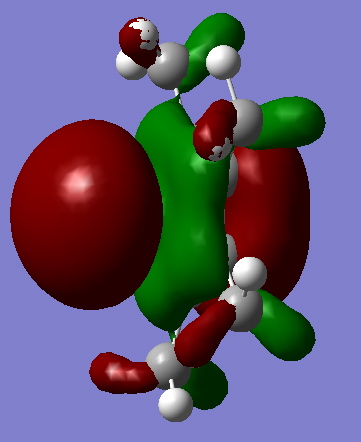
    The journey starts with the previous observation that the HOMO of the carbyliumylidene cation, shown in the previous post, has prominent electron density along the five-fold symmetry axis of the molecule;

    The HOMO orbital
    The HOMO orbital. Click for 3D

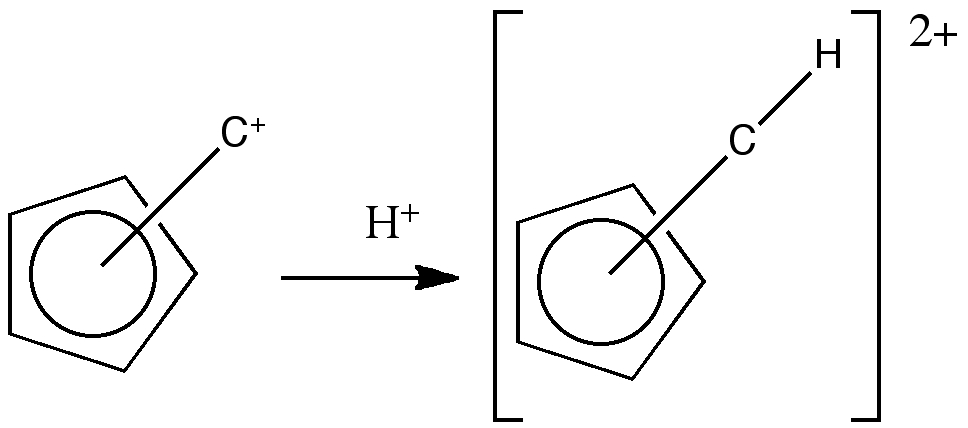
    This suggests that the apical 5-coordinate carbon might actually be basic, and hence coordinate a proton to form a di-cation (below). So adding a proton results in the following stable (in the sense of having all positive force constants) structure, with apical C-C bond lengths of 1.7Å (compared to 1.8Å for the unprotonated system) and the bouncing castle/trampoline mode of 875 cm-1 (DOI: 10.14469/ch/2410) is likewise increased (for the pentamethyl derivative of the structure shown below). The apical C-H stretch has the highest value of all the CHs in the molecule, 3208 cm-1. The calculated proton affinity of the parent compound is 134.2 kcal/mol. To put this into context, we can compare this value with a range of first and second proton affinities reported for carbon bases by Frenking[cite]10.1002/cphc.200800208[/cite]. The highest second proton affinity there reported (ie protonation of an already positive system) is around 106 kcal/mol, which is a good deal less than that found here! So we might conclude that our value must be a candidate for highest second proton affinity ever proposed for a carbon base.

    Hexa-coordinate Carbon?
    Hexa-coordinate Carbon?

    The value of ρ(r) for the AIM bond critical point located for each of the five apical C-C bonds is 0.156 au, again up from the value for the unprotonated species. As before, the Cp ring itself shows no ring critical point. An ELF analysis (below) shows five disynaptic basins in the C-C bond region, with the basin integrating to 0.75 electrons each. Together with the electrons in the apical C-H bond, 6.09 electrons are associated with basins surrounding this carbon atom. Both the AIM and the ELF concur in describing this carbon as not only hexa-coordinated, but hexavalent (although the bonds are not the conventional two-electron type, but perhaps more akin to a six-centre-four-electron interaction).

    ELF Basins
    ELF Basins. Click for 3D

    So I suggest that simple protonation of a highly basic cation has resulted in a six-coordinate carbon atom, which exhibits six strong bonds coordinated around it. I suppose it is inevitable again that one ends this post with the question whether this species too might one day be made.

  • It’s penta-coordinate carbon Spock- but not as we know it!

    In the previous two posts, I noted the recent suggestion of how a stable frozen SN2 transition state might be made. This is characterised by a central carbon with five coordinated ligands. The original suggestion included two astatine atoms as ligands (X=At), but in my post I suggested an alternative which would have five carbon ligands instead (X=cyclopentadienyl anion).

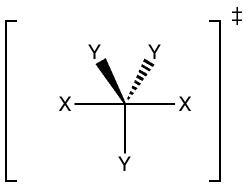
    The Sn2 transition state
    The Sn2 transition state

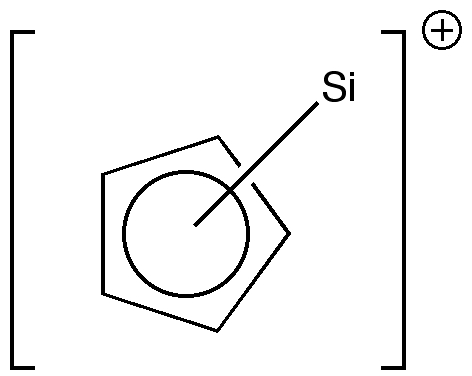
    However, these five ligands are not all equal; far from it. Three form normal strength bonds to the central carbon, and two very weak (deci)bonds. So, could a molecule be made with five equal bonds all coordinated to a central carbon atom? Well, the inspiration for designing such a molecule comes with the report of a remarkable compound of silicon by Jutzi and co-workers[cite]10.1126/science.1099879[/cite]. Examples with Ge, Sn and  Pb are also known.

    The silyliumylidene cation
    The silyliumylidene cation

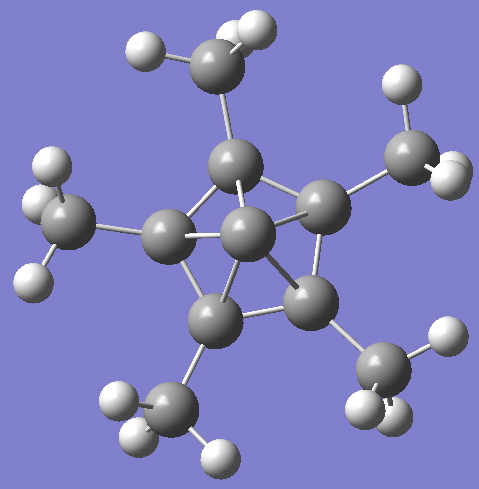
    Using a large non-coordinating anionic counterion, a crystal structure could be determined for the pentamethyl derivative (Refcode: BIDLEG), which reveals the five-fold symmetry of the silicon coordination. The obvious mutation therefore is to see if the corresponding carbon compound might be stable.  A B3LYP/6-311G(d,p) calculation (DOI: 10.14469/ch/2408) run with  C5 symmetry reveals this system to have only positive force constants, with five equal C-C bonds to the central carbon, each with the unusual length of 1.799Å. The bouncing castle vibrational mode involving the pentacoordinate carbon has a value of  767 cm-1

    The carbyliumylidene Cation
    The carbyliumylidene Cation

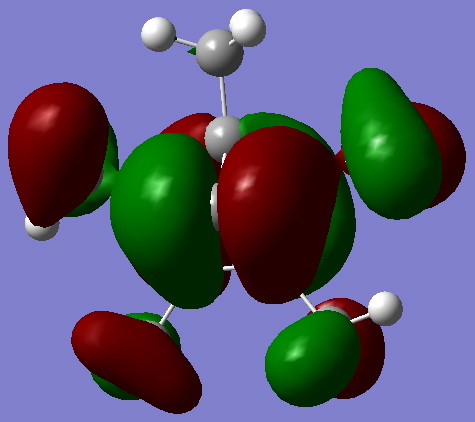
    So, not only do we now have a clearly penta-coordinate carbon, all five bonds are of equal length! More unusual still, all five ligands occupy one hemisphere of the carbon coordination. Why might such a geometry be stable? Well, as with the silicon analogue, C2+ has only two valence electrons left. To elevate this to the standard octet, it must accept six electrons, and the cyclopentadienyl anion fulfils this role perfectly. The top three occupied molecular orbitals are shown below.

    The HOMO orbital
    The HOMO orbital. Click for 3D
    The HOMO-1 (degenerate) orbital
    The HOMO-1 (degenerate) orbital. Click for 3D

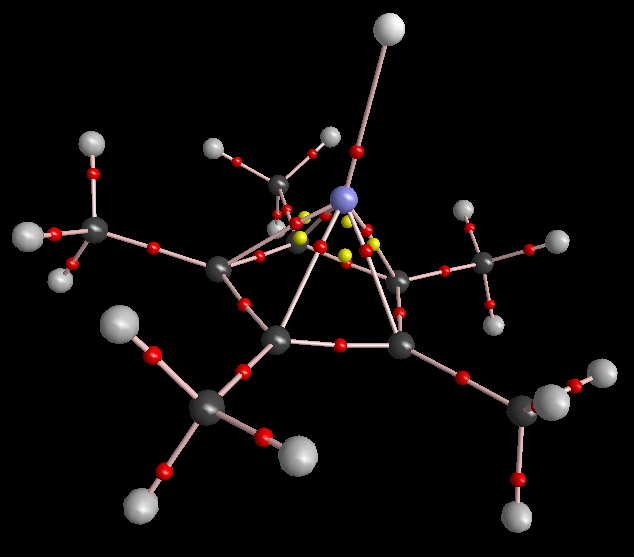
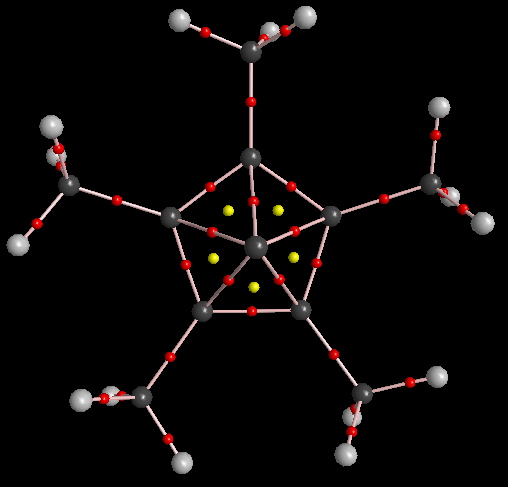
    An AIM analysis (below) shows five equal bond critical points, with ρ(r) 0.13 au for each (see previous post for comparison), a value which probably can be described by the term bond. The ∇2ρ value of +0.07 au is similar to that quoted in the previous post. Noteworthy is the observation that no ring critical point (RCP, yellow dots) can be found for the cyclopentadienyl ring itself, only for the five three-membered rings to the pentacoordinate atom.

    AIM (Atoms-in-Molecules) analysis
    AIM (Atoms-in-Molecules) analysis

    Can the species be made? Well, given that it seems the case that carbon and silicon chemistries are inverted, ie what is stable with silicon is unstable with carbon, and vice versa, the answer is probably no. But one never knows until one has tried!