Tag: metal

  • Ways to encourage water to protonate an amine: superbasing.

    Previously, I looked at models of how ammonia could be protonated by water to form ammonium hydroxide. The energetic outcome of my model matched the known equilbrium in water as favouring the unprotonated form (pKb ~4.75). I add here two amines for which R=Me3Si and R=CN. The idea is that the first will assist nitrogen protonation by stabilising the positive centre and the second will act in the opposite sense; an exploration if you like of how one might go about computationally designing a non-steric superbasic amine that becomes predominantly protonated when exposed to water (pKb <1) and is thus more basic than hydroxide anion in this medium.
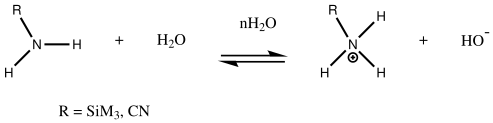
    NH3-8

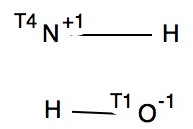
    Before reporting any calculations, let us see what the CSD (Cambridge structure database) might contain. The search query is simple, a 3-coordinate amine forming a 4-coordinate quaternary nitrogen with one N-H and a positive (formal) charge on the N, and a 1-coordinate oxygen with one O-H and a negative charge on the O. With the constraints R < 10%, no disorder and no errors, one gets as many as 15 hits,[cite]10.14469/hpc/361[/cite] several of which also apparently contain separate water molecules in the crystal. A warning bell (perhaps several) sounds, since if R < 5%, the number of hits drops to just 2; these are clearly difficult structures to refine! So there is some tantalising evidence that in the solid state at least, the quaternary ammonium group (with at least one N-H), water and a hydroxide anion might be capable of co-existence. As noted below some fascinating 2-coordinate amines have also been reported as having superbasic properties.
    NH3-8

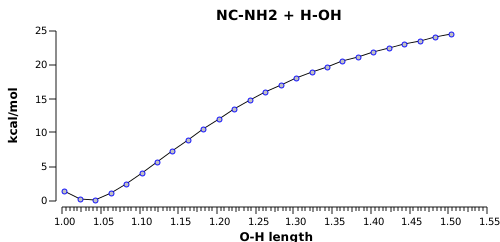
    R=CN: the well known compound cyanamide is known to act only as an acid and its basic properties are never quoted. Shown below is the reaction path for transfer of a proton from water to the amine using an 8-water model (n=8) in which two bridges can serve to help stabilize any ionic form. The energy required to do so however is at least 24 kcal/mol (ωB97XD/Def2-TZVPPD/SCRF=water) which indicates that no protonated amine is formed. This can be attributed to the electron withdrawing cyano group strongly destablising any adjacent positive ammonium centre and thus effectively completely inhibiting its formation.
    NH3-8

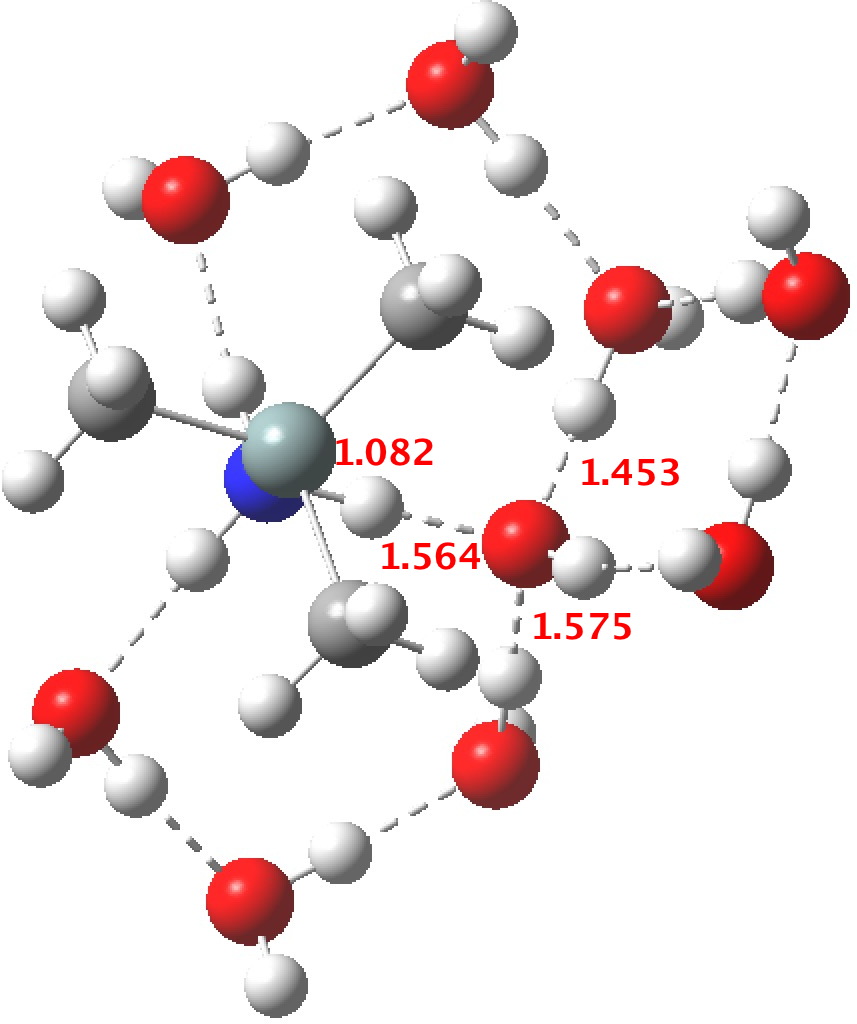
    R=Me3Si: this too is already known[cite]10.1016/j.jorganchem.2006.09.021[/cite],[cite]10.5517/CCNDXZX[/cite] but only in the presence of the non-coordinating counter-anion B(C6F5)4 crystallised from non-protic solution. An ionised form can now be located using the model above. This has the structure shown below; note the very short hydrogen bonds associated with the hydroxide anion and the possibility of forming only two water bridges across the ion-pair. The relative free energy of the ion-pair (table below) shows it to be if anything less basic than ammonia. 
    NH3-8

    n=8 R=H R=SiMe3 R=CN
    ΔΔG298 7.0[cite]10.14469/ch/191946[/cite]

    7.6[cite]10.14469/ch/191987[/cite],[cite]10.14469/ch/191982[/cite]

    >24[cite]10.14469/ch/191983[/cite]

    NBO (natural bond orbital) analysis might here  be a useful metric of basicity. Hence Me3SiNH2…H2O  suggests that donation from the N lone pair into an antiperiplanar Si-C bond is quite large (E(2) = 11.9 kcal/mol), although alternative donation by nitrogen into the H-O σ* bond  of the water is much higher (33.4 kcal/mol). 

    Perhaps the basicity of simple amines is related to their ability to form stabilizing water bridges across the ion-pair? With trimethylsilyl substituents, this feature (and hence the basicity) is partially or even fully suppressed as in e.g. tris(trimethylsilyl)amine.The pKb of the latter appears to be unreported[cite]10.1039/tf9646001257[/cite] but it does seem to be only weakly basic and "inert to H2O",[cite]10.1002/zaac.19603030502[/cite] a property attributed instead to multiple character in the Si-N bonds. 

    I will in a future post look at the alternative class of phosphazenium amines which do manage to achieve superbasicity.[cite]10.5517/CC12MRFW[/cite]


    A phosphazenium 3-coordinate amine[cite]10.1002/anie.198711671[/cite] was in 1991 claimed to be the strongest metal-free neutral base. This has now been superceded by combining this base motif with that of a sterically operating proton sponge.[cite]10.1021/ja409760z[/cite],[cite]10.5517/CC12MRFW[/cite] I will report the computational modelling of these systems in a later post.

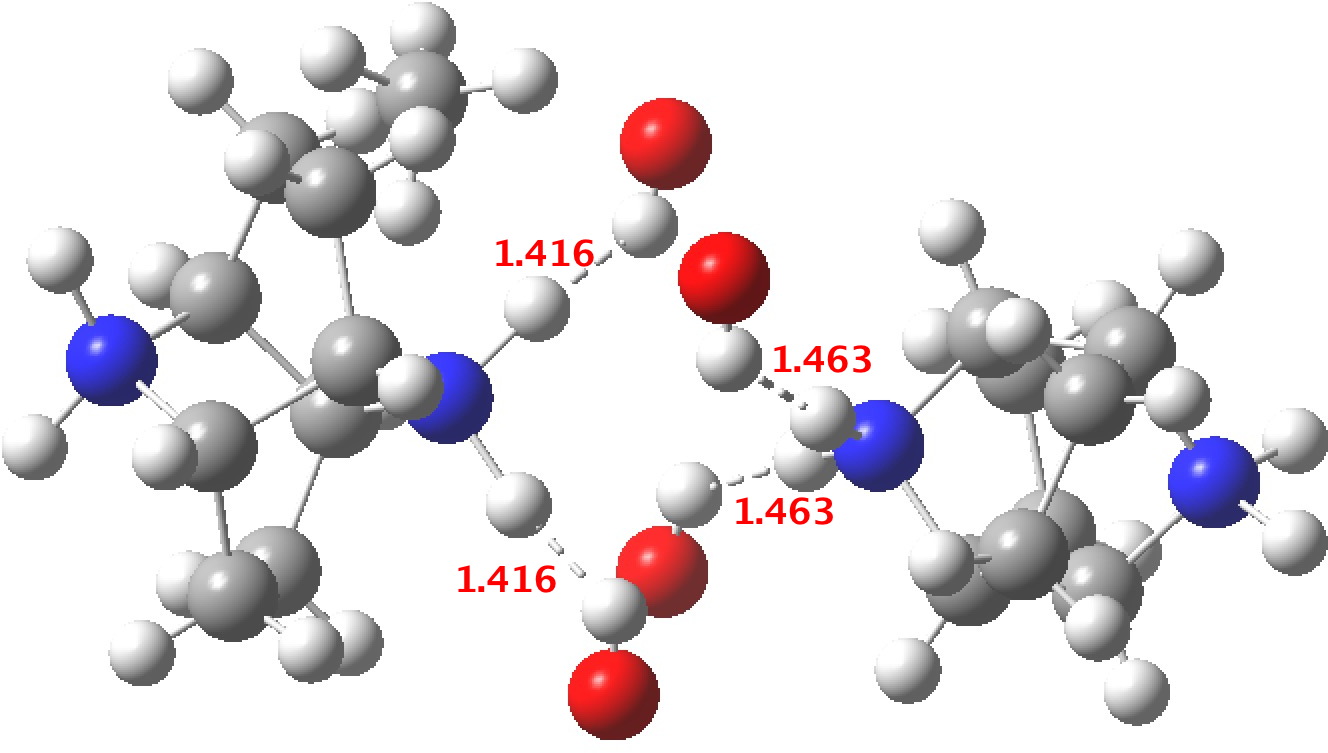
    One of the structures identified with R<10% is UBEJIU[cite]10.1021/jm991140q[/cite] and which is worth showing below. Note the apparent close contact of the type N-H…H-O (1.416-1.463Å) rather than the expected N-H…OH.  If correct (this feature is not mentioned in the article itself) it would be classified as a dihydrogen bond, a type normally only found in situations such as B-H…H-N. There are a number of other inconsistencies which must be resolved if this structure is to stand as correct.
    NH3-8

  • Celebrating Paul Schleyer: searching for hidden treasures in the structures of metallocene complexes.

    A celebration of the life and work of the great chemist Paul von R. Schleyer was held this week in Erlangen, Germany. There were many fantastic talks given by some great chemists describing fascinating chemistry. Here I highlight the presentation given by Andy Streitwieser on the topic of organolithium chemistry, also a great interest of Schleyer's over the years. I single this talk out since I hope it illustrates why people still get together in person to talk about science.

    NH3-8

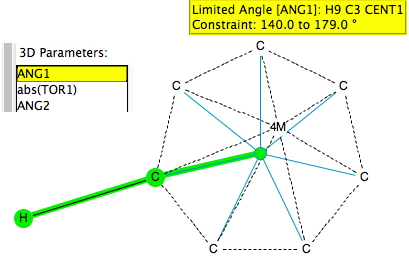
    The presentation focused on the structure of the simplest possible metallocene, lithium cyclopentadienyl and why the calculated structure showed that the hydrogen atoms attached to the cyclopentadienyl ring pointed slightly away from the metal rather than towards it (by ~1-2°). Various explanations had been put forward, some had waxed and then waned. It was still basically an open problem. Now, the title of the symposium was Theory and Experiment: A Meeting at the Interface; Streitwieser had given the theory and whilst listening, I realised I might be able to help relate this to known experiments, i.e. crystal structure data. I could do so by analysing the known crystal structures of metallocenes.[cite]10.1021/acs.jchemed.5b00346[/cite] So here is the basic search query, and I will go through it thus:

    1. A general ring is defined (sizes 4,5,6,7,8) and the ring and metal-C bonds are all specified as of type "any" (it is difficult to know how such bonds might be classified, ie delocalised, aromatic, etc, so best not to constrain things) and a metal is attached.
    2. 4M is basically any metal; again the search is unconstrained, but one could focus on certain columns of the periodic table if one wished.
    3. A ring centroid is computed.
    4. ANG1 is defined as the angle H-C-centroid, the angle of interest in Andy's talk. The limits were constrained to lie between 140° and 179°. I did this because when the angle becomes 180°, the torsion becomes mathematically undefined and I did not want to risk this happening.
    5. TOR1 is defined as the torsion H-C-centroid-metal. Values of 180° would indicate that the hydrogen was pointing away from the metal; values of 0° would indicate it was pointing towards the metal. The absolute value of the torsion is taken to avoid confusion induced by its sign.
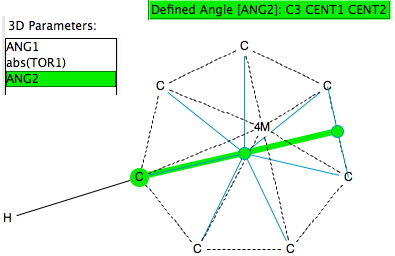
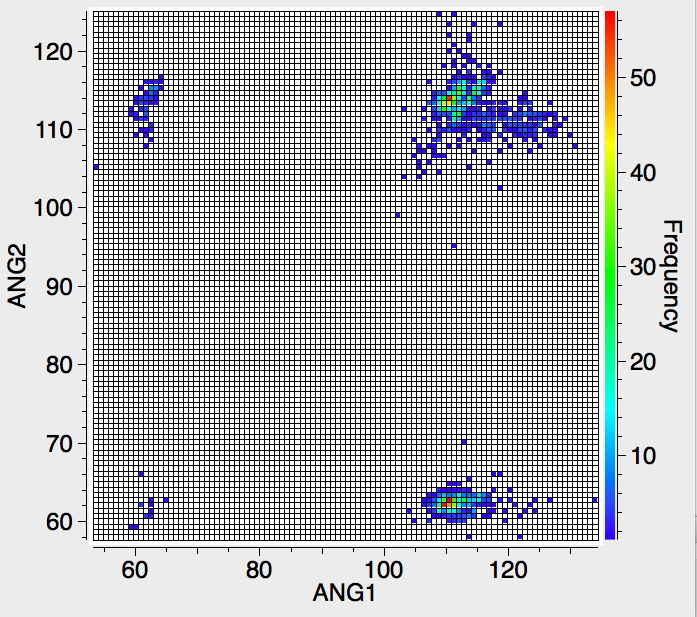
    6. ANG2 is one test whether the ring is planar. For an even membered ring, it is the angle subtended at the centroid to opposing carbon atoms. For odd membered rings it is the angle at the centroid involving one carbon and a centroid defined by an opposing pair of atoms (see below).
    7. The quality of the crystal structure determination is controlled by specifying that the R value be < 5%, no errors, no disorder. Also, the terminal H-positions are normalised (to correct known errors in H distances deriving from x-ray diffraction). I would point out that in the early days, the actual positions of the hydrogen were often not actually determined, but "idealised". In this case this would mean that the H-C-centroid angle would probably be set to 180°. For perhaps the last 20 years or so however, the positions of hydrogen atoms have been routinely refined. Unfortunately, I know of no search query that can separate the two cases, and so we will have to live with the mixture and see what we get.
    8. We define another constraint separately, which is that the temperature of the data collection sample is <140K. This ensures that the data will be free of more vibrational/thermal noise and so should be rather more accurate.
    9. Finally, a note on the topic of "research data management" or RDM. I have deposited the files defining the search query in a repository and have assigned DOIs both to the overall search collection[cite]10.14469/hpc/346[/cite] and to each individual search definition, the DOIs for which are shown below.

    NH3-8

    NH3-8

    The 4-ring case.[cite]10.14469/hpc/347[/cite] Here the temperature constraint was relaxed, since there are few entries. The two red "hot-spots" occur at torsion angles of ~180° (hydrogen pointing away from metal) at bond angle values of between 173-176°. 

    NH3-8

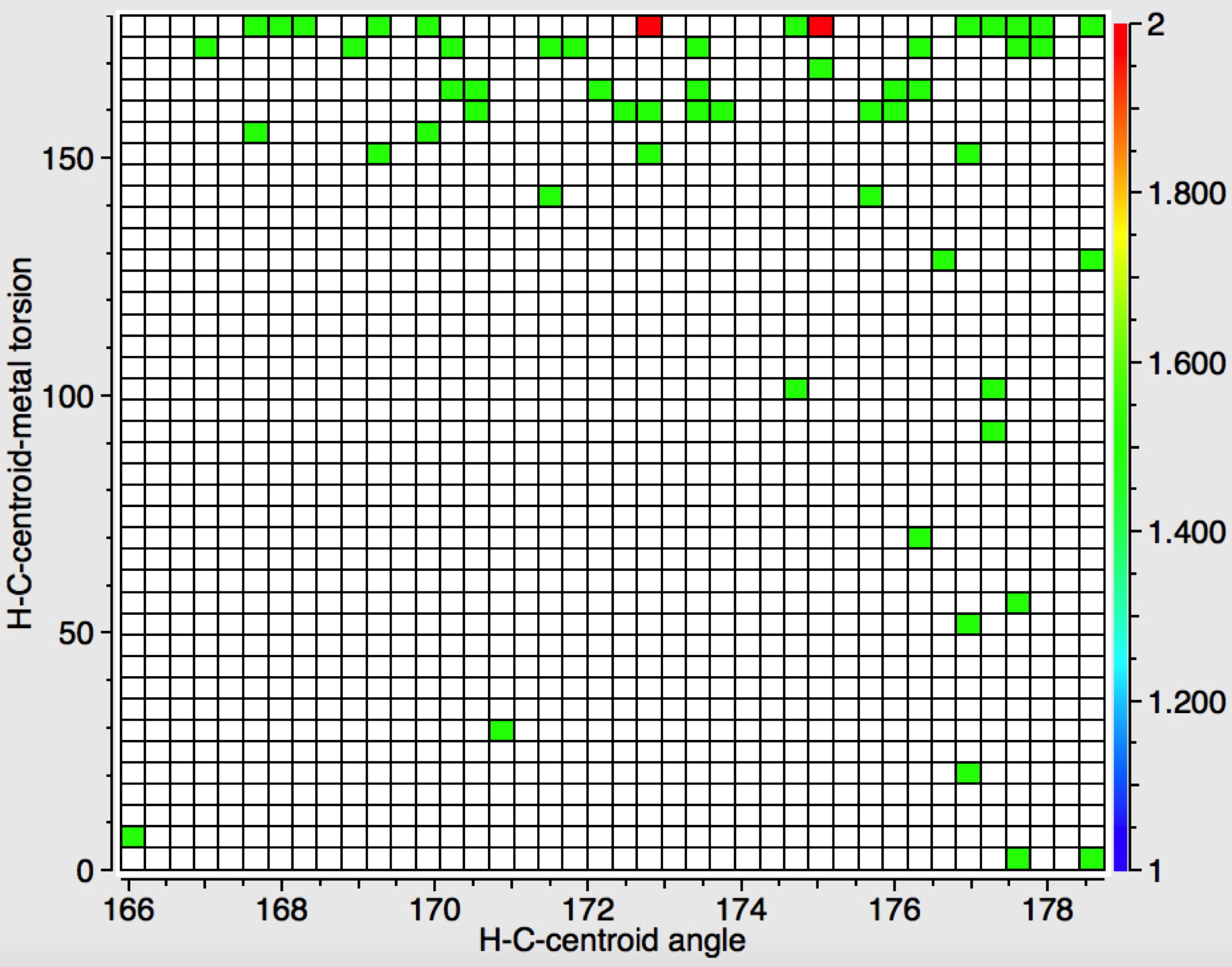
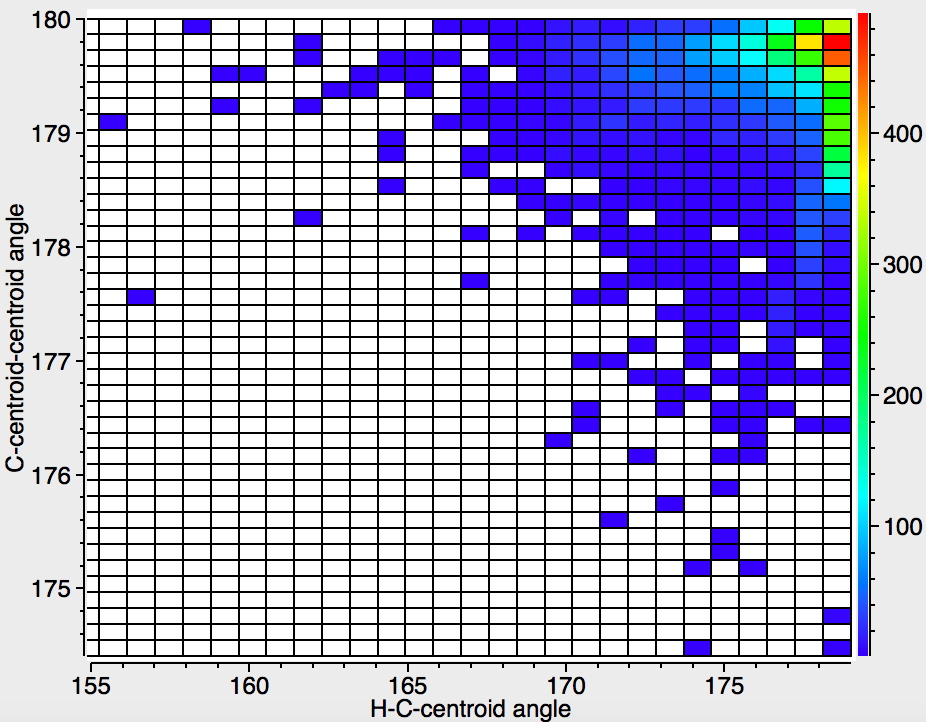
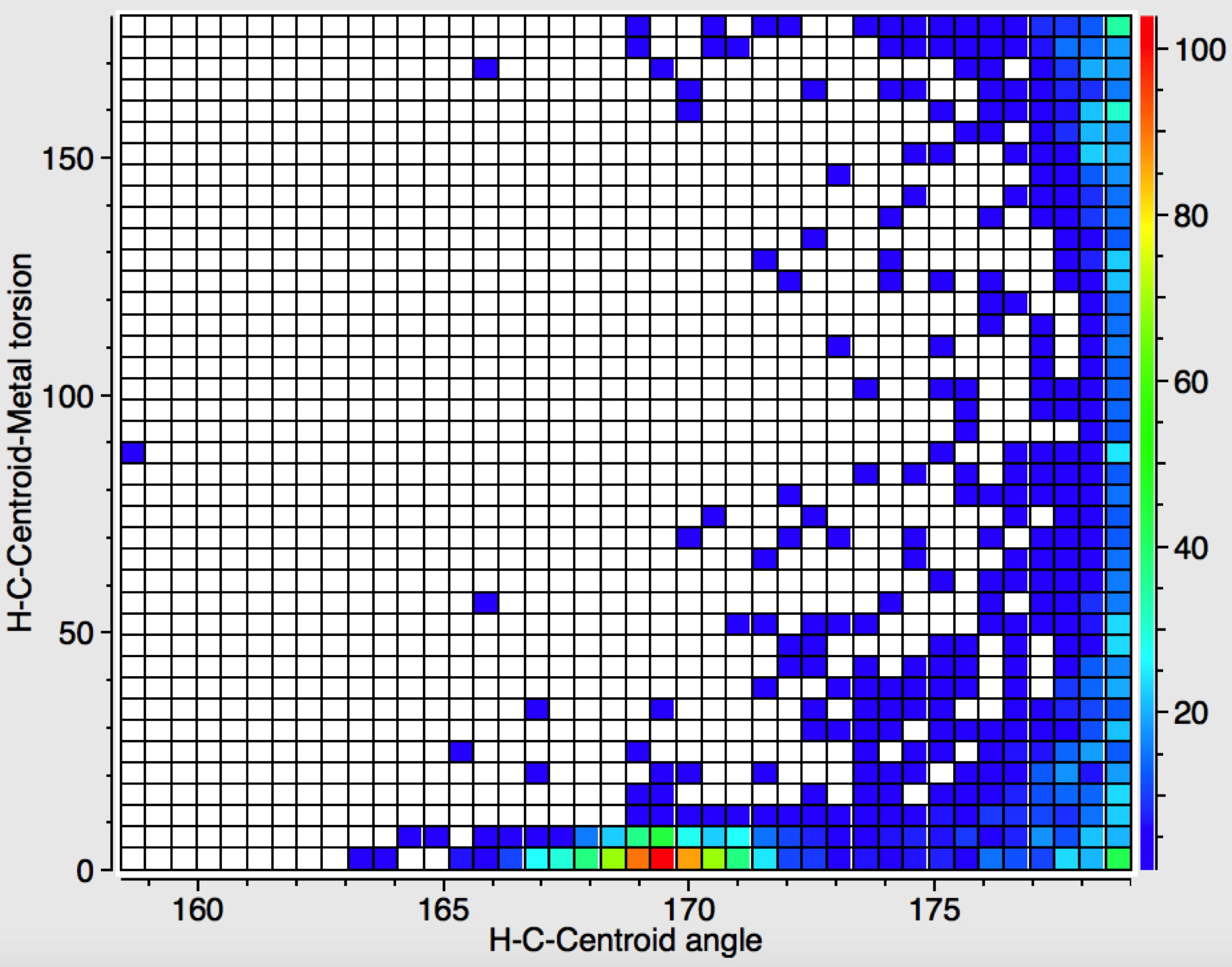
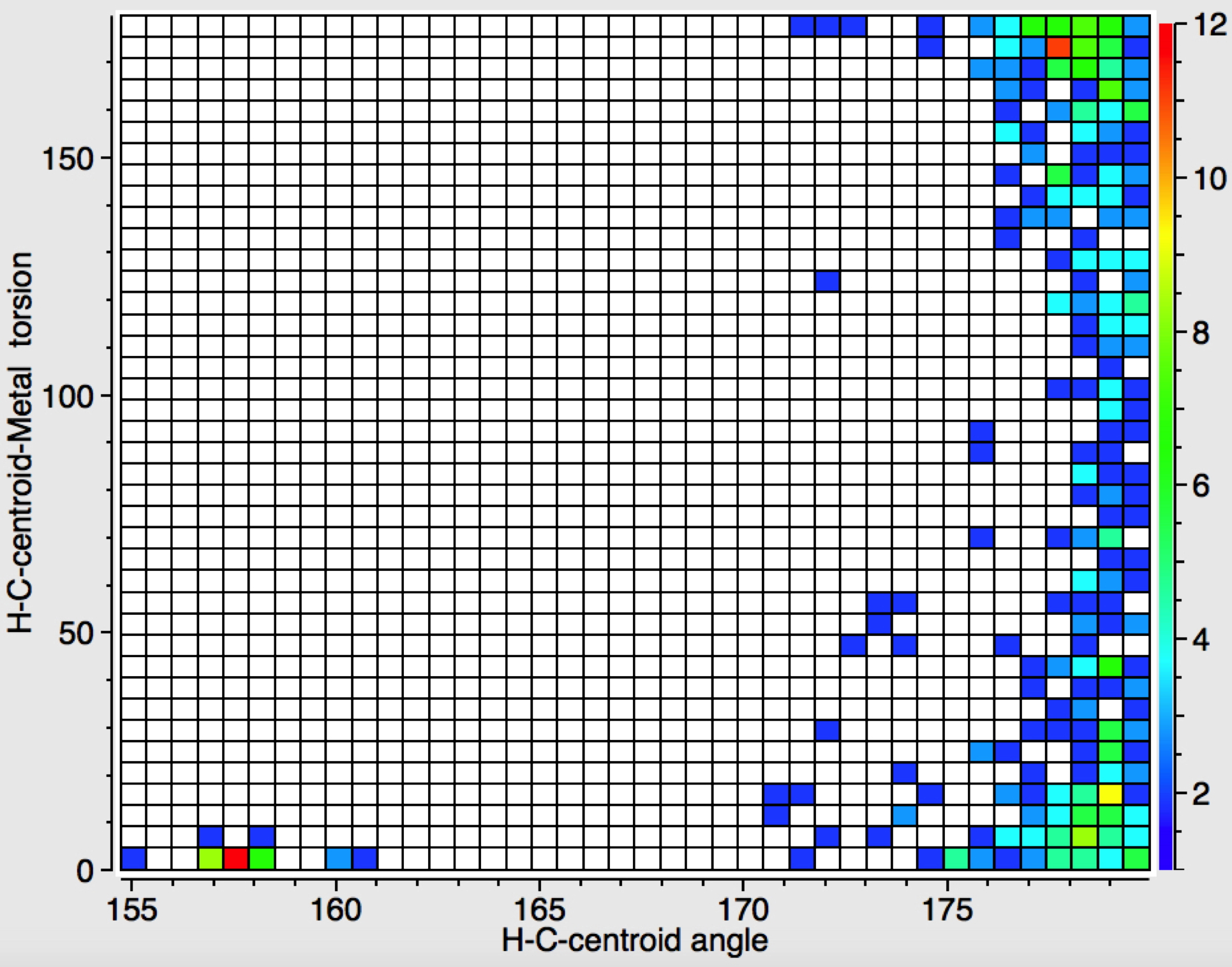
    The 5-ring case.[cite]10.14469/hpc/348[/cite] This includes the classic ferrocene example, the first metallocene for which the structure was correctly identified. There are many more examples, and this search is now constrained to <140K. The two hot spots occur at bond angles of very close to 180°, at which values the torsion itself becomes undetermined. That the hot spots actually occur at 0° and 180° and are not spread evenly across the right hand side axis is remarkable given this. There is a significant tail for the 180° torsion (H pointing away from metal) down to H-C-centroid angles of about 170°, but there is no evidence of this tail for torsions of 0°.

    NH3-8

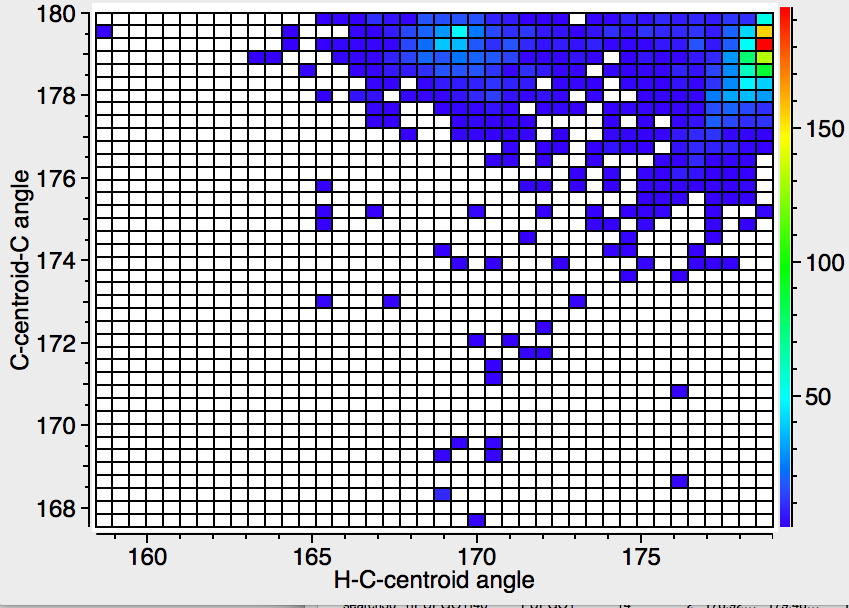
    One more test must be applied to see if the 5-ring is planar or not. The deviation from planarity is only 2-3°, and there seems to be no correlation between lower values of the H-C-centroid bond angle and non-planarity.

    NH3-8

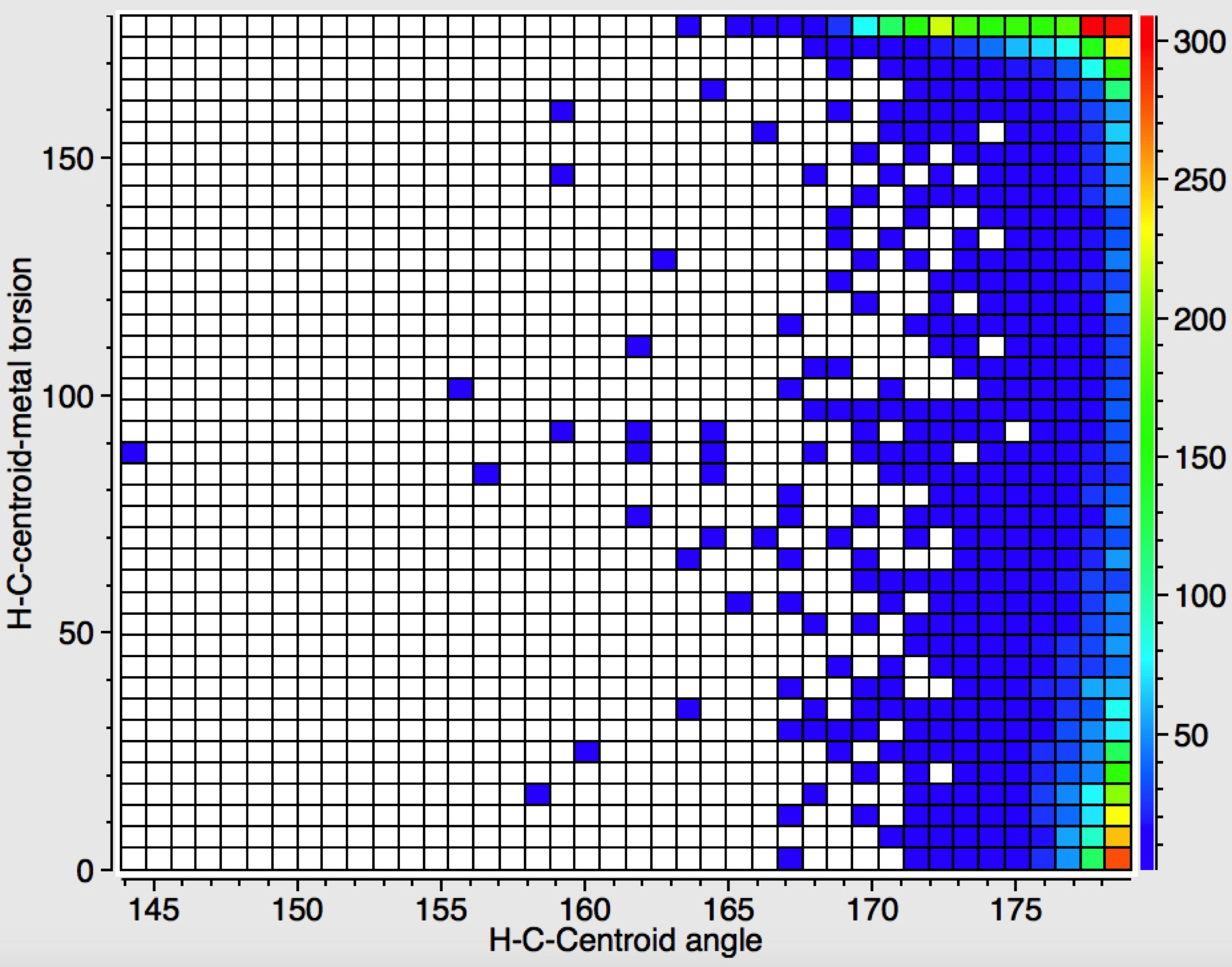
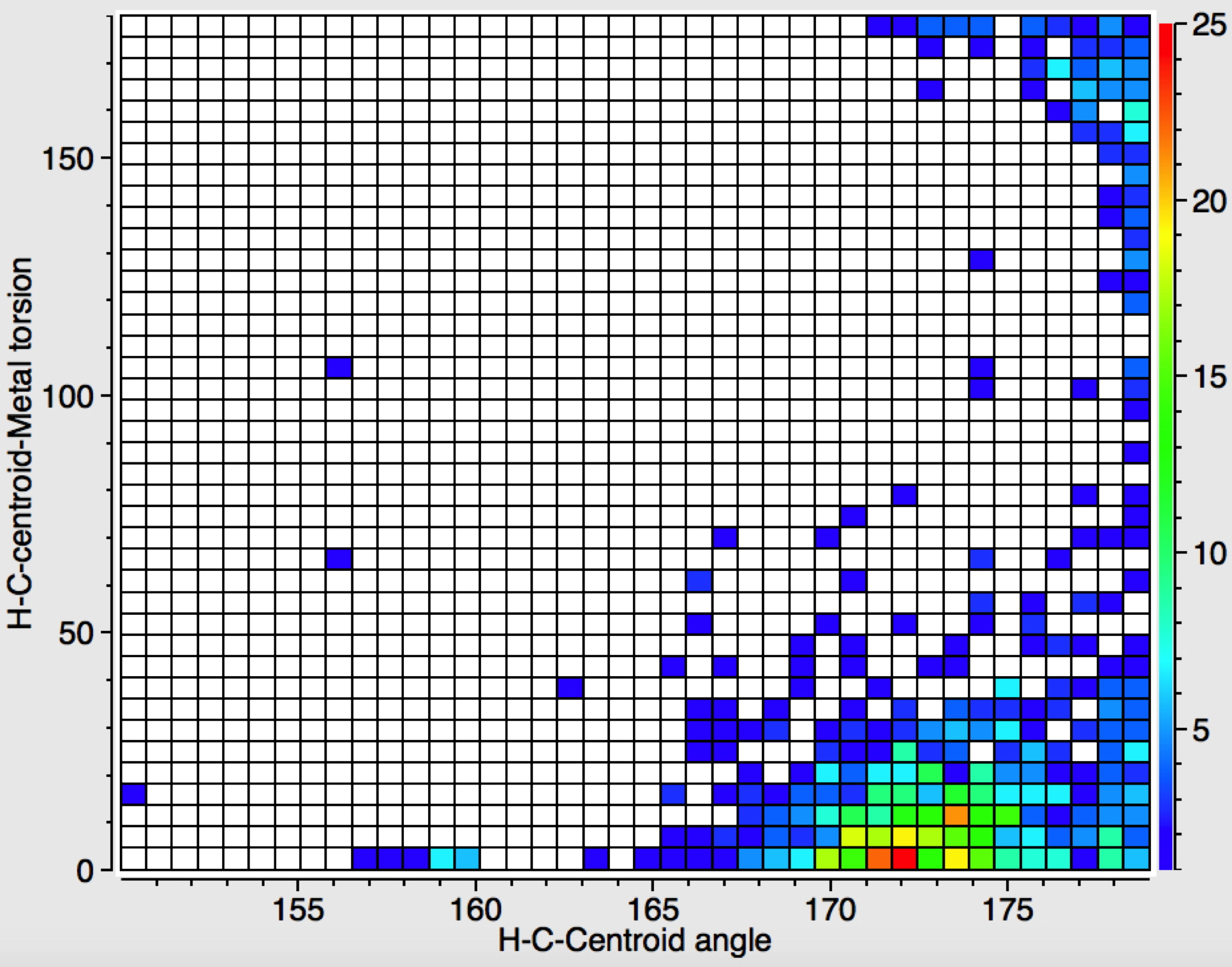
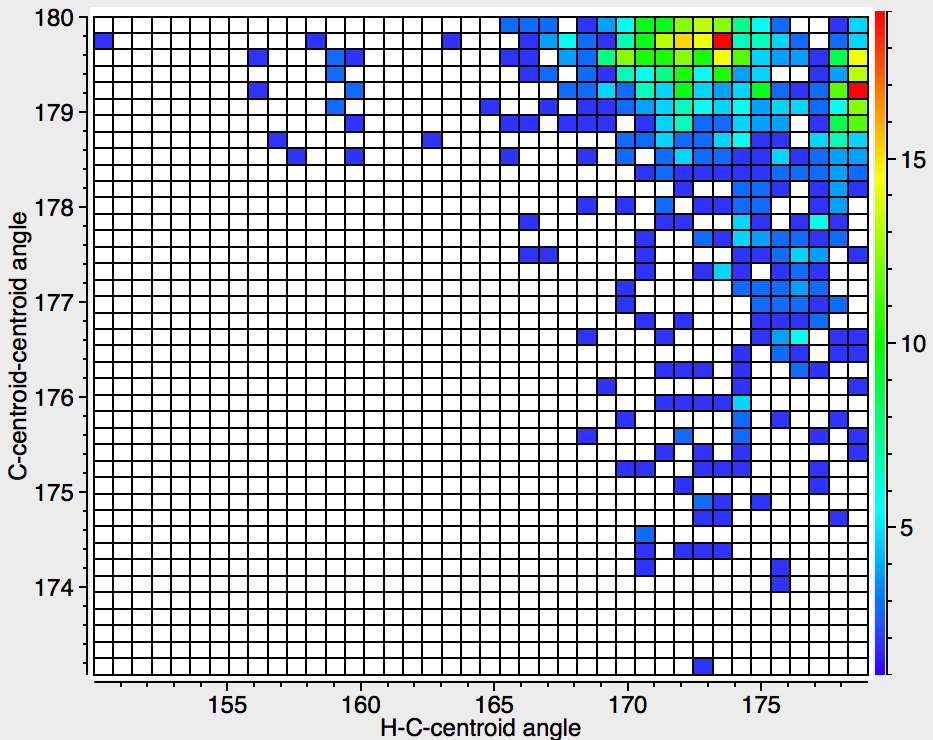
    The 6-ring case.[cite]10.14469/hpc/349[/cite] There are again numerous examples of data <140K for such rings. There is now a very distinct hotspot at angles of ~170° for the case/torsion where the hydrogen is pointing towards the metal.

    NH3-8

    This feature persists when the ring planarity is tested, and it occurs specifically for rings where the angle subtended at the centroid is ~180° and H-C-centroid angles of ~170°. So this is clear-cut effect which demands explanation #1.

    NH3-8

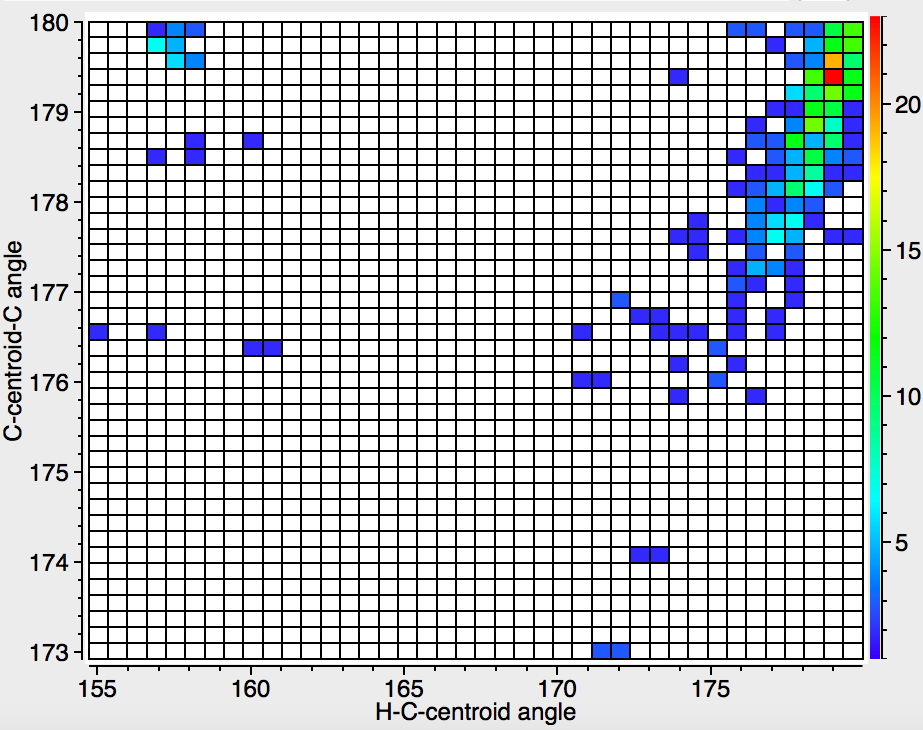
    The 7-ring case[cite]10.14469/hpc/350[/cite] again shows a strong hot spot at ~172° for a torsion corresponding to the hydrogens pointing towards the metal. This hot spot is matched by angles subtended at the ring centroid that are close to 180° (i.e. planar). This is clear-cut effect which demands explanation #2.

    NH3-8

    NH3-8

    The 8-ring case[cite]10.14469/hpc/351[/cite] also shows a hot spot for hydrogens pointing towards the metal by the strikingly large degree of ~157°, and this feature is associated with a linear C-centroid-C angle. This is clear-cut effect which demands explanation #3.

    NH3-8

    NH3-8

    The 9- and 10-ring cases.  There are no examples!  Time to make some?

    To summarise. 

    1. The above was done during a conference in response to a point made by one of the speakers. In fact, it proved possible to show the speaker the diagrams above <18 hours after he gave the talk.
    2. An immediate question that arose from this discussion was whether the hot-spots were artefacts of non-planar rings. So the ANG2 test was added to the plots the next day (today) as part of this dissemination.
    3. Also discussed (yesterday) was how these conference insights might be shared. I suggested the forum here and Professor Streitwieser heartily agreed. Another alternative was to write it up as a regular journal article. But we both agreed that ..
    4. what you see here is just a statistical analysis. The next stage would be to individually inspect all the molecules which make up these statistics. You see it might just be that every molecule contributing to a "hot-spot" cluster might have special circumstances which conspire to make it look as if there is an interesting chemical effect going on. It is unlikely that such coincidences could accrue in such a manner, but the possibility does have to be considered.
    5. I think we both felt that a better way was to expose the basic effects here, as a sort of open science research project, and anyone interested could then (a) try to replicate these plots, which is why you will find the DOIs of datasets containing the definition files to assist in any such replication and (b) tunnel down to any specific hot spot to identify the precise chemical characteristics that might give rise to the geometrical effect.
    6. This could then be followed up by computational analysis of the electronic properties which might give rise to the effect. This would in effect complete the cycle, since this was the starting point for Streitwieser's original talk. Remember, the theme of the celebration was the interplay between theory and experiment, a particular favourite of  Schleyer's.
    7. Regarding the chemical insights, a distinct trend over the ring sizes 4-8 can be seen. The 4-ring shows the hydrogens pointing away from the metal, the 5-ring could be said to be largely agnostic (remember the error in crystallographic angles is probably in the region 1-3°) whilst there is an indication that for the 6-8 rings the ring hydrogens tend to point towards the metal. I have summarised three key points illustrating this as #1-3 above.
    8. It is tempting to conclude that a fairly general chemical effect is operating here over #1-3, although of course it could be a number of effects specific to each ring which merely look like a general trend.

    So the chemical interpretation of this project is unfinished, a general feature of much of science of course. But my aim here was to give a flavour of how a scientific meeting at its best can bring together like (or often unlike) minds which can tease out new connections and lead perchance to new discoveries.


    These hours were productively employed by sharing a Franconian banquet together, and a modicum of sleep, as well as the searches described above. And in case you see no citations at the bottom of this post, they too take about 48 hours to propagate through the CrossRef and DataCite systems. Be patient and they will appear. In my original representation, I showed the Hs pointing towards the metal. In fact Prof Streitwieser has just contacted me reversing this orientation and correcting my recollection of his lecture.

  • Discovery based research experiences: gauche effects in group 16 elements.

    The upcoming ACS national meeting in San Diego has a CHED (chemical education division) session entitled Implementing Discovery-Based Research Experiences in Undergraduate Chemistry Courses. I had previously explored what I called extreme gauche effects in the molecule F-S-S-F. Here I take this a bit further to see what else can be discovered about molecules containing bonds between group 16 elements (QA= O, S, Se, Te). 

    OO-SQ

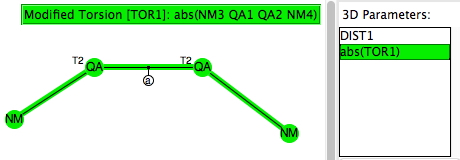
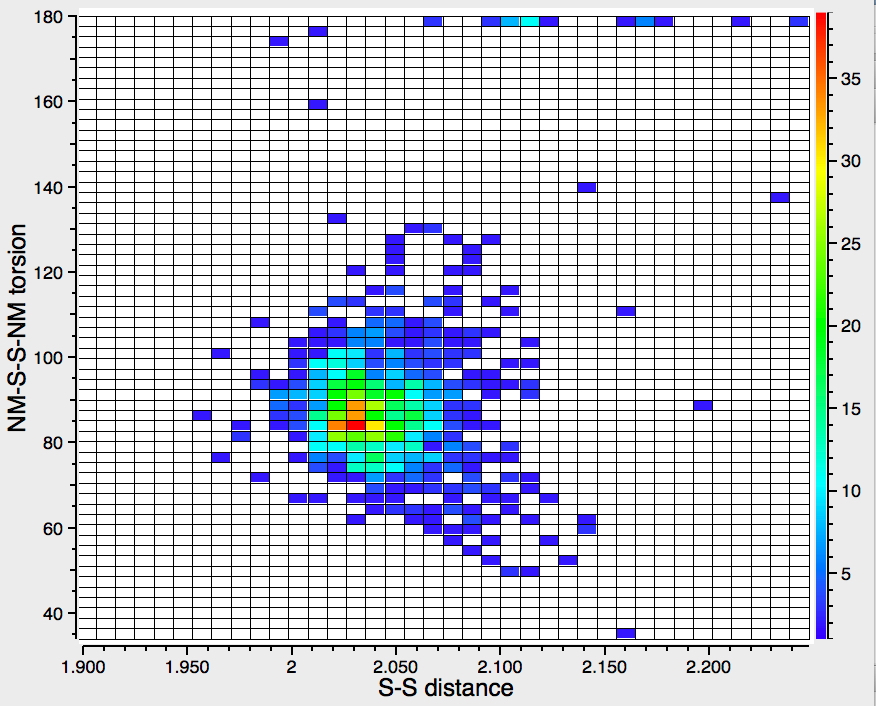
    The search definition is shown above, with DIST1 being the QA-QA bond length, the QA-QA bond being acyclic, each QA bearing only two bonded atoms and NM being any non-metal. The first result shown is for QA=S.

    S-S

    1. The first discovery is that the most common torsion (red-hot spot) is about 90°, but there appears to be a statistically significant distortion towards longer S-S distances as the torsion deviates from this angle. For those who are so inclined it would perhaps be worth improving my term "appears to be" with a more formal numerical analysis of the distribution shown above and its significance. Any offers?
    2. The other discovery worth exploring is the number of occurences with an angle of 180°. With F-S-S-F itself (not a solid), I had previously noted that this angle actually represented a transition state in the torsion! So what might be inferred from these examples?

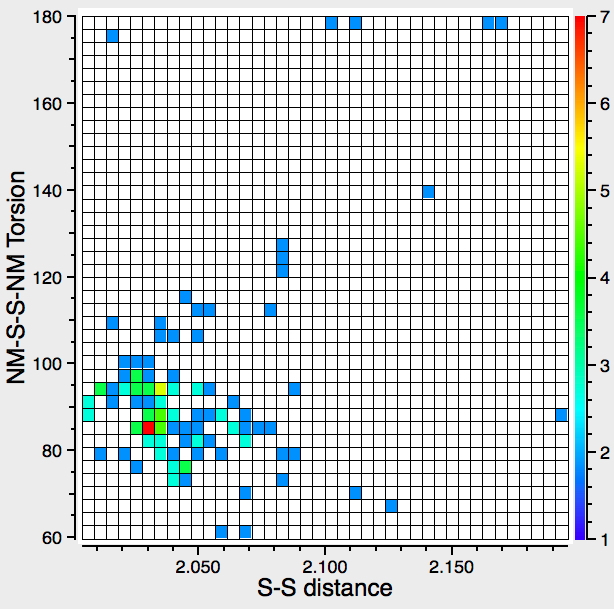
    The next search includes a further constraint that the temperature the data was recorded at be <140K. This reduces vibrational "noise" and so should increase the significance. S-S-140

    1. Here we discover the same "V"-shaped distribution as before, possibly more significant statistically than the previous search. Again, a proper statistical analysis of the significance of this result is desirable.

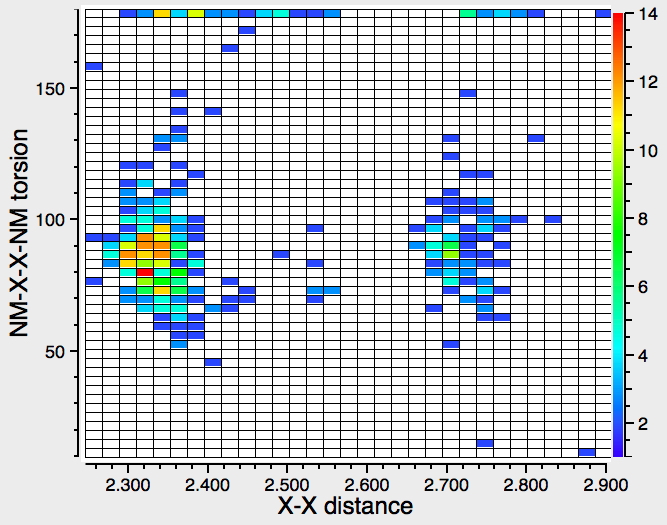
    The next search is for QA = Se or Te. X-X

    1. The Se and Te distributions can clearly be distinguished, with a weak "V-shape" visible for Se, but absent for Te. Again, those hits at 180!
    2. There are a few instances "in-between" the two distributions, which appear to be  Se-Te systems.

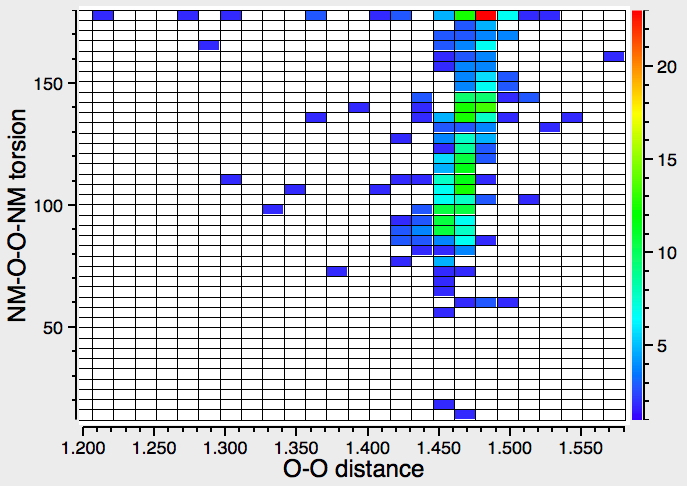
    Finally, QA=QB = O.

    O-O

    1. The discovery here is the apparent absence of any "V-shaped" distribution.
    2. The hot spot now occurs at 180°, but with a tail down to 60° or less. Clearly, the definition of "NM" as any non-metal probably needs to be explored further for specific instances to see what influence the nature of NM has. NM for example could be another O, which might be a severe perturbation. 

    So here I have tried to tease out seven directions for further discovery. I am attending/presenting at the session I noted at the top and will report back on any interesting observations.


    Acknowledgments

    This post has been cross-posted in PDF format at Authorea.

  • Deviations from tetrahedral four-coordinate carbon: a statistical exploration.

    An article entitled "Four Decades of the Chemistry of Planar Hypercoordinate Compounds"[cite]10.1002/anie.201410407[/cite] was recently reviewed by Steve Bacharach on his blog, where you can also see comments. Given the recent crystallographic themes here, I thought I might try a search of the CSD (Cambridge structure database) to see whether anything interesting might emerge for tetracoordinate carbon.

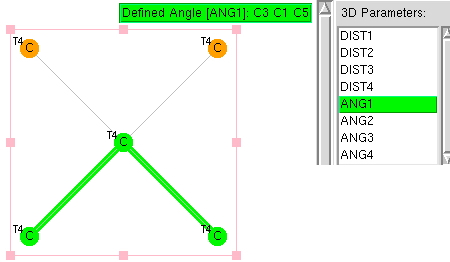
    The search definition is shown below using a  simple carbon with four ligands, the ligands themselves also being tetracoordinate carbon. The search is restricted to data collected below temperatures of 140K, as well as R-factor <5%, no errors and no disorder. Cyclic species are allowed and a statistically reasonable 2773 hits emerged from the search.

    Scheme

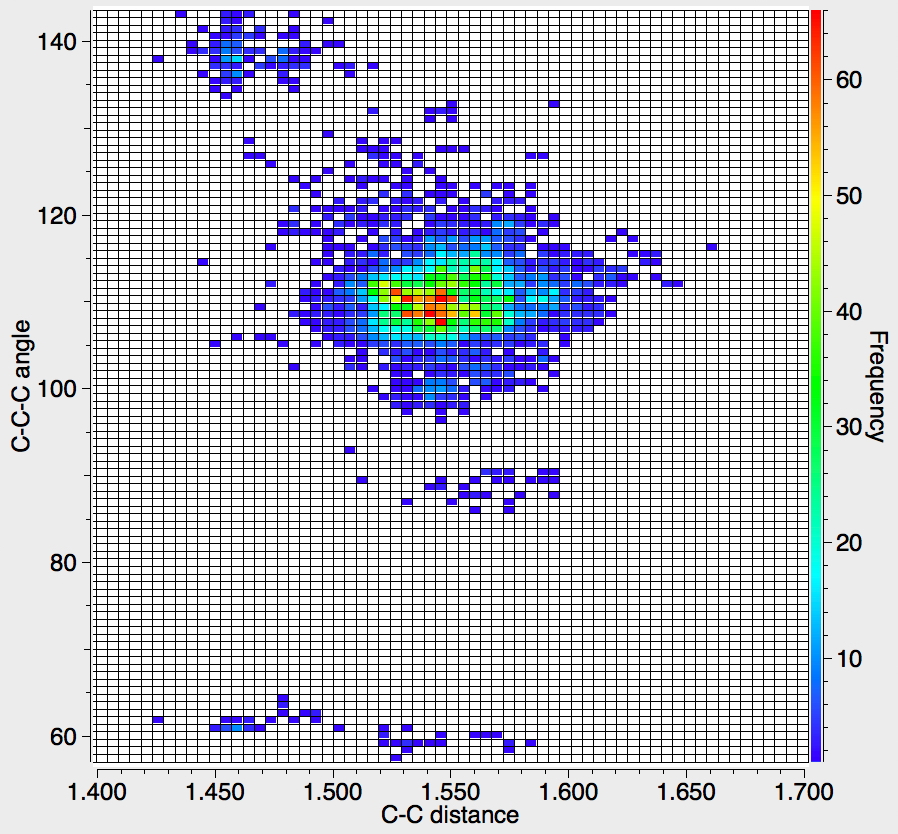
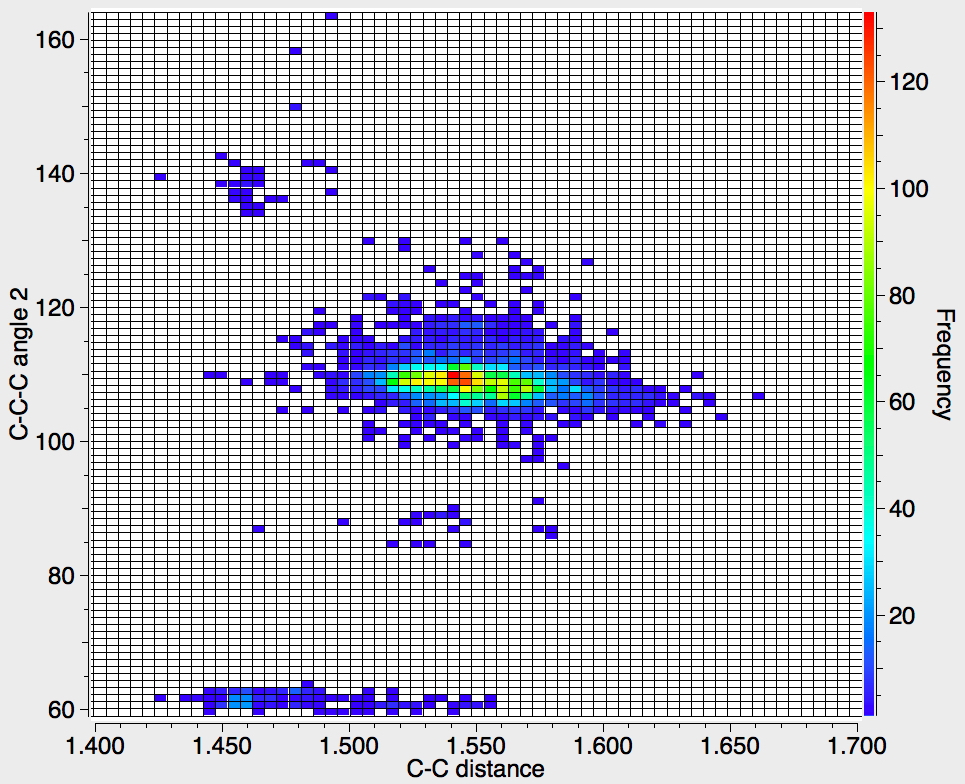
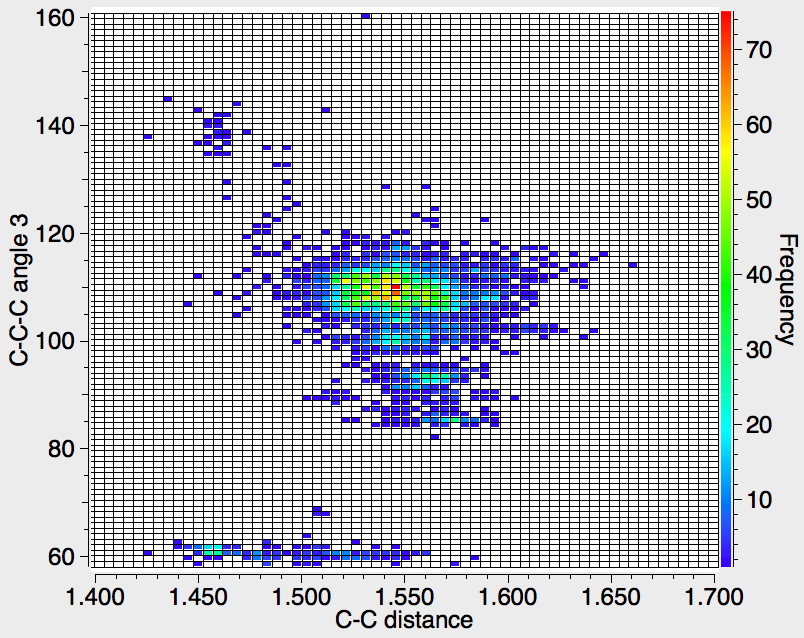
    Recollect that the idealised angle subtended at the centre is 109.47°. I show below three separate heat plots of the search results. Why three? The way the search software (Conquest) works is that one could define four C-C distances and six angles, and then plot any combination of one distance and one angle. I show just three combinations here, but could have included many more.

    There appear to be four distinct clusters of values for this angle that emerge from the three plots shown below (the "bin size" is 100, and the frequency colour code indicates how many hits there are in each bin).

    1. The hotspot is unsurprisingly ~109° with a corresponding C-C distance of ~1.54Å.
    2. There may be two clusters at angles of ~60° (cyclopropane), with C-C values ranging from ~1.47 to ~1.55Å.
    3. A collection at ~90° (mostly cyclobutane?), with C-C values up to 1.6Å.
    4. A collection at ~140° (again small rings), now with much shorter C-C values of ~1.46Å. This reminds of the approximation that the hybridisation in e.g. cyclopropane is a combination of sp5 and sp3.

    Scheme

    Scheme

    Scheme

    Ideally, what one might want to plot would be sums of four angles; for a pure tetrahedral carbon the sum would always be 438° (4*109.47°) but for a pure planar carbon it could be as low as 360° (4*90°). One could then see how closely the distribution approaches to the latter and hence reveal whether there are any true planar tetracoordinate carbon species known. Although the Conquest software cannot analyse in such terms, a Python-based API has recently been released that should allow this to be done, although I should state that this requires a commercial license and it is not open access code. If we manage to get it working, I will report!


    As a teaser I also include a plot of six-coordinate carbon, in which the ligands can be any non-metal. Note the clusters at angles of 60, ~112 and ~120-130°. It is worth pointing out that the definition of the connection between a carbon and a ligand as a "bond" becomes increasingly arbitrary as the coordination becomes "hyper". Because crystallography does not measure electron densities in "bonds", we know nothing of its topology in this region. It is therefore quite possible that the appearance of the heat plot below might be related just as much to whatever convention is being used in creating the entry in the CSD as it would be to a quantum analysis of the bonding.

    Scheme


    Acknowledgments

    This post has been cross-posted in PDF format at Authorea.

  • Mechanism of the Lithal (LAH) reduction of cinnamaldehyde.

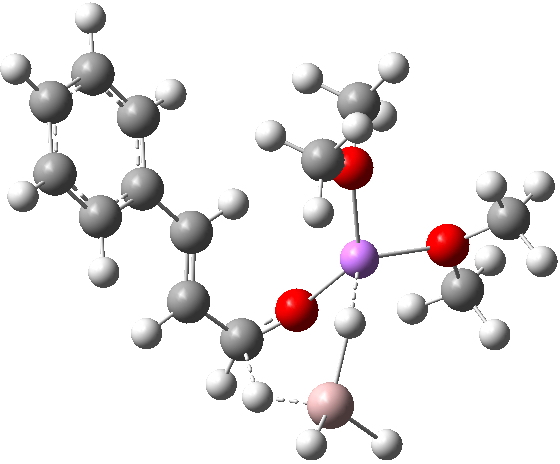
    The reduction of cinnamaldehyde by lithium aluminium hydride (LAH) was reported in a classic series of experiments[cite]10.1021/ja01197a060[/cite],[cite]10.1021/ja01202a082[/cite],[cite]10.1021/ja01190a082[/cite] dating from 1947-8. The reaction was first introduced into the organic chemistry laboratories here at Imperial College decades ago, vanished for a short period, and has recently been reintroduced again. The experiment is really simple in concept; add LAH to cinnamaldehyde and you get just reduction of the carbonyl group; invert the order of addition and you additionally get reduction of the double bond. Here I investigate the mechanism of these reductions using computation (ωB97XD/6-311+G(d,p)/SCRF=diethyl ether).

    LAH
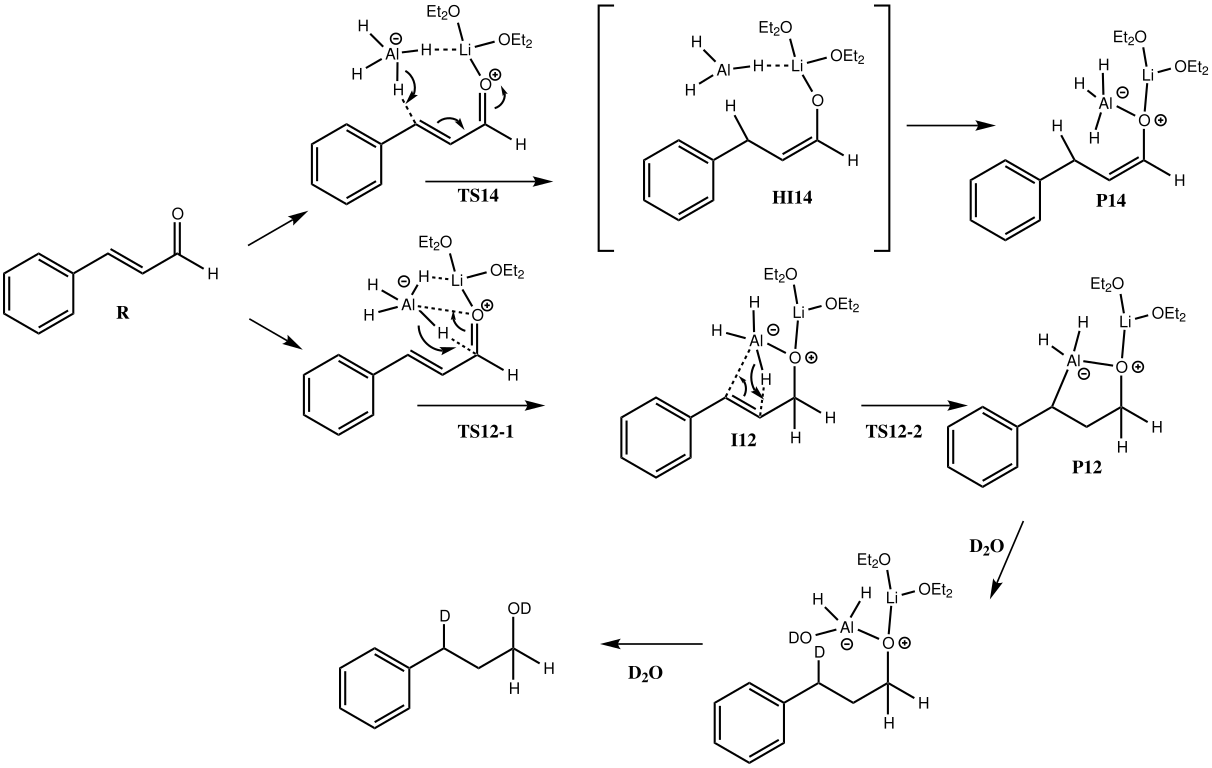
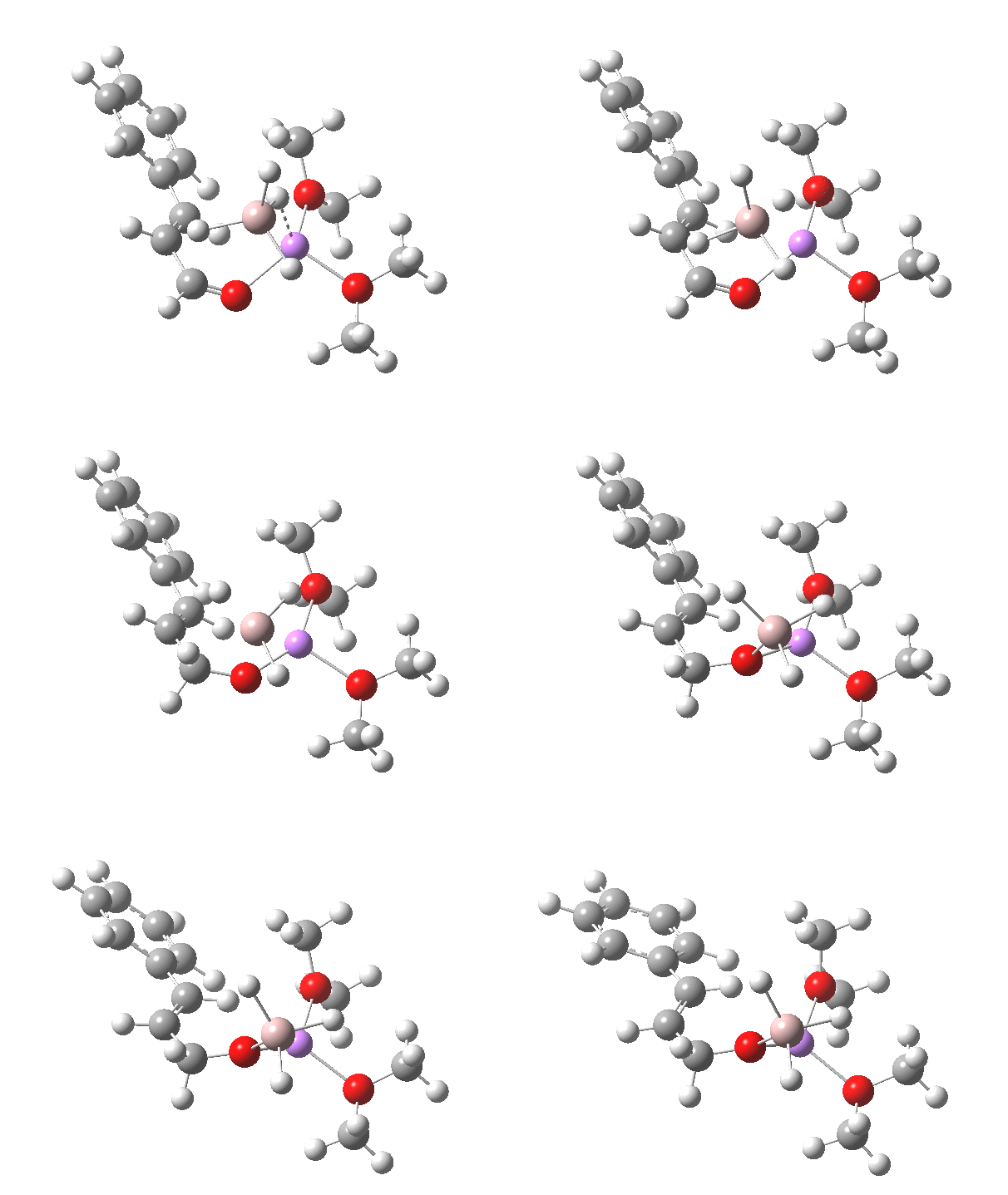
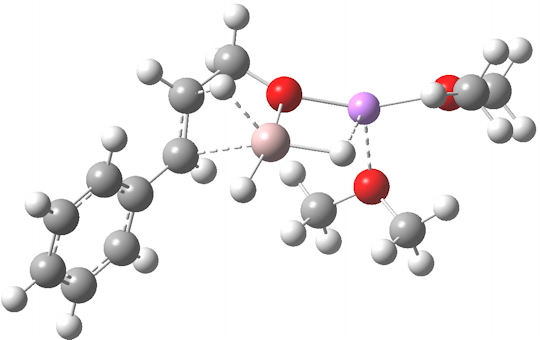
    The mechanism can be envisaged as proceeding through a 1,4-hydride attack (TS14) with a hidden intermediate (HI14) on the reaction path, or instead finding a pathway involving either one or two consecutive 1,2-attacks; TS12-1, TS12-2 via an explicit intermediate I12. Experiment shows that quenching with D2O at the end of the reduction to replace a C-Al with a C-D bond certainly seems to rule out the 1,4 route, since that would not lead to incorporation of deuterium at the benzylic position. So does the computational model reflect this reality?

    Species Relative ΔG, kcal/mol FAIR Data-DOI
    R 0.0 [cite]10.14469/ch/191154[/cite]
    TS14 +11.7 [cite]10.14469/ch/191148[/cite]
    P14 -38.8 [cite]10.14469/ch/191152[/cite]
    TS12-1 +8.4 [cite]10.14469/ch/191149[/cite]
    I12 -35.8 [cite]10.14469/ch/191151[/cite]
    TS12-2 +6.5 (42.3) [cite]10.14469/ch/191156[/cite]
    P12 -52.4 [cite]10.14469/ch/191155[/cite]

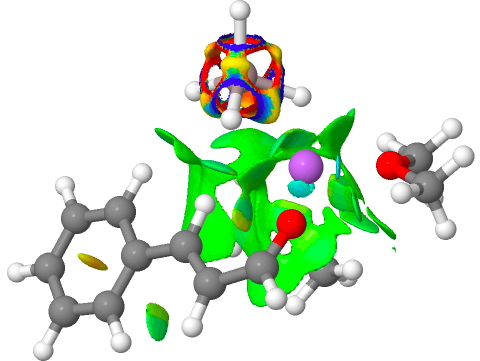
    I have chosen a model in which two dimethyl ether molecules solvate the lithium cation. The reactant itself has an interesting structure, in which two of the Al-H bonds form bridges to the Li, which ends up being five-coordinated. Further weak C-H…O=C hydrogen bonding is also observed. The NCI (non-covalent-interaction) surfaces are well worth inspecting (inspection notes: the NCI surrounding the Al has artefacts, since the value of the electron density surrounding the metal is lower than covalent density for the other elements. Click on the image below to load the 3D model).

    Click for  3D
    Click for 3D

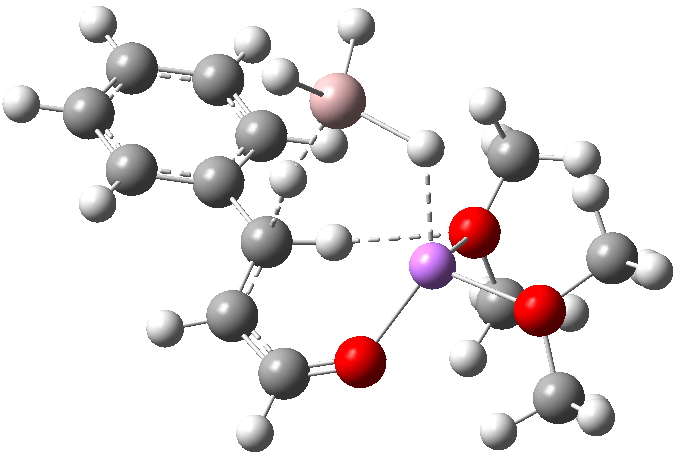
    TS14 retains that C-H…O=C hydrogen bond, but the double Al-H-Li bridge is lost. The 8-ring for the TS allows the hydride transfer to be approximately linear, and the Bürgi-Dunitz angle of approach of the hydride to the double bond is 107.4°. Whilst the barrier is acceptably low, the reaction reaches a cul-de-sac down this path; it has no low energy escape route.

    TS14
    Click for 3D

    TS12-1 loses the C-H…O=C hydrogen bond, but being 3.3 kcal/mol lower in free energy than TS14 fortunately provides a lower energy alternative to that cul-de-sac! The Bürgi-Dunitz angle is 112.0°.
    TS12-1
    LAH12-1

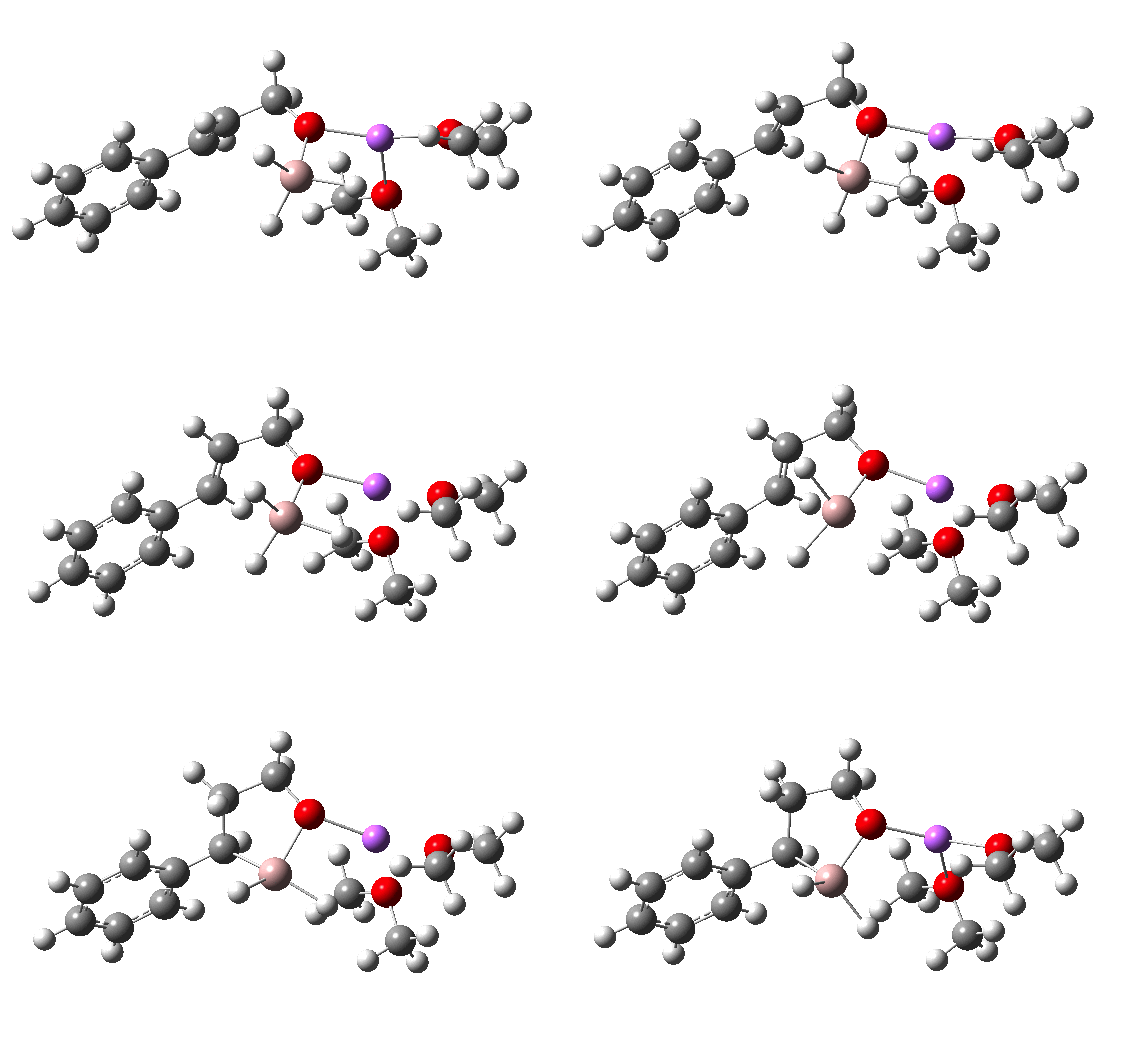
    TS12-2 is required to proceed further to the dihydrocinnamyl alcohol reduction product P12, and now we have to confront the nub of the problem. Why does this further reduction only proceed when the LAH is in excess? TS12-2 itself corresponds to an Al-H addition across a C=C double bond.[cite]10.6084/m9.figshare.1362146[/cite], with a similar barrier to TS12-1. The answer to this conundrum is to recognise that I12 forms what is called a resting state for the reaction, and that to proceed further the reaction has to overcome the barrier from I12 to TS12-2. That barrier is 42.3 kcal/mol, far too high to proceed thermally. When one encounters an unreasonable barrier, one has to look very carefully at the model one has constructed for the process.

    Click for 3D
    Click for 3D

    LAH12-2a

    Clearly, the model I used here is lacking something. Since the reaction only proceeds when LAH is in excess, we can formulate the hypothesis that further LAH must be added to the model, from which a more reasonable barrier might emerge. If I find out how that can be done, I will report back here.


    LAH as a reagent was originally available in powder form, which could be quite tricky to handle and could cause fires if not handled properly. The lab organiser Chris tells me it now comes in standard-sized pellets which are far easier and safer to handle in a laboratory, allowing its re-introduction.
    Biographical note. This footnote is added because I spent three years as a Ph.D. student trying to construct transition state models by measuring kinetic isotope effects. My failure to do so convincingly meant I decided to spend a further three years as a Post Doc inverting the concept by learning how to model transition states using quantum mechanical computation. I first applied these skills as an independent researcher to locating the transition state for Cl-H addition (vs Al-H in this post) across a C=C double bond and computing the associated isotope effects.[cite]10.1039/C39810000939[/cite] This article ends with the assertion that “SCF-MO calculations may provide a more rational basis for interpreting kinetic isotopes than the reverse procedure of attempting to establish a transition state model from the observed kinetic data.” It is nice to see that posterity has shown that this assessment was about right.

  • Caesium trifluoride: could it be made?

    Mercury (IV) tetrafluoride attracted much interest when it was reported in 2007[cite]10.1002%2Fanie.200703710[/cite] as the first instance of the metal being induced to act as a proper transition element (utilising d-electrons for bonding) rather than a post-transition main group metal (utilising just s-electrons) for which the HgF2 dihalide would be more normal (“Is mercury now a transition element?”[cite]http://dx.doi.org/10.1021%2Fed085p1182[/cite]). Perhaps this is the modern equivalent of transmutation! Well, now we have new speculation about how to induce the same sort of behaviour for caesium; might it form CsF3 (at high pressures) rather than the CsF we would be more familiar with.[cite]10.1038/nchem.1754[/cite] Here I report some further calculations inspired by this report.

    The argument goes something like this. Xenon difluoride (XeF2) is a well-known stable compound of xenon. Caesium comes immediately after xenon in the periodic table (electron shell properties [Xe].6s1) and so Cs+ would be iso-electronic with Xe. If the latter can form a stable difluoride (and higher), why not Cs? A neutral compound following this line of argument would therefore be CsF3.

    So here comes a calculation. I used a large basis set (Def2-QZVPPD basis for Cs), with a pseudopotential describing 46 core electrons (including the two d-shells) and a further 8 in the 5s/p shell to make up the [Xe] core + 1 extra in the 6s shell) using the ωB97XD functional to obtain the geometry, shown below.[cite]10.6084/m9.figshare.861029[/cite]

    Click for 3D
    Click for 3D and normal modes

    All 3N-6 normal vibrational modes are real, which indicates it is a proper minimum in the potential energy surface. A QTAIM analysis shows that ρ(r) at the bond critical points is pretty respectable for bonds (below). The QTAIM-derived average number of electrons on Cs is 7.4, which gives a charge of 1.6 on the Cs , thus involving the 5p shell as well as the 6s.

    CsF3-AIM

    The most obvious question is what is the free energy change when the species dissociates to CsF and F2? This is exo-energic by 25.1 kcal/mol[cite]10.6084/m9.figshare.861030[/cite], not as large as you might have thought! Well, what about the barrier to such dissociation? The transition state for this process is shown below, delightfully asymmetric![cite]http://hdl.handle.net/10042/26513[/cite] and this gives a free energy barrier of 33.9 kcal/mol (the IRC smoothly defines this reaction[cite]10.6084/m9.figshare.861038[/cite],[cite]10.6084/m9.figshare.861047[/cite]).

    Click for animation
    Click for animation

    We may conclude from this brief foray that in CsF3 caesium would indeed deserve to be called a p-block element, although this is not quite as good as it sounds. Take a look for example at the highest occupied molecular orbital. It certainly involves the p-block, but this orbital is in fact anti-bonding, and the Cs-F bonds derive their strength from the lower occupied orbitals.

    Click for  3D
    HOMO. Click for 3D


    Click for 3D
    HOMO-6. Click for 3D

    And the final take-home message. The report of this molecule[cite]10.1038/nchem.1754[/cite] suggests it could be stable under high pressure. Here, the free energy barrier to dissociation is calculated to be indeed high, which implies that if made it could be kinetically quite stable even under normal pressures (in an inert matrix where it would be prevented from reacting with itself).

    POSTSCRIPT: The LUMO below is also antibonding, but is mostly 6s on Cs. If one force-populates this by a double excitation from the  HOMO, the resulting state is higher in energy (the wavefunction is stable to both singlet and triplet excitations). Which shows that Cs utilises (antibonding) 5p rather than (antibonding) 6s in this species.

    CsF3-LUMO

  • The butterfly effect in chemistry: Bimodal M~S bonds?

    I noted previously that some 8-ring cyclic compounds could exist in either a planar-aromatic or a non-planar-non-aromatic mode, the mode being determined by apparently quite small changes in a ring substituent. Hunting for other examples of such chemistry on the edge, I did a search of the Cambridge crystal database for metal sulfides. 

    The search was specified as following:

    1. Any element from one of the three transition metal series, TS1, TS2 or TS3
    2. to contain a M-S bond (any type of bond)
    3. with the restriction that the sulfur has only one atom attached (the metal)
    4. R < 0.05
    5. No errors and no disorder

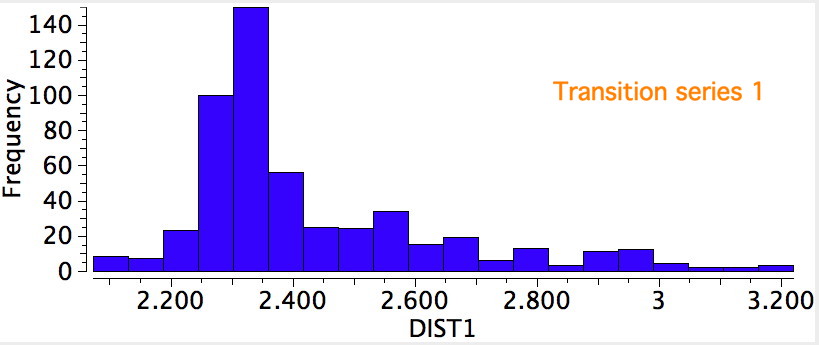
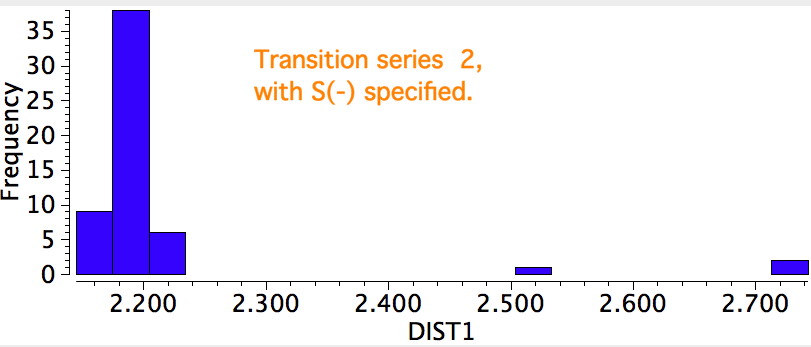
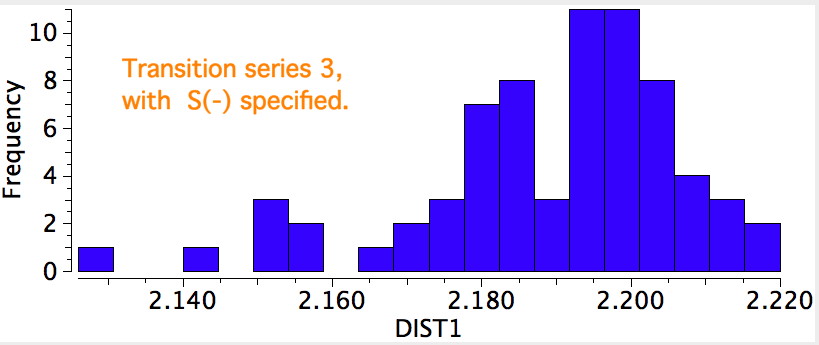
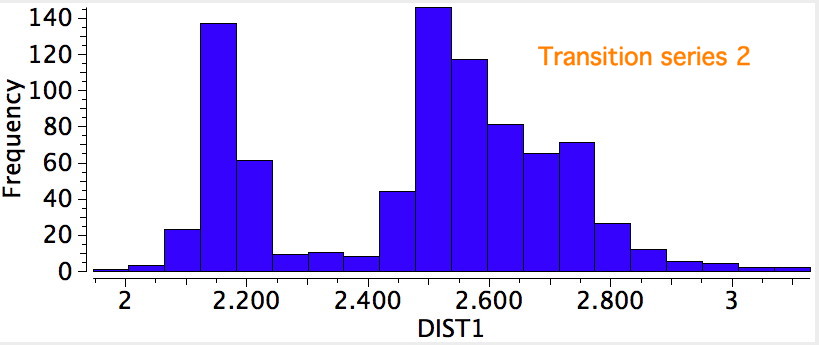
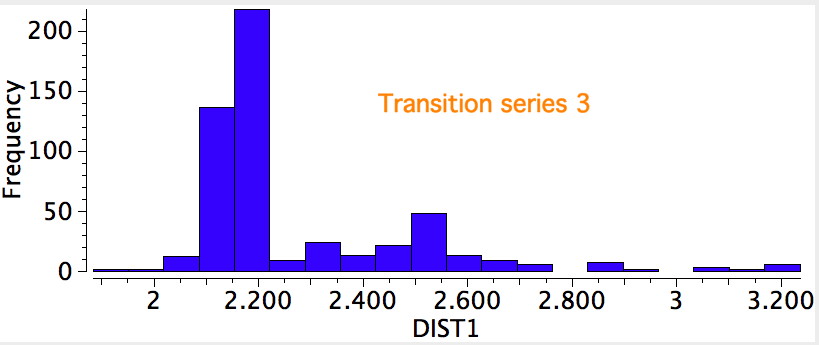
    The results for the three transition series were quite different. The first row indicated a distribution with a single maximum (~2.3Å), albeit with a very long tail reaching out to 3.2Å. The second row had a very clear bimodel distribution, with two peaks, at ~2.2Å and ~2.55Å, the latter having the greater number of examples. The third row showed an inverse distribution, with the prominent peak at ~2.2Å and the smaller peak at 2.55Å. 

    TS1TS2 TS3

    A search for the possible reasons for the bimodal distributions is now needed. This could be done in two ways; (a) to refine the search, or (b) to individually scrutinize each example to identify if any chemical reasons can be found. Since there are 100s of examples, I will concentrate on the first tactic. The most obvious is that the compounds cluster into neutral and ionic, as below, which allows the search to be constrained to only entries where a negative charge has been assigned to the sulfur.

    MS

    TS2m TS3m

    This reveals such entries are a fraction of the total, and for these the C-S bond length clusters around 2.2Å. Which leaves us with a mystery. This would mean that the neutral systems, presumably with a formal M=S bond, would have to be responsible for the entries at ~2.55Å. Could it really be that a higher bond order results in a longer bond? 

    What the search does not allow us to do (or I am unaware of how to do it) is to identify whether there are any pair of examples where the ligands surrounding M are identical but where one of the pair has a short and the other a long M-S bond. Or indeed such a pair where the differences between the ligands are small (however that is defined). Similarly, one cannot constrain the searches by spin state to see if that might be responsible. It would also be nice to have the system automatically evaluate whether the valence shell on the metal is full (18) or not (16, 17) to see if that is related to the bond length. Indeed, an example of needing to count the valence shell was recently brought to my attention by a student, and it will be the subject of a future post. 


    Acknowledgments

    This post has been cross-posted in PDF format at Authorea.

  • Is dicarbon (C2) a molecule of chemical interest?

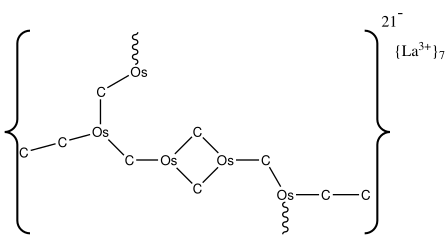
    C2 (dicarbon) is certainly interesting from a theoretical point of view. Whether or not it can be described as having a quadruple bond has induced much passionate discussion[cite]10.1038/nchem.1263[/cite],[cite]10.1002/anie.201208206[/cite],[cite]10.1002/anie.201301485[/cite],[cite]10.1002/anie.201302350[/cite]. Its occurrence in space and in flames is also well-known. But does it have what might be called a conventional chemistry? Other highly reactive species (cyclobutadiene is a well-known example) can often be tamed by trapping as a ligand coordinated to a metal and so one might speculate upon how C2 responds to the proximity of a metal. As is noted here[cite]10.1002/anie.201208206[/cite], dicarbon as a ligand has been known a long time as part of what is referred to as carbide chemistry. In this regard it is thought of as the di-anion, C22- (and isoelectronic therefore with dinitrogen). Thus calcium carbide, but in fact the degree to which the dicarbon can absorb electrons is thought to be wide (as judged by the resulting C-C bond length, see[cite]10.1002/anie.201208206[/cite]). Here I take a look at just one metal carbide[cite]10.1016/j.jssc.2008.08.005[/cite] that caught my eye (there are hundreds of others, many no doubt equally interesting!).

    dicarbon

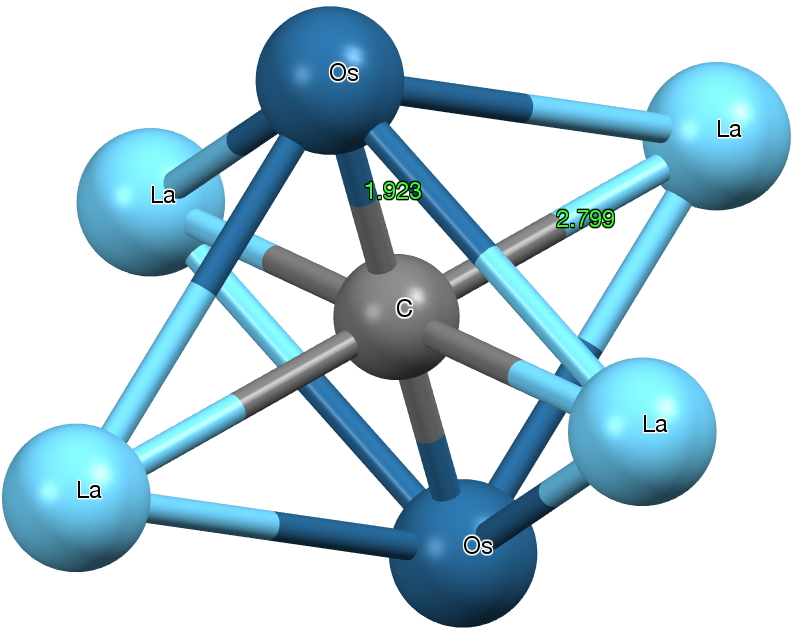
    One first notices that the standard attempt at a representation above does not do it justice; a Lewis valence bond drawing (in which electrons are accounted by partitioning into bonds) it most certainly is not. Nine carbons and four osmiums have absorbed 21 electrons, donated (formally) from seven lanthanum atoms. But easily discerned is that of the nine carbons, four are dicarbon and five are mono carbon. It is worth exploring the immediate environment of each of these types. The monocarbon is in fact hexa-coordinated by two Os and four La, a form of carbon coordination that was only relatively recently identified.

    Click for  3D
    Click for 3D

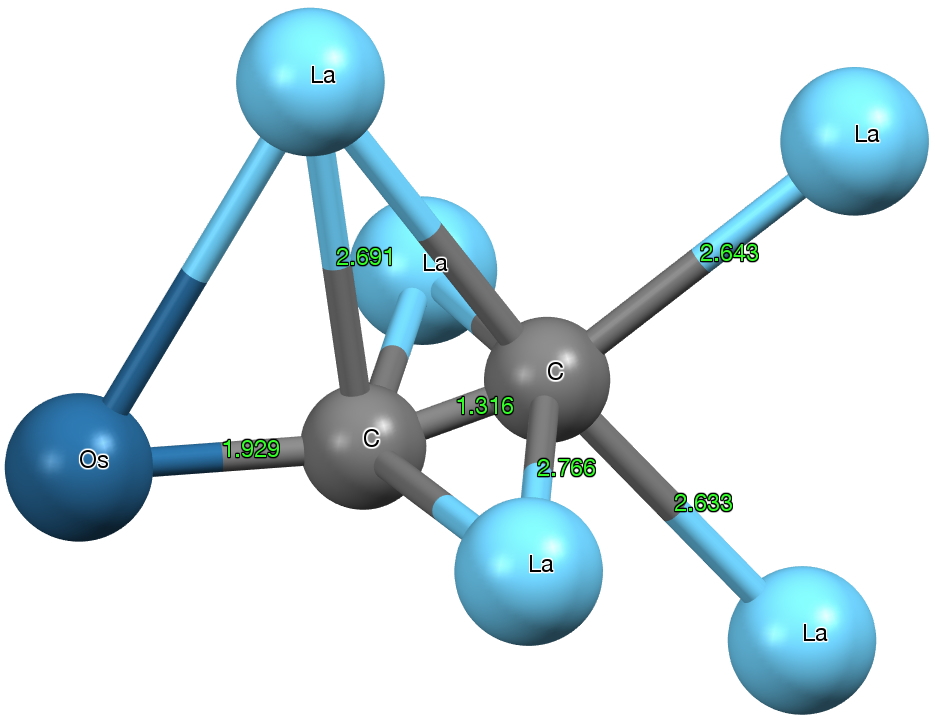
    But the dicarbon unit is if anything even stranger. The C-C bond length is ~1.316Å (a relatively long distance compared to many carbides) more or less commensurate with a double bond. The carbons are both end-on σ-coordinated and also triply π-coordinated. with one more metal coordinating in a manner somewhat in-between these two modes. One carbon is 5-coordinate, the other 6-coordinate. The Os-C bond length has a relatively short value of 1.93Å (the sum of the double bond covalent radii for Os and C is 1.83, the single bond radii 2.04), and so it might be tempting to represent it as Os=C=C.

    Click for  3D
    Click for 3D

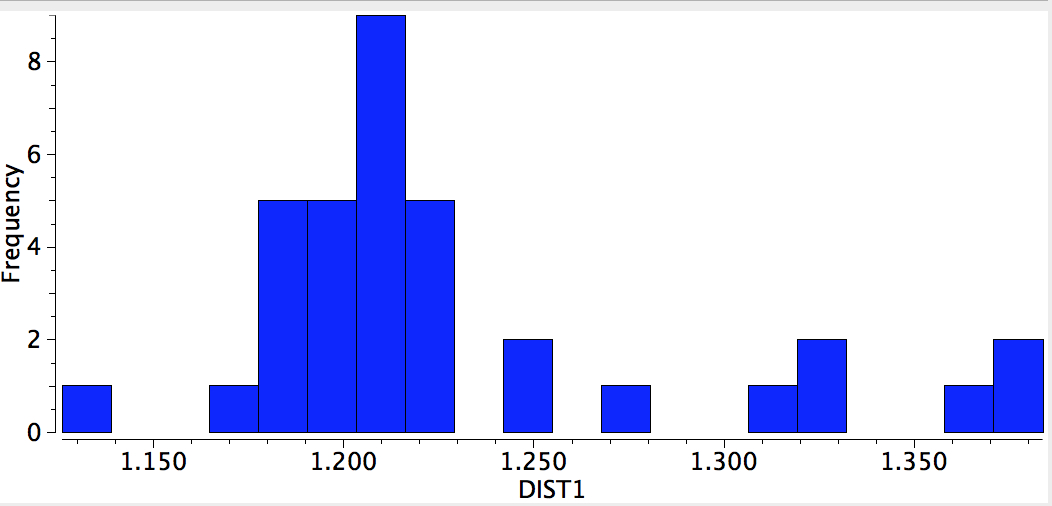
    This one example reminds us that even an element such as carbon, where one might imagine the bonding environments would be well-known, can still reveal unusual behaviours. Taking a look at the histogram below, which indicates C-C lengths in Metal-CC-Metal complexes (where the carbon coordination is restricted to 2) indicates the diversity of behaviour possible with this simple little ligand.

    LaOsCC-hist

  • Au and Pt π-complexes of cyclobutadiene.

    In the preceding post, I introduced Dewar’s π-complex theory for alkene-metal compounds, outlining the molecular orbital analysis he presented, in which the filled π-MO of the alkene donates into a Ag+ empty metal orbital and back-donation occurs from a filled metal orbital into the alkene π* MO. Here I play a little “what if” game with this scenario to see what one can learn from doing so.

    Au+cbd

    Firstly, I will use Au+ instead of Ag+, so as to make a comparison with Pt2+ a little more direct. The electronic configurations are of course [Xe].4f14.5d10.6s0 and [Xe].4f14.5d8.6s0 respectively. I will also replace a simple ethene with cyclobutadiene, the intent here being that this cyclo-diene is a very much better π-donor due to its anti-aromatic character. It also now has the possibility of acting as a four or a two-electron donor. I started with M=Pt+[cite]10.6084/m9.figshare.703546[/cite] by adding another double bond to the structure of the ethene complex. 

    Pt-cbd

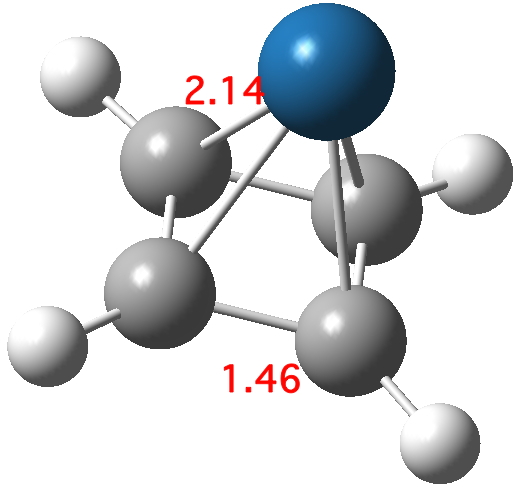
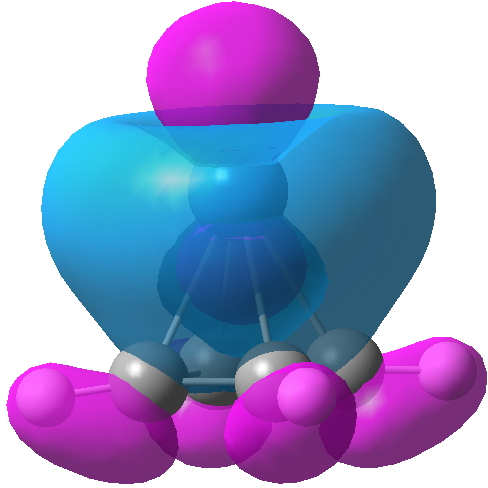
    Optimising this starting structure in fact moves the metal and the final geometry has C4v symmetry; in other words the metal is bound symmetrically to all four carbons. The four C-C lengths are all the same (1.46Å) and strongly suggest that four electrons from the cyclobutadiene are participating in bonding; the Pt2+ is clearly capable of accepting four electrons, two into 6sand two into 5d8. In the process, the cyclobutadiene looses its antiaromaticity. The molecular orbitals of this species are all lovely; I illustrate just one below.

    Click for  3D.
    Click for 3D.

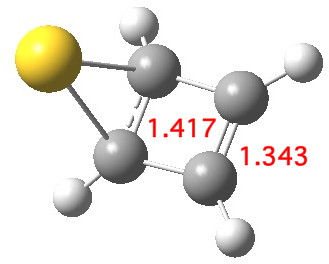
    If the Pt in this C4v structure is mutated into Au+, the resulting optimised stationary point exhibits a negative force constant characteristic of a transition state[cite]10.6084/m9.figshare.703547[/cite]. As the d-shell is already fully, the Au can only accept two electrons, and this is therefore a nice illustration of the “18-electron” rule in operation. So, the Au+ complex must exist in at least one lower energy form. For example, one where the Au+ is coordinated to only one alkene is 94 kcal/mol lower in free energy.[cite]10.6084/m9.figshare.703576[/cite] This form results in electrons from the coordinated alkene being donated into the 6s Au orbital, and this action reduces the anti-aromaticity of the cyclobutadiene ring.

    Au-cs

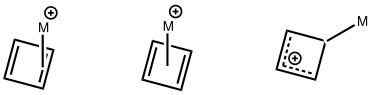
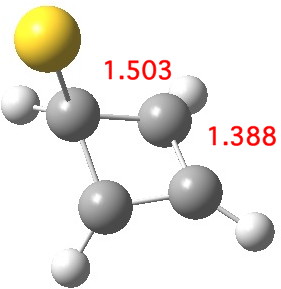
    Another isomer also achieves this result, resulting in a further lowering in free energy of 11.0 kcal/mol[cite]10.6084/m9.figshare.703577[/cite] The anti-aromaticity this time is eliminated by forming an allyl cation on the ring. I have described this mode in another post, commenting on the effect when a guanidinium cation interacts with cyclobutadiene.Au-cs1

    We have learnt that cyclobutadiene has many modes for eliminating 4n-electron antiaromaticity and other destabilising influences upon the ring. It can accept four electrons from a suitable acceptor (Pt2+), or two electrons from Au+ in two different ways.

  • The π-complex theory of metal-alkene compounds.

    The period 1951–1954 was a golden one for structural chemistry; proteins, DNA, Ferrocene (1952) and the one I discuss here, a bonding model for Zeise’s salt (3).

    Zeise

    In “A review of π Complex Theory”,  Bull. Soc. Chim. Fr., 1951, 1 8 , C79 (it is not online) M. J. S. Dewar sets out his theory of the role of π-complexes in (mostly) organic chemistry. The paper derives from an international colloquium held in Montpellier, in which audience responses to the presentation are included as an annex to the article itself. It is as a footnoted response (to P. Bartlett) that Dewar presents his theory of the alkene-metal π-complex, of which the best known example is Zeise’s salt (3).

    Dewar-symmetryDewar1

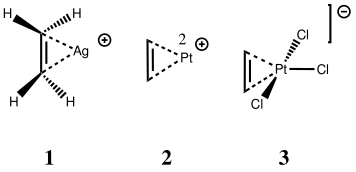
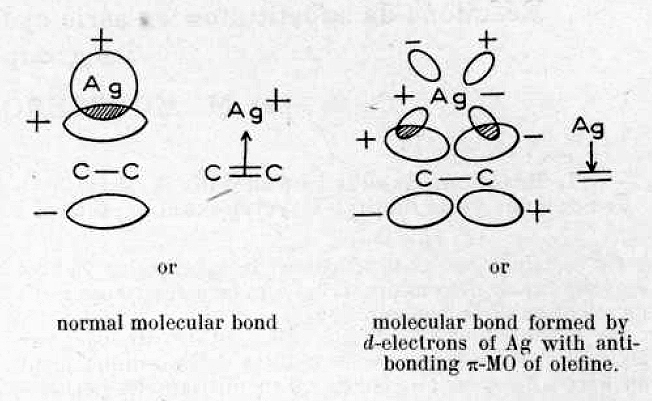
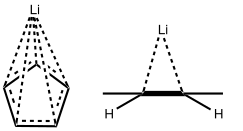
    This diagram illustrates the binding of a silver cation Ag+ to ethene (1). Dewar uses group theory to show how the molecular orbitals from ethene can be combined with the atomic orbitals on the metal. Two filled and two empty orbitals combine to give two new combinations, with a total occupancy of four electrons defining the interaction between alkene and metal. Dewar regards this four-electron-three-centre interaction as distinctive from simply the formation of two single metal-C bonds (a metallacyclopropane).

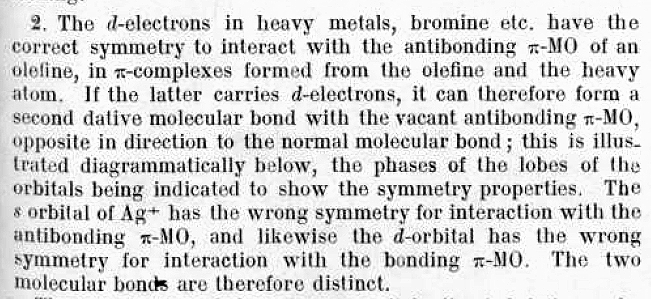
    Zeise’s salt itself derives from Pt2+ by addition of three chloride anions to give PtCl3. To compare this with Dewar’s Ag+ example, I use here just the naked metal cations 1-2. I went about this analysis as follows:

    1. I did ωB97XD/Dev2-SVP calculations, optimising the geometry into C2v symmetry.
    2. The electronic configuration of Ag+ is [Kr].4d10.5s0 and Pt2+ is [Xe].4f14.5d8.6s0.
    3. The two metals therefore do differ; Ag+ can only accept electrons into a 5s atomic orbital (AO), whilst the Pt2+ can accept electrons into either the 6s or the empty 5d AO.
    4. The molecular orbitals identified for discussion here at 17, 13 and 11 (this is a pseudopotential calculation) of which 17 is doubly occupied for Ag+  and unoccupied for Pt2+. Why three when Dewar’s analysis above describes only two? All (might) become clear shortly!
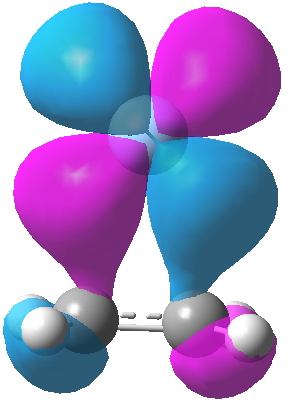
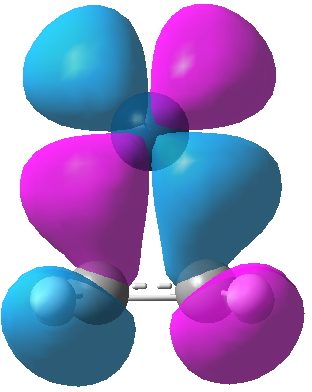
    5. Firstly, I start with the “back-bonding” orbital as shown on the right in Dewar’s diagram. This is the interaction of the filled metal dxz orbital with the alkene π* empty anti-bonding orbital and the combination emerges as orbital 13 of the three considered here. It is antisymmetric with respect to rotation about the axis of symmetry and one of the two planes of symmetry, and is given the label (irreducible representation) B1. Map Dewar’s “-“ sign to blue and “+” sign to purple to match them up. But also notice that the Pt orbital is rather more anti-bonding in the C-C region than Ag analogue. The C-C computed length (1.423Å) is indeed longer than that for the Ag complex (1.363Å, click on the images below to see a rotatable model of these orbitals). You will also notice that this orbital is “contaminated” with contributions from the C-H bonds; no longer are the π- and σ- electrons orthogonal as they are in ethene itself. This mixing of components from other parts of the molecules is what makes a clear-cut analysis of such systems trickier than you would infer by looking at Dewar’s diagram above! This also happens from the ligands on the metal (Cl in Zeise’s salt for example).
      Ag Pt
      Ag-13 Pt-13.
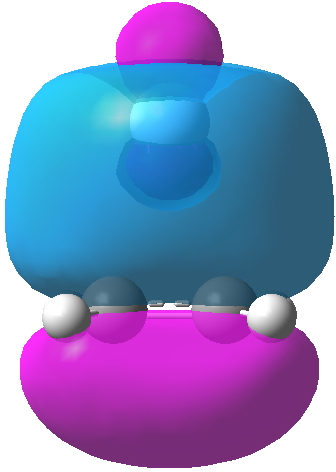
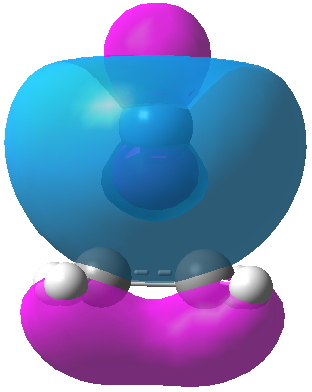
    6. Let us now go hunting from the second of Dewar’s orbitals, which he describes as the interaction between the filled alkene π-MO and an empty Ag s-AO. Orbital 17 closely resembles Dewar’s sketch on the left, although additional lobes can be seen. It is symmetric with respect to all three elements of symmetry (axis and two planes) and hence is labelled A1. Where Dewar writes that the two molecular bonds are distinct, he means that they have different symmetries and hence cannot interact with each other (they are orthogonal). But hang on; although this orbital is doubly occupied for Ag, it is unoccupied for Pt! So does that mean that Dewar’s argument cannot hold for Zeise’s salt itself (the bonding in this molecule is often referred to as the Dewar-Chatt-Duncanson model[cite]10.1039%2FJR9530002939[/cite]). No. It turns out that for Ag, the alkene π-MO is interacting not with a pure unhybridised Ag s-AO, but with an s+dz2 hybrid (albeit with rather more s and rather less dz2). This creates two modified hybrid AOs, one of which interacts with the alkene π-MO to give orbital 17. This is what those extra lobes are about, the contribution from the 4dz2 AO on Ag. Because this combination on Pt is empty, the Ag complex has a shorter C-C bond than Pt.
      Ag Pt
      Ag-17 Pt-17
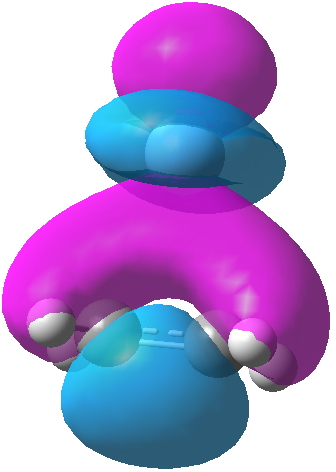
    7. Well, Pt still needs explaining, since we have only found one of Dewar’s two interactions. I mentioned that s+dz2 hybrids could be created, and here the second of these interacts with the bonding alkene π-MO to give another A1 instance  11, again with the same symmetry properties with respect to the three elements of symmetry present (but this time with rather more dz2 than s). It is this orbital which is now occupied for Pt.
      Ag Pt
      Ag-11

      Ag-11


    The famous Dewar π-complex model of alkene-metal interaction as applied to the Ag+ cation describes one “normal molecular bond” and a second bond “opposite in direction to the first”, what we now call a back-bond. What has emerged however is that two “normal molecular bonds” can be identified for Ag+ based purely on their symmetry but only one for Pt2+ (which of course has two valence electrons less) and both exhibit one back-bond.  The diagram above must absorb a further pair of electrons from a formally non-bonding filled dz2 orbital, whilst recognising that hybridisation may allow it too to take on some bonding role.

    You might ask what the missing orbitals 12, 14-16 are?  Well, formally they derive from the other occupied four metal d-orbitals, but in fact mixed heavily with the C-H bonds of the ethene. I have to conclude that a molecular orbital analysis of e.g. Zeise’s salt (with additional orbital mixing from the three chlorides) ends up being pretty complex! But despite this complexity, Dewar’s original hypothesis, produced in response to a question from the audience, certainly started something. It is worth reminding that the 1952 Nobel-prize winning suggestion for the structure of Ferrocene[cite]10.1021/ja01128a527[/cite] includes no group theoretical orbital analysis of the bonding on a par with Dewar’s 1951 insights.


    In fact, the MOs turn out to be pretty sensitive to the ligands surrounding the metal, and so those presented here for the naked cations will differ from those for “real molecules” such as Zeise’s salt.