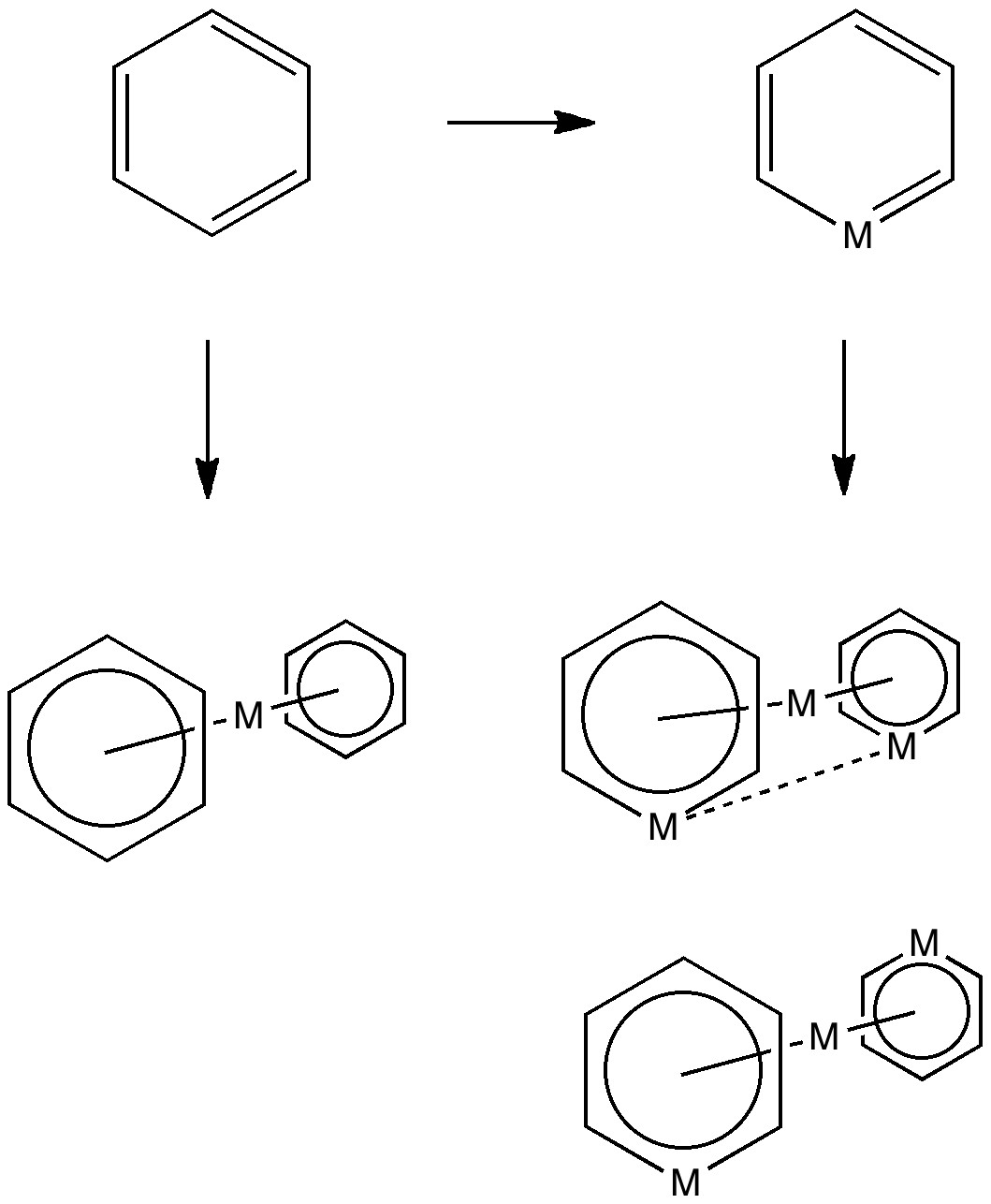
Much like chocolate, some of us metallaholics cannot get enough. So WUQXIP proved an irresistible frolic (DOI: 10.1021/om020789h). Let us start with benzene. It can have metals added in two ways, whilst preserving its essential aromaticity.
Triple metal delight.
Making a metal sandwich is of course very well known, ferrocene being the first example where the bonding was identified. Replacing a carbon with a metal is a little more recent, having been suggested by Hoffmann in 1979. This is known as a metallabenzene. The compound below combines both features.
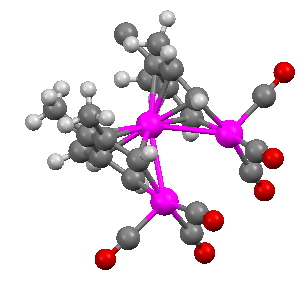
WUQXIP. Click for 3DThe metal is Ruthenium (coloured purple above) in the same column of the periodic table as Iron. What of the triple delight? Well, the compound really is more than the sum of its parts. The original authors (Ulrike Effertz, Ulli Englert, Frank Podewils, Albrecht Salzer, Trixie Wagner and Martin Kaupp) speculated about whether there might be bonding between any of the Ru atoms. You see an apparent mutual attraction meant that they were rather closer than the sum of their van der Waals radii would suggest they should be. Their relative orientation (they could easily have avoided each other) was very suggestive. So a metal-metal bond would be our third delight! To find out, the authors noted above did an ELF analysis. I have repeated this and the result is shown below.
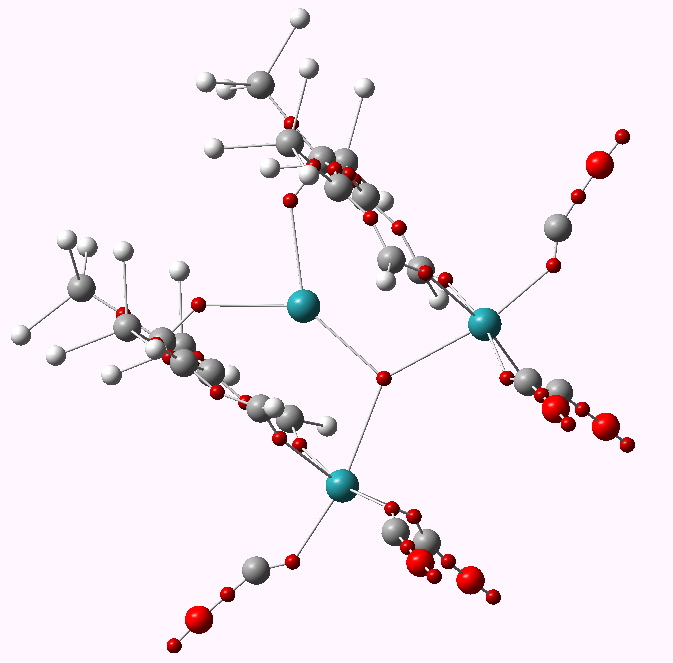
ELF basins for WUQXIP. Click for 3DA trisynaptic basin is revealed between the three ruthenium atoms; a classic example of a three-centre bond. It integrates to 0.64 electrons (B3PW91/Dev-2-pVDZ), so its fairly weak. But still strong enough to bring the three ruthenium atoms closer together. A true triple metal bonding delight!
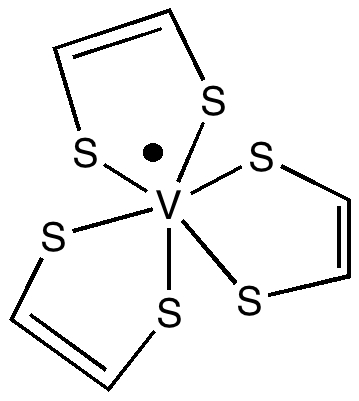
The molecule below was characterised in 1996 (DOI: 10.1246/cl.1996.489) and given the name tris(dithiolene)vanadium (IV). No attempt was made in the original article to give this molecule a Lewis structure using Lewis electron pair bonds. This blog will explore some of the issues that arise when this is attempted.1
NAMPOG.
The name given to the molecule by the chemists who made it reflects the ligand used, which we can represent as cis-HS-CH=CH-SH (via its di-sodium salt and reaction with VCl3). Its entry in the Cambridge crystal database is NAMPOG (which carries only the slightest of semantic or structural information). The chemical name however does carry some further information, namely the designation tris implies three fold symmetry (D3h in this case), and hence that all three ligands are in fact identical (structurally).
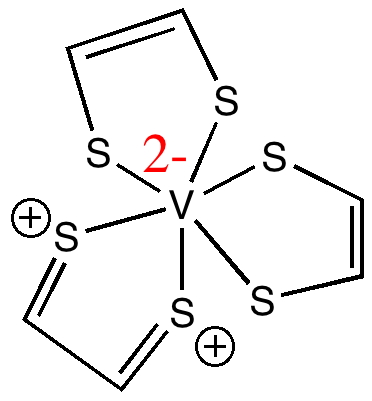
A nominal first stab at a Lewis electron pair representation reflecting this symmetry might be as shown above. At this point we hit a logical problem with the final component of the assigned name; the formal oxidation state of the metal is designated IV. However, three moles of (-)S-CH=CH-S(-) imply the ligands carry a formal charge of 6-, and that therefore the metal must be 6+, or VI. Six however is not an oxidation state normally exhibited by vanadium. Why did the original discoverers designate it IV? Well, because careful electron counting reveals the system as a whole has 161 electrons, of which 71 are designated as valence electrons, and hence it must have one unpaired valence electron. In the representation above, that electron is shown resident on the V atom with a dot, and the ESR spectrum measured for the molecule turns out to be apparently characteristic of V(IV) systems (they do not mention whether they also compared the spectra with those derived from genuine examples of V(II), see below). This implies (as the authors note) that a total of only 4- must be delocalized over the three dithiolene ligands.
Returning to our electron counting, of the remaining 70 valence electrons, 24 electrons are implicit above as twelve sulfur lone pairs (which are sometimes shown as double dots, but their explicit inclusion here would cause clutter) and so we presume the remaining 46 electrons must be in Lewis-like electron pair bonds. Well, the structure above implies 24 such bonds (the six C-H lines, as well as the Hs are also omitted by convention, again to avoid clutter!). We can begin to see why the original article lacks a Lewis structure, since the one above contains too many electrons (48 rather than 46).
How might one proceed to rescue the situation? Because a great many possible Lewis structures could be drawn, we have to learn a little more about the molecule and seek recourse in the bond lengths measured for the system. The most obvious is the C-C length, which turns out to be 1.36Å, a value significantly longer than expected for a C=C double (i.e. a four electron) bond, but a little shorter than the 3-electron bond found in e.g. benzene.
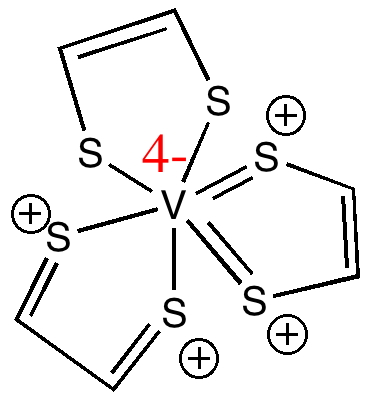
A second attempt at a Lewis structure
The Lewis structure (one of three equivalent ones) now has 5 lines in the C-C region, or ~3.3 electrons per C-C bond averaged over three ligands, which seems to match the length a little better. It also has 25 lines representing nominal electron pairs and ten sulfur lone pairs, a total of 70 electrons. The net effect of this representation is to transfer two electrons from the sulfur lone pairs to the vanadium, and hence to reduce the formal charge at the metal from 6+ to 4+, or to V(IV). This sort of behaviour, where electrons can be borrowed from a ligand and used to reduce (or oxidise) the metal they are coordinated to is called non-innocent behaviour. The dithiolene ligand is notoriously non-innocent. It results in this case in our innocent assumptions that bonds are defined by an integer number of electrons [2,(3),4,(5) or 6 as in Lewis’ original classifications] are no longer adequate, and that non-integer descriptors must also be used.
There is still one counting rule we have not inspected. To complete its valence shell to reach Kr, V needs 18 valence electrons. The representation above gives it 13. So how about the following, which ends up with a valence shell of 17 electrons for vanadium (and an oxidation state of V(II))?
Third time lucky?
This implies that the V-S bonds might be a little shorter than normal. Well in NAMPOG its 2.35Å, perhaps slightly shorter than a typical V-S single bond of ~2.4Å, but in fact we are now down at the noise level, and its clear that we have probably reached (if not exceeded) the limit of semantic interpretation of the Lewis model. In this case, only three (of 100s of possible) Lewis structures have been discussed, and of course they were selected only because we had some experimental information to discriminate between them. And we must be aware that whilst Lewis structures are the simplest way of analysing the electron distribution in a molecule, far more sophisticated analyses are nowadays possible. The real question is which analysis can actually result in a greater insight into the molecule? But the least that can be said about molecule NAMPOG is that it causes one to think about the problems of representing bonding (I will draw the line however at using this example in my university admissions interviews!).
1 I thank J. P. P. (Jimmy) Stewart for drawing this molecule on my blackboard and hence provoking this blog post.
The Grignard reaction is encountered early on in most chemistry courses, and most labs include the preparation of this reagent, typically by the following reaction:
2PhBr + 2Mg → 2PhMgBr ↔ MgBr2 + Ph2Mg
The reagent itself exists as part of an equilibrium, named after Schlenk, in which a significant concentration of a dialkyl or diarylmagnesium species is formed. The topic of this blog entry is to analyse the structure and bonding in this latter species.
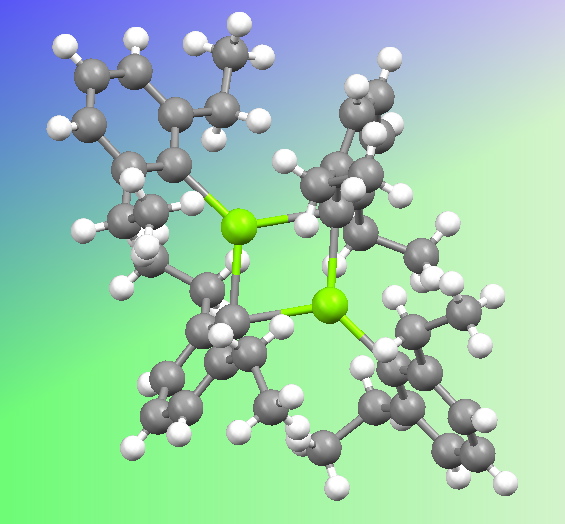
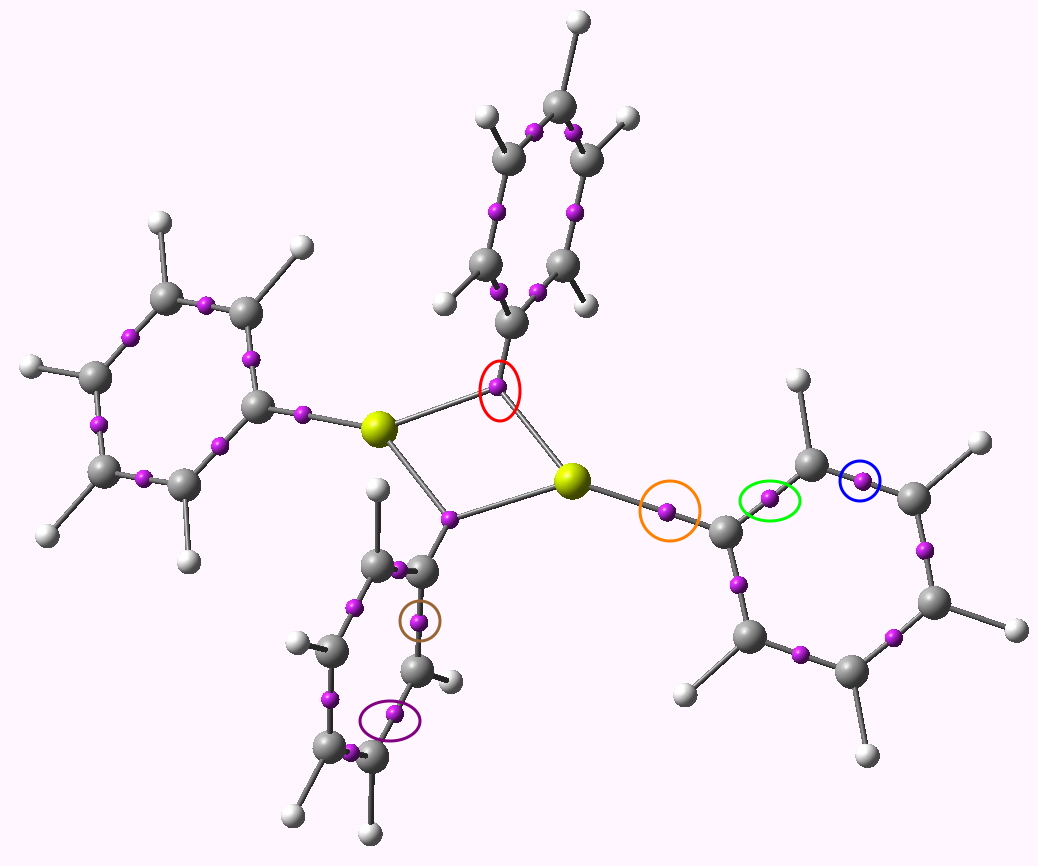
First, the structure is shown below (for 2,6-diethylphenyl magnesium). This reveals a dimeric structure with a four membered ring core, comprising two Mg atoms connected by two bridging aryl groups.
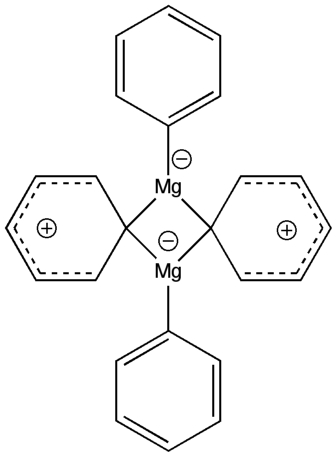
The crystal structure of a di-aryl magnesium. Click to view 3DThe question to be addressed here is the nature of the aryl groups. Put simply, it seems as if their bridging role means that one of the six carbons involved in the benzene ring has become sp3 hybridized. This would in turn mean that the cyclic conjugation of the benzene ring is interrupted, and a species akin to the Wheland intermediate is formed in which the aromaticity of two of the benzene rings is no longer sustained. This situation could be depicted thus;
A Simple bonding representation in Ph2Mg dimer
Is this really the best way of depicting the bonding in this species? A more subtle analysis of the bonding can be achieved using a technique known as ELF (involving analysis of the electron localization function). This reveals bonds as so-called synaptic basins, which come in two varieties; disynaptic basins corresponding to two-centre bonds, and trisynaptic basins which reveal three-centre bonds (there is also a monosynaptic basin which corresponds to electron lone pairs). Such an ELF analysis (based on a B3LYP/6-311G(d,p) computed wavefunction for Ph2Mg dimer) is shown below;
ELF analysis of the bonding in Ph2Mg dimer. Click for 3D modelThe small purple dots represent synaptic basins. Several of these are circled. The ones circled in orange are conventional disynaptic forms, and the basins can be integrated to to 2.48 electrons each. The red basin however is clearly revealed as a trisynaptic form (covering both metal centres and the carbon) and integrating to 2.7 electrons. The three basins surrounding each Mg atom integrate to 7.91 electrons, which reveal the metal to have a conventional octet of electrons in its valence shell. The bonding in the central region could therefore be described as comprising two three-centre-three-electron bonds. The key aspect of this is that the two bridging phenyl groups do not break their aromaticity, ie all four phenyl/aryl groups largely retain their aromaticity! Thus the disynaptic basins for the normal non-bridging phenyl group and circled in green integrates to 2.6 electrons and the blue to 2.8 (an ideal aromatic bond would of course integrate to 3.0 electrons), whereas the equivalent basins for the bridging phenyl (brown and purple, 2.5 and 2.8) are virtually the same.
It is interesting how a veritable mainstay of most taught chemistry courses, the Grignard reagent, can have such subtle aspects of the bonding surrounding both the metal atom and the aromatic groups, and how rarely this bonding is actually dissected in most text books.