Tag: Technology/Internet

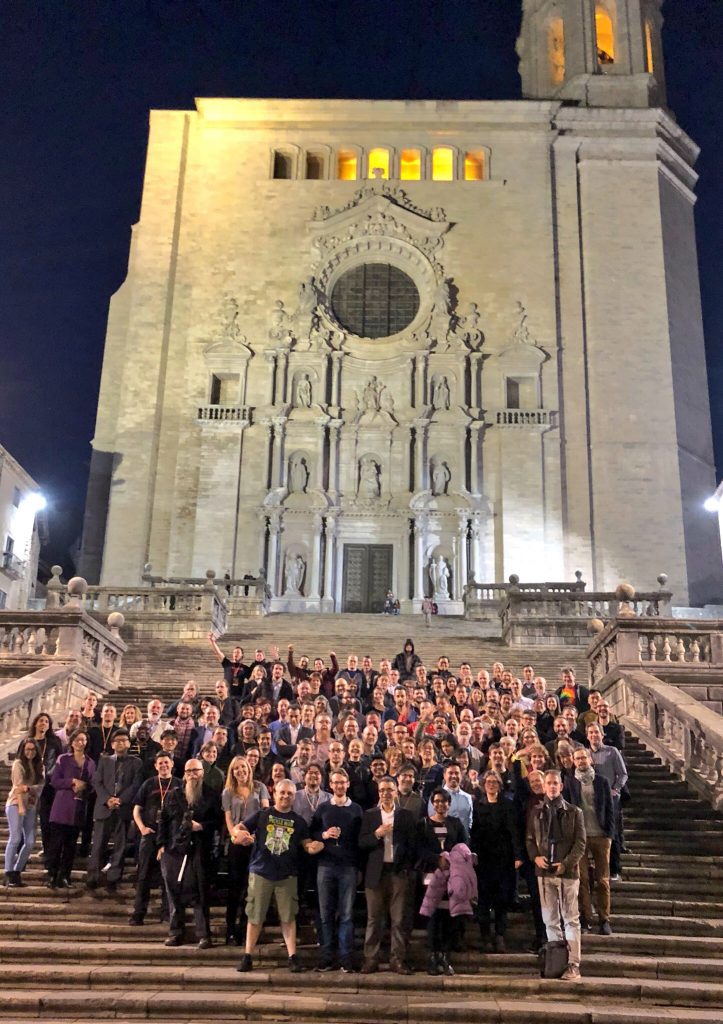
  • PIDapalooza 2018. A conference like no other!

    Another occasional conference report (day 1). So why is one about “persistent identifiers” important, and particularly to the chemistry domain?

    The PID most familiar to most chemists is the DOI (digital object identifier). In fact there are many; some 60 types have been collected by ORCID (themselves purveyors of researcher identifiers). They sometimes even have different names; in life sciences they tend to be known instead as accession numbers. One theme common to many (probably not all) is that they represent sources of metadata about the object being identified. Further information if which allows you (or a machine) to decide if acquiring the full object is worthwhile. So in no particular order, here are some of the things I learnt today.

    1. Mark Hahnel noted the recent launch of the Dimensions resource which links research data with other research activities; I have not yet had a chance to learn its capabilities, but it seems an interesting alternative to other stalwarts such as eg Google Scholar etc.

      You can try this example: https://app.dimensions.ai/discover/publication?search_text=10.6084&search_type=kws&full_search=true which retrieves articles in which the data repository with prefix 10.6084 (Figshare) is cited. Try also the prefix 10.14469 which is the Imperial College repository.

    2. Andy Mabbett talked about the deployment and use of persistent identifiers (the Q numbers) in Wikidata, which increasingly underpin the basis for the various flavours of Wikipedia. He also noted their use of some 50 different identifiers.
    3. Johanna McEntyre noted some 5M published articles in life sciences which reference 1M+ ORCID identifiers, easily the domain with the fastest uptake of this type. Also noted was the new FREYA project; aiming to connect open identifiers for discovery, access and use of research resources.
    4. Tom Gillespie talked about RRID, or Research Resource Identifiers. Included in this are hardware, including instruments and with around 6000 RRIDs systematized so far. They argue this area promotes both the A and I of FAIR (accessible and inter-operable). Of course A and I mean many things to many people.
    5. Several other presentations talked about the finer detail of metadata, such as sub-classifications into e.g. descriptive/admin/technical, but I did rather miss demos showing how search queries of such fine-grained metadata could be constructed.

    Apart from the presentations themselves, PIDapalooza is unusual for some other activities. Thus you could go get your PIDnails done, with a selection of 8 or so tasteful logos to choose from. There will be tattoos tomorrow (this is a conference for younger people after all). I may grab a photo or two to provide evidence!


  • FAIR data ⇌ Raw data.

    FAIR data is increasingly accepted as a description of what research data should aspire to; Findable, Accessible, Inter-operable and Re-usable, with Context added by rich metadata (and also that it should be Open). But there are two sides to data, one of which is the raw data emerging from say an instrument or software simulations and the other in which some kind of model is applied to produce semi- or even fully processed/interpreted data. Here I illustrate a new example of how both kinds of data can be made to co-exist.

    I will start with a recent publication[cite]10.1002/anie.201407165[/cite] with the title Crystallographic Snapshot of an Arrested Intermediate in the Biomimetic Activation of CO2The nature of this intermediate caught the eye of another research group, who responded with their own critique[cite]10.1002/anie.201411654[/cite] along with the comment “However, since we have no access to the original crystallographic data …” They might have been referring to the semi-processed data (containing the so-called hkl structure factors) but they may also have been alluding to the raw image data captured directly from the diffractometer cameras. That traditionally has not been available via the CSD (Cambridge structural database), but would be required for a complete re-analysis of the crystal structure. Now the first example of how both FAIR (processed) data and raw data can co-exist has appeared.

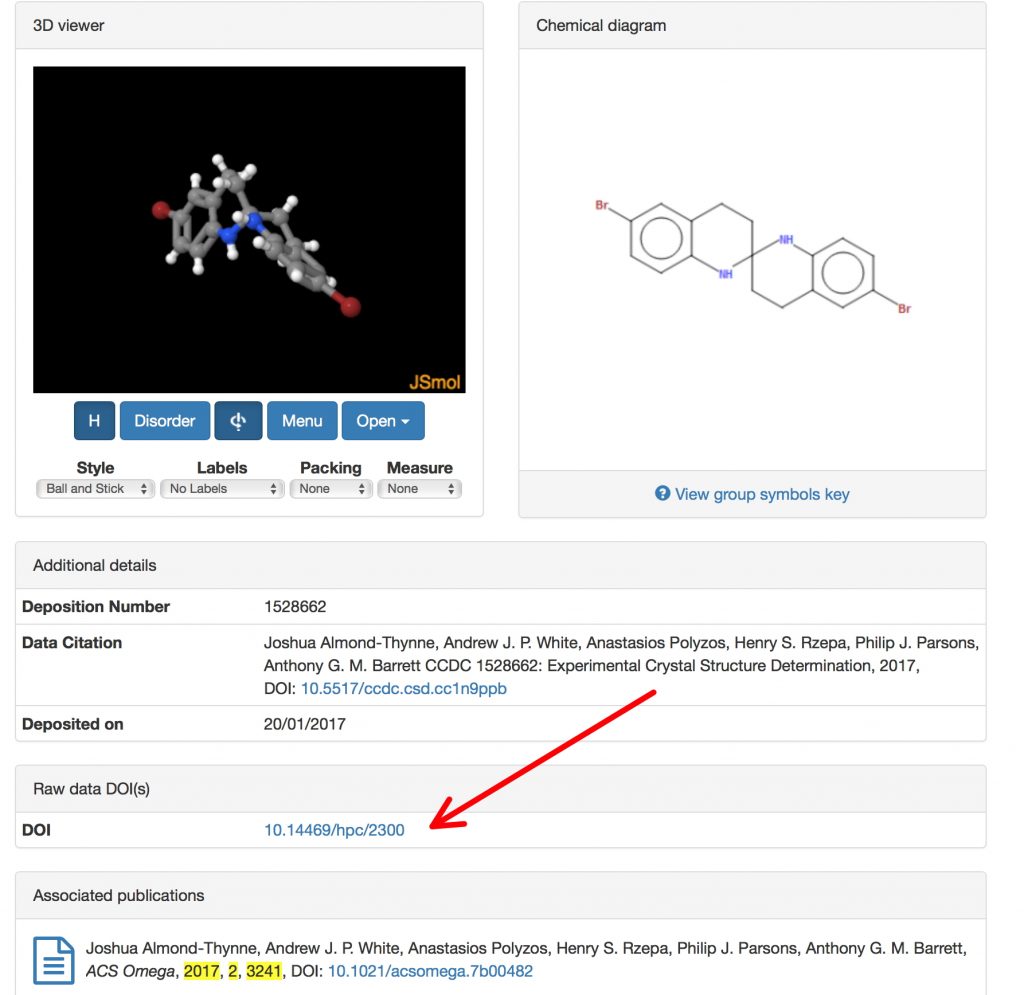
    The latest version of the CSD database shows an entry resulting from the following publication[cite]10.1021/acsomega.7b00482[/cite] and the deposited data has its own DOI there (10.5517/ccdc.csd.cc1n9ppb). That entry in turn has a DOI pointer to the Raw data (10.14469/hpc/2300) held in a different location and the pointer is reciprocated (⇌) with the latter pointing back to the former. Both datasets point to the original article, thus completing a holy triangle.

    There is more. The Raw dataset (10.14469/hpc/2300) declares it is a member of a superset, called Crystal structure data for Synthesis and Reactions of Benzannulated Spiroaminals; Tetrahydrospirobiquinolines (10.14469/hpc/2297where you can find information about six other related structures. That collection is in turn a member of a superset called Synthesis and Reactions of Benzannulated Spiroaminals; Tetrahydrospirobiquinolines (10.14469/hpc/2099where DOIs to other types of data associated with this project can be found, such as Computational data (10.14469/hpc/2098) and NMR data (10.14469/hpc/2294). Although a human can with some determination follow these associations up, down and across, the system is designed to also be followed by automated algorithms that could traverse this web quickly and efficiently.

    So you can now see that a crystal structure held in the CSD could be the starting point for a journey of FAIR data discovery, in manner that has not hitherto been possible. How quickly the CSD will become populated by links to Raw (and other) data remains to be seen. I have not yet discovered any mechanism for specifying a CSD query which stipulates that Raw data must be available, but no doubt this will come.

    To end, back to the Biomimetic Activation of CO2 referred to at the start. With no access to the original data, recourse was made to computational modelling.[cite]10.1002/anie.201411654[/cite] Which where  I came in, since I wanted access to the original (computational) data. Sadly it did not appear to be available with the article,[cite]10.1002/anie.201411654[/cite] in much the same manner as the original complaint. Perhaps, when FAIR data becomes fully accepted as part of how science is done nowadays, such complaints will become ever rarer!


    In fact the original authors did respond[cite]10.1002/anie.201504197[/cite] with an acknowledgement that their original conclusions were not correct.

    Almost. The article [cite]10.1021/acsomega.7b00482[/cite] cites DOI: 10.14469/hpc/2099 (Ref 28), but it does not cite DOI: 10.5517/ccdc.csd.cc1n9ppb because the latter had not been minted yet at the time the final proofs were corrected, and there is no mechanism to add it at a later stage.

  • Two stories about Open Peer Review (OPR), the next stage in Open Access (OA).

    We have heard a lot about OA or Open Access (of journal articles) in the last five years, often in association with the APC (Article Processing Charge) model of funding such OA availability. Rather less discussed is how the model of the peer review of these articles might also evolve into an Open environment. Here I muse about two experiences I had recently.

    Organising the peer review of journal articles is often now seen as the single most important activity a journal publisher can undertake on behalf of the scientific community; the very reputation of the journal depends on this process being conducted responsibly, thoroughly and with integrity by the selected reviewers. Reviewers undertake this process voluntarily, mostly anonymously, without remuneration or recognition and often with short deadlines for completion. After one such review, I recently received an interesting follow-up email from the journal, suggesting I register my activity with Publons.com, a site set up to register and give non-anonymous credit for reviewing activities. I should say that Publons is a commercial company, set up in 2012 to to “address the static state of peer-reviewing practices in scholarly communication, with a view to encourage collaboration and speed up scientific development”. Worthy aims, but like many a .com company nowadays, one might ask what the back-story might be. Thus many of the Internet giants, Google, Facebook, Twitter etc, do have back-stories, which often underpin their business models, but which may only emerge years after their founding. With only a hazy idea of what Publons’ back-story might be, I went ahead and registered my reviewing activity.
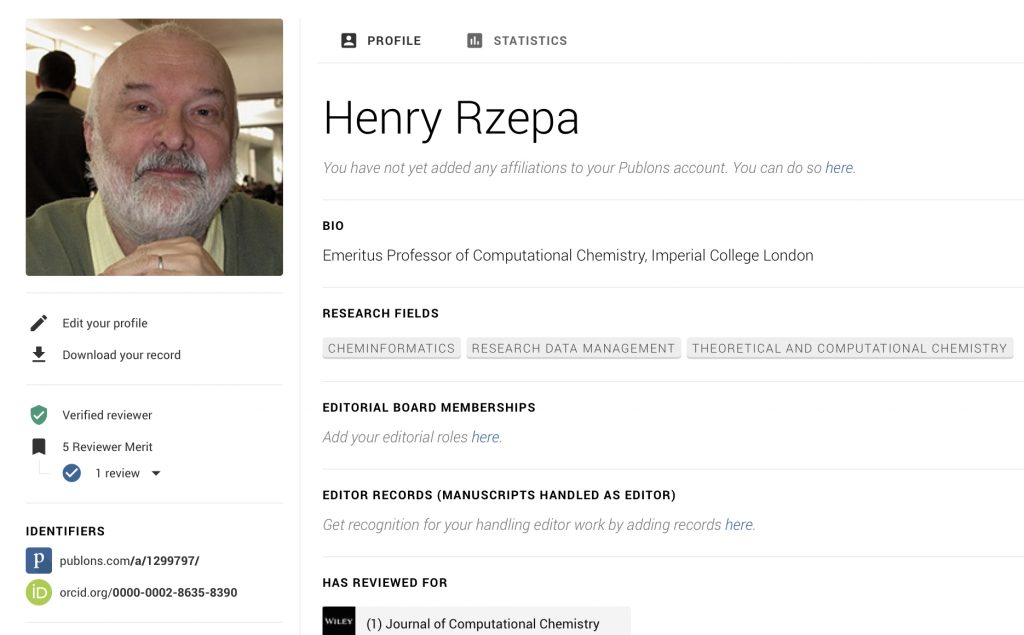
    After doing so, I then accessed my entry. You only learn that I have reviewed for a particular journal, but nothing about the actual process itself. I did not really think that this experiment had done much to encourage collaboration and speed up scientific development. It might be useful for early career researchers to get their name exposed however.

    I can almost understand why the review itself might not be publicly displayed, but as a result you learn nothing about the factual basis of the review and whether it might have been conducted responsibly, thoroughly and with integrity. Instead, I now suspect that the presence of my name on this site might merely encourage other publishers to deluge me with requests for further (freely donated) refereeing.

    Discussing this at lunch, a colleague (thanks Ed!) reminded me of a veritable journal called Organic Syntheses. Here, authors submit a synthetic procedure and open identified “checkers” are invited to repeat the procedure and comment on it. The two roles are kept separate (i.e. the checkers do not become co-authors), but they could get credit for their activity. Thus if you view a typical recent entry[cite]10.15227/orgsyn.094.0217[/cite] you will see a full biography and affiliation of the checkers given at the end, with footnotes often describing their own observations if they differ from those of the authors. 

    This set me thinking whether an open peer review process might also contain such an element of checking, as well as informed comment, nay opinion, about the article itself and the conclusions it makes. The opportunity arose when I was contacted by an author who was about to submit a computational article to a journal. This journal allowed open peer review. If I agreed to review, my name would be attached to the article if accepted for publication. I undertook this on the basis that I would use this review to conduct some limited checking of the computations and other assumptions underpinning the conclusions in the submitted article. I also wanted this open process to include the data on which my review was based. Most importantly if anyone wished to replicate my replication, the barriers to doing so should be as low as is possible. Shortly thereafter, I received a formal invitation from the journal and I set about my task. Crucially, all my own calculations supporting the review were archived in a data repository, albeit under embargo. In my cover letter I included the DOI for my data and the embargo access code, so that the authors (and the editor of the journal if they so wished) could inspect the data against which I wrote my review.

    Then followed standard procedures, whereby the authors took my comments into consideration, revised the article and the final version was indeed accepted and published.[cite]10.1073/pnas.1709586114[/cite] You will find the two referees/checkers listed, although unlike Organic Syntheses,  there is no bibliographic information about them or their affiliation. I did ask the journal if they could at least link my ORCID identifier to my name, but that request was refused. If my name had been a common one, then disambiguating it into a unique identity could be a challenge. There was also no mechanism to associate my identity on the journal with any data on which I had based my review. Really, the only open aspect of this process was just my (potentially ambiguous) name, nothing else. No follow-up was received from the journal to add the review to Publons. 

    The next stage was to contact the author who had originally set the process under way to ask them if they would mind my releasing the data on which my review had been based. They agreed, as also they did to my telling this story. The overall outcome is thus a published article with the reviewers (if not their reviews or any supporting evidence for their review) openly named. In this specific case, there is also an open dataset with a formal link back to the article in the form of a DOI (10.14469/hpc/2640, although I suspect this aspect is unique, even precedent setting), but one driven by the reviewer and not the journal. It would be nice to have bidirectional links between both article and the review data, but I do not know any publishers currently operating such a mechanism (if anyone knows such, please tell).

    Now to the broader questions about the process described above. I think that the aspiration to encourage collaboration and speed up scientific development may indeed have been promoted by this association between article and the data assembled by the reviewer. Whether the final article was improved as a result of the processes described here I will leave the authors to comment if they wish. As with the checkers employed by Organic Syntheses, such a review process takes not just time, but resources. Resources that currently have to be freely donated by the reviewers and their host institution and which clearly cannot become expensive, time-consuming or onerous. That was not the case as it happens here; my contributions were facilitated by my having sufficient expertise to perform the tasks I undertook really quite quickly.

    I will raise one more issue; that of whether to add my review to the dataset which is now openly available. In fact it is not included, in part because it related to the initially submitted version of the MS. The final MS version has been revised and so many of the comments in my review may only make sense if you have the first version to hand. It would be perhaps unreasonable to make the first drafts of manuscripts routinely available (although historians of science would probably love that!) alongside the reviews of that first draft. But I could also see a case for doing so if the community agreed to it. One to discuss for the future I think. There is also the associated issue of what should happen to any dataset associated with a review in the event that the final article is rejected and not accepted. Should the data remain permanently under embargo and the reviewer’s identity permanently anonymous? Perhaps opening up even such datasets might nevertheless  encourage collaboration and speed up scientific development, but I fancy some would consider that a step too far!
  • FAIR Research data: Gravitational waves as an example from the astrophysics community.

    In 2016, the world heard that gravitational waves had been detected and now a third instance is reported. Given that the data associated with these detections are perhaps amongst the most important instances in recent times, I thought I might take a peek at how it was managed.

    1. The original report in 2016[cite]10.1103/PhysRevLett.116.061102[/cite] cited (Ref 116) data as DOI: 10.7935/K5MW2F23.
    2. The second instance[cite]10.1103/PhysRevLett.116.241103[/cite] also cites (Ref 89) a DOI: 10.7935/K5H41PBP
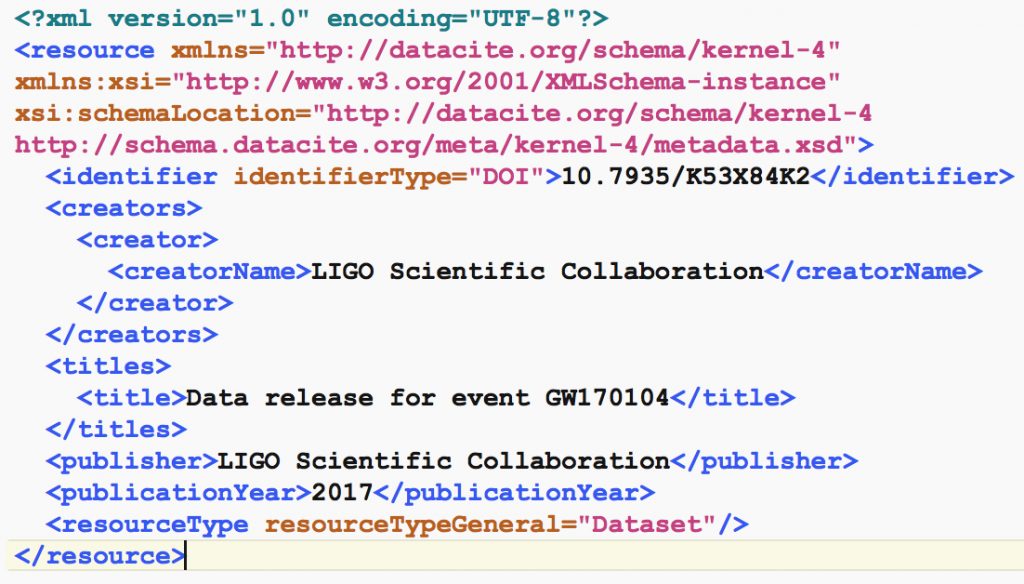
    3. Today a third instance was reported[cite]10.1103/PhysRevLett.118.221101[/cite] with data cited (Ref 180) as DOI: 10.7935/K53X84K2
    4. Sixth instance in 2017[cite]10.1103/PhysRevLett.119.161101[/cite], Data (Ref 80) DOI: 10.7935/K5B8566F.
    5. A complete list of events is available at losc.ligo.org/events/

    Each of these datasets is beautifully presented, with interactive components making the data very accessible and indeed FAIR. Recently, guidelines for how to cite data have emerged and the FORCE11 organisation has interpreted them for authors, publishers and journal editors, and repository administrators and it is good that the data for these detections has adhered to these principles. When implemented, it will identify e.g. Refs 116, 89 or 180 in the above articles with attributes that will trigger something called EventData with the objective that it retrieves and exposes the activity that occurs around research data objects and brings to light links between publications and data, citations, software, reuse, documentation, etc. At the moment I presume that these three data citations do not yet trigger any EventData. However, there are plans to for both CrossRef and DataCite to implement search procedures to find such EventData. When this service goes live, I intend to explore its potential; watch this space.

    I did one other check on each of the datasets:

    These download the metadata associated with each dataset. Ideally this could contain a host of information about the data and in particular its creators (i.e. the ORCID of each of the many authors describing how the data was acquired and interpreted). I show just the last as an example in full (the others are similar). Its pretty minimal.

    Now there is an area that this otherwise magnificent example of open data sharing could improve upon. In a forthcoming post, I will show how rich metadata population of a chemistry dataset can be used to enhance it and also to trigger EventData as noted above.


    For a famous chemical controversy involving gravitational fields, see here.

  • Curating a nine year old journal FAIR data table.

    As the Internet and its Web-components age, so early pages start to decay as technology moves on. A few posts ago, I talked about the maintenance of a relatively simple page first hosted some 21 years ago. In my notes on the curation, I wrote the phrase “Less successful was the attempt to include buttons which could be used to annotate the structures with highlights. These buttons no longer work and will have to be entirely replaced in the future at some stage.” Well, that time has now come, for a rather more crucial page associated with a journal article published more recently in 2009.[cite]10.1039/b810301a[/cite]

    The story started a few days ago when I was contacted by the learned society publisher of that article, noting they were “just checking our updated HTML view and wanted to test some of our old exceptions“. I should perhaps explain what this refers to. The standard journal production procedures involve receiving a Word document from authors and turning that into XML markup for the internal production processes. For some years now, I have found such passive (i.e. printable only) Word content unsatisfactory for expressing what is now called FAIR (Findable, accessible, inter-operable and re-usable) data. Instead, I would create another XML expression (using HTML), which I described as Interactive Tables and then ask the publisher to host it and add that as a further link to the final published article. I have found that learned society publishers have not been unwilling to create an “exception” to their standard production workflows (the purely commercial publishers rather less so!). That exceptional link is http://www.rsc.org/suppdata/cp/b8/b810301a/Table/Table1.html but it has now “fallen foul of the java deprecation“. 

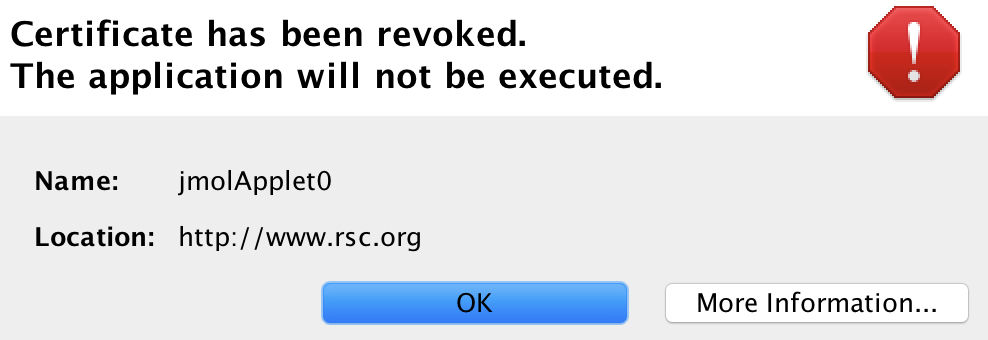
    Back in 2008 when the table was first created, I used the Java-based Jmol program to add the interactive component. That page, when loaded, now responds with the message:

    This I must emphasise is nothing to do with the publisher, it is the Jmol certificate that has been revoked. That of itself requires explanation. Java is a powerful language which needs to be “sandboxed” to ensure system safety. But commands can be created which can access local file stores and write files out there (including potentially dangerous ones). So it started to become the practise to sign the Java code with the developer certificate to ensure provenance for the code. These certificates are time-expired and around 2015 the time came to renew it. Normally, when such a certificate is renewed, the old one is allowed to continue operation. On this occasion the agency renewing the certificate did not do this but revoked the old one instead (Certificate has been revoked, reason: CESSATION_OF_OPERATION, revocation date: Thu Oct 15 23:11:18 BST 2015). So all instances of Jmol with the old certificate now give the above error message. 

    The solution in this case is easy; the old Jmol code (as JmolAppletSigned.jar) is simply replaced with the new version for which the certificate is again valid. But simply doing that alone would merely have postponed the problem; Java is now indeed deprecated for many publishers, which is a warning that it will be prohibited at some stage in the future.‡ So time to bite the bullet and remove the dependency on Java-Jmol, replacing it with JSmol which uses only JavaScript.

    Changing published content is in general not allowed; one instead must publish a corrigendum. But in this instance, it is not the content that needs changing but the style of its presentation (following the principle of the Web of a clear-cut separation of style and content). So I set out to update the style of presentation, but I was keen to document the procedures used. I did this by commenting out non-functional parts of the style components of my original HTML document (as <!– comment –>) and adding new ones. I describe the changes I made below.

    1. The old HTML contained the following initialisation code: jmolInitialize(".","JmolAppletSigned.jar");jmolSetLogLevel('0'); which was commented out.
    2. New scripts to initialize instead JSmol were added, such as:
      <script src="JSmol.min.js" type="text/javascript"> </script>
    3. I added further scripts to set up controls to add interactivity.
    4. The now deprecated buttons had been invoked using a Jmol instance:  jmolButton('load "7-c2-h-020.jvxl";isosurface "" opaque; zoom 120;',"rho(r) H")
    5. which was replaced by the JSmol equivalent, but this time to produce a hyperlink rather than a button (to allow the greek ρ to appear, which it could not on a button): <a href="javascript:show_jmol_window();Jmol.script(jmolApplet0,'load 7-c2-020.jvxl;isosurface &quot;&quot; translucent;spin 3;')">ρ(r)</a>,
    6. Some more changes were made to another component of the table, the links to the data repository. Originally, these quoted a form of persistent identifier known as a Handle; 10042/to-800. Since the data was deposited in 2008, the data repository has licensed further functionality to add DataCite DOIs to each entry. For this entry,  10.14469/ch/775. Why? Well, the original Handle registration had very little (chemically) useful registered metadata, whereas DataCite allows far richer content. So an extra column was added to the table to indicate these alternate identifiers for the data.
    7. We are now at the stage of preparing to replace the Java applet at the publishers site with the Javascript version, along with the amended HTML file. The above link, as I write this post, still invokes the old Java, but hopefully it will shortly change to function again as a fully interactive table.
    8. I should say that the whole process, including finding a solution and implementing it took 3-4 hours work, of which the major part was the analysis rather than its implementation.

    It might be interesting to speculate how long the curated table will last before it too needs further curation. There are some specifics in the files which might be a cause for worry, namely the so-called JVXL isosurfaces which are displayed. These are currently only supported by Jmol/JSmol. They were originally deployed because iso-surfaces tend to be quite large datafiles and JVXL used a remarkably efficient compression algorithm (“marching cubes”) which reduces the cube size one hundred-fold or more. Should JSmol itself become non-operational at some time in the (hopefully) far future (which we take to be ~10 years!) then a replacement for the display of JVXL will need to be found. But the chances are that the table itself will decay “gracefully”, with the HTML components likely to outlive most of the other features. The data repository quoted above has itself now been available for ~12 years and it too is expected to survive in some form for perhaps another 10. Beyond that period, no-one really knows what will still remain. 

    You may well ask why the traditional journal model of using paper to print articles and which has survived some 350 years now, is being replaced by one which struggles to survive 10 years without expensive curation. Obviously, a 3D interactive display is not possible on paper.[cite]10.6084/m9.figshare.797481[/cite] But one also hears that publishers are increasingly dropping printed versions entirely. One presumes that the XML content will be assiduously preserved, but re-working (transforming, as in XSLT) any particular flavour of XML into another publishers systems is also likely to be expensive. Perhaps in the future the preservation of 100% of all currently published journals will indeed become too expensive and we might see some of the less important ones vanishing for ever?


    Nowadays it is necessary to configure your system or Web browser to allow even signed valid Java applets to operate. Thus in the Safari browser (which still allows Java to operate, other popular browsers such as Chrome and Firefox have recently removed this ability), one has to go to preferences/security/plugin-settings/Java, enter the URL of the site hosting the applet and set it to either “ask” (when a prompt will always appear asking if you want to accept the applet) or “on” when it will always do so. How much longer this option will remain in this browser is uncertain.

    In the area of chemistry, an early pioneer was the Internet Journal of Chemistry, where the presentation of the content took full advantage of Web-technologies and was on-line only. It no longer operates and the articles it hosted are gone.

  • Conference report: an example of collaborative open science (reaction IRCs).

    It is a sign of the times that one travels to a conference well-connected. By which I mean email is on a constant drip-feed, with venue organisers ensuring each delegate receives their WiFi password even before their room key. So whilst I was at a conference espousing the benefits of open science, a nice example of open collaboration was initiated as a result of a received email.

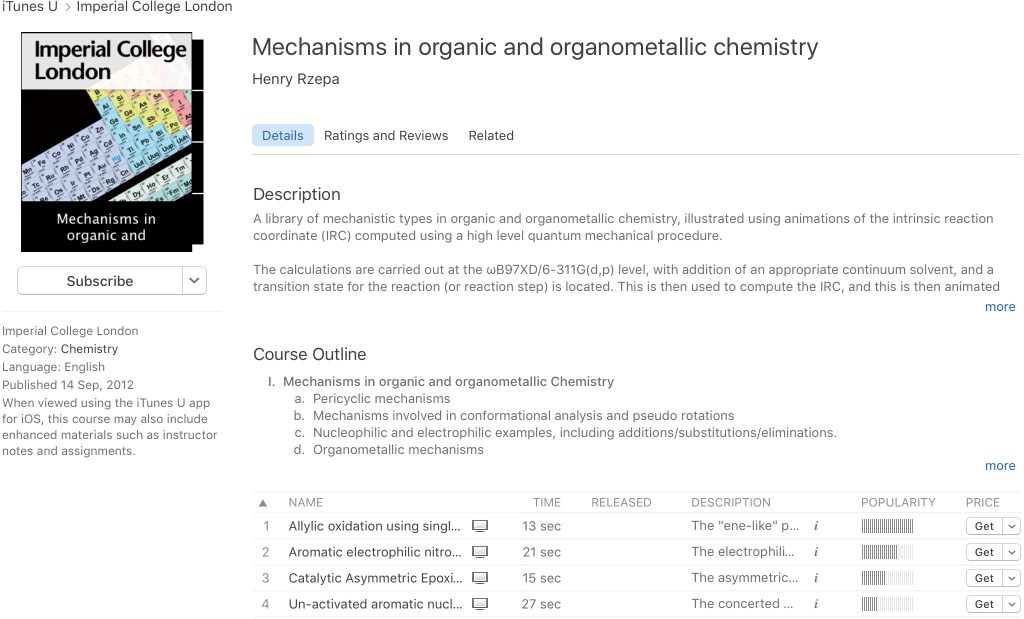
    Steven Kirk  contacted me with the following query: Do you know of any open-access database of calculated IRCs with coverage of as broad a range of classes of chemical reactions as possible? I recollected that about six years ago, I was exploring the use of iTunesU as a system for delivering course content in a rich-media format. I produced animations for about 115 reactions (many of which as it happens were taken from this blog, but quite a number were also unique to that project) and placed them into iTunesU, and now sending the URL https://itunes.apple.com/gb/course/id562191342 to Steven.

    I should at this point explain something of the structure of such an iTunesU course.

    1. An essential feature is the course icon, seen below on the left. Since the course is hosted by Imperial College, it had to be an officially approved icon. I am sure you can believe me if I tell you that this took a month or so to obtain, with a fair bit of persistence required!
    2. I also had to get approval to place the iTunes app on all the teaching computers so that students could open the course. Believe me again when I tell you that I had to persuade the Apple lawyers in Cupertino to release a special license for this app to persuade our administrators here to install it on the Windows teaching clusters. Another few months had passed by.
    3. When creating an entry (using e.g. https://itunesu.itunes.apple.com/coursemanager/ ) one has to specify values for various descriptors, also often called metadata. Thus any one entry has fields for name and description, with the popularity added by Apple. Only a few words are visible in the description field, which can be expanded in iTunes using the i button.
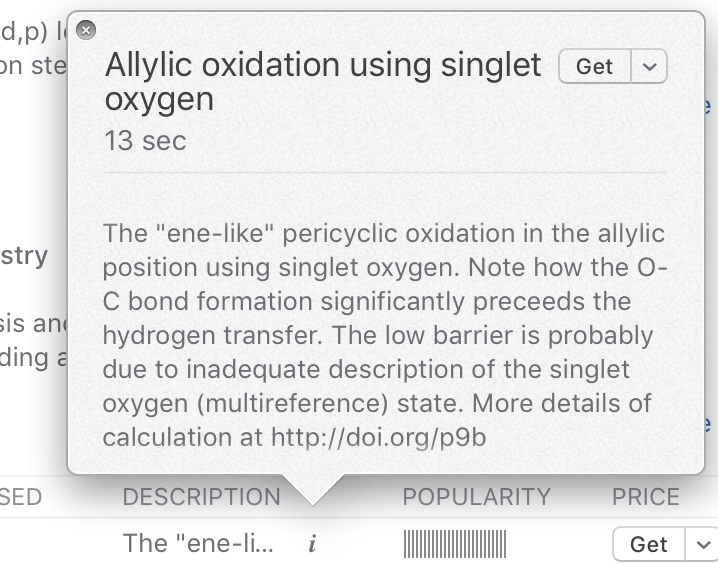
    4. Steven meanwhile had replied asking if the original data that was used to generate the IRC might be available. Specifically his second question was “So the DOIs are only stamped into the animation’s bitmaps, or are they also somewhere in the metadata?“. That little i button is not easy to spot, and there is no indication, in the event, of what information it might actually contain.
    5. Here it is expanded. The contents are unstructured text, into which I have placed the required DOI.
    6. The lesson here is that I had fortunately had the foresight to include a link to the IRC data in anticipation of just such a question from someone in the future. But black mark to Apple here; the text cannot be selected and copied into a clipboard! It is fairly unFAIR data, since it can only be inter-operated (the I of FAIR) by a human re-typing it by hand. And the human has also to recognise the pattern of a DOI; a machine could not obtain this information easily. Moreover Steven is a Linux user; he does not readily have access to the iTunes app on this operating system!
    7. Also, there were 115 such entries, and now the prospect was rearing that each would have to be hand processed. Moreover, because the text was unstructured, there was no guarantee that I would have adopted the same pattern for all 115 entries.
    8. Fortunately Steven was on the ball. I quote again: it turns out iTunes isn’t needed at all. A service I found on the web http://picklemonkey.net/feedflipper-home/ takes an ITunes URL and converts it to an RSS feed. Opening this feed in Firefox and RSSOwl respectively let me save the feed as XML and HTML (both attached).
    9. This is currently where we stand (Steven’s first email was two days ago), but it’s not finished yet. Depending on how assiduous I was five years ago, some DOIs to the data may be acquired from the list. Sometimes I simply wrote e.g. See http://www.ch.imperial.ac.uk/rzepa/blog/?p=6816 knowing that the links to the data were there instead. I can already see that some descriptions have neither a DOI nor a link to the blog. More detective work will be needed, unfortunately.

    How might the situation described above been avoided? Well, Apple in iTunesU only provided in effect one metadata field, and this was an unstructured one. Anything went in that field. Had they provided (or had the course creator been able to configure it themselves) there might have been another field entitled say “data source“. This could moreover been made a mandatory field and a structured one. Thus it might have only accepted known types of persistent identifier, such as a DOI. Further, the system could have checked that the DOI was actually resolvable. Before you ask, I did log a “bug” with Apple asking this be done, but nothing ever was. With such a tool to hand, I might have achieved data sources for all the 115 entries. The resulting XML (as generated above) could have been used to automate the retrieval of all 115 datasets describing this course. 

    At this stage then, Steven can follow-up his interest in building a reaction IRC library and analysing it. I will do all I can to encourage Steven not to make the mistakes I did and to ensure that any further data that is required to augment the library does not suffer the problems above. On the other hand, I console myself that in two days, much of the data for the course I created five years ago was salvageable; I wonder how many other iTunesU courses there are for which that can be said!

    I will let (with some blushing) the final word be Steven’s: You are one of the few chemists who has both pioneered and built the principles of ‘open chemistry’ into their actual scientific work. I visit your blog occasionally knowing that there is a very high probability I could download and tinker with the results of real calculations.


    Might I assure all the speakers that I concentrated totally on their talks rather than incoming emails!

  • The challenges in curating research data: one case study.

    Research data (and its management) is rapidly emerging as a focal point for the development of research dissemination practices. An important aspect of ensuring that such data remains fit for purpose is identifying what curation activities need to be associated with it. Here I revisit one particular case study associated with the molecular structure of a product identified from a photolysis reaction[cite]10.1126/science.1188002[/cite] and the curation of the crystallographic data associated with this study.

    This particular dataset (CSD, dataDOI: 10.5517/cctnx5j) is associated with an article entitled “Single-Crystal X-ray Structure of 1,3-Dimethylcyclobutadiene by Confinement in a Crystalline Matrix“.[cite]10.1126/science.1188002[/cite] Data for crystal structures supporting a research article is required (at least in part) to be deposited into the Cambridge structure database (internal reference MUWMEX) and for which a significant level of curation is performed. Although the definition of the term curation has evolved over the last few years, here I take it to include the following:

    1. Identification of appropriate metadata describing the data. For molecules, this would include any identifiers such as the name of the molecule and the connectivities of the atoms constituting that molecule.
    2. The submission of this metadata to a suitable aggregator, such as e.g. DataCite and its inclusion in any other databases associated with the data. These two tests are part of the FAIR data guidelines[cite]10.1038/sdata.2016.18[/cite], covering the F (findable) and A (accessible).
    3. Performing any validation tests for the data that can be identified. With crystal structure data in CIF format, this is defined by the utility checkCIF and helps to ensure the I (inter-operable) of FAIR. The R refers in part to the licenses under which the data can be re-used.

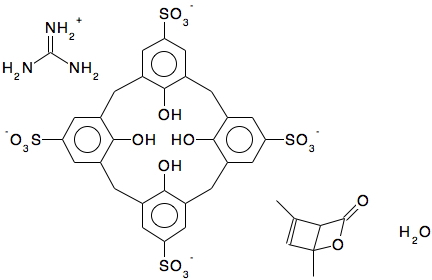
    On (it has to be said rare) occasions, these procedures can lead to a disparity between the author’s conclusions arrived on the basis of their acquired data and the metadata identified by the independent curators. This difference is most obviously illustrated in this case study by the chemical names inferred by the curation process for the structure represented by the data in the CSD:

    • chemical name: “tetrakis(Guanidinium) 25,26,27,28-tetrahydroxycalix(4)arene-5,11,17,23-tetrasulfonate 1,5-dimethyl-2-oxabicyclo[2.2.0]hex-5-en-3-one clathrate trihydrate
    • chemical name synonym: “tetrakis(Guanidinium) tetra-p-sulfocalix(4)arene 1,3-dimethylcyclobutadiene carbon dioxide clathrate trihydrate“.

    Only the synonym agrees with the title given by the original authors in their publication.[cite]10.1126/science.1188002[/cite] One might indeed strongly argue that these two names are not in fact synonyms, since they refer to quite different chemical structures with different atom connectivities. A search of the database for the sub-structure corresponding to 1,3-dimethylcyclobutadiene does not reveal any hits and so the information implied by this synonym is not recorded in the index created for the CSD database.

    I asked the scientific editors of the CSD for some guidance on the curation procedures applied to crystal structure datasets and they have kindly allowed me to quote some of this.

    1. “In cases such as this, we as editors are sometimes faced with conflicting information and have to try our best to strike a balance between the data presented in the CIF, a published interpretation and our knowledge based on the information already in the CSD”.
    2. “In areas where there is a particular conflict between these, we often would include a comment (usually in the Remarks or Disorder field as appropriate)”. For this particular dataset, one finds the following under the Disorder field:
      • “Under UV radiation the clathrated pyrone molecule converts to a disordered mixture of square-planar 1, 3-dimethylcyclobutadiene and rectangular-bent 1, 3-dimethylcyclobutadiene in van der Waals contact with a carbon dioxide molecule. The ratio of the square-planar to rectangular-bent 1, 3-dimethylcyclobutadiene clathrate is modelled with occupancies 0.6292:0.3708”.
      • It is not entirely obvious however whether this last comment originates from the original authors or from the data curators. It does not resolve the difference between the assigned chemical name and the indicated chemical name synonym.
    3. “In the case of MUWMEX, I think that the editor produced a diagram (below) which seems chemically reasonable based on the crystallographic data with which we were provided and tried to cover the situation regarding disorder, van der Waals contacts etc in the ‘Disorder’ field. At this point, it is left to the CSD user to decide for themselves.”

    We have arrived at a point where the CSD user must indeed decide what the species described by this dataset actually is. Ideally, the best recourse would be to acquire the original data in full and repeat the crystallographic analysis. This is an aspect of the curation of crystallographic data that is not conducted as part of the current processes, which would require as a minimum a superset known as the hkl information to be present in the data. Again, to quote the CSD scientific editors:

    1. “With regard to your question: Is there any mechanism in the Conquest search to identify structures where the hkl information is present? I understand that it is not currently possible to do this in ConQuest. It is, however, possible … to access structure factor data (where available) using Access Structures.”

    For MUWMEX, the hkl information is not present in the CSD dataset and in 2010 when the structure was published would have to be obtained directly from the authors. By 2016 however, its presence in deposited datasets was becoming far more common. It is worth pointing out that even the hkl information is not the complete data recorded for the experiment.  That is represented by the original image files recording the X-ray diffractions. This latter is hardly ever available as FAIR data even nowadays.

    I hope I have here illustrated at least some of the challenging aspects of curating scientific data and the issues that can arise when derived metadata (in this case the name and the atom connectivities of a molecule) reveal conflicts with the original interpretations. This for an area of chemistry where both the data deposition and its curation is a very mature subject, having operated for ~52 years now. It is still a process that requires the intervention of skilled curators of the data, but perhaps even more importantly it reveals the need to identify even more strictly what the provenance of the interpretations is. Should the CSD curation rest merely at the stage of teasing out and flagging inconsistencies and allowing the user to then take over to resolve the conflicts? Should it be more active, in re-analyzing data for each entry where conflicts have been detected? Perhaps the latter is not practical now, but it might be in the near future. What is certain is that with increasing availability of FAIR data these sorts of issues will increasingly come to the fore. And not just for the very well understood case of crystallographic data but for many other types of data.

  • Supporting information: chemical graveyard or invaluable resource for chemical structures.

    Nowadays, data supporting most publications relating to the synthesis of organic compounds is more likely than not to be found in associated “supporting information” rather than the (often page limited) article itself. For example, this article[cite]10.1021/jacs.6b13229[/cite] has an SI which is paginated at 907; almost a mini-database in its own right! Here I ponder whether such dissemination of data is FAIR (Findable, accessible, interoperable and re-usable).[cite]10.1038/sdata.2016.18[/cite]

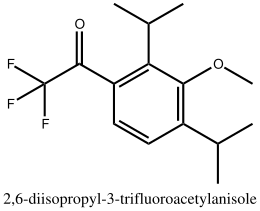
    I am going to use this article as my starting point.[cite]10.1038/nchembio.1340[/cite] One of the compounds synthesized is shown below; it is not explicitly discussed in the main body of the article. So how findable is it?

    1. A search of Scifinder (Chemical abstracts) using the structure above reveals one hit, the source being the expected one.[cite]10.1038/nchembio.1340[/cite]
    2. A search of Reaxys (used to be Beilstein) reveals no hits in their own database, but one hit is noted in …
    3. Pubchem, where it occurs as substance 163835830. The source is again cited correctly[cite]10.1038/nchembio.1340[/cite]. One of the properties reported is the InChI key: JSLVVAICXSKSEQ-UHFFFAOYSA-N. This is the same key generated from the structure drawing programs Chemdraw or ChemDoodle.
    4. Google on the other hand finds nothing for JSLVVAICXSKSEQ-UHFFFAOYSA-N.[cite]10.1039/B502828K[/cite]
    5. I also tried Google Scholar but again with no luck.

    So supporting information does appear to be indexed by both Chemical Abstracts and Pubchem; it is thankfully not a graveyard![cite]10.1186/s13321-016-0175-x[/cite] The chemical databases do return valuable additional information about the molecule, such as e.g. its InChI key and much else besides. Given that presumably the open PubChem resource IS indexed by Google, it must be a policy somewhere that prevents e.g. JSLVVAICXSKSEQ-UHFFFAOYSA-N from being found.

    I suppose the next question might be Supporting information: chemical graveyard or invaluable resource for chemical spectra? I confess here that this post was in fact inspired by a previous one on the topic of the provenance of NMR spectra. And perhaps also with some input from the concept of sonification of spectra, in which an instrumental spectrum is converted into a sound signature to allow blind people access to such information. I wonder whether a sonified unique digital signature could be used to search for spectra, somewhat in the manner that InChI helped in tracking down (or not) the molecule above? I think it would be reasonable to say that e.g. NMR spectra as embedded in say a 907 page supporting information document are likely to be very much less FAIR[cite]10.1038/sdata.2016.18[/cite]. The solution there of course is better provenance and better metadata, as I previously mulled.


    There are 262 numbered compounds reported in this article, many with much associated data.

    I cannot help but wonder what a carbonyl group sounds like!


  • The provenance of scientific data – establishing an audit trail.

    In an era when alternative facts and fake news afflict us, the provenance of scientific data becomes ever more important. Especially if that data is available as open access and exploitable by others for both valid scientific reasons but potentially also by those with other motives. Here I consider the audit trail that might serve to establish data provenance in one typical situation in chemistry, the acquisition of NMR instrumental data. 

    Here I describe how such data is generated in my department; details may vary elsewhere.

    1. The prospective user of the NMR service is allocated a service ID. In our case, that ID relates to the research group rather than to individual researchers. This ID is parochial, it does not reference any other information about the user in the institute. Only the service manager has the information to associate this ID with real users and this information is normally not distributed.
    2. When a sample is submitted, this ID is used to create a new folder containing the data as a sub-folder of the group ID and located on the NMR data servers.
    3. The dataset itself contains a number of files that contain an audit trail (names such as audita.txt, auditp.txt) with the fields: ##AUDIT TRAIL= $$ (NUMBER, WHEN, WHO, WHERE, PROCESS, VERSION, WHAT). Typically, none of these files have propagated the original user ID under which the data was collected; to do so would require a programmatic connection between the local authentication systems and the spectrometer software used, a connection that is normally missing. Thus the first break in the provenance trail.
    4. In principle other audit trails can be inferred from these files, such as the unique identity of the instrument provided by its manufacturer. Further information such as e.g. the probe used to collect the data (probes can be readily changed over) or any calibration data used in setting up the instrument for the data collection are by and large not recorded. To my knowledge, although an instrument can have a unique serial number, such serial numbers of swappable components such as probes are not recorded by the collection software. Thus the second break in the provenance trail.
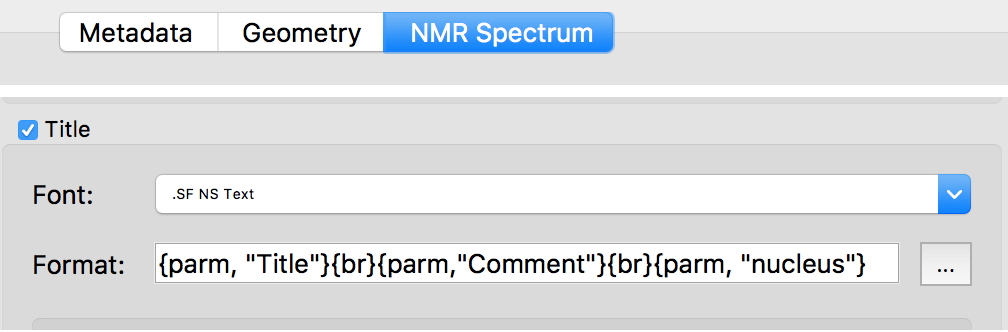
    5. This data then needs to be processed by further software. In this case we use the MestreNova system for this task. Each dataset has editable assigned properties; below I show those that can be associated with the spectrum (accessed with MestreNova using Edit/Properties). All this comes from the information collected by the instrument. The user’s identity can be inserted into the “title” field, the display of which is off by default. 
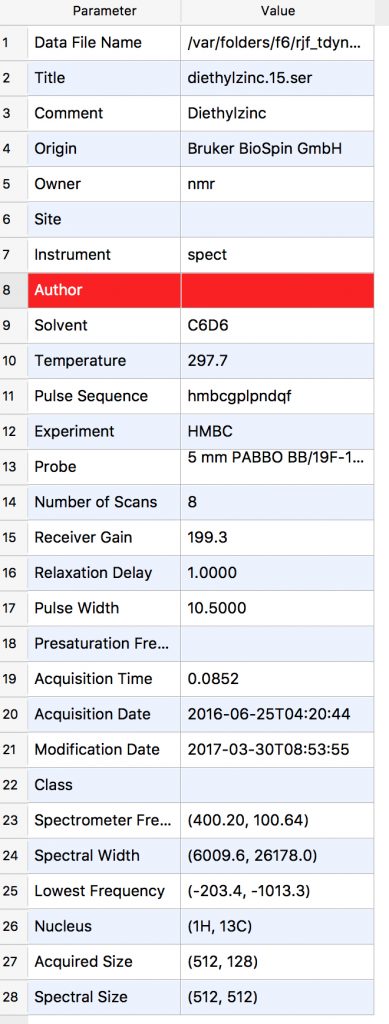
    6. There is also a section for parameters, a synonym for which might be metadata and accessed using this program from View/Tables/Parameters. If Author was entered as a parameter in the dataset by the spectrometer software, the Mnova document would retrieve that information. Equally, an ORCID identifier for the author entered at the time of data collection and thus stored in the dataset could be read by Mnova, stored and displayed if configured to do so. It would be fair to say however that this option is rarely if indeed ever systematically implemented by NMR instrument data collection software and so is never propagated to the data processing software (as highlighted in red below). Thus a third break in the provenance trail.
      This is also an alternative and this time formal metadata field that can be populated, by default as shown below with the type of spectrum and nucleus. These properties are not controlled in the sense of only allowing those terms that are present in a specified dictionary. The jargon for such control is a metadata schema. This is not used here, since dissemination of this information is not intended; the software accepts whatever information it is given. 
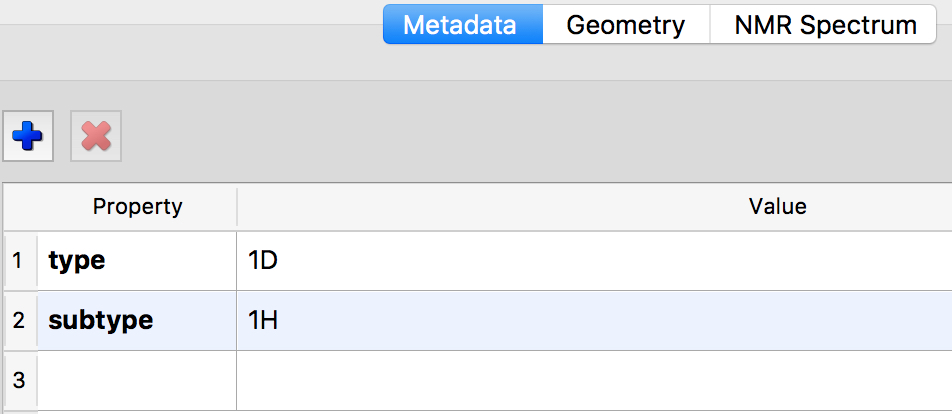
      There are thus several opportunities to collect the identity of the experimenter and thus attribute provenance to the collected data, but this does very much depend on the will of researchers, institutions or publishers to enforce specific policies around this. The fourth break in the provenance trail.
    7. The dataset can then be uploaded (DOI: 10.14469/hpc/1291), at which stage provenance can finally be added using the ORCID credentials of the person publishing the dataset, who of course may or may not be the person who actually recorded the data! The full metadata for this specific collection can be seen at data.datacite.org/10.14469/hpc/1291. Or to put it another way, this is the first point in the provenance chain where the metadata is controlled by a schema and is also discoverable in a standard programmatic manner, i.e. the preceding link. The provenance is now formally associated with the ORCID identifier using the DataCite metadata schema. You should be aware that a local policy is that access to the repository at https://data.hpc.imperial.ac.uk is only allowed by cross-authentication with http://orcid.org/ using the user’s ORCID. This identifier is then automatically propagated to the metadata held at e.g. data.datacite.org/10.14469/hpc/1095. Currently however, none of any metadata originally recorded in either the instrumental file set or the processed MestreNova file is forwarded on to the metadata record held at DataCite; again loss of information and potentially of provenance
    8. The peer-reviewed article resulting from the interpretation of this data however can be associated with the provenance introduced in the previous stage; see data.datacite.org/10.14469/hpc/1267  and the IsReferencedBy property. 

    Now imagine if there was a common thread in all the stages of acquiring, processing and publishing this scientific data based on the ORCID. 

    1. Providing an ORCID could be made an essential requirement of access to the instrument.
    2. This information would be propagated to the dataset …
    3. by inclusion in one or more of the audit trail files.
    4. At this stage, further persistent identifiers associated with the instrument manufacturer could be added, which help identify not only the instrument used, but sub-components such as the changeable probe. This would allow access to any calibration curves or probe sensitivity and other aspects.
    5. The ORCID and other relevant information could be picked up by the software used to convert the data into spectra and propagated into the metadata containers for this software …
    6. where its use is controlled by a specified schema.
    7. At this stage, the ORCID and information such as the nucleus recorded, the sample temperature etc can be propagated on to the final metadata records.
    8. And the reader of the article describing this work would have a formally defined provenance audit trail they could follow back to the start of the experiment or forward to a published article. In this case, the data claims provenance (acquired from peer review) from the article, but it should also work in reverse with the article claiming provenance from the data on which it is based. The indexing of this bidirectional exchange is one of the exciting features that we should see emerging from CrossRef (holders of metadata about articles) and DataCite (holders of metadata about research data) in the near future.

    We are clearly a little way from having the infrastructures described above for establishing such data audit trails. To do so will require cooperation from instrument manufacturers, at least in the example as charted above, as well as researchers, institutions, publishers, peer-reviewers and funding bodies. The first step would be to ensure that all scientists who intend collecting, processing and publishing data should claim an ORCID. That remark is directed specifically at undergraduate, postgraduate and post-doctoral researchers, not just at their supervisor or their PI (principal investigator). At a point when the discussion about alternate facts and perhaps even alternate data risks a general loss of confidence in science, we should be pro-active in establishing trust in the scientific processes.


    You can see an example obtained by this process at DOI: 10.14469/hpc/1095

    This requirement is a strong driver for the uptake of ORCID amongst our student population.