In the previous two posts, I noted the recent suggestion of how a stable frozen SN2 transition state might be made. This is characterised by a central carbon with five coordinated ligands. The original suggestion included two astatine atoms as ligands (X=At), but in my post I suggested an alternative which would have five carbon ligands instead (X=cyclopentadienyl anion).
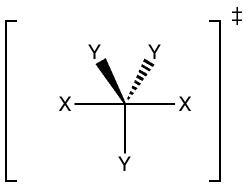
However, these five ligands are not all equal; far from it. Three form normal strength bonds to the central carbon, and two very weak (deci)bonds. So, could a molecule be made with five equal bonds all coordinated to a central carbon atom? Well, the inspiration for designing such a molecule comes with the report of a remarkable compound of silicon by Jutzi and co-workers[cite]10.1126/science.1099879[/cite]. Examples with Ge, Sn and Pb are also known.
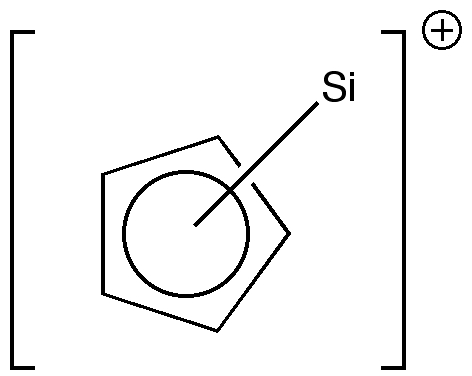
Using a large non-coordinating anionic counterion, a crystal structure could be determined for the pentamethyl derivative (Refcode: BIDLEG), which reveals the five-fold symmetry of the silicon coordination. The obvious mutation therefore is to see if the corresponding carbon compound might be stable. A B3LYP/6-311G(d,p) calculation (DOI: 10.14469/ch/2408) run with C5 symmetry reveals this system to have only positive force constants, with five equal C-C bonds to the central carbon, each with the unusual length of 1.799Å. The bouncing castle vibrational mode involving the pentacoordinate carbon has a value of 767 cm-1
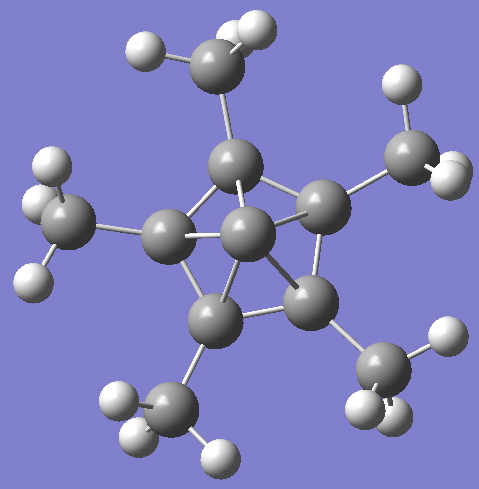
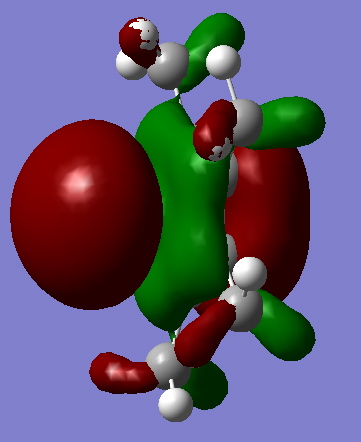
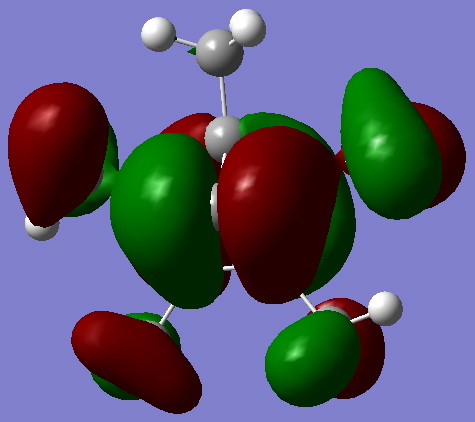
So, not only do we now have a clearly penta-coordinate carbon, all five bonds are of equal length! More unusual still, all five ligands occupy one hemisphere of the carbon coordination. Why might such a geometry be stable? Well, as with the silicon analogue, C2+ has only two valence electrons left. To elevate this to the standard octet, it must accept six electrons, and the cyclopentadienyl anion fulfils this role perfectly. The top three occupied molecular orbitals are shown below.
 |
 |
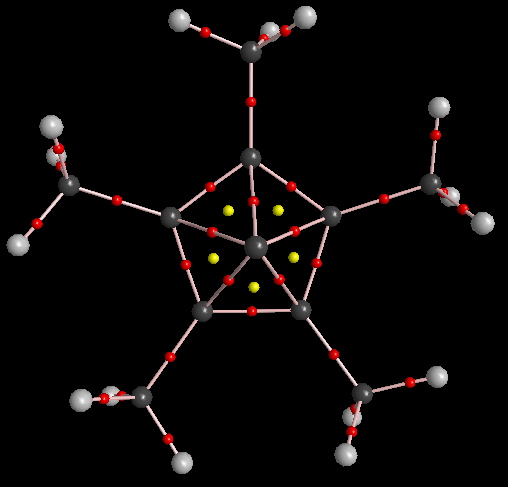
An AIM analysis (below) shows five equal bond critical points, with ρ(r) 0.13 au for each (see previous post for comparison), a value which probably can be described by the term bond. The ∇2ρ value of +0.07 au is similar to that quoted in the previous post. Noteworthy is the observation that no ring critical point (RCP, yellow dots) can be found for the cyclopentadienyl ring itself, only for the five three-membered rings to the pentacoordinate atom.
Can the species be made? Well, given that it seems the case that carbon and silicon chemistries are inverted, ie what is stable with silicon is unstable with carbon, and vice versa, the answer is probably no. But one never knows until one has tried!


Leave a Reply