Author: Henry Rzepa

  • What is the largest angle possible at 4-coordinate carbon – 180°?

    Four-coordinate carbon normally adopts a tetrahedral shape, where the four angles at the carbon are all 109.47°. But how large can that angle get, and can it even get to be 180°?

    A search of the CSD (crystal structure database) reveals a spiropentane as having the largest such angle, VAJHAP with 164°[cite]10.1021/ja00186a058[/cite]
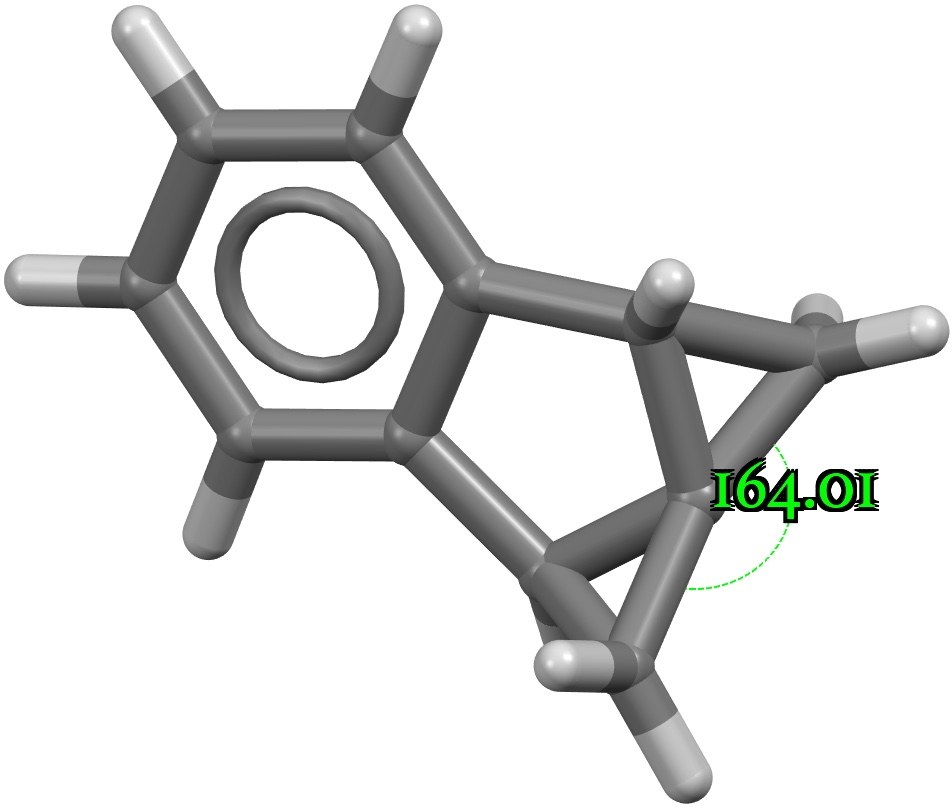
    Because crystal structures might have artefacts such as disorder etc, it is always good to check this with a calculation; hence ωB97XD/Def2-TZVPP (FAIR data DOI: 10.14469/hpc/11148) for which a calculated angle of 163.8° is reassuring. The smallest angle in this system by the way is 58°, pretty normal for three-membered rings.

    The localised orbitals show the C-C region defining the large angle to be very “bent” (a banana bond) but otherwise fairly normal.

    So can one “engineer” an even larger angle? Replacing the C=C of the benzo group with a shorter CHgroup produces the following, which is now almost linear (almost a “hemispherical” carbon).


    What about the smallest angle at 4-coordinate carbon? Could it be significantly smaller than the 57° noted above for a three membered ring? Searching the CSD reveals XAQHIH[cite]10.1021/jo050471+[/cite] with an angle of 43° but the calculation above now does not confirm this, the angle changing from 43° to 59° during optimisation. A reminder that when exploring extreme geometric values, always check with a calculation!


    The next candidate is CAZFUE[cite]10.1016/S0040-4039(00)94150-9[/cite] with an apparent measured angle of 48°. This appears to have C2 symmetry, and a calculation with this gives a value of 46.6°. But all is not what it seems. This is a classic example of a semibullvalene [3,3] Cope rearrangement, caught in the “middle” so to speak (See this post here). In fact this geometry is actually a transition state, and the crystal structure is the thermal average of two positions, making it appear symmetrical. The ground state for this structure as calculated is different! The two angles now emerge as 40 and 57° (average 48.6°). At the “transition state”, one of the four “bonds” to carbon is unusually long (2.07Å), which is the direct cause of the small 48° angle. If this is not allowed as a “bond”, the angle at the other true 4-coordinate carbon emerges as normal at 57°

    So the answer to the smallest angle does seem to be around 57°, but it could be as small as 47° if one allows bonds of 2.07Å in one’s definition of 4-coordinate. The candidate for the largest bond angle, of almost 180°, seems a reasonable synthetic target!
  • Why does octafluorocubane have such a high sublimation point?

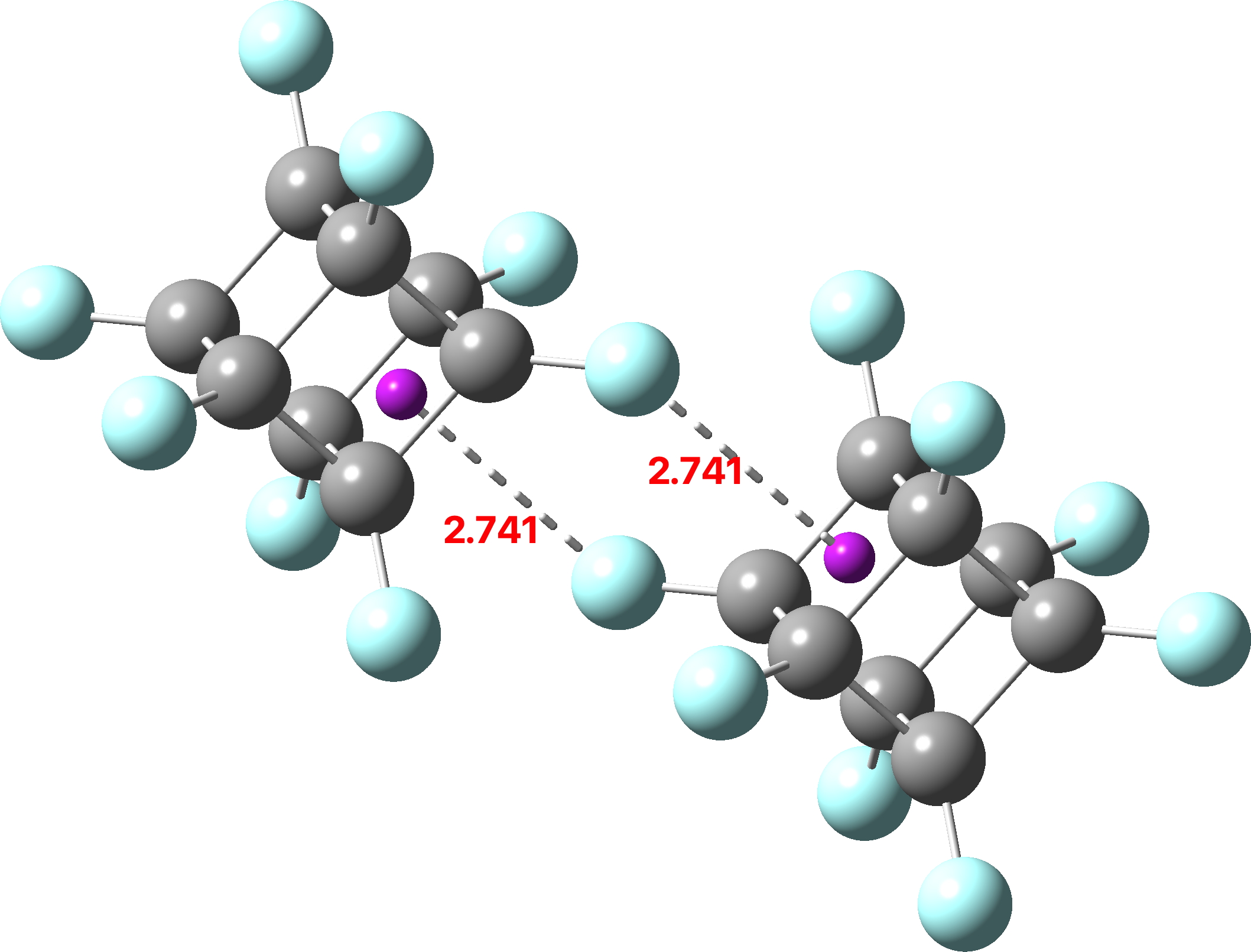
    The recently reported synthesis[cite]10.1126/science.abq0516[/cite] of octafluorocubane established a sublimation point as 168.1–177.1°C (a melting point was not observed). In contrast, the heavier perfluoro-octane has an m.p. of -25°C. Why the difference? Firstly, the crystal structure is shown below, albeit as a dimer rather than a periodic lattice (click on image to obtain 3D coordinates).

    The distance between a fluorine and the centroid of the 4-membered carbon ring is 1.741Å. Our crystallographer (thanks Andrew!) gives me the following analysis of the periodic crystal lattice:

    The asymmetric unit (crystal structure DOI: 10.5517/ccdc.csd.cc29z5p5) contains only two fluorine atoms (F1 and F2) and two carbon atoms (C3 and C4). Due to the symmetry/special positions, the C8F8 cube is formed of six C3’s, six F2’s, two C4’s and two F1’s. The 2.741Å contact comes from an F2 and hence there are six of these (and six faces). The closest F…C4(centroid) intermolecular separation for F1 is ca. 4.20Å. From the crystal structure one can indeed observe six C-F bonds of length 1.341Å and two of length 1.338Å, some 0.003Å shorter.

    So time for some calculations (FAIR Data DOI: 10.14469/hpc/11132). The energies shown here are for the C2h-symmetric dimer relative to two monomers.

    Method ΔE ΔH ΔG F…centroid distance, Å
    HF/Def2-TZVPP -1.19 -0.01 +4.53 3.288
    B3LYP/Def2-TZVPP -1.17 -0.00 +4.54 3.176

    B3LYP+GD3+BJ/Def2-TZVPP

    -5.24 -4.00 +2.87 2.859 (2.741 expt)

    MP2/Def2-TZVPP

    -7.42 2.718 (2.741 expt)

    The three methods were chosen as approximations to establish (a) the effect of a dispersion/correlation correction, using the standard third-generation Grimme method and (b) the effect of more general dynamic correlations as being the difference between a Hartree-Fock calculation and DFT one. The values show the HFa and B3LYP-DFT as being very similar, but adding the GD3+BJ term stabilises the dimer significantly, as well as producing an F…centroid distance only a little longer than that measured. Each cube will sustain three pairs of such interactions, so the total stabilisation energy is  ~15 kcal/mol and the enthalpy stabilisation is ~12 kcal/mol. A periodic boundary calculation of the complete cell would certainly be an even better model of this system. Nonetheless one further test, of the trend in length between the six interacting F atoms with a ring centroid and the two that do not (exp Δ-0.003Å shorter for the latter) is also replicated by the B3LYP+GD3+BJ/Def2-TZVPP calculation (Δ-0.006Å) which suggests the simple dimer model is not badly wrong.

    So from these results, it appears that the attractive interactions between molecules octafluorocubane resulting in its high sublimation temperature may not be simply electrostatic interactions (a HF calculation would model that) or indeed of dynamic correlation (modelled by DFT methods) but a more complete electron correlation of the type normally described as dispersion and eg available via multi-reference and/or coupled-cluster methods. It may indeed come as a surprise that this molecule is a high melting solid because of dispersion, but the unique geometry allows an F to interact with four carbons via such forces, and to accumulate six of these per molecule in the crystal structure. So really quite unusual.

    To end, it would certainly seem worthwhile to apply higher levels of theory to confirm this result, since the GD3+BJ induced-dipole/induced-dipole dispersion model is a relatively simple one, and as I commented in my WATOC notes, much higher level models of this effect are now becoming available.


    aAs suggested by Cina Foroutan-Nejad, a commentator on the previous blog post


    This post has DOI: 10.14469/hpc/11135


  • Octafluorocubane radical anion – where does the extra electron sit?

    Derek Lowe reports the story[cite]10.1126/science.abq0516[/cite] that the recently synthesized octafluorocubane can absorb one electron to form a radical anion – an electron in a cube. So I thought it would be fun to compute exactly where that electron sits!

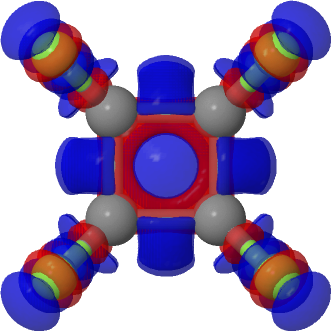
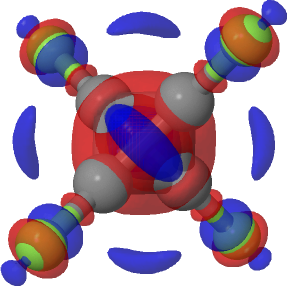
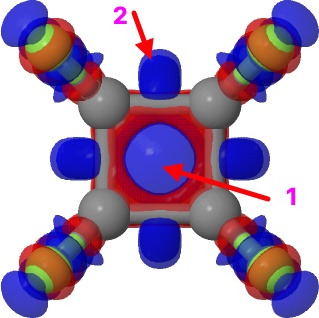
    A ωB97XD/Def2-TZVPPD/SCRF=chloroform calculation (DOI: 10.14469/hpc/11090) is carried out on the neutral system (optimizing its geometry) and then the radical anion at the same geometry. Cubes of total electron density are evaluated for both and then the neutral form is subtracted from the anion. The result is shown below (density isosurface value 0.0025 au; click on the image to load a rotatable 3D model of the density difference).

    The below is at the optimised anion geometry for both species;

    The colour code is that blue represents the location of the additional electron, and red indicates reduced electron density compared to the anion. Arrow 1 shows an additional sphere of density inside the cube – yes, an electron in a cube. But you probably would not have anticipated that the outer surface of the cube (arrow 2) is also surrounded by that electron and there is a reduced density layer on the inside surface of the cube. The C-F bonds have regions of both additional density and reduced density.


    Postscript: Perfluorododecahedrane added as per comment

    Postscript: Perfluorotetrahedrane added for completeness


  • Four stages in the evolution of interactive ESI as part of articles in chemistry journals.

    A previous post was triggered by Peter alerting me that interactive electronic supporting information (IESI) we had submitted to a journal in 2005[cite]10.1021/ic0519988[/cite] appeared to be strangely missing from the article landing page. This set me off recollecting our journey, which had started around 1998, and to explore what the current state of these ancient IESIs were in 2022. I have now reached 2014 in this journey, which is being recorded as it happens in the comments page of the post. I discovered there were four distinct stages in that evolution of IESI which I thought it would be of interest to record here.

    1. From around 1998 to 2004, our efforts at IESI centred around a browser plugin called Chime, which was itself derived from stand-alone code called Rasmol and a collaboration between the company that implemented this (MDL) and Netscape, who happened to have offices in San Francisco close to each other. Chime came in two versions, free to use and a commercial version that added further functionality such as access to MDL databases etc. An example from 1998[cite]10.1039/A805668D[/cite] can be seen at https://www.rsc.org/suppdata/perkin2/1998/2695/ and the code is shown below:
      <EMBED border=0 src="geom+vib/12e-dft.gau" name="12e-dft"
      align=center width=150 height=150 spiny=36 startspin=true
      display3D=sticks PLUGINSPAGE="http://www.ch.ic.ac.uk/cgi-bin/plugin.cgi"
      script="zoom 175;"></EMBED>

      I have to say that access to the data underpinning this IESI is still good; but the interactive component itself has long gone, along with Chime itself.

    2. By 2005, Jmol had emerged as a more general open-source browser plugin replacing Chime. This so-called Java “run time library” had to be installed by the user into their browser instance (and hence required admin rights). The interactivity in the first article where we deployed it[cite]10.1021/ja043819b[/cite] was invoked as per below.
      <applet height="300" archive="JmolApplet.jar"
      width="300" code="JmolApplet" name="TS2"
      mayscript="true" id="TS2">
      <param name="progressbar" value="true" />
      <param name="progresscolor" value="blue" />
      <param name="boxmessage"
      value="starting JmolApplet ..." />
      <param name="emulate" value="chime" />
      <param name="boxbgcolor" value="black" />
      <param name="load" value="RRSS_fm-5-ts2-49.xyz" />
      </applet>

      It is this invocation where the interactivity was rescued by Angel as described in the earlier post comments page in the form of an adaptor library that converts the syntax above to modern form.

    3. By 2007, this applet syntax had gone, to be replaced by a JavaScript version invoking the same Java-based Jmol.[cite]10.1021/ic062473y[/cite]
      <script type="text/javascript" src="JSmol.min.js"></script>
      <script type="text/javascript" src="js/Jmol2.js"></script>
      <!-- The second command is modern, to convert to using  JSmol -->

      and then to invoke a molecule:

      <script type="text/javascript">
      jmolApplet(300,"load GaL3.mol; select all; spacefill 0.25; 
      wireframe 0.1; center atomno=1")</script>

      Here again an adapter library to update this syntax is available as Jmol2.js.

    4. Around 2012, the development of a Java replacement of Jmol by the script-based JSmol had started (ten years ago almost to the day!). Our first deployment was in 2014[cite]10.1039/C3SC53416B[/cite] where you can see an example in operation at DOI: https://doi.org/10.14469/hpc/11017 You will notice that bets were being hedged and the viewer was given a choice of using either Jmol (Java) or JSmol (Javascript). The reason was that in terms of speed, Jmol was perhaps 15 times faster than JSmol and so more complex rendered objects such as orbital isosurfaces, or proteins, could be very slow in JSmol. As computers themselves have got faster, and Javascript implementations in browsers similarly so, the need for Java has largely faded other than some specialist applications. Now only
      <script type="text/javascript" src="JSmol.min.js"></script>

      is needed to set things up, whilst the molecule call is illustrated by eg

       <a href="javascript:Jmol.script(jmolApplet0, 
      'load 24880.log',%20';frame 13;spin 3;')">log</a>

    Now, ten years on from the genesis of JSmol, the functionality and capability of this program have continued to increase by leaps and bounds, but the general form has remained stable.

    One other change in our usage did also occur in 2014. Previously the content being viewed came from a local file installed on the web server, as per eg 24480.log above. However we were now starting to source such files directly from a data repository, being a specialist resource to host such content. All that would be needed was the DOI of the repository collection where the data was being hosted, along with the Media type of the desired file. But that comes with its own issues and this is another story that will be told elsewhere.

  • Unexpected Isomerization of Oxetane-Carboxylic Acids – an alternative autocatalytic mechanism evaluated.

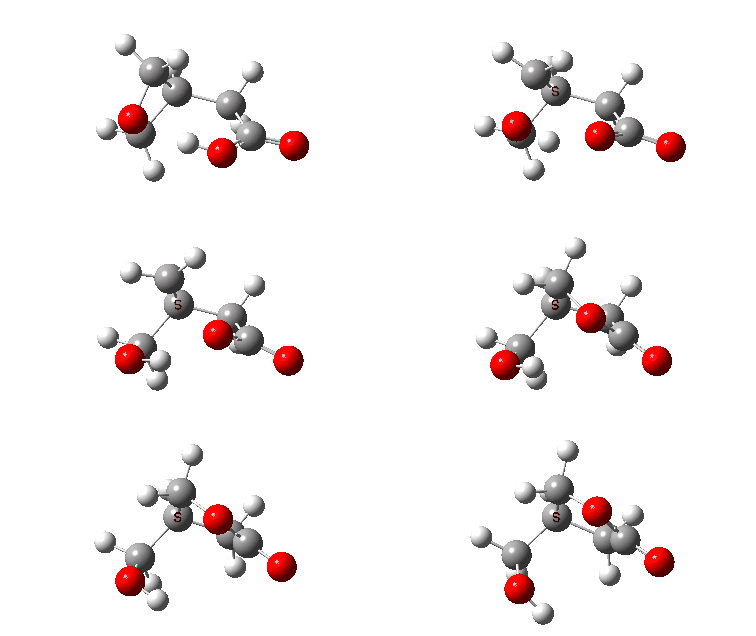
    Previously, I looked at autocatalytic mechanisms where the carboxyl group of an oxetane-carboxylic acid could catalyse its transformation to a lactone, finding that a chain of two such groups were required to achieve the result. Here I look at an alternative mode where the oxetane-carboxylate itself acts as the transfer chain, via a H-bonded dimer shown below.

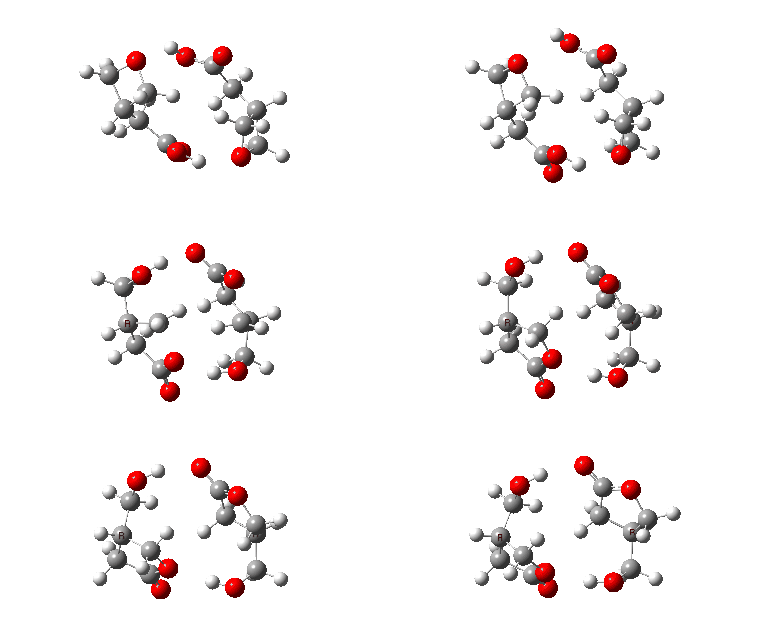
    The IRC energy profile is shown below for a C2-symmetric stationary point in which each molecule catalyses the opening of the other in a concerted manner. The apparent free energy barrier is 72.6 kcal/mol (ωB97XD/Def2-SVPP).

    In fact this is what is called a second order saddle point, having two negative force constants in its calculated diagonalised force constant matrix. To remove the unwanted one, it is necessary to find transition states that accomplish the transfer consecutively rather than concurrently. There are two and their IRC energy profiles are stitched together below. This shows also that the proton transfers (IRC -1, +2) also happen asynchronously.

    This results in a lower barrier (49.0 kcal/mol), but still far higher than the one obtained using a chain of two carboxylic acids. So this particular version of an autocatalytic transform is not in the event viable.


  • Unexpected Isomerization of Oxetane-Carboxylic Acids – substrate design.

    Having established a viable model for the unexpected isomerism of oxetane carboxylic acids to lactones[cite]10.1021/acs.orglett.2c01402[/cite], and taken a look at a variation in the proton transfer catalyst needed to accomplish the transformation, I now investigate the substrate itself.

    R’ is set to have three values, R’=H (the original substituent), R’= CH3 and R’= CF3 (FAIR data DOI: 10.14469/hpc/10820)

    R’ ΔG, kcal/mol
    H 27.0
    CH3 29.1
    CF3 39.6

    The inference is clear-cut; to inhibit the isomerisation to a lactone, CF3 groups substituted onto the methylene groups of the oxetane will effectively do this, with CH3 itself having a much weaker effect.


    DOI: 10.14469/hpc/10861 and 10.14469/hpc/10862


  • Unexpected Isomerization of Oxetane-Carboxylic Acids – catalyst design.

    Previously, a mechanism with a reasonable predicted energy was modelled for the isomerisation of an oxetane carboxylic acid to a lactone by using two further molecules of acid to transfer the proton and in the process encouraging an Sn2 reaction with inversion to open the oxetane ring.

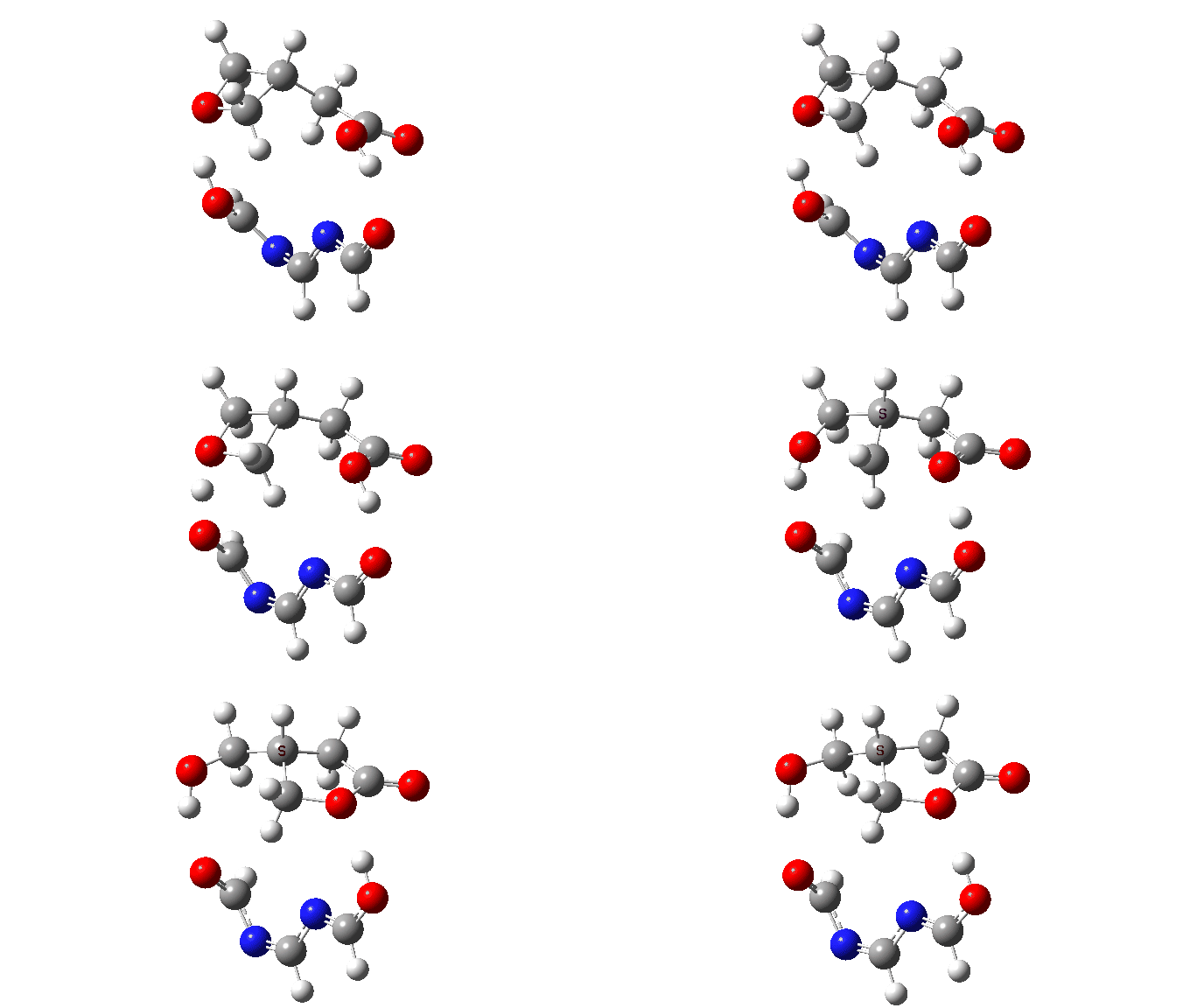
    We are now ready to explore variations to this mechanism to see what happens. The first hypothesis is that of replacing two carboxylic acids with one molecule with similar properties, the argument being that bringing two acids together decreases their entropy and hence increases the free energy required for the process. If they come pre-joined, this entropic problem is eliminated and the free energy should reduce. Shown below is a small conjugated molecule with the central OHO motif replaced by NCN instead.

    The activation free energy (ωB97XF/Def2-TZVPP, FAIR DOI: 10.14469/hpc/10820) is 18.4 kcal/mol, to be compared to 27.0 when using two carboxylic acids for the transfer. Of course, one would need to optimise the catalyst for many properties, including ease of synthesis, stability, size, isomerism etc, but you get the idea from the procedure here.

    The catalyst “designed” here is for proton transfer. One has to wonder whether bespoke catalysts of this type might be useful for any reaction where proton transfer is a vital component!


    DOI: 10.14469/hpc/10858 and 10.14469/hpc/10862


  • Web page decay and Journals: How an interactive “ESI” from 2006 was rescued.

    In 2006[cite]10.1021/ic0519988[/cite] we published an article illustrating various types of pseudorotations in small molecules. It’s been cited 20 times since then, so reasonable interest! We described rotations known as Lever and Turnstile as well as the better known Berry mode. Because the differences between these rotations are quite subtle, we included an interactive electronic supporting information to illustrate them. That ESI was written in HTML and used Jmol to animate the rotations. Now, 16 years is a long time in the Web ecosystem (some early wag suggested, like dogs, that one year in normal time approximates to about 7 years in Web time) and inevitably, like e.g. both Rasmol[cite]10.1039/P29950000007[/cite] and Chime before it, Jmol no longer works when invoked from a Web browser; Java applets are very much dead and we are now on the fourth generation of molecule viewer, JSmol. Two days ago I was contacted by someone (thanks Peter!) who had noticed that the journal landing page did not seem to point to any ESI. Here I tell the story of what happened next.

    Thus the landing page[cite]10.1021/ic0519988[/cite] does not mention any method for accessing any ESI. But since the page is paywalled, you have to login to see more. When you do this, you get a reference to “enhanced objects”, so I should explain what these were.

    The norm nowadays seems to be that ESI is expressed as a PDF file, but that allows interactivity only with extreme difficulty. In 2006, if you wanted this feature, you used HTML. The publisher (ACS) coined the expression of WEO, or Web-enhanced object. We produced perhaps 50 or so of these for various publishers and in those days they were hosted on publishers’ own sites. At some stage since 2006, these pages have been moved and the enhanced object for this article has been (temporarily?) “lost”. It is perhaps easy to understand why, since changes to the publishers publication workflows would need to factor in such pages and probably there were not enough of them to merit inclusion in the workflow.

    So on to 2022, when I was contacted by Peter about this issue. Whenever we submitted such interactive ESI, we always kept a local copy, and indeed this was quickly located at DOI: 10.14469/hpc/10849, now of course allocated its own DOI. By now the ESI had lost its interactivity, but more worryingly, was lacking any error messages. Why? This was the  HTML code then used:

    <applet width="300" name="ClF5-gsA"
     height="250" archive="JmolApplet.jar" code="JmolApplet"
     mayscript="true">
     <param name="progressbar" value="true" />
     <param name="progresscolor" value="blue" />
     <param name="boxmessage"
     value="Downloading JmolApplet.jar" />
     <param name="boxbgcolor" value="black" />
     <param name="boxfgcolor" value="white" />
     <param name="load" value="ClF5-gsAC2vpTZ.mol" />
     <param name="script"
     value="select all; labels off; spacefill 0.25; 
     wireframe 0.1; center atomno=2" />
     </applet>

    In modern web browsers this is simply ignored. So the solution is to rewrite this code into modern syntax, and for this I turned to a long time hero and expert, Angel, who is one of the active maintainers of JSmol, the successor to  Jmol.  A few hours later a conversion script came back. It is just 55 lines long!  It is invoked in the header of the HTML document as: 

    <script type="text/javascript" src="JSmol.min.js"></script>
    <script type="text/javascript" src="convertJmolApplets.js"></script>

    and hey presto, all works as originally. I transclude a small snippet here to give a flavour, although the original is formatted for wide pages, so go see all the ESI there.

    So what is the take home message? Well, it turns out that the Java/Jmol syntax developed for the Web more than 20 years ago has actually proved pretty resilient. And so pages where technology has overtaken them can sometimes be quite easily rescued and restored back to life. A number of those WEOs from the early naughties have indeed been rescued by expedients such as described above. And perhaps in 10 years time when Javascript and JSmol have themselves moved on, further rescues will be needed. But had I been asked back in 2006 or earlier whether I expected those interactive ESI pages to still be working 16+ years later, I may well have replied that it seemed unlikely. So it is a very pleasant surprise to find that they (now) are. All we need is for the journal itself to point to a working version; for that, keep your eyes peeled.

    On a more general point, a history of “ESI” as used in chemistry would be an interesting topic. Although generally thought of as having its roots around 1996, it may well go back further. Any historians around?


    Available at https://wiki.jmol.org/index.php/Jmol_JavaScript_Object/Legacy and 10.14469/hpc/10852


  • Unexpected Isomerization of Oxetane-Carboxylic Acids – a viable mechanism

    In the previous post, I looked at the intramolecular rearrangement of the oxetane carboxylic acid to a lactone, finding the barrier to the Sn2 reaction with retention was unfeasibly high. Here I explore alternatives.

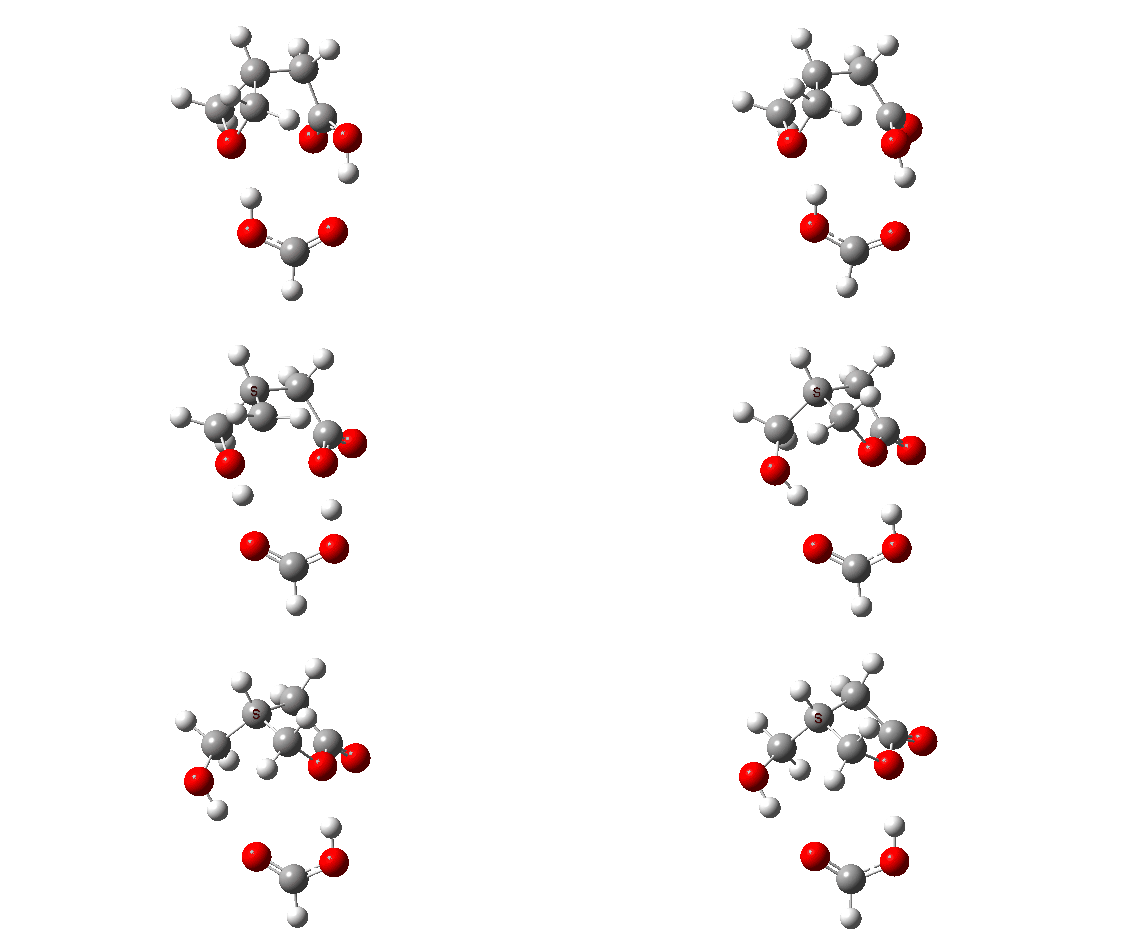
    1. This first attempt uses a second molecule of a carboxylic acid (modelled as formic acid for simplicity) to see if it can catalyse the reaction. All FAIR data at 10.14469/hpc/10820

      The reaction still occurs with retention at the Sn2 centre, and the free energy barrier is 47.9 kcal/mol (ωB97XD/Def2-TZVPP), very little different from the unimolecular reaction without additional acid (49.9 kcal/mol).
    2. How about inversion at the Sn2 centre? The energy profile now looks quite wrong, because the additional acid is too small to simultaneously straddle the entire molecule from the point of proton removal to the point of reprotonation, if inversion occurs at the Sn2 centre. The reaction ends up (or starts, depending on your point of view) with a proton in the wrong place!

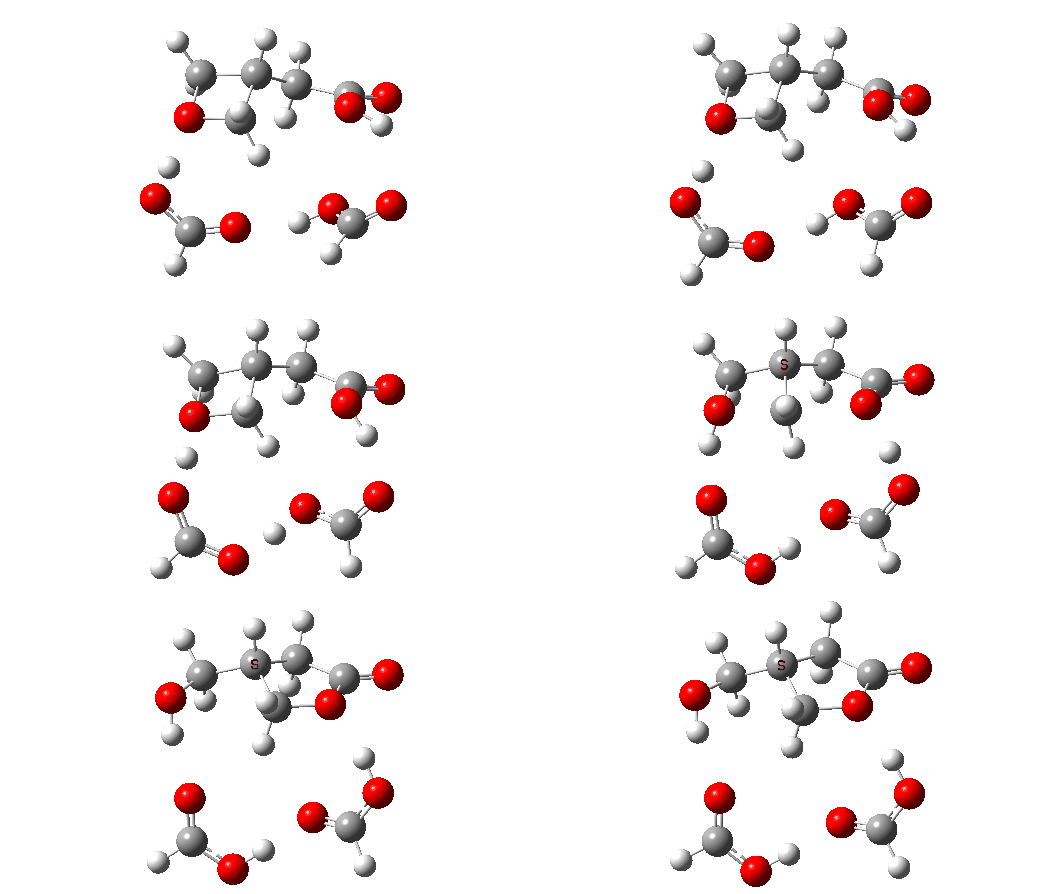
    3. So the need to make the proton transfer agent larger, by now including TWO additional carboxylic acids.


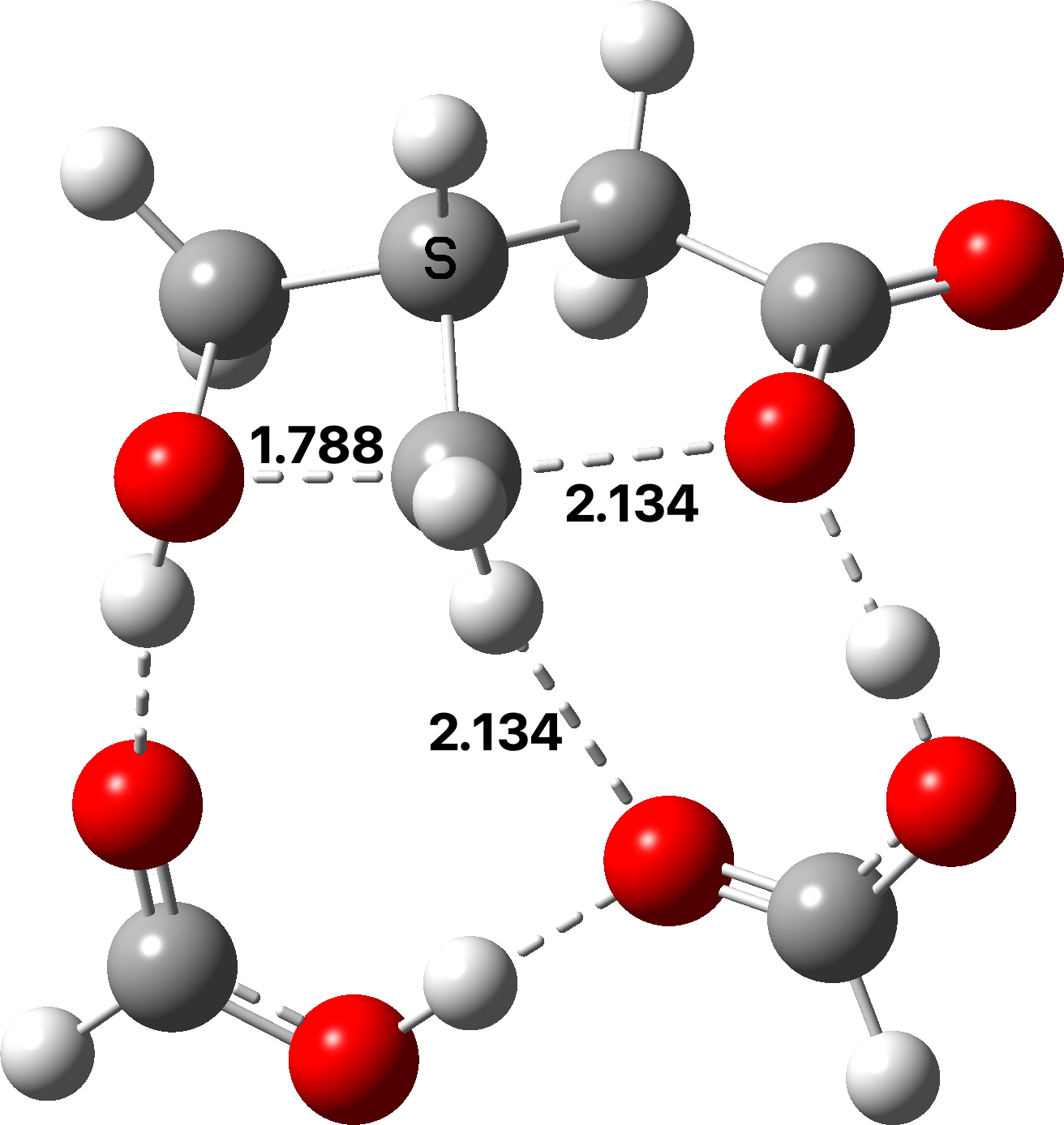
      There are now three proton transfers, one at each end of the oxetane-carboxylate and the product lactone and one between the two transfer acids. Watch the animation carefully to note the sequence in which they occur. The free energy barrier is now 27.0 kcal/mol for a standard state of 1 atm (ωB97XD/Def2-TZVPP). This could be reduced (3.2 kcal/mol or more) for the higher effective molar concentrations in the liquid or solid state of the pure oxetane.
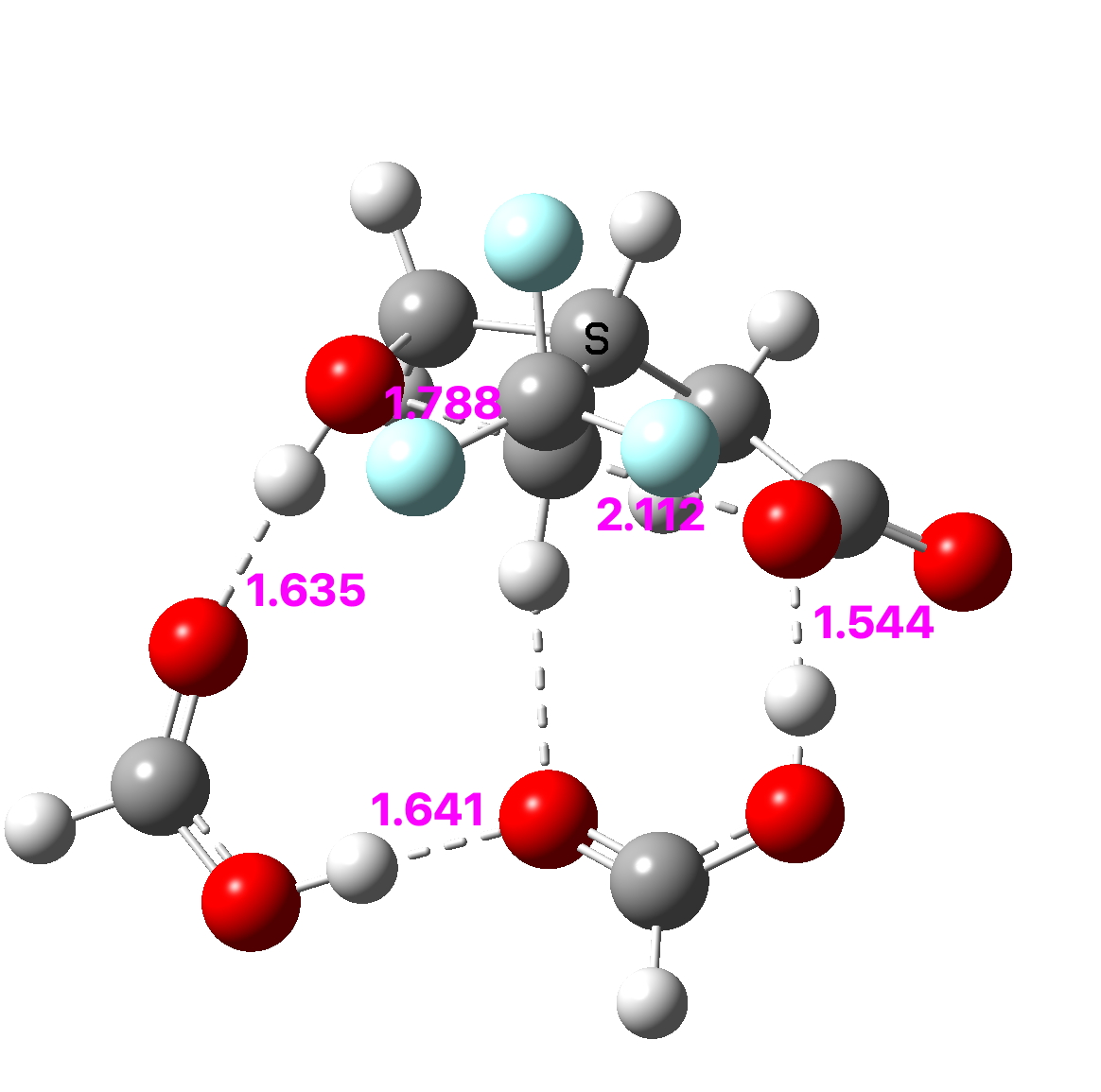
    4. The structure of this transition state (click image below to view 3D model) shows one interesting point of CH…O interaction between transfer catalyst and substrate.

    The next steps will be to explore the impact of making substitutions in the oxetane ring; there now seems to be a viable model to use for this purpose.


    DOI 10.14469/hpc/10848 and 10.14469/hpc/10862


  • Unexpected Isomerization of Oxetane-Carboxylic Acids – a first look at the mechanism

    Derek Lowe’s blog has a recent post entitled A Downside to Oxetane Acids which picks up on a recent article[cite]10.1021/acs.orglett.2c01402[/cite] describing how these acids are unexpectedly unstable, isomerising to a lactone at a significant rate without the apparent need for any catalyst. This is important because these types of compound occur frequently in the medicinal chemistry literature.

    The isomerism is reported to occur quite slowly but significantly in the pure substance, being complete in around a year. Any uncatalysed mechanism must comprise a proton transfer to the oxygen of the oxetane followed by an Sn2 displacement at the methylene group in the protonated oxetane. This could be stepwise or concerted (the latter shown with arrows above). To determine the answer, an ωB97XD/Def2-TZVPP/SCRF=chloroform calculation was performed (FAIR data DOI: 10.14469/hpc/10820) which clearly shows a concerted reaction, albeit one in which a proton transfer (IRC ~-1.5) preceeds the Sn2 displacement with retention of configuration! The transition state appears to have no biradical character. The activation free energy is ΔG 49.9 kcal/mol and the reaction is clearly exoenergic.


    The dipole moment response shows that the proton transfer induces a larger dipole moment, which then reduces as the Sn2 reaction occurs.

    The calculated free energy barrier of ~50 kcal/mol is ~15-20 kcal/mol too high to occur thermally and so the observed reaction either occurs via a different mechanism, perhaps bimolecular in which one molecule of the oxetane-carboxylic acid acts as a catalyst for a second molecule to rearrange, or one in which a stronger external acid catalyst operates, such as traces of other acid in the system. Exploring the sensitivity to substituents on the oxetane ring (CH3, CF3, etc) might also cast light on the mechanism, as might testing the stereochemistry of the two carbons next to the oxygen of the oxetane; do they retain, invert or scramble the configuration at these two centres?


    DOI: 10.14469/hpc/10863 and 10.14469/hpc/10862