Author: Henry Rzepa

  • Improving the Science blog – The Rogue Scholar service.

    Some 13 years ago, I speculated about the longevity of the type of science communication then (and still now) represented by Blogs. I noted one new project called ArchivePress that was looking into providing solutions equivalent to what scientific journals have done for some 350 years of science communication. The link to ArchivePress no longer works, but details of the project can still be found here. Since then the technology and infrastructure has moved on, with a new backbone provided by the use of persistent identifiers (PIDs) in the form of DOIs. The PID ecosystem is now extensive and so a revival of the concept has recently been launched called The Rogue Scholar. Here I take a look at some of is features and illustrate these with application to this blog.

    To quote its aims “The Rogue Scholar improves your science blog in important ways, including full-text search, long-term archiving, DOIs and metadata”. Lets take these four ways and compare them with how scientific journals function.

    1. Full text search. The traditional journal is full-text indexed by its publisher, but of course there are many science publishers out there and they focus on indexing only their own journals. There are an estimated 30,000+ science journals, covered by commercial abstracting agencies such as SciFinder. A search engine that aggregates full text searches across (most?) journals is Google of course. Type a full text search string, enclosing it in quotes to get a literal search of the entire string, and you are quite likely to find the journal article. Try this for yourself and report back if it does not work. If you try scholar.google.com instead, it will not work (even using the Advanced search/Exact phrase constraint). Try then some text from a blog and again with scholar.google.com it will not work but with Google it does (I have not tried other search engines).

        • Now try eg the blog search using RogueScholar and you get the successful result shown below.
        • Full “advanced mode” searching is of course second nature to chemists, who apply a variety of fielded or constrained searches are part of their regular routine (including eg chemical substructure searching), but you often need specialist abstracting and indexing agencies such as Scifinder for this. But RogueScholar will offer constrained searches I understand at some stage, based on “metadata” and so I will take this topic next.
    2. MetaData and DOIs. When a journal article is published, part of the process is to gather metadata about the article and submit it to a metadata aggregating agency such as CrossRef. In exchange, the latter offer a DOI which functions as a unique and persistent identifier for that article. The metadata terms can be used in a constrained search with CrossRef, and with DataCite for FAIR data. RogueScholar does exactly the same, it gathers metadata from a registered blog post, including ORCID identifiers associated with the post, registers it and enables searching. Try e.g. 0000-0003-3315-3524 as a search term and see what you get. This also works for DOIs (try 10.59350/65c45-3ew97 as a search term). So here too, we can see parity emerging with conventional journal publishing.
    3. The final component is long-term archiving. Again journals have been doing this for a long time (on paper) and in the last 30 years or so in digital form. Blogs have until now lacked this and here again RogueScholar is promising such long term archiving in its next iteration.
      • This actually raises one interesting, albeit difficult, aspect of blogs – one however that may in fact be somewhat unique to this particular blog. The topic of my very first post here back in 2008 was how interactive 3D molecular models could be included in the post itself to help the reader explore the chemical points I was trying to make. Back then I regarded it as something that could not be so easily done as part of journal articles[cite]10.1080/13614579509516846[/cite] (although you do see it nowadays), but that feature certainly presents a challenge to long term archival! I do not see a solution for this one on the horizon.

    Rogue Scholar is still a very young service, and no doubt will evolve rapidly from this point, so I may revisit in say six months time to see how it has come along. Meanwhile, try it out and see what you think. And because science blogs can now be assigned a DOI on the same level as journal articles, they too can join the so-called universe of “Knowledge or PID graphs“[cite]10.1016/j.patter.2020.100180[/cite].


    For example “In 2022, bicyclo[3.1.1]heptanes were proposed to mimic the fragment of meta-substituted benzenes in biologically active compounds
    The schematic representation of a chemical reaction mechanism is often drawn using a palette of arrows connecting or annotating the various molecular structures involved. These can be selected from a chemical arrows palette, taken for this purpose from the commonly used structure drawing program Chemdraw.”


    This post has DOI: 10.59350/8m2d8-47b52

  • The “double-headed” curly arrow as used in mechanistic representations.

    The schematic representation of a chemical reaction mechanism is often drawn using a palette of arrows connecting or annotating the various molecular structures involved. These can be selected from a chemical arrows palette, taken for this purpose from the commonly used structure drawing program Chemdraw. Explanations of how to apply the individual arrows are not always easy to find however! Circled in red are the ones to be discussed here, although most carry fascinating and often subtle meanings!

    The most common meaning of the double-headed arrow is probably best illustrated by the scheme below, which involves the addition of a nucleophile to a carbonyl compound, forming a presumed “tetrahedral” intermediate, which is then immediately followed by the eviction of a leaving group – the chloride anion in the example below. The two red arrows show an electron pair firstly moving to the oxygen, and then with the reverse arrow 2 back to reform the carbonyl group. This process is called an addition/elimination mechanism. It is therefore tempting to conflate the two steps into one by instead using a double-headed arrow (3, blue), which if nothing else, saves a little bit of time in the drawing – a useful examination technique!

    Of course, the top scheme (red arrows) is a two-step process, involving a discrete (tetrahedral) intermediate and two transition states. The conflated scheme below it (blue arrows)  might imply (or not) a single-step process with a single transition state. Since few people who draw such schemes have any information on whether it is a two-step or a single step process, the actual chemical meaning of the double-headed arrow is left implicitly ambiguous, without implying anything about how many discrete steps are involved. However, it is tempting to conclude that the first red arrow (1) reduces the double bond order of the carbonyl group to a single bond, which might therefore be expected to lengthen and the second red arrow (2) reforms the double bond, thus shortening the bond. The two arrows clearly do not move simultaneously. The conflated third arrow (3) leaves the status of the carbonyl bond length changes undefined, or might it mean that it first gets longer and then shorter along the reaction path, depending of course on which moves first!

    Enter computation, where the energy pathway of such a reaction can be computed, along with geometries at each stage. Here I explore three examples to see what results (ωB97XD/De2-TZVPP/SCRF=DCM), FAIR DOI: 10.14469/hpc/13171

    Acetyl chloride + Methanol.

    This uses a model in which a proton transfer from the methanol to the chloride anion is facilitated by water. This enables (but does not enforce) a continuous concerted process to occur. This emerges from the computed intrinsic reaction coordinate (IRC) as having a low barrier and an exothermic reaction, which agrees with experimental observation. The required proton transfer is part of the concerted process, albeit occurring in a second lower energy stage (IRC ~+1.5).

    But take a look at how the carbonyl bond length changes along this IRC. It first shortens, and only starts to lengthen as the chloride is evicted. So the carbonyl group actually contracts in length at the transition state, the opposite of what might be inferred by using a double-headed arrow.


    Also included is the dipole moment response, which does seem to correspond to the formation of an ionic intermediate!

    Acetyl chloride + HF.


    Hydrogen fluoride as a nucleophile replacing methanol shows a much higher barrier, since it is less good as a nucleophile in this context.

    Again, observe the bond length response of the carbonyl group, which is at its shortest at the (single step) transition state.

    This corresponds to a different interpretation of the double-headed arrow, as per below, but occuring as part of a single concerted process not involving any intermediate.

    The dipole moment response is rather different from methanol.

    Acetyl chloride + Methylamine.

    The energy profile now shows two distinct transition states (IRC ~7 and again at 0.0). The first is a very low energy addition to the carbonyl group with concerted eviction of the chloride anion, which only hydrogen bonds to the water shown. The second stage is the proton transfer from the nitrogen to the water and thence relayed to the chloride anion, for which a transition state at IRC ~0.0 is found.

    But now observe the bond length response, which shows a distinct maximum around the first transition state (IRC ~7). This is the opposite behaviour to the previous two systems, and now indeed matches the original inferences one might make from the double headed arrow.

    So we can conclude that there are in fact TWO types of double-headed arrow which could be used in mechanistic representations. The first is when arrow 1 is ahead of arrow 2 (red), resulting in initial weakening of the carbonyl bond. The second is when arrow 4 is ahead of arrow 5, resulting in initial strengthening of the carbonyl bond.

    Perhaps to avoid confusion, we really need two different representations of a double-headed arrow to clearly differentiate them! Perhaps a reversal of the direction of the arrowhead? But that does not (yet?) exist in the Chemdraw palette.


    This is part of the arcane “knowledge” of chemistry which is often absorbed rather than learnt by students of the subject, but which as a result becomes a language that becomes inscrutable to anyone else! Another example was noted in the previous post.

  • Pre-mechanism for the Swern Oxidation: formation of chlorodimethylsulfonium chloride.

    The Swern oxidation[cite]10.1016/0040-4020(78)80197-5[/cite] is a class of “activated” dimethyl sulfoxide (DMSO) reaction in which the active species is a chlorodimethylsulfonium chloride salt. The mechanism of this transformation as shown in e.g. Wikipedia is illustrated below. However, an interesting and important aspect of chemistry is not apparent in this schematic mechanism and to rectify this, a full computed mechanism is laid out below, for which the FAIR data has a DOI: 10.14469/hpc/13151

    The first step involves attack of the oxygen of the DMSO on one carbon of the oxalyl chloride, which can be considered as an addition/elimination substitution at the carbon. The departing chloride anion ends up loosely associated with the sulfur centre. The net result is that the trigonal bipyramidal sulfur is axially coordinated by the chlorine, but equatorially coordinated by the oxygen. The transition state for this step (TS1), shown at IRC = 0.0 in the above energy profile, has a relatively low activation barrier. Click on any animation to view 3D model.

    TS1

    TS1

    The key step is what is called a pseudorotation at the sulfur centre (TS2), which transforms the ax/eq relationship of the Cl/O atoms at the sulfur into an ax/ax one (TS at IRC +8.5 above). This is the energy high point along the reaction path. Note also the large increase in dipole moment, indicating ionic character, along the path involving TS1 and TS2.

    TS2
    TS2

    The S-O bond length response during this transformation is shown below. As the chlorine moves into this di-axial relationship, the S-O bond begins to weaken, from 1.635Å at the start, 1.675Å at the TS and 2.242Å at the end (Def2-TZVPP basis set).

    This prepares the system for the final step (TS3), which is cleavage of the already weakened S-O bond (TS at IRC = 13.0 below, TS = 0.0 being the pseudorotation), accompanied by extrusion of CO, CO2 and Cl. The liberated “ionic” chloride anion ends up loosely associated with the sulfur (2.88Å), whilst the “covalent” chlorine which had helped to evict the oxygen is 2.06Å.


    TS3

    So to conclude, the mechanism of the formation of chlorodimethylsulfonium chloride is perhaps better illustrated as shown below involving the extra pseudorotation step, which as it happens is actually the rate determining step for this reaction. This pre-mechanism to the Swern oxidation is given little attention in most representations, such as the one at Wikipedia. But it actually contains a multitude of interesting (stereoelectronic) effects and is well worth teaching!


    Well, not quite. The Wiki version does not show the eliminating chloride anion in the first step (which is implied). The resulting curly arrows in the Wikipedia version are unbalanced and hence not formally correct! The double-headed arrow included in the representation above indicates an addition/elimination mechanism, which can be tracked by monitoring the carbonyl C=O bond length (@Def2-TZVPP). It starts at 1.181Å, reaches a maximum of 1.194Å just after the TS and then drops back to 1.186Å at the end as the chloride anion eliminates.


    Citing this blog post: DOI 10.14469/hpc/13156


  • Blue blood.

    Respiratory pigments are metalloproteins that transport O2, the best known being the bright red/crimson coloured hemoglobin in human blood. The colour derives from Fe2+ at the core of a tetraporphyrin ring. But less well known is blue blood, and here the colour derives from an oxyhemocyanin unit based on Cu1+ (the de-oxy form is colourless) rather than iron. See below for the carapace of a red rock crab.

    Here I take a look at this very unusual structure, the core of which is an imidazole ring coordinated via nitrogen to the metal Cu.
    A search of the crystal structure database for the following sub-structure reveals 12 hits, with a range of O-O distances ranging from 1.37 to 1.54Å. A histogram of the O-O lengths in the Cu(O-O)Cu sub structure shown below shows quite a distribution amongst the 12 known examples.

    Of these, one (UTETEU[cite]10.1039/D2FD00162D[/cite], DOI: [cite]10.5517/ccdc.csd.cc1l9d7j[/cite]) is perhaps the closest to the oxyhemocyanin core, albeit with the imidazole heterocycle replaced by the isomeric pyrazole ring (no Ag or Au examples are known). The overall 2+ charge deriving from two Cu1+ units is internally balanced with two 4-coordinate B1- end caps, and this system was chosen as the starting model for some computational studies.[cite]10.1021/ja00030a025 [/cite]

    Firstly, the crystal structure reveals an O-O distance of 1.531Å; the O=O distance (from crystal structures where it is present) is ~1.24Å (DOI: 10.5517/cct597h) for neutral (triplet?) oxygen, ~1.50Å for the dianion O22- and 1.32Å for the monoanion O21-[cite]10.1039/A800952J[/cite].

    Computational models were constructed at the ωB97XD/Def2-SVPP level, FAIR Data DOI: 10.14469/hpc/12584.

    The computed O-O distance for a singlet state of the complex is shorter than that measured in the crystal structure (1.368 vs 1.531Å). At the better Def2-TZVPP basis set level, the O-O bond length is 1.379Å, still shorter. A model of singlet state oxyhemocyanin itself (Def2-TZVPP) as a di-cation (these charges are balanced by carboxylate anions from the surrounding protein) shows a very similar O-O bond length (1.361Å).

    How about the oxyhemocyanin as a triplet state, the same state of isolated oxygen itself? Oxyhemocyanin now has a O-O distance of 1.477Å (Def2-TZVPP) and a Cu-O distance of 1.972 (1.934 from crystal structure of UTETEU). The UTETEU analogue has a calculated distance of 1.483Å (crystal structure 1.531Å), which strongly suggests that this system exists as a triplet rather than as a singlet spin state (click on image below to view as a 3D model).

    The spin density in UTETEU is shown above, which indicates that the two unpaired electrons are delocalised on Cu, nitrogen and O atoms, compared to only the oxygen in O2 itself.

    So we may conclude from this brief investigation into the structures of this component of “blue blood” captures oxygen as a sandwich between two copper atoms (a mode very unlike the iron equivalent in hemoglobin), and moreover that the spin state in this capture retains the triplet motif of gaseous oxygen itself, whilst the spin density of the unpaired electrons is delocalised over both copper, nitrogen and oxygen.


    This post has DOI: 10.14469/hpc/13111


  • Physical Sample identifiers – the future?

    I have variously talked about persistent identifiers on this blog. These largely take the form of DOIs (Digital object identifiers), and here they relate to either journal articles or datasets associated with either the article or the blog post or both. Other disciplines, particularly the earth sciences, have long used persistent identifiers (PIDs) to identify physical objects rather than digital ones. One of my ambitions is to assign such identifiers to a small but highly historical collection of physical objects in my possession, as described at this post. As a prelude to this project, here I describe some ways of searching for physical objects that have been assigned a PID. Thanks Rorie for providing these! 

    1. Here is a general search for physical objects with associated metadata describing them as registered with DataCite. https://commons.datacite.org/doi.org?query=types.resourceTypeGeneral:PhysicalObject (11,269,090 items)
    2. The search can be slightly constrained to find only identifiers that originate from the earlier IGSN ID (International generic sample number) see here for details and https://www.igsn.org/about/ for the organisation set up) using the syntax query=client.client_type:igsnCatalog types.resourceTypeGeneral:PhysicalObject (9,642,030 items)

    The exciting prospect is that in due time, such searches could be constrained by adding specifically chemical properties, most obviously eg an InChI identifier. At the moment, it is unlikely any existing samples have even been registered with such a term.

    1. Thus combining two queries would give the following:
      query=client.client_type:igsnCatalog types.resourceTypeGeneral:PhysicalObject+AND+subjects.subjectScheme:inchikey+AND+subjects.subject:*
    2. Removing the PhysicalObject constrain gives a different response:
      query=(subjects.subjectScheme:inchikey+AND+subjects.subject:*+OR+subjects.subjectScheme:inchi+AND+subjects.subject:*)

     When this becomes possible, (see project above!), it would enable for example journal articles (or the FAIR data associated with them) to reference information about a physical sample associated with eg the preparation of a molecule new to science.

  • Diberyllocene — and Lithioborocene?

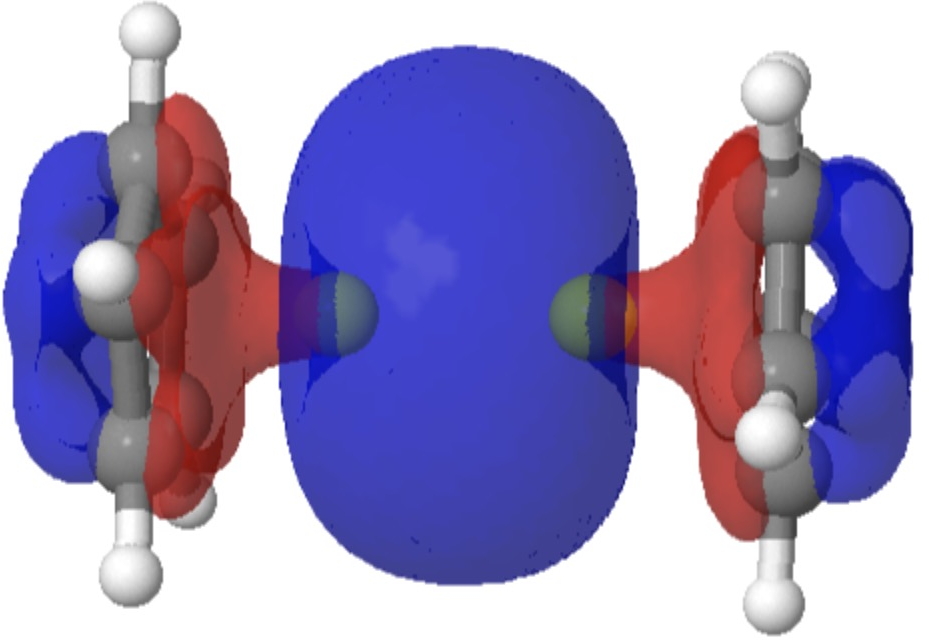
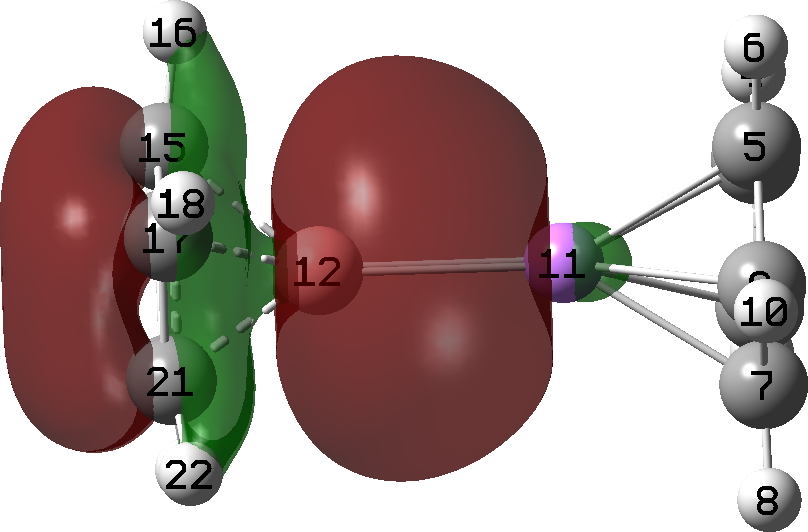
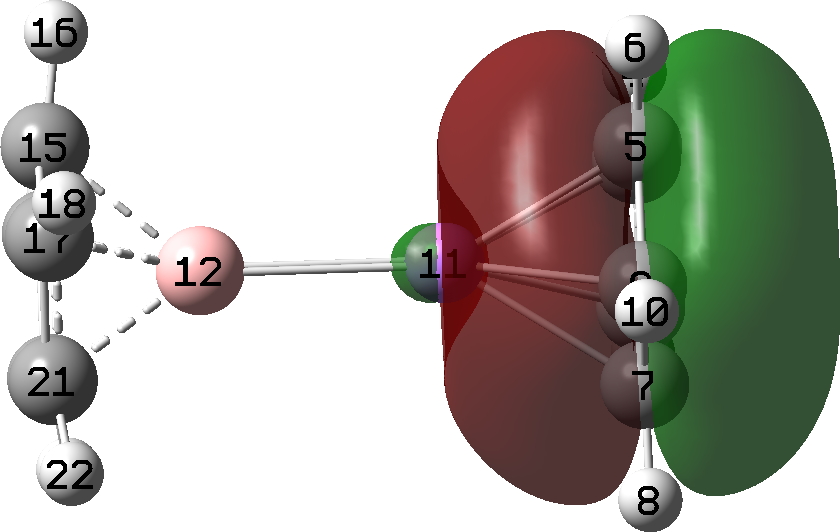
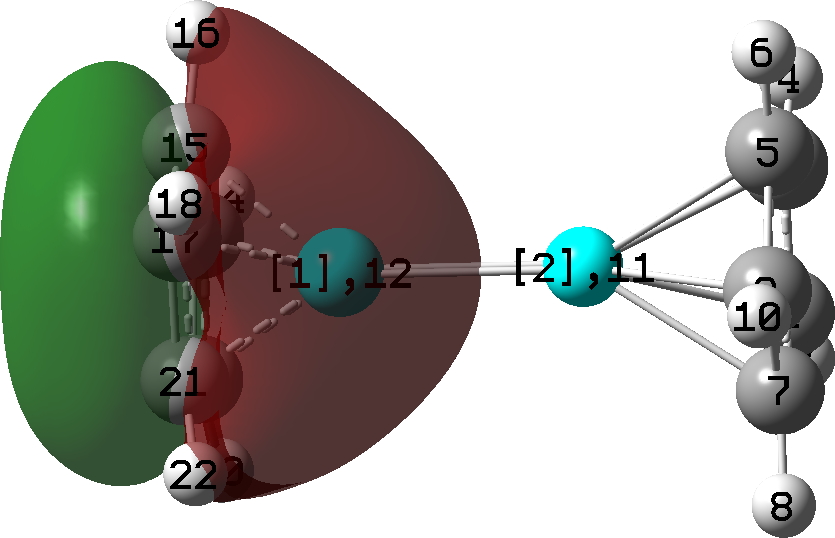
    Sometimes, the properties of a molecule are predicted long before it is synthesised. One such is diberyllocene. I first encountered a related molecule, beryllocene itself, many moons ago.[cite]10.1021/ja00471a020[/cite] This was unusual because unlike the original metallocenes, the metal atom was not symmetrically disposed between the two cyclopentadienyl faces. Now diberyllocene is finally reported in which replacing one Be by Be-Be induces (according to calculation, D2) symmetry[cite]10.1126/science.adh4419[/cite]. I will not repeat the excellent analysis of the wavefunction reported in this article, but confine myself to showing two molecular orbitals which examplify its bonding.

    Highest occupied molecular orbital
    Lowest occupied π-molecular orbital

    The HOMO (FAIR data[cite]10.14469/hpc/12702[/cite]) essentially shows a Be-Be single bond, originating formally from the central Be22+ dication, balanced by the two cyclopentadienyl anion ligands. Click on the images to see this orbital in  3D.

    Oddly, an excited state of Be2 on its own actually carries a Be=Be double bond, a property again predicted a long time ago by theory. The most stable π-MO in diberyllocene originates in the six electron aromatic cyclopentadienyl rings. By acquiring a share of six electrons from one Cp ring, and a share of the two electrons from the Be-Be bond, each Be atom achieves the octet of electrons known by generations of students. This is the sort of molecule that could be taught in schools at an early stage to illustrate the octet rule. And its good to know that simple new molecules illustrating this are still being discovered by chemists.


    Since this started with experimental realisation of a predicted molecule, can I suggest as a new prediction, lithioborocene,[cite]10.14469/hpc/12703[/cite] in which a B and an Li isoelectronically replace two Be atoms? Individually, lithiocenes, boracenes and Li-B bonds are known from crystal structures. So it’s not a way out prediction to combine these observations. Any friendly synthetic chemist up for the challenge?


    This post has DOI: [cite]10.59350/v1cma-xjk91[/cite]

  • The Pinacol rearrangement.

    This is a venerable organic reaction, which curiously I have not previously covered here. First described in 1859, its nature was only properly elucidated in 1873. It is a member of a class of reaction I have previously named “solvolytically assisted pericyclic”, or “perisolvolytic“. Here I explore some of the subtle stereoelectronic effects observed for this apparently simple reaction.

    It applies to a class of molecule known as 1,2-diols. Protonation is quickly followed by migration of a (in this example) methyl group, followed by deprotonation of the carbonyl group formed by this process. There are two mechanistic stages, the first being the departure of the now protonated “ol” unit, and the second the migration of the methyl. In most text books and of course Wikipedia, these are shown as very distinct steps. But they could also occur in one concerted step, albeit probably asynchronously.

    A B3LYP+GD3+BJ/Def2-TZVPP/SCRF=ethanol calculation provides mechanistic detail (FAIR Data 10.14469/hpc/1769)

    1. To start with, we note the H-bond formed between O22-H21. Between IRC = -10 and -6, this lengthens from 1.625Å to 1.843Å, destabilising the protonated alcohol group.
    2. Between IRC -6 to -1, the C1-O19 bond breaks, from a starting length of 1.556Å to ~2.787Å.
    3. When IRC 0.0 is reached (the transition state), the C11 methyl starts to migrate across, a process mostly complete by IRC +2. 
    4. The final stage is formation of a weak interaction between C2 and O19 to reach IRC 7.
    5. Several more minor effects can also be discerned. Firstly methyl C3 rotates, to set up a better hyperconjugative interaction with the temporary carbocation forming at C1. This rotamer forms the first of several “hidden intermediates” in the reaction, intermediates which almost form before being consumed, at IRC -6.5 (see the plot above labelled RMS gradient form, for the minimum in the function at this IRC value).
    6. Another hidden intermediate appears at IRC -2, being the transient carbocation, as shown in stepwise versions of this mechanism, such as the Wikipedia page. But its not real, merely hidden! As it approaches, methyl C7 rotates to maximise the hyperconjugative interactions.
    7. At IRC ~+3, methyl C15 rotates to again maximise hyperconjugation with the newly formed C=O bond.

    Ca we quantify some of these effects? This can be done by computing localised orbitals (NBOs) and pairwise interactions between a donor NBO (a bond or a lone pair) and an acceptor NBO (an antibonding orbital). 

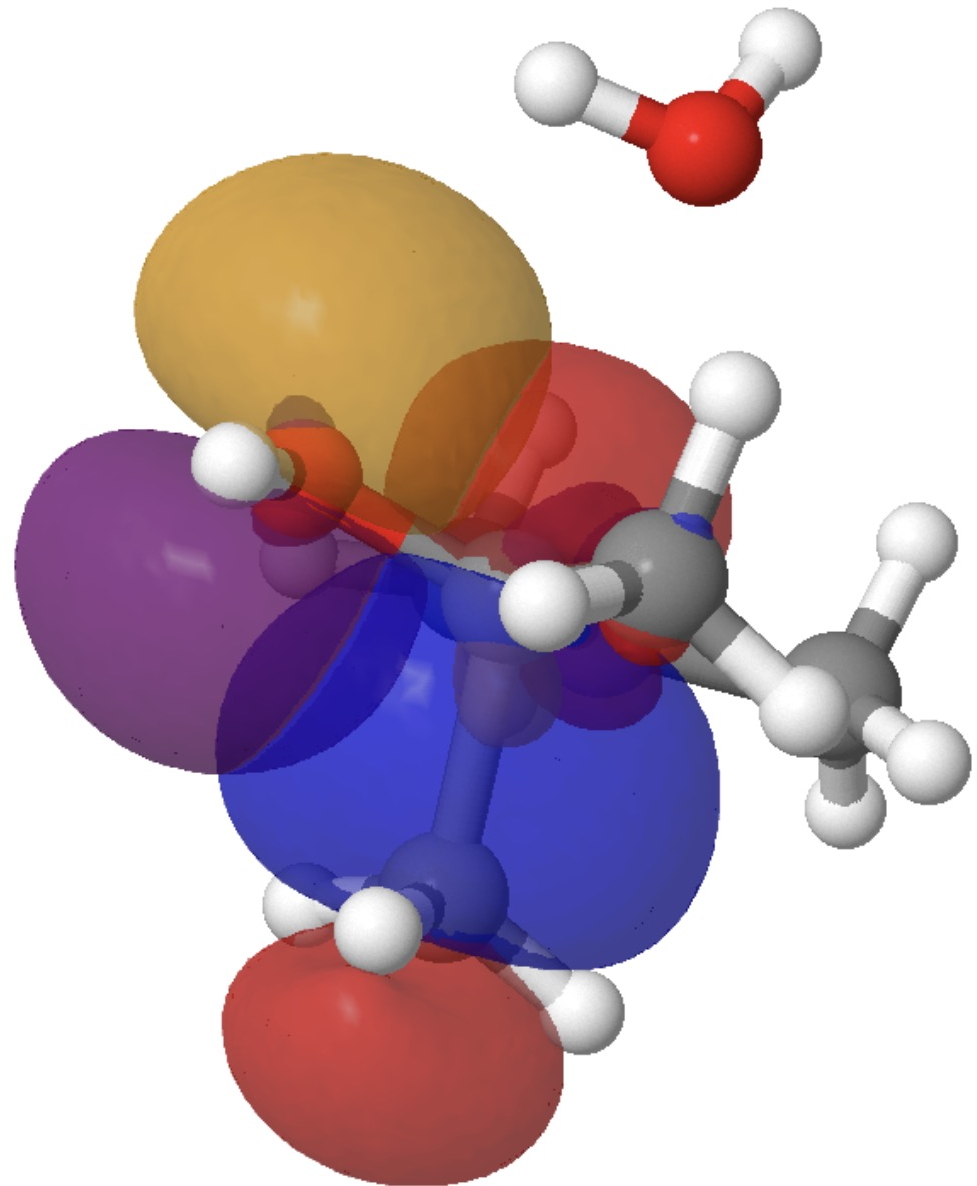
    1. The E(2) interaction between donor bond C2-C11 and acceptor C1-O19 is 3.3 kcal/mol (above the noise, but not especially strong). It corresponds to an antiperiplanar alignment of the C2-C11 σ orbital and the C1-O19 σ* orbitals and results in the breaking of bond C2-C11 (and reformation as C1-C11). 
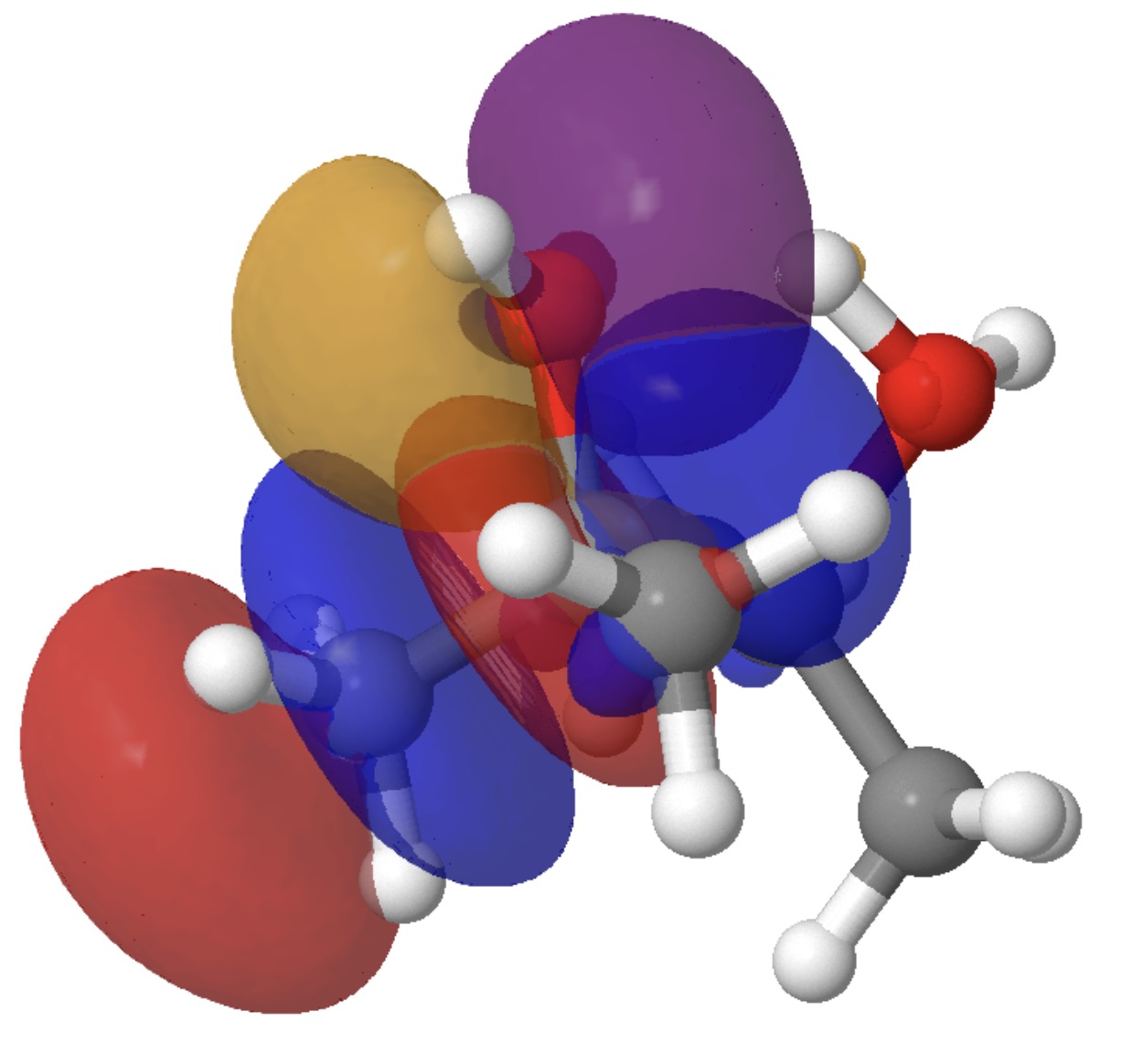
    2. The E(2) value between donor lone pair O22 and acceptor C2-C11 σis 6.9 kcal/mol and corresponds to antiperiplanar alignment of these two orbitals, resulting in formation of the C=O carbonyl π-bond, whilst simultaneously increasing the antibonding character of the C-C bond to encourage it to break.

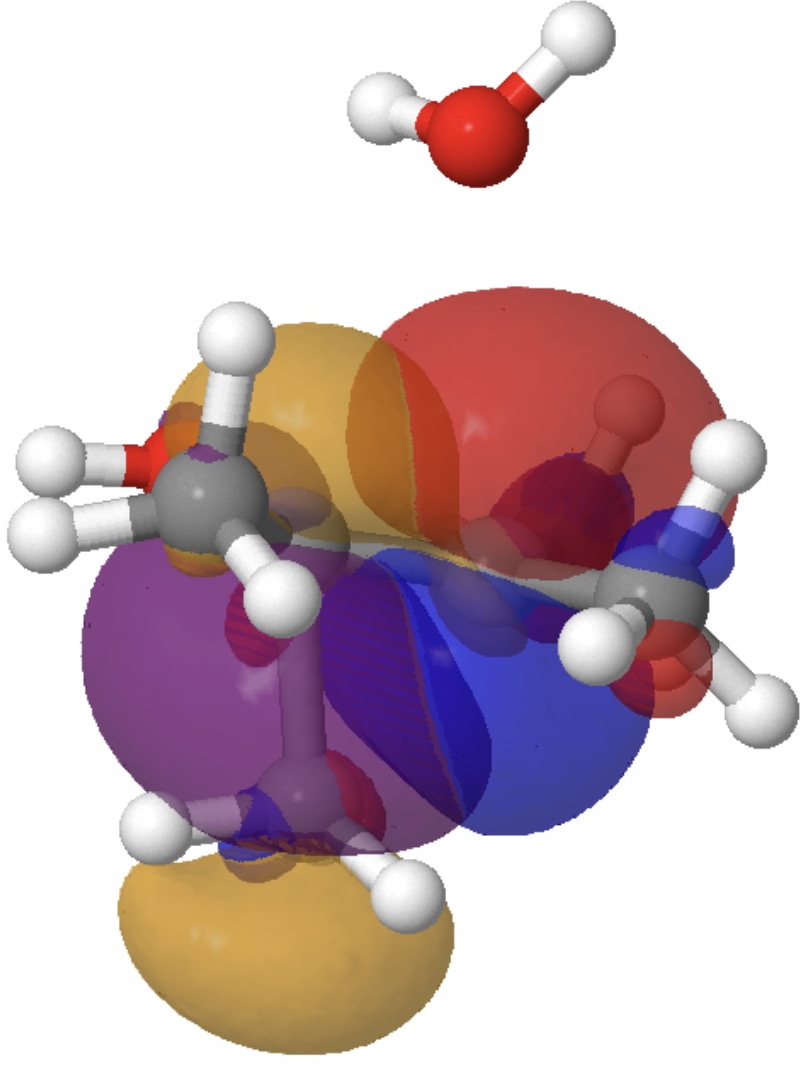
    Models of these two interactions can be seen below. Click on the image to load them. The colour blue overlaps positively with the colour purple, and red with orange.

    By the time the transition state is reached, these two interactions have evolved to the following:

    So this venerable reaction has some nice subtle stereoelectronic behaviour. Those methyl rotations have been skipped over here, but a deeper look into them might also be worthwhile. There is much more to this reaction, but I will leave this analysis here.


    This post has DOI https://doi.org/10.14469/hpc/12684


  • “For chemists, the AI revolution has yet to happen”.

    This editorial from Nature[cite]10.1038/d41586-023-01612-x[/cite] is a timely reminder of the importance of data. But also, not just any data, but “accurate and accessible training data“. Accessible of course is one of the attributes of FAIR (Findable, Accessible, Interoperable and Re-usable). The editorial also states “data need to be recorded in agreed and consistent formats, which they are not at present“. That is covered by the I and R of FAIR, often applied in conjunction with metadata recording the Media type that the data is held in (See DOI https://doi.org/jvk9 for examples of the use of Media types in chemical computation and chemical NMR). Again, “The best possible training sets would also include data on negative outcomes“. This relates to the separation of the two publication processes, namely the article itself (or the story behind the data) and the data itself as a first class scientific object. Thus when we publish FAIR data in association with articles, the data archive will often contain data that is not used in the article itself (perhaps because it led to a negative outcome), but is nevertheless part of the FAIR data collection for that topic. Even if the data does not lead to journal publication, publishing it in a data repository means it will not be lost. Somebody (or AI software) may still find it useful.

    Whilst the acronym AI is increasingly used and hyped up, I would argue that FAIR should accompany the use of the term AI in most cases (as indeed it is at eg.[cite]10.1002/mrc.5186[/cite]). Amongst other benefits, FAIR implies a metadata descriptor record is present, which if richly populated, would help address the “accurate” of “accurate and accessible” by adding context. As we show here[cite]10.1002/mrc.5186[/cite], FAIR is also “AI-Ready“. Indeed an often used alternative expansion of the acronym is “FAIR is AI-Ready”. It is indeed designed to be so if the metadata is sufficiently rich. I also remind that an IUPAC working party is working to produce recommendations to help with this aspect.[cite]10.1515/pac-2021-2009[/cite]

    My final comment adds to the requirement of “accurate and accessible training data“. I would reformulate this as “accurate, accessible and complete training data“. Much data in chemical science is recorded on an instrument, or computed using modelling software. As it emerges from the instrument or the software package, it can be said to be “complete”. Nothing has been thrown away at this stage. But think of eg NMR data. This is acquired as a FID, and then subjected to analysis (A Fourier Transform, after weighting, which does introduce potential artefacts into the data!). It is the latter data type that is invariably published, often in a visual (PDF) form which may lack numerical accuracy and which is machine processable only with difficulty.  Or think of crystallography, where data emerges as diffraction images and is then transformed into structure factors and coordinates. Only the last form is often published (as a CIF file), but the original data is almost never so (see[cite]10.1021/acsomega.7b00482[/cite] for an example where complete crystallographic data is published). Then again, chemical computations. The full record of the computation is often produced as a “checkpoint” or “interoperability format” (see eg DOI: 10.14469/hpc/10043) which contains the computed wavefunction and which can be re-used to compute a wide variety of new properties. But most articles currently record computational data simply as a set of atom coordinates. If you are really lucky, you might get some keywords used to run the calculation. But nothing which would eg allow an AI-algorithm to easily compute a property it might need. We cannot be sure that a machine learning/AI procedure might not benefit from such complete data.

    So, FAIR and AI are conjoined, they each need the other and should not be separated. And to repeat, where data is transformed before being published, please also add the complete dataset, not just any reduced form.


    Post DOI: 10.14469/hpc/12586


  • Tunable aromaticity? An unrecognized new aromatic molecule?

    Some time ago in 2010, I showed a chemical problem I used to set during university entrance interviews. It was all about pattern recognition and how one can develop a hypothesis based on this. In that instance, it involved recognising that a cyclic molecule which appeared to have the cyclohexatriene benzene-aromatic pattern 1 was in fact a trimer of carbon dioxide. Perhaps small amounts of this aromatic molecule exist in solutions of fizzy drinks? Analysing these patterns occupied about 10-20 minutes of an interview, and although you might think I was posing a difficult challenge, many students successfully rose to it! Now I revisit, but with a slightly better reality check on a related molecule 2 (cyanuric acid).

    .

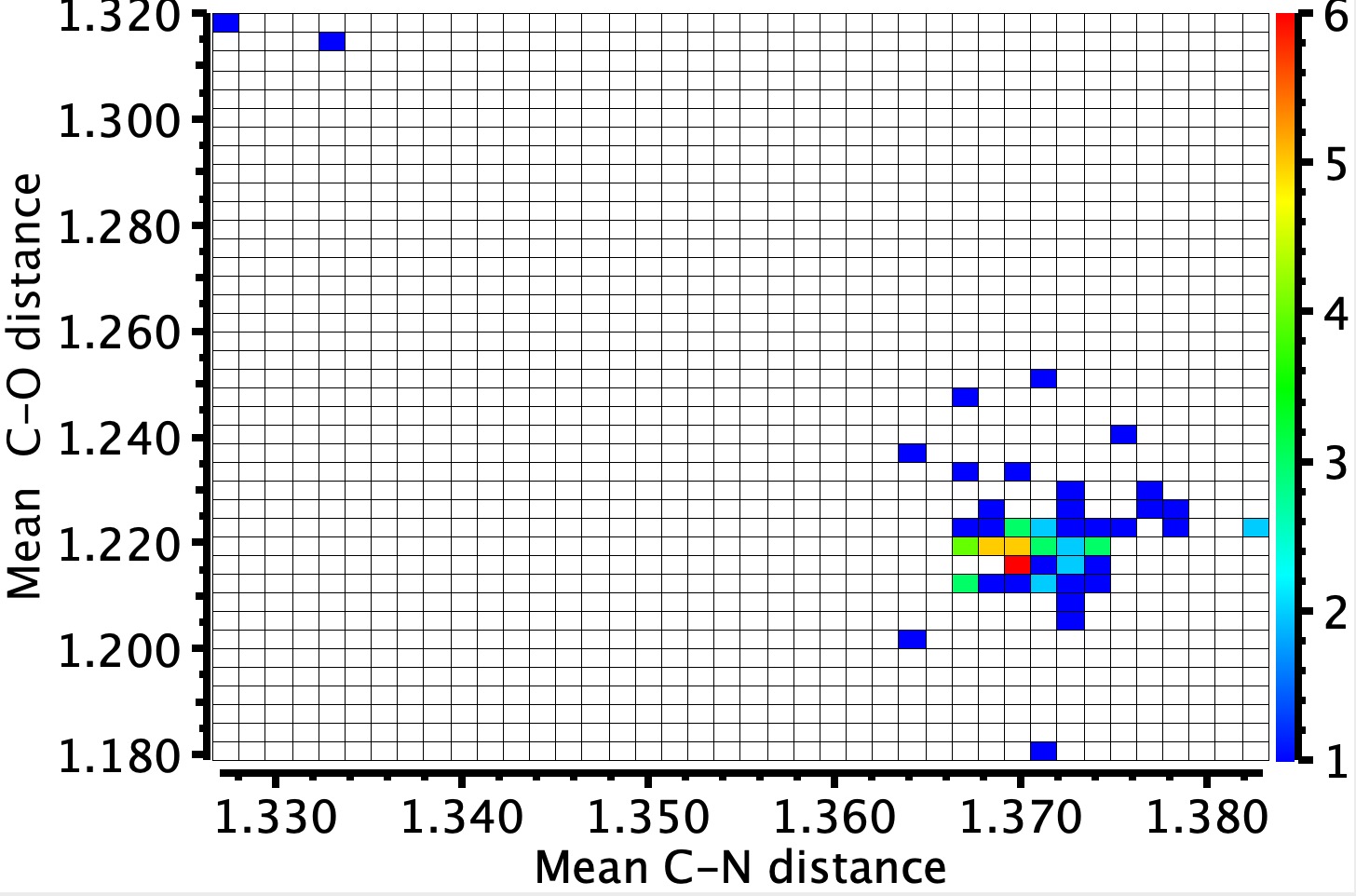
    As many as 58 examples of crystal structures of 1,3,5-triazinane-2,4,6-trione 2 (cyanuric acid) are known, often with a co-adduct. Cyanuric acid is in effect a cyclic trimer of isocyanic acid rather than of carbon dioxide. These examples tend to be planar, with a mean C-N ring distance of ~1.37Å and a C-O distance of 1.22Å. 

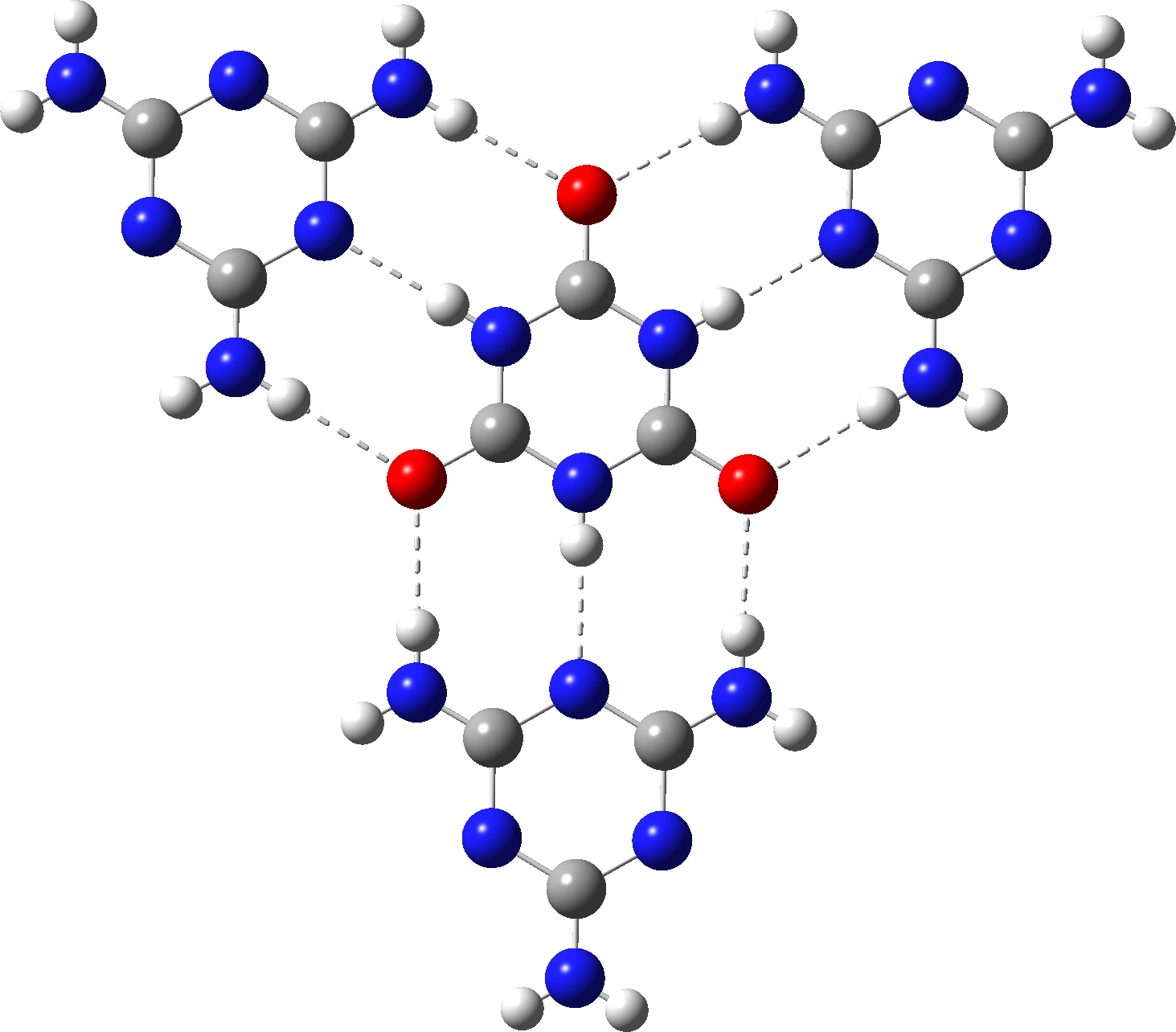
    Two outliers stand out, both from a very recently published article, being a co-adduct with melamine (1,3,5-triazine-2,4,6-triamine).[cite]10.1016/j.apsusc.2022.155161[/cite] QACSUI02 exhibits a shorter C-N distance of ~1.33Å but a longer C-O distances of 1.32Å and have a symmetrical patten of hydrogen bonds to the six receptors of the central unit. Could this correspond more closely to the cyclohexatriene resonance structures shown to the left of the diagram at the top? The first task is to see if these bond lengths can be replicated using calculation (often a useful procedure to check that the crystal structure is correct). For this purpose, the structure below was chosen as the starting point for various models, using an ωB97XD/Def2-TZVPP model.

    Model C-N distance C-O distance
    QACSUI02 (crystal structure) 1.331 1.318
    ωB97XD/Def2-TZVPP as single layer 1.3678 1.2185
    ωB97XD/Def2-TZVPP three layers 1.365 1.218
    ωB97XD/Def2-TZVPP no H-bonds 1.3816 1.2002

    XAKSOU (crystal structure) 1.367 1.208
    ωB97XD/Def2-TZVPP  1.3670 1.2213

    This creates a mystery. The calculated bond lengths show that whilst H-bonding to the central ring decreases the C-N length by 0.014Å and increases the C-O length by 0.017Å, this effect is nowhere near large enough to match the apparent lengths in the crystal structure, where a C-N effect of ~0.037Å would be needed.

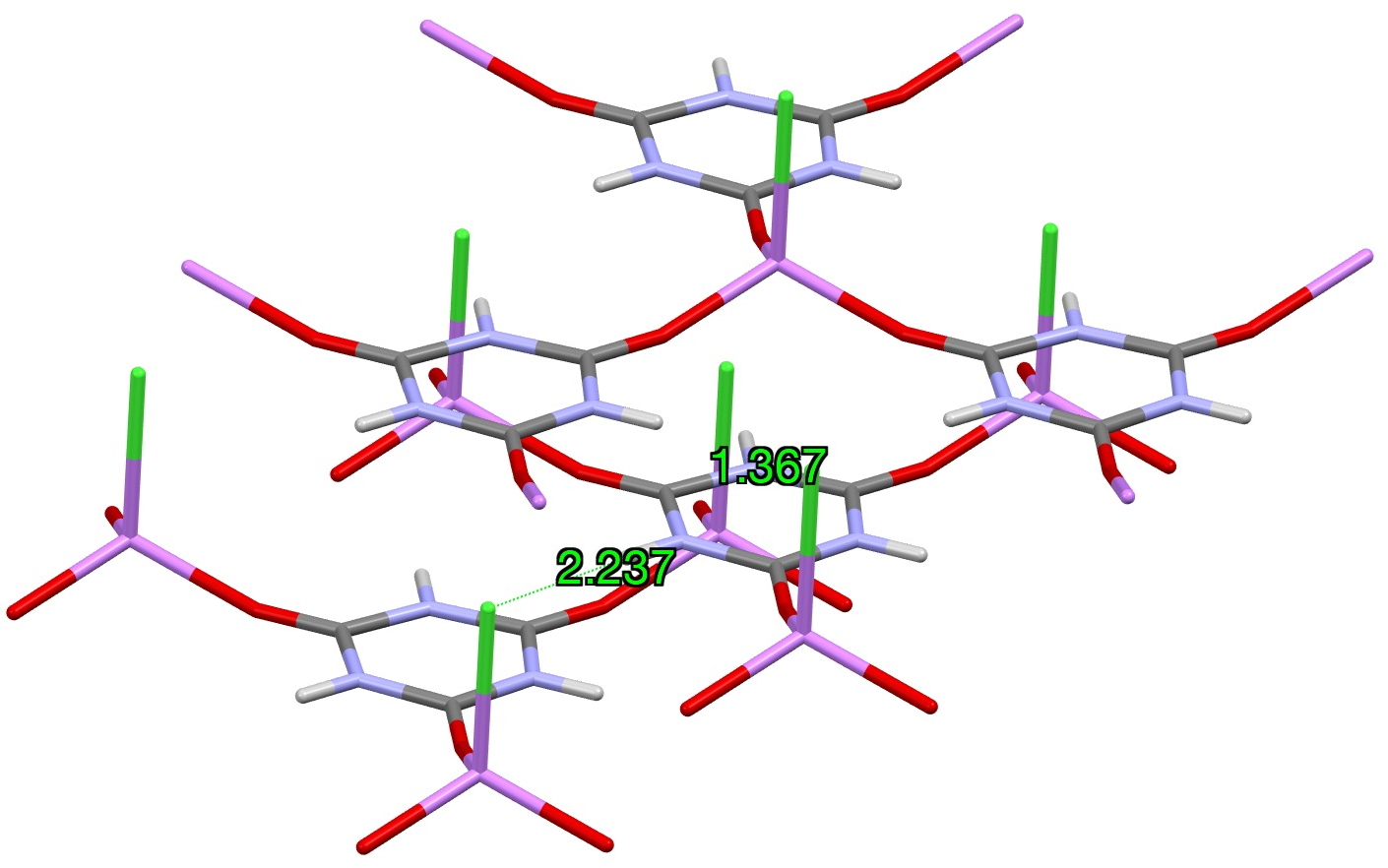
    Another system XAKSOU has been reported where discrete LiCl units replace the hydrogen the H-bonds formed to melamine above.[cite]10.1039/C7CE00037E[/cite] A Li is coordinated to the carbonyl oxygen instead of a hydrogen bond, and a chloride anion from another molecule in the unit cell replaces the H-bond to nitrogen.

    In the computed model, an intramolecular Cl-H hydrogen bond is used as the model, resulting in similar C-N lengths as the crystal structure (one which does not match the lengths in the outlying crystal structure QACSUI02)

    So the final question to ask is whether this latter structure is aromatic. NICS(0)/(1) values of -2.8/-1.1ppm are computed, which suggests very little aromaticity (aromatic values would be -10 to -20 pm). So it does not seem as if aromaticity can be tuned into cyanuric acid 2 by polarising both the NH and CO units with ionic/H-bond interactions so that the aromatic cyclohexatriene motif is better favoured over the 1,3,5-triazinane-2,4,6-trione non-aromatic resonance form. Are there any other examples where aromatically tunable molecules might be possible?

  • One vs two bond rotation – An example using Acyl amides

    One of the important aspects of chemical reaction mechanisms is the order in which things happen. More specifically, the order in which bonds make or break when there are more than two involved in undertaking a reaction. So we have:

    1. concerted mechanisms, when all bonds in any particular stage of a mechanism are changing in concert via a unique transition state,
    2. asynchronous concerted mechanism, when all the bonds are changing, but not necessarily all at the same rate and which may involve so called “hidden intermediates”, but which nevertheless stil involves only one transition state.
    3. stepwise mechanisms, in which more than one transition state is involved, connected by a discrete intermediate along the pathway.

    Here I consider an example of another type of (isomerisation) mechanism, involving bond rotations rather than bond formations or breakages. The two bonds in this case have a higher bond order than 1, and so are starting to verge on a type of isomerism known as atropisomerism, where the rotation takes place on a relatively slow time scale (unlike single bonds themselves, where rotation about them is normally relatively fast). Do two such bonds rotate in a stepwise or a concerted manner? In the structure below, we have two rotatable bonds, shown in red and blue, which due to conjugation of the lone electron pair on the nitrogen atoms with the carbonyl group have bond orders >1. Do these bonds rotate in concert or in a stepwise manner?

    The calculations of the rotations are done at the B3LYP+GD3+BJ/Def2-SVPP/SCRF=DCM level, Data DOI: 10.14469/hpc/12299

    1. Firstly, for the system R=R’ = Me. The reaction coordinate is specified around the red bond.

      The animation along the IRC (Intrinsic reaction coordinate) appears below, where you can see the red bond rotating and the blue bond spectating.

    2. The response of the dihedral angles about both bonds is shown below, which reinforces the conclusion that whilst one dihedral changes by about 180°, the other hardly changes. The overall dipole moment changes significantly as a result of the relative orientation of the two carbonyl groups changing. The two bonds can be said to rotate in a stepwise mechanism, involving an intermediate where one has rotated and the other has not.


    3. When the bulk of the central group is increased, different behaviour is now observed.

    4. Both dihedral angles now change by ~180°, in concert but not in synchrony! The first more or less transforms evenly by ~180°, but the second changes direction at ~IRC=-5 to rejoin the other.

    When the steric bulk means that the rotating substituents start to interfere with each other, so-called “gearing” starts to take place where the motions of the two become coupled by the gears. The rotations are now a concerted asynchronous process.

    So now to my concluding thought. The above is a simple example of gearing involving rotation about two coupled bonds. So how many bonds can be simultaneously geared so that when one rotates, the others do as well? I am now hunting for an example of three such bonds geared together. And is there a limit to how many can do so in concert? Here we enter into analogy with bond cleavage, where there are numerous examples of bonds breaking in concert, if not in synchrony. Most pericyclic processes are of this type. Is there a similar patten in bond rotations?