Author: Henry Rzepa

  • The Macintosh computer at 40.

    On 24th January 1984, the Macintosh computer was released, as all the media are informing us. Apparently, some are still working. I thought I would give my own personal recollections of that period.

    In fact, the Mac reached UK stores via a dealership only in 1985. What brought it to the attention of our university chemistry department was that also in 1985 the Chemdraw program was released and visitors to e.g. ACS meetings that year (probably the spring meeting) brought news of it back. A third piece of the puzzle, the Laserwriter also appeared that year. What difference would all this make? Well, take a look at the diagram in this 1983 article[cite]10.1016/S0040-4020(01)88625-7[/cite]. I drew that with stencils and transfer lettering, and the diagrams in this article took me ages! The article was submitted to what was called a “camera ready” journal, as part of the process of accelerating its publication, so it had to be as perfect as I could make it. I had to start from the beginning several times, since sometimes even Typex could not fix the errors or rescue the diagram from being a bit to big to fit onto the Journal provided template.

    After drafting these diagrams, I vowed never again! Fortunately, the Mac, Chemdraw and the Laserwriter appeared some 18 months later! I remember going around the (mostly organic) chemists in the department, asking if they would like to join in a bulk purchase and we ended up with 10 Macs. By 1985, the model had moved on to the Mac 512K which were the ones actually purchased and photos of the front and rear of one are shown below (I still have it, hoping a collector might make me an offer one day).

    The first year of use revealed an infamous quirk. The port on the rear of the Mac 512K did not support attachment of any hard drives (although in 1985 these were ferociously expensive for a 10 MB drive!) and so most of the time one spent not using eg Chemdraw but pushing floppy disks in and out of the machine. A year later, the Mac Plus 1Mb version was introduced (third photo) and this had a SCSI port. I attached such a 10 Mbyte drive to this port and the bliss at not having to rotate floppy disks was immense.

    Back to the 512K model. After they were delivered, I gathered all 9 other users and introduced them all to the mouse. In the first 15 minutes, there were rumblings that they would never get used to such a strange object, but at roughly the 45 minute mark, they were all converts. The program demonstrated was of course Chemdraw. Microsoft Word was not yet available but another simple word processor was (WriteNow) and everyone practised constructing diagrams such as the above. What joy! And no Typex, or starting the diagram from scratch – merely a simple 10 second edit.

    By 1987 as I recollect, there were many 1MB models now installed and we set about networking them all together and connecting them to the Laserwriter. We even managed to use the Mac to connect to STN international to search Chemical Abstracts[cite]10.59350/85xp6-2sy65[/cite] and the modern era was well under way.

    So this is my tribute to the Mac on its 40th birthday. I still use them to this day.

  • A mechanistic exploration of the Wilkinson hydrogenation catalyst. Part 1: Model templates

    Geoffrey Wilkinson first reported his famous work on the hydrogenation catalyst that now bears his name in 1965[cite]10.1039/C19650000131[/cite] and I met him at Imperial College around 1969 and again when I returned there in 1977. He was still working on these catalysts then and I was privileged to collaborate with him on unravelling the NMR spectra of some of these compounds.[cite]10.1039/C39820000482[/cite],[cite]10.1016/S0277-5387(00)86558-4[/cite],[cite]10.1016/0277-5387(82)80008-9[/cite]. During that period, computational modelling of the mechanisms of molecules containing transition elements was still in its infancy and I never extended my collaboration into this area at that time. Now, even if belatedly, I decided to explore this aspect and started to do this about two weeks ago. Here I thought that I would use this opportunity to show how I am going about it.

    The diagram below is an extension of the one found at Wikipedia and here is acting in effect as a “Finding Aid” for the data that would be gradually generated for the mechanism. At the outset, I decided to build my own version to also act as a laboratory notebook charting my progress, building the finding aid as I went. This explains, by the way the rather amorphous expansion of the diagram!

    Before discussing the mechanism itself, I point out some features of the diagram itself. Each computed species is associated with a free energy (in Hartree) acting as a FAIR-type identifier for the calculation[cite]10.59350/nk414-18p76[/cite] as a means of improving the findability of the data and the replicability of the result. Also included is the energy relative to the lowest point in the mechanism (itself set to 0.0) and next to that you can see a five digit code. If prefixed by the string https://doi.org/10.14469/hpc/ this acts as a digital object identifier (DOI) for each calculation, pointing to a landing page providing information about the archived dataset. The top-level DOI [cite]10.14469/hpc/13538[/cite]13538 acts as a collection or container for the project, being also the DOI that would normally be cited in any description of the results, such as here. The diagram above uses the graphical vector format SVG, which allows hyperlinks to be inserted. So if you click on one of these strings embedded in the diagram (see e.g.[cite]10.1039/C7SC03595K[/cite]), it should take you straight to the data for that result.

    The first point to make about the mechanism itself are the stereochemistries of the various 3-6 coordinate species, which in the Wikipedia mechanism are not really discussed. On the right hand side of the diagram, two alternative pathways with different stereochemistry are included. On the lhs (in grey) a different sequence of events is set out, which rejoins the main pathway at the dotted line. The next point to make is the level of computational theory adopted, it being the MN15L DFT procedure, which is suitable for transition metal elements, and the Def2-TZVPP basis set – together with a continuum solvent correction. For rapid exploration, I made an initial big approximation, which was to set the substituent on the phosphorus to R=H rather than R=Ph. This allows templates for the entire cycle to be constructed relatively rapidly, and then revisited as desired in a follow up exploration using these templates.

    The mechanistic features are described below. The DOI suffix is quoted for you to locate on the diagram.

    1. To the right of the cycle, we follow the accepted route, which is initial loss of one phosphine ligand, followed by insertion of H2 onto the Rhodium (13559)
    2. The hydrogens inserted can pseudorotate into a different stereochemical orientation (13563) and either of these stereoisomers can now complex with the alkene (13569 or 13576).
    3. The two resulting 6-coordinate complexes could in theory interconvert by a different pseudorotation (Turnstile[cite]10.1021/ic0519988[/cite]), but this appears high in energy (13580)
    4. One of the carbons of the alkene complex now inserts into the Rh-H bond (13543, 13578) to form a Rh-alkyl complex in which an agostic-style Rh-H interaction is apparent (13545, 13588)
    5. The agostic interaction is removed (13598, 13589) to form stereochemical isomers of the Rh-alkyl complex (13593)
    6. Another pseudorotation sets up the stereochemistry for the final step (13554, 13592).
    7. The remaining Rh-C bond can now insert into the remaining Rh-H bond, at which point the two separate isomeric paths now coalesce to form a single transition state (13596 ≡ 13549) releasing the activated Rh complex where the cycle first started and hence completing the cycle.
    8. To the right of the diagram are two cul-de-sac intermediates (in grey) which result from re-addition of phosphine to the hydride complex.
    9. To the left of the diagram is an alternative sequence which involves adding alkene to the Rh  first, and only then followed by H2 addition (13584, 13583). The energies of this path does appear significantly higher than the alternative. Once the alkene/H2 complex is formed, it now rejoins the cycle on the right of the diagram (horizontal double headed dashed arrow).

    You can follow the (relative) energies of this mechanism from the diagram; they are all reasonable for a thermal reaction. However, I will refrain from making any overall decision about the rate determining step (thought to be step 7 above), because the model for both the phosphine ligand and the (unsubstituted) alkene do not yet have any steric components, which are known to be important. What we have here therefore are templates for the next stage of studying the mechanism, when Ph3P and e.g. propene will replace the current models.

    Here I have tried to show a somewhat different approach to “laboratory notebook management”, whereby each step in the investigation can be accompanied by a persistent identifier (as a DOI) to that step, pointing to a location where the coordinates for the template can be readily obtained. The DOIs are added as each step completes, in this case into a Chemdraw diagram. Unfortunately, Chemdraw does not have a hyperlink tool (I did ask them to a few years back) and this can only be added to the export SVG file at the final stage. I inserted 40 such hyperlinks using a text editor; the process was not too onerous and because the SVG file is text based, it is also easily edited for errors and small corrections. Curiously, SVG editing tools such as the veritable Inkscape do not currently support addition of hyperlinks and given the well-established mechanisms for hyperlinking text, it seems odd that this has not developed for images.

  • Scholarly journals vs Scholarly Blogs.

    First, a very brief history of scholarly publishing, starting in 1665[cite]10.1098/rstl.1665.0001[/cite] when scientific journals started to be published by learned societies. This model continued until the 1950s, when commercial publishers such as Pergamon Press started with their USP (unique selling point) of rapid time to publication of ~3 months,[cite]10.1016/0040-4020(57)85003-0[/cite] compared to typical times for many learned society publishers of 2 years or longer. Fast forward another 50 years or so, and the commercial publishers were now dominating the scene, but the business model was still based on institutional subscriptions, whereby the institution rather than authors paid the costs of publication. As the number of journals expanded, even well-off institutions had to make difficult decisions on which subscriptions to keep and which to cancel. By the late 1990s the delivery model was changing from print to online, but the overall issue was that many scientists around the world no longer had access to many journals.

    Enter the APC, or article processing charge, whereby the authors themselves had to reimburse the journals for publishing their papers, although they could often still recover these costs from their institution. The cost of an APC depended on the reputation of the journal; those with the highest “impact factors” often charged the highest APCs, some of which could reach £5000+ for a single “paper” (still called that even in an electronic era). Also, some journals remained “hybrid”, where the costs were split between institutional subscriptions and APC funded. At least the latter could be accessed by anyone (including the “public”) without restriction (Open-Access) often also referred to as GOLD  and even Diamond (also known as platinum) articles which  are  GOLD open access but without author fees. Diamond is typically used by publishers who are keen to emphasise that they do not charge authors to publish open access.

    With many APCs ranging from £1000 up to £5000 or more, some started asking why it should cost so much to have this type of publishing infrastructure. Also in the early 2000s, “social media” started up, which at first tended to concentrate on instant publication and hence impact. The longevity of these media was not considered capable or indeed even desirable of rivalling that achieved by journal publishers, which after all had been around for 360 years or so. Things have begun to change however. Enter as an example Rogue Scholar, and its associated blog Front Matter. The aim here is to exploit the underpinning technical infrastructure of a blog host by automatically adding features more commonly associated with learned society or commercial journal publishing.

    I wrote[cite]10.59350/8m2d8-47b52[/cite] about some of the features available last September and now only four months later the functionality continues to expand. This includes:

    1. The ability to acquire a JATS XML version (Journal article tag suite), the standard format for scholarly articles
    2. I had previously noted that Blog posts are assigned a DOI based on the Crossref registration agency, and hence also acquire a metadata record which becomes useful for searching. All 800+ of the posts on this site have such a DOI for example.
    3. One interesting recent use of blogs is to act as a science newsletter associated with a funded grant, as an adjunct to simply publishing the research results in a journal.
    4. Indexing is also making big strides with the introduction of an API (application programmer interface), another service offered by scholarly publishers. As part of this, fields of science are being added to the metadata to enable filtering such as eg Chemistry
    5. Archiving, in theory for all of posterity, is also starting to be addressed . This requires transformation from HTML, typically used in blogs, to a medium more appropriate for long term archiving.

    The cost of the infrastructures described above are certainly very much less than eg the APC charges noted above, in part because they are so highly automated. I expect things will move very rapidly on this front.


    It is hoped to automatically include these in the post itself in the future. Meanwhile, it can easily be retrieved by a suitable search.

  • Macrocyclic peptide antibiotics – now Zosurabalpin – then antibacterial agents based on cyclic D,L-α-peptide architectures.

    Zosurabalbin[cite]10.1038/s41586-023-06873-0[/cite],[cite]10.1093/ofid/ofad500.1754[/cite], is receiving a great deal of attention as a new class of antibiotic which can target infections for which current treatment options are inadequate. It is a cyclic peptide and seeing this triggered memory of an earlier such species reported way back in 1995[cite]10.1002/anie.199500931[/cite],[cite]10.1038/35086601[/cite]. This octa-peptide (YIJDIE, DOI: 10.5517/cc58gxs) was presumed to function in a novel manner, having linear water channels wide enough to form a molecular nanoscale pipe for a stream of water molecules to flow along. When inserted into the bacterial cell membrane via its lipophilic sidechains, it drained the bacterium of its cell water within seconds, thus killing it. A 3D model shows the effect very clearly.

    Zosurabalpin does not function in this manner. Its structure was devised by optimising the various substituents until optimal activity was obtained (see this patent WO202319441).

    The ligand (VB6) is seen below. A program such as Chimera can tease out many more details.

    Zosurabalpin embedded in the protein pdb8frn can be viewed below and the coordinates can be obtained via DOI: 10.2210/pdb8frn/pdb

    The original 1995 report[cite]10.1002/anie.199500931[/cite] about the cyclic octapeptide appears was never developed into a clinically useful antibiotic, but I wonder where this approach led to.

  • Molecules of the year 2023 – part 2. A FAIR data comment on a Strontium Metallocene.

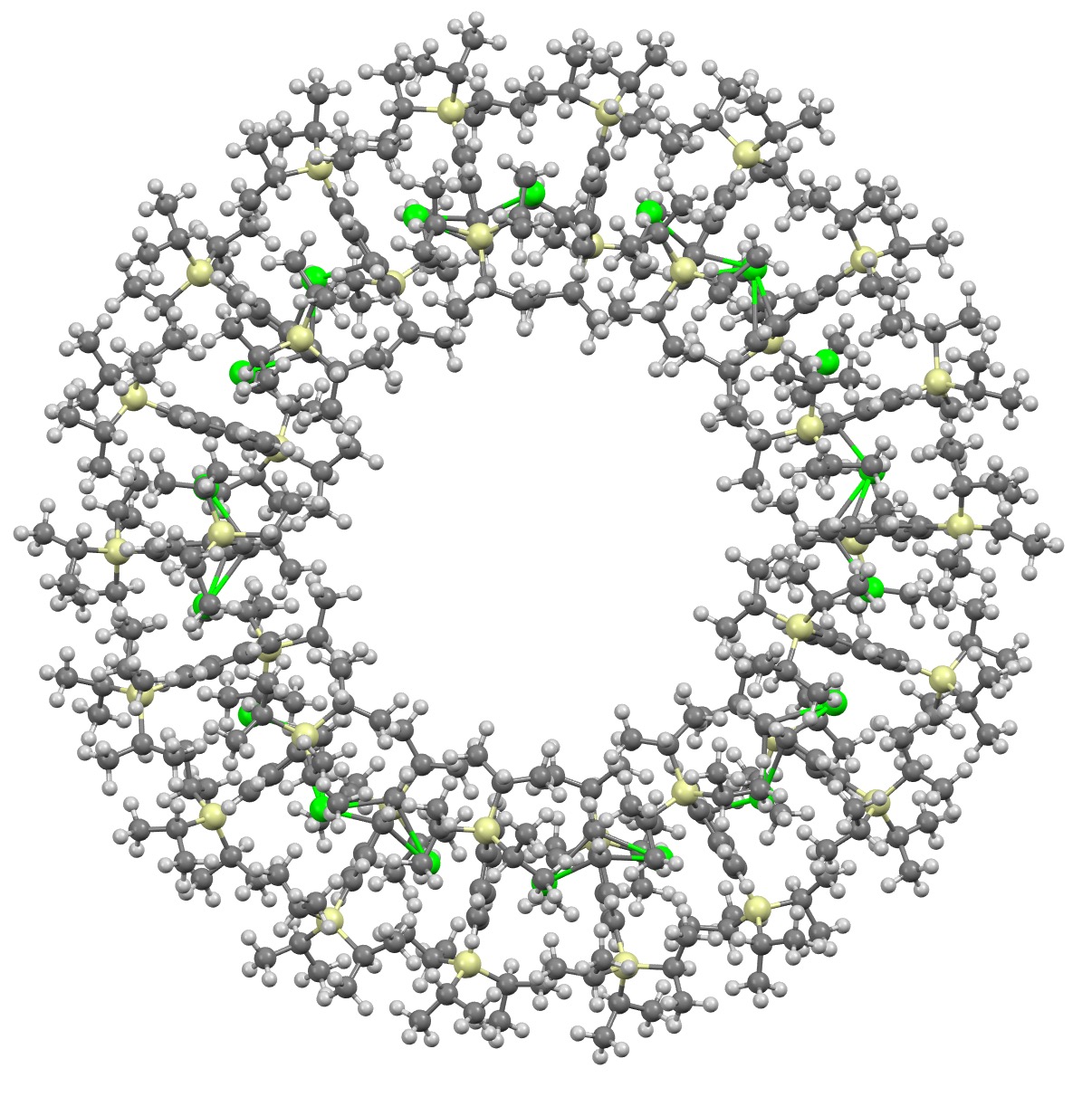
    I will approach this example of a molecule-of-the-year candidate – in fact the eventual winner in the reader poll – from the point of view of data. Its a metallocene arranged in the form of a ring comprising 18 sub-units.[cite]10.1038/s41586-023-06192-4[/cite] Big enough to deserve a 3D model rather than the static images you almost invariably get in journals (and C&EN). So how does one go to the journal and acquire the coordinates for such a model?

    Well, nowadays most reputable journals include a “data availability” statement, which in this case is indicated using a URL-style identifier for supporting information. This means by the way that this identifier may not be persistent, since the path to the document in the string https://static-content.springer.com/esm/art%3A10.1038%2Fs41586-023-06192-4/MediaObjects/41586_2023_6192_MOESM1_ESM.pdf may change in the future according to the publishers production workflows. The Acrobat file contains the required coordinates, of which I give a small sample here:

    18‐ring
    ‐‐‐‐‐‐‐‐‐‐‐‐‐‐‐‐‐‐‐‐‐‐‐‐‐‐‐‐‐‐‐‐‐‐‐‐‐‐‐‐‐‐‐‐‐‐‐‐‐‐‐‐‐‐‐‐‐‐
    1386
    Energy = ‐29312.63737385 dispersion contribution = ‐2.415738946
    C 5.1700172 1.6243489 ‐11.0779621
    C 5.6857216 1.5855492 ‐12.4187559
    C 6.0496599 0.6048512 ‐13.3969079
    C 6.1219344 ‐0.8254711 ‐13.5066237
    

    I selected the molecule coordinates within the PDF, pasted into a text editor and then spent a few minutes removing the resulting extraneous blank lines due to the page breaks present in the PDF document (a paginated document format is NOT a good vehicle for data!). I then added further lines (topped and tailed it) to eg make it viewable using a molecular editor such as Gaussview, only to get the following error.

    A bit of research leads to eg the following page: The difference between a dash and a minus sign. There you find four different glyphs any of which could look like a minus sign – there could in fact be more. Next, using the following resource: https://www.fontspace.com/unicode/analyzer#e=4oCQ tells us that the “-” found in the supporting information is in fact a “hyphen“. Typed from a keyboard as a “-” one learns this is a “hyphen-minus“. There is also “−” which emerges as a “Minus sign“, whilst a “–” emerges as an “EN Dash“. Confused yet? Well, it all does rather depend on whether the creator of the molecular viewing program you are about to use has included all these variations in their program code. In this case clearly not, since a hyphen is not recognised. Once you get to this stage, around 30 minutes of occasional head scratching have elapsed, and you further have figured out how to do a global find and replace of a hyphen by a minus using your preferred software.

    What does all this have to do with FAIR? This means Findable, Accessible, Interoperable and Reusable. And those actions have to be possible not only by a human but by an autonomous and probably unsupervised system gathering data for machine learning or artificial intelligence. The Finding was facilitated by the “data availability” statement using the article DOI (a fully persistent identifier), but probably only a human could actually cope with the diversity of presentations for data found across multiple publishers (thus, to be technical, the access location of supporting data is rarely if ever actually declared in the metadata record associated with the DOI, which is what a machine would need to access the data). The Access in this case means resolving the URL above, but only if it does not change in the future! But the next bit, the Interoperability, is more of a challenge. Like myself, many a human might also take 30 minutes, or indeed just give up, in coping with the challenge of recognising that a hyphen is not a minus! So although we are grateful for that “data availability” statement, I dream of the day when that will in fact become a “FAIR data availability” statement! Not many signs of that happening yet. I guess the AI-algorithms will in fact get smarter faster than people for coping with such issues.

    Anyway, you now have a 3D model of the 18-metallocene as this year’s selected molecule of the year! Click on the image above to load it.


    For example, the data for this post is available at a FAIR repository, with the persistent DOI identifier: https://doi.org/10.14469/hpc/13536. This contains the optimised coordinates using the PM7 method. These are very little different from the coordinates from the article, which were obtained using the PBE0/Def2-TZVP method, a remarkable calculation given it uses 21618 basis functions!

  • Molecules of the year: 2023

    The Science education unit at the ACS publication C&EN publishes its list of molecules of the year (as selected by the editors and voted upon by the readers) in December. Here are some observations about three of this year’s batch.

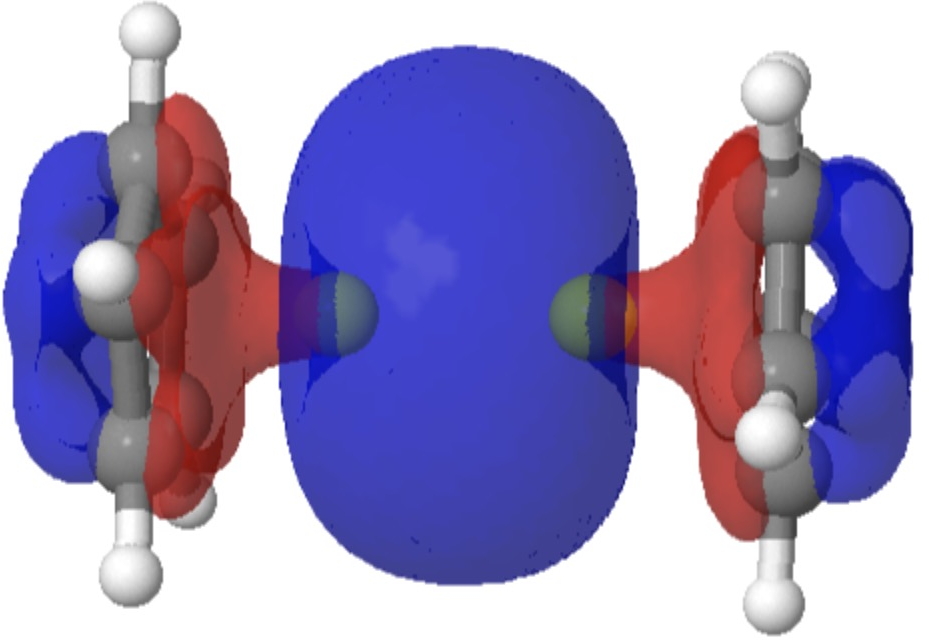
    1. Diberyllocene[cite]10.1126/science.adh4419[/cite] with its unusual Be-Be bond has already beeen covered on this blog.[cite]10.59350/v1cma-xjk91[/cite], where I commented that lithioborocene should be possible to make as well.
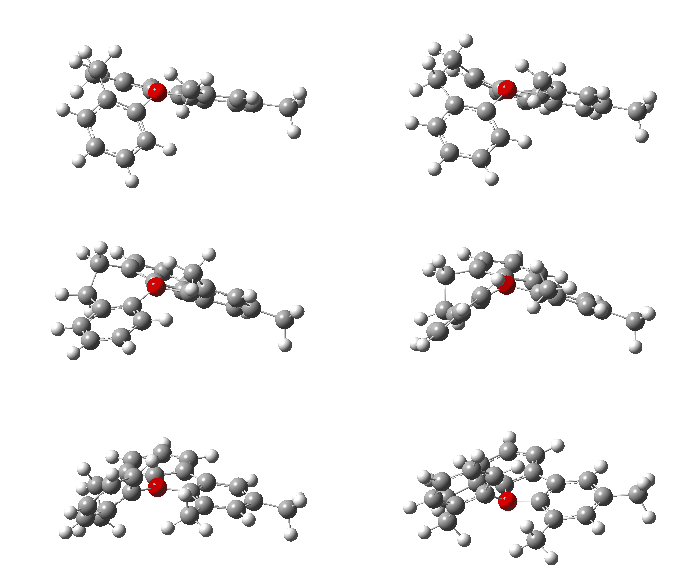
    2. The second in the list is the synthesis of the chiral triaryloxonium ion[cite]10.1038/s41586-023-05719-z[/cite] HICBUU(Crystal DOI: 10.5517/ccdc.csd.cc2cjynj). Curiously, this combines the features of two of our recent publications (with Chris Braddock)[cite]10.1021/acs.joc.6b02008[/cite],[cite]10.1021/acs.jnatprod.2c00749[/cite]. The first of these speculated upon a mechanism involving an intermediate (and as it happens chiral) oxonium ion and its subsequent rapid fragmentation by nucleophilic attack. This meant it was never isolated, unlike the one reported this year.[cite]10.1038/s41586-023-05719-z[/cite] The second article of ours involved another class of chiral natural product called polysiphenols and their enantiomerisation by a process called atropisomerism via a two stage process. This as it happens is also the feature reported for the the chiral triaryloxonium ion.

      The atropisomerism involves restricted (high energy) rotation about an axis shown as a dotted red line, accompanied at a separate stage with rotation about the C-C single bond shown in blue. The polysiphenols showed similar two-stage atropisomerism.

      I show an intrinsic reaction coordinate calculation of this process below, being respectively the energy response and the dihedral angle responses about the 16-17 bond (blue) and the axis 2-18 (dashed red) and ending with an animation of the process.


      Note how the C-C rotation is much lower in energy than the about the red axis. It is also interesting to observe that pyramidal inversion at the chiral oxygen centre via a trigonal planar unit only happens at an IRC value of ~+30, well after both transition states have passed!

    3. The third topic is represented by the crystal structure NITRUH (Crystal DOI: 10.5517/ccdc.csd.cc2fcr2n),[cite]10.1038/s41586-023-06539-x[/cite]. This is announced at the C&EN page as “carbene breaks octet rule”, in having only four valence electrons at the central carbon atom. The structure is certainly unique, the motif shown below having only one entry in the crystal structure database. Leaving aside the observation that a true carbene also breaks the octet rule with its nominal six valence electrons, how could this arise? Well, shown below are six canonical forms of this species (the original article shows four) of which species 1a is the one referred to as having only four valence electrons at the central atom, whilst 1b is that favoured in the article.

      What does a calculation reveal (ωB97XD/Def2-TZVPP; DOI for data 10.14469/hpc/13532)? The Wiberg bond index calculated for the central carbon atom is 3.8328, which corresponds to 7.67 electrons. Far from four! The Wiberg bond orders along the chain are 1.54, 1.14, 1.83, 1.83, 1.12, 1.58 (the species is calculated as not quite symmetrical as an isolated molecule) which is a close match to structure 1e (not shown in the article). Dare I suggest that the tag line for this entry in the C&EN article is a good example of copywriters hyperbole, something designed to catch the interest and attention of the reader? Well, it certainly succeeded, but I venture to suggest that although the molecule is indeed interesting and unique, it does NOT break the octet rule. A good discussion point perhaps for a chemistry tutorial?

  • The journey from Journal “ESI” to FAIR data objects: An eighteen year old (continuing) experiment.

    Around 1996, journals started publishing what became known as “ESI” or electronic supporting information, alongside the articles themselves, as a mechanism for exposing the data associated with the research being reported and exploiting some of the new opportunities offered by the World Wide Web. From the outset, such ESI was expressed as a paginated Acrobat file, with the Web being merely a convenient document delivery mechanism. Such ESI would eventually reach more than 1000 such pages in length in some chemistry articles. The richer opportunities of Web interactivity were far less exploited. I have written about various aspects of this throughout this blog[cite]10.59350/qypm4-qfv97[/cite],[cite]10.59350/cqesx-a0e83[/cite],[cite]10.59350/z9g5j-r2p69[/cite], together with one early compendium of our own data examples.[cite]10.59350/wczky-8sf79[/cite] Here I update that compendium starting from 2005 to the current 2023 and add further information, being the current state of curation of some of these early examples. Curation became necessary because many of the earlier examples were no longer functional due to changes in the way journals expose these data objects or indeed changes at the data repository end of things over this 18 year period.

    Table 1. Eighteen years of publishing journal FAIR data objects and their current
    curation location
    # Article DOIa Year Title Article Data URL/
    Data Citationa
    Curated version via DOI
    1 10.1021/ja043819b 2005 A Computational Analysis of the Ring-Opening Polymerization of rac-Lactide Initiated by
    Single-Site β-Diketiminate Metal Complexes:  Defining the Mechanistic Pathway and the Origin
    of Stereocontrol
    Archive Tables S1, S2 and S3
    2 10.1039/b510508k 2005 Double-twist Möbius Aromaticity in a 4n+2 Electron Electrocyclic Reaction Table S1 Table S1
    3 10.1021/ol0518333 2005 A Double-Twist Möbius-Aromatic Conformation of [14]Annulene Archive Figure S1
    4 10.1021/ja061400a 2006 Synthetic, Structural, Mechanistic, and Computational Studies on Single-Site
    β-Diketiminate Tin(II) Initiators for the Polymerization of rac-Lactide
    WEO Table S1
    5 10.1021/ic0519988 2006 A Computational Study of the Nondissociative Mechanisms that Interchange Apical and
    Equatorial Atoms in Square Pyramidal Molecules
    Index for 14 WEOs Index for 14 WEOs
    6 10.1021/ic062473y 2007 In Search of the Bailar and Rây−Dutt Twist Mechanisms That Racemize Chiral Trischelates:
    A Computational Study of ScIII, TiIV, CoIII, ZnII, GaIII, and GeIV Complexes of a Ligand
    Analogue of Acetylacetonate
    WEOa,WEOb,WEOc,
    WEOd,WEOe, WEOf
    Index to WEOa-f
    7 10.1021/ol703129z 2008 Lemniscular Hexaphyrins as Examples of Aromatic and Antiaromatic Double-Twist Möbius
    Molecules
    WEO WEO
    8 10.1021/np0705918 2008 Structural Reassignment of Obtusallenes V, VI, and VII by GIAO-Based Density Functional
    Prediction
    WEO WEO
    9 10.1021/ja710438j 2008 Intrinsically Chiral Aromaticity. Rules Incorporating Linking Number, Twist, and Writhe
    for Higher-Twist Möbius Annulenes
    Archive,WEO1, WEO2, WEO3,
    WEO4
    WEO1, WEO2, WEO3, WEO4
    10 10.1021/jo801022b 2008 Chiral Aromaticities. AIM and ELF Critical Point and NICS Magnetic Analyses of
    Möbius-Type Aromaticity and Homoaromaticity in Lemniscular Annulenes and Hexaphyrins
    Archive, WEO WEO
    11 10.1021/ct8001915 2008 Chiral Aromaticities. A Topological Exploration of Möbius Homoaromaticity Table 1 Table 1
    12 10.1039/b810147g 2008 A computational investigation of the structure of polythiocyanogen Table 1 Table 1
    13 10.1039/B810301A 2009 Wormholes in chemical space connecting torus knot and torus link π-electron density
    topologies
    Table 1 Table 1
    14 10.1021/ol901172g 2009 The Chiro-optical Properties of a Lemniscular Octaphyrin Table 1 Table 1
    15 10.1021/jp902176a 2009 The Geometry and Electronic Topology of Higher-Order Charged Möbius Annulenes Table 1 Table 1
    16 10.1039/B911817A 2009 The distortivity of π-electrons in conjugated boron rings Table 1 Table 1
    17 10.1038/nchem.373 2009 The importance of being bonded Exploratorium Exploratorium
    18 10.1039/B913295C 2009 Unusual regiodivergence in metal-catalysed intramolecular cyclisation of γ-allenols Tables 1 & 2 Tables 1 & 2
    19 10.1016/j.tetlet.2009.02.228 2009 A dramatic effect of double bond configuration in N-oxy-3-aza Cope rearrangements—a
    simple synthesis of functionalised allenes
    Not hosted Table
    20 10.1021/ed800058c 2009 Racemization of Isobornyl Chloride via Carbocations: A Nonclassical Look at a Classic
    Mechanism
    Table Table

    aTo inspect the metadata associated with any article, use eg https://api.crossref.org/works/10.1002/anie.202006283/transform/application/vnd.crossref.unixsd+xml
    and check how eg the data citation is expressed there.


    The future seems likely to be influenced by the increasing requests from publishers for data to be made available in so-called FAIR-form, via an appropriate citation using a data DOI. The other feature on the horizon is the introduction of tools such as “Finding Aids“, where an automated script is able to automatically identify relationships between various data objects and the molecular content expressed within them and to generate a tool which exploits these relationships by adding further layers of navigation and especially of Findability to the data objects. I hope to show such an example here shortly – watch this space.


    This table contains only the first 20 entries, since the whole table does not seem to display correctly on this blog. The whole table can be seen here. See also this backup version of the post.

  • A trip down memory lane: An online departmental connection map from 1989.

    In 2023, we very much take for granted that everyone and pretty much everything is online. But it was not always so and when I came across an old plan indicating how the chemistry department at Imperial College was connected in 1989, I was struck by how much has happened in the 34 years since. Nowadays all the infrastructures needed are effectively “built in” to the building when it is constructed and few are even aware of them. But in 1989 that was not at all true.

    To introduce the plan I discovered, I will first try to very briefly summarise the evolution of computing and IT infrastructures in a typical university and its departments.

    1. I will commence around 1960, when most universities started supporting computer “mainframes”. For Imperial college, this was an IBM machine and to access its resources, one had to physically go to the punch room allocated for the purpose. I remind that this is only around 16 years after the Colossus machine started operating in Bletchley park.
    2. By around 1974, although visiting the “card reader” and the “line printer” was still the best way to access the (single) mainframe, a few select users had access to a “teletypewriter” in their own department. In that year I had started my PhD and I spend quite a lot of time in one such room writing programs and running them, all at the speed of 300 baud. The mainframe was now a CDC 6400 and the terminal was connected to it by a wire running through the heating tunnels.
    3. By around 1977, the teletypewriter was augmented with a graphics terminal ( Tektronix 4014) which could be used for generating plots, phototypesetting etc. It now operated at 9600 baud, using two line boosters to achieve this effect.
    4. By about 1981, there were 3-4 terminals in the department, with the number increasing rapidly. They now could be used to access resources around the world. I remember the impact that access to STN International (connecting to Chemical abstracts, called SciFinder nowadays) using such a terminal had on most of the researchers. If the queue was too long, you instead went to the library, where they had also installed such a terminal. One terminal was devoted to word processing, using a simple command line editor, where I wrote my scientific articles. Joy! To support these terminals, we had installed devices called PADs (packet assemblers/disassemblers) running at 19600 baud and supporting the X25 protocol.
    5. By 1986, the department had already gone through one generation of graphical interface computers (Corvus Concept computers with their own network) which supported early word processing and we were starting to support IBM PCs connected to the PADs by serial lines and the newly released Mac Computers. The latter had their own network (Appletalk) and because these machines were so popular (due to Chemdraw), we started to install an extensive Appletalk network, connected to a core Webster Multigate, which was itself routed to the main College resources using thick wire ethernet. Attached to the Appletalk was our first laser printer! I well remember going to an Apple FTP site and periodically downloading the latest version of their operating system onto a floppy disk so that we could update our Macs and stop them crashing quite so much.
    6. And so we reach 1989, and the complex networking shown there.

    All this was done within the department, since the central computing resources (the “computing centre”) in 1989 were still focused on the use of mainframes, but starting to devolve into networked workstations (mostly Silicon graphics) by 1991. It would be another decade or so before they full morphed into an IT division and left mainframes behind. By now, networks had become firmly part of the core of their operations.

    1. But before this, but not shown on this map, chemistry installed in 1999 about 40 WiFi base stations so that people could start to access online resources without the “wires” shown in the above diagram. Mostly in those days Mac computers.
    2. And with WiFi and then cellular support, came the phones of course.
    3. I will finish by saying that the current generations of PCs and Macs (which had replaced the workstations) are still “wired” into the department infrastructures, now at speeds of 1 Gbit!

    In 2023 a new phenomenon has emerged – software tunnels to allow secure access into the departmental network. We use a product called ZScaler (replacing VPN), and it depends intimately on having a phone to authenticate access. Without that phone and its own 5G access, it is difficult to do anything nowadays.

    Quite a lot of change over 34 years!

  • Two influential textbooks – “Mee” and “Mellor”.

    I am a member of the  Royal Society of  Chemistry’s Historical group. Amongst other activities, it publishes two editions of a newsletter each year for its members. A new theme was recently launched asking for contributions on the topic of  “two influential books” and shortly to appear in the winter 2023 edition will be the following recollections by myself (reprinted here with permission).


    Two influential books

    1. Practical Organic Chemistry by A. J. Mee, J. M. Dent and Sons, 1959 (”Mee”)
    2. Modern Inorganic Chemistry by G. D. Parks and J. W. Mellor, Longmans, 1946 (”Mellor”)

    My connection with both these books goes back to around 1962 and is set in a particular context. Being an only child, I played extensively with my two cousins who lived nearby. Their mother had a science degree and was in fact the owner of the inorganic text. When my aunt decided to emigrate to Canada in that year along with my cousins, she left her textbooks with my parents, perhaps in the very prescient anticipation that I would discover and read them. They were stored deep inside in the cupboard under the stairs. I was forever crawling into small spaces – a habit that had often caused consternation to my parents even at the age of three – and it was there I discovered the Mellor one day. It is not the kind of book that a twelve-year-old would normally start reading, but my parents had noted that I was missing my cousins and had decided to purchase a chemistry set for me as some form of distraction. There was something of a disconnect of course between all the fascinating compounds described in the Mellor text, and the relatively small range of chemicals in the boxset. The disconnect was made worse since I was particularly fascinated by the explosive and dangerous compounds described in the Mellor. Chlorine heptoxide (p 507) is just one example that attracted me particularly, including its explosive nature. Nitrogen tri-iodide (p 401) is of course far more famous and therein lie several more stories.[cite]10.59350/d4xrw-f1j66[/cite]
    Mellor is scattered with diagrams of the apparatus used to prepare the compounds described, but I have no idea why as a 12-year-old I found all this so fascinating! Indeed I read about almost any oxide avidly- especially if it was coloured. So, after a few days, and with all the chemicals in the set exhausted, I needed to find replacements.

    I have no recollection about how I located A. N. Beck and Sons in Stoke Newington (no Google in those days of course), but they were a regular high street pharmacist who happened to have a basement where they would sell often exotic chemicals to 12-year-old boys and girls. None of this bears thinking about nowadays of course! Stoke Newington was a lengthy bus ride away from where we lived in southeast London, but I happily ventured on my own on the 72 bus and started returning not only with a new batch of chemicals but also the glassware needed to perform ”proper” experiments. Imagine my delight when I got a water pump and was able to do reduced pressure distillations. All this in a small (unventilated) annex to the kitchen in the house, the use of which my parents just about tolerated. At least until the day that I mixed ethanol with a mixture of sulfuric and nitric acids and sprayed a rather nice Jackson Pollock brown pattern onto the kitchen ceiling. My punishment for doing this was learning how to repaint the ceiling – I have been none too fond of painting ceilings ever since. I was now able to explore a few more of the compounds mentioned in the Mellor text, which I continued to absorb avidly. But soon I realised that there was much more to chemistry than described in Mellor.

    A. N. Beck and Sons not only sold chemicals but also had a few books for purchase and that is how one day I went home clutching A. J. Mee’s text on practical organic chemistry. That contained 297 experiments, many of which could be conducted in my new home laboratory. I started that book with dyes, which magically transform entirely colourless compounds into startingly bright reds and yellows and less often blues and greens. Indeed, at age 17 when I was starting my university course applications, I even applied to the colour chemistry course at Leeds. It is my regret that during this period, I never attempted the synthesis of mauveine, a compound that has a very local flavour since the site of the factory that its discoverer Perkin built to manufacture it is just down the road from where we now live.[cite]10.59350/j80na-mgz43[/cite] After several years, I had ticked around half of the experiments in Mee and saved not a few of the final products in sealed glass specimen tubes. Dinitrogen tetroxide is a memorable sample from that period, since it is not easy to seal a compound that boils at 22 C.

    I should mention one interesting characteristic of the experiments described in Mee – the propensity to use large quantities of compounds. A typical experiment could use up to 10-50 g of material. As someone with a limited budget (approximately half of which was now being spent on attending football matches), I soon realised that a ten-fold reduction in quantities did not lessen the enjoyment of the preparation. Nowadays in some taught laboratories, the quantities are often measured in mg! The preparation of benzidine was an exception, involving 2g of this highly carcinogenic species and which I followed Mee to the letter. I still have nightmares about my experiments with this species and the quantity of it I produced – the Mee text does not mention the toxicity.

    Just to balance things out, I should mention that I also (tried to) read a theoretical chemistry text by J. W. Linnet which contained no home experiments to perform but probably sowed the seeds for my subsequent career years later.

    By the time I started my university course in 1968, I was able to shut down my home laboratory (much to the relief of both parents) and continued in a somewhat safer university laboratory. Perhaps unsurprisingly, given the six years or so of practical experience I already had, I was delighted to win a prize for practical chemistry in my final year. By this stage of course, the standard inorganic texts were books by Cotton and Wilkinson and Vogel’s practical organic chemistry – both in a very different style from my two selections above. I continued making molecules for my three years of PhD during the period 1971-74 – mainly sterically hindered indoles and indolinones – and it was these final syntheses that set me on my subsequent career of modelling reactions using quantum mechanics – a story told elsewhere.[cite]10.1002/ijch.202100034[/cite] But without doubt, both the Mellor and the Mee books played a crucial role in directing me along this long and winding path.

    In 2014, some fifty years after reading my two highlighted books, I decided to find out if anyone else had similar experiences and I posted about them on my blog.[cite]10.59350/hjf0v-c0z37[/cite] To my delight 52 responses have been received to date and perhaps this newsletter article might encourage a few more? It turns out I was not alone. I even got one response from Hillary Beck Grant, whose father Kingsley Beck was the son of Albert Neve Beck. She vividly remembers the smell in the basement where two women did all the bottling, packing and dispatching. Sounds very similar to my own kitchen annex!


    J. W. Linnett, The Electronic Structure of Molecules: A New Approach. 1964, Methuen.

  • More examples of “double-headed” curly arrows: S and C Nucleophiles attacking acetyl chloride

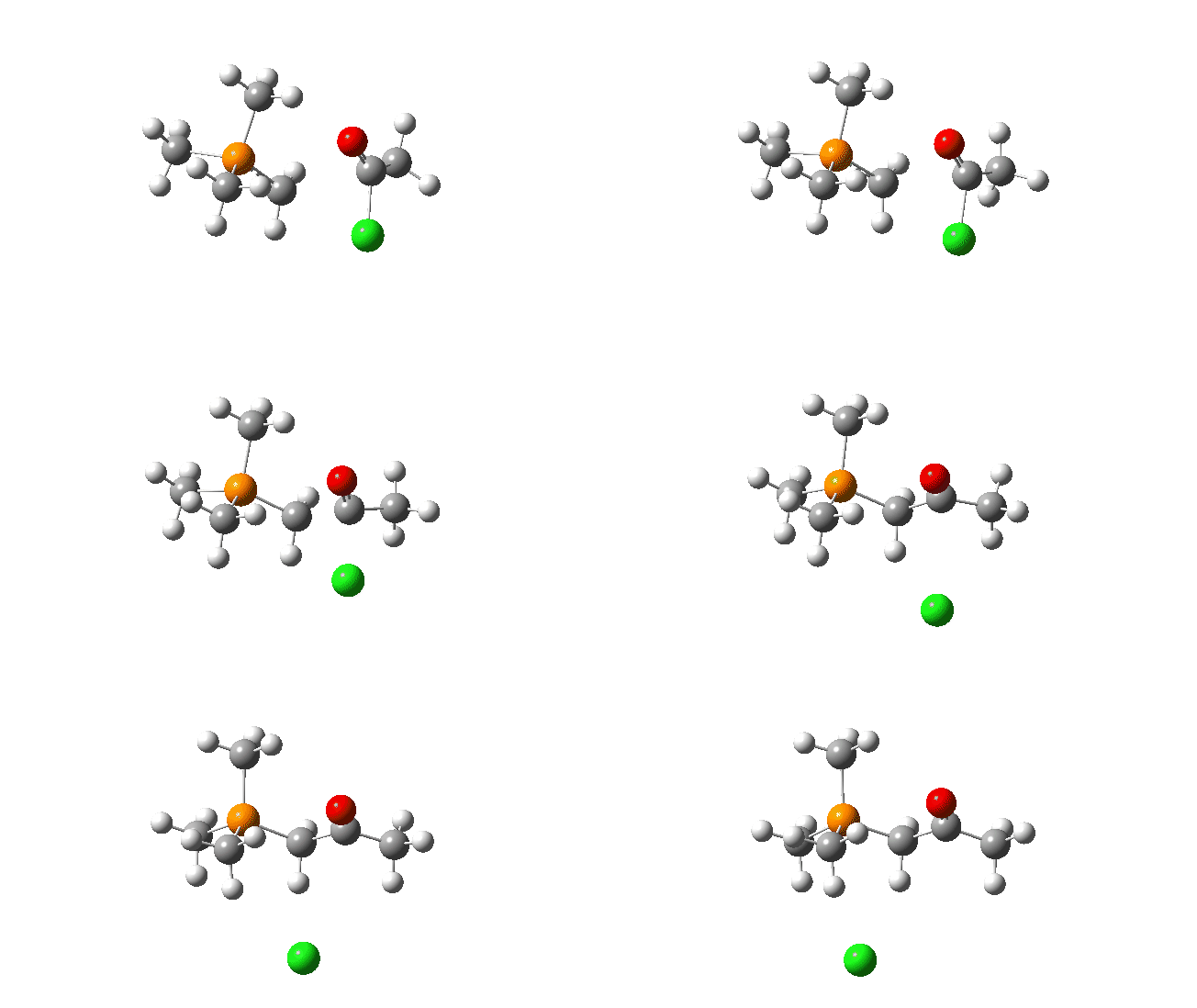
    In an earlier post on this topic,[cite]10.59350/f00wf-5tq46[/cite] I described how the curly-arrows describing the mechanism of a nucleophilic addition at a carbonyl group choreograph in two distinct ways, as seen in red or blue below. The arrows in red can be described as firstly addition to the carbonyl group to form either a transient intermediate (a two-step process) or instead a formal transition state state as a concerted single-step mechanism. The blue arrows do the reverse; firstly elimination and then followed by addition. I will use the shorthand AE for the first type and EA for the second type. Here I explore some more nucleophiles to see which of these two mechanisms they follow. Data for these results can be found at 10.14469/hpc/13171
    N- carbon ylid: This is a very facile (low-barrier) reaction with a C-O bond length response that initially increases steeply, followed by a more modest decline and hence corresponds to an AE mechanism.

    P carbon-Ylid:  Essentially identical to the previous example, and again an AE mechanism.

    S carbon-ylid: Again, an AE mechanism.

    S-nucleophile:  This one is different, showing a larger barrier and initial small decrease in the C-O length followed by a larger increase. This one is an EA mechanism.

    As I noted previously, it would be useful to have two double headed curly arrows available in palletes of these; <—> (AE) and >—< (EA) to illustrate the difference between the two mechanistic types.


    This is the first instance where I cite a blog using a CrossRef DOI generated for it. Previous such citations used a DataCite DOI, which the bibliographic software used here to add them to the post (Kcite) does not support.