Tag: Historical

  • Hafnium and Niels Bohr

    In 1923, Coster and von Hevesy[cite]10.1038/111079a0[/cite] claimed discovery of the element Hafnium, atomic number 72 (latin Hafnia, meaning Copenhagen, where the authors worked) on the basis of six lines in its X-ray spectrum. The debate had long raged as to whether (undiscovered) element 72 belonged to the rare-earth group 3 of the periodic table below yttrium, or whether it should be placed in group 4 below zirconium. Establishing its chemical properties finally placed it in group 4. Why is this apparently arcane and obscure re-assignment historically significant? Because, in June 1922, in Göttingen, Niels Bohr had given a famous series of lectures now known as the Bohr Festspiele on the topic of his electron shell theory of the atom. Prior to giving these lectures he had submitted his collected thoughts in January 1922[cite]10.1007/BF01326955[/cite].

    Like Mendeleev before, who had predicted ekasilicon, ekaaluminium and ekaboron (eventually discovered as germaniumgallium and scandium), Bohr had used his electron shell theory to (correctly) predict the properties of element 72. In modern terms, he had concluded that its electron shell structure must be 2.8.18.32.10.2 or [Xe].4f14.5d2.6s2. Classification as a rare earth would have resulted in the 4f shell having 15 electrons, impossible in Bohr’s theory. Coster and von Hevesy note in their article that Bohr’s striking prediction was now verified. Bohr latter told this story in his  Nobel  prize lecture.

    Why I am writing all of this? For various reasons:

    1. Unlike Mendeleev, Bohr’s prediction of the properties of a (then uncharacterized) element, whilst famous at the time, is nowadays largely forgotten by chemists. It is one of the great achievements of the then new quantum theory.
    2. Reading the 67 pages of Bohr’s article[cite]10.1007/BF01326955[/cite] on the topic reveals no discussion of element 72 (articles of this era are nowadays only available as scanned images, not full text, and one must rely on a human visual scan of all 67 pages, which of course may not be reliable) but its (absence) in the table below is striking. Here VI means the 6th row of the periodic table.
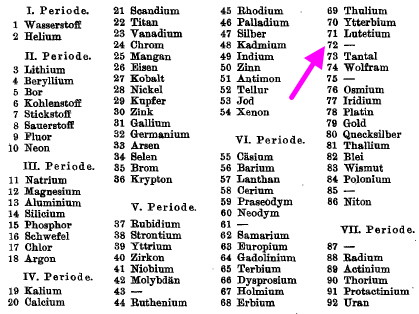
      Niels Bohr’s Periodic table, 1922.
    3. Notice the only other missing elements, Technetium (43), Promethium (61), Astatine (85), Francium (87) and Rhenium (75, the only non-radioactive one remaining to be discovered),
    4. I must presume that Bohr introduced his discussion of element 72 into his June lectures to make an impact with his audience! One might have hoped that tracking down what happened between January 1922, when Bohr fails to make much of the missing element 72, and June in the same year would be possible from Coster and von Hevesy’s citation of Bohr in 1923. But it was the practice of the time to rarely cite one’s sources. Thus they give no published citation to Bohr, and one might conclude that they might instead be quoting Bohr from his lectures rather than his writings (poor old Bury, now forgotten![cite]10.1021/ja01440a023[/cite]).
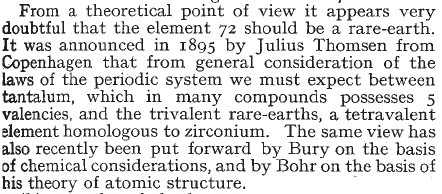
      Coster and Hevesy’s allusion to Bohr’s theory.
    5. Bohr’s own 1922 article on the topic is also visually striking. It contains in its 67 pages:
      1. 13 (short) equations
      2. Two figures (the second a variation on the first)
      3. One table (above).
      4. and lots of text (in German).
      5. No citations at the end, not even one, although many people are acknowledged in the text itself.
      6. No explicit statement of shell structures as e.g. 2.8.18.32.10.2 or [Xe].4f14.5d2.6s2.

      Given that Bohr’s article can be regarded as one of the most influential of the 20th century (even prior to its being placed on a firm theoretical footing by solution of the Schroedinger equation for the hydrogen atom), I find it interesting how quickly it achieved this status (Bohr won the Nobel prize in 1922 as well). One might conclude that reputations were made as much via verbal presentations as by the immediate visual impact of the associated publications.

    Finally, I note the striking contrast between Bohr’s article[cite]10.1007/BF01326955[/cite] and Langmuir’s[cite]10.1126/science.54.1386.59[/cite], written about a year earlier in 1921, although first set out in 1919. Here, Langmuir[cite]10.1126/science.54.1386.59[/cite] sets out some postulates, the first of which is shown below (and first explained in 1919)
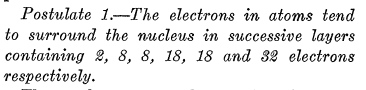
    Langmuir’s 1921 postulate.

    The filled electron shells are clearly set out here (much more clearly than in Bohr’s 1922 article[cite]10.1007/BF01326955[/cite]). But yet again, we remain uncertain as to how Langmuir arrived at this postulate (perhaps here) Although he (very briefly) mentions Bohr in his own paper, it is only in the context of speculating about what prevents the electrons from falling into the nucleus, and few citations are again given (a notable exception is to Pease[cite]10.1021/ja01438a003[/cite] for suggesting the triple bond). We may only suspect that Langmuir had heard Bohr talking about his theory, and had extended G. N. Lewis’ concept (also not directly cited) of (filled) valence shells for his own theory of chemical bonding.

    Well, in a little less than 90 years, we have progressed from finding almost no sources cited in some of the most influential papers of the 20th century, to the DOI (or URL) embedded in everything. I think that when the history of the present era is written, the introduction of the DOI/URL will take its place in the pantheon of great scientific events. Its the connections that matter, stupid!


    Postscript. Hevesy in this review[cite]10.1021/cr60005a001[/cite] written in 1925 sets out a good history of Hafnium. This article contains (on p7) a clear statement of the electron shell structure of Hafnium as 2.8.18.32.8.2.2, which is cited as Bohr’s result. Hevesy quotes Bohr via reference 12, which is in fact to a book Bohr published in 1924. There is no mention of Langmuir in Hevesy’s review.

    Postscript1: Hafnium (as its oxide) is now an essential element to the ever smaller fabrication of silicon chips (32nm and smaller). It is one of 14 elements considered essential to the future green technologies (six of which, but not including  Hafnium, are considered in critical risk of supply disruption by 2015).
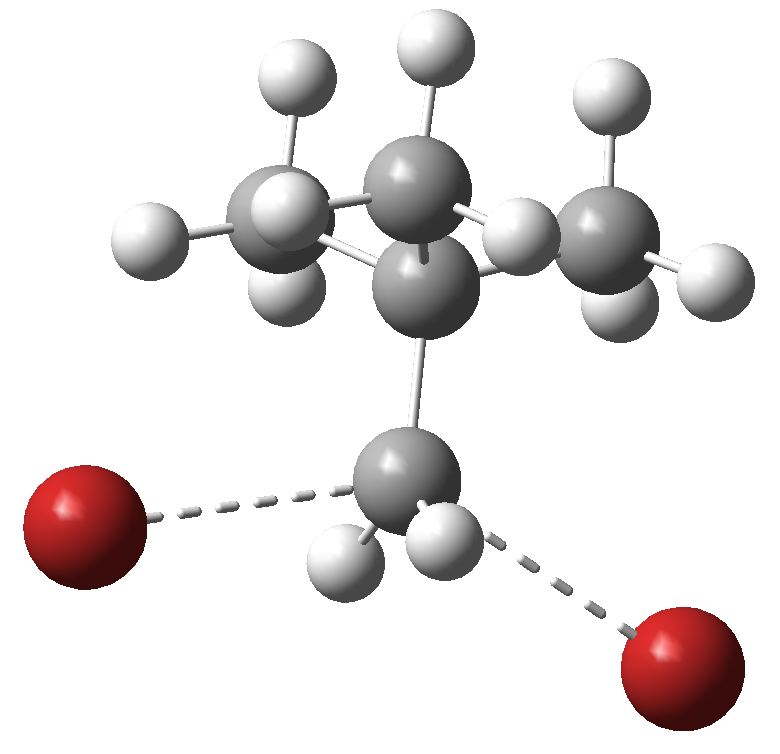
  • The Sn1…Sn2 mechanistic continuum. The special case of neopentyl bromide

    Introductory organic chemistry invariably features the mechanism of haloalkane solvolysis, and introduces both the Sn1 two-step mechanism, and the Sn2 one step mechanism to students. They are taught to balance electronic effects (the stabilization of carbocations) against steric effects in order to predict which mechanism prevails. It was whilst preparing a tutorial on this topic that I came across what was described as the special case of neopentyl bromide, the bimolecular solvolysis of which has been identified (DOI: 10.1021/ja01182a117) as being as much as 3 million times slower than methyl bromide. This is attributed to a very strong steric effect on the reaction, greater even than that which might be experienced by t-butyl bromide! Time I thought, to take a look at what might make neopentyl bromide so special, and what those supposed electronic and steric effects were really up to.

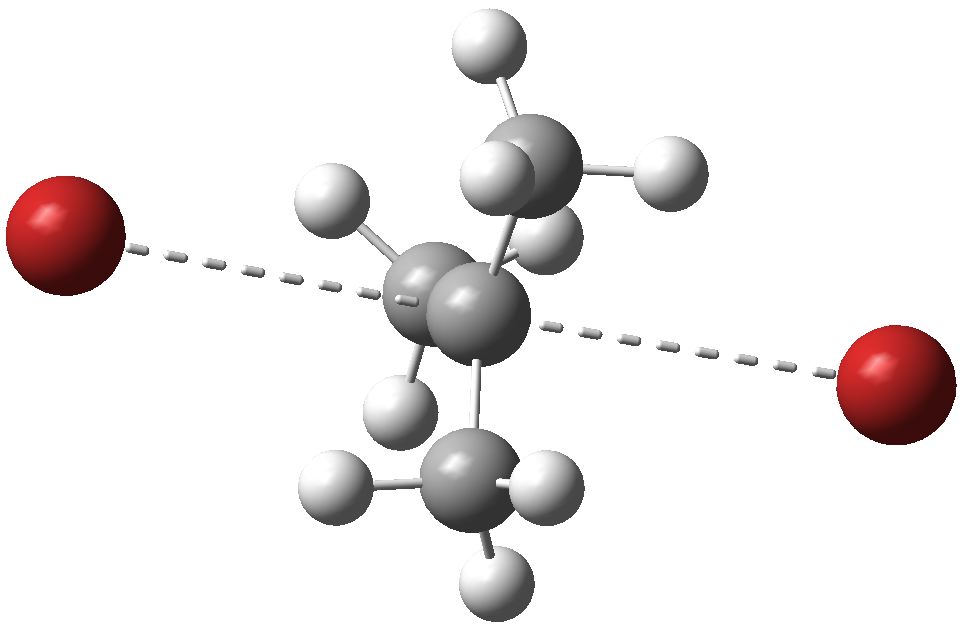
    How does one construct a quantitative model? Well, a method which incorporates both van der Waals effects (dispersion attractions) and solvation in computing a potential energy surface seems appropriate. I used ωB97XD/6-311G(d,p) with SCRF correction for methanol as solvent. This predicts the following transition state structure. The calculated (free energy) barrier from the reactant is 30.2 kcal/mol.

    Sn2 transition state structure for neopentyl bromide. Click for 3D.
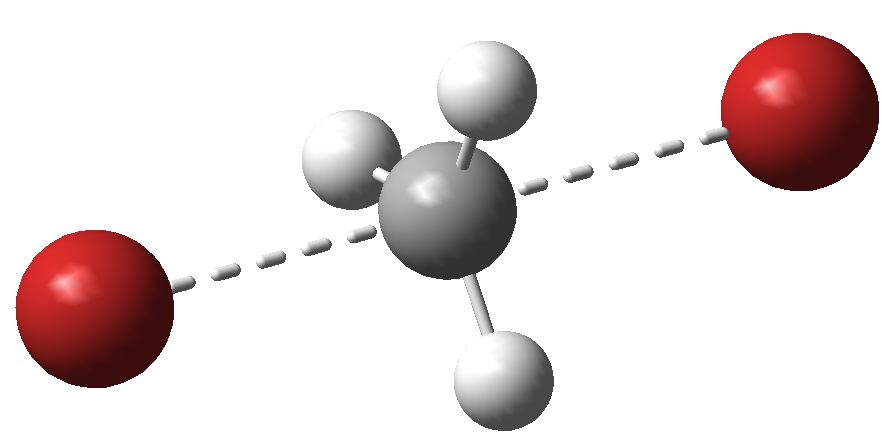
    Compare this with that for methyl bromide itself, for which a free energy barrier of 20.8 kcal/mol is calculated, a reasonably facile reaction at room temperature.

    Sn2 transition state for methyl bromide. Click for 3D.
    What do these models tell us?

    1. Firstly, the difference in free energy of activation, ΔΔG, for the two reactions is 9.4 kcal/mol. We can apply this equation: ΔΔG = -RT ln (kmethyl/kneopentyl). This comes out at around 8.3 million (at 298K). The agreement with experiment is not at all bad (in reality, one might expect a better model to include explicit hydrogen bonding from the reagants to the solvent, which are neglected in this simple model).
    2. Next, notice that whilst the transition state for methyl bromide can sustain a linear arrangement of the Br…C…Br atoms, that for neopentyl bromide is quite bent, at 140° Why is it bent? To cast light on that, we need to know the van der Waals radii for H (1.1) and Br (1.95Å), giving a sum of 3.05Å. Any contact between these two that is significantly shorter than this value could be reasonably defined as steric bumps. Indeed, inspecting the model throws up four Br…H contacts of ~2.9Å. If the Br…C…Br atoms were linearly arranged, these bumps would be far worse. So neopentyl bromide is indeed sterically hindered!
    3. But wait, how about measuring the C…Br distances in the transition states? About 2.7Å for neopentyl, but noticeably shorter at 2.5Å for methyl bromide. We can interpret that as indicating that the neopentyl bromide transition state has a little more carbocation character than methyl bromide. The extreme manifestation of that would be an ion pair, or more accurately an ion triple, such as Br(-)…C(+)…Br(-). So, as the carbocation character increases, the steric effects would decrease!
    4. But this needs further calibration. So how about t-butyl bromide. Students of course are told that for this species, there is a change in mechanism from Sn2 to Sn1. What does the computer say? The calculated structure is shown below, and it reveals a barrier of 18.9 kcal/mol, with a C-Br length of 3.43Å.
      Sn1 (Sn2) transition state for t-butyl bromide solvolysis. Click for 3D
      Well, the barrier is even lower than methyl bromide! And the C-Br distances almost 1Å longer. This supports the Br(-)…C(+)…Br(-) model, and confirms that lengthening the C-Br distance in the transition state does tend to indicate more ionic (i.e. Sn1) character. If you inspect the transition state vibrational mode, you will find another spectacular difference. For the Sn2 reaction proper, the motion is of mostly the two bromines and the central carbon. With the Sn1 mechanism, it is rotation of a methyl group (which is attempting to align with the carbocation centre being formed). This methyl motion is why such Sn1 reactions exhibit large secondary deuterium kinetic isotope effects! Again, the closest approaches between H and Br are ~ 2.9 -3.0Å, in this case very similar to the Sn2 mechanism.

    So in this simple example, we can see illustrated many interesting effects; the balance between Sn1 and Sn2, the close approaches between atom pairs that characterize steric effects, the difference between fully ionic and less ionic structures, how the reaction normal mode (coordinate) changes with this changing mechanism. The text books have not gotten it wrong, but its nice to have some numbers associated with these concepts.

  • Ferrocene

    The structure of ferrocene was famously analysed by Woodward and Wilkinson in 1952[cite]10.1021/ja01128a527[/cite],[cite]10.1016/S0022-328X(00)88947-0[/cite], symmetrically straddled in history by Pauling (1951) and Watson and Crick (1953). Quite a trio of Nobel-prize winning molecular structural analyses, all based on a large dose of intuition. The structures of both proteins and DNA succumbed to models built from simple Lewis-type molecules with covalent (and hydrogen) bonds; ferrocene is intriguingly similar and yet different. Similar because e.g. carbon via four electron pair bonds. He did not (in 1916) realise that 8 = 2(1 + 3), and that the next in sequence would be 18 = 2(1 + 3 + 5). That would have to wait for quantum mechanics, and of course inorganic chemists now call it the 18-electron rule (for an example of the 32-electron rule, or 2+6+10+14, as first suggested by Langmuir in 1921[cite]10.1126/science.54.1386.59[/cite] (see also here[cite]10.1002/anie.200604198[/cite]).
    Iron has an argon core, and 6 (of a maximum of 10) 3d electrons, 2 (of a maximum of 2) 4s, and 0 (of a maximum of 6) 4p electrons. Or, 8 = 2 + 0 + 6 rather than 18 = 2 + 6 + 10. So Woodward and Wilkinson argued that sharing a further 10 electrons would bring iron up to, in effect, a Lewis shell (albeit one using not just s and p shells, but d shells too). These 10 electrons would be provided by two cyclopentadienyl radicals. Thence a Nobel prize (for Wilkinson)! But wait!

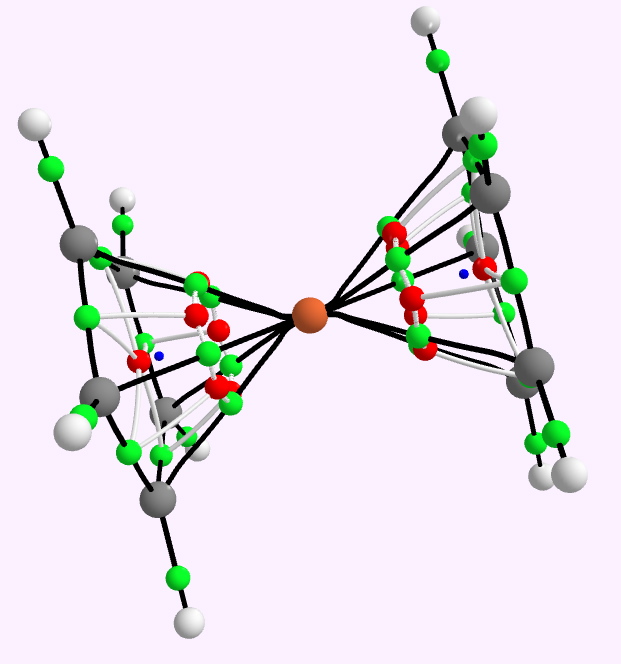
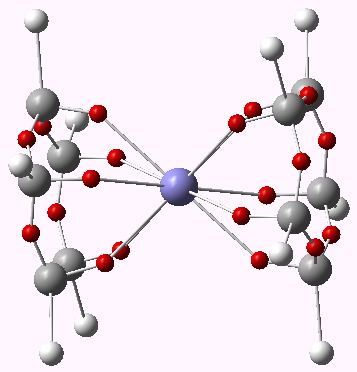
    QTAIM analysis for Ferrocene. Green=bcp, red=rrp, blue=ccp.

    Firstly, let me adjust slightly the counting above. Rather than starting with neutral Fe, we ionise it to Fe2+. Rather than starting with two cyclopentadienyl radicals, let us use two aromatic cyclopentadienyl anions. But now, Lewis' idea of covalency via shared electron pair bonds struggles. If 18 electrons really are being deployed (12 from the cyclopentadienyl anions, 6 from the Fe2+), does that imply 9 shared electron-pair bonds? How might the bonds in ferrocene be represented? This matters. Since the 1970s, the idea of searching for molecules via what is called its connectivity (a simple index which ignores bond order, and simply specifies whether two atoms are connected by a bond, any kind of bond, or not) has revolutionised searching for molecules. Think of CAS, Pubchem, REAXYS, CCDC, and SMILES and InChI. So is it useful to try to partition 9 bonds into ferrocene (it kind of difficult, since it has five-fold symmetry)? Indeed, most students trying to search for a ferrocene in any of the aforementioned databases will scratch their head over this one. The normal solution is to draw 10 bonds from the iron, one to each of the ten carbon atoms (and the databases accept this as a valid search query). But what can that mean?

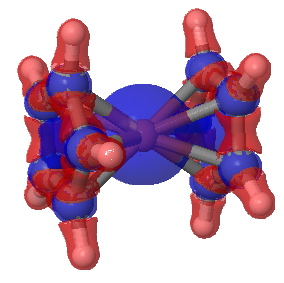
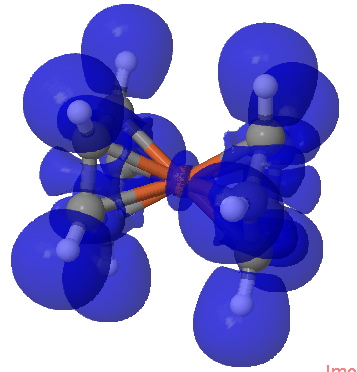
    To find out, I show here a QTAIM and an ELF analysis of the bonds (in italics, since we do not know if these conform to Lewis covalent bonds or not). The QTAIM is shown above, and it shows a bond-critical point along all ten of the Fe…C regions. The electron density, ρ(r) at each of these is 0.083 au. In truth, this is rather low, even for a single bond. The Laplacian ∇2ρ(r) at each of these points is +0.29, which is in what Hiberty and Shaik have called the charge-shift category (i.e. NOT a covalent bond). The Laplacian isosurface is shown below, contoured at 0.25, and you can see each of the bond-critical points for the ten Fe-C regions is shrouded in blue (a positive Laplacian). So, NOT a pure covalent two-electron bond of the Lewis variety then(?).

    Electronic Laplacian for ferrocene. Click for 3D
    How about how many electrons are there in these Fe-C bonds? Enter that other method known as ELF (also the subject of many blog posts here, go searching if you want to find out more).;


    Centroids of ELF basins for ferrocene. Click for 3D.
    Yes, there again are C-Fe disynaptic basins! But the integration of the basin is a measly 0.3e (of ~3.1 electrons for all ten Fe-C bonds). Of course, ELF can detect the difference between covalency and ionicity (the disynaptic basins vanish for ionic bonds), and the low basin count suggests a fair degree of the latter. The ELF function itself is pretty, and is shown below.


    ELF isosurface for ferrocene. Click for 3D
    We can see that ferrocene has departed a long way from Lewis' model of an electron pair bond, or perhaps even from the covalent bond. But at least we can be assured that the connection table often used for searching for ferrocene and its derivatives is not a fiction! Next, uranocene!

  • Why are α-helices in proteins mostly right handed?

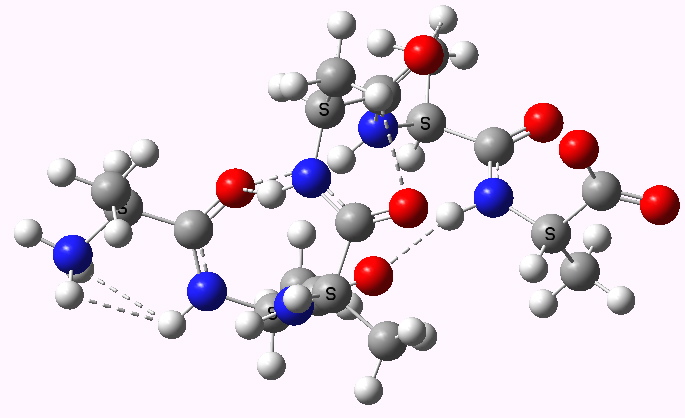
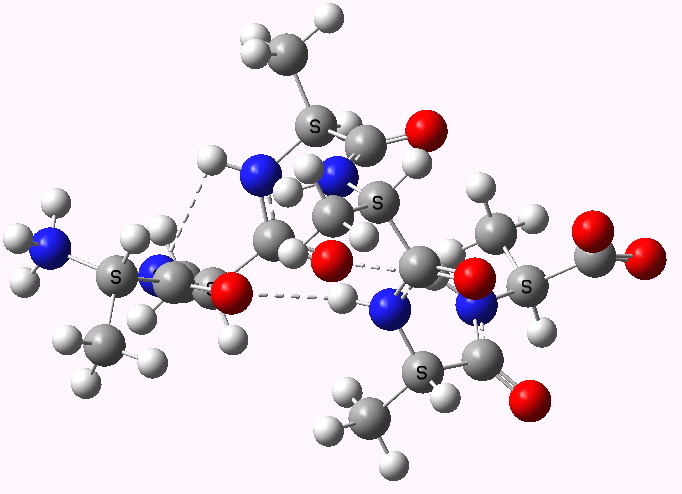
    Understanding why and how proteins fold continues to be a grand challenge in science. I have described how Wrinch in 1936 made a bold proposal for the mechanism, which however flew in the face of much of then known chemistry. Linus Pauling took most of the credit (and a Nobel prize) when in a famous paper[cite]10.1073/pnas.37.4.205[/cite] in 1951 he suggested a mechanism that involved (inter alia) the formation of what he termed α-helices. Jack Dunitz in 2001[cite]10.1002/1521-3773(20011119)40:22%3C4167::AID-ANIE4167%3E3.0.CO;2-Q[/cite] wrote a must-read article[cite]10.fgkwqb[/cite] on the topic of “Pauling’s Left-handed α-helix” (it is now known to be right handed). I thought I would revisit this famous example with a calculation of my own and here I have used the ωB97XD/6-311G(d,p) DFT procedure[cite]10.1021/ct100469b[/cite] to calculate some of the energy components of a small helix comprising (ala)6 in both left and right handed form.

    Firstly, it is important to note that Pauling was apparently not aware of the absolute handedness of amino acids (which are (S) in CIP terminology). This had in fact only been established a few months before Pauling’s publication by Bijvoet[cite]10.1038/168271a0[/cite], and news of this might not have reached Pauling. So Pauling guessed (or perhaps, he had already built his models, and did not have time to reconstruct them) and his famous α-helix diagram[cite]10.1073/pnas.37.4.205[/cite] turned out to be the enantiomer of the real McCoy. As with DNA itself, the helix bears a diastereomeric relationship to the chirality of the amino acids; both have to be inverted to get the proper enantiomer (which is what Pauling did). The secret that Pauling had discovered was hydrogen bonding, and particular, weak N-H…O=C interactions (Wrinch had thought it was strong covalent N-C-OH bonding instead). Of course, there are other effects at work, which include van der Waals or dispersion interactions, electrostatic effects resulting from the large dipoles in peptides (not least due to the zwitterionic character), the planarity of the peptide bond itself, the potential for other types of hydrogen bond (e.g. C-H…O) and entropic effects. I have split some of these down for left and right handed forms of DNA in another post.

    It turns out calculating most of these effects on an even-handed basis is not that easy. Only the recent advent of dispersion-corrected DFT procedures, together with solvation algorithms that allow for accurate geometry optimisation and subsequent evaluation of free energies allows such a calculation to be performed. Hitherto, it has been mostly molecular mechanics that has been used (which itself relies on many parameters from quantum mechanics, such as atom charges, and explicitly identifying interactions for hydrogen bonding). By returning to a quantum-mechanical model, some of these assumptions inherent in the mechanics method need not be made.

    We showed in 1991[cite]10.1039/P29910000531[/cite] that an effective solvation treatment required for the zwitterionic form of amino acids in aqueous solutions would ideally comprise not only a self-consistent-reaction-field, but also explicit water molecules as solvent. Here only the former solvation term is included, but expanding the model to include water is certainly possible. Both the zwitterionic and the neutral forms of (ala)6 are included below, so that the effect of a large dipole on the structure and relative helical stability can be estimated. One notes that (even in a dielectric cavity corresponding to water), the extended zwitterions are high energy species.  In a protein, they of course would be stabilized by the immediate environment of the ions. The right-handed helix clearly comes out as more stable (by about 1 kcal/mol per residue, see also[cite]10.1021/ja960665u[/cite] but this is not really due to either dispersion effects or entropy and must therefore arise largely from the hydrogen-bond like interactions. Ionizing the termini to form a zwitterion increases the propensity for a right handed helix slightly.

    Relative thermodynamic energies (kcal mol-1) of (ala)6 α-helices
    System Total energy Dispersion ΔΔH298 Δ(T.ΔS298) ΔΔG298
    Left, neutral 0.0
    0.0 0.0 0.0 0.0
    Right, neutral -4.0
    +0.2 -4.0 0.9 -4.9
    Left, zwitterion 0.0 0.0 0.0 0.0 0.0
    Right, zwitterion -7.1 0.1 -6.3 1.7 -8.0

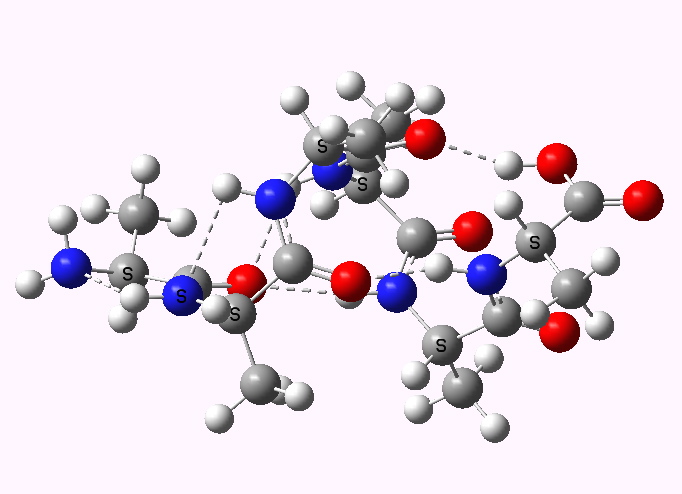
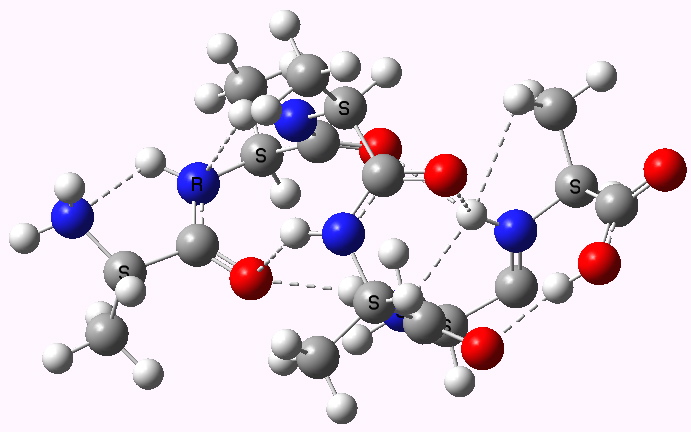
    Shown below are the calculated structures. The chains have (inter alia) unusual bifurcated hydrogen-bonding interactions, between one carbonyl group and two N-H groups (show as atom with halo). These are not quite the models that Linus Pauling built!

    Left handed. Click for 3D
    Right handed. Click for 3D
    Left handed zwitterion. Click for 3D
    Right handed zwitterion. Click for 3D

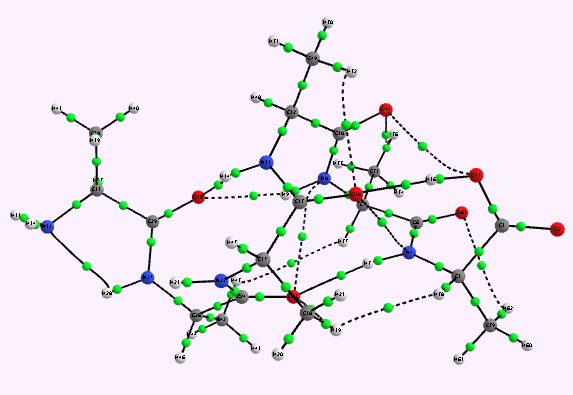
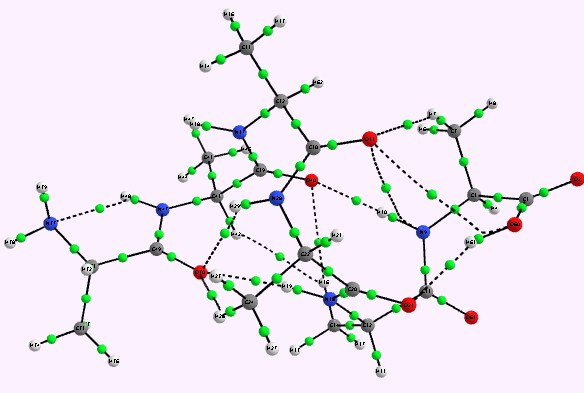
    For a more objective analysis of the interactions within the system, a QTAIM analysis is shown below.

    Left helix. Bond critical points in green. Click for 3D.
    Right helix. Click for 3D

    Whilst the overall conclusion is that theory agrees well with the experimental observation that peptide sequences tend to coil into right rather than left handed helices, the reasons they do so is a little more subtle than simple model building alone can reveal. As the AIM shows, a plethora of unusual and weaker interactions occur within these helices, a full analysis of which must await presentation elsewhere.

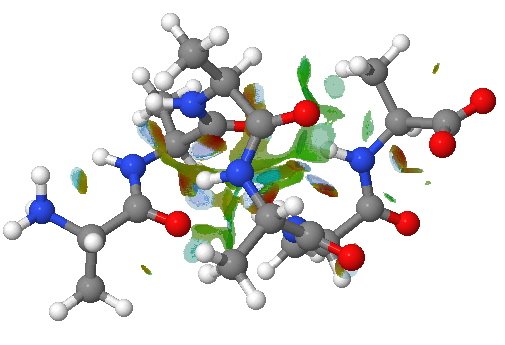
    An NCI analysis reveals strong hydrogen bonds as blue-shaded surfaces.

    NCI surface. Click for 3D.
  • The colour of Monastral blue (part 2).

    Andy Mclean posted a comment to my story of copper phthalocyanine (Monastral blue). The issue was its colour, and more specifically why this pigment has two peaks λmax 610 and 710nm making it blue. The first was accurately reproduced by calculation on the monomer, but the second was absent with such a model. Andy suggested this latter was due to stacking. Here, the calculated spectrum of a stacked dimer is explored.

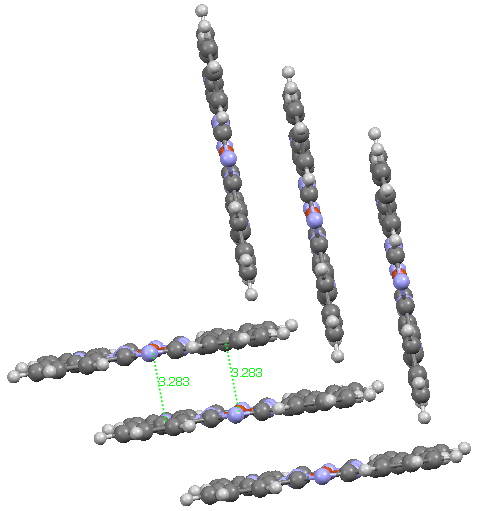
    Copper phthalocyanine, showing herring-bone stacking. Click for 3D.
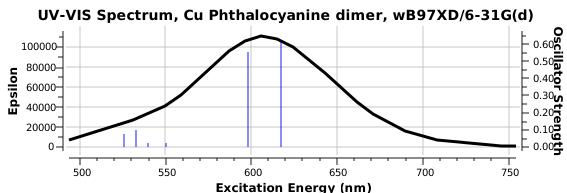
    The X-ray structure (above) shows layers of the phthalocyanine, dislocated so that the Cu of one unit aligns perfectly with a N of the units above and below the first one (Cu-N 3.28Å). This corresponds to the di-axially solvated system I explored in a comment appended to the original post. The TD-DFT calculated (since each unit is a doublet radical, the dimer was treated as a triplet state, this being much lower in energy than a singlet closed shell state)  electronic spectrum for two units, stacked above each other as shown above reveals two transitions at ~ 600 and  620 nm. This is still some way away from reproducing the measured  (solid state or solution spectra).

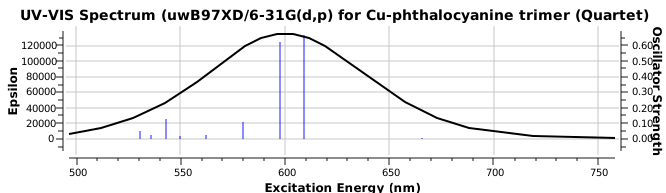
    The hypothesis must now be that the effect of such π-π stacking on the electronic spectrum converges only slowly with the degree of stacking (if indeed it is that that is the root cause of the 710nm transition). A calculation on a triple-layered model is currently under way (this being the absolute limit of what can be done without a periodic boundary model). The spectrum will be appended to this post in a week or so (see below). There is little sign of the spectrum evolving a quite separate band at 710nm. The model is still incomplete!

  • The Cyclol Hypothesis for protein structure: castles in the air.

    Most scientific theories emerge slowly, over decades, but others emerge fully formed virtually overnight as it were (think Einstein in 1905). A third category is the supernova type, burning brightly for a short while, but then vanishing (almost) without trace shortly thereafter. The structure of DNA (of which I have blogged elsewhere) belongs to the second class, whilst one of the brightest (and now entirely forgotten) examples of the supernova type concerns the structure of proteins. In 1936, it must have seemed a sure bet that the first person to come up with a successful theory of the origins of the (non-random) relatively rigid structure of proteins would inevitably win a Nobel prize. Of course this did happen for that other biologically important system, DNA, some 17 years later. Compelling structures for larger molecules providing reliable atom-atom distances based on crystallography were still in the future in 1936, and so structural theories contained a fair element of speculation and hopefully inspired guesswork (much as cosmological theories appear to have nowadays!).

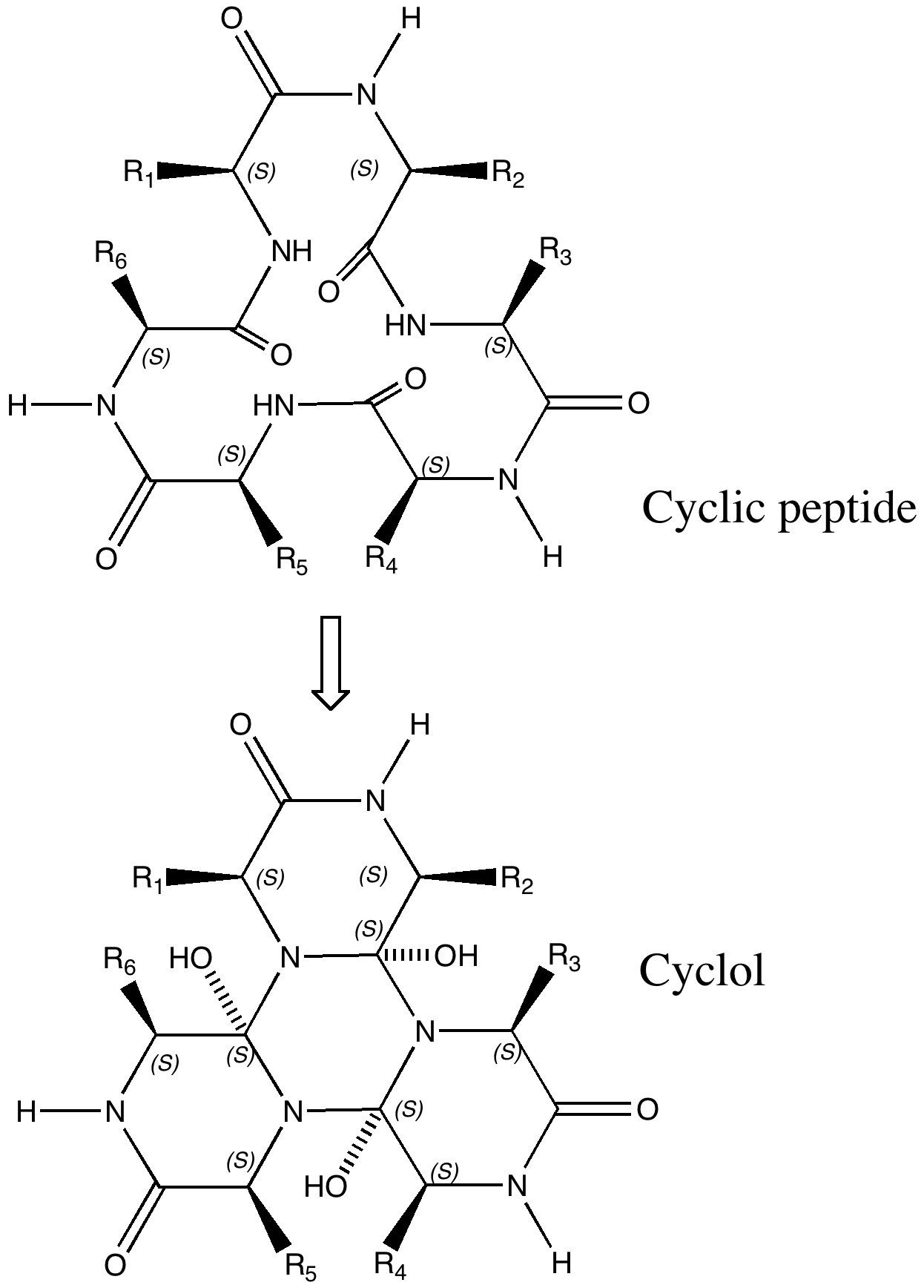
    Dorothy Wrinch was a mathematician who came up with just such a hypothesis for rigid protein structure, based in effect on elegance and symmetry, coupled with some knowledge of chemistry and crystallography[cite]10.1098/rspa.1937.0159[/cite]. She had noticed that the repeating polypeptide motif might be folded such that a cyclisation could occur to give what she termed a cyclol (an organic chemist would call this an aminol, and we would also now recognize it as a three-fold tetrahedral intermediate of the type involved in the hydrolysis of peptides). Wrinch proposed that this cyclisation could be repeated on a large scale to produce rigid scaffolds for proteins. The three-fold symmetric elegance of such motifs clearly appealed to this mathematician (the interesting symmetrical and conformational properties of the central cyclohexane-like ring were still to be fully recognised by anyone. Since Wrinch built many 3D models of her cyclols, one can but wonder how that central ring was represented, and whether its chair conformation was at all recognised. Another Nobel prize awaited the discoverer of this, Derek Barton).

    The Cyclol structure. Click for 3D.

    An immense controversy immediately broke out (not least because little direct spectroscopic evidence for the OH groups could be found). The story is rivetingly told by Patrick Coffey in his book Cathedrals of Science (ISBN 978-0-19-532134-0). Linus Pauling entered the fray in 1939[cite]10.1021/ja01876a065[/cite], and one of the arguments he deployed was not so much symmetric elegance but thermodynamics (he also suggested hydrogen bonding and  S-S linkages for rigidifying proteins). The proposed cyclisation, he suggested, led to a very high energy species. Whilst Wrinch attempted to refute this[cite]10.1021/ja01847a004[/cite], Pauling’s arguments won almost everyone over. Although Wrinch forlornly continued to promote her idea, last reviewing the topic as late as in 1963[cite]10.1038/199564a0[/cite], crystallography was now producing cast iron data for protein structures. None have ever emerged with a cyclol motif, and this hypothesis is now firmly consigned to untaught history[cite]10.1002/pro.5560060627[/cite]. To this day, no examples of the tris(aminol) cyclol ring are to be found in the Cambridge small molecule crystal structure database either, although some related tetrahedral intermediates are known as crystalline species (see for example here) and they can be quite easily characterised in solution.[cite]10.1021/ed064p725[/cite]

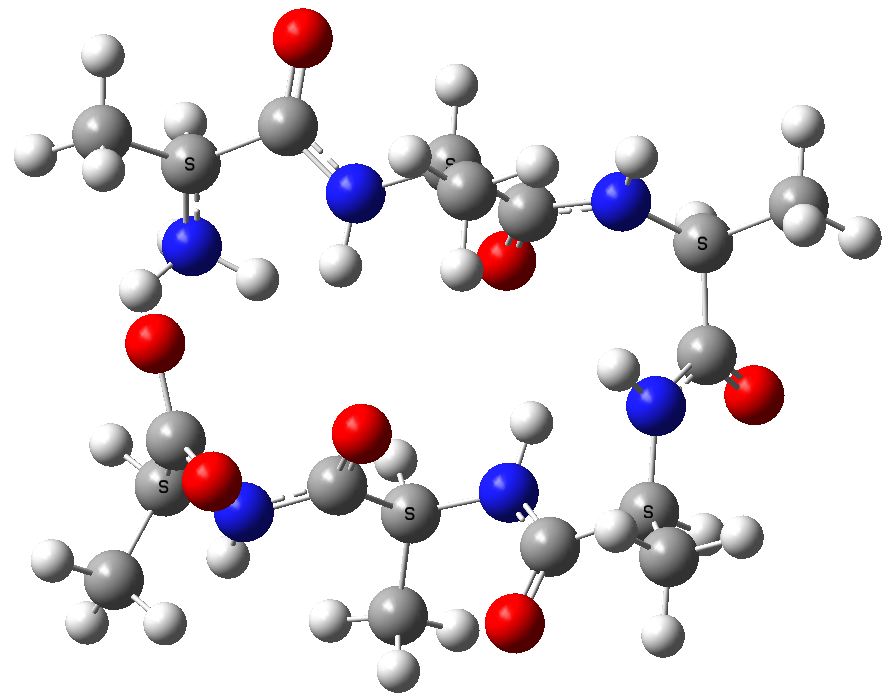
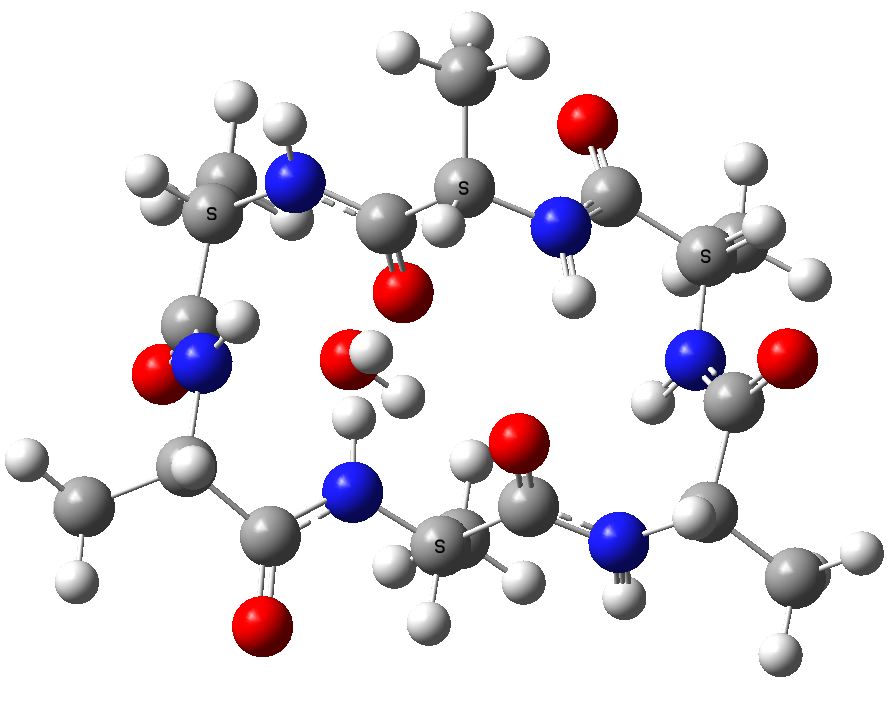
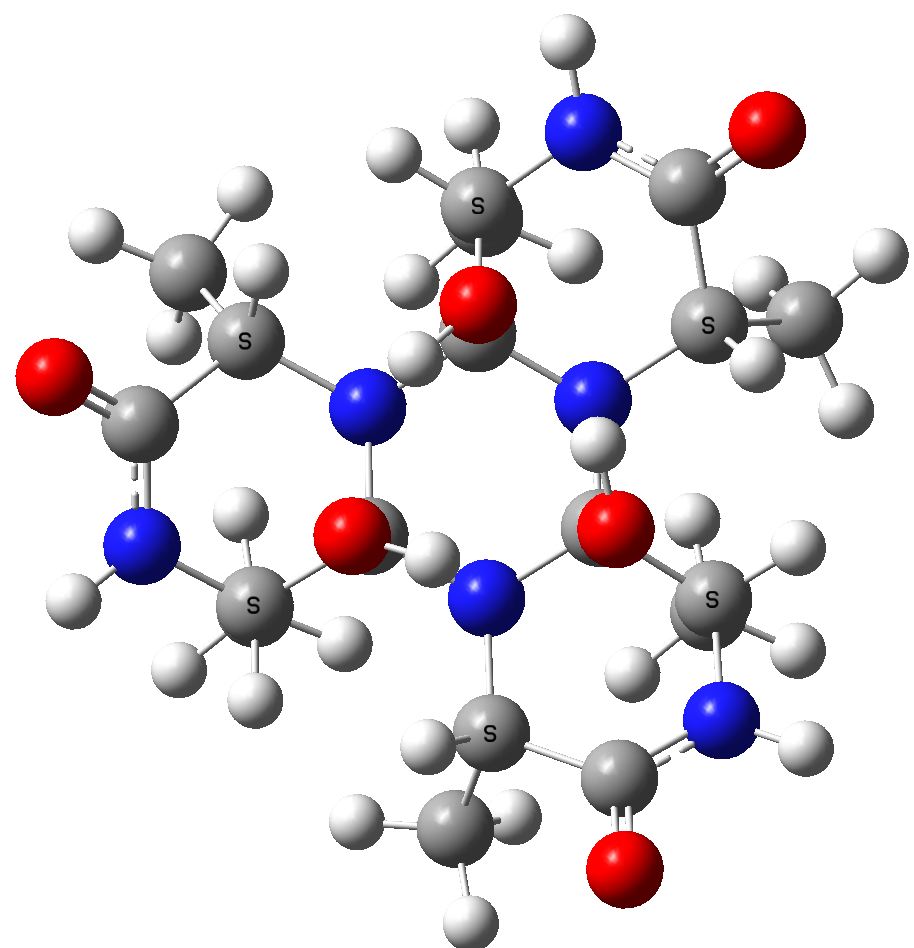
    When I read the story, it struck me that modern theory could easily verify how valid Pauling's thermodynamic argument was. I have picked (ala)6 as my model, and have calculated the relative free energy (ΔG298) of the following three isomers.

    1. An acyclic zwitterionic form of this hexapeptide, calculated with a SCRF reaction field for water to allow for the ionic nature (ωB97XD/6-31G(d,p)), reveals a proton transfer to a neutral system, with an energy of +7.3 kcal/mol
      Acyclic (ala)6, in zwitterionic form
    2. A cyclic neutral peptide, which results from elimination of water from 1, again calculated with a water reaction field[cite]10.14469/ch/8194[/cite], revealing a relative free energy of +0.0 kcal/mol
      Cyclic (ala)6
    3. The cyclic isomer 3 resulting from further cyclisation of 2[cite]10.14469/ch/8197[/cite] with a relative free energy of +69.0 kcal/mol
      Cyclol model for (ala)6.

    From this, it appears that model 3 is ~69 kcal/mol less stable than the cyclic peptide 2, or 11.6 kcal/mol per amino acid residue. Pauling's thermodynamic arguments suggested a value of ~28 kcal/mol per residue (a value which Wrinch disputed as unreliable). So, in one sense, the above calculation is closer to Wrinch than to Pauling! In another, it still means Wrinch was wrong!! It is worth speculating why Pauling's estimate is out. The cyclol 3 exhibits anomeric stabilizations, which of course were unknown in Pauling's time. Both 2 and 3 exhibit attractive, but different, van der Waals attractions which contribute to their stabilities and Pauling took no account of any entropy differences between 2 and 3. In retrospect,  3 was simply too rigid to allow most enzyme catalysis models to function, as we recognise them nowadays.

    You might ask why I have revived a long forgotten theory as the topic of this post. Well, I think it is always worth revisiting the past, and re-examining old assumptions. When we do so, we find that Wrinch did not miss by as much as her detractors perhaps implied. With a little more luck, she might have gotten it right. Science is a bit like that, you need a dose of luck sometimes!


  • Monastral: the colour of blue

    The story of Monastral is not about a character in the Magic flute, but is a classic of chemical serendipity, collaboration between industry and university, theoretical influence, and of much else. Fortunately, much of that story is actually recorded on film (itself a unique archive dating from 1933 and being one of the  very first colour films in existence!). Patrick Linstead, a young chemist then (he eventually rose to become rector of Imperial College) tells the story himself here. It is well worth watching, if only for its innocent social commentary on the English class system (and an attitude to laboratory safety that should not be copied nowadays). Here I will comment only on its colour and its aromaticity.

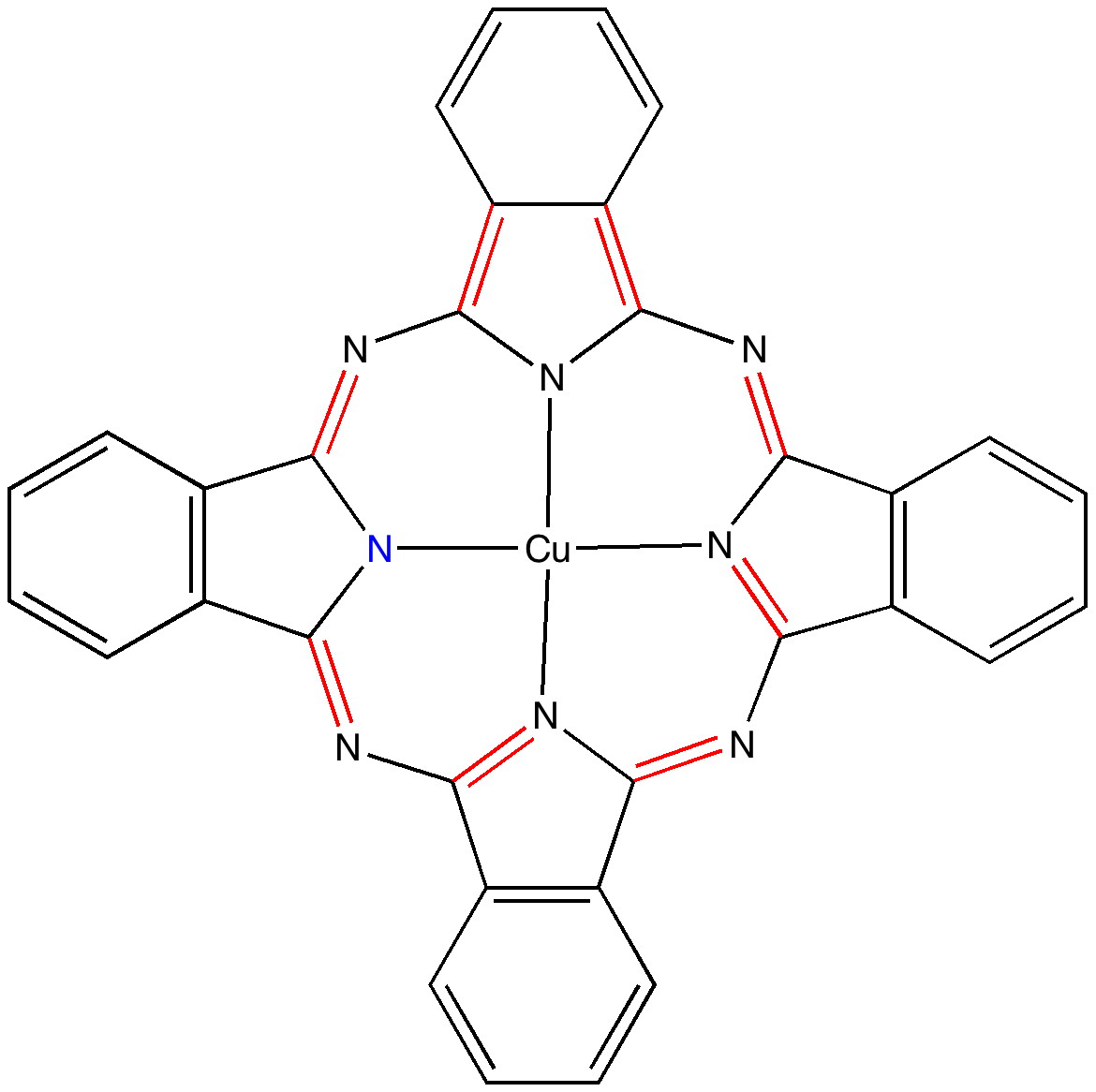
    Copper phthalocyanine

    In 1933, Hückel was still thinking about his molecular orbital electronic theory of benzene, but for ~15 years, there remained little need for the rule we now know as 4n+2, because n was invariably equal to 1 for most known aromatic molecules! It was only the discovery of so-called non-benzenoid aromatics in the 1940s (e.g. Dewar’s tropolone structure) that propelled chemists to identify aromatic molecules with other values of n. And Monastral blue is a prime example of n=4 (although it would be of interest to find out when it became so associated with the Hückel rule). If you count the red bonds above, there are eight, along with one lone pair of electrons located on the highlighted (blue) nitrogen atom. This makes 18 π-electrons in the ring, or 4×4+2 (there are paths other than the one shown, but they give the same count). Part of the reason for the remarkable thermal stability of this molecule must be its aromaticity.

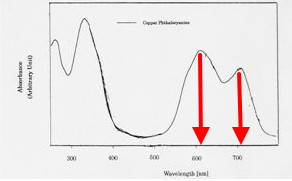
    So what about the colour? The visible spectrum is shown below, with λmax ~ 610 and 710nm.

    Visible absorption spectrum of copper phthalocyanine.

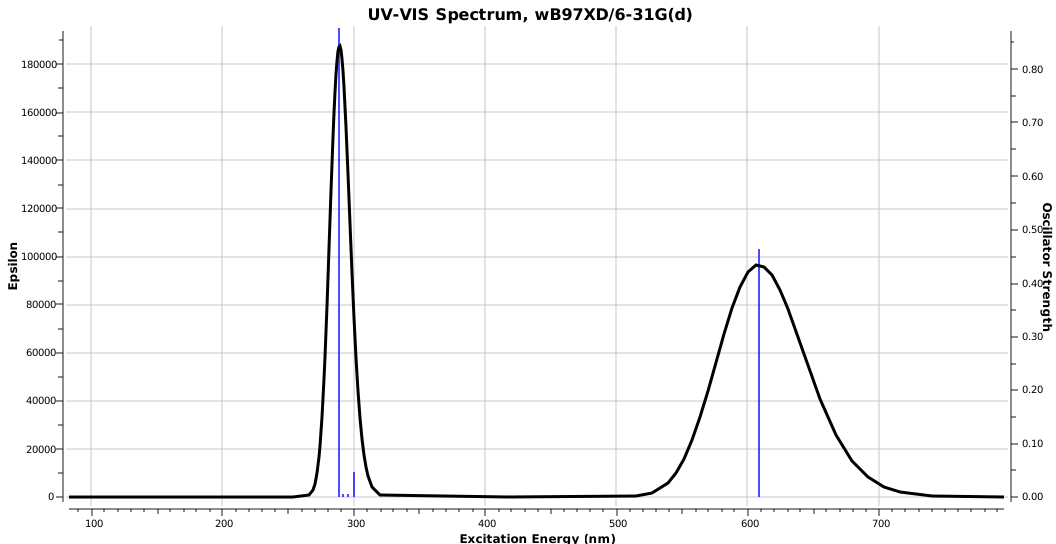
    Well, a TD-DFT ωB97Xd/6-31G(d) calculation reveals the following. This reproduces the band at 610nm very nicely, but leaves the identity of the band at  710nm mysterious. How does that originate? One might speculate that this could arise from the presence of another species. Thus copper phthalocyanine itself is neutral, but it could easily be oxidised to a cation, and this could then form a  1:1 π-complex with a second molecule of the neutral radical (DOI:10.1021/ja00238a021 )

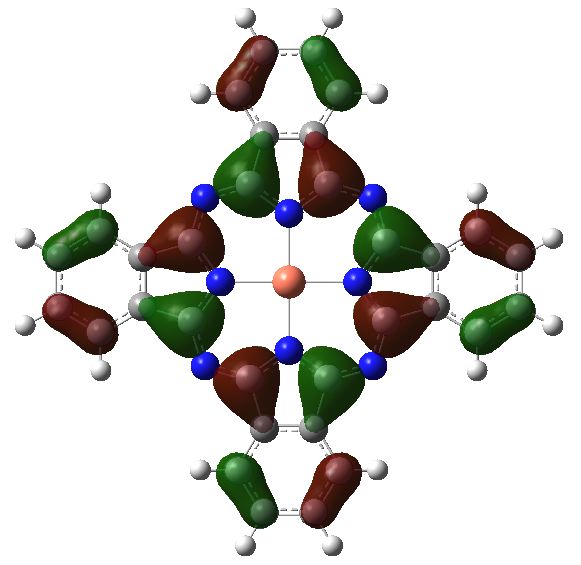
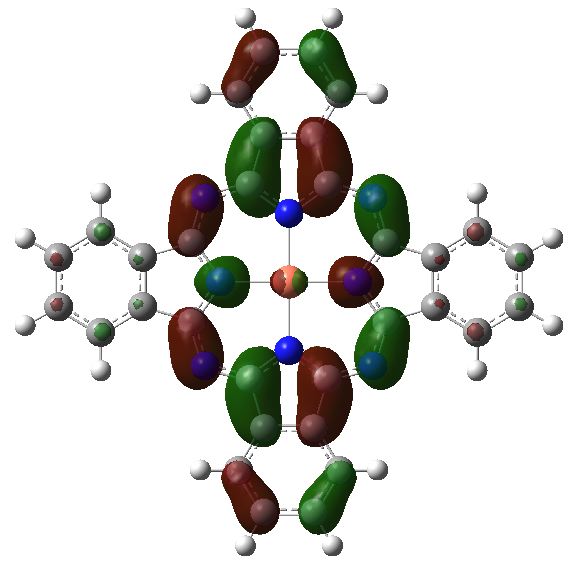
    The electronic excitation at ~610nm arises from the following MOs:

    Orbital 147, the highest occupied MO (HOMO). Click for 3D
    Orbital 148, the lowest unoccupied MO. Click for 3D

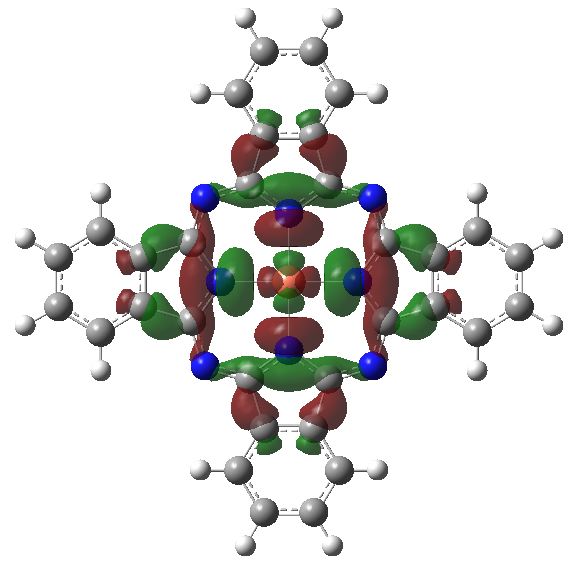
    The unpaired electron in copper phthalocyanine occupies the following rather interesting orbital, which appears not to be involved in its blue colour.

    Orbital 146. The singly occupied MO. Click for 3D

    So, just as with mauveine, a mystery remains. The colour of Monastral blue is not monochromatic, in that it appears to be caused by two bands in the 600-700 region. Calculation however reveals it to have only one band at 610nm. What is the other one?

  • The colour of purple

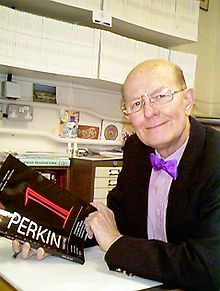
    One of my chemical heroes is William Perkin, who in 1856 famously (and accidentally) made the dye mauveine as an 18 year old whilst a student of August von Hofmann, the founder of the Royal College of Chemistry (at what is now  Imperial College London). Perkin went on to found the British synthetic dyestuffs and perfumeries industries. The photo below shows Charles Rees, who was for many years the Hofmann professor of organic chemistry at the very same institute as Perkin and Hofmann himself, wearing his mauveine tie. A colleague, who is about to give a talk on mauveine, asked if I knew why it was, well so very mauve. It is a tad bright for today’s tastes!

    Charles Rees, wearing a bow tie dyed with (Perkin original) mauveine and holding a journal named after Perkin.

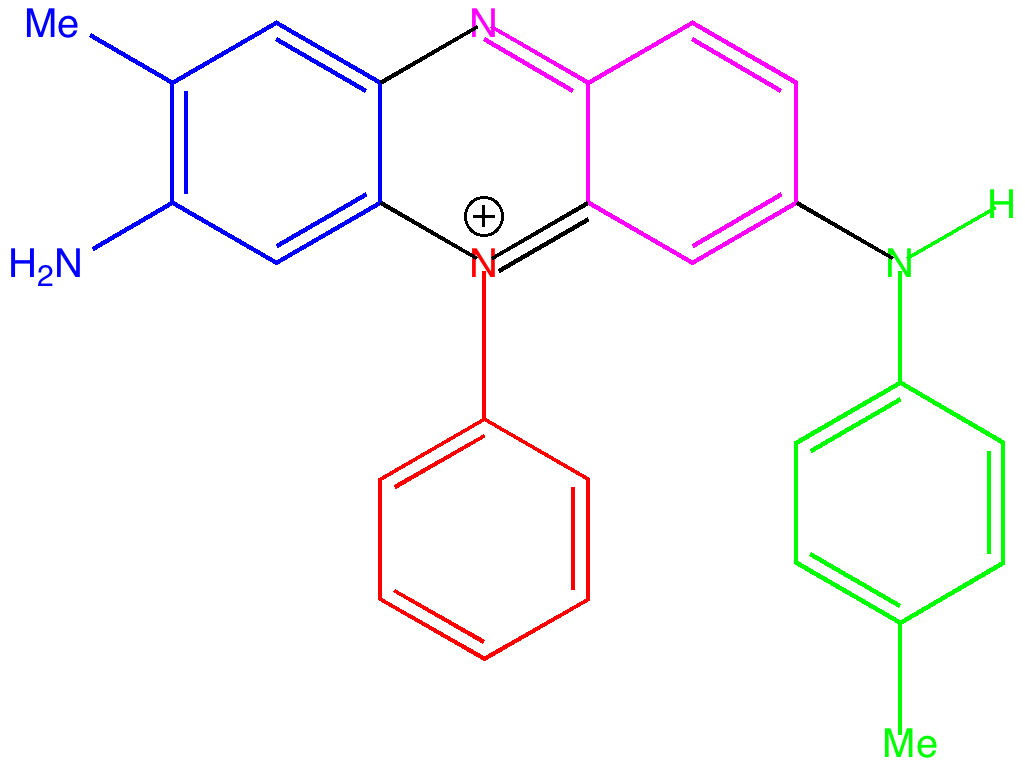
    The first thing to note about mauveine is that it is not a single compound; actual samples can contain up to 13 different forms! These all vary in the number of methyl groups present which range from none up to four, in various positions. These compounds all have absorption maxima λmax in the range 540-550nm, the colour of purple. The structure of one of these, known as mauveine A, is shown below.

    Mauveine A. Click to load 3D
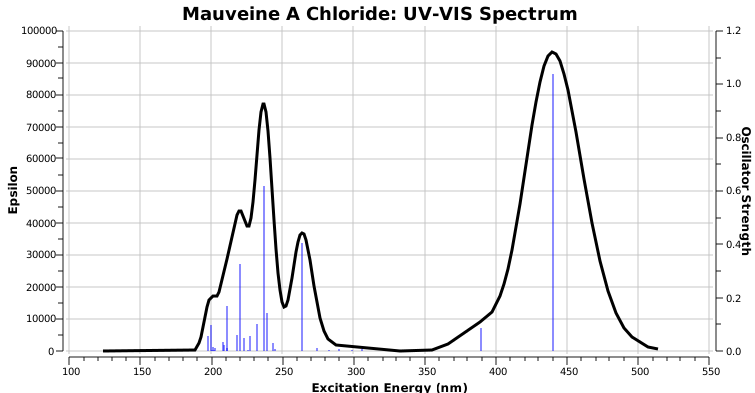
    You can see from this that something is missing. The so-called chromophore is a cation, and an anion needs to be provided to balance the charge. We will now attempt to predict the color of purple using purely the power of quantum mechanics (for many years, accurate prediction of colour was a holy grail amongst dye chemists for obvious reasons). The anion can be chloride, and the colour is often measured in methanol as solvent. So the first task is to calculate this ion-pair. This used to be easier said than done (and in the past, the anion was often simply neglected). But using the ωB97XD density functional procedure (to get the van der Waals interactions modelled correctly) and a 6-311++G(d,p) basis set, coupled with a smoothed-cavity continuum solvation procedure, and two molecules of water (standing in for methanol, which is a bit bigger) as explicit solvent molecules, we get the structure apparent when you click on the diagram above (DOI: 10042/to-7320). Application of time-dependent density function theory (TD-DFT) gives a measure of the UV-optical spectrum (below, loaded as a scaleable SVG image. If you are using a modern browser, it should display. If not, try the latest FireFox, Chrome, Safari etc).


    This has several noteworthy aspects.

    1. The visible (right hand side) part of the spectrum is very monochromatic, with λmax ~440nm. In other words, mauveine has a pure and intense colour.
    2. This λmax is hardly affected by the presence of the counterion.
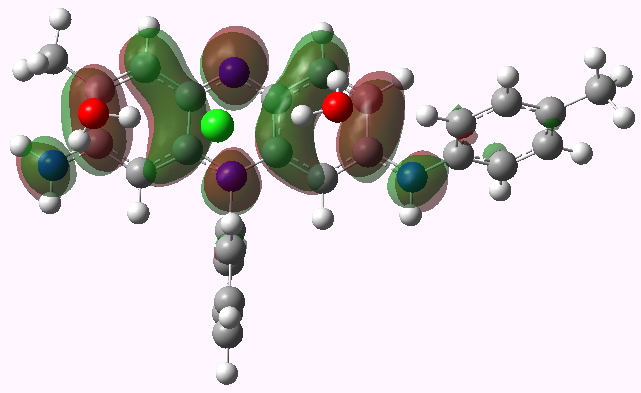
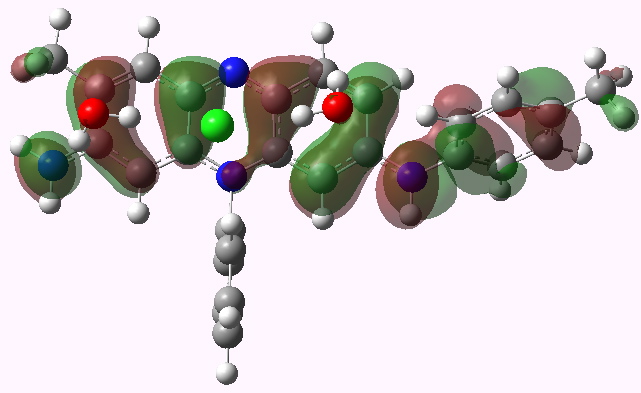
    3. The electronic transition responsible for this band is a simple HOMO (highest-occupied-molecular-orbital) to LUMO (lowest-unoccupied-molecular-orbital) excitation of an electron.
    4. These orbitals are shown below.
      LUMO HOMO
      Mauveine A. LUMO. Click for 3D
      Mauveine A. HOMO. Click for 3D
    5. Note how the excitation involves the central region of the molecule, and one of the pendant aryl groups, but not the other. One might presume that tuning the colour would only work if changes are made to the first of these aryl groups.
    6. There is a real mystery about the calculated value of λmax, which differs from the observed value by about 100nm (the wrong colour, making mauveine orange rather than purple). Normally, this sort of time dependent density functional theory has errors no greater than 15-20nm. The calculated value of λmax is not sensitive to the basis set, or the presence or not of the counter ion and solvent. Clearly, a discrepancy of this magnitude must have some other explanation. Watch this space!

    So this post ends with a bit of a mystery. The fanciest most modern computational theory gets the colour of mauveine wrong by ~100nm. Why?

  • A short history of molecular modelling: 1860-1890.

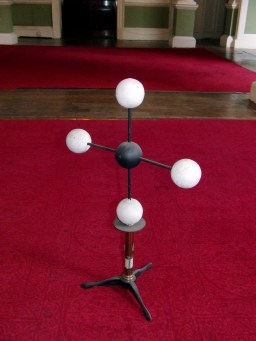
    In 1953, the model of the DNA molecule led to what has become regarded as the most famous scientific diagram of the 20th century. It had all started 93 years earlier in 1860, at a time when the tetravalency of carbon was only just established (by William Odling) and the concept of atoms as real entities was to remain controversial for another 45 years (for example Faraday, perhaps the most famous scientist alive in 1860 did not believe atoms were real). So the idea of constructing a molecular model from atoms as the basis for understanding chemical behaviour was perhaps bolder than we might think. It is shown below, part of a set built for August Wilhelm von Hofmann as part of the lectures he delivered at the Royal College of Chemistry in London (now Imperial College).

    The original August Wilhelm von Hofmann molecular model, located in the archives at the Royal institution, London and used by Hofmann in his 1865 lecture there

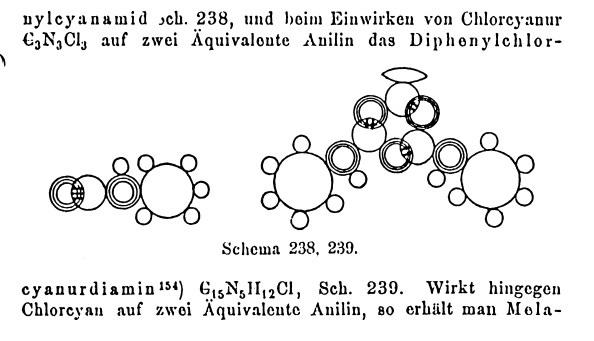
    This grand-daddy of all molecular models does have some interesting features. The most obvious is that the carbon atom at the centre is square planar (tetrahedral carbon was still 14 years in the future). What HAS survived to the present day is the colour scheme used (black=carbon, white=hydrogen, and not shown here, red=oxygen, blue=nitrogen, green=chlorine).  But another noteworthy aspect is the relative size of the white hydrogen, which is larger than the black carbon. This deficiency was however very soon rectified in 1861 by Josef Loschmidt, who published  a famous pamphlet in which he set out his ideas for the structures of more than  270 molecules (many of which by the way were cyclic, and this some four years before Kekule’s dream!). An example (#239) is shown below, which gets the relative sizes of the atoms more or less correct (OK, chlorine is shown with rather an odd shape). To get an idea of how good Loschmidt’s model actually was, click on the diagram to load a modern model, and compare the two! Even more impressive, these diagrams pre-date van der Waals work on the finite sizes of atoms, first presented in 1873.

    Loschmidt’s molecular models. Click for 3D

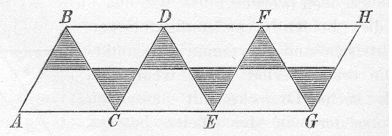
    To conclude, I cannot resist showing one more model. Hermann Sachse believed cyclohexane could not be planar. To try to convince people, in 1890 he included a  “flat-packed” model in the pages of a journal article,  evidently believing that people would cut it out, and assemble it into a 3D shape.

    Flat-packed molecular model of cyclohexane

    You might have noticed a theme in the present blog of presenting 3D models for many of the molecules I discuss (include the Loschmidt one above). For the historians amongst you, I note our 1995 article in which we updated[cite]10.1039/P29950000007[/cite] Sachse’s origami with an article featuring how to incorporate interactive models into journals (still sadly only too rare). Perhaps a history of the molecular model, and how it has been presented over 150 years might be an interesting one to trace!


    Acknowledgments

    This post has been cross-posted in PDF format at Authorea.

  • The handedness of DNA: an unheralded connection.

    Science is about making connections. Plenty are on show in Watson and Crick’s famous 1953 article on the structure of DNA[cite]10.1038/171737a0[/cite] but often with the tersest of explanations. Take for example their statement “Both chains follow right-handed helices“. Where did that come from? This post will explore the subtle implications of that remark (and how in one aspect they did not quite get it right!).

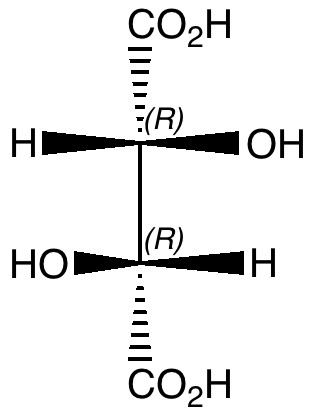
    The right handed helix is illustrated in the article cited above as perhaps the most famous scientific diagram of the 20th century (as recounted in the TV program by Marcus du Sautoy). It was drawn by Odile Crick, a professional artist, and it is easily her best known work (the original, sadly, appears lost). Many say it has never been bettered; I do not reproduce it here for fear of copyright infringement, but you can see Odile (who died only recently) and her diagram here. One however has to go to the Watson-Crick (WC) full paper[cite]10.1098/rspa.1954.0101[/cite] for an explanation of why they decided the helix was right-handed, or (P)- in CIP terminology.[cite]10.1002/anie.196603851[/cite] In my opinion (as a chemist), this is a far better read than the short and more famous note in Nature. There (on page 87) one finds the immortal statement “we find by trial and error that the model can only be built in a right-handed sense”. They follow that remark with another which I will quote later in this post. But the preceding observation is footnoted, and that footnote must rank as one of the most unheralded in science (unlike e.g. Fermat’s). For this footnote notes another article, published just two years earlier[cite]10.1038/168271a0[/cite] in which the absolute handedness of a small molecule was finally confirmed after ~50 years. The molecule is shown below, and again in modern CIP terminology, the two chiral carbon atoms both have (R) configurations rather than (S). Until this point, the (R) configuration had merely been a guess with an evens chance of it being right (and had it been wrong, imagine how many textbook diagrams would have needed changing!).

    The absolute configuration of natural tartaric acid.

    Chemists had, in the preceding 50 years, by synthesis and transformation, connected the configuration of tartrate to the ribose sugars that form the linker in DNA, and so Watson and Crick built their famous model of DNA assured in the knowledge that the absolute configuration of their ribose sugar was correct. But that assurance, it is important to remember, had only come two years earlier! The (correct) structure of DNA was very much a discovery of its time, and this connection between tartrate and DNA I think deserves the accolade of great connections in science (I write this in the Semantic Web sense).

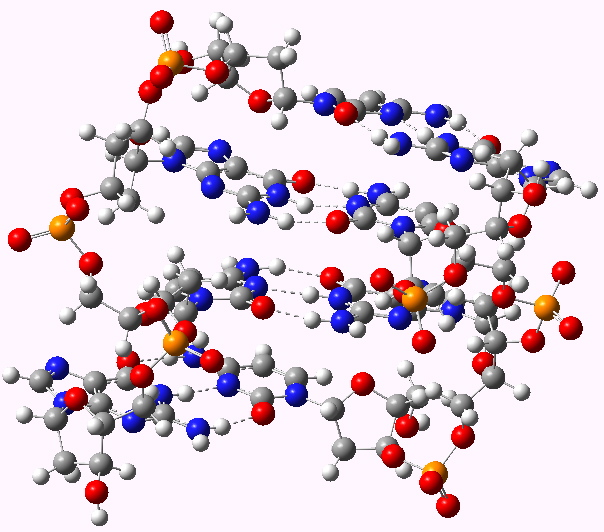
    On to another statement to be found in the full WC article: “Left handed helices can only be constructed by violating the permissible van der Waals contacts” Given the nature of the molecular model building tools that WC[cite]10.1039/JR9480000340[/cite] had at their disposal,* I suspect we must forgive them this assertion.[cite]10.1016/0022-2836(79)90506-0[/cite],[cite]10.1038/287755a0[/cite] But of course, building models using the van der Waals constraints (amongst others of course) is what modern computers are really very good at. So what might a modern visitation of this very issue yield? Shown below is a small DNA duplex, named d(CGCG)2 (DOI: 10.2210/pdb1zna/pdb) This uses only the CG base-pairing motif (the other of course is AT). Well, it turns out that DNA constructed from CG-rich duplexes does NOT necessarily adopt a right handed helix after all! WC (for this particular condition) were in fact wrong, and clearly the van der Waals contacts are not after all objectionable. Left-handed helices (as a left hander myself, I am naturally drawn to them) are also known as Z-DNA (the right handed form is called B-DNA), although many left-handed representations have in fact been drawn in error.


    The DNA duplex d(CGCG) showing a left handed helix. The ribose is in the 2E conformation. Click for 3D and see if you can find any objectionable van der Waals contacts!

    The model when stripped of its water molecules, is then of a size (250 atoms) which is easily amenable to a modern quantum-mechanical DFT calculation. Importantly, this has to include dispersion corrections (the van der Waals contacts referred to above) to get the correct geometry, and one can use e.g. ωB97XD/6-31G(d) + continuum water solvation correction to compensate for the missing waters[cite]10.1039/C0CC04023A[/cite] for an example of its use for a large molecule, or indeed this post). In truth, this combination of characteristics in a model has only recently become possible for a molecule of such size.

    Well, now that a good accuracy wavefunction for e.g. d(CGCG) is possible, what might one do with it? Well, the chiro-optical properties might be calculated[cite]10.1002/chir.20804[/cite] including the optical rotation at a specified frequency, or e.g. the electronic circular dichroism spectrum. Such properties are normally computed only for much smaller molecules. Watch this space (or the journals).


    * Note added in proof (as the saying goes): This article[cite]10.1039/JR9480000340[/cite] by Derek Barton published in 1947, some six years before WC claimed “violation of  the permissible van der Waals contacts“, established clearly the principles behind the model building by WC and in many ways could be described as the start of quantitative molecular model building. The very same equation used by Barton to model dispersion attractions is still used in e.g. the ωB97XD DFT method noted above.