Tag: Historical

  • Henry Armstrong: almost an electronic theory of chemistry!

    Henry Armstrong studied at the Royal College of Chemistry from 1865-7 and spent his subsequent career as an organic chemist at the Central College of the Imperial college of Science and technology until he retired in 1912. He spent the rest of his long life railing against the state of modern chemistry, saving much of his vitriol against (inter alia) the absurdity of ions, electronic theory in chemistry, quantum mechanics and nuclear bombardment in physics. He snarled at Robinson’s and Ingold’s new invention (ca 1926-1930) of electronic arrow pushing with the put down “bent arrows never hit their marks“.  He was dismissed as an “old fogy, stuck in a time warp about 1894.” So why on earth would I want to write about him? Read on…

    He did worthy (nowadays this could mean dull) chemistry on e.g. naphthalenes, but I want to focus on two articles from the period 1887-1890[cite]10.1039/CT8875100258[/cite],[cite]10.1039/PL8900600095[/cite]. Let me set the scene by reminding of an earlier post showing the structure of a bis(stilbyl)ketone, dated 1921. The two aromatic groups (yes, they really are such) are drawn in the manner we would nowadays draw cyclohexane. This practice in fact continued in texts and articles for perhaps 30 more years! Not much sign of electronic accounting there then! And by a professor at Imperial College no less, where Armstrong had been.
    Aromatic molecule, circa 1921

    So when would you date the diagrams below? So called Clar representations, originating from the 1950s? The one on the bottom below cites Clar and dates from 2010[cite]10.3390/sym2031653[/cite], but the one above it comes from Armstrong’s 1890 article!
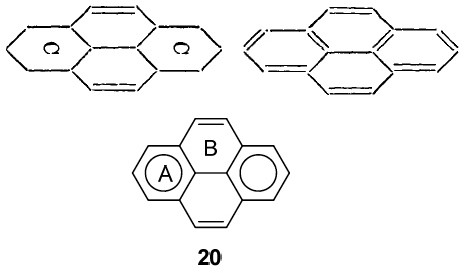
    Two representations of pyrene, 2010 and 1890.

    Clar representations are used to count electrons (as coming in six packs). But there is little doubt that Armstrong’s use of a “C” (or inner circle, which is exactly what it is) means six as well. The evidence I present below, taken from his 1887 article.
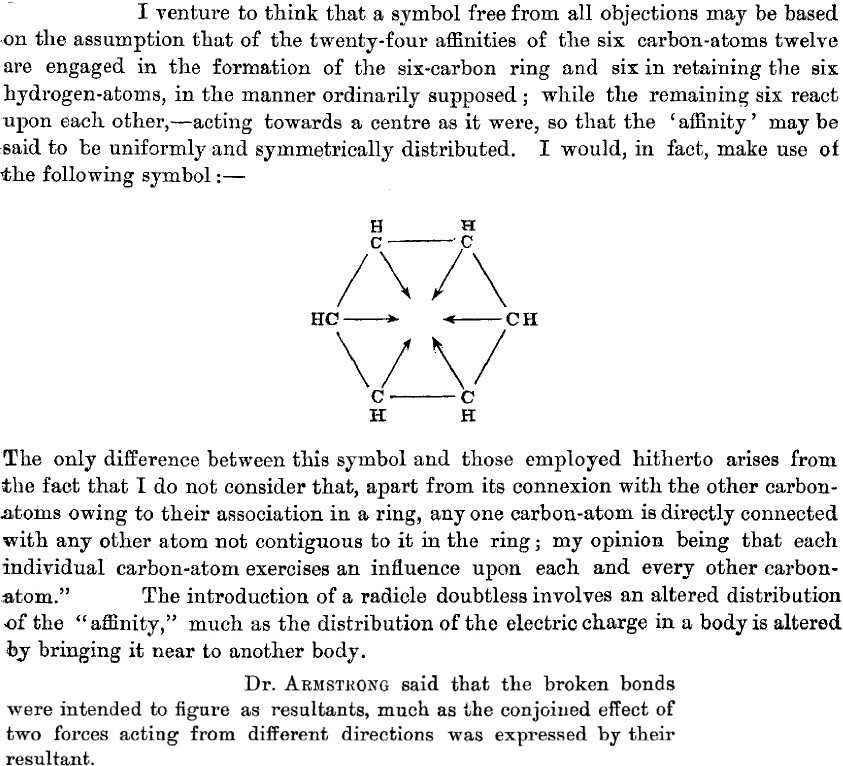
    Armstrong’s six-pack
    1. He counts the six carbons as having a total of 24 what he calls affinities (definition: An attraction or force between particles that causes them to combine), or four per carbon. Let us make life easy and equate affinity=electron (remember, the electron itself was not yet discovered or named!). He disposes of 12 affinities/electrons to form what we now call six carbon-carbon σ bonds, and a further six for the  six C-H bonds.
    2. He is left with exactly six affinities/electrons, which he presupposes to act upon each other, in the manner of resultants (the old term for vectors). In fact, he replaces these six vectors by a circle (the inner circle) in his second article of 1890.
    3. He invents delocalization in all but name when he states that any one atom has an influence on other atoms not contiguous to it in the ring (he really did have o/m/p directing influence in mind here).
    4. He compares the introduction of a substituent (R, which comes from the old name Radicle) perturbing the distribution of the affinity to how electric charges perturb each other. So, the affinity behaves as if it might have electrical (from which the name electron came of course) properties? And it might be described by a vector?
    5. Remember, this is a scientist who in later life did not believe in electronic theories of chemistry? Really? Well, again in 1890:
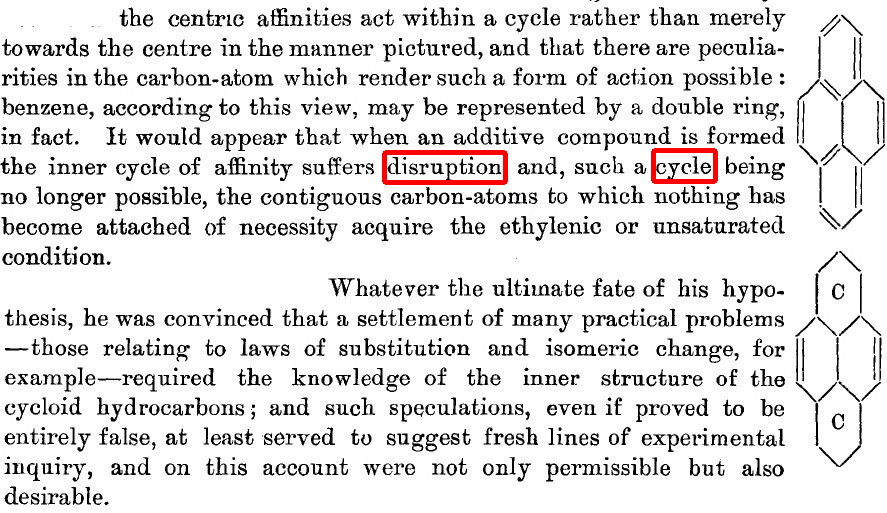
    Is this an affinity (=electronic) theory of chemistry?
    1. Here, he is refining his vector representation of affinities, saying that these vectors in effect define a circle, an inner circle no less. One that can be disrupted  (Robinson some 30 years later wrote[cite]10.1039/CT925270160[/cite] of how the cycle of six electrons are able to form a group that resists disruption) when an additive compound is formed (his examples are all electrophiles, what we now call electrophilic addition) such that the remaining carbons become merely unsaturated. There seems little doubt he is describing what we now call a Wheland Intermediate.
    2. Is this really a man who did not believe in electronic theories of chemistry? What about that concluding paragraph then? The laws of substitution require a knowledge of the inner structure of (what we now call the aromatic) hydrocarbons?
    3. And that such speculations may suggest fresh lines of experimental inquiry? This all sounds very much like the modern use of quantum mechanics and its electronic eigenvectors to describe the probability distribution of electrons (remember, Armstrong did not approve of this either) to probe the inner structure of molecules and to suggest new experiments.

    We have a real mystery. Armstrong got so very close to a modern theory of chemistry. Was he asleep when Stoney named the electron around 1891 and Thomson discovered it in 1897? If only he had followed his own advice! Ah well, just as well he was ignored in the 20th century when he preached against it all.


    W. H. Brock, “The case of the Poisonous Socks”, chapter 20, RSC Publishing, 2011, 978-1-84973-324-3 Clar, E. The Aromatic Sextet; Wiley: New York, NY, USA, 1972.

  • Computers 1967-2011: a personal perspective. Part 4. Moore’s Law and Molecules.

    Moore’s law describes a long-term trend in the evolution of computing hardware, and it is often interpreted in terms of processing speed. Here I chart this rise in terms of the size of computable molecules. By computable I mean specifically how long it takes to predict the geometry of a given molecule using a quantum mechanical procedure.

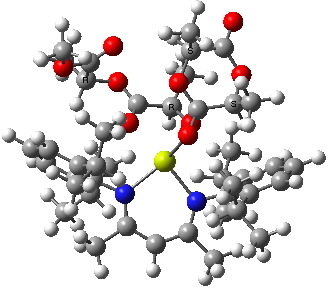
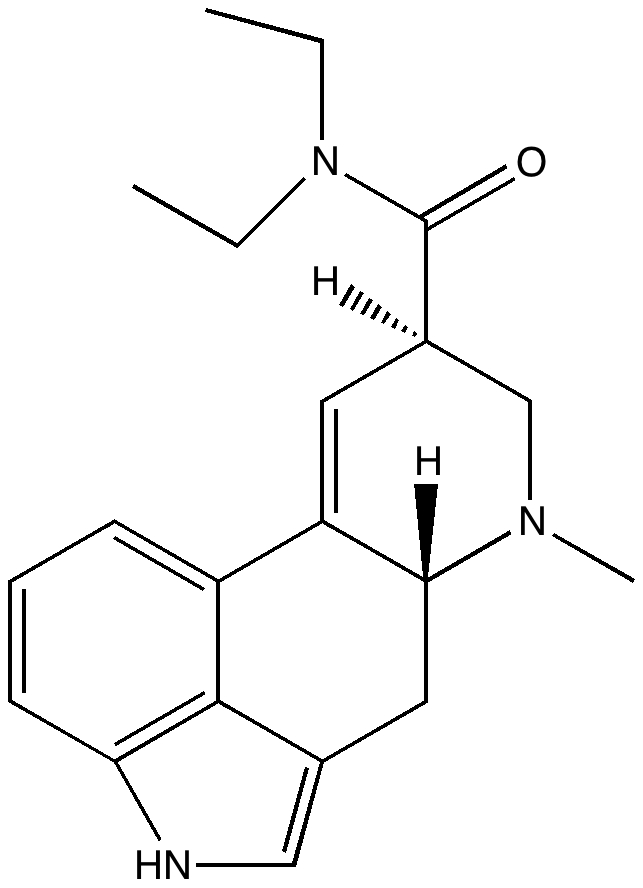
    LSD, the 1975 benchmark for computable molecules.

    The geometry (shape) of a molecule is defined by 3N-6 variables, where N is the number of atoms it contains. Optimising the value of variables in order to obtain the minimum value of a function was first conducted by chemical engineers, who needed to improve the function of chemical reactor plants. The mathematical techniques they developed were adopted to molecules in the 1970s, and in 1975 a milestone was reached with the molecule above. Here, N=49, and 3N-6=141. The function used was one describing its computed enthalpy of formation, using a quantum mechanical procedure known as MINDO/3. The computer used was what passed then for a supercomputer, a CDC 6600 (of which a large well endowed university could probably afford one of). It was almost impossible to get exclusive access to such a beast (its computing power was shared amongst the entire university, in this case of about 50,000 people), but during a slack period over a long weekend, the optimised geometry of LSD was obtained (it’s difficult to know how many hours the CDC 6600 took to perform this feat, but I suspect it might have been around 72). The result was announced by Paul Weiner to the group I was then part of (the Dewar research group), and Michael immediately announced that this deserved an unusual Monday night sojourn to the Texas Tavern, where double pitchers of beer would be available. You might be tempted to ask what the reason for the celebration was. Well, LSD was a “real molecule” (and not a hallucination). It meant one could predict for the first time the geometry of realistic molecules such as drugs and hence be taken seriously by people who dealt with molecules of this size for a living. And if you could predict the energy of its equilibrium geometry, you could then quickly move on to predicting the barriers to its reaction. A clear tipping point had been reached in computational simulation.

    In 1975, MINDO/3 was thought to compute an energy function around 1000 to 10,000 faster than the supposedly more accurate ab initio codes then available (in fact you could not then routinely optimise geometries with the common codes of this type). With this in mind, one can subject the same molecule to a modern ωB97XD/6-311G(d,p) optimisation. This level of theory is probably closer to 104 to 105 times slower to compute than MINDO/3. On a modest “high performance” resource (which nowadays runs in parallel, in fact on 32 cores in this case), the calculation takes about an hour (starting from a 1973 X-ray structure, which turns out to be quite a poor place to start from, and almost certainly poorer than the 1975 point). In (very) round numbers, the modern calculation is about a million times faster. Which (coincidentally) is approximately the factor predicted by Moore’s law.

    I will give one more example, this time for an example dating from around 2003, 28 years on from the original benchmark.

    Transition state for lactide polymerisation.

    This example has 114 atoms, and hence 3N-6 =336, or 2.42 times the 1975 size. It is a transition state, which is a far slower calculation then an equilibrium geometry. It is also typical of the polymerisation chemistry of the naughties. Each run on the computer (B3LYP/6-31G(d), with the alkyl groups treated at STO-3G) now took about 8-10 days (on a machine with 4 cores), and probably 2-4 runs in total would have been required per system (of which four needed to be studied to derive meaningful conclusions). Let us say 1000 hours per transition state. Together with false starts etc, the project took about 18 months to complete. Move on to 2010; added to the model was a significantly better (= slower) basis set and a solvation correction, and a single calculation now took 67 hours. In 2011, it would be reduced to ~10 hours (by now we are up to 64-core computers).

    In 2011, calculations involving ~250 atoms are now regarded as almost routine, and molecules with up to this number of atoms cover most of the discrete (i.e. non repeating) molecular systems of interest nowadays. But the 1975 LSD calculation still stands as the day that realistic computational chemistry came of age.

  • The colour of purple is … not orange but mauve?

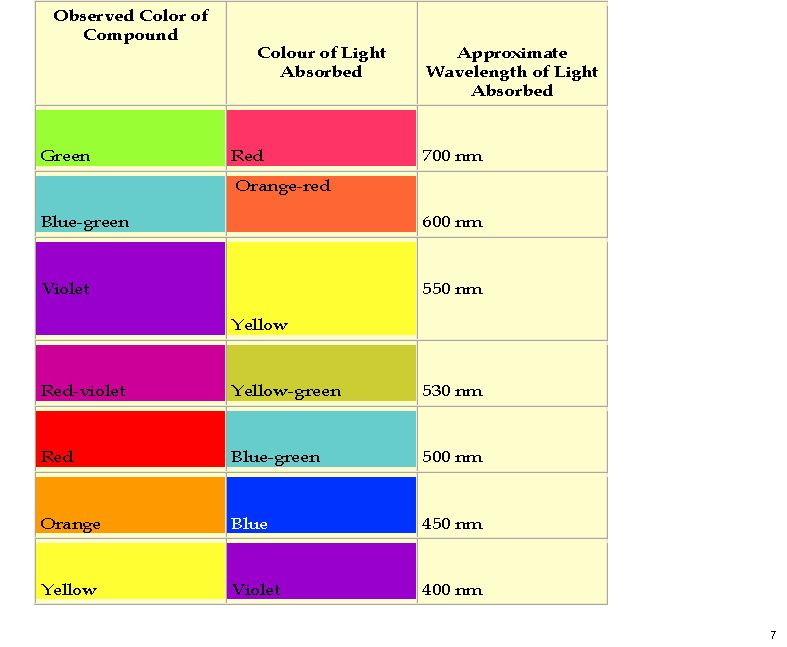
    My previous post on the topic of mauveine left the outcome dangling. Put simply, λmax is measured at about 549nm for mauveine A, but was calculated at about 440nm using a modern method for predicting colour (TD-DFT). According to the colour table below, that would make it orange, not mauve. Can the theoretical prediction be out by 110nm, or might it be the structure of the molecule itself that has been wrongly described?
    colour table

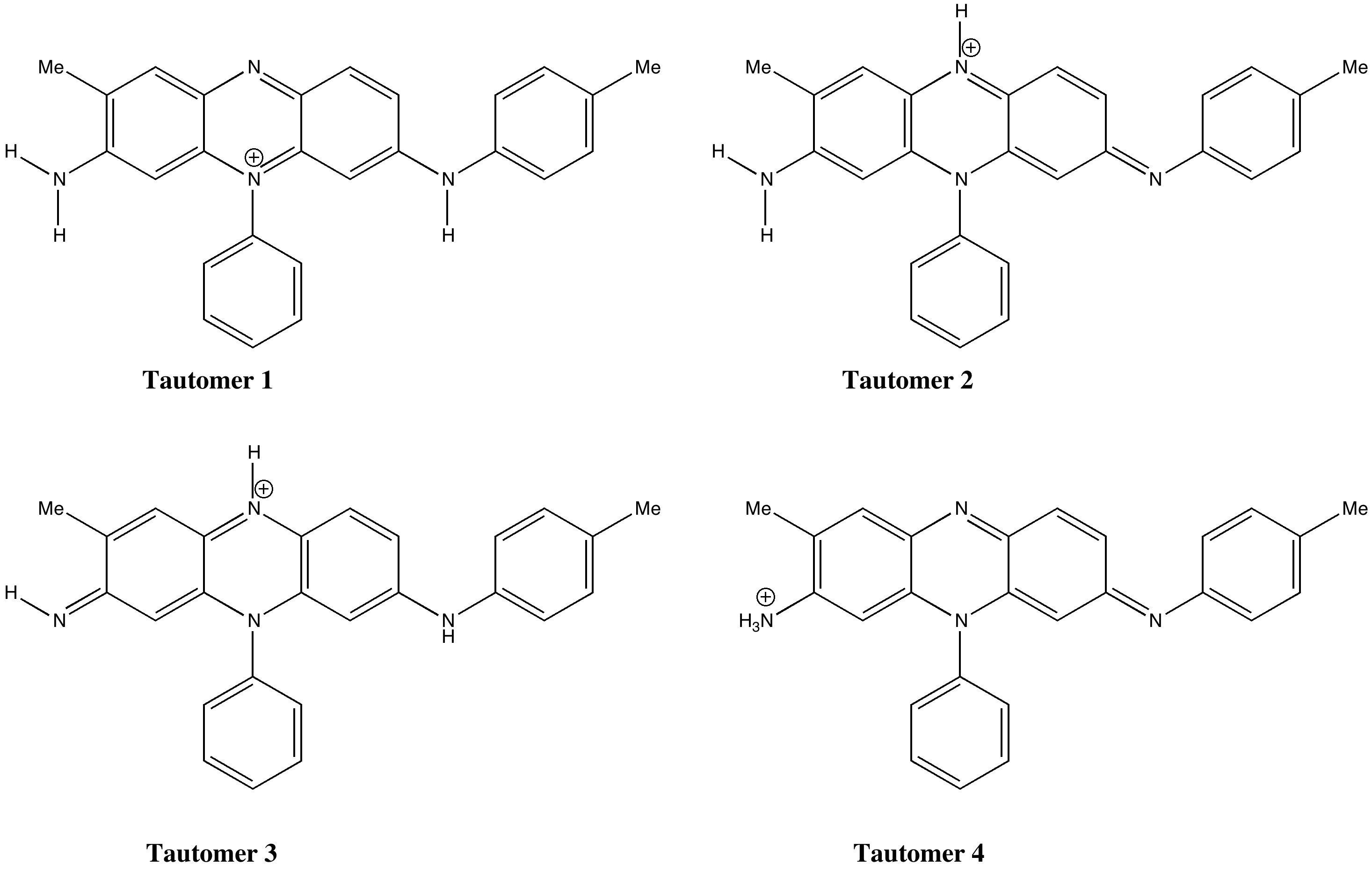
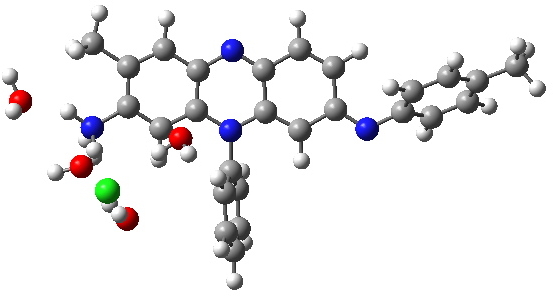
    A new idea struck me, summarised below. No crystal structure of a mauveine has ever been reported, and so the position of the N-H groups is not determined. It is normally drawn as tautomer 1, but what about tautomers 2-4?

    Tautomers of mauveine.

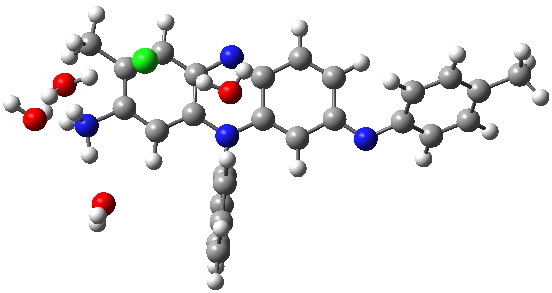
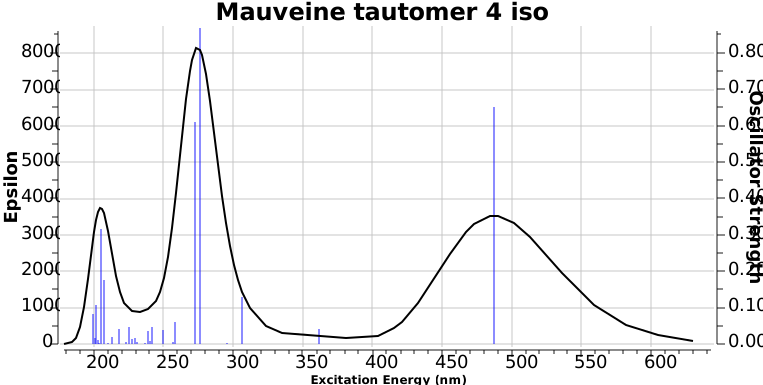
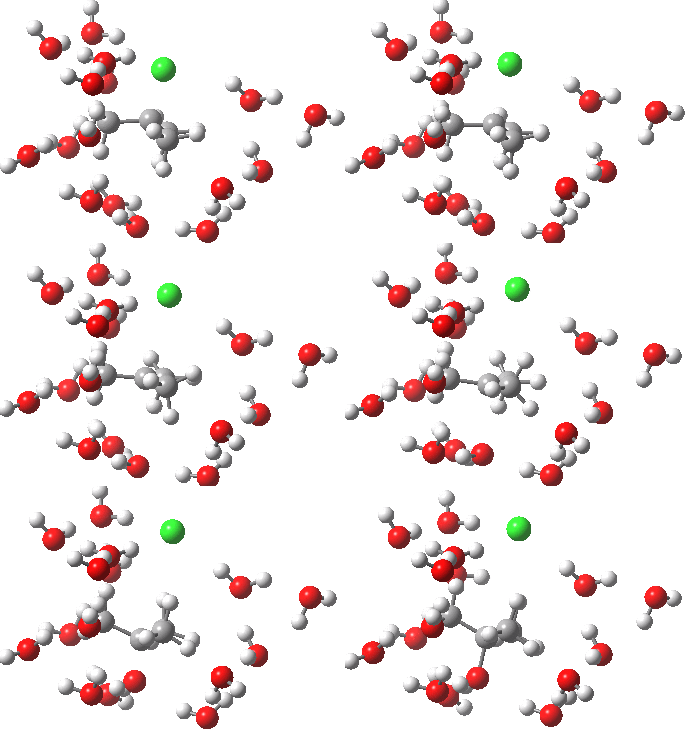
    Following the principle of completeness, it is important to include a counterion. And because the colour mauve is recorded in methanol solutions (i.e. it is unlikely to be due to aggregation), we will include some explicit solvent (water) as well. To illustrate the model, I show the geometries calculated for two counter-ion isomers of tautomer 4 using ωB97XD/6-311G(d,p)/SCRF=water.

    Tautomer 4. Click for 3D.
    Tautomer 4, with different arrangement of Chloride. Click for 3D.

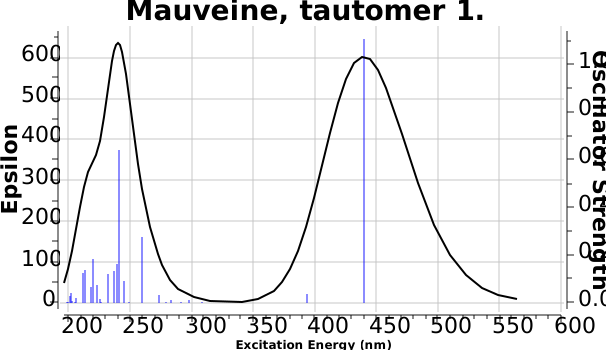
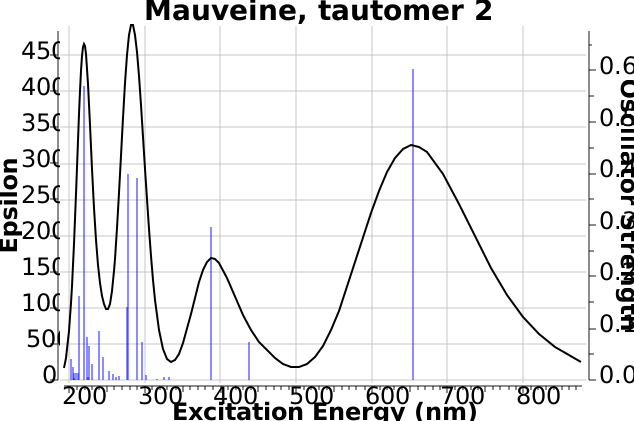
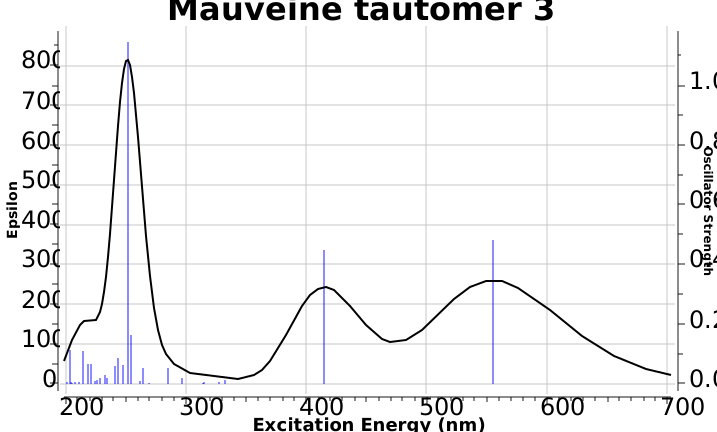
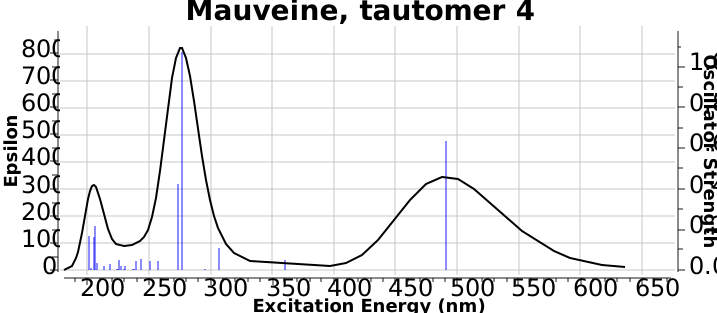
    The predicted UV/Visible spectra are shown below (ωB97XD/6-311++G(d,p)/SCRF=water model), and  λmax ranges from 440 to 655nm simply by moving one proton around! The spectrum that matches the measured best corresponds to tautomer 4. Unfortunately, it is calculated to be about 15 kcal/mol higher in energy than tautomer 1, which is the lowest in energy.

    λmax 440 λmax 655
    colour table colour table
    λmax 555 λmax 490
    colour table colour table
    λmax 487
    colour table

    So one step forward, and one back. A better colour match can be obtained by modelling a different tautomer of mauveine, but this now leaves the energy unexplained. I think perhaps a determined effort to get mauveine itself to form good crystals and to analyse those to confirm where the three exchangeable hydrogens reside would be well worth the effort. Even then, that will not necessarily tell us what is happening in solution. Such an old, and famous molecule, and still there is a mystery.

  • The SN1 Mechanism for a third time. Exploration of the intrinsic reaction coordinate.

    As the title hints, I have been here before. The SN1 solvolysis mechanism of t-butyl chloride was central to the flourishing of physical organic chemistry from the 1920s onwards, and it appears early on in most introductory lecture courses and text books. There we teach that it is a two-stage mechanism. Firstly the C-Cl bond heterolyses to form a stable tertiary carbocation intermediate, which in a second stage reacts with nucleophile (water) to form e.g. t-butanol. This is contrasted with the SN2 mechanism, where these two stages are conflated into a single concerted process, involving no intermediates. Here I explore an intrinsic reaction coordinate for the hydrolysis of t-butyl chloride which attempts to tease out whether this simple picture is realistic.

    The basic model comprises t-butyl chloride and 16 water molecules. These are subjected to a wB97XD/6-311G(d,p) calculation with a continuum water solvent field applied throughout. The functional is different from the one I used last time, since  I wanted one that included dispersion attractions. The basis set is also better.

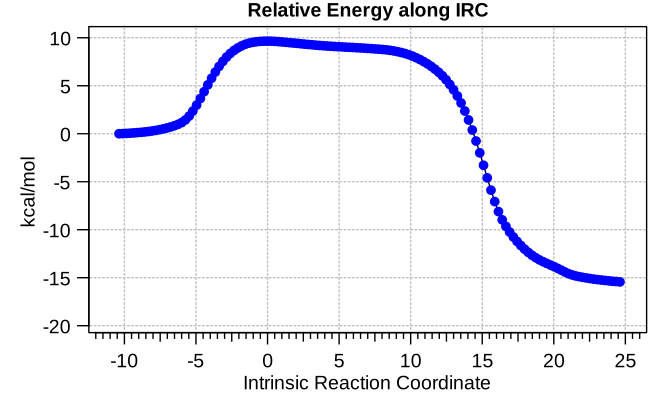
    1. At IRC -5, we see the first stage of the mechanism, the cleavage of the C-Cl bond. Note how the methyl flag waves at this point.
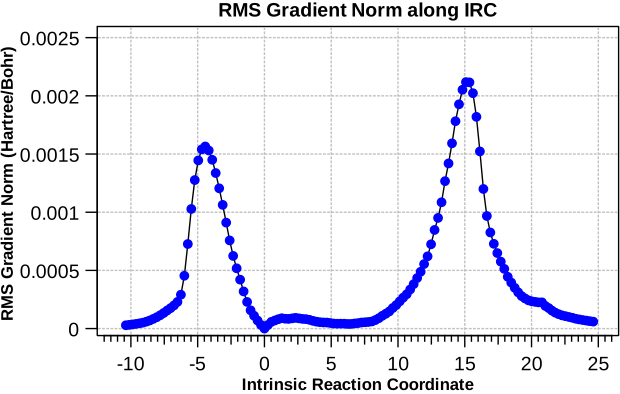
    2. At IRC 0.0 we have the transition state, at which point the gradients of the energy are precisely zero.
    3. At IRC +5, we have a very slight dip/inflexion point in the potential, but the gradients do not actually go to zero. This is the point that would correspond to the formation of a carbocation. The SN1 mechanism proper would require a formal intermediate here, with zero gradients.
    4. At IRC ~+15, we see a new phenomenon, the attack of a water molecule on the “almost” carbocation, reflecting in fact an SN2 mechanism.
    5. At IRC ~+20, we see a slight blip, which in fact is reorganisation of the hydrogen bonds of the surrounding water molecules, accompanying the formation of an entirely ionic chloride.
    6. All these processes are animated in the diagram below, where you can see other features:
      1. Note the methyl rotation just after the Cl has started leaving, and another when the C-O bond formation is completing.
      2. Note the hydrogen bond reorganisation near the end.
    (anharmonic) IRC for hydrolysis of t-butyl chloride. Click to see the (harmonic) transition normal mode.

    As I noted in my previous post on the topic, there are other complexities, involving potential proton transfers amongst the water molecules which is not reflected here. As is not unusual in science, sometimes the most apparently simple processes turn out to have hidden complexities.

  • Historical detective stories: colourful crystals.

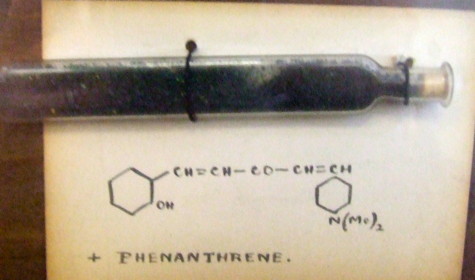
    Organic chemists have been making (more or less pure) molecules for the best part of 180 years. Occasionally, these ancient samples are unearthed in cupboards, and then the hunt for their origin starts. I have previously described tracking down the structure of a 120 year-old sample of a naphthalene derivative. But I visited a colleague's office today, and recollected having seen a well-made wooden display cabinet there on a previous visit. Today I took a photo of one of the samples:

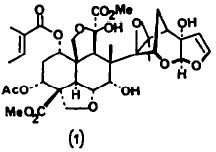
    One of the "Hofmann" collection.

    No date, no name, but a structure! As I noted before, when it comes to structures, you have to research the conventions (and numbering) used at the time. Thus note the apparent cyclohexane rings, the N(Me)2 group and the lack of stereochemistry around the alkenes. The former dates the sample to before 1950, whilst the use of Me to mean methyl puts it in the 20th century. Which is shame, since it had been known as the "Hofmann" collection, meaning some sort association with August von Hofmann, the first professor of organic chemistry in the UK, who occupied that position from 1845-1864. Samples that old are very rare. The one above by the way is very deep green (the photo does not do it justice), and very crystalline! Tracing the history of where the display cabinet might have been did indeed reveal that it probably started its life at the same institute as Hofmann was working in (and where I now work), but little more than this was known about it.

    A search of the Beilstein database (nowadays known as Reaxys) revealed a collection of samples corresponding to the above structure (with benzenes of course, not cyclohexanes), but co-crystallised with different molecules, and dating from 1921. These were known as the Heilbron collection, and this was encouraging, since Heilbron was indeed a successor to Hofmann, being active in the 1920s. During his career, he and his students probably made 100s, if not 1000s of compounds, so why did they go to the considerable expense of having beautiful wooden cases built to house these particular samples? Probably because the basic colour varied from yellow to black (perhaps 400nm difference in λmax) and for which they had no explanation! So, much like some people are cryofrozen in the hope an advanced civilisation might bring them back to life in the future, these samples were mounted in a display cabinet in the hope that someone would find out the origins of their variable colour.

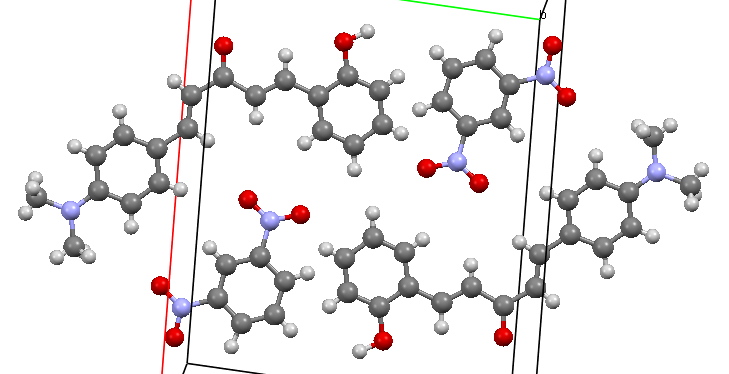
    Well, in 1984 (some 63 years after the event)[cite]10.1007/BF00656759[/cite] researchers at the lsrael Institute of Technology, Haifa, came upon the 1921 article (but not the samples; if they read this they might be amazed that these still exist!), repeated (most of the) syntheses, and determined the crystal structure of three of the molecules (but conspicuously not the one above). One 3D structure is shown below. The colours were ascribed to charge-transfer interactions between the components of the molecules.

    DADZIR. Click for 3D

    As I noted previously, it is well worth preserving chemical samples for future generations (and sometimes that generation is 120 years in the future!). Sadly, health and safety aspects (real or imagined) mean that such collections are being lost to posterity at an every increasing rate. Soon, there may be no collections of old chemicals left. That would be indeed a loss to science. So if you know of a lovingly preserved case of old chemicals, go take a look at it. And if it's in danger of being put in the skip, then rescue it. There is no telling what may be scientifically interesting about it.

  • Steve Jobs and chemistry: a personal recollection.

    Steve Jobs death on October 5th 2011 was followed by a remarkable number of tributes and reflections on the impact the company he founded has had on the world. Many of these tributes summarise the effect as a visionary disruption. Here I describe from my own perspective some of the disruptions to chemistry I experienced (for another commentary, see here).

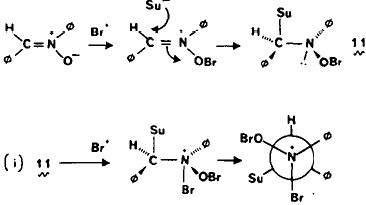
    Chemical diagram, circa 1983.

    The diagram above originates in 1983 just before the impact of Jobs’ vision burst upon chemistry. It was published in one of the new-generation of camera-ready journal, the objective being to reduce publication times from a typical 12-24 months down to around around three months. Camera-ready meant that the authors had to prepare a photo-ready manuscript; the role of these journals was to photograph, print and publish. The diagram above was prepared using stencils and Rotring technical pens together with Letraset lettering. The snippet above would probably take an hour or two to draft; the diagrams for an entire article were probably about 1 weeks work. Imagine how much time would be needed for a 200 page PhD thesis (some of this time was occupied by rushing out to a purchase more Letraset sheets because one had run out of say the letter r needed to represent the bromine in the above!). The diagram below was publishedin the same camera-ready journal in 1987.

    Chemical diagram, circa 1987.

    It was produced using Chemdraw on an Apple Macintosh computer introduced in 1984 (and which reached UK chemistry departments in 1985) and printed on an Apple laser printer. It would have taken perhaps 5 minutes to produce. More significantly, by copying and pasting (terms which need little explanation nowadays), one could re-use the diagram repeatedly as a template in a more complex scheme for little extra effort. You might argue that these two diagrams do not actually differ in quality that much (actually, the Apple-derived diagrams are of much higher quality than implied above, and the loss of quality is because the article has subsequently been scanned by the journal). But in fact the impact of Jobs’ Macintosh computer was far greater than just being able to produce nice chemical diagrams. Because it also introduced chemists to disruptive new concepts, the consequences of which are still impacting today.

    The first is the idea of the re-use of digital data, as mentioned above. Once one had a diagram drawn, one could use it to almost instantly derive other properties of the molecule. For example, the molecular weight or an atom connection table. This in turn could be used to start an online search. And it was the Macintosh that really bump-started the idea of online activities.

    Although chemistry had started going online around 1980 (I remember a single terminal station enabling STN express online access to chemical abstracts being introduced then, and in fact computational chemists were already online around 1974), the idea of an entire department of researchers ALL being online in their lab or office was very much the result of introducing the Macintosh in 1985. It came with a network connector at no extra cost. This in turn allowed all owners of such a computer to connect online to the (then very expensive) laser printer, and as a by-product almost, to the rest of the world! I have described some of the disruption this introduced elsewhere. By around 1987, most of our Mac users were happily going online (it has to be said that owners of IBM PCs were rarely doing so at this time). That is one of the true legacies that Jobs’ disruptive technologies introduced to us chemists.

    I am going to quote Samuel Butler now, writing in 1863: “I venture to suggest that … the general development of the human race to be well and effectually completed when all men, in all places, without any loss of time, at a low rate of charge, are cognizant through their senses, of all that they desire to be cognizant of in all other places. … This is the grand annihilation of time and place which we are all striving for, and which in one small part we have been permitted to see actually realised“.

    Steve Jobs made a big contribution to that general development of the human race!

  • Breakdowns in communication: the two cultures

    In his famous lecture in 1959, C. P. Snow wrote about the breakdown in communications between the “two cultures” of modern society — the sciences and the humanities (arts). That was then. This is now, and the occasion of my visit to a spectacular “city of arts and sciences complex” in Europe. An un-missable exhibit representing science and life was the 15m high model of DNA. Now to be fair this is styled an artist’s impression, and one presumes that an artist is allowed license. But how much license? And at how much expense to the science? And is there a counterbalance to the art where the science is fastidiously (but artistically) preserved?

    Artistic impression of DNA.

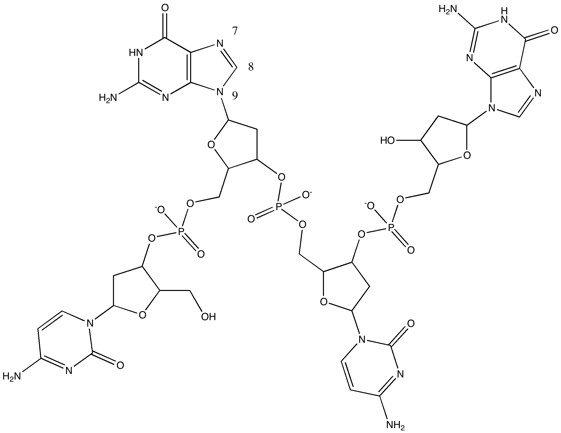
    Let us start from the scientific end of this story, and try a mapping between the two representations. Below is a chemical diagram of one strand of the DNA duplex, showing two cytosines (the single 6-ring base) and two guanines (the 5+6 ring base) joined by a 5-ring ribofuranose to phosphates.

    A scientific interpretation of DNA. Click for 3D model (of left handed duplex DNA!)
    The artist has mapped the phosphates to the blue spheres and is clearly taking the license of not showing all the atoms (and in particular the other heteroatoms, such as O and N). That is schematic and designed not to overwhelm. I am more or less still happy (although the missing carbonyls are strange). Next, the phosphates are linked to the ribose. If you look carefully you might spot that the link is built to the centre of a C-C bond (I am starting to get slightly worried now). You can also clearly see that the links to the guanines are via the 8-position of that ring, rather than the 9-position. Is this due to artistic license or the thought that it does not much matter? The pairs of bases, famously hydrogen bonded in a complementary manner, are now joined by a single “bond”, one end of which is now again attached at a bond mid-point. Little of the science of hydrogen bonding is preserved with this representation!


    One more detail. These “rungs” joining the duplex have been rotated by 90° so that the planes of the bases are parallel to the helical axis, rather than perpendicular. How did the artist manage to construct his model in this orientation? Well, probably because he had been given a template similar to the (2D) structure diagram I showed above. A chemist would immediately “see” what is implicit in that diagram, which is all the C-H bonds. Chemists tend to miss these out, because they can be cluttered. But the hydrogen atoms are there, and they do occupy space. In the 3D model, they are still missing. If you imagine their positions in that model, you will immediately spot a number of locations where two hydrogen atoms are trying to occupy almost the same position in space! Of course, were you to rotate the sugar-base-base-sugar rungs by 90° this would create space for these invisible hydrogens.

    So what about this breakdown in communication between the scientist and the artist? The latter has attempted two effects. One is to remove unnecessary detail so that one can directly go to the essentials. The other is to “move” the various components around so that they achieve greater “artistic effect”, but with a resulting substantial loss of scientific accuracy. I happen to believe that the model would have looked equally attractive if these scientific liberties had not been taken (perhaps even better!). Perhaps, as I suggest above, the artistic interpretation should be accompanied by a scientific one, to allow the visitor to the museum to see both? Or the communication between sculptor and scientist improved?

    Well, I console myself with the observation that at least the artist represents a right rather than a left handed helix!

  • Computers 1967-2011: a personal perspective. Part 3. 1990-1994.

    In 1986 or so, molecular modelling came of age. Richard Counts, who ran an organisation called QCPE (here I had already submitted several of the program codes I had worked on) had a few years before contacted me to ask for my help with his Roadshow. He had started these in the USA as a means of promoting QCPE, which was the then main repository of chemistry codes, and as a means of showing people how to use the codes. My task was to organise a speakers list, the venue being in Oxford in a delightful house owned by the university computing services. Access to VAX computers was provided, via VT100 terminals. Amazingly, these terminals could do very primitive molecular graphics (using delightfully named escape codes, which I learnt to manipulate).

    An expert on the use of such codes was George Purvis, who hailed from the quantum theory project at the University of Florida at Gainesville. He had developed QUIPU for VAX/VT100 and together we had much fun setting things up for the participants at these QCPE workshops (which ran 1986-1990). During one session, George asked me whether I thought a properly implemented and reasonably cheap graphical user interface might have commercial potential in chemistry. Remember, the VAX/Evans&Sutherland PS390 system we had acquired in 1987 was NOT cheap. I must have encouraged him, since in 1990 George (now part of the CACHE, or computer assisted chemistry, group at the Tektronix corporation in Beaverton) had brought to market a “shrink-wrapped” system which did just that. This was, in many ways, well ahead of its time. It was based on a then state-of-the-art Macintosh computer, with a co-processor that could crunch floating point numbers quite fast (this was then very rare in so called personal computers, being reserved for supercomputers). It had a unique spherical trackball (almost a haptic device) for rotating molecules, and a liquid crystal polarized screen running at 120Hz (60Hz for the left eye, 60Hz for the right eye). Wearing polarized (passive) glasses, the stereo 3D effect via the 19″ screen (big for its day) was awe inspiring. What is more, two people could sit at it and both see molecules in stereo.

    We managed to get a grant to purchase such a system, and I well remember taking it to the 1990 Oxford workshop (I had now taken over from Richard for the UK workshops) in the back of my car. This involved driving to my office on a Saturday, and heaving the thing out. A security guard saw me doing this and arrested me. After much ado, I was forced to take the CACHE to my office and told not to try that again. I waited 30 minutes, and took it out the back door (which nowadays has a black security camera watching it, but in those days was not guarded) and on to Oxford (checking for police sirens all the way). I think I made the trip to Oxford with this thing in the back of the car one more time, where I used it to give a poster at a conference, handing out the 3D glasses to anyone who expressed an interest (and reclaiming them rapidly if they posed no interesting question). I still fancy this was almost unique in the history of posters (which tend, even nowadays, to be printed on paper). Reflecting on this, I realise that my total aversion to Powerpoint probably dates from that time.

    At this stage, I will tell you about some of the science we did with the remarkable stereographical 3D CACHE system. The first is our realisation that the Pirkle reagent exhibits a π-facial hydrogen bond from the OH group (DOI: 10.1039/C39910000765). Indeed, I notice that four of the posts here relate to this topic! Once you know what you are looking for, its trivial to spot. But I recollect that the crystallographers who did the structure for us had failed to identify this unusual hydrogen bond; it took the CACHE, and its 3D glasses, for us to notice it.

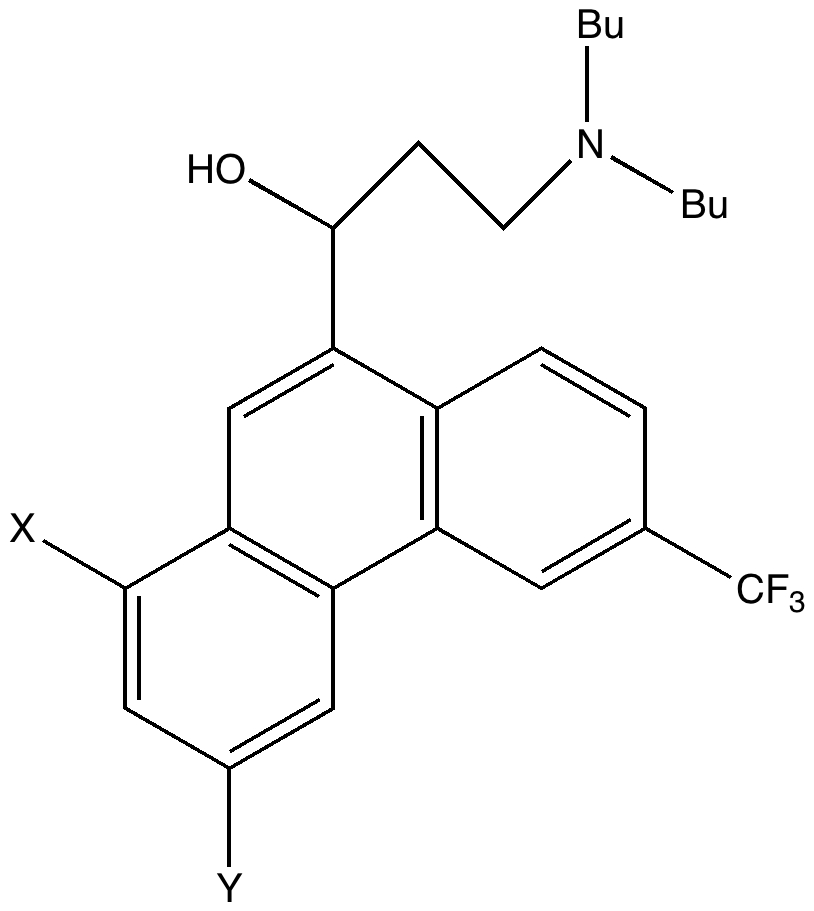
    But the really important breakthrough using CACHE was a different molecule, halofantrine (X=Y=Cl, DOI: 10.1039/C39940001135) an antimalarial pharmaceutical molecule.

    Halofantrine.

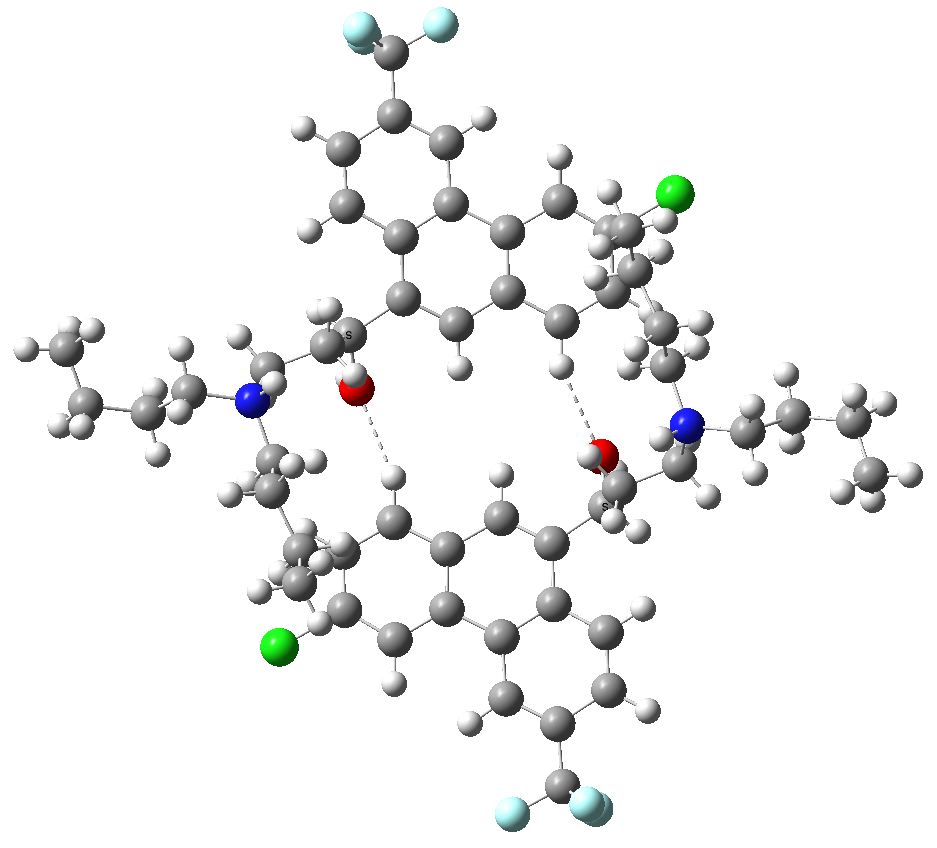
    At this stage, pharmaceutical companies were assiduously resolving chiral compounds into their enantiomers and testing each separately for biological activity. It had been noticed that whereas X=H, Y=Cl could NOT be resolved on a chiral column, replacing X=H by X=Cl suddenly made it possible to do so. But why? Well, in order to inspect this with the CACHE system, we asked for the crystal structure to be done. Back it came and Mike Webb and I sat inspecting the coordinates in full stereoscopic glory, as I recollect for about an hour, twiddling the viewpoint here and there. Each of us would take over the haptic trackball for 10-15 minutes, and we would then discuss what we saw. In one of those magical moments (I can assure you that shivers do run down one’s back at moments like this) we spotted that X=H had a strong hydrogen bond to the OH of another molecule, whereas X=Cl did not. Suppressing that C-H…O interaction forces the molecule to π-π stack instead, and this mode now enables it to better interact with the chiral column and hence resolve.

    Halofantrine. Click for 3D.
    Some of that magic is recreated above. If you click on the image, the coordinates will be loaded. Now that the relevant interaction is highlighted, it is so easy to spot you might wonder how anyone would have ever missed it!. At any rate, shortly after writing this article, I sat down to write another on a new phenomenon called the World-Wide-Web. And to illustrate why the Web might become important, we highlighted halofantrine, and how the Web could carry such immediately visual information to its readers. This blog, in effect, is a direct descendent of that article (which, by the way, is still available in HTML form here). So, 3D graphics led to the (chemical) Web. What a tangled web indeed.

    And to end with 3D. I live in hope that shortly, stereoscopic tablets will make an appearance. Given that the CACHE system noted above was heavy (it was a major struggle moving the monitor into the car, as described above), it will be an amazing evolution to see (almost) pocket sized devices being carried around for the same purpose.

  • Computers 1967-2011: a personal perspective. Part 2. 1985-1989.

    As a personal retrospective of my use of computers (in chemistry), the Macintosh plays a subtle role.

    1. 1985: In the previous part, I noted how the Corvus Concept computer introduced a network hard drive (these still being too expensive for any one individual to afford one); the same principle applied to the 1985 Macintosh but now relating to the remarkable introduction of the laser printer. Until then, us chemists had used french curves (see previous post for an explanation), stencils or transfer lettering. It could be really tedious preparing a complex manuscript. Indeed, in some published articles of the time, one often saw hand-drawn chemical diagrams! So when the Macs arrived in 1985 (and it has to be said the associated rise of ChemDraw at that time), it became imperative to network them so that everyone could have access to that precious laser printer (I still remember its network name, selected using the aptly named Chooser utility). Fortunately, the Mac came with a network port (unless I am mistaken, this was not an invariable feature of the IBM PC of the period). The network was created using a router (the first time I had come across one of these) from the Webster corporation in Australia, and our local electrician and his colleagues suddenly found themselves putting in Appletalk cables everywhere. The poor chemists in the department not only had to get used to the mouse pointing device and unfloppy floppy disks, but to the idea of selecting network devices.
    2. 1987:We also acquired a Microvax with an Evans and Sutherland PS390 stereographics device at this time (more of which later in another post), and this came with an interesting bonus. Haggling had managed to leave about £25K left over, which I decided to spend on a “grown up proper network”. This took the form of a thickwire ethernet of about 400m length. This stretched from the Microvax to the main college hub and thence the outside world (the “Internet”) and also to the close-by new network distribution cabinet where one end of the Fibre optic cable was terminated (a bonus of all this was a Pirelli calendar, yet another story that must wait to be told).  The fibre was strung to a catenary connecting to our other building (the idea being that it should be immune to lightening strikes. I had earlier explored the idea of a copper cable routed through tunnels connecting the two chemistry buildings, and spent a most interesting day down in those tunnels exploring. Therein lies yet another story for another day). Anyway, we now had a 10 megabit network (1000 times faster than the old PADs, which were still around) and this was connected to the Webster multigate routers (there were two of them now, one for each building). Our Macs all had the Internet!

      Apple, bless their hearts, distributed a control panel called MacTCP, and after I figured out what it all meant (network masks, Class C subnets and the like) I let everyone know that another network device had been added to join the laserprinter. Few IBM PC owners could boast this. At this stage, in truth, there was not that much people could connect to. Using MacTelnet, we could indeed access CAS Online, and print the search to a laserprinter. Using MacFTP, we could get files remotely from other FTP servers, and we started to acquire coordinate files for our molecular modelling. This in turn brought the realisation that the existing formats (Brookhaven protein databank files were the most common at the time) were not ideally suited for the purpose, and this could be seen as another spark for the CML (XML) work that started about nine years later. I also remember discovering that Apple computer ran their own FTP server, where I could download the latest operating system disk images (Systems 5-7 as I recollect were obtained from this site ). Things were free (but not always that easy) in those days. Our Macs ended up have the latest OS on them (in other words, they tended to crash a little less) almost as soon as it was released (and the Mac app store™, with its impending 4.6 Gbyte of OS X Lion about to be downloaded is merely the latest example of this).

    3. 1987: Armed with all this experience, I was also asked to serve a two year stint on the editorial advisory board of the Royal Society of Chemistry. At the time, what is now called supporting information was just starting, and of course it was going to be in print only. I suggested that perhaps the RSC should plan for the day when it could be online instead (the term online was not, I think, in that common use then, and electronic journals were also not yet common). I was still not happy that the only way to access that information would have to be FTP file transfers, but then little did I realise then that Tim Berners-Lee at CERN already had a glimmer in his eye.
    4. 1988: The network on the Macs became a little more useful in this year, when a Macintosh email client called Eudora was released (in truth, I had already sent my first email in 1976, from CMU in Pittsburgh whilst on a visit there, to the person standing next to me!). The Microvax alluded to above provided the mail relay, and a few brave individuals started sending email (not that many people had email addresses in those days mind you). The RSC was still grappling with this. I remember putting my email address at the top of an article submitted to them, and the copy-editor deleted it from the proofs as “unrecognised address form“. I re-instated it, they deleted it again. After some telephone negotiation, it remained (although the RSC assured me it would confuse the journal readers mightily). For the record, if you do manage to find it, it no longer works (being something like rzepa@vaxa.ch.ic.ac.uk. We were still learning how to do things properly then).
    5. 1989: I managed to convince the department that it would be useful to use computers for undergraduate teaching, and we opened a computer room with 12 Macs. I maintained them using a wonderful network utility called  RevRDist for Mac, which cloned a master Mac onto the 12 clients, and made the task of adding new software very easy. There was always lots of good software for Macs in those early days. But to introduce students to how to use them, I did feel impelled to produce a 4 page printed handout explaining it all. And I only did this once a year. Clearly again, the need to manage this better must have been in my mind.

    This post focuses on a very short period, because I wanted to get across how (in my mind at least) chemistry became globally networked for the (chemical) masses (or at least those with Apple Macintosh computers!), and the role the laserprinter Pippa played in this development.

  • Computers 1967-2011: a personal perspective. Part 1. 1967-1985.

    Computers and I go back a while (44 years to be precise), and it struck me (with some horror) that I have been around them for ~62% of the modern computing era (Babbage notwithstanding, ~1940 is normally taken as the start of the modern computing era). So indulge me whilst I record this perspective from the viewpoint of the computers I have used over this 62% of the computing era.

    1. 1967: I encountered (but that term has to be qualified) my first computer, suggested to me as an alternative to running quarter marathons on Wimbledon common at school by an obviously enlightened teacher! I wrote a program (in Algol) on paper tape, put the tape in an envelope, and sent it off to Imperial College (by van) to run, on an IBM 7094. A week later, printed output showed you had made a mistake on line 1 of the program. As I recollect, after about eight weeks of this, I got the program to run (and calculated π to 5 decimal places).
    2. 1970: By now I was a student (again at Imperial College), and was introduced to Fortran, then a radical new innovation to a chemistry degree. The delightfully named pufft compiler combined with the 7094 again, but this time with punched Holerith cards as input and line printer output. I cannot remember what we were asked to program. I do remember that the punched cards were produced by a pool of punch card operators, working from code pages written by the programmer. Some students (not me!) thought it great fun to give their Fortran variables naughty names (which the punch card operators then refused to punch, thus causing the student to fail the course!).
    3. 1971: I really liked this programming lark, so when instant-turnaround was introduced that year, I decided to do a proper program. It was called NLADAD (yes, I was no good at names, even then), which stood for non-linear-analysis of donor-acceptor complexes. The idea was to take recorded NMR chemical shifts, and fit them to an equilibrium A+B ⇔ AB+B ⇔ AB2 using non-linear regression analysis. It must have been all of 200 lines of code (OK, I did not write the matrix inversion routine myself)! Instant turnaround was also great, you got to punch your own cards this time, and had the great excitement of feeding them into a card reader yourself. You then walked about 5 yards to the line printer and waited agog. No waiting one week, this was less than a minute. Or it would have been if the line printer did not paper-wreck every two minutes! (I might add that I have a dim recollection of a member of the computer centre staff standing by to recover these paper wrecks. He, by the way, is now the director of the ICT division here!).
    4. 1972: I am now doing a PhD (yes, boringly, yet again at Imperial College). I had found the one and only teletypewriter in the chemistry department. The crystallographers had secreted it away in their empire, but were very dismayed to find me occupying it constantly. Instant was now even more instant. I was now connecting to a time-sharing CDC 6400 computer, at the dazzling speed of 110 baud (or bytes per second). These were small bytes by the way, since the CDC used 6 bits per byte. The result was that one did everything in UPPER CASE, since a 6-bit byte only allows 64 characters! My (still Fortran) programs reached probably 1000 lines of code now, and I was engrossed in deriving non-linear analyses of steady state chemical kinetics (about four different kinds of rate equation as I recollect). Ah, the joys of covariance analysis, and propagation of errors (I was in a kinetics lab, and all the other students plotted graphs on graph paper, and if pressed, plotted gradients of graphs, the so-called Guggenheim plots. I thought this the dark ages, but no-one volunteered to join me in this single teletypewriter room. Not even the attractive girls in the group. I was the geek of my time, no doubt about that. My kinetic analysis did however have one upside. Its how I meet my wife to be a few years later!).
    5. 1974: PhD completed, I was now ready to go to Texas, where everything is bigger (and in terms of computers, slightly better, a CDC 6600 now and a 300 baud teletypewriter!). I had been computing now for seven years, and finally I actually got to SEE the device for the very first time. My mentor, Michael Dewar, had a sort of special relationship with the university. His students (and possibly only his students) were allowed to go into the depths of the machine room, where behind plate glass you could see the CDC 6600. I soon learnt how to get even closer. It was not particularly exciting however. I was more entranced with the CALCOMP flatbed plotter, which was located next to the 6600. Pictures at last (you probably do not want to know that to convert my kinetics in 4 above to pictures, I got quite expert in using a french curve. Look it up before you jump to conclusions). Part of the pact I negotiated was that I was only allowed into the inner sanctum at 03:00 in the morning (sic!). Still a geek then! Oddly, I was one of the few students in Dewar’s group using the CALCOMP, but at least we now had pictures of the molecules I was now calculating (using MINDO/3). To put the computing power into context, in 1975, Paul Weiner, another group member, announced that he had completed a full geometry optimisation of LSD, this having taken about 4 days to do on that over-worked 6600. The entire group went out to celebrate. Many pitchers of beer were drunk that nite.

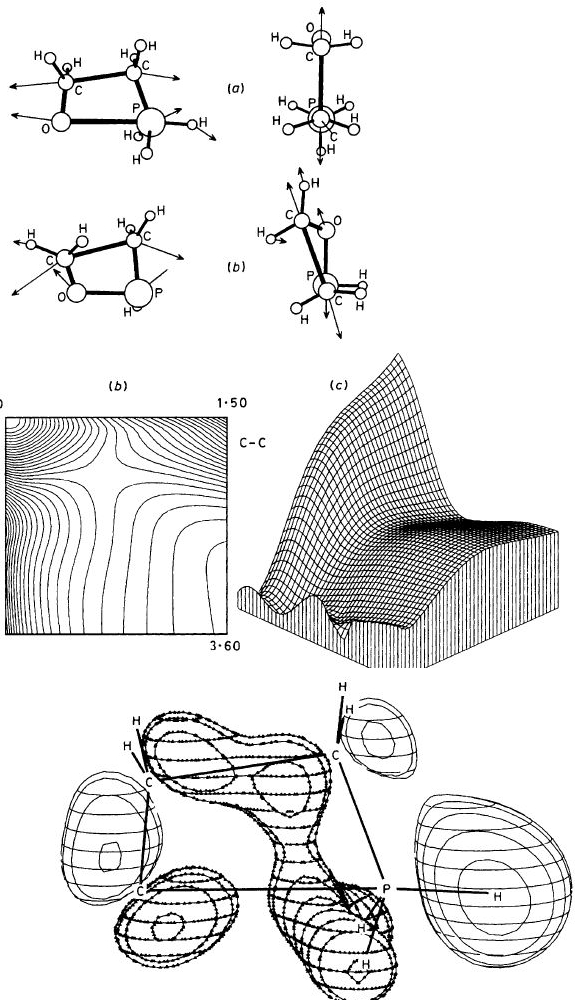
      Computer graphics from 1976.
    6. 1977: Back to Imperial, where we might have also now had a CDC 6600. And a Tektronix terminal running at the dizzying (hardwired end-to-end) speed of 9600 baud. I learnt to Word process on this device (using a word processor, written in Fortran, although not by me) and I wrote three review articles by this means, using a fancy phototypesetter as the printer. My next program, STEK, probably ran to about 5000 lines of code, and it persuaded the Tektronix to plot all sorts of things, ball&stick diagrams, isometric potential surfaces, molecular orbitals, and the like (and jumping ahead, my experience with this program eventually led to CML, and Peter Murray-Rust, but that is indeed jumping ahead). I think I also managed to gain access to the Imperial machine room, that inner sanctum, yet again. But for reasons I will not go into, it was not as interesting as the Texan machine room.

      Chemistry Computer graphics, circa 1977-85.
    7. 1979: I encountered a Cray 1 computer, and probably also 8-bit bytes (and yes, lower case printer outputs) for the first time at the University of London Computing Centre.
    8. 1980: Remember that teletypewriter, encountered earlier. Well these were now running at 2400 baud and I started to organise the deployment of a chemistry department computer network to sprinkle several such terminals around the department. The controller was a PAD, and in that year, we introduced STN ONLINE using this network. It was the first time we could search CAS online ourselves (previously, it was a service offered by the library). Literature searching has not been the same since.
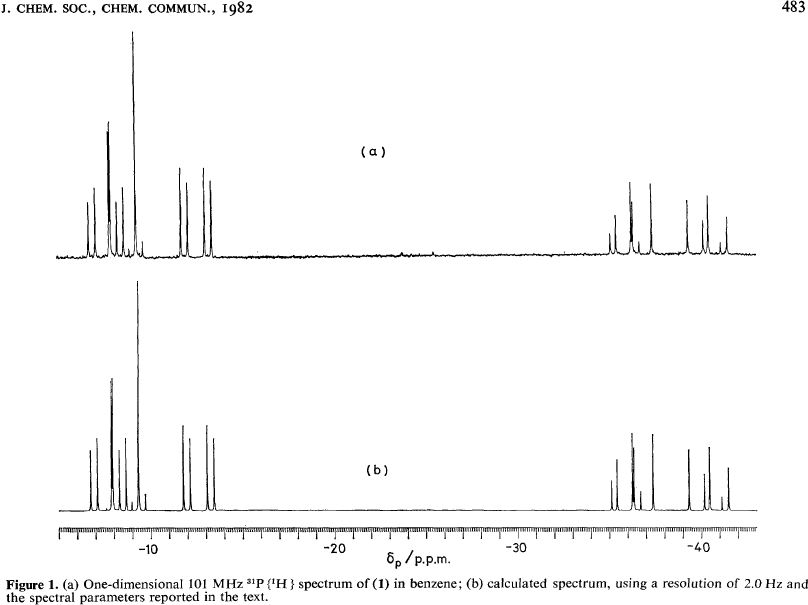
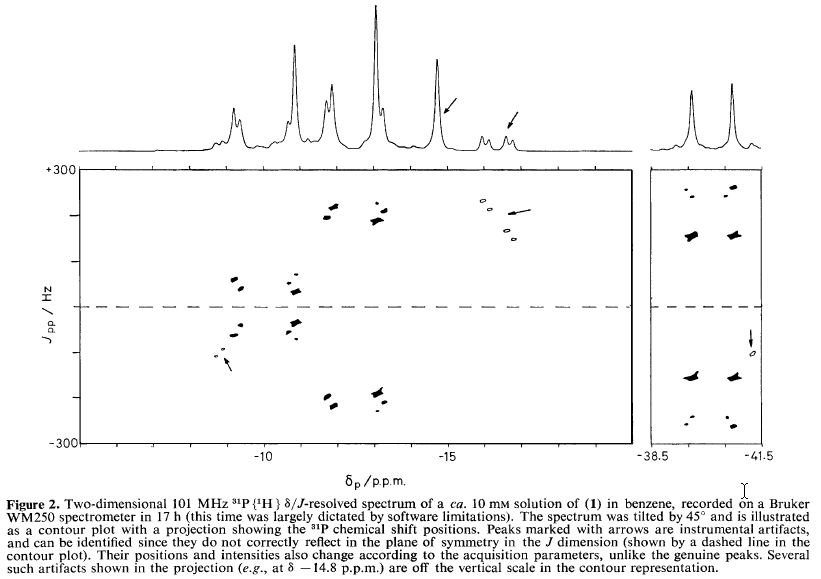
    9. 1980: I finally again encountered a real computer, which one could happily listen to without creeping into machine rooms in the middle of the night. It was the data system on a Bruker Spectrospin 250 MHz superconducting NMR spectrometer. I had many adventures on this system. It was installed, by the way, on more or less the same day as the birth of my first daughter Joana. It had a hard drive (5 Mbytes as I recollect, and cost an absolute fortune, around £10,000 if I remember correctly).
      Combining Quantum mechanics and NMR.

      Computer graphics 1982, from NMR spectrometer.
    10. 1982: More networks, this time a curious computer known as the Corvus Concept, using a networked hard drive (possibly as big as 20 Mbytes by now), and a large screen.
    11. 1985: Enter the Mac (OK, the IBM PC came a little earlier, but it was not entrancing). Now one really had a tactile computer that made noises (not always nice), produced smoke signals occasionally, and ejected its floppy disk incessantly. Yet another revolution to cope with. As I type this, I look down on that Mac, which is still underneath my desk. Wonder if its worth anything on ebay?

    Well, a second consecutive blog, with (almost) no pictures or molecules. And I have only gotten to the half way stage of my story. Better break off then.